A New Phase In The Torture Debate?

As the Senate Intelligence Committee Report on the war crimes of the last administration nears publication (if the CIA doesn’t censor it to shreds), you can begin to hear the stirrings of some kind of reckoning with the past. As the years have gone by, the incontestable fact that the Bush administration tore up the Geneva Conventions, brazenly broke domestic and international law, and unleashed a wave of abuse and torture and mistreatment of prisoners, has been harder and harder to deny. Even the protestations of a man like Jose Rodriguez – “It worked!” – merely underline the point. The law against torture is absolute. There is never any defense of it because of perceived utility. Dick Cheney keeps boasting and bragging of the torture program he invented for the first time in American history, publicly admitting a war crime for which there is no statute of limitations in domestic and international law.
But the one place where the debate has not really broken out is in the political party that embraced those war crimes – the GOP. Yes, John McCain took on the torture crowd in 2008 and won the nomination. But his successor, Mitt Romney, pledged to “double Gitmo” and bring torture back. Very few Republican writers want to confront the topic; Charles Krauthammer actually favors the setting up of a specific torture unit, without pondering whether its shirts should be brown. Torture enthusiasts, like Marc Thiessen, are given perches at the Washington Post, while war criminals like Cheney and Hayden are given endless platforms on the Sunday morning talk shows.

But if Rand Paul runs for president, a debate will surely have to break out. David Corn – is David trying to kill off Paul’s candidacy or trumpet it? – digs not so deep again to discover unequivocal hostility to the torture of the Bush-Cheney years in some interviews Paul did in 2009. Encouragingly, Paul won’t have any truck with the newspeak echoed by the craven New York Times. Interviewed by Friend Of The Dish Scott Horton, Paul was clear when answering the question “What’s your position on torture and war crimes prosecutions for the many torturers in the previous administration?”:

I am opposed to torture, and I think our country should have a higher ideal than that …Torture is always wrong and shouldn’t be performed.

On a subsequent radio show, Paul stated:

If Republicans want Dick Cheney to be sort of the representative of our party, still defending torture, which is not something America stands for, it’s just another way to shrink the Republican Party.

The good thing about this stance – and the real promise of a Rand Paul candidacy – is that it will force an honest debate in the GOP. No more denialist bullshit about “EIT”s; no more pussy-footing around the fact that of course what was done was torture; and a demand for clarity about whether a future Republican president would seek to finally consign the Geneva Conventions in the trash-heap of history or whether he or she will return to the traditions of George Washington and the civilized world. We may get the wrong answer from the GOP nominee. But at least we will know where we are. And whether Americans care any more about an embrace of the barbarism so often exhibited by our enemies.

The Most Deportations Ever?

Deportations Obama And Bush

Dara Lind claims “Obama is deporting more immigrants than any president in history”:

Obama says he has tried to make deportation policy “smarter” by targeting “criminals” and “gang bangers” — and not going after families. At the same time, the Department of Homeland Security has pushed to deport more immigrants than ever. Immigration officials wrote a “goal” of 400,000 deportations per year on a whiteboard at their headquarters, according to the New York Times.

The federal government couldn’t do both. So, in the end, Obama’s plans to selectively target deportations just ended up augmenting the Department of Homeland Security’s deportation dragnet — rather than replacing it.

Not everyone agrees with that calculation:

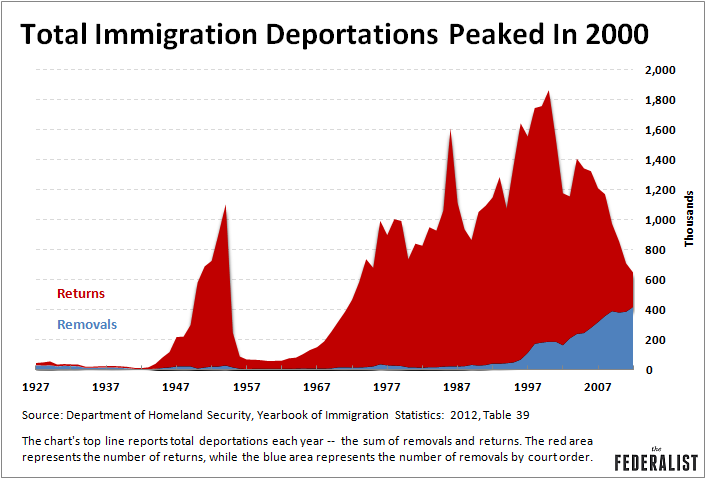
[New Democrat Network], in a memo being released Thursday, totaled the number of both “removals,” when individuals are deported from the country, and “returns,” when they are turned back at the border without a formal deportation process. Analyzed in this manner, the total number has fallen over the course of the Obama administration. That’s because while more people have been removed, returns have dropped dramatically.

Sean Davis goes after Lind:

In order to make her point that Obama was far more willing to deport illegal immigrants than his predecessor, she was forced to ignore and exclude 80 percent of all deportations under Bush. That’s right. How laughably wrong is Vox’s claim, which was obviously meant to make Obama look tough in order to make it easier to pass some type of immigration amnesty? …

The relative ease with which return deportations can be administered is one reason why they have been the overwhelmingly preferred method under every president of the modern era: not only do “returns” give apprehended immigrants the opportunity to enter legally in the future, the method also spares the courts from being gummed up with immigration cases. Under Carter, 97 percent of deportations were classified as “returns.” Under Reagan, it was 98 percent. For Bush I, it was just shy of 97 percent. For Clinton, it was 93 percent. And under George W. Bush, who oversaw over 10 million deportations between 2001 and 2008, returns comprised over 80 percent of all deportations. By way of contrast, that number was 50 percent through the end of Obama’s first term as president.

He provides a chart:

Deportations

Where The Hard Left Says No, Ctd

A few readers add some perspective to this controversy:

I am sure I won’t be the first to point out the brutal irony that a university named after Justice Louis Brandeis would seek to limit “insensitive” discourse.  Perhaps Brandeis’ most famous opinion was his concurrence in Whitney v. California (1927), wherein he emphasized that disturbing debates epitomized American democracy:

Those who won our independence believed that the final end of the state was to make men free to develop their faculties, and that in its government the deliberative forces should prevail over the arbitrary. They valued liberty both as an end and as a means… They believed that freedom to think as you will and to speak as you think are means indispensable to the discovery and spread of political truth; that without free speech and assembly discussion would be futile; that with them, discussion affords ordinarily adequate protection against the dissemination of noxious doctrine; that the greatest menace to freedom is an inert people; that public discussion is a political duty; and that this should be a fundamental principle of the American government.

Ultimately, Brandeis stressed that “[T]he fitting remedy for evil counsels is good ones.”

Another reader:

To put this in some perspective, when I was an underclassman at Brandeis in the mid-’70s, the university awarded an honorary degree to Bob Guccione, the publisher of Penthouse Magazine.

Rumor was that he had given $1 or $2 million to the university which, in those days, was a lot of money, and that was why they were doing it.  The student body and faculty, especially feminists (who were numerous), were outraged, and many noted the irony of a university whose seal, translated into English, meant “Truth unto its innermost parts,” giving an honorary doctorate to the publisher of a sexually oriented magazine featuring naked women.  The protests did nothing.  Guccione got his honorary degree.

The Internet is a blessing and a curse.  Forty years ago, a loser like Bob Guccione got his honorary degree at Brandeis over the loud protests of students and faculty because nobody beyond the university could hear them.  The critics of Ms. Ali were able to twist a single interview into a major controversy using the Internet.  I think the Internet is as much to blame as the “hard left'” as such.

Political correctness and orthodoxy cut both ways.  Just ask “moderate” Republicans.  One of the prime organizing elements of the Tea Party and the hard right has been the Internet.  Like it or not, that’s where future battles over our intellectual future will be waged.  Scares the shit out of me.

Can Data Make Medicare Healthier?

Yesterday, the Centers for Medicare & Medicaid Services (CMS) made public a huge amount of Medicare payment data. Prior to the release, Nicholas Bagley explained what the information entails:

CMS will publicly release comprehensive data on physician billing practices in Medicare, including information about specific, identifiable doctors. The move is controversial: the AMA, for one, is “concerned” that the data “will mislead the public into making inappropriate and potentially harmful treatment decisions and will result in unwarranted bias against physicians that can destroy careers.” And I’ll bet a few doctors in Miami, with its extraordinary rate of Medicare spending, are sweating bullets.

Darius Tahir considers the impact of the release:

One possibility is that releasing the data shames some providers into more responsible behavior.

As Amitabh Chandra, an economist and professor of public health at Harvard, suggested, fear of bad publicity might cause some higher-charging doctors to cut back on their reimbursements. And while individual consumers are unlikely to spend much time investigating doctors, professional researchers in the media and in academia will.

In fact, they already are. Initial reporting from the Wall Street Journal indicated that the top 1% of providers accounted for 14% of Medicare billing, with ophthalmologists making up roughly one-third of the top 1,000 billers. A report from the Department of Health and Human Services’ inspector general argued that the agency should scrutinize that specialty more closely, and this data shows why.) The New York Times on Wednesday reported that two Florida physicians who had the highest Medicare reimbursements in the country were also generous donors to the Democratic Party.  CMS hopes to encourage more such investigating, and not just from professional reporters. It has sponsored a contest for coders, calling on them to take the data and render it in a form that’s usable and interesting. The winner gets $20,000.

Suderman digs into the data:

It’s going to take a while to fully process all this information, but a couple things stand out already from the stories that have been written so far. One is the sheer scale of the payments involved. The data set doesn’t cover anywhere close to the entire Medicare program, but it offers a look at $77 billion worth of payments to 880,000 medical professionals in the year 2012. From that group, The Washington Post notes, about 4,000 physicians billed the program more than $1 million. And a handful billed in excess of $10 million.

It won’t surprise many people that the highest billers are concentrated in the sunny state of Florida. The state has a heavy concentration of seniors. It’s also a haven for Medicare fraud. And the data suggests a possible correlation between unusually high billing and payment funny business.

Max Ehrenfreund focuses on how drug prescribing jacks up Medicare spending:

A dose of Avastin costs only $50. A dose of Lucentis costs $2,000. Both Avastin and Lucentis are made by the same company, and they’re remarkably effective in treating a form of macular degeneration that was long the leading cause of blindness among the elderly, The Post reported. They are very similar on a molecular level and probably cost about the same amount to manufacture.

Nonetheless, doctors prescribe Lucentis almost as often as Avastin. They also make more money doing so. Medicare is legally obliged to pay for any drug a doctor prescribes, and doctors also receive commissions of 6 percent to cover their own expenses. The commission a doctor collects on each dose of Avastin would be only about $3, as opposed to $120 on each dose of Lucentis. Congress and the courts have refused to allow Medicare to save money by scrutinizing doctors’ decisions.

As a result, taxpayers spent about $1 billion in 2012 more than they would have if doctors had been prescribing Avastin. Avastin, for all intents and purposes, has been shown to be equivalent to Lucentis in six studies and one massive review of Medicare records.

Jason Millman asked the top 10 Medicare billers why they were paid so much money. One explaination:

Jean Malouin, a family practitioner in Ann Arbor, Mich., and the highest-ranking woman on the list, suggested her perch at No. 17 is misleading. “I am most definitely not a high volume Medicare biller!” she wrote in a email.

Malouin said that she has a small private practice but is also the medical director of an experimental University of Michigan project trying to improve care and cost-efficiency at nearly 400 clinics across the state. All the project’s claims are paid in her name, which probably explains why the data show she treated more that 200,000 patients and collected about $7.6 million from Medicare.

Where The Hard Left Says No

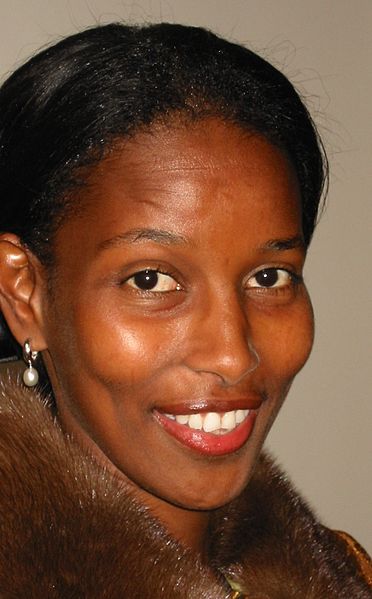
The rescinding of an honorary degree to Ayaan Hirsi Ali is not exactly an act of punishment. No one has a right to any such degree and Brandeis is fully within its rights to breach basic manners and fail to do basic research about an 372px-Ayaan-Hirsi-Ali-VVD.NL-1200x1600honoree’s past work. And Ayaan has indeed said some intemperate and extreme things at times about Islam as a whole. But to judge Ayaan’s enormous body of work and her terrifying, pioneering life as a Somali refugee by a few quotes is, I’m afraid to say, all-too-familiar as an exercise in the public shaming of an intellectual for having provocative ideas. There seems to be an assumption that public speech must seek above all else to be “sensitive” rather than provocative, and must never hurt any feelings rather than tell uncomfortable truths. This is a terrible thing for liberal society as a whole and particularly terrible for a university campus, where freedom of thought should be paramount (although, of course, the hard academic left every day attempts to restrict that freedom).

The “outrage” at heterodoxy applies particularly to any members of an “oppressed” group who try and challenge the smelly little orthodoxies they are supposed to uphold. The venom and hatred seems to ramp up if the heretic is also a woman or African-American or gay or Latino or Jewish. For a woman of color like Hirsi Ali to challenge the religion of Islam is far more threatening to the p.c. left than, say, a Sam Harris or a Christopher Hitchens. The latter can be dismissed as white males (there’s no prejudice like p.c. prejudice); Hirsi Ali not so much.

Here, after all, is the biography of a woman the left wanted Brandeis to dishonor: a young Somali girl forced to endure genital mutilation at the age of five and who was going to be forced into an arranged marriage if she did not flee her country; a refugee from brutal misogyny whose attempts to expose Islam’s treatment of girls and women led to death threats because of a documentary she wrote, and whose director was subsequently murdered. She runs a foundation that aims to protect girls and women in America from being abused at the hands of Islamic traditionalists. It’s worth noting that for the hard left, none of this really matters. Or perhaps it matters more. Because her credentials are so strong, the attempt to mark her as a bigot is that much more strenuous.

This double standard goes both ways, of course.

The Fox News right is always desperate to get a member of a minority to challenge p.c. orthodoxy just because they’re a minority – giving some individuals far more weight than the cogency of their arguments might otherwise deserve. It is as if both sides cannot acknowledge that ideas are ideas – and that the human mind can entertain them, regardless of gender or skin color or sexual orientation.

So, unlike Bill Kristol, I have no objection to Brandeis’ awarding Tony Kushner an honorary degree. I find Kushner’s politics drearily socialist and some of his work agitprop. But he provokes; he’s a really gifted playwright; he makes enemies; and engages the world of ideas forthrightly from the farthest reaches of the left. Why can we not debate if establishing the state of Israel was a mistake, for example? Why, for Kristol, is that topic out of bounds? Why on earth would a university choose not to give a man an honor just because he once dared to make that argument? Kushner was challenging his own ethnic group just as powerfully as Hirsi Ali is challenging her own. But here is the question: why is he lionized and Hirsi Ali disinvited? Why are provocative ideas on the “right” less legitimate than provocative ideas on the left?

That’s why this is dismaying. Not just because Brandeis has, within its rights, behaved shabbily; but because it wants to rig the public debate in favor of one set of arguments over another. There are many places that one might expect that to happen – but not a university.

[Update: as I disclosed last night, Ayaan is a friend of mine; and also the wife of a dear and old friend of mine, Niall Ferguson. So, as always, I have a bias. Sorry not to have disclosed it a second time for those just coming to the controversy.]

[Update: dissents from readers here]

Attacking With Natural Gas

20140405_gdm952

Keith Johnson outlines how Russia has used energy as a weapon in its conflict with Ukraine:

Russian President Vladimir Putin raised the prospect Wednesday of making Ukraine pay in advance for the natural gas that it buys from Russia, a potentially ruinous move for the credit-challenged Ukrainian government. Ukraine’s total gas debt to Russia now totals more than $16 billion, Russian officials said. … Moscow has jacked up the price it charges Ukraine twice in recent days by a total of more than 80 percent, making gas sold to Ukraine among the priciest in Europe.

In a brazen display of chutzpah, Moscow justified the second price hike after abrogating a 2010 treaty between the two countries. Under the terms of that so-called Kharkiv accord, Moscow offered price discounts to Ukraine as a lease payment for the Russian naval base in Sevastopol, on the Crimean Peninsula. Now that Russia has forcibly annexed Crimea and taken over the naval base, it argues that discount no longer applies.

Putin is also threatening European countries with gas shortages if Ukraine doesn’t pay its bill:

Russian President Vladimir Putin sent a letter to 18 European leaders Thursday saying that a dispute over Ukraine’s gas debt to Russia could impact gas distribution throughout the continent, urging them to offer financial assistance to the indebted country. … Although the International Monetary Fund has already agreed to provide Ukraine with between $14 and $18 billion to avoid a default,that figure is far smaller than what Putin claims the country owes. In his letter, Putin says that Ukraine owes Russia $17 billion in gas discounts on top of a potential $18.4 billion debt due to a 2009 fine. He said that this debt grows by billions every day.

Meanwhile, as Matt Ford explains, losing Crimea has dealt a severe blow to Ukraine’s goal of energy independence:

The loss of Crimea only further weakened Ukraine’s already-tenuous energy security. Almost all of the fuel for Ukraine’s 15 state-owned nuclear reactors, which accounts for almost half of the electricity the country generates, comes from Russia. Ukraine’s domestic reserves of uranium are paltry, and it lacks the enrichment capacity to turn what it does have into usable fuel. Russia, by comparison, is a net uranium exporter to Europe and owns nearly half of the world’s enrichment capacity.

Ukraine still has some domestic-energy alternatives in the long term, but these require significant investment. The country possesses the third-largest shale gas reserves in Europe, estimated to hold nearly 1.2 trillion cubic meters, but commercial extraction isn’t slated to begin until 2020 at the earliest. That timeline might have been overly optimistic even before the revolution, considering the environmental impact of hydraulic fracturing (“fracking”) and the public resistance that comes with it. Another complicating factor is location: one of the two large fields, the Yuzivska field, falls almost entirely within the Donetsk and Kharkiv oblasts, two of the eastern regions in which Ukraine has accused Russia of fomenting revolts.

The Economist expects that, over time, Europe will decrease its dependence on Russian gas:

The shock of the Crimean annexation should speed up sluggish European decision-making on storage, interconnection, diversification, liberalisation, shale gas and efficiency. And though the decision-makers may detest Mr Putin, in private they will admit that he may thus have done them a favour. They already knew what to do. They just didn’t want to do it.

(Graphic from The Economist)

Yglesias Award Nominee

.jpg

“I would argue that conservatism and the cause of limited government are undermined by loose talk and an excessive animus toward the federal government. These days, in fact, conservatives would be well served to focus a good deal more attention on the purposes of government, not simply its size. I say that because during the Obama era the right has been very clear about what government should not be doing, or should be doing much less of, and for understandable reasons. But it has not had nearly enough to say about just what government should do. That needs to be corrected — and in the process conservatives need to be careful to speak with care and precision about our Constitution and the role of the federal government in our history,” – Pete Wehner, Commentary.

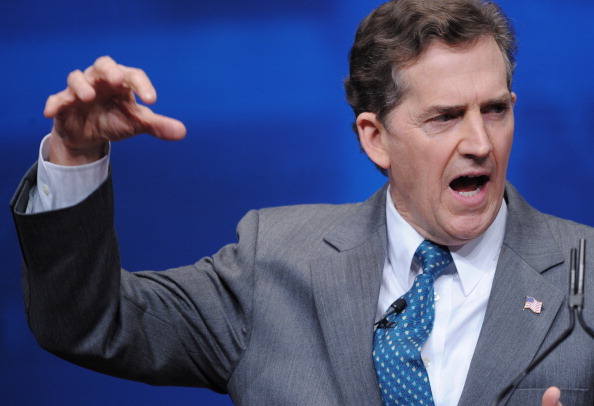
This was in response to Jim DeMint’s surreal attempt to force American history into his rigid ideology. Somehow, in DeMint’s imagination, the civil war was won without “big government.” But the federal government is never “bigger” than in wartime, its powers never so expansive. When that federal government is sending troops to conquer half the country, how much “bigger” can it get? You can totally see why Chait pounces thus:

Everybody knows the slaves were freed by Ronald Reagan, and he did it by cutting taxes.

Kilgore goes deeper:

[DeMint’s ]rap is based on a series of palpable falsehoods that are extraordinarily common in the exotic world of “constitutional conservatism:” the deliberate conflation of the Declaration of Independence with the Constitution (this is how they sneak God and “natural rights”—meaning property and fetal rights—into the latter); the idea that the Civil War was about everything other than slavery; and the claim of Lincoln’s legacy, even though the Great Emancipator was in almost every respect a “big government liberal” as compared to the states rights Democrats—DeMint’s ideological and geographical forebears who touted the Constitution even more regularly (and certainly more consistently) than today’s states rights Republicans.

But this is more than a debate. DeMint now runs the Heritage Foundation, and has run it into the ground with know-nothingism and partisanship.

What was once a right-of-center oasis in rigorous social science, economics, social policy, science proper and other academic disciplines, is now a purely political operation, run by ideologues. And the consequences of replacing solid research with ever-more abstract ideological posturing are dire. A major political party is flying blind a lot of the time.

Look at the response to the ACA. Heritage once innovated several features of Obamacare; now the GOP scrambles to produce anything as a real alternative that can grapple with some of the same issues. Paul Ryan issues a report on poverty that rests on fatal misunderstandings of social science. Another potential candidate, Ben Carson, rightwing “intellectual”, Allen West, puts out a book with fake quotes pulled off the Internet. And the seriously smart ones – Ted Cruz, par exemple – specialize and revel in demagoguery they must know is irrelevant to governing.

This is the mark of a party more interested in selling books to a devoted audience, not a party capable of actually running a government. Which is why, in my view, the GOP is increasingly conceding the full responsibility of running a country in favor of a constant stream of oppositional pirouettes and rhetorical excesses. That may win a few midterms; but it will never win a general. Nor should it.

(Photo: Jim DeMint by Mandel Ngan/AFP/Getty)

Why Aren’t Gay Men On The Pill? Ctd

During a recent “Ask Anything” taping with Dave Cullen, to discuss his book Columbine for the 15th anniversary this month, he opened up about his experience with Truvada, which he’s been taking for almost a year now:

Meanwhile, the in-tray is starting to fill up with responses to my post:

Thank you so much for your writing on Truvada and celebrating it for the godsend that it is. I’m in a serodiscordant couple, so to hear it described as a “party drug” makes me feel ill. If eliminating fear at the heart of a relationship is a party, then, yeah, that’s a party I’ll go to. If wanting to fuck the person I love safely makes me a whore, well then I suppose I’m a whore. The names can’t hurt our community as much as HIV has. So if takes being called names to finally end this virus, then let them call us whatever they want.

Another:

Your blog has been one of the few places I can go for reassurance about PrEP ever since going on it six months ago. I am 28 years old and have grown up in a generation of gay men that has been taught that truvadanot using condoms is tantamount to instantaneous seroconversion. When I first started taking Truvada, I was excited to share my experiences with friends and loved ones. But since that time, I have decided to no longer disclose my use of prep, since I have experienced a significant amount of backlash from friends as well as prospective sex partners. It can sometimes be a passive remark, like a friend telling me that this is a “lifestyle choice.” Other times, it is a more brash statement, like “truvada whore”. They assume I am on the pill because of a sex life that is somehow more licentious than my counterparts that are not on prep, which isn’t true.

The advent of PrEP has created a unique relationship between those who are taking steps to prevent HIV seroconversion and those who already have HIV: a shared interest in treating and eradicating a devastating health threat. But in our own community, we continue to face backlash thanks in no small part to misinformation propagated by groups like AIDS Healthcare Foundation. On one side we see a group looking toward effective treatment options built on a foundation of openness. On the opposite side is a swath of gay men who stigmatize those who have HIV, and yet, are simultaneously wary of those men who take pills to prevent getting the HIV disease. A paradox, if ever there was one.

Another reader:

OMFG you spoke the truth here, thank you. What’s frustrating is that so few people are speaking it. Unfortunately, I am recently (December 2013) HIV positive. (Don’t date pathological liars.) However, the drug cocktail (Complera in my case) is amazing, and I’m already undetectable with no side effects, but it would of course be better if I weren’t on it in the first place.

I’d been active in HIV/AIDS related work heavily 15-20 years ago, when I was much younger, and fell out of it for various reasons, so it’s been an education diving back into the weeds of it. Because of highly effective treatment options, HIV is a fundamentally different disease than it was in 1999, when I was last in a job working with mostly HIV+ patients. It’s now a treatable, chronic condition and not a terminal illness, and one that’s harder for treated patients to transmit and one for which it’s possible for non-patients to get a pretty effective prevention drug for.

Yet it feels like the public health and prevention strategies are still stuck in 1992, when the disease was still a death sentence. No wonder HIV infection rates amongst gay men are rebounding. We need to fight the disease as it exists today. That disease profile includes the current prognosis, transmission risks and prevention tools, each of which has changed dramatically since current HIV public health measures came into place. It’s happening, but not fast enough, and that slow pace is causing more people (like me) to get infected unnecessarily.

Andrew, you can sometimes be a pain in the ass, riding your hobby horses, and sometimes I want to slap you. It’s your best AND your worst quality, and it can be infuriating, even when I agree with you. But it’s moved the needle before (gay marriage, anyone?), and I think you have an opportunity to move the needle here to save lives and reduce the infection rate. Agree or disagree with you, when you get passionate on a topic, you’re hard to ignore and you force the conversation into the open, and this is a conversation that’s not being had in the open enough.

So please make this the first of many posts on the subject, and infuriate and annoy the hell out of us. You’ll do a world of good.

Ask Dayo Olopade Anything: Who’s Better For The Environment?

In our final video from the whip-smart Olopade, author of The Bright Continentshe outlines why Africans are often greater conservationists than their Western counterparts:

Meanwhile, a reader sounds off:

I’ve been liking what Dayo Olopade has said so far, but this latest bit on fat and lean economies is extremely problematic in my view.

Everyone likes to make fun of everyone rushing out to buy a slightly better iPhone, but if you look at where people spend their money, it’s mostly on healthcare, housing, and education. This is true almost the world over, whether the economy is “fat” or “lean”. I’m sure she wouldn’t have problems with anything like this, but if you’re going to make an entire classification for economies then you need to complain about more than the iPhone.

There’s actually some good economic literature looking at this on the other side, with a seminal paper titled “Economic Lives of the Poor“, which talks about the types on consumption decisions made by the very poorest people, those living on less than 2$ or 1$ a day (they talk about both groups, and not just in Africa). The thing is, these poor groups also tend to spend their money in ways that we would call inefficient, like 10% of their income on alcohol and tobacco and 10%on weddings and funerals (varying by country of course). So these people who are quite possibly starving are spending 20% of their income on things that aren’t necessary. And they often buy sweet food instead of something that provides calories more cheaply (7% of their income on sugar!).

But see how uncomfortable this position is? Who the heck am I to say that this spending is making their life worse? If you or I were in their position, wouldn’t we like a little bit of chocolate every now and then, just to make the day tolerable? Wouldn’t you get drunk when you could, just to forget the awfulness of things?

Look, I’m not trying to equivocate the a new iPhone with starving, but saying you know what other people should buy better than they do is a very slippery slope, and one that I will never be comfortable with, no matter their good intentions.

For all of Dayo’s Ask Anything videos, go here.

(Archive)

Hyperactive Prescribing? Ctd

A clinical psychologist writes:

I work primarily with children and families and I am routinely asked to do ADHD evaluations. Typically big crowds show up in October, after those first parent-teacher conferences, and again in April, as the year winds down and parents panic about their kids’ grades. I have three major points to make:

I. ADHD is absolutely over-diagnosed. There are two populations where this happens:

(1) Non-upper-class boys (and a few girls) who display disruptive or aggressive behavior, whose schools go diagnosis-shopping so the kid can be chemically restrained with stimulant drugs. In most cases, the behavior is totally operant: The kid has learned that if he curses, threatens, hits, dances on the furniture, etc., he will be sent out of the classroom and/or out of the school. Mission accomplished! And then people have the balls to tell me that “discipline doesn’t work.” Well, no shit. If you consistently reward a behavior, you get more of it.

2) Upper-class children whose parents go diagnosis-shopping so their kids can get extra services, supports, and stimulant medication to help them study.

II. ADHD is absolutely under-diagnosed. There are two populations where this happens:

1) Girls (and a few boys) who are merely distractible, not hyperactive or impulsive, so they’re not behavior problems. Your daydreamers. Your space cadets. Your absent-minded professors. These kids get called lazy. Unmotivated. Disorganized. Won’t do her homework. Makes simple mistakes; she should know better! She knows what to do, she just doesn’t do it! These kids develop a very negative self-image because they get a lot of negative feedback from their environment. They wind up depressed. I have seen one kid become suicidal because he truly believed he was stupid and would never achieve anything meaningful in life. (The under-diagnosis is more likely when the kid is intelligent and does well on standardized tests. Jimmy is so intelligent, but…)

2) Adults who are older than about 30 and were missed as kids. They (we) grew up before the great over-diagnosis wave, or grew up outside of the urban areas where it was more common. These people tend not to have achieved everything they could have. They tend to have problems in their working life because they forget things, miss details, make simple errors that most people just wouldn’t make. Quite a few develop hobbies or great big life projects that never quite coalesce. Most develop some neat tricks to compensate for their problems with attention, memory, and task completion. Some really believe, after a lifetime of negative feedback from their environment, they are stupid and underachieving. Depression and low self-esteem is fairly common in this group. A few develop anxiety problems because they’re terrified of the constant mistakes they make at work.

III. Your reader who’s a counseling psychology student is full of shit. ADHD and other learning disabilities show up when they show up, when the kid’s compensatory abilities intersect with an environment that’s too demanding for them. That can happen in childhood or it can happen later. The big points where it shows up, in my experience, are in about fourth grade, in the transition to middle or high school, or once in a while in college or beyond.

Another adds, “The fact that a third-year graduate student in psychology can say this is terrifying”:

While I agree that medicating kids who don’t have ADD is a problem, under-diagnosis is as well. I’m a 34-year-old man with ADD (the inattentive form). I was only diagnosed with it 18 months ago, and the first day I took medication was a revelation. I felt more alert and less foggy than I ever had before; the continual slush and confusion that sapped my brain on a daily basis was gone.

Why did it take until 32 for me to be diagnosed? Three of the big warning signs for ADD – bad grades in school, trouble holding down a job, and more car accidents – never showed up. The inattentive variety wasn’t well known – Driven to Distraction didn’t even come out until my freshman year in high school. ADD people thrive on structure, so if you’re someone who enjoys school and works hard, it’s possible for you to do well despite ADD. I was a creative person, too (still am) so the ADD behaviors I did have just got written off as spaciness.

Unfortunately, as my struggles with my creative work increased, my combined ADD and depression drove me to suicidal thinking, which so alarmed my therapist that she sent me to a talented and sympathetic psychiatrist who, after digging into my life, diagnosed me. (A key “tell” for him: while I like to read, I can’t get through two pages of a book without my brain veering off into some related fantasy.) I am not exaggerating when I say that without this diagnosis and treatment for the disorder, I could be dead.

Another identifies himself as “one of those ‘privileged’ students your psychological doctoral student scoffed at”:

I was diagnosed with ADHD after failing to get my master’s degree for six years. My entire life has been hampered by this problem that no one thought I had because I didn’t fit the typical hyperactive behavior profile. I think back to the times when I was playing outfield, trying desperately to pay attention through an inning and failing. About how I couldn’t excel at a simple manual labor job because I’d “zone out” and slow down. And how I got good (but not great) grades, but it took me about twice as long to finish my assignments as other people.

After my diagnosis and a prescription of amphetamine, my life fell into place. I started taking and excelling in advanced mathematics courses I’d been dreaming about for half a decade. Jesus, it even helped my fucking social issues. It was probably the most content I had ever been in my life.

But then my doctor left, and a new one took over. He decided I was not ADHD, but was in fact one of those people “gaming the system,” as your psychology student described it. Thus my diagnosis was rescinded. I have never been more furious in my life than when I was sitting in his office, realizing that he didn’t give a shit what I said; he’d already decided I was a fraud, and the appointment amounted to Kabuki theatre.

The fallout was pretty epic. I could barely keep up with my next semester’s workload, and to this day (over a year later) I’m not functioning at the level I was before stimulants. I lost my research position due to inability to work. Now I have no funding, even without taking courses or working I cannot make inroads with my thesis, and I’m realizing that without stimulants I will never excel in my chosen career of engineering. Since this is the United States, I can’t afford to see doctors independent of the university system, so I live in a state of perpetual impasse: my choice is to either be effectively owned by the psychiatric system for the rest of my life, or walk away from the career I’ve been building for most of my life. I have no money, no job, no future, and no hope.

Previous Dish on ADHD herehere, and here.