What Does Cuba Mean For 2016?

by Dish Staff

Cuba Parties

Rand Paul came out in support of President Obama’s historic opening with Cuba yesterday, putting him at odds with his putative primary competitors:

“The 50-year embargo just hasn’t worked,” Paul said. “If the goal is regime change, it sure doesn’t seem to be working, and probably, it punishes the people more than the regime because the regime can blame the embargo for hardship. “In the end, I think opening up Cuba is probably a good idea,” he said.

The senator’s approach separates him from several potential Republican presidential hopefuls, including former Florida Gov. Jeb Bush, Govs. Scott Walker of Wisconsin and Bobby Jindal of Louisiana and Paul’s Senate colleagues Marco Rubio of Florida and Ted Cruz of Texas. His more libertarian outlook could win him support in agricultural states like Iowa, which holds the nation’s first presidential caucuses. Paul’s comments also parallel those of Democrat Hillary Rodham Clinton, who wrote in her book “Hard Choices” that the embargo was a failure that gave the Castro regime “a foil to blame for Cuba’s economic woes.”

Kilgore expects Paul to pay a political price for that position:

Perhaps Paul is calculating that no one will care about Cuba policy by the time the 2016 nominating contest gets serious, and that could be true. But if, say, Marco Rubio is in the field, I don’t think Paul will be able to avoid the issue.

And I’ll betcha the other candidates will gang up on him just as they did on Ron about Iran, even as they largely refused to challenge his crazy monetary policy ideas or his long association with extremists. Conservative mistrust of the Paul family on national security issues hasn’t gone away by any means, and it’s surprising he’s giving it new life, even if he’s absolutely right on policy grounds. I’m quite sure Jennifer Rubin is writing a blog post on this fresh evidence of his “isolationism” as we speak.

Indeed, Rubio was quick to swat back that Paul “has no idea what he’s talking about”, to which Paul replied in a series of tweets, including this zinger:

Larison doubts that Rubio’s black-and-white approach to Cuba will win over very many voters:

It’s hard to see how Rubio benefits by becoming the leading opponent of a policy change that most Americans, most Floridians, and most Cuban-American Floridians support. He will win more applause from other hard-liners in his party, but that’s not something that a candidate running for re-election in a “swing” state normally wants. If it has an effect, it probably does more to hurt him in Florida, especially because of the positive effects that restored relations will likely have on Florida.

I fail to see how becoming the leading defender of an outdated and failed policy that most of his constituents reject improves Rubio’s chances of re-election. Yes, it raises Rubio’s national profile and it will get him a lot more attention in the coming year, but it’s not clear that Rubio benefits from being identified primarily with his hard-line foreign policy views. It is conceivable that Rubio could end up losing his Senate re-election bid because he becomes so closely identified with trying to block a change in policy that most people in his state say they want.

Waldman agrees:

On this issue, [Marco Rubio] is kind of like the teenager who wears a bow tie to school and agrees fervently with the senior citizens who are so fond of him that kids today have no respect, and ought to shut off that awful hip-hop and listen to some real music, like Tommy Dorsey or Glenn Miller. … But I don’t think he’s going to run anyway. He’s up for re-election to his Senate seat in 2016, so he’d have to give it up to run for president—and if he didn’t get the nomination, he’d be left with nothing. He’s only 43 years old, so he could run in 2020, 2024, or pretty much any time in the next quarter-century. He’s a pretty good politician, but he’s not so spectacularly skilled that he can reasonably look over the field and say, “I can take all of these bums.” So it’d probably be best for him to sit it out. And when he does run, Cuba probably won’t be an issue anymore.

But Greg Sargent isn’t so sure:

I would like all of this to be true. But here’s an alternate possibility: There may be no downside for Rubio here, particularly given what he needs to accomplish in the short term if he is running for president. After all, if Obama’s move does produce some successes in “accelerating change and democracy” in Cuba or in any other ways, it seems unlikely that they will be even acknowledged at all  inside the Conservative Entertainment Complex or among the GOP primary voters Rubio is apparently trying to reach. So where’s the gamble in getting this wrong?

Then, of course, there’s the money. As Kenneth Vogel and Tarini Parti discover, wealthy opponents of normalization are already lining up to line the pockets of the “right” candidates:

Since Obama’s announcement, top Cuban-American donors have been reaching out and offering support to the U.S.-Cuba Democracy PAC, a leading opponent of normalization, according to the group’s director Mauricio Claver-Carone. “You’re definitely going to see a boon,” predicted Claver-Carone. “It will carry through the next cycle and will translate over to Jeb and Marco,” said Claver-Carone, whose group has hosted both Bush and Rubio at recent events, including a gala headlined by Bush last month in Miami that raised $200,000. …

And there’s an even deeper-pocketed group on the same side of the issue backed by the Koch brothers’ political operation. The LIBRE Initiative, which courts Latino voters with a conservative economic message, is registered under a section of the tax code – 501(c)4 – that allows it to shield its donors’ identities and requires only bare-bones financial disclosure and only well after Election Day. From July 2012 through June 2013, the group raised $5 million, according to its tax filings, and sources say it spent millions in this year’s midterms attacking Democrats in Texas, Arizona and Florida. The sources expect it to increase its spending in 2016, including potentially on ads opposing normalization.

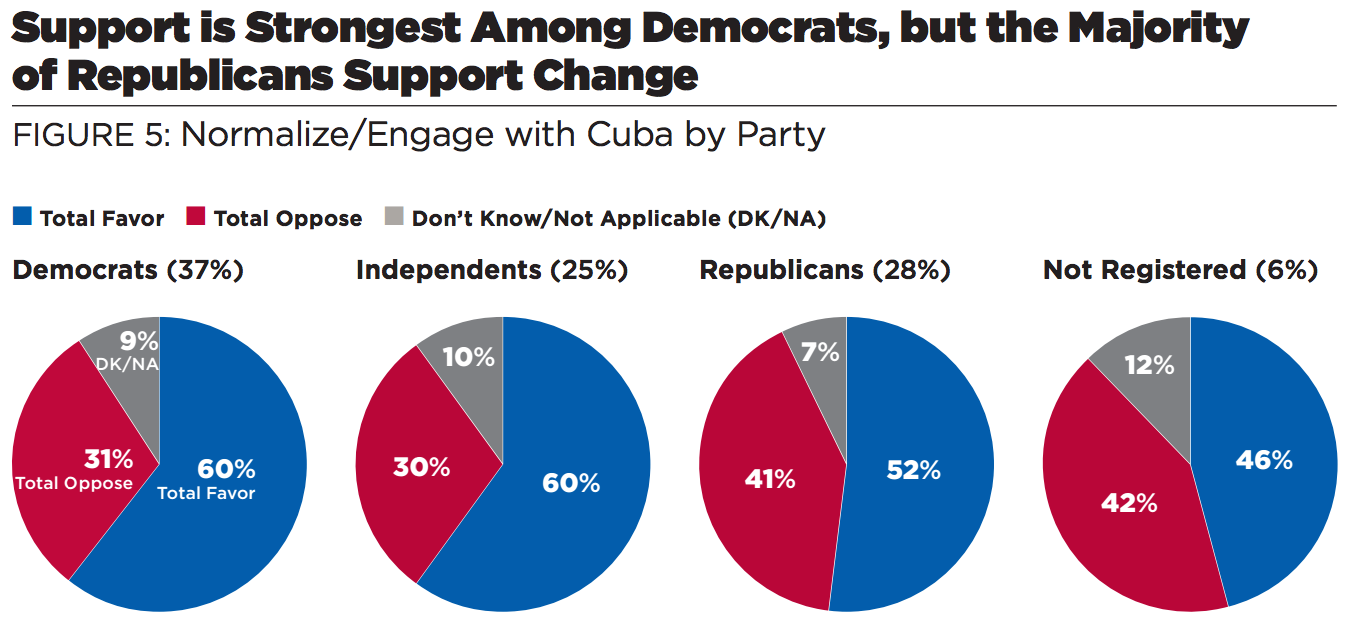
(Chart showing majority Republican support for normalizing relations with Cuba from a February Atlantic Council report (pdf).)


Losing Your Faith In Santa, Ctd

by Dish Staff

Readers join Dish staffers in sharing their stories:

Around age 5, my father took me to the mall for some shopping and the ritual Santa visit. Whatever it was he needed to buy, the journey was unsuccessful on that front, and we traveled enhanced-buzz-13665-1354006755-0 directly to another mall to try again. Of course, there was at this second mall another Santa, one with somewhat different facial features and proportions. I quickly deduced these could not both be Santa, and, QED, Christmas was a fraud.

Pinned with the sudden outburst of my doubts, Dad didn’t miss a beat. “Well of course Santa can’t be at every mall,” he said nonchalantly.  “He’s a busy guy, making toys. He has a lot of helper Santas he sends out to find out what people want for Christmas. They’re called ‘subordinate Clauses.'”

Maybe he’d been waiting his whole adult life to make that pun. Maybe it came to him in a brilliant flash. Needless to say I didn’t get it for many more years. But I bought the substance when it counted, and the benevolent illusion was preserved.

Not for this reader:

I believed in Santa until I was five or six. Then I learned about gravity, and I wasn’t sure how the sleigh could fly, since reindeer don’t have wings or jets. The more I thought about the logistics of Santa, the more they bothered me. How did Santa get around the world in one night? The Polar Express, which I loved, implied that he didn’t even get started until after midnight, and that made the whole thing seem even more implausible.

This story has an unexpected twist:

I have an older brother, by 3 years. As with most older brothers, mine delighted in ruining anything I believed in or liked.

Knowing this, one year my dad took my brother aside and told him, “I know you don’t believe in Santa anymore, but don’t ruin it for your brother.” As my dad tells it, my brother’s bottom lip started quivering, and with tears in his eyes, he looked up at my dad and said, “There’s no Santa??” He was certain my brother no longer believed and felt so guilty for ruining his eldest son’s Christmas that year.

Another reader:

Santa was revealed to me as an empty suit the Christmas I was 5. We were at my grandparents house when the adults informed me that Santa had decided that I should open my presents before Christmas morning (I have no idea why other than they just wanted open presents early) so he was making an express delivery. This announcement was followed by a big ho ho ho on the porch that sounded just like my uncle and my gifts magically appeared. I got suspicious.

But I still wanted to give him the benefit of the doubt, so the next year I wrote my Santa letter and asked him for a Dancer Ballerina doll, which I got, only to have her twirl one time and break. My mother told me that they must have made a mistake in Santa‘s workshop, so Rudolph would probably fly back in a day or two to take it back so the elves could repair the ballerina’s twirl. But the next day I found the box she came in – in my mother’s bedroom hidden under some quilts, and the sticker on it didn’t say North Pole; it said Sears. And I was done.

Weird thing though: I didn’t tell my parents for another year or two. They seemed to get such a kick out of Santa that I didn’t want to ruin it for them.

Another:

I don’t have any recollection of losing my faith in Santa, but I do have a quick anecdote about my daughter, now eight. Mid-October, as we are eating dinner, she asks, “So, when are you and Mom going to give KJ (older brother) and me The Talk“? The capital letters were quite clear in her speech. Having already explained to her how she arrived on this world, I was a little confused.

“What talk?”

The talk where you tell us there is no Santa Claus, you’ve been buying all the presents, and then lying to us so we wouldn’t ask you for more?”

“Oh. Next year.”

“Cool.”

Another got both Talks at once:

I believed in Santa for an almost embarrassingly long amount of time. I was 13 years old when my mother sat me down and informed me that if I was going to start learning about sex, I might as well learn the truth about Santa. The problem for me was a combination of too clever parents (I was regularly required to put toys and clothes  out on the porch in early December for Santa to “recycle” so that when my younger siblings or cousins received them it wouldn’t be weird), and a stubborn need to believe in magic that has unfortunately followed me into adulthood. Well, that, and as I repeated told my classmates, “My parents are way too poor to buy that stuff, so Santa has to be real.”

Another older believer:

I was relatively late to the game of realizing Santa wasn’t real (I think I defended his existence to numerous doubtful friends).  But my realization happened as a result of just thinking too hard one car ride with mom.  I started to think that if Santa were real, my capacity to receive presents would be limitless – I could have not only a Nintendo, but every game they ever produced.  I mean, if he’s got these elves making toys and magical powers, why couldn’t I receive everything I possibly wanted?

I realized that deep down I knew this was impossible, that there were economic restraints on Christmas.  So I just turned to my mom and said “there’s no Santa is there,” and she replied “no.”  And that was the end of it.

(Image via Cess Padilla)

What Can We Do To North Korea?

by Dish Staff

Given how little trade most of the world does with North Korea, further economic sanctions aren’t really an option:

Trade North Korea

Peter Singer, mercifully, rules out war:

We didn’t go to war with North Korea when they murdered American soldiers  ​in the 1970s with axes. We didn’t go to war with ​North Korea when they fired missiles over our allies. We didn’t go to war with ​North Korea when one of their ships torpedoed an alliance partner and killed some of their sailors. You’re going to tell me we’re now going to go to war because a Sony exec described Angelina Jolie as a diva? It’s not happening.

As Will noted, Chait recommends that the government make Sony whole. Ambinder disagrees:

I wondered online if Sony could argue somehow that it is too big to fail — that if the attack is tied to a country, then perhaps the company can be indemnified from lawsuits arising from its own alleged neglect. The answer is no.

Going forward, Congress might consider some sort of risk pool for companies that meet strict standards and still find themselves the victim of state-sponsored hacking. Sony does not seem to have met those standards. It was low-hanging fruit. Sony will have to eat its losses, because saving Sony from embarrassment is not in our national interest. But securing open access to the internet for American companies is now considered to be a critical national security issue.

Bloomberg View’s editors think “Sony and other corporations can’t expect the U.S. government to respond to every attack on their behalf”:

However embarrassing and costly to the studio, the hacking represents a cybercrime, not an act of cyberterrorism directed at civilians or vital national infrastructure. (By the same token, threats against theaters showing a Hollywood comedy that mocks Kim Jong Un hardly compare with the vows of annihilation that constantly pour out of North Korean state media.) Companies need to improve their own defenses.

They ask, “What level of attack would prompt a U.S. counterstrike?”

There’s no need for any new red line to be drawn here. It would only help the Kim regime calculate the risk-reward ratio for its cybermischief. Ambiguity can help deter North Korea from attempting anything more serious, such as an attack on the U.S.’s critical infrastructure.

It’s worth keeping in mind that certain individuals, like Kim Zetter, still have doubts that North Korea is responsible for the attack:

Nation-state attacks aren’t generally as noisy, or announce themselves with an image of a blazing skeleton posted to infected computers, as occurred in the Sony hack. Nor do they use a catchy nom-de-hack like Guardians of Peace to identify themselves. Nation-state attackers also generally don’t chastise their victims for having poor security, as purported members of GOP have done in media interviews. Nor do such attacks involve posts of stolen data to Pastebin—the unofficial cloud repository of hackers—where sensitive company files belonging to Sony have been leaked. These are all hallmarks of hacktivists—groups like Anonymous and LulzSec, who thrive on targeting large corporations for ideological reasons or just the lulz, or by hackers sympathetic to a political cause.

Barbara Demick listens to another skeptic:

“There is such a level of vindictiveness toward Sony that it feels more like an ex-employee or a business dispute,” Martyn Williams, a long-time North Korea watcher, who has taken a contrarian view on the attack, said. Williams believes that the hackers could be using North Korean software, or possibly imitating North Korean tactics, to cover their own tracks. He notes that the Guardians of Peace hackers didn’t mention “The Interview” before this week. He also believes that a recent message on a text-sharing Web site that threatened moviegoers and invoked 9/11 was unlikely to have come from North Korea. “North Korea is definitely capable of annoying its neighbors, but to make these kind of threats, saying ‘Remember 9/11,’ I don’t think North Korea is so stupid,’’ Williams said.

On the other hand, today the FBI officially blamed North Korea for the hack.

The End Of Serial, Part Three

by Michelle Dean

Without Rabia Chaudry, a civil rights attorney in Maryland, there would have been no Serial. Chaudry is the family friend of Adnan Syed’s who approached Koenig about doing the story in the first place. She is personally convinced Syed is innocent, and had hoped Koenig would come to advocate for his release the way she had. At TIME yesterday, she recorded her disappointment with the way it played out instead:

A few weeks ago Koenig visited me do a follow-up interview. None of that interview made it into the remaining episodes, but at that time, and on the mic, she told me that after a year of investigating, she had failed to find a smoking gun. She found nothing that either condemned Adnan for certain, and nothing that exonerated him for certain.

It was not a punch to the gut, necessarily, but a quiet closing of a chapter that I had held open for 15 years. In the midst of the enormous coverage of the case and show, of hearty congratulations for staying on it, of lots of movement by the different teams of lawyers now working to help Adnan, I felt like a failure.

After making the decision unilaterally to get media involved, I’ve felt heavily responsible for the pain it’s forced Adnan and his loved ones to go through. It would be worth it, I hoped. Something concrete would surface. Koenig wouldn’t tolerate the fuzziness. She would dig till she struck rock.

Except Koenig didn’t. Chaudry adds that she nonetheless doesn’t regret taking the story to Koenig. And that Koenig still plans to follow the story, and that some good has come of the show. Still. I do not know Chaudry, though I interviewed her briefly for a piece. Reading the above three paragraphs made my own gut churn on her behalf anyway.

It is not unusual for subjects to feel disappointment with what journalist ultimately manage to dig up. Janet Malcolm’s The Journalist and the Murderer is pretty much entirely about the conflict between what the writer writes and what the subject is hoping she’ll write. But expecting the disconnect doesn’t make the experience less wrenching for everyone.

Obama Scraps Our Failed Cuba Policy, Ctd

by Dish Staff

Previous input from the in-tray here. Another reader gives a shoutout to Francis: “For the pope to be a broker for the deal makes the whole story even more interesting.” Another looks at the opening of Cuba with realist eyes:

There is no hypocrisy in maintaining normal relations with China, Saudi Arabia, and other violators of human rights while denying that status to Cuba. Saudi Arabia has lots of oil and a strategic position in the world producing world. It is a relationship of economic convenience, and both sides understand that. China offers huge trade opportunities, and in the beginning of our relationship, a counter to the Soviet Union. You have diplomatic relations with states when it is necessary and prudent.

Cuba offers nothing to the USA or its citizens other than another tourist destination, cigar, and rum. There are practically no consequences to US citizens for not normalizing relations other than opening up yet another Caribbean tourist destination, and providing access to cigars, and rum. Just because Cuba has not liberalized its society doesn’t make our foreign policy a “failure” any more than other nations who have diplomatic relations with Cuba “failed” to effect an opening.

I’m not opposed to ending the travel ban, but we should have gotten a lot more out of Cuba for normalizing relations. At a minimum, Obama should have required Castro to lift all restrictions for Cubans to have Internet access.

Update from a reader:

Normalizing relations doesn’t give us anything in terms of security? Really? Here’s a simple thought experiment: is it better to have friendly relations with neighbors or antagonistic relations with neighbors?

Another relates to Will’s criticism:

Just amazes me how the left romanticizes Cuba, even as it attempts skepticism. I just got off the phone with a friend from Cuba. Her family is sending a blood pressure machine to a relative in Cuba because none are to be found.

Another provides some family history:

Nothing steams me up more than one of the comments from your reader:

We all know the real reason: political posturing. Castro stripped Cuban aristocrats of their wealth. They fled to Florida and have been propping up anti-Castro policy ever since. There are no principles here.

Well, here is a story about one such “aristocratic” family. My mother’s mother, with her eight children between the ages of 15 and 1, left Cuba in 1960 with nothing but a tiny suitcase and the clothes on their backs.  She would meet her husband in Miami, where they would begin a new life.  They left family, friends, their homes, their country.  Slowly, many of her family and friends also left for Miami and elsewhere after thinking that Fidel would be the answer to all of Batista’s corruption.  My grandmother never saw her mother again, who passed away in 1977.

My grandfather was the son of a middle-class family in Havana, nicknamed Barbarito because he was born on Sta. Barbara’s Saint Day.  During the time Batista was in power, my grandfather was imprisoned for six months for, in his words, “Conspirando” (conspiring).  After their emigration from Cuba, he remained active in conspiring, but to overthrow the Castro regime and to return home.  He always believed he’d return. My grandfather passed away in 1990, my grandmother passed away in 1992, never having returned to Cuba.

My mother, who left Cuba when she was 10, visited Havana in the mid-nineties. She was allowed to go to her grandmother’s home, though only allowed in the front salon. The man who lived in the lower part of house kept many of her grandmother’s items, including photos of her and her family.  They were little snapshots of their daily life in Cuba, remembrances of what they left.  She was able to take them back to her brothers and sisters.

I am also part of the diaspora, having been born in England to a Guyanese father, coming to Miami in 1980, now living in Los Angeles.  I consider myself Cuban. In memory of my grandparents, I have chosen not to go to Cuba until conditions change and the Castro regime topples.  This week’s news is part of that change, though I am undecided as to my feelings about it and am still processing what that means for my uncles, aunts and friends.

When I read the comment above, as well as all the jokes about McDonalds and the Americanization of Cuba, I am shocked at the disregard for the suffering millions of people have had on both sides of the Florida Strait for the past fifty plus years.  This week’s news should not be about making jokes, making blanket statements about what one thinks happened in the fifties and sixties, about Republicans and Obama, or about one’s vacations plans.  The news is about peoples homes and loved ones, regardless of political leanings.

Another reader is also “thrilled by the news”:

Cuba is the most depressing place I’ve ever been. I flew from Merida to Havana as part of my trip around the world in my mid 20s. Everyone I met was in their mid-late 20s and very attractive but short due to protein deficiency (they talked about eggs once a week). They all had masters. None of them worked. The highlight of their day was meeting up with me to get a Coke and an ice cream in the park using the dollar line (I happily treated).

I still recall one conversation I had with the guys I met up with every day. They couldn’t believe that there were poor people in Mexico. That got me thinking. Mexicans can’t believe there are poor people in the United States. Both a simple and extremely complicated concept to consider.

Another dissents:

Your blog fails to mention the gross human violations the Castro brothers have committed over the past 50 years.  The alacrity and glee your blog has greeted the diplomatic opening with a government comprised of thugs is breathtakingly hypocritical and disappointing.

Details of that despotism from Raúl Castro here. Another reader thinks of the birds:

Far more worrisome than Golden Arches spoiling all those picturesque Havana ruins is the prospect of Cuba‘s coastal areas, some of the most pristine in the hemisphere, getting turned into resorts. The jailing/isolation of Cuba has been a blessing for birds and wildlife, which enjoy nearly pre-Columbian conditions in some spots. I am eager for theCuban people to enjoy more freedom, and I think it’s all but certain they would embrace an more American-like lifestyle very quickly if given chance. That’s one of the things the people griping about Obama’s “betrayal” forget or ignore – the allure of the bonuses of our system. But Cuba‘s coasts are a rare world treasure.

And another disparages one of the main conduits of commentary this week:

Hard to feel much sympathy for anyone feeling his comments maligned after posting them on Twitter, e.g., the funky Cuba vs McDonalds kerfuffle.  If Twitter is inherently inadequate for in-depth analysis, then don’t use it to express your views and then expect to be cut slack because there was no space to get at an issue more profoundly.  Best, I would imagine, to confine oneself to pith and snark, or otherwise accept the likelihood of being misunderstood, willfully or not.

Is Obama Due For A Comeback?

by Dish Staff

Earlier this week, Beinart made the case that Obama is bouncing back:

This year’s dominant storyline was about Obama and the midterm elections. Most key Senate races took place in red and purple states where Democratic candidates distanced themselves from Obama, thus magnifying the media’s perception that he was a political pariah.

Next year, however, the story won’t be 2014 but 2016. And the Democratic story, in all likelihood, will be Hillary Clinton’s march toward her party’s nomination. While Obama was certainly unpopular this fall in states like Kentucky, he remains quite popular among the liberal activists who play an outsized role in Democratic primaries. In fact, Obama retains a connection to many them that Hillary Clinton has never enjoyed. The closer she comes to the nomination, the more nostalgic some of those grassroots liberals will become about Obama. And this new context—Obama versus Hillary among Democratic activists—rather than Obama versus Alison Lundergan Grimes among Kentucky midterm voters—will cast him in a more favorable light.

That may be true, but Waldman isn’t expecting Obama to win the approval of many Republicans:

[P]artisan identification has sorted and sharpened, and people on both sides are even less willing to give the other side’s guy credit for anything. Bush’s approval among Democrats was in the single digits for most of the last three years of his presidency, and Obama’s approval among Republicans has hovered around 10 percent (sometimes even lower) since 2010.

What that means is that if Obama has a revival in approval, it’ll look not like the 65 percent Clinton had at the end of his term or Reagan had just before Iran-Contra, but more like 50 or 55 percent. That represents most everyone from his party, and a little over half of independents. There are actually very few true independents; most lean to one party or another. Obama won’t get approval from the Republican-leaning ones, but he can get the Democratic-leaning ones, and if things are going well, most of the true independents (who represent maybe 10 percent of the population). Add that all up and it’ll come out to something like that 55 percent number.

“Stephen Colbert” Signs Off

by Dish Staff

A reader writes:

I didn’t know before I saw the episode last night that Andrew was going to be in the star-studded finale of the Colbert Report.  When I saw him there, it felt like a friend had made it into the inner circle.  I was more excited to see him than any of the other guests, like he was “one of us”.  Just sending this because I wonder if other Dishheads felt the same way.

In his review of the series finale, James Poniewozik calls Colbert “America’s greatest, most genuine phony”:

That Colbert was able to be “Stephen Colbert” at such a high level for some nine years was the 56-game-hitting-streak of American comedy, a feat we may not see equalled again. He kept it up in part by taking the show on the road. He brought his act to the White House Correspondents’ Association Dinner, got Doritos to sponsor his favorite-son run in the 2008 South Carolina primary, and — in what was probably his high-water mark — in 2011 went through the process of founding a real SuperPAC. It was simultaneously an epic work of performance-art satire and genuine public-service education.

Before the finale, Colbert was already in the process of letting go of “himself”; on Wednesday’s show, he held a yard sale of Report memorabilia, unloading a copy of his correspondents’ dinner speech to a crying baby, selling a bottle of “Ass Juice” to a lucky bargain hunter. He seemed at peace, and why shouldn’t he be? He’s going on to something new, taking over for David Letterman at CBS. And while that’s generated much interest in what Colbert will do as himself, I’m not too concerned.

Update: A reader flags this post of Andrew’s from October 18, 2005, titled “Pure Genius”:

Last night’s Colbert Report, of course. O’Reilly fileted. My only worry is: how can he keep it up?

Making It About Gender

by Michelle Dean

The news about humanity is never very good when it comes from Reddit, is it? Today’s contribution comes via an editorial at WIRED. Its authors, Elena Glassman, Neha Narula and Jean Yang, are scientists at MIT. They described the gendered horror show that was their Reddit AMA:

Within an hour, the thread had rocketed to the Reddit front page, with hundreds of thousands of pageviews and more than 4,700 comments. But to our surprise, the most common questions were about why our gender was relevant at all. Some people wondered why we did not simply present ourselves as “computer scientists.” Others questioned if calling attention to gender perpetuated sexism. Yet others felt that we were taking advantage of the fact that we were women to get more attention for our AMA.

The interactions in the AMA itself showed that gender does still matter. Many of the comments and questions illustrated how women are often treated in male-dominated STEM fields. Commenters interacted with us in a way they would not have interacted with men, asking us about our bra sizes, how often we “copy male classmates’ answers,” and even demanding we show our contributions “or GTFO [Get The **** Out]”. One redditor helpfully called out the double standard, saying, “Don’t worry guys – when the male dog groomer did his AMA (where he specifically identified as male), there were also dozens of comments asking why his sex mattered. Oh no, wait, there weren’t.”

“Oh, it’s just Reddit,” you might be saying to yourself. As a seasoned 4chan conspiracy theorist myself –at this point I think “4chan prank” whenever some weird story begins to break, at first even wondering if the whole Sony leak could be a 4chan hoax, if they could have made up the whole document stash – I understand the impulse to brush this sort of thing off as trolling. It is that, and undoubtedly some of these comments come from the sort of pure unmitigated jerkery commonly found in the underbelly of the internet.

But it’s also something else. Because their comments aren’t all that far from ones I have heard myself, said with utter sincerity. Men don’t respond very well, still, to the notion that gender might be relevant. They might be a little meaner about it in anonymous spaces online, but you can see the problem everywhere.

One of the slim, ephemeral benefits of being publicly identifiable as a feminist is that I don’t tend to be in male-dominated or even male-only spaces very often. There is one giant exception to that. Years ago, I spent some time in a journalism school. An admissions fluke had me in a class that was overwhelmingly male. There was one other woman, but she dropped out early.

I knew I was in for it when in a very early class, one of the other students starting waxing philosophic about fact-checking and John D’Agata. And towards the end of this digression, he referred to the magazine The Believer. And then he referred to its editor as “Ben Marcus’s wife.” Full stop.

I’m polite. I’m Canadian. I waited for the discussion to come around to me. I said something like, “You know, her name is Heidi Julavits. I wouldn’t call her Ben Marcus’s wife, if I were you.” I meant it rather benevolently at the time. I was amused.

Now, to be clear, at the time the student registered chagrin. As I recall, he said something like, “Oof, that probably sounded sexist, didn’t it.” It did. There he had it. We moved on.

But the incident hardened into a parable within our small class. Mea culpa: I participated in this hardening by sometimes teasing the other student about his use of the phrase.

The parable didn’t come to be about him, though. It came to be about me, about what I was like, meaning that I was the kind of person who’d insensitively attack a man for making an inadvertently sexist comment. And gradually, the story became a way for the other male students to express their frustrations with my views of the world. I remember very clearly one of them bringing it up – it seemed to come up way too often – months later and saying, “There was nothing wrong with what he said. Ben Marcus is more famous than Heidi Julavits.”

Now, you could be forgiven for not wanting to do the fine filigree work of parsing reputations here. Suffice to say that I don’t think either Marcus or Julavits would be upset if I said that neither of them was particularly famous. I do, actually contend, that even within the kind of meager fame literary circles bestow on writers and editors like them, that Julavits is likely better known. This may only be true because Marcus writes experimental fiction and she is involved with more widely accessible work. (The latter is not an insult in my world.)

But that isn’t the point. The point is it’s odd to classify a woman as someone’s wife, particularly in a professional context, and no, your gut feeling that someone is more famous does not get us away from the problem with the phrase. Even if you didn’t “mean” to be sexist, the identifier “somebody’s wife” is a remnant of sexism. Women take it personally. They should. It was long used as a way to inform women that, as in Rebecca Solnit’s phrase, “This is not their world.”

The tossed off remark was only the spark of the larger problem, though. When I said something that day, and even later when I teased the student, I wasn’t trying to be a warrior for gender justice. I was trying to gently remind a bunch of young men that they, too, should pay attention to the names of women. It was almost friendly professional advice, because it was quite possible that they’d end up pitching stories to her.

Nonetheless, it labelled me as the person in the class who “made things” about gender. It made me the butt of these young men’s jokes. Which eventually had the result of making me angry with most of them, because there are only so many times you can hear from people that your apprehension of reality is incorrect before you start to get angry with them. I realize they might have felt the same way about me. But they outnumbered me at the time. Which they still do, by the way, just about everywhere in journalism that I’d actually like to go.

That’s another way of saying that besides injured feelings, I had history and statistics to be angry about. As do those MIT science professors.

A Legal Threat To Legalization

by Dish Staff

Marijuana Colorado

Nebraska and Oklahoma are suing Colorado for legalizing marijuana:

Two of Colorado’s neighboring states, arguing that the legalization of marijuana for Coloradans is causing crime problems across state borders, asked the Supreme Court on Thursday to allow them to file a lawsuit directly before the Justices.  If the suit goes forward, Nebraska and Oklahoma’s filing said, the Court should rule that the commercial part of the Colorado scheme is unconstitutional and could no longer be enforced.

Josh Harkinson explains the states’ grievances:

Evidence has been mounting that Colorado can’t contain all of its weed. In June, USA Today highlighted the flow of its marijuana into small towns across Nebraska. Since 2011, the paper reported, felony drug arrests in Chappell, Nebraska, a town just seven miles north of the Colorado border, have jumped 400 percent.

Colorado has vowed to defend its laws:

Colorado Attorney General John Suthers isn’t backing down. In a statement, he said he intends to defend the state’s marijuana laws. “Because neighboring states have expressed concern about Colorado-grown marijuana coming into their states, we are not entirely surprised by this action,” Suthers said. “However, it appears the plaintiffs’ primary grievance stems from non-enforcement of federal laws regarding marijuana, as opposed to choices made by the voters of Colorado. We believe this suit is without merit and we will vigorously defend against it in the U.S. Supreme Court.”

Sullum doubts the prohibitionists will prevail:

As Deputy Attorney General James Cole explained to the Senate Judiciary Committee last year, the Justice Department decided against trying to block marijuana legalization in Colorado and Washington after concluding that there was no viable legal strategy to stuff the buds back into the jar. It is well established that Congress cannot compel states to punish activities they decide should not be treated as crimes. Although the federal government might have more success in challenging a state’s licensing, regulation, and taxation of marijuana businesses, Cole said, the upshot of such a victory would be a legal but completely unregulated market. Given the way the Supreme Court has interpreted the Commerce Clause with reference to the ban on marijuana, the feds might force Colorado and Washington to scrap their rules for growing and distributing marijuana. But they cannot constitutionally force Colorado and Washington to arrest, prosecute, and imprison marijuana growers and distributors.

(Photo: A tourist purchases marijuana at La Conte’s Clone Bar & Dispensary during a marijuana tour hosted by My 420 Tours in Denver on December 6, 2014. By Craig F. Walker / The Denver Post)

Howard Roark And The Hacker’s Veto

by Will Wilkinson

The hacking of Sony and the studio’s subsequent decision to halt the release of The Interview is incredibly weird and it’s left me pretty well stumped. First of all, I’m not 100% positive North Korea is the culprit. I’m not aware of dispositive evidence (maybe the government has it) and it’s more than a little surprising that the North Koreans could do anything so competently. I guess they could pay somebody to do it. In any event, the idea that the North Korean dictator gets to decide what Americans are allowed to watch is outrageous. What leaves me baffled and vexed is what to do about it.

Jonathan Chait wants to the feds to step in and backstop the studios:

The federal government should take financial responsibility. Either Washington should guarantee Sony’s financial liability in the event of an attack, or it should directly reimburse the studio’s projected losses so it can release the movie online for free. The latter solution has the attractive benefit of ensuring a far wider audience for the film than it would otherwise have attracted.

I don’t think this is a bad idea at all, but it’s not clear to me that it gets us far toward solving the problem of the hacker’s veto. What if the Guardians of Peace threaten to blow up Amazon or Netflix server farms, or Comcast HQ, and once again the studio, or the distributors, with perfectly understandable myopic capitalist prudence, capitulate? I mean, when several theaters resolved to show Team America: World Police in the place of The Interview, Paramount said “Nope, shut it down” – a move, in the words of Peter Suderman, that “can really only be described as next-level cowardly bullshit.”

It would seem to me that, in the end, the only real answer is spine. It’s hard not to agree with George Clooney:

We should be in the position right now of going on offense with this. I just talked to Amy an hour ago. She wants to put that movie out. What do I do? My partner Grant Heslov and I had the conversation with her this morning. Bryan and I had the conversation with her last night. Stick it online. Do whatever you can to get this movie out. Not because everybody has to see the movie, but because I’m not going to be told we can’t see the movie. That’s the most important part. We cannot be told we can’t see something by Kim Jong-un, of all f*cking people.

Quite so. But, again, how do you ensure that all the players down the distribution chain don’t get the jitters? As Jonah Golberg notes:

The only problem: At least one cable company preemptively surrendered to North Korean intimidation, too, reportedly saying it would not air the film. Now, even if Sony had a backbone transplant, it couldn’t release the movie.

Sony could still dump it on the Internet and let it spread virally. It would lose ticket sales, but the company would strike a defiant blow nonetheless.

Don’t hold your breath. Sony would rather go the way of appeasement. And so would everyone else, it seems.

Clooney worries, and I think he’s right to worry, that our lack of spine is going to lead to insipid, bland, inoffensive, a political film-making. Freddie de Boer observes that we’ve got that problem already:

What I wonder is why people aren’t a little more put off by a form of censorship that is more insidious, and will likely affect far more movies in the long run: the soft censorship of appealing to the Chinese government in order to reap the Chinese box office. There have been widespread claims that recent blockbuster movies like the latest Transformers have been written so as to appease Chinese censors. There’s nothing wrong with writing movies to reach out to a particularly huge foreign box office– why wouldn’t you want your movie to play to Chinese moviegoers?– but appealing to the Chinese government is a whole other ball of wax. That’s where you  can see genuine self-censorship coming in. And while I imagine that this whole thing will blow over before long, without a great deal of long-term damage, I think the urge to play in China -and for the Chinese government —  will only grow over time.

The problem of willingly selling out to the Chinese reminded me of Ayn Rand, whose bracing moral lessons I’m sure Freddie had in the back of his mind. Rand’s finest novel, The Fountainhead, is an anti-capitalist screed about the spiritual and cultural evil of catering to market demand. Forget the problem of giving the commie censors what they want. It’s wrong to give the free market what it wants, when what it wants is aesthetically debased, which it always is. The architect hero of The Fountainhead, Howard Roark, is the ultimate in spine, the patron saint of never selling out. When one of his perfect, austere modernist buildings is bowdlerized the better to suit the public taste, he blows it up. That’s right, Howard Roark is a terrorist, a jihadi for artistic integrity. Maybe Howard Roark is the answer. Maybe can show us the way. Maybe Sony needs to feel that it is unsafe not to release The Interview. Maybe Seth Rogen needs to blow something up! Or maybe Brian Beutler is on to something, and the best we can do is call on Anonymous to steal the movie and make sure that, in this case at least, market-based American spinelessness can’t put a gag on our precious stoner auteurs.