Little Progress On The Peace Process

JORDAN-US-PALESTINIAN-ISRAEL-DIPLOMACY

Peter Beaumont reports that John Kerry and Mahmoud Abbas met for “urgent consultations” Wednesday night “amid fears the stalled Middle East peace talks are heading towards collapse”:

Kerry arrived in the Jordanian capital hours after an Arab League summit in Kuwait released a statement emphatically declaring that Arab leaders would never recognize Israel as a “Jewish state,” a key demand Netanyahu has made of Palestinians.

The meeting between Kerry and Abbas comes amid increasingly harsh rhetoric from both sides. On Tuesday Abbas accused Israel of a “criminal offensive” to step up settlement building in Jerusalem and the West Bank. In reply a senior Israeli official accused Abbas of trying to “torpedo the peace process” while parading “rejectionism as a virtue.”

Joshua Mitnick notes that “with uncertainty rising about the fate of the talks, some members of Mr. Netanyahu’s coalition are balking at following through on a politically controversial Israeli commitment to release 26 convicted Palestinian prisoners by Saturday”:

Israel’s media reported that Jonathan Pollard, an American Jew serving a life imprisonment of spying for Israel in the 1980s, might be freed by the U.S. to gain Israeli support for the release. The reports were denied by the U.S.

Aaron David Miller has compiled a list of “five ways to tell the Middle East peace process is in big trouble.” Number one: “Jonathan Pollard’s name comes up”:

This is a peace process perennial. And when it sprouts up, look out. In 1998, in an effort to reach an interim agreement between Palestinian leader Yasser Arafat and Netanyahu, the Israeli prime minister pushed what has become a standard request since 1985 – release Jonathan Pollard. From Israel’s point of view – and as illogical and objectionable as it may sound to an American – the imprisoned spy who was convicted for spying on the United States is like a soldier left on the battlefield. Israel is obligated to get him back. The presumption is that releasing him would afford this prime minister a political coup at home and make it easier to permit him to swallow some peace-related issue. At the 1998 Wye River summit, CIA Director George Tenet threatened to resign when President Bill Clinton seemed inclined to consider the request. Current CIA Director John Brennan may well have the same reaction. Nothing demonstrates how far afield we’ve come and how shaky this peace process is when you start mixing Pollard apples with peace process oranges. It’s a sure sign that the focus has shifted to the wrong set of issues driven by the wrong set of motives.

John Judis, who calls the peace process “nearly dead” and places most of the blame at Netanyahu’s feet, notes “there have also been signs that Kerry has either been losing interest or giving up hope in the negotiations”:

In his opening statement to a Senate Committee on March 13, he mentioned American foreign policy concerns with the Ukraine, South Sudan, the Maghreb, Central Asia, the Korean peninsula, and Zambia, but not with Israel and the Palestinians. At a Town Hall meeting with students at the State Department on March 18, Kerry described the situation in the Ukraine and then listed “other challenges that are very real.” He cited “Syria, the challenge of Iran’s nuclear weapon, of Afghanistan, South Central Asia, many parts of the world.” Conspicuously absent was Israel and Palestine.

If Kerry does withdraw and lets the talks collapse, or simply allows them to peter out after a grudging agreement to extend them without a meaningful framework agreement, the Israelis and Palestinians are very unlikely to resolve their differences. And that could set the stage for a real tragedy.

Daniel Levy looks for another way forward:

[T]he emphasis placed on American-sponsored bi-lateral negotiations may not have been such a good idea in the first place. Progress might be better served by having the Palestinians pursue their rights through international fora, civil disobedience and a focus on international law and Israeli violations thereof, even if America would pro forma oppose such initiatives. The accumulation of Palestinian leverage might then change Israel’s political calculus and even create new space for American-led peace efforts. Unsurprisingly such ideas are not to Israel or America’s liking, while Palestinian civil society and many in the political arena lose patience with their leadership for not adopting such a line.

But not everyone has lost hope. Jon Emont notes that in Israel, a business group called Breaking The Impasse is trying to pressure Netanyahu on a peace deal:

BTI has real clout. The Israeli economy is dominated by a relatively small number of tycoons. According to [Yarom Ariav, [Lavi Capital executive chairman and former Ministry of Finance general director,] the businesspeople who make up BTI control more than 30 percent of Israel’s GDP, when you add up their personal wealth, the companies they run, and the funds they oversee. This gives BTI’s members, including tech entrepreneur Yossi Vardi and Meir Bran, the CEO of Google Israel, influence with Israel’s center-right leadership. It also means that the January advertising blitz was a test run for a potentially far larger public campaign.

(Photo: US Secretary of State John Kerry gestures as leaves the Jordanian city of Amman on March 27, 2014, en route to Rome. Kerry and Palestinian president Mahmud Abbas held ‘constructive’ talks on the Middle East peace process, a US official said Thursday, as crunch decisions loom in the coming days. By Jacquelyn Martin/AFP/Getty Images.)

The Computer Feels Your Pain

Machines are better than people at telling when pain is real:

In the experiment, more than 150 participants were shown short videos of the faces of people who either dunked their arms in ice water or pretended to dunk their arms in ice water. The group was asked to gauge the authenticity of each pained reaction, and succeeded in weeding out the fakers from the true sufferers only 51.9 percent of the time – no more accurate than if they simply had left their guess to chance. Next, the researchers showed the same videos to computers with special expression recognition software. The computers’ accuracy? Eighty-five percent.

That the humans performed so poorly actually is no surprise. Scientists have known for a while that even trained physicians can’t reliably differentiate between real and faked pain expressions. But the computers’ results were unprecedented.

How the experiment worked:

[Researcher Marian] Bartlett’s system is based on something called the Facial Action Coding System, or FACS, which was popularized by the psychologist Paul Ekman in the ’70s and ’80s and is used today by everyone from TSA screeners to animators trying to imbue their characters with more realistic facial expressions. It’s a way of describing virtually any facial expression that’s anatomically possible by breaking it down into its component movements — a wrinkle of the nose, a tightening of the eyelid, a lowering of the brow, and so on. The idea is that each of these movements maps onto a specific muscle or set of muscles.

Bartlett’s team has been working for years to create a computer vision system to automate FACS and to develop machine learning algorithms that can learn to recognize patterns of facial movements that correspond to particular emotions. (They also founded a company, Emotient, based on the same technology — more on that later). The new study is the first to assess how well the system distinguishes genuine from fake facial expressions and compare its performance to that of human observers.

The practical applications:

[Bartlett] thinks automated pain detection could be useful for doctors and nurses working with children. Research suggests that pain is often underreported and under treated in kids, she says. She’s also developing systems that detect more than just pain. The company she co-founded, Emotient, recently released an app for Google glass aimed initially at salespeople looking for insight into their customers’ mood. Presumably, any Google Glass wearer will eventually be able to use it.

A realtime color-coded display indicates which emotions the system is supposedly picking up in the people around you. The company claims it can accurately detect joy, sadness, anger, fear, and disgust. And if you’re being a Glasshole, the app just might clue you in: It’s also programmed to detect contempt.

Reality Check

Approval of Obamacare has rebounded slightly:

ACA Opinion

Sargent sees this as evidence that in seven months the law will “recede as an issue, while other factors (candidates, the economy, the terrible map for Dems) come to the fore”:

The new poll finds that in March, 38 percent viewed the law favorably, versus 46 percent who saw it unfavorably. That’s a substantial narrowing from the 34-50 spread during the dark days of January, and a return almost to where opinion was in September (39-43), before the rollout disaster began.

Drum adds:

This suggests that the main reason for the blip was Obamacare’s well-publicized rollout problems. Once those got addressed, and people were able to sign up without too much hassle, opinions turned back around.

But the poll also finds that many of the uninsured remain unaware of the original deadline. Kilgore calls that “genuinely depressing news”:

The poll also shows that two-thirds of the uninsured have not attempted to secure insurance over the last six months, so it’s not like the problem can be attributed to the initial problems at healthcare.gov, unless you assume large numbers of people were spooked by the bad publicity (unlikely, given the apparent lack of knowledge about all aspects of Obamacare evident among the uninsured). You can certainly argue that the administration and Obamacare proponents have vastly underestimated the difficulty of informing the uninsured of their new options. But on the other hand, the common conservative claim that “America” has looked at Obamacare thoroughly and rejected it misses what is going on almost entirely.

Suderman’s takeaway from the same poll: “Half the uninsured say they’ll stay uninsured.”

Ban Contraception?

Catholic Culture‘s Phil Lawler thinks it would be a great idea:

Catholic politicians [are] under a moral obligation to oppose contraception because they are obligated to serve the common good, and contraception violates the common good. The use of contraception is not merely a moral offense for Catholics, similar to eating meat on a Friday in Lent. As Pope Paul explained in Humanae Vitae, contraception is a violation of the natural law, harmful to anyone who engages in the practice. Contraceptives harm people (especially women) and harm our society. Catholic politicians – all politicians, actually – should look for opportunities to restrain the practice.

It would be interesting to find a single woman who agrees. But it’s always bracing to see a Christianist be consistent for a change. Ponnuru responds to Lawler:

I’m part of the small minority of Americans who agrees with nearly all of those words. They do not, however, establish that prohibition is the right policy.

There are many potential harms that we have good reasons not to seek to prohibit. … I think a faithful Catholic politician could reasonably conclude – because it is true – that there is not much that government can do to restrain contraception (there are few “opportunities”), let alone much sensible that government can do; and that in the case of many oral contraceptives, the restriction on over-the-counter sales in our society serves no useful purpose.

Meanwhile, Bouie considers how evangelicals’ views on contraception are shifting to the right:

At the moment, few evangelicals have joined conservative and traditional Catholics in opposing birth control. It has been an extreme position for evangelicals, limited to the far right wing of the movement. Indeed, in a 2009 poll by the National Association of Evangelicals, 90 percent of respondents said that they approve of contraception.

But the fight against the Obamacare contraception mandate has begun to transform the landscape of evangelical belief about hormonal birth control. Concerns over potential “abortifacients” like Plan B have led to concerns over the “pill” itself, and evangelical leaders like Albert Mohler have warned their followers against the “contraceptive mentality,” and encouraged them to “look closely at the Catholic moral argument” for guidance.

That is indeed a fascinating development. I don’t buy the Magisterium’s argument against contraception, believe it profoundly weakens the much more important case against abortion, and was a prime example of what is wrong with papal supremacy in the church. Pope Paul’s own commission came to the opposite conclusion, as have the vast majority of Catholics. But, look, I have no objection whatsoever to Christians who agree with Pope Paul actually living out the reality. The best approach if this is your view is to proclaim it by example, rather than enforce it imprudently by law.

Egypt’s New Strongman Makes It Official

EGYPT-POLITICS-UNREST-VOTE

Michelle Dunne expects that Abdel-Fattah al-Sisi, who announced his run for Egyptian president yesterday, “will not face serious competition on either the right or the left”:

There will most likely be no Islamist contender: Morsi’s Muslim Brotherhood, now officially considered a terrorist organization, would hardly be tolerated, and Salafi organizations are divided between those supporting Sisi and those boycotting the process. One serious Islamist candidate in 2012, Strong Egypt Party leader Abdel Moneim Aboul Fotouh, has already said he will boycott this election, as will 2012 leftist candidate Khaled Ali. Candidates from the nationalist camp are unlikely to run against Sisi because they do not want to defy the military, whose leaders announced their support for Sisi’s candidacy in an unprecedented statement that many politically aware Egyptians found startling. The one announced competitor so far, Nasserist Hamdeen Sabahi, will draw some protest and labor votes but the young revolutionaries he attracted in 2012 are now scattered and demoralized.

Robert Springborg, noting that two-thirds of Egyptians approve of Sisi, considers his appeal:

The field marshal’s popularity is due to that of the military, which continues to be the most trusted institution in the country, with around 90% of Egyptians expressing their support for it; to his message of restoring stability by virtue of a crackdown on Islamists; by his skillful projection of an upbeat officer image, replete with snazzy headgear, combined with that of a devout Muslim harboring traditional respect for women and Christians; and by his careful avoidance of substantive policies, especially those of economics.

That this message, which avoids truly critical matters, can be so popular and believable attests in part to his skill in delivering it, which rests both on his military background and on his traditional upbringing in Cairo’s al-Gamaliyya district, the very heart of historic, Islamic Cairo venerated by novelist Naguib Mahfouz and in the imagination of most Egyptians. He is the very living example of what traditional Egyptian values and practices can produce. And even if he is ultimately revealed as “fahlawi,” a skilled deceiver of others, that too could be positively interpreted as a sign of his Egyptianness and suitability for a leadership role.

But Steven A. Cook argues that the country’s politics “are likely to be hotly contested, even under a President Sisi”:

To the casual observer, Sisi must seem like the only political force in Egypt. A cult of personality followed closely on the heels of the army chief’s emergence last summer: The military-friendly media framed Sisi as “Egypt’s savior,” and stories quickly emerged of Egyptian brides with the field marshal’s visage painted on their fingernails, Sisi chocolates, sandwiches, and pajamas, as well as the standard Middle Eastern strongman-poster-on-every-public-building phenomenon.

But Sisi-mania actually revealed the potential fragility of the army chief’s political position. After all, if the field marshal was as broadly championed as the government would like everyone to believe, there would be no need for ostentatious professions of faith to him. Even recent popular votes don’t necessarily suggest overwhelming support: Although it is true that 98 percent of voters gave their approval to a new constitution in the January referendum – a vote widely seen as a proxy to test support for Sisi – but only 38.6 percent of eligible voters actually went to the polls. The very fact that the interim government has moved aggressively to suppress dissent suggests that Egyptian leaders are vulnerable to political challenges.

Robert Mackey registers an online backlash:

Although Mr. Sisi’s popularity with many Egyptians looking for a strongman to end the turmoil that followed the 2011 uprising is unquestioned, the news of his plans to stand for the presidency was greeted with anger, dismay and sarcasm online by activists, rights workers and commentators who had hoped for something other than a return to autocracy. Before, during and after his televised declaration, they heckled Mr. Sisi, the odds-on favorite for the presidency, on Twitter.

A sample tweet is above. Juan Cole thinks the al-Sisi run “mixes together two motifs”:

First, it is a sort of Bonapartism, a restoration of the presidency to a military man, which had been the case with Egypt’s four post-1952 presidents. The tradition was briefly interrupted in 2012-2013 when there was a civilian, Muslim Brotherhood president, Muhammad Morsi. The military in turn is a steward of the enormous public sector, both of state business elites and of public sector workers.

Second, al-Sisi represents himself as a conduit for substantial influxes of new money into Egypt. Governments that depend on outside money coming in instead of on in-country taxes are called “rentier states” by political scientists. … Most rentier states nowadays get their money from primary commodities such as petroleum and natural gas. Egypt has few hydrocarbon resources. But another way to receive “rent” or external money is to have strategic use for the donor. The $2 billion a year the US gave Egypt after 1978 was strategic rent. Now Saudi Arabia feels insecure about the challenge from Iran, given that the Obama administration seems to be making up with Iran. And it is afraid of the surge of populist Muslim movements that challenge its legitimacy. So having the Egyptian military provide security to the small oil monarchies of the Gulf makes sense both to the emirs and to Egypt. Egypt is being hired as a large security guard.

Ben W. Heineman Jr. considers the challenges Sisi will likely face in office:

Today, the Egyptian economy is in as much distress as it was when Morsi took office. Not only are rates of poverty, inflation, and unemployment high, but GDP growth is sluggish, the budget deficit is yawning, tourism is down, the need for imported fuel is great, and public debt (both foreign and domestic) stands at $268 billion, or 107 percent of GDP. … As president, rather than puppet master, Field Marshal Sisi will grapple with Egypt’s economic challenges in a far more exposed way. And, as was the case for the country’s past two presidents, these profound and prolonged problems could be his undoing – no matter how strong his security state.

(Photo: An Egyptian man has on his chest a portrait of Egypt’s Defence Minister General Abdel Fattah al-Sisi with a slogan in Arabic reading “I vote for the loin of Egypt for the presidency” outside a polling station during the vote on a new constitution on January 14, 2014 in Cairo. By Khaled Desouki/AFP/Getty Images)

What’s Next For Afghanistan?

AFGHANISTAN-ELECTION-ATTACK

With the country’s presidential elections some two weeks away, Dov Zekheim offers his endorsement:

It is critical not only for Afghanistan, but for the United States and the West, that his successor be a man – all remaining candidates of the original 27 who put their names forward are men – who appreciates not only Western values, but actually lives by them. That man clearly is the current front runner by the slightest of margins, Ashraf Ghani. The former finance minister, advisor to Karzai (though his advice was invariably ignored), and World Bank official is a genuine friend of the West in general and of the United States in particular.

I had the distinct pleasure of working alongside him when, as Under Secretary of Defense, I also was DoD’s civilian coordinator for Afghanistan. Ashraf was finance minister at the time, and he was doing his utmost to employ such power that his office afforded him to regularize Kabul’s intake of resources and its budgets. He tried to professionalize those civil servants who worked for him. He sought not to confront the warlords – he knew that was a losing battle – but rather to pursue a strategy of co-opting them even as he worked around them.

However, just yesterday Taliban militants attacked an election office next to Ashraf Ghani’s home. As Sean Carberry notes, during the Afghan election season, “the candidates are busy campaigning – and the Taliban are busy attacking”:

The latest attack came Tuesday morning in Kabul when two suicide bombers detonated themselves outside one of the offices of the Independent Election Commission. Moments later, several gunmen ran inside and waged a three-hour gun battle with dozens of Afghan police. … Last week, four teenage gunmen smuggled pistols through several checkpoints at a highly secure five-star hotel in Kabul and shot diners in the restaurant. They killed a highly regarded Afghan journalist, his wife and two of his children. They also killed four foreigners, including an international election monitor staying at the hotel.

As a result of that attack, two out of the three international election monitoring organizations that were planning to observe the elections have pulled their people out of Afghanistan, raising further questions about the integrity of the April 5 vote for a successor to President Hamid Karzai. There’s no clear-cut favorite in the race, and it’s quite likely that no candidate will get 50 percent of the vote, which will necessitate a runoff between the two top vote-getters. That would mean an extended campaign and the prospect of additional violence.

(Photo: A bloodied election poster that reads ‘Your vote is your future’ lies on the ground at the site of a suicide attack on an election commission office in Kabul on March 25. Fifteen people died in violence around Afghanistan less than a fortnight before the country’s presidential poll. Insurgents have vowed a campaign of violence to disrupt the ballot on April 5, urging their fighters to attack polling staff, voters, and security forces in the run-up to election day. By Wakil Kohsar/AFP/Getty Images)

Manipulated For The Greater Good?

Screen Shot 2014-03-27 at 10.43.02 AM

Nitsuh Abebe pulls the curtain back on Upworthy’s editorial process. On the site’s mission:

Much of Upworthy’s content does feel like reality TV. A lot of it also feels like advertising. This isn’t an accident; the site’s built, tactically and deliberately, to appeal to what skeptics once called the lowest common denominator. Its choices are the ones you’d normally associate with a race to the bottom—the manipulative techniques of ads, tabloids, direct-mail fund-raising, local TV news (“Think This Common Household Object Won’t Kill Your Children? You’d Be Wrong”). It’s just that Upworthy assumes the existence of a “lowest common denominator” that consists of a human craving for righteousness, or at least the satisfaction that comes from watching someone we disagree with get their rhetorical comeuppance.

In some respects, Upworthy does represent a slight paradigm shift in the constantly churning world of writing and the web. It’s really about producing writing or visuals or videos that people want to share. Their contribution to the evolution of the web, like Buzzfeed’s, is honing and finessing and mastering the tricks and techniques of getting people to share Upworthy items on their Facebook pages. One reason so many of the posts are indeed shared, as the piece points out, is not just the very catchy formulaic headlines (already expiring from over-use) but, more importantly, that they are not strident or edgy or in any way discomfiting. That way, the posts can be attached to a Facebook feed as a way of expressing your identity, of solidarity with the disadvantaged, of the appearance of caring. It really is a beautiful circle, designed, of course, to make shitloads of moolah at some point by dominating the sharable content that has become much of our common reading material.

But here’s the thing: is crafting “content” for sharing the same thing as writing or journalism? Here’s my basic test.

Does the writer of the piece select the topic because he or she believes it sincerely to be worth writing about? And does the writer want the piece to be read for its point rather than merely passed around to maximize revenues and traffic? Upworthy rather brilliantly collapses its business rationale – nothing but “evergreen standards like ‘Human rights are a good thing’ and ‘Children should be taken care of’” that will be easily shared – and its journalistic rationale – i.e. we want to make the world a better place by being nice to children, puppies, etc. The reason why it’s hard to be completely cynical about Upworthy is that the content, if anyone reads it, is so, well, uplifting. But of course, that’s the real, deep cynicism behind it.

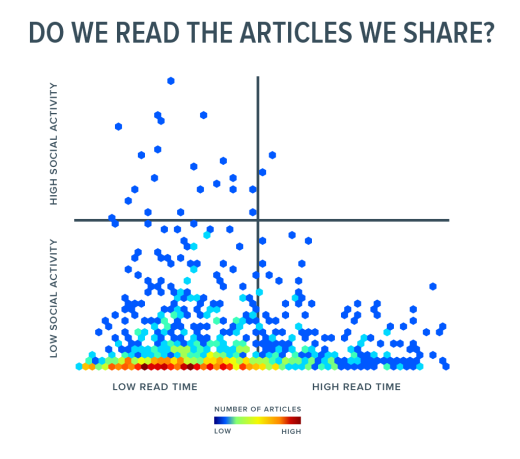
Next month, we’re told, Upworthy will unveil its monetization strategy. So at some point, we’ll see exactly what it’s about: the money or the writing? But it’s vital to recall what Tony Haile, CEO of Chartbeat has discovered, illustrated in the chart above:

A widespread assumption is that the more content is liked or shared, the more engaging it must be, the more willing people are to devote their attention to it. However, the data doesn’t back that up. We looked at 10,000 socially-shared articles and found that there is no relationship whatsoever between the amount a piece of content is shared and the amount of attention an average reader will give that content.

When we combined attention and traffic to find the story that had the largest volume of total engaged time, we found that it had fewer than 100 likes and fewer than 50 tweets. Conversely, the story with the largest number of tweets got about 20% of the total engaged time that the most engaging story received.

So Buzzfeed and Upworthy are really about sharing for money than reading for interest. We may be evolving into a web where everything is shared and nothing is actually read. And journalists are leading the charge.

Planes Are Safer Than Cars Everywhere

Increasing aviation safety in developing countries is a low priority for Charles Kenny:

The macabre but exhaustive website planecrashinfo.com put the odds of being killed on a single airline flight at about one in 4.7 million across 78 major world airlines; among the airlines with the worst safety records, the odds rise to one in 2 million. In the middle of the last decade, the fatal crash rate for Kenya Airways was about three in 1 million. For Ethiopian Airlines, it was four in 1 million. That’s higher than that of U.S. carriers such as American Airlines (0.6 fatal crashes per 1 million flights) or United (0.5 per million)—but it still suggests flying is safe, and that the gap between poor and rich countries is small.

That’s not true for driving.

While it’s widely known that flying is statistically safer than driving, just how much safer varies from country to country. Data from the World Health Organization and the World Bank suggest that, in the U.S., there are 1.4 fatalities per year for every 10,000 cars on the road. In Malaysia, there are seven; in Kenya, 87—more than 60 times the rate in the U.S., compared with about a fivefold gap in air safety. Given how often people drive, and how indispensable car travel is in most countries, the gap in developing countries’ road safety records is far more troubling than their air safety records are impressive.

In other MH370-inspired commentary, Emily Yoffe uses psychology to explain our fascination with flight 370:

[I]t’s the specific nature of the disappearance of Flight 370 that pings some of our most basic cognitive drives. In their book The Scientist in the Crib, Alison Gopnik, Andrew Meltzoff, and Patricia Kuhl write, “Babies become interested in, almost obsessed with, hiding-and-finding games when they are about a year old. There is the timeless appeal of peekaboo. … Babies also spontaneously undertake solo investigations of the mysterious Case of the Disappearing Object.” So, from our earliest days, we focus our attention on objects that are hidden, and then revealed. This consuming play, they write, “contributes to babies’ ability to solve the big, deep problems of disappearance, causality, and categorization.” No wonder we’re watching CNN’s nonstop coverage of a disappearing object.


Why Are We So Overwhelmed?

Brigid Schulte’s new book looks at why we’re constantly battling “the overwhelm.” Nicole Dubowitz explains how the idea for the book came about:

As a mom of two young kids, Schulte was incredulous when University of Maryland sociologist John Robinson asserted that women have at least thirty hours of leisure time every week — “not as much as men,” he said, “but women have more leisure now than they did in the 1960s, even though more women are working outside the home.” He encouraged Schulte to keep a diary on her leisure time usage and report back. Overwhelmed began with the author’s 2010 feature in The Washington Post magazine, where she posed the first of many questions: “How did researchers compile this statistic that said we were rolling in leisure — over four hours a day? Did any of us feel that we actually had downtime?”

In keeping her diary, Schulte was pretty sure she would prove Robinson wrong, or else find that she had been “squandering” away leisure time while feeling overwhelmed. More questions for the book developed: Do our daily commitments “contaminate” the leisure time we do have? Why are things the way they are, and is there anything we can do to make them better?

Hanna Rosin digs into Schulte’s findings:

To be deep in the overwhelm requires not just doing too many things in one 24-hour period but doing so many different kinds of things that they all blend into each other and a day has no sense of distinct phases.

Researchers call it “contaminated time,” and apparently women are more susceptible to it than men, because they have a harder time shutting down the tape that runs in their heads about what needs to get done that day. The only relief from the time pressure comes from cordoning off genuine stretches of free or leisure time, creating a sense of what Schulte calls “time serenity” or “flow.” But over the years, time use diaries show that women have become terrible at that, squeezing out any free time and instead, as Schulte puts it, resorting to “crappy bits of leisure time confetti.”

Helen Lewis points out that we bring on some of the stress ourselves:

The relatively affluent have to take some responsibility for worshipping at the Altar of Overwork, an attitude Schulte calls “busier than thou”. Just as having a tan became a status symbol once it denoted that you could afford foreign holidays, so being overwhelmed is a badge of honour for middle-class professionals. Oh, between Jonny’s clarinet lessons and my Mandarin classes and Steve getting promoted to partner, I don’t have a minute to myself, they trill. Having no free time makes the point you don’t just have a job. You have a career. You are Going Somewhere.

Schulte’s prescription is simple: decide whether you love the bragging rights of being busy enough to live in a debilitating whirlwind of activity. If you don’t, perhaps leave the clarinet unmolested and the boxercise class undone. As for housework, one researcher’s message to women is refreshingly simple: be a slattern. “Do you have to be able to do open-heart surgery on the kitchen floor?” he asks. Also, make sure Himself pulls his weight.

In an interview, Schulte explains how her perspective has changed:

I was just with my father who’s had a stroke, and sitting in a hospital room really makes you remember: … We don’t have that much time; what do you want to make of your life here on this Earth? And so, my to-do list is really: What are my priorities? What is most important to me? And then everything else, everything my to-do list used to be, I call the other 5 percent — it shouldn’t take more than 5 percent of my time or energy. There’s a lot of stuff that I used to do that I don’t do anymore.

“One Of The Most Ageist Places In America”

That’s how Noam Scheiber describes Silicon Valley:

Tech luminaries who otherwise pride themselves on their dedication to meritocracy don’t think twice about deriding the not-actually-old. “Young people are just smarter,” Facebook CEO Mark Zuckerberg told an audience at Stanford back in 2007. As I write, the website of ServiceNow, a large Santa Clara–based I.T. services company, features the following advisory in large letters atop its “careers” page: “We Want People Who Have Their Best Work Ahead of Them, Not Behind Them.”

And that’s just what gets said in public. An engineer in his forties recently told me about meeting a tech CEO who was trying to acquire his company. “You must be the token graybeard,” said the CEO, who was in his late twenties or early thirties. “I looked at him and said, ‘No, I’m the token grown-up.’ ”

One consequence: cosmetic surgery is in high demand:

In talking to dozens of people around Silicon Valley over the past eight months – engineers, entrepreneurs, moneymen, uncomfortably inquisitive cosmetic surgeons—I got the distinct sense that it’s better to be perceived as naïve and immature than to have voted in the 1980s. And so it has fallen to [San Francisco surgeon Seth] Matarasso to make older workers look like they still belong at the office. “It’s really morphed into, ‘Hey, I’m forty years old and I have to get in front of a board of fresh-faced kids. I can’t look like I have a wife and two-point-five kids and a mortgage,’ ” he told me.

McArdle wonders why venture capitalists prefer younger entrepreneurs:

One possibility is that VCs are looking for a lottery ticket of sorts — the fantastic scores that will make you Facebook money from a small initial investment. And maybe you’re more likely to get a winning lottery ticket from a young entrepreneur, not just because they’re unconstrained by past experience, but also because the markets they cater to simply have more of that potential than businesses based around an older demographic. Older people are more set in their ways and have more obligations; they’re unlikely to spend hours of their valuable time helping you build a sustainable user base for the next Facebook or Twitter.

Another possibility is that most of the people who want to be first-time entrepreneurs are in their 20s and early 30s, before they have families and mortgages that need to be paid every month. Because older entrepreneurs are rare, they don’t fit investors’ mental model of what an entrepreneur looks like.