Not Succumbing To The Spectrum

Ron Suskind’s son, Owen, was diagnosed with “regressive autism” after he stopped speaking at age 3. Years later, Ron used Iago, the parrot from Aladdin, to start a conversation:

I freeze here for a minute, trying to figure out my opening line; four or five sentences dance about, auditioning. Then, a thought: Be Iago. What would Iago say? I push the puppet up from the covers. “So, Owen, how ya doin’?” I say, doing my best Gilbert Gottfried. “I mean, how does it feel to be you?!” I can see him turn toward Iago. It’s as if he is bumping into an old friend. “I’m not happy. I don’t have friends. I can’t understand what people say.”

I have not heard this voice, natural and easy, with the traditional rhythm of common speech, since he was 2. I’m talking to my son for the first time in five years. Or Iago is. Stay in character. “So, Owen, when did yoooou and I become such good friends?”

Owen’s story continues in the must-see video above. And the rest of his dad’s moving essay is here. Meanwhile, Atlantic readers – spurred by Hanna Rosin’s story about her son Jacob – share their own stories about family members with autism spectrum disorder. Here’s Josh from London:

I feel like writing this article is a betrayal.

I feel like I will never truly be able to accurately represent [my brother’s] illness. Even calling it an “illness” is wrenching. He’s a regular person that cannot handle certain situations. The stigma attached to a permanent mental illness that affects sociability is a subtle sort of oppression to the person given it. I see my brother wrestle with his identity a lot. Some days he thinks he’s been over or misdiagnosed; other days he seems to know more than anyone else how much his illness affects him. I can’t even begin to imagine the pain that some interactions must cause him, though I can see it on his face.

“Small kids have small problems; big kids have big problems.” No phrase is truer when talking about a child on the autism scale. The anxieties and inflexibilities of a child are much simpler to deal with than the deep pits of despair and intractable problems of an adult. We are on the borderlands: My brother is just sick enough to be diagnosed, but not sick enough to differentiate himself from anyone else in society. He is always absolutely fine until the moment he’s not. We dragged him through school and university, but will we be able to drag him through the rest of his life?

Much more Dish on autism here.

The Anti-Barbie

Realistic Barbie

James Hamblin highlights a doll designed with the body measurements of a typical 19-year-old American woman:

Lammily is the forthcoming plastic doll whose motto is, “Average is beautiful.” Her body shape is based on averages of data from the U.S. Centers for Disease Control that is more often used to track the American obesity epidemic. She is not affiliated with Mattel’s Barbie.

Virginia Postrel sees problems:

Before embracing the reassuring claim that “average is beautiful,” consider the CDC statistics behind Lammily’s physique.

Based on a representative sample of 118 people, the agency reports that the average 19-year-old female American stands 5 feet 4 inches tall. She has a 33.6-inch waist and a 14.1-inch upper arm. She weighs 150 pounds, giving her a body mass index of 25.5. That indicates that she is overweight. BMI is, however, a crude and controversial measure. Better are the CDC’s direct body-fat measurements. They confirm the same bad news: The average 19-year-old’s body is about 32 percent fat, just at the threshold for obesity.

If Lammily were true to life, in other words, she’d have rolls of fat, not a firm plastic tummy. Her figure would turn off both beauty-minded girls and health-conscious parents.

Adrian Lee adds:

It doesn’t help, either, that there is only one race (in an increasingly diverse U.S., it’s tough to say instinctively that Caucasian remains the average), which is a bit intentional: Lamm has said that he wants the figure to have that “J. Crew look,” which is more than a little bit WASPy.

Amanda Hess doubts Lammily will solve anything:

The problem with Barbie is not that she’s the only doll on the block. If parents want their girls playing with dolls proportioned like normal humans, they already have the choice to buy Only Hearts Club dolls or Journey Girls. Enough parents buy these dolls that they continue to exist. Some of them are even sold in major toy stores. But way, way, way more parents buy Barbies, and her stranglehold over the doll market is the reason she gets so much flak. …

Barbie’s impossible frame will remain the impossible standard. And as long as it is, daughters of feminist mommies and daddies who hit daycare with a doll who looks exactly like all the other girls’ Barbiesonly shorter and fatter—may not end up learning the lesson of beauty-at-any-size that the doll was created to deliver.

The Best Of The Dish Today

The news cycle is so punishing these days you might be forgiven for thinking the Obama era is over. But it isn’t. It’s at its peak in terms of impact, because policies, especially economic ones, take some time to have effect. Five years in, we have enough data – so reading through the Economic Report from the Council of Economic Advisers is therefore a helpful exercise. And it seems to me to be a rather impressive record – and utterly alien from the picture of gloom and dysfunction the Republicans are currently concocting.

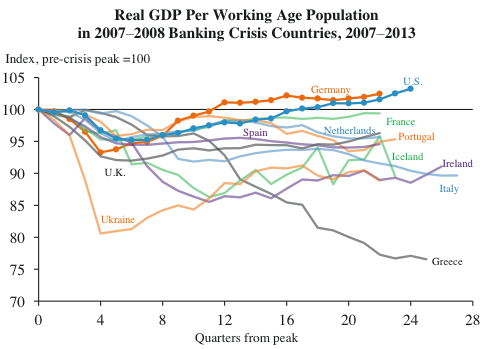
I’ll restrict myself to core facts that are not in dispute, rather than the arguments in the report. Take the economy. Despite unprecedented austerity at the state and local government level, it’s now clear that the US has recovered from the Great Recession better than any other economy:

Screen Shot 2014-03-10 at 7.37.56 PM

At least we can say with certainty that the stimulus didn’t fail, despite the silly denial in the GOP. The massive debt overhang – always the biggest drag on growth – has also been substantially reduced:

Screen Shot 2014-03-10 at 7.47.40 PM

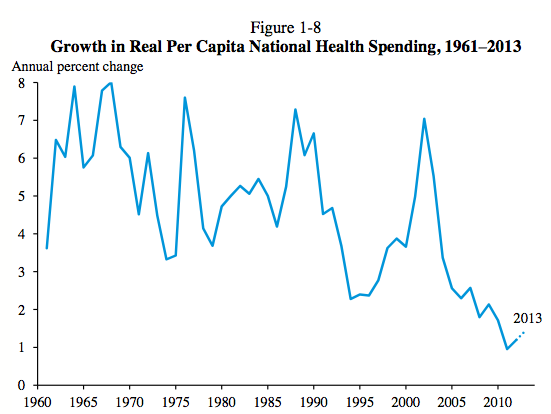
The deficit has come down at a rapid pace, without tipping us back into recession. And a key indicator of future debt – the cost of healthcare – is looking much better than it once did (although the causes for it remain disputed):

Screen Shot 2014-03-10 at 7.49.08 PM

Then this amazing chart:

Screen Shot 2014-03-10 at 7.35.11 PM

If someone had suggested to me in 2009 that by 2014, after the worst recession since the 1930s and after the huge debt pile-up in the Bush years that the US would be growing steadily, gaining energy independence, and cutting its deficit deeply, I’d have been amazed. We’ve so easily forgotten the extraordinary crisis Obama inherited. We shouldn’t. This presidency was always going to be judged on whether it could return the US to normal governance after the economic calamity of 2007, and after the disastrous wars that were far from over. I fail to see how Obama has failed in any critical respect. Not that it gets him much praise these days. For that we may have to wait for history’s judgment.

Today, I responded to Rod Dreher’s newfound victimhood; and I touted Rand Paul’s exclusive advantage among the GOP primary potentials: his appeal to Millennials. Palin earned a Hathos Red Alert; and we aired the concept of sub-atomic free will from a splendid essay by David Graeber. The window view made me want to visit France. Then two photographs: one pixellated, one GiFed. Check them both out.

The most popular post of the day was Hathos Red Alert; followed by The Christianist Closet?

See you in the morning.

Ebert On Addiction

Ted Pillow admires the late critic not just for his movie reviews, but for his often piercing insights into the nature of addiction (in 2009, Ebert revealed that he was a recovering alcoholic). Pillow has assembled “The Unofficial Roger Ebert Reader On Addiction,” pieced together from reviews and blog posts. One snippet:

The story of every drunk or addict is different in the details but similar in the outlines: Their days revolve around finding and using a sufficient supply of their substance of choice to avoid acute mental and physical discomfort. Eventually it gets to the point where everything else—job, family, self-image—is secondary. They all feel the need for something … the natural sources of pleasure have been replaced with higher-octane substitutes, which have burnt out the ability to feel joy. Going through the motions of what once gave them escape, they feel curiously trapped.

Another:

Why do alcoholics begin down the same hazardous road day after day? Any alcoholic knows that life is not all bad, that there comes a moment between the morning’s hangover and the night’s oblivion when things are balanced very nicely, and the sun slants in through the bar windows, and there’s a good song on the jukebox, and the customers might even start dancing. Each day is a window that opens briefly after the hangover and before the blackout, and you can never tell what you’ll see through that window. The alcoholic’s day consists of trying to keep that window open.

More here. Tons of Dish on addiction here.

An Ethics Lesson

A reader shares a story similar to the Seattle vice-principal who was fired from his Catholic high school for marrying his husband:

Although I’ve been advocating change in the Catholic Church towards the LGBT community for decades now, the news that Pope Francis seems to be open to civil unions has left me sad. Let me explain why.

In May 2006, two weeks before final exams, I was abruptly fired from my position as an ethics teacher at a major Catholic high school in a Southwestern state for being gay. The termination was performed in a way that was a public shaming before my students and the rest of the faculty. I had been at the institution for six good years – ones in which I distinguished myself by creating numerous new courses and campus organizations while being an active published scholar (I hold a Ph.D) – when the school principal learned I was gay.

Because I had been working without pause of any kind and needed to develop a love life (I was single), my best friend said it was time for me to settle down and take care of myself. He suggested that I create a profile on MySpace (Facebook was then in its infancy), and in a meek, very G-rated way, I mentioned on it that I was interested in having a relationship. Since the principal had recently not only permitted, but endorsed, such teacher infractions of the morality clause such as marrying after having been divorced and pregnancy by means of in vitro fertilization, I naturally felt that having a boyfriend in my own private life would be allowed as well. But as it turned out I was dead wrong.

After calling me into his office with the vice principals in tow, I was immediately discharged. One of the vice-principals and the football coach were instructed to personally escort me as I gathered and carried my classroom materials to my jeep. When I pressed the headmaster as to the reason of my firing, all he would say is, “You know why, you know why.” No amount of pleading could induce him (or any of the school administrators) to speak further on the matter. Moreover I could not appeal this termination to a review board or the bishop. By this time I was openly weeping and stammering “Why?” As all of this was going on, students stood around wondering, some of them crying. The last student who saw me that fateful afternoon asked, “What’s going to happen to you?”

(Incidentally that particular student was one of two or three kids at the school starting to come out of the closet. The following year the principal physically segregated them away from the heterosexual students by making them take them lunch in the campus ministry room.)

There are no words for how shattered I was, and still am. Almost at once I lost my ability to sleep. I was so anxious that I was only got two or hours of sleep a week. No exaggeration. Meanwhile, the students rallied behind me (for which I am deeply grateful), but the attorneys I consulted told me that there was nothing legally I could do. Soon the story made the local, then the national, then the international media. A powerful member of the school’s Board of Directors went out of her way to approach me in order to offer me a job in her large organization. Yet as soon as she found out I couldn’t sue the diocese, she quietly dropped her invitation by keeping herself “unavailable” or “in meetings” whenever I tried to follow up. I continued to endure debilitating chronic insomnia. Then, in time, something worse happened: my immune system broken down.

On Halloween morning 2008, I woke up to what seemed the worst flu of my life. I later discovered it was Epstein-Barr. Just getting out of bed was all I could I do, much less having to go about life. The fatigue was indescribable. That illness, alas, had a domino effect: my previous two-year “fight or flight” condition caused me to have a terrible hormone imbalance, but even that was still nothing. This was because I developed acute burning in my body while simultaneously feeling my skin starting to go numb. I learned a new word: neuropathy. Other mysterious symptoms (such as crippling gastrointestinal pain) lead me first to over 20 doctors and specialists, and afterwards to the Mayo Clinic in Scottsdale. Along the way I had 9 MRIs, 2 Cat Scans, and 1 spinal tap. After many years, my diagnosis was finally in: extreme anxiety.

Through it all I have amassed tens of thousands of dollars of medical bills, and will almost certainly declare bankruptcy. As an adjunct professor, I am making only $12 an hour even though I am teaching the maximum load. I’ve long stopped making student loans payments. To get through life I do Mindfulness Meditation, but am also on 3 anti-anxiety/anti-depression medications. And I still have that initial symptom, insomnia. Though I have never once experimented with drugs (not even marijuana), I am contemplating trying ayahausca to see if I am able to put my life back together.

Pope Francis’ musings about permitting gays and lesbians to have a life which includes personal love and shared commitment have, alas, come too late to help me.

Looking East From Ukraine

The despots of Central Asia have two reasons to be nervous:

On the one hand, the success of the Euromaidan protests in driving Ukrainian leader Viktor Yanukovych from power obviously raises concerns amongst central Asia’s ruling elite regarding the sustainability of their hold on power.  When they first saw a popular protest movement lead to the removal of Eduard Shevardnadze in 2004’s Georgian Rose Revolution, popular protest movements quickly spread across Eurasia and fueled similar regime changes in Ukraine and Kyrgyzstan. Perhaps fearing a similar “viral” effect of Yanukovych’s ouster regionally, the regimes have sought to control information on the situation. …

On the other hand, central Asian leaders also must be watching recent events in Crimea with an eye toward the potential actions of Russia in its “near abroad.”

Although none of the central Asian states could be characterized as solidly anti-Russian, they all have reasons to exert their independence from Russia.  In this context, one must assume that recent events have transformed the “Ukrainian question” into the “Crimean question” for the central Asian leaders.

Meanwhile, Dan Twining considers the lessons for leaders in the Far East:

First, economic interdependence is no safeguard against military conflict. Europe is Russia’s largest trading partner and the primary market for Russia’s energy exports, which provide 50 percent of government revenue. Moscow craves a trade and investment agreement with the United States. These facts have not deterred Russia from invading Crimea — just as Japan-China interdependence has not moderated Chinese revisionism in the Senkaku Islands.

Second, autocracies overestimate their power and leverage, while democracies underestimate theirs. Russia is a declining power with horrific social indicators kept afloat by oil and gas revenue. Its “allies” — Belarus, Kazakhstan, and Armenia — do not form the coalition of the future. China has much more going for it. But the hype around its rise has inflated Beijing’s sense of itself, while diminishing Western and Japanese confidence. Yet the big democracies have far more internal political resilience than China’s regime, whose greatest fear is of its own people.

The Christianist Closet?

Screen Shot 2014-03-10 at 1.30.08 PM

In an angry rant, Dreher accuses me of being “smug and naive” when talking about the crosses that marriage equality opponents have to bear under the “new McCarthyism”:

It’s very, very easy for the self-employed Andrew, who is on the power-holding side of this cultural equation, to demean as “delicate and insensitive” people who face real and significant professional consequences for their religious dissent.

What I find so fascinating about Rod’s deployment of the “you’re too privileged to have a say” argument is that it’s exactly the same debating point once leveled at me by gay leftists. When I basically told gay people to stop thinking of themselves as victims and start thinking of themselves as equal citizens – one part of the case for putting military service and the right to marry at the forefront of the movement – there were howls of derision. But I remain convinced that the only way to escape the victim-trap was to transcend it. And that’s really my advice to Christianists: Get over yourselves and get on with your lives. Rod claims I am blind to terrible discrimination:

Sullivan’s complaint is disingenuous. I hear all the time from religious conservatives in various fields — in particular media and academia — who are afraid to disclose their own beliefs about same-sex marriage because most people within those fields consider opposition to SSM to be driven solely by hatred.

Earlier this year, I had a conversation with a man who is probably the most accomplished and credentialed legal scholar I’ve ever met, someone who is part of this country’s law elite. The fact that I can’t identify him here, or get into specifics of what he told me, indicates something important about the climate within law circles around this issue. On this issue, he lives in the closet, so to speak, within his professional circles, and explained to me why it has become too dangerous to take a traditionalist stand in law circles, unless one is prepared to sabotage one’s career.

Hand me the world’s tiniest violin. If someone is fired for his religious beliefs, he can sue (which is more than can be said for gay people fired for their orientation in many states). The rest is truly spectacular whining. There are always going to be social pressures that favor or disfavor certain views. What about a gun control enthusiast in rural Texas? Or a pro-choicer in Mississippi?

In a polarized polity, this may get worse for both sides. My view – and I don’t see how Rod can have ignored it – is maximal respect for sincerely held opinions. Just as many conservatives over the years have politely acknowledged without endorsing my marriage, so I politely acknowledge the convictions of Christianists, and seek dialogue with them. That’s how I’d like this to shake out. Only recently, for example, I defended Erick Erickson’s point in this debate. And insofar as there is gay intolerance or fanaticism, I oppose it as strongly now as I always have (including opposing outing).

But the hysteria and self-pity among those who, for centuries, enjoyed widespread endorsement for the horrible mistreatment of gay people really is too much. The victimology that was born on the left is now alive and whining on the right. It’s a self-defeating position and a thoroughly unattractive one. In the end, one begins to wonder about the strength of these people’s religious convictions if they are so afraid to voice them, and need the state to reinforce them. Which is one more reason why the decline of Christianism makes the rebirth of Christianity a more exciting prospect. Liberated from the state and social support, Christians may have to become what they once were: outsiders, prophets, the salt of the earth.

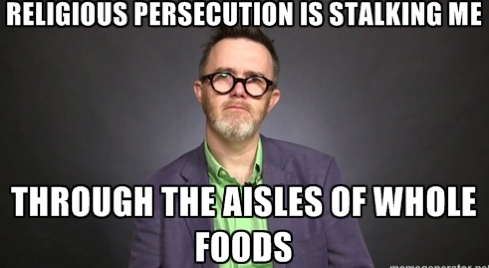
(Illustration: Memegenerator)

Hawking Points

Condoleezza Rice pushes for a tough response to Russia over Ukraine:

The immediate concern must be to show Russia that further moves will not be tolerated and that Ukraine’s territorial integrity is sacrosanct. Diplomatic isolation, asset freezes and travel bans against oligarchs are appropriate. The announcement of air defense exercises with the Baltic states and the movement of a U.S. destroyer to the Black Sea bolster our allies, as does economic help for Ukraine’s embattled leaders, who must put aside their internal divisions and govern their country. …

The events in Ukraine should be a wake-up call to those on both sides of the aisle who believe that the United States should eschew the responsibilities of leadership. If it is not heeded, dictators and extremists across the globe will be emboldened.

Responding to Rice, Larison tears up this notion that American inaction emboldens our rivals:

What Rice et al. perceive as “inaction” in Syria, Russia and Iran likely perceive as ongoing interference and hostility to their interests. The crisis in Ukraine also looks very different to Moscow than it does to the Westerners that have been agitating for an even larger and more active U.S. role.

Western hawks were frustrated by how slow their governments were to throw their full support behind the protesters, and as usual wanted the U.S. and EU to take a much more adversarial and combative approach with Russia because they see Western governments as being far more passive than they want. However, Moscow doesn’t perceive the U.S. role in Ukraine to be a limited or benign one, and the toppling of Yanukovych has been fitted into their view that the protests were a Western-backed plot from the beginning. The idea that Russia would have responded less aggressively to the change in government if the U.S. had been giving the opposition even more encouragement and support is dangerously delusional, but that is what one has to believe in order to argue that the U.S. “emboldened” Moscow in Ukraine.

Drum also doubts Putin was encouraged by American weakness:

Putin didn’t invade Crimea because the decadent West was aimlessly sunning itself on a warm beach somewhere. He invaded Crimea because America and the EU had been vigorously promoting their interests in a country with deep historical ties to Russia. He invaded because his hand-picked Ukrainian prime minister was losing, and the West was winning. He invaded because he felt that he had been outplayed by an aggressive geopolitical opponent and had run out of other options.

None of this justifies Putin’s actions. But to suggest that he was motivated by weakness in US foreign policy is flatly crazy.

Amid the saber-rattling, Adam Gopnik emphasizes the importance of preventing a war:

[W]e should be doing what sane states should always be doing: searching for the most plausible war-avoiding, nonviolent arrangement, even at the cost of looking wishy-washy. … The parallel with the failure of appeasement in the thirties is false, because that circumstance was so particular to its moment. The underlying truth then was that there was no point in appeasing Hitler because there was no possibility of appeasing him. The German Army was the most powerful force in Europe, indeed, in the world, and Hitler had long before decided on a general European war. He wanted one, and for him it was only a question, at best, of delaying it until his odds were marginally better. If Putin wants a general European war, we will know it when he invades a NATO nation. There is no shortage of real trip wires in the region, and no need to discover new ones.

Paul Miller pans the flawed approaches of both the liberal internationalists and the Cold Warriors, and suggests a third way:

The middle course would acknowledge that there are limits to what America can achieve: It cannot stop Russia from believing Crimea is vitally important to Russian security, and it cannot fight a cost-effective war with a nuclear power. The United States should realistically accept some form of Russian presence or influence in the peninsula and not turn this into a litmus test of American credibility.

At the same time, the United States should ask what is right for the Ukrainians, not just for Americans. It should not cynically abandon all Ukraine to Russia’s despotism. That may mean sustaining a large flow of aid to democratic dissidents in a Russian-dominated Ukraine, strengthening U.S. security assurances to the government if it manages to keep Russia at bay, or even bringing Ukraine fully into the orbit of Western institutions while letting Crimea secede or join the Russian Federation.

My take on the hawks’ position is here. Previous Dish on the US response to the Ukraine crisis herehere, and here.

How Much Should We Fear Fascists In Ukraine?

Moynihan rips into Putin’s defenders in the Western press:

Let’s acknowledge that ideologues rarely exist without a certain degree of hypocrisy. But when Viktor Yanukovych’s goon squads were unleashed on protesters in Kiev, wielding truncheons and firing bursts from Kalashnikovs, it was nevertheless disconcerting to see Ukrainian anti-government protesters–of varied political backgrounds and issuing varied demands–blithely dismissed by a significant number of Western journalists as fascists and neo-Nazis, if not stooges of the United States government. Indeed, it all sounded too much like the Soviet reaction to the 1956 Hungarian uprising, when Moscow claimed to have narrowly avoided “the threat of a fascist dictatorship” (which was, of course, precipitated by American interference) by the dispatch of a benevolent invading military force. And like 1956, one didn’t have to look to far to find–from both the fringe left and right, and many ironically self-identifying as anti-imperialist–those ready to “contextualize” the violence visited upon protesters and justifying the arrival of Russian troops on Ukrainian soil.

Remnick provides a reality check:

It is worth remembering that, in the back-and-forth of Ukrainian governments since 1991, both the pro-Russian leaders, like Viktor Yanukovych, and the pro-Europeans, like Yulia Tymoshenko, have been brazen thieves, enriching themselves at fantastical rates. Both sides have played one half of the country against the other. And the fact that the protests in Kiev were not, as Moscow claims, dominated by fascists and ultra-nationalists does not mean that such elements are absent from the scene.

Ukraine has yet to develop the politicians that its fragile condition and its dire economy demand. In December, when John McCain spoke to demonstrators in Kiev’s Independence Square, he stood side by side with Oleh Tyahnybok, who was once expelled from his parliamentary faction after demanding battle with “the Muscovite-Jewish mafia.” Perhaps this was bad advance work from team McCain—much like the advance work on the Sarah Palin nomination—but it did manage to fuel Moscow’s bonfire of suspicion.

Oleg Shynkarenko recently profiled Pravy Sektor (Right Sector), the far-right group – led by Dmitro Yarosh, seen in the above video – that allegedly threw the first molotovs at EuroMaidan:

The Right Sector trumpets the ideology of Ukrainian nationalism, which reaches its zenith in the Ukrainian Insurgent Army, which in its heyday was lead by [Stepan] Bandera. (He was assassinated by a KGB agent in Munich in 1959.) From 1942 to 1954, the group acted fought against the German and Soviet Armies. Now, its descendent organizations are dedicated to advancing the 20th-century throwback notion of the primacy of the nation-state. Their rhetoric may sound utopian (or dystopian), but it’s actually quite archaic. “If non-Ukrainians understand Ukrainians’ urge towards their nation, and are disposed to it and help in struggle, we are disposed to them too; if they are neutral and don’t prevent us in our struggle, we are neutral to them, too; if they object our right to be a nation-state and work against us, we are hostile to them,” Bandera once said.

But Jamie Dettmer isn’t too worried about the group:

The Kremlin has made much of the vanguard combatant role Right Sector and others of the far-right ilk played in the street battles that raged in Independence Square against Yanukovych’s feared berkut (riot police). And the Western media, when not covering the standoff in Crimea, has been drawn to the ideological menace of Ukraine’s far right and to the swaggering Right Sector fighters and their SS iconography in Kyiv’s Independence Square.

But opposition politician and rights campaigner Lesya Orobets says that while the Right Sector’s part in the ousting of Yanukovych shouldn’t be underestimated, its importance in the country’s future politics shouldn’t be overestimated. “They were a small element in the revolution, although significant, and they were brave enough to do what others wouldn’t,” she says. “But I don’t see much room for their radicalism now in democratic politics. Ukrainians are tolerant. Right Sector will have some small support if it develops as a political party, maybe five to seven percent of the vote. I don’t see a big political future for them.”

Rand Paul, The GOP, And The Young, Ctd

W. James Antle III summarizes the libertarian’s foreign policy approach:

Rather than get into a shouting match with more hawkish Republicans over Russia—though he has condemned Vladimir Putin as often as he has tweaked the thinly-veiled Cold War nostalgia masquerading as foreign-policy thought in some corners of the right—he is making his case from a strong, limited-government conservative perspective.

What Paul has been saying ever since he filibustered John Brennan’s CIA nomination over drones is that the Lindsey Graham view of foreign policy—a permanent war in which the American homeland is a battlefield—is incompatible with constitutionally limited government. You can have a national-security state of that scope or you can have the Bill of Rights, but you can’t have both.

It’s a powerful way of forcing Republicans – and all of us – to confront the core trade-offs in a constantly evolving war on terror. And it compares, starkly, with Marco Rubio’s retread of neconservatism on steroids. It’s a possibly shrewd bet in a crowded field, but it still feels like Rubio is trying to impress Bob Kagan and Bill Kristol and all the other boomers stuck in the 1970s. Pareene nails it:

Take a look at [Rubio’s] handy list of things “Obama must do” about Ukraine, which includes expanding NATO to Georgia and also stating “unequivocally” that Putin is a mean jerk.

(When Tough, Muscular Foreign Policy types think calling for actual war won’t be received well, they usually fall back on demanding that the president say Tough things unequivocally.) Now he’s at CPAC, telling people that North Korea will nuke California as Iran is nuking New York as we wage a global struggle against China and Russia and “totalitarianism.” Sounds like fun!

If this is what the Marco Rubio comeback is going to look like, I’m not convinced it’s a wise strategy. Republicans may be obsessed with the image of our “weak” president “folding” before “tough” Vladimir Putin, but Americans in general are not hugely interested in picking fights with other countries at the moment.

Larison is unimpressed with the argument that Rubio is going to have some kind of broad appeal like Bush II did. Meanwhile, Matt Lewis looks at how Cruz is positioning himself:

Cruz is making a bet that Paul’s more libertarian positions on issues like non-interventionism aren’t a mainstream opinion. So he will set up shop just on the other side of Paul. Anyone who says, “I really like Paul’s position, but I think we need to stand up to Russia,” now has a home. Or the guy who says, “I hate drones, but I don’t want Iran to go nuclear,” has a candidate.

Whoever wins this foreign policy debate may be extraordinarily important for the future of the United States in the world.