How Good Are Jeb’s Chances?

by Dish Staff

How Conservative

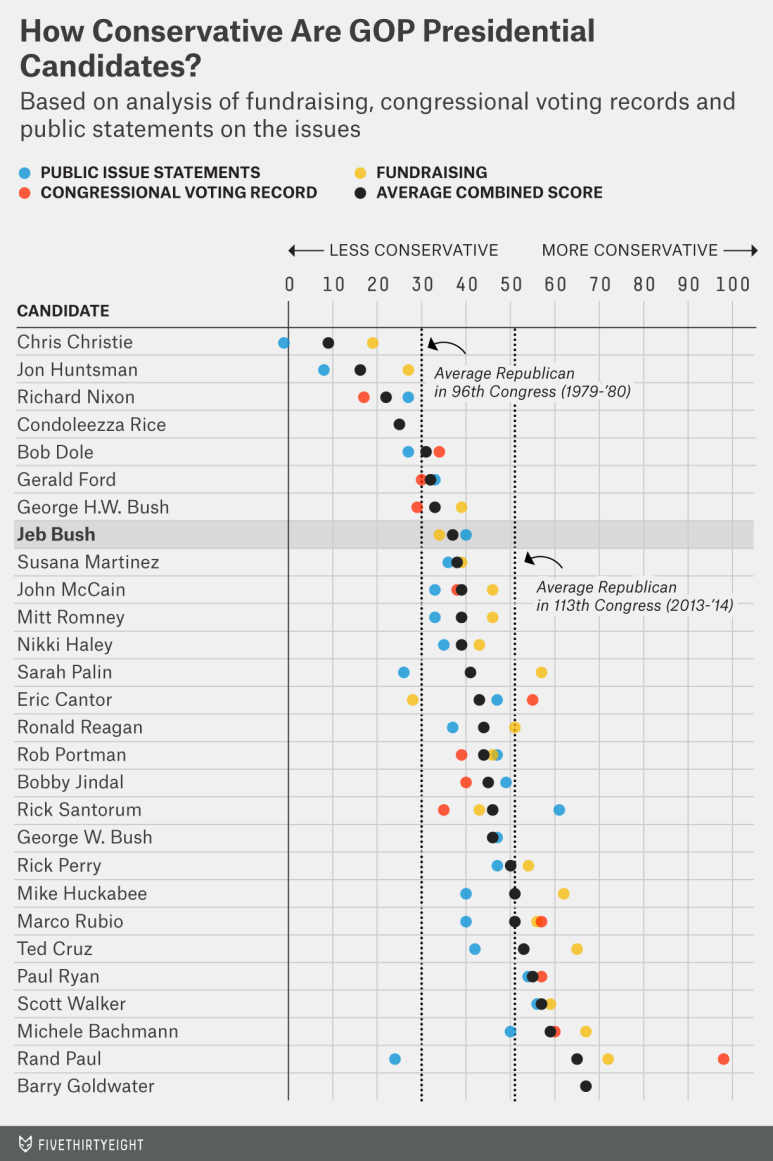
Nate Silver and his team created “ideological scores for a set of plausible 2016 Republican candidates based on a combination of three statistical indices: DW-Nominate scores (which are based on a candidate’s voting record in Congress), CFscores (based on who donates to a candidate) and OnTheIssues.org scores (based on public statements made by the candidate)”:

Bush scores at a 37 on this scale, similar to Romney and McCain, each of whom scored a 39. He’s much more conservative than Huntsman, who rates at a 17.

Still, Bush is more like his father, George H.W. Bush, who rates as a 33, than his brother George W. Bush, who scores a 46. And the Republican Party has moved to the right since both Poppy and Dubya were elected. The average Republican member in the 2013-14 Congress rated a 51 on this scale, more in line with potential candidates Marco Rubio, Paul Ryan and Mike Huckabee.

So as a rough cut, Bush is not especially moderate by the standard of recent GOP nominees. But the gap has nevertheless widened between Bush and the rest of his party.

The odds Silver gives Jeb:

Betting markets put Bush’s chances of winning the Republican nomination at 20 percent to 25 percent, which seems as reasonable an estimate as any. You can get there by assuming there’s a 50 percent chance that he survives the “invisible primary” and the early-voting states intact and a 40 percent to 50 percent chance that he wins the nomination if he does. It’s a strategy that worked well enough for McCain and Romney.

But Larison argues that “some of the things that have previously been identified as Bush’s ‘strengths’ may no longer be advantages”:

Many conservatives have less patience with Bush’s corporate “centrism” now than there was ten years ago. He may not have a “Mitt Romney problem,” but he has the problem of being corporate America’s favorite candidate. The politics of immigration today is more treacherous for pro-immigration Republicans. Brian Beutler may be overstating the case when he says that Obama’s executive action on immigration has doomed Bush from the start, but he isn’t wrong that being seen as a pro-amnesty politician is a bigger problem for Bush now than it would have been just a few years ago.

Bush is often lauded for his interest in education reform, but this may end up being a serious weakness in a Republican nomination fight.

On that front, Yglesias doubts the Common Core matters:

The thought that the Common Core, of all things, would somehow derail a presidential campaign is a little odd. Federal education policy is a second-tier issue, and as Nate Silver has shown there’s no clear partisan tilt on the Common Core issue among the mass public. Lots of ordinary parents find the Common Core to be somewhat bizarre, but it’s well-supported among education experts.

And, crucially, Jeb is not some kind of ideological heretic on education policy issues. Within the relatively small world of conservative education specialists, he’s extremely well-liked. If party leaders decide that a charge against the Common Core is their #1 goal for 2017, then obviously Jeb is out of luck. But that would be a very weird thing to decide.

Robby Soave disagrees:

It’s true that Mitt Romney managed to win the nomination despite having an unpalatable former position on his election’s pivotal issue—Obamacare. But Romney managed to hedge his previous support for the program by insisting that he never would have taken it to the federal level. Bush, on the other hand, isn’t hedging his Common Core support one iota. He remains the most high-profile supporter of national education standards on the right.

Anyone who expects rank-and-file conservatives to overlook the issue is underestimating the extent of anti-Common Core sentiment among the electorate.

First Read notes that Jeb isn’t particularly popular:

According to our poll, just 31% of all voters say they could see themselves supporting him for president, while 57% say they can’t. He’s more popular among Republicans (55% support, 34% can’t support), which is the second-best GOP score in the poll behind Mitt Romney (see at the bottom). But he fares worse among Democrats (9%-79%) and, more importantly, independents (34%-52%). These numbers follow our Nov. 2014 NBC/WSJ poll, which found Bush’s fav/unfav rating at a net-negative 26%-33%. Of course, this is all subject to change. We could see how Bush — if he runs and bests his GOP competition — could improve his numbers among Republicans and some independents. Nothing can change polling numbers like success. But right now, he’s not Mr. Popular (in large part, we think, because of his last name). And it’s going to take time for him to become Jeb and not a Bush.

Francis Wilkinson asserts that “Bush appears to be demanding that the party now change to suit him”:

Unlike Christie and Romney, two guys who talk tough but shrink from confrontation with the party base, Bush seems determined to run as someone who really does call it as he sees it. It’s an admirable stance and perhaps Bush is sufficiently authentic that it’s the only one possible for him. Call it the audacity of hope. For there is no evidence that his party is eager for anything like straight talk.

Along the same lines, Nate Cohn is unsure the GOP establishment will get its way:

If top G.O.P. donors are indeed choosing between Mr. Bush, Mr. Christie and Mr. Romney, they might not have a better option than Mr. Bush.

But Mr. Bush is not a particularly strong candidate either. He may have friends in the donor class, but he hasn’t run for office in a decade, and he enters with no base of support among the G.O.P. primary electorate. He may not be lucky enough to face an opponent as flawed as Mr. Santorum or Mr. Huckabee. This year’s Republican candidates have the potential to be far stronger than in recent cycles, and if one builds momentum, the establishment’s early, anointed pick might not be able to stop him.
Niebuhr On Race In America

by Dish Staff

US-CRIME-POLICE-RACE-UNREST

The evangelical ethicist David Gushee pulled down Reinhold Niebuhr’s early masterpiece, Moral Man and Immoral Society, from his shelf, re-reading it with Michael Brown and Eric Garner in mind. Some background:

Written to pierce any surviving liberal optimism as the Roaring ’20s gave way to the disastrous ’30s, Niebuhr’s primary thesis concerns the effects of sin on human society and, in particular, on human collectivities or groups. Niebuhr says that all human life is marked by sin, especially in the forms of ignorance and selfishness, but at least the individual sometimes demonstrates the potential to rise above ignorance and selfishness to reach rational analysis and unselfish concern for others. Human groups, on the other hand, are both more stupid and more selfish than individuals. They seem especially impervious either to rational or moral appeal, easily prone to self-deception and demagoguery, and apparently needful of the imposition of a power greater than their own power if they are to accede to any changes that cut against their own self-interest.

Though the book focuses on economics, Gushee highlights Niebuhr’s telling comments on race: 

Niebuhr writes: “It is hopeless for the Negro to expect complete emancipation from the menial social and economic position into which the white man has forced him, merely be trusting in the moral sense of the white race.” That’s because, as Niebuhr writes throughout, groups which benefit from the existing structure of society have no particular interest in seeing that structure changed.

Moreover, privileged groups have an extraordinary ability to “identif[y] [their] interests with the peace and order of society.” Self-deception reigns among the privileged because, among other reasons, to see reality more truly would place an unbearable moral pressure on such groups to resign privilege in favor of greater justice. Instead, privileged groups call in the forces of state power in the purported interests of the “peace and order” of society as a whole, but in fact to suppress movements of the oppressed for social change and greater justice.

Knowing that only forceful resistance to white privilege has any hope of changing the existing structures of power, Niebuhr ponders whether that pressure will be more effective if it is violent or if it is nonviolent. Niebuhr refuses to draw an absolute distinction between these forms of pressure. He does conclude that “non-violence is a particularly strategic instrument for an oppressed group which is hopelessly in the minority and has no possibility of developing sufficient power to set against its oppressors. The emancipation of the Negro race in America probably waits upon the adequate development of this kind of social and political strategy.”

The Dish recently featured Gushee’s groundbreaking speech on the full inclusion of gay Christians in the Church here.

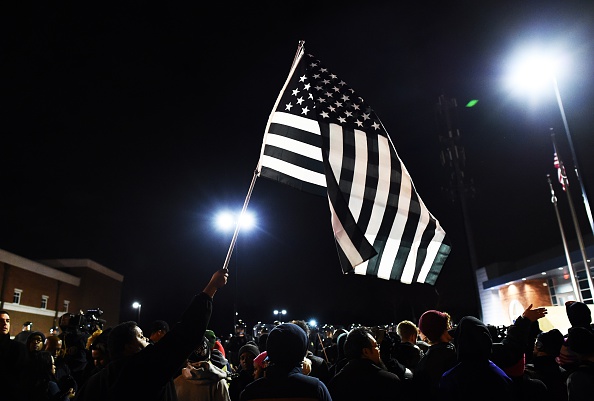
(Photo: A protester waves a “black and white” modified US flag during a march following the grand jury decision in the death of 18-year-old Michael Brown in Ferguson, Missouri, on November 24, 2014. By Jewel Samad/AFP/Getty Images)

Abe Stays On

by Dish Staff

Michael Auslin takes a broad look at the economic implications of Japanese Prime Minister Shinzo Abe’s recent win:

[T]he question now is how far Abe will push the long-awaited structural reforms that he has promised will revitalize the economy and boost wages. There is no longer any excuse for delay, as Abe has another four years ahead of him and no significant opposition standing in his way. A failure to boldly tackle the most difficult reforms, such as in the agricultural sector or in the labor market, not to mention the Trans-Pacific Partnership free trade agreement, will seem doubly damning given Abe’s parliamentary strength. The only reason he doesn’t charge full-steam ahead at this point would be that, deep down, he is not really committed to changing Japan, Inc. That would be a missed opportunity of historic proportions.

Bloomberg View’s editors hope that Abe follows through:

Even Japan’s weak opposition parties more or less acknowledge the good that the first two “arrows” in Abe’s program — massive monetary easing and fiscal stimulus — have done. The Bank of Japan’s bond-buying has driven down the yen 30 percent against the dollar and filled the coffers of companies with global earnings. The unemployment rate is remarkably low; the stock market is rising. Nor is there much quibbling about the direction of Abe’s third arrow — structural changes aimed at improving Japan’s competitiveness.

But it’s not clear that the third arrow will hit its mark:

Tweaks — taxing corporations that sit on their cash rather than investing it or raising wages, for instance — might help around the margins. But the real problem is that for all his energy and verve, Abe has not fundamentally altered the status quo in Tokyo.

Japan’s entrenched bureaucracy waters down reforms almost instinctively. That means small changes are all but certain to be whittled to nothing. Abe’s first two arrows succeeded in part because of their size and shock value: They were designed to change expectations radically, and for a time they did. Abe needs another big bang — something much more than a $25 billion stimulus package.

Back in November, John Cassidy spelled out why he supports Abe:

There’s no convincing reason why a country that is as advanced, well-educated, and hard-working as Japan should remain stuck in an economic rut for decades on end—even if it has run up a great deal of debt. Viable policy options exist to confront deflation, to effect a permanent exit from the liquidity trap, and to get the country growing again, sustainably. These policies aren’t easy to market or enact, but, after years of being saddled with pedestrian leadership, Japan has finally found a Prime Minister, in Abe, who is willing to take some of the necessary measures and confront the people who oppose them.

Be that as it may, Joel Kotkin argues that “it is increasingly clear that the epicenter of Japan’s crisis is not its Parliament, or the factory floor, but in the bedroom”:

 Japan has been on a procreation holiday for almost a generation now, with one of the lowest fertility rates on the planet. The damage may prove impossible to overcome. Japan’s working-age population (15-64) peaked in 1995, while the United States’ has grown 21% since then. The projections for Japan are alarming: its working-age population will drop from 79 million today to less than 52 million in 2050, according to the Stanford Institute on Longevity.

Uber, But For The Proletariat

by Will Wilkinson

Uber Graphic

There’s something about Uber, the popular ride-sharing service, that brings out the nutty in people. During the awful hostage situation yesterday in downtown Sydney, the volume of people trying to get out of Dodge by beckoning an Uber car kicked the app’s surge pricing into effect. This is most sensible. You see, the increase in demand (and no doubt the dangerous conditions) had reduced the supply of available drivers, leaving many of those desiring a car without one. Surge pricing sweetens the deal for drivers, drawing idle supply into action, helping to ensure that those who want service can get it. This does not amount to the exploitation of a dire situation. It is the best way to ameliorate it. The alternative to temporarily higher prices is a total lack of cars, not a bunch of open cars at normal non-surge pricing. This ought to be obvious, but apparently it is not, and there was an instant backlash to the implementation of surge pricing. Olivia Nuzzi of the Daily Beast gets it exactly right:

Uber’s surges are not price gouging, as some have erroneously claimed. Uber––which is actually not the only method of transportation on Earth, despite what it may seem like––warns passengers about the surge before it allows them to order a car, and if the surge is over two times the normal rate, the app forces users to type it in, just to make sure they really understand what they are getting themselves into.

As the Sydney hostage crisis unfolded, Uber customers and observers alike took to Twitter to complain about the sky-high fares, calling the policy “Marxian” and “downright predatory.”

Gawker sneered that Uber is “Ayn Rand’s favorite car service.”

Uber responded to the PR nightmare by reversing the surge, refunding those affected, and doling out free rides. They shouldn’t have. There is plenty to chastise Uber for––I am a frequent and enthusiastic critic of the company’s inadequate background check process––but price surging is not among its sins. […]

How does the world owe you a private car, priced as you deem acceptable, that didn’t exist five years ago? If you don’t like Uber’s surge pricing, you are still welcome to travel by subway, cab, bus, camel, horse and carriage, or you can just fucking walk. If none of those options appeal to you, you might consider meandering over to a country with a different economic system.

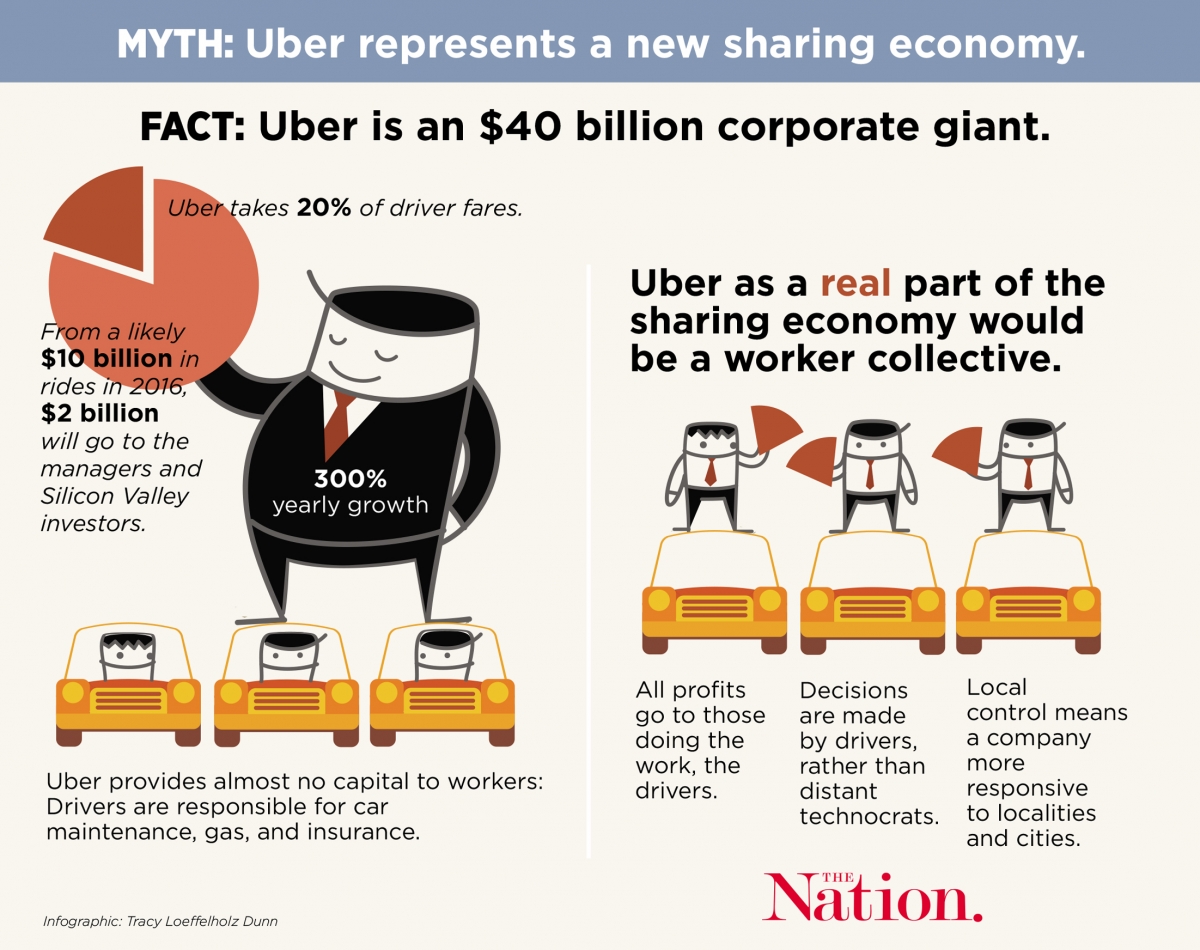
Or… Or… transform this country’s economic system and socialize Uber! That’s the entertaining proposal of Mike Konczal and Bryce Covert in The Nation:

[T]hink about what the capitalist managers at Uber are doing with their cut of the company’s money. They are fighting regulators and hiring lobbyists in order to bring down the incumbent taxi-medallion business. They are also spending money on advertising, in order to get customers interested in using a ride-sharing service. These are both expensive projects, and they open the door for competitors. Newer ride-share ventures can piggyback on Uber’s success and take advantage of these new terms, with Uber having already spent all that initial money. This is called the “second-mover advantage,” and it explains why Uber is such a vicious company.

But after this initial project, what exactly are the capitalists at Uber contributing to the company? Almost all of the actual capital is already owned by the workers, in the form of cars that they pay for and maintain themselves. And these workers labor individually, doing the same tasks, so there’s no need for a management class to control their daily operations. The capital owners maintain the phone app, but app technology isn’t the major cost, and it’s getting cheaper and easier by the day.

Given that the workers already own all the capital in the form of their cars, why aren’t they collecting all the profits? Worker cooperatives are difficult to start when there’s massive capital needed up front, or when it’s necessary to coordinate a lot of different types of workers. But, as we’ve already shown, that’s not the case with Uber. In fact, if any set of companies deserves to have its rentiers euthanized, it’s those of the “sharing economy,” in which management relies heavily on the individual ownership of capital, providing only coordination and branding.

There’s perhaps a problem or two with this proposal. “It takes an entrepreneur to start up ride-sharing,” Konczal and Covert write, “but not to run it as a firm. A worker collective is the obvious transition.” A system in which entrepreneurship is routinely rewarded with a forced “transition” to a worker collective is a system that is unlikely to continue to producing a valuable of entrepreneurial innovation.

But I really do like the idea of the drivers getting a bigger share of the profits. If it’s true, as they say, that “Newer ride-share ventures can piggyback on Uber’s success and take advantage of these new terms,” then it seems that Uber and Lyft drivers ought to be able to organize, finance the creation of a new app (no big deal, it would seem), and then dominate the market by charging less than those awful, useless, Silicon Valley tech-bro rentiers, all the while getting paid more. Why go through the tumult of trying to socialize Uber when a worker collective would so clearly out-compete Uber? Or maybe it’s not so clear that it would. Maybe organizing drivers, developing, maintaining, and continuously improving an app, doing all the necessary marketing, and managing the whole system isn’t really such a breeze, and by the time you take into account all those costs, which worker-collective drivers would have to cover, they’d end up keeping something in the neighborhood of 80% of their fares, just like Uber drivers. That’s my hunch.

Still, a more worker-centric Uber seems like a neat idea, and the prospect of developing one from the ground up, no matter how unlikely it may be, seems a lot less unlikely than simply stealing Uber – at least here in the mad-dog capitalist Amerikkka. Maybe the government of a country less in the grip of neoliberal market fundamentalism will gently force Uber to transition to a worker collective. Actually, I hope that happens. It would be interesting to see how it works out.

A C-Section Gone Medieval

by Dish Staff

The victims of a brutal procedure are finally getting some justice:

Petrified and in agony, Mary had been subjected to a symphysiotomy – a controversial operation that was seldom used in the rest of Europe after the mid-20th century, but which was carried out on an estimated 1,500 women in Ireland between the 1940s and 1980s. The procedure involves slicing through the cartilage and ligaments of a pelvic joint (or in extreme cases, called pubiotomy, sawing through the bone of the pelvis itself) to widen it and allow a baby to be delivered unobstructed.

Critics blame the continued use of the operation on a toxic mix of medical experimentation, Catholic aversion to caesarean sections and an institutional disregard for women’s autonomy.

They claim it has left hundreds of surviving women with life-long pain, disability and emotional trauma. For some in Ireland, it is yet another scandal perpetrated against women and girls, joining revelations over the Magdalene laundries (where “wayward” women were abused), the deaths of children at mother-and-baby homes and sex abuse in the Catholic church.

Not everyone agrees with this analysis: some doctors and historians argue that these criticisms fail to account for wider changes in medical culture. But this year the mothers who believe they were wronged finally got some encouraging news. In July, the UN Human Rights Committee called for the Irish government to hold an investigation into the issue. And last week saw the deadline pass for applications to the state’s ex gratia redress scheme, which offered women who have been through the procedure compensation sums of between £40,000 and £120,000. More than 300 women are said to have applied.

Their supporters say the moves are not before time. Mark Kelly of the Irish Council for Civil Liberties says that, despite having interviewed victims of torture, “this remains just one of the most appalling things that we have come across”. Nigel Rodley, chair of the UN Human Rights Committee, called the use of the operation without patients’ informed consent a “systematic assault”.

Will Torture Return?

by Dish Staff

Frederick Schwarz Jr. fears so:

[B]y making the story narrowly about how torture didn’t work in these instances rather than that torture doesn’t work at all and, more fundamentally, that it should never be used by any White House because it is immoral and illegal––as well as harmful to America’s reputation and the safety of American captives––there is greater risk a future administration faced with peril will say: “Well, we can do it better.”

Itamar Mann compares America to Israel:

The endurance of forceful interrogation in Israel, even after the Israeli Supreme Court seemingly banned it, reflects an inability to abolish such methods.

This reality has been documented by several important Israeli human right organizations, chiefly the Public Committee Against Torture, who initially brought the 1999 case to court. The most important question about torture and other abusive interrogation is not whether it is “civilized” or not. It is what kind of political reality it makes possible, and what kind of political reality it preserves. In the Israeli context, this was and remains an intractable political reality of undemocratic military control over a civilian population.

Thirteen years after 9/11, leading legal academics decry America’s “forever war” (as Harold Koh called it). The perpetrators of torture remain immune from prosecution. And somewhat surprisingly, last week CIA director John Brennan refused to say that the agency will no longer engage in torture. All these reflect a similar inability to move forward. The future of torture in America is all but guaranteed.

Do We Trust Cops Too Much?

by Dish Staff

Police Confidence

Last week, Scott Clement flagged a poll finding that recent events “might have actually increased white Americans’ belief that their local cops treat blacks fairly”:

There’s been no such boon in confidence among African Americans, though. Just 12 percent express a great deal of confidence in local police’s equal treatment of blacks and whites — a number that is squarely within the 10-to-17-point range in previous surveys. Only one-third have at least a “fair amount” of confidence in their neighborhood police, compared with 78 percent of whites.

Josh Marshall thinks “people who are part of or sympathetic to the movement tied to Michael Brown, Eric Garner, Tamir Rice and others sometimes miss just what deep wells of support and trust police have in the population”:

Police officers are consistently among the most trusted professions in the country, as attested in numerous public opinion surveys. That said, respect and trust and deference to police is heavily tied to public perceptions of the threats they protect us from. And as we’ve discussed, crime rates have been falling rapidly for two decades.

After the Garner non-indictment, Damon Linker advocated against giving officers the benefit of the doubt:

How many bad apples are there? And which ones? We have no idea — and our asinine, knee-jerk deferral to the police, our unwillingness to hold them accountable before the law when they make a questionable call to use deadly force, ensures that we will never know. And it also ensures that the bad apples will receive the message that they have free rein to do whatever they want, with nearly complete impunity.

Until this changes, all of our lofty encomiums to individual liberty and limited government will amount to nothing but empty air.

The Case For Jeb (Or Hillary)

by Will Wilkinson

Former US president George Bush (2nd-L), his wife

So it looks like Jeb Bush is running for president. The prospect of a Bush vs. Clinton race in 2014 does not warm the cockles of any of my internal organs, but I want to put in a speculative word for presidential dynasties, despite the repugnance of that idea to my small-“r” republican ideals.

The president is the head of the executive branch of government. You took social studies, right? But, really, what does that mean? It means that the president is nominally in charge of the entire, vast bureaucracy of the American state, including the military and the various spy shops. I think it helps to try to maintain a distinction between the government and the state. Let’s say the government is made up of a constantly churning set of elected officials – the president and congress. (Not sure whether to put the courts in here or not, but no matter; this is just a rough-and-ready division.) The state is the more-or-less permanent administrative apparatus – all the many thousands of clock-punchers at the EPA and the FBI and Homeland Security and Commerce and Labor and State and the Pentagon and the NSA, etc. It’s what the chief executive is executive of, how he (or she!) executes, the way the government governs. It’s also way more than the executive can possibly keep tabs on.

Each president has a handful of political appointees in each agency, but either they come from outside and don’t really understand how things work, in which case they’ll more than likely be manipulated by the senior agency hacks, or they come from inside, in which case their loyalty is more likely to align with the agency’s internal powers-that-be than with the president. The chief executive has a thousand strings he can pull, but a lot of them aren’t actually connected to the various agencies’ real mechanisms of influence and power.

What we have here is a classic principal/agent problem. If you want the president to have effective power to govern via the bureaucracy, you’ll want him to be able to overcome some of the problem of bringing the agencies to heel. A big part of the problem is that agents almost necessarily have information their principals need but don’t have, and can use these asymmetries in information – can dole it out or withhold it or misrepresent it – to manipulate the principal into wanting what the agents wanted all along. Just think about how brazenly the CIA lies to congressional oversight committees. There’s no reason to think they don’t do it to presidents, too.

The most effective presidents, in terms of overcoming agency problems, will be those with strong preexisting networks within the bureaucracies willing to circumvent the de facto power structure and independently transmit reliable information straight to the White House. One reason I thought in 2008, and still think today, that Hillary Clinton would have been a more effective chief executive than Barack Obama is that a senator and insider wife of a two-term president is much more likely to have useful allies and contacts within the bureaucracy than a green, freshman senator new to town. And what’s even better than that? The son of a former CIA director, vice-president and president, who is also the brother of a two-term president. If Jeb Bush is worried that somebody in the CIA or State Department is dicking him around, there’s a good chance he knows a guy who knows a guy who is owed a big favor and can get him the straight scoop. And that’s power – the power by which the government renders the far-flung and opaque permanent state governable.

It may well be that the insider power of dynastic presidents amounts to a form of corruption, as our populist, republican instincts suggest. But it may also be that, given the vast scope of the modern state, presidents without this sort of power can’t really be said to be in charge. And the enormous, deadly, often malign power of the sprawling American security state makes it worth asking whether a decent president who isn’t really in charge is better than an odious one who is.

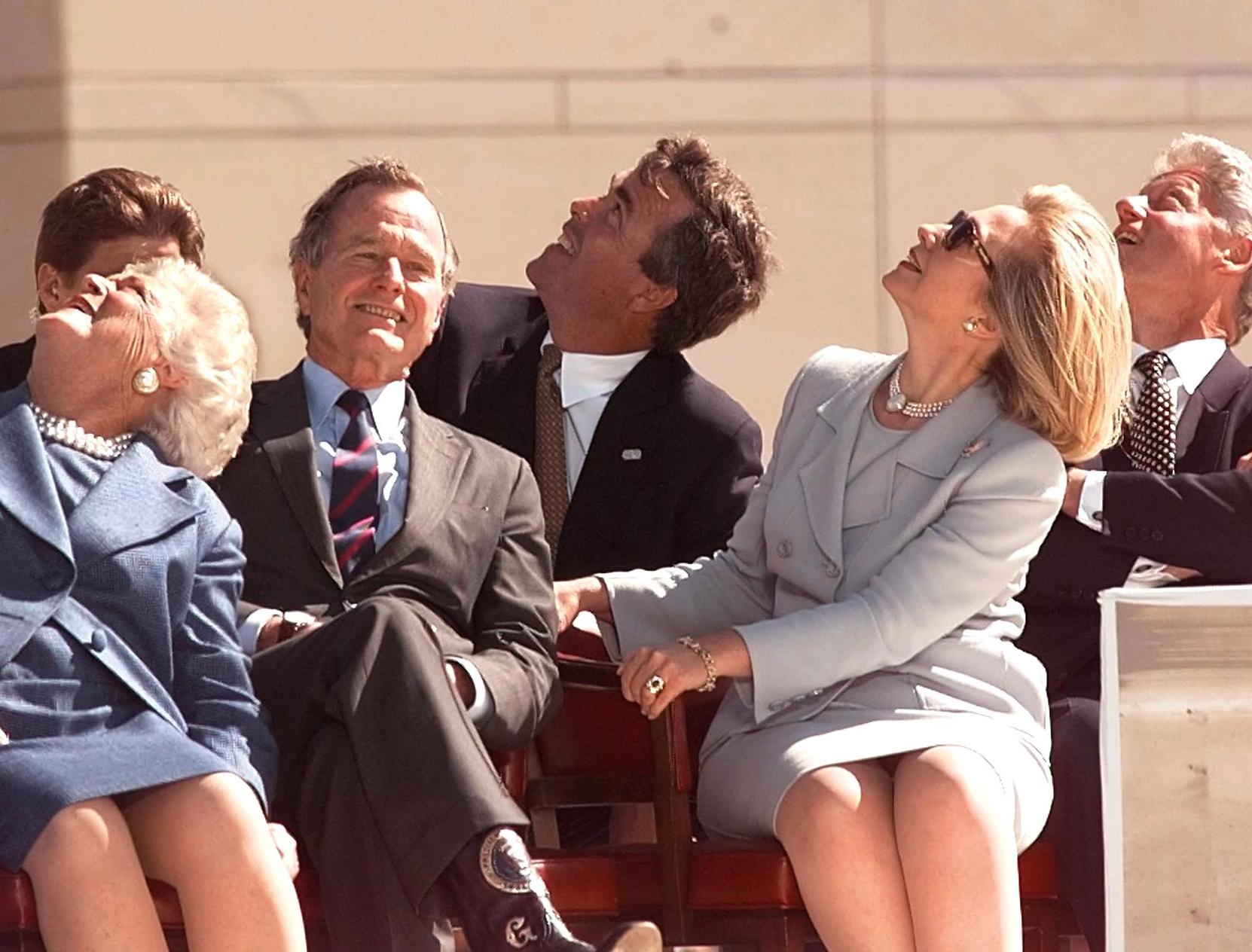
(Photo: Former US president George Bush, his wife Barbara Bush, their son Jeb Bush, First Lady Hillary Clinton, and US President Bill Clinton look up to see the US Army Golden Knights parachute team at the conclusion of the dedication ceremony of the George Bush Library in College Station, TX on November 6, 1997. By Joyce Naltchayan/AFP/Getty Images)

So, Jeb Bush Is Running

by Dish Staff

Noah Millman expects “Jeb Bush will be a very formidable candidate whose entry will seriously change the shape of the race.” And that we “have every reason to believe that the most-likely choice the voters will be presented with in 2016 will be Bush versus Clinton”:

The 2016 primaries on the Democratic side will feature Hillary Clinton ignoring a handful of protest candidates who never get any traction. And on the Republican side they will feature Jeb Bush coopting his most formidable opponents on his way to defeating a Rand Paul insurgency that more closely resembles Eugene McCarthy in ’68 than Ronald Reagan in ’76. And the general election will be the most-depressing of our lifetimes.

Kilgore sizes up the race:

Bush is now the Establishment fave who has taken the most overt steps towards running for president, which puts some extra pressure on Chris Christie since Bush’s PAC will at a minimum put the arm on many potential campaign donors in a way that will tend to commit them.

As fate would have it, McLatchey put out a new national poll this very day showing Jeb running second to Mitt Romney … and taking the lead if Mitt stays out. This will be enough for many Establishment types, who can be expected to begin calling Jeb the “frontrunner.” But truth is, he’s only running at 14% (16% if Mitt doesn’t run), and in a trial heat against Hillary Clinton, he’s trailing 53-40, which doesn’t exactly burnish the “electability” credentials he’d definitely need to convince conservatives to ignore his policy heresies and his family’s reputation for playing them for fools.

Larison downplays Jeb’s chances:

Certainly there would be no better way to announce that the GOP remains in thrall to the Bush era than to choose another Bush as standard-bearer. The problem with this isn’t just that it would reward dynasticism, but that it would be rewarding an especially incompetent dynasty. That’s why I assume that there will be enough Republican voters that won’t go along with a Bush revival. For one thing, they don’t have to, and for another Bush isn’t likely to be the best or most compelling candidate in the 2016 field.

Allahpundit gives Bush better odds:

Even as I write this, conservatives are scoffing on Twitter that Bush is way overhyped and will flame out badly in the primaries. I disagree … There are a lot — a lot — of low-information “somewhat conservative” voters who won’t particularly care that Jeb supports Common Core or immigration reform; he’ll have hundreds of millions of dollars behind him to give him a rosy glow on early-state TV sets. He probably can’t win Iowa, especially if Christie or Romney runs and splits the centrist vote with him, but I’m not sure why he can’t win New Hampshire, South Carolina (which just reelected Lindsey Graham, remember), and of course Florida. He’s smart and polished and he’ll have big-name establishmentarians like Rove slobbering all over him in the media for months to come. How many times do we need to see a McCain or Romney nominated before we internalize the reality that yes, Jeb Bush has a decent chance?

Paul Constant also takes Jeb seriously:

We will have two candidates with eminently familiar names spending hundreds of millions of dollars on advertising every two weeks, trying to convince us simultaneously that their brand of nostalgia is the best. If this election really does turn out to be a marketing battle between the Clinton brand and the Bush brand, I could see Americans tuning out of the election process in droves. Nothing will make people feel sicker about participating in politics than the sense that they’re pawns in a battle between two wealthy arms of American aristocracy. This matchup could bring the lowest turnout we’ve ever seen in a national election, and we all know that when turnout is down, Republicans win elections. I believe President Jeb Bush is absolutely a very real possibility.

Jonathan Bernstein chips in his two cents:

Republicans haven’t had to live with extreme uncertainty about their nominee for a long time; and some may be very tempted to just settle for the next Bush in line. And by all accounts, Jeb is simply a better politician than either his brother or his father (or, for that matter, his grandfather).

On the other hand, this field looks a lot more like the impressive 1980 candidate group in which George H.W. Bush finished as the far-back runner-up than it does the uninspiring 2000 array that George W. Bush trounced. What’s more, W. checked off all the conservative boxes; Jeb doesn’t. His positions on education (supporting Common Core) and immigration reform (he’s for it) may not disqualify him from the nomination, but both will draw serious opposition, and there are several potential candidates who could exploit that.

Beutler wonders how Jeb will handle immigration:

[T]he central question facing Republicans at the outset of the primary will be what the next president should do not about immigration in the abstract, but about Obama’s deportation program specifically. Most candidates will be pledge to end it. To test his formula, Bush will have to promise not just to end it, but to replace the executive actionswhich he called “extraconstitutional”with a more legitimate legislative scheme.

It’s not a replacement, though, if it doesn’t create a legal status for the people who will benefit from Obama’s deferred action plan. And if he pledges to create such a status, the right will abandon him.

Waldman welcomes that debate:

Bush doesn’t just support comprehensive immigration reform, he talks about the subject in a very different way from most other Republicans. In a speech earlier this year, he described undocumented immigrants this way: “Yes, they broke the law, but it’s not a felony. It’s an act of love, it’s an act of commitment to your family.” And there’s no question that Bush feels this sincerely. He wrote a book on immigration reform (which his opponents’ aides are no doubt scouring for quotes that can be used against him). His wife is an immigrant from Mexico. He speaks Spanish. His kids look Hispanic. He’s not going to suddenly change his position on immigration.

What this means is that by being one of the top-tier candidates in the race, Bush instantly changes the immigration debate in the primaries. It isn’t that any of the other candidates are going to move to the left, but the discussion will not just be about who wants to build the highest border fence. There will be at least one person talking about immigrants in human terms.

Haley Sweetland Edwards focuses on Jeb’s other big vulnerability – his support for Common Core:

Louisiana Governor Bobby Jindal, who is often listed among the potential Republican presidential hopefuls, used to support Common Core, but now is so publicly against it that he has launched lawsuits against his own state and the U.S. Department of Education, claiming that the standards are a violation of state rights.

While most of that is shameless political theater, it still leaves Jeb Bush in a tricky position: in order to win the Republican nomination, he’s going to have to win over the Republican conservative base, which hates Common Core with the fire of a thousand suns. The easiest way to do that would be to disown Common Core. But that’s not likely to be in the cards.

With Jeb running, Vinik thinks Rubio is toast:

If there is one loser from Bush’s decision to explore a presidential run, it’s Senator Marco Rubio, also from Florida. Bush has deep connections to the donor base in Florida thanks to his eight years running the state. If Bush does choose to runand the signs clearly point that way nowit will leave little room for Rubio to mount his own presidential campaign.

Rich Lowry sees an opening for Cruz:

The Texas senator wants a pure establishment–Tea Party fight and a Jeb candidacy does the most to tee that up by potentially squeezing out the candidates who have some appeal to both wings. So Jeb getting in would be the biggest windfall for Cruz since the shutdown fight, without which he wouldn’t be in such a strong position (it gave him an enormous boost among the grassroots and a huge e-mail list).

Jim Newell speculates about Christie’s ability to raise money:

Chris Christie, who, if he runs, will be vying for the same pile of dough — let’s call it the “Wall Street Journal CEO Council” money. Christie is in a difficult situation now. He wants to run for president and is willing to torture however many pigs as necessary to prove his mettle. But all those people who begged him to run in 2012 may be more interested in Jeb Bush, their private equity blood brother and considerably less of a loudmouth.

Relatedly, Cillizza hears that fundraising was one reason for Jeb jumping in early:

[S]everal people I talked to suggested that with a 2016 primary price tag, likely somewhere between $150 million and $200 million, even a Bush has to start raising money sooner rather than later.  “It allows the organization of the donor community,” noted one Republican. “The Bush network grinds into gear and gets big commitments.” (An interesting side point worth considering: Does the “Bush network” exist in anything close to its 2004 form? “Most of these people haven’t raised money in a long time,” said one unaligned consultant.)

Finally, Aaron Blake views “biggest question from here on out is not so much who leads in the polls, but who runs”:

If Marco Rubio, Chris Christie and Romney all run, that cuts into Bush’s chances, because he draws from the same pools of supporters and donors. That’s not so much the case with Carson, Mike Huckabee, Rand Paul and Ted Cruz.

Would You Report Your Rape? Ctd

by Dish Staff

Another reader adds his story to the powerful thread:

I want to offer a male perspective from someone who has been through something similar, in order to say it’s not just women who have these reactions. As a young teenager I was sexually abused by a teacher/coach, someone who had become like a father-figure to me (I’ve never met my real father, who left before I was born). It happened a few times, but I was eventually able to avoid him when the teacher transferred to another school.

I never told anyone until I was 19 or so, when I just couldn’t deal with my depression on my own and finally told certain friends and family. My mom reported it to the original school and contacted the police. They were sympathetic but didn’t do anything to follow up or take away his position. Mine was the only reported case. I did write a letter for the police and have it filed as a report, but I never followed up. I spoke briefly with a police investigator on the phone who was pretty clear that since it was several years prior, and my word against his, that it would be a tough case to push forward. I told myself that if other reports came up then I would testify or participate in whatever investigation was necessary, but didn’t want to go any further if it was just me, and ultimately didn’t ever follow up on it.

Later in my early-20s I did get counseling for my depression. The counselor wanted to pursue the police case again, since the individual was still a teacher in the school system.

I was doing better psychologically and she felt obligated to by law, as well as her personal desire to see the man behind bars. With my permission, she contacted a police investigator again. I spoke with him initially on the phone, but ultimately I still couldn’t handle it. I stopped seeing the counselor and did not follow up any more with the police. It wasn’t necessarily a conscious decision. It was like everything would shut down. I became so anxious that I went numb and just couldn’t face it. When pushed, I would answer questions and was open about it. But my subconscious reaction was to avoid the situation as much as possible.

I am not a weak man or someone afraid of confrontation. I served in the military, including a tour in Iraq. I have seen and faced some tough situations, but I never suffered the fear and anxiety that I faced when trying to report what happened to me or the idea of confronting my abuser. For the most part I do not suffer from PTSD related to my Iraq experiences. But I do, even still, suffer from PTSD related to my sexual abuse and find it difficult to have long-term, intimate relationships. I am in a far-better place then I was, but it is still there.

I know that if other reports came up that my abuser had done similar things to someone else, then I would gladly testify and confront him, do whatever I could do put that person behind bars. I’m not sure I could do that for myself though, and would still find it very hard to face him. I still feel guilty that I didn’t do more to report and push the case, as your other reader stated, and pray that no one else was ever abused because I didn’t have the courage or ability to follow through. I can understand completely why a woman wouldn’t want to report her rape, or might only report it to the school, but not push for a criminal case. That seems to be the natural reaction.

I agree with you completely that there has to be some defense process for the accused, even at the school level, but at the same time many schools and police need to be more assertive in pushing for investigations and going to the next step. Many victims just won’t be able to be their own advocates.