The Vanilla Icing Of Rap, Ctd

A reader quotes another:

I’m not saying the white boy you posted doesn’t have skills, but the alphabet rapping concept, including progressive acceleration, was done a long time ago by Blackalcious [see above]. I’m more okay with white boys having their place in hip hop if they bring their own perspective and style to the table, like The Streets for example.

In sum: Once “Alphabet Aerobics” hit in 1999, a white person can’t make a rap with the alphabet and still be considered original. White rappers having their own perspective and style means they can’t revisit a concept done by a black artist, even if it was done 15 years ago. Obviously this is artistic elitist bullshit. While having predominantly black artists in hip hop made for amazing music, as it was a medium for artistic outsiders willing to do something new, it got mired in cliches and authenticity-by-skin-color, leading to a lot of forgettable, stale music. The reader who you quoted is still stuck in looking to skin color for authentic music, and it’s racist. Not nearly as degrading or dehumanizing as institutional slavery, Jim Crow, or unjust as white privilege that still exists today. But it’s racist nonetheless, and he/she probably excuses it because it’s focused against whites.

On a very different note:

I almost wrote you a letter during the Dylan Farrow discussion, but I never quite found quite got to it. But now you’ve brought Brother Ali into it. Brother Ali is not just a talented freestyle rapper. He’s also a touching and personal lyricist. A few years ago, our family was shattered by the discovery that a very young relative was the victim of molestation by her father.

We immediately took in their family (minus one person who, with any luck, will never leave the loving embrace of our state’s prison system.) They’ve been living with us for several years as their mother puts her life back together, brick by brick. The daily challenges go beyond the scope of a letter to a popular blogger.

As the victim is still a child, it partly feels like a waiting game. What will she remember? Will she feel isolated by her past? As a teenager, will she be overcome by anger? Will she be able to find love and comfort as an adult, or will she be constantly haunted? Will she feel the need to take some form of revenge, as Dylan Farrow did? Was Farrow’s letter cathartic? If so, will she ever get a chance to do something like that herself?

I’m predisposed to believe Farrow. True or not, whatever happened in that family, she’s clearly in a tremendous amount of pain. I hope that she can release her anger. I hope that she can find peace and love in her life. Hell, I hope I can release my anger some day.

I first heard Brother Ali’s song Babygirl right about the time this all went down, which was amazing timing. Brother Ali discusses it after performing it in this video (around minute 5):

Hearing it then was touching. I applaud him for writing it. It can’t be easy to open up your family’s life for art like that.

On a side note, in the middle of all of this, my mother became very ill with c. diff collitis. She spent nearly five months of a year in hospitals, coming very close to the end several times. She eventually received a fecal transplant. After that, her health took a nearly unbelievable turn for the better. With the c. diff no longer killing her, other systems were allowed to come back to normal. So, that’s a Dish Trifecta for me. Stop stalking me!

And thanks for reading.

Thanks for sharing.

Leaning In, Falling Flat

Rosa Brooks pushes back against Sheryl Sandberg’s “lean in” philosophy and the culture of overwork, arguing that women, in particular, should fight for their right to relax:

Here’s the thing: We’ve managed to create a world in which ubiquity is valued above all. If you’re not at your desk every night until nine, your commitment to the job is questioned. If you’re not checking email 24/7, you’re not a reliable colleague. But in a world in which leaning in at work has come to mean doing more work, more often, for longer hours, women will disproportionately drop out or be eased out.

Why? Because unlike most men, women — particularly women with children — are still expected to work that “second shift” at home. … It’s hard enough managing one 24/7 job. No one can survive two of them. And as long as women are the ones doing more of the housework and childcare, women will be disproportionately hurt when both workplace expectations and parenting expectations require ubiquity. They’ll continue to do what too many talented women already do: Just as they’re on the verge of achieving workplace leadership positions, they’ll start dropping out.

Kathleen Geier applauds:

[S]lacking off unjustly gets a bad rap. People often enhance their abilities to think independently, to develop their own interests, and to do creative work when they’re not on someone else’s clock — when they’re just doing stuff they enjoy on their own time. It’s scary that our 24/7 economy seems to be allowing less and less time for that (at least, for those who are employed). I pity the Sheryl Sandbergs of the world who, as Kate Losse noted, appear to place little value on “pleasure and other nonproductive pastimes.”

Olga Khazan examines why Brooks’ call will be hard to follow:

U.S. policy doesn’t exactly make it easy to lean out even temporarily. Only about a fifth of moms get fully paid maternity time off, and high-powered “key employees” can be legally denied reinstatement if they go on family or medical leave.

Parents who truly wish to split the “workday” between actual work and childcare might also discover that the U.S. lacks a culture of part-time work, even though more than half of American working moms would prefer to work part-time or not at all. Part-time employees at American companies are much less likely to have access to benefits like retirement, medical care, and sick leave than are their full-time colleagues. U.S. workers are some of the least likely among the OECD nations to work part-time. (And even in countries where working less is accepted, the career disparity persists because it’s generally women, not men, who choose this route.)

Religious Liberty Or Anti-Gay Animus? Ctd

A reader writes:

You quote Conor thusly: “I can’t help but wonder, when I hear about Christian businesses boycotting gay weddings, is how many of weddingcakedavidmcnewgetty.jpgthose businesses also refuse to take photographs or bake cakes for other marriages that don’t strictly conform to Biblical codes.”

In fact we know exactly that it’s only the gays they have discriminated against. The two biggest cases cited for these laws are the photographer in New Mexico and the baker in Oregon, Sweet Cakes by Melissa. The Portland alt-weekly, the Willamette Week, contracted Sweet Cakes for a host of cakes for other seemingly unChristian occasions, like babies out of wedlock, divorce party, pagan solstice, and stem cell success. All were agreed to by the company.

Indeed they were. Two priceless examples:

WW Asks – I was calling to get a quote on a cake for a midsummer solstice party. My coven is celebrating on Friday, June 21. The decoration would be very simple: just a green pentagram. We’d like to pick it up sometime that afternoon, before the bonfire. It’ll be for about 30 people.

Sweet Cake says – “For 30 people we have a couple options… We have two kind of cakes you could have. About the diagram you want on the cake, I’m not sure how much extra that would be.”

And this:

WW Asks – I’m shopping around for a nice baby shower cake for my friend. It’s her second baby with her boyfriend so I’m not looking for anything too big or fancy—probably enough to serve 15 to 20 people.

Sweet Cake says – “We have a sheet cake that will feed 30, or a 10-inch cake that would feed 30 people. The 10-inch cake is $50 and the sheet cake is $52. Or we have an 8-inch cake that would feed 15 for $40.”

I think the question in the core case is answered. Their only expression of religious freedom is the right to turn gay couples away. That’s not religious freedom. It’s bigotry.

Regnerus, Resurrected

Nora Caplan-Bricker observes that the 2012 Regnerus sociological study, which suggested that children of gay parents had relatively poor outcomes, is still being used to support conservative arguments against marriage equality despite the expert consensus that it was fundamentally flawed:

The denunciations of Regnerus’ work haven’t kept it from having influence. The study appeared in amicus briefs during the DOMA and Prop 8 cases that went before the Supreme Court in 2013. According to the Human Rights Campaign (HRC), which has tracked mentions of the study, it has come up in legislative debates in HawaiiIllinoisColoradoMarylandMinnesotaRhode Island, and the U.S. Congress. Before Regnerus was scheduled to testify in Michigan, his study was used as evidence in cases that went to court in Hawaii and New Mexico. Regnerus’ work has even influenced debates abroad—especially in Russia, where Yelena Mizulina, the chairwoman of the Duma’s committee on family, women and children, cited him to argue for a law banning same-sex adoption, which was enacted this February.

Dave Camp vs The Tax Code

Tax Reform Camp

House Ways And Means Committee Chairman Dave Camp’s tax simplification proposal is out (pdf). Waldman provides the knee-jerk liberal response:

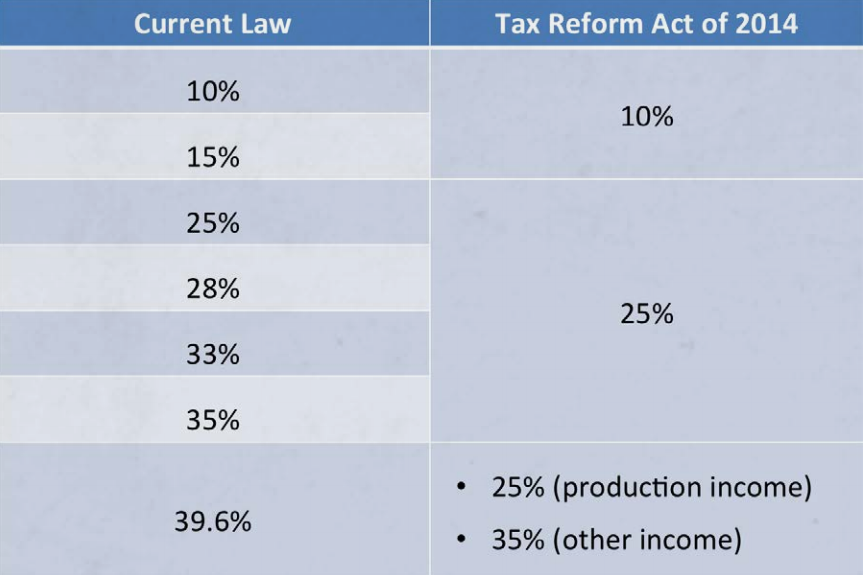
The centerpiece is an elimination of most tax brackets, leaving only two, at 10 percent and 25 percent. In a total shocker, that means a huge tax break for the wealthy! I know—I too am amazed that Republicans would propose such a thing.

Pareene has actually read the proposal:

Yes, it contains a tax cut, and effectively cuts tax rates on dividends and carried interest — two huge sources of income for the very rich — but it also taxes large financial institutions, adds a surcharge for very high-income households, and closes some loopholes that primarily benefit wealthy taxpayers.

Drum gives Camp credit “for going after a long laundry list of very specific deductions”:

Camp’s plan is long and includes upwards of a hundred specific tax deductions that he wants to reform or eliminate. There are enough caveats that it’s hard to tell exactly how far his proposals go, but again, kudos to him for making specific proposals at all. His plan may be DOA precisely because he was so specific, but kudos anyway. I’ll be interested in following the reaction as everyone figures out just whose ox would be gored by his various bullet points. Should be fun.

Critics are already dismissing some of Camp’s revenue-raisers as “gimmicks”:

Camp reportedly would allow U.S. companies with overseas operations to repatriate some of their foreign-sourced income at a lower tax rate — which would raise revenue in the short term but not in the longer term. The same would be true with some of the proposed depreciation changes allowed in the proposal.

Chuck Marr, the head of tax policy for the Center on Budget and Policy Priorities, said his organization would oppose any proposal that uses these methods to raise revenue temporarily while cutting taxes permanently. He also questioned whether Camp’s proposal would count against revenue the enactment of so-called tax extenders, provisions such as the research-and-development tax credit, which expired at the end of the year, and are always extended by Congress.

Salmon likes Camp’s proposal for a bank tax:

At heart, this is a Pigovian tax on something (too-big-to-fail financial institutions) we don’t want, and often Pigovian taxes are more effective than regulation when it comes to minimizing such things. What’s more, it’s sharp enough to hurt: JPMorgan, for instance, would have ended up paying about 15% of its 2013 net income in this one tax alone.

For exactly that reason, however, I’m still skeptical that the tax will ever actually arrive. Those ten institutions are extremely powerful, and are more than capable of persuading politicians on both sides of the aisle to vote against a tax which singles them out for pecuniary punishment. The tax was a good idea in 2010, and it’s a good idea today. But it has very little chance of ever becoming a reality.

Pethokoukis thinks “mortgage interest reform is maybe the best of his tax reform plan”:

The [mortgage interest deduction] is a $70-billion-a-year, market distorting subsidy for the purchase of expensive homes by high-income taxpayers. It does little to promote homeownership by Americans of more modest means. There is no sound economic reason to use the tax code to artificially advantage the higher-end real estate sector over other sectors of the economy.

In any case, Brett Logiurato expects the plan to go nowhere:

On Wednesday, even House Speaker John Boehner wouldn’t publicly offer his support for the legislation. In a press conference, he said it was good to start a “conversation” about tax reform. But, when asked if the party was prepared to back Camp’s plan, he told a reporter, “You’re getting a little bit ahead of yourself.”

Camp is likely making this play because it’s the last year of his chairmanship on the Ways and Means Committee — and because one of the dreams of every Ways and Means chair is to lead a comprehensive overhaul of the nation’s too-complicated tax system.

Howard Gleckman looks further into the future:

In the end, the details of Camp’s plan are less important than the fact that he wrote a plan. His framework, like the ones proposed by President George W. Bush’s orphaned tax reform commission, the Bowles-Simpson fiscal commission, the Bipartisan Policy Center, and others will help inform future efforts to rewrite the code.  Think of Camp’s plan as one big step down a very long road.

Right-Sizing The Military, Ctd

Stephen Mihm explains what Chuck Hagel’s 2015 defense budget might mean for the economy:

Hagel’s proposal to cut the military spells trouble for the stock market, right? Actually, no. The headlines about plans to reduce the size of the Army by 6 percent obscured the news that, over the coming years, the actual level of defense spending is set to rise slowly, from $535 billion in 2016 to $559 billion in 2019. And that’s before members of Congress move to shelter their districts’ pet projects.

In fact, what most analysts have missed is that the reduction is strictly in the number of active personnel, not overall military expenditures.

Joyner supports the cuts:

Hagel and the Joint Chiefs have repeatedly emphasized—correctly, in my judgment—that it’s far preferable to take the risks associated with a small but highly trained and well equipped force than those associated with a larger but “hollow” force that is unprepared for the fight. Accordingly, they “chose further reductions in troop strength and force structure in every military service—active and reserve—in order to sustain our readiness and technological superiority, and to protect critical capabilities like special operations forces and cyber resources.” That’s a difficult but necessary trade-off.

But Lindsay Cohn thinks the Pentagon is going about personnel reductions in the wrong way:

It is a mistake to believe that reducing numbers automatically introduces efficiency. In a normal American firm, cutting personnel is an efficient means of reducing costs because a firm can choose whom it wants to fire and can engage in lateral hiring when its need for personnel increases again. In the military, however, one cannot simply fire the lowest-performing people and replace them with new hires, nor can one engage in lateral hiring for certain specialties when a sudden need arises (e.g. combat medics, artillerymen, military lawyers). While it is possible to pass over low-performing officers and deny re-enlistment requests from below-average enlisted personnel, the military has little control over the timing of such actions, and may face budgetary time limits that force out higher performers. In general, the forces will achieve personnel cuts by reducing recruiting and relying on voluntary attrition. This is an inefficient means of managing personnel.

Michael Krepon considers the fate of our nuclear arsenal:

So far, Hagel has been silent about reductions in nuclear forces, promising to preserve all three legs of the so-called triad — missiles, bombers and submarines — while making “important investments to preserve a safe, secure, reliable and effective nuclear force.” But reductions in nuclear forces are coming: It’s not a question of whether, but when — and how deep.

The Dawn Of Ska

Diving deep into a history of Jamaican music, John Jeremiah Sullivan attempts to pinpoint the emergence of ska:

When I … [was] doing my best to stake out some understanding of what was going on musically in Kingston in the late Fifties and early Sixties, I ran into the riddle that bedevils every person who gets lost in this particular cultural maze, namely, where did ska come from? That strange rhythm, that chop on the upbeat or offbeat, ump-ska, ump-ska, ump-ska, exemplified quintessentially in “Simmer Down” (or in parts of Bruno Mars’s “Locked Out of Heaven,” if there’s doubt of its relevance). Did someone think that up? Can it be traced to a particular song or band, or accident, or earlier Caribbean style (mento, calypso)? Maybe its evolution should be followed out of the island’s deeper past, from African and Afro-Caribbean sources, and Indian influences—both kinds of Indian, in Jamaica’s case. There were a disproportionate number of Chinese-Jamaicans helping to shape Kingston’s music scene—did that have any effect?

As with almost all cases of musicological origin-hunting, the answer is something tedious like, “Yes and no to all of the above.”

Multiple streams converged to prepare the ground for that rhythm, for it to become a rhythmic move that would make sense to the Jamaican ear (and body), or to the fingers of a Jamaican guitarist.

Nevertheless there are moments that can be pointed to, when you hear the insistent uptick venturing forth. Theophilus Beckford’s piano on the classic Fifties proto-ska “Easy Snappin’” is one. You hear it there in the way Beckford’s pounding the chord, hear the rhythm offering itself, If you felt like going all the way, we could play it like this. Count Ossie’s polyrhythmic Rasta drumming on the Folkes Brothers’ “Oh, Carolina” is another such moment. The horns on Cuban-Jamaican blues master Laurel Aitken’s “Boogie in My Bones.” (Or over in the States, electric-guitar pioneer Wild Jimmy Spruill’s string-scratching fingernail technique on Wilbert Harrison’s 1959 “Kansas City”—Spruill a sharecropper’s son from Fayetteville, North Carolina; Harrison a churchgoing city kid from Charlotte). Sit down with any ska freak, and they’ll give you many other moments.

Update from a reader:

I’m a music and film producer based in San Francisco. I just had to add one really cool anecdote about ska music from Jamaica, as I didn’t see John Jeremiah Sullivan mention it in his write-up. I have worked with many Jamaican musicians, and some of the old school ones as well, including The Melodians, who were one of the original reggae groups. I have heard this story repeated by many of them. The “ska sound” story is essentially that there were radios around here and there in Jamaica, and of the few radios that did work, some were able to get signals from the United States, but signal was not fully clear, and frequently bounced in and out. So when musicians listened to these American songs, they thought that’s how cool music from the U.S sounded, with this off-beat rhythm. Some of the early ska songs from Jamaica are literally covers of early American Motown songs, almost 95% like the original recordings, except the Jamaicans adding a ska beat.

(Video: “Simmer Down” by Bob Marley and the Wailers, 1964)

Lights Out On Mt. Gox

The oldest Bitcoin exchange has gone offline and appears to be insolvent. The crash has cast doubt on the crypto-currency’s future, but Patrick McGuire downplays the event:

For those who are taking the long-view of Bitcoin, this is a large speed bump that will cause a lot of people grief for a long time; but there are bigger and better services on the way that will be able to learn from this crucial example of how not to run a Bitcoin exchange.

Brian Doherty puts the crash into perspective:

A reminder: if you had invested $1,000 in the horrible mistake of Bitcoin five months ago, that thousand would be worth about four times that today. After this Mt. Gox news.

Certainly, that huge value increase is not proof of Bitcoin’s eternal value as either investment or currency (and inflation in the former isn’t that healthy for use as the latter). But it is a sign that “it’s over, man” seems doubtful. People still believe. And that’s important when it comes to either investment or currency.

Kadhim Shubber bids the exchange good riddance:

Mt. Gox has become a gangrenous limb, infecting the wider bitcoin community with fear, uncertainty, and doubt.

Its reputation has been in a slow decline for some time now—toward the end of last year, news emerged that $5 million of Mt. Gox’s cash had been seized by the U.S. government. The revelations appeared to explain why withdrawals from Mt. Gox had been slow since June 2013, when the seizures occurred. As new and better-run exchanges sprung up, Mt. Gox increasingly became a burden, a holdover from bitcoin’s teenage years.

McArdle thinks the Mt. Gox crash makes Bitcoin regulation inevitable:

I’ve never been very bullish on Bitcoin, because ultimately, the better it performs at evading government surveillance of currency transactions (and government ability to manage debt loads via inflation), the harder those governments are going to try to shut it down. And it turns out that governments are very good at shutting down these sorts of … call them financial workarounds … because they can order the banks and payment networks that service the vast regular economy to refuse to take Bitcoins or take payments from companies that do take Bitcoins. What governments have done to online poker and offshore banking havens, they can do to Bitcoin vendors.

What happened at Mt. Gox only helps the government make its case for much tighter regulation of these networks.

Heather Timmons notes that some Bitcoiners are coming around to the idea of regulation, at least from within:

A growing number of participants believe the nascent bitcoin industry needs to accept the fact that expanding beyond the fringe comes with some some trappings of accountability.

“Nowadays, all bitcoin exchanges are very seriously considering and implementing compliance requirements based on their local jurisdiction’s rules,” said Eddy Travia, chief start-up officer of Seedcoin, a bitcoin company incubator. His firm’s investments include MexBT, a Mexican Bitcoin exchange, where “a large part of the resources…are invested into compliance-related activities,” he said, mostly based on self-imposed rules that are “a kind of self-regulation in anticipation of any potential concerns from the local authorities.”

Felix Salmon assesses the situation:

I actually do believe Coinbase and other next-generation bitcoin companies when they say that they’re much more robust than their predecessors. But I don’t believe that regulators, and the public at large, will believe them. Bitcoin is based on mistrust, which makes it almost impossible for this circle to be squared. There is a small number of cryptogeeks who really love the paradox that they can trust the protocol precisely because they don’t need to trust any given institution. Regulators, it’s fair to say, tend not to be among them. And neither are normal people, who don’t understand the math behind bitcoin, and who have no real ability to secure their coins on their own, and who thereforeneed to be able to trust whatever institution they’re using to store their bitcoin-denominated wealth.

In order for the end of Mt Gox to be a blessing for bitcoin, we’re going to need to see an influx ofnew entrants into the asset class — people who never trusted Mt Gox, but who are happy to trust (say) Coinbase.

School Lunch On Layaway?

A Salt Lake City school got national attention last month for refusing to give meals to students with outstanding lunch bills, following similar decisions in Texas and New Jersey. Patricia Montague of the School Nutrition Association calls the rise of lunch debt “a broad and growing national problem”:

School meal programs are self-sustaining and financially independent of a school district’s education budget. However, federal regulations prohibit school meal programs from carrying debt from unpaid meal charges from one school year to the next. So when parents don’t pay the balance, and meal programs are unable to cover the costs, school districts are forced to pick up the tab. As a result, many school meal programs have been forced to institute controversial charge policies governing whether, and what, their school cafeterias will serve to students who are unable to pay for a meal.

Research indicates that an increasing number of children arrive in the cafeteria unable to pay for their meals. A 2012 SNA survey of school meal program directors found that 53 percent of school districts were experiencing an increase in unpaid meal charges. Of those facing the increase, 56 percent anticipated that the accumulated debt from those charges would be greater at the end of the school year compared with that of the previous school year. Thirty-three percent anticipated a significant increase in debt. Some meal programs acquire thousands, even hundreds of thousands, of dollars in debt from unpaid meal charges. New York City’s public schools reportedly incurred $42 million in unpaid meal debt between 2004 and 2011.

What Makes A Government Legitimate?

A reader asked in the context of the Venezuela unrest, “Do you really think that every regime that you don’t like is necessarily illegitimate?” Another reader replies:

Egypt is probably the best example here. Mubarak was pro-Western but was very clearly illegitimate and undemocratic. Morsi was popularly elected and certainly had more legitimacy than Mubarak, but also had his authoritarian streak. We can rightly condemn Mubarak’s regime for its lack of legitimacy and then turn around and criticize Morsi and the Muslim Brotherhood for attempting to consolidate power and its increasing authoritarianism. And we can now be wary that the army that replaced Morsi may not guide the country back to democracy.

Venezuela, where I lived for 9 years in the ’80s and early ’90s, is a similar story. The country has had a reasonably democratic, albeit very corrupt, government for many years. It could rightfully be criticized for enriching the elite and ignoring the country’s poor and sowing the seeds for its own electoral overthrow by Hugo Chavez. On the other hand, Chavez, whether you agree with his policies or not, became increasingly un-democratic.

Despite the fact that he used the trappings of democracy, via elections and referenda, he nonetheless became increasingly intolerant of dissent, manipulative of elections, and generally undemocratic, not to mention his economic repression of opponents. This appears to have followed through to the government of Nicholas Maduro. If the opposition does manage to bring down Maduro, there is no way of knowing how things will end up. It could be that a chastened opposition decides that it will govern both effectively and legitimately; it is also possible that Maduro could be replaced with a right-wing dictator, whose policies might be more pro-western but who may be more illegitimate than Chavez or Maduro.

Because there is a gradient in legitimacy from “mostly democratic” to “elected dictatorships,” it is hard to draw a line, especially when an inherently un-democractic means is used to bring about a change in regime. Moreover, as with Egypt, there is no guarantee that the outcome of a popular overthrow of an authoritarian leader won’t lead to his replacement by another authoritarian leader. I didn’t support Chavez in the least, but I thought the military coup against him in 2002 was ill-advised.

But at this point things in Venezuela may have reached a breaking point. It is always my hope that the two sides will seek compromise and that transition from authoritarianism to democracy is (mostly) smooth (and it does happen; for example Augusto Pinochet, perhaps one of the most authoritarian and illegitimate leaders in the Western Hemisphere, nonetheless voluntarily gave up his power and abided by the results of a free and fair referendum on his rule. It is perhaps not surprising that Chile has been a stable Democracy since). I would love nothing more than for Maduro to release political prisoners, loosen restrictions on the press, decentralize power, etc., and for future elections to be completely free and fair. I’m not optimistic.

Richard Obuchi makes related points:

Polity IV is a project of the Center for Systemic Peace, which codifies characteristics of political regimes in order to classify them –in opposite extremes- as “Institutionalized Democracies” or “Autocratic Regimes”. To formulate the indicator, Polity IV considers the election mechanism for the Executive Power (meaning regulations, competition and open participation); institutional constraints on the exercise of power by the Executive Power; and the degree of regulation and political competition.

Even though President Maduro claims that the 19 elections held in Venezuela between 1999 and 2013 confirm Venezuela’s democratic nature, in truth the country’s political system tends toward an autocratic regime.

Rodrigo Linares blames the Venezuelan crisis on institutional decay. He argues that the “rock-bottom-basic institutions a modern country needs – the high school civics triad of the Executive, the Legislature, and the courts – have just plain stopped operating in anything like a recognizable form”:

[I]n theory, there’s supposed to be a National Assembly and an independent Supreme Court in place able to keep an overzealous President in check. That is where Venezuelan institutions, and its politicians, have failed the country. First, in 2004, the Supreme Court was packed with a gaggle of unconditional yes-men (and women), ending any hope for judicial redress. Then our parliament went into a protracted death spiral.

A simplified mission of the Parliament is, of course, to pass legislation, but it is a lot more than that. It is place for different political forces to meet and talk (parler in french). In this space, political forces look for common ground to reach solutions that satisfy all representatives, and through the representatives, the constituents. The Parliament is an outlet for discontent, a space for negotiation where progress is slow but effective.

We talk and argue in Parliament so that we don’t have to do it out in the streets. But we broke Parliament, and turned it into a boxing ring, and we allowed our courts to be packed, breaking the one final check to authoritarian control.

Meanwhile, a reader provides “a personal view of the man Maduro calls a fascist and The Nation considers elitist”:

Leo Lopez and I were roommates in our firstyear at the Kennedy School in 1994. It’s bizarre to seem him branded a right-winger, since his economic views The candidates for the primary electionstended to be closer to what The Nation usually supports, which is to say they tended to be a little on the left side of the norm even at Harvard. Those not being my politics, we had some good debates. What I remember clearly is that what he cared about most, and talked about most, was how to improve the lives of Venezuelan people. Never once did he bemoan how the elites in his country needed to take back power. Quite the opposite.

“The very picture of privilege”? Just before school started, when I went to buy furniture for my room, Leo went trolling the streets of Cambridge for discarded junk with which to outfit his bedroom. The desk he made out of an abandoned door was particularly impressive.

Leo stood out in other ways. He was serious in a way that the rest of us weren’t, surely because while all of us cared about public policy (he and I were both in the Masters in Public Policy program) politics in Venezuela mattered to him in a far more profound way than our American debates about whether Tom Foley or Newt Gingrich should be speaker of the house.

Leo’s no elitist. He’s an idealist. He’s not a fascist, he’s a democrat.

Beyond all that, he was also a hell of a nice guy. It’s hard to be that focused on serious matters and still retain a cheerful disposition, but Leo managed it. While we never became close friends, it was pretty much impossible not to like him. Venezuela’s lucky to have him, and I’m sure you’ll join me in praying he stays safe.

(Photo from Getty)