Unfriending Facebook

A decade after the social network’s launch, Nicholas Tufnell has given up on the site, explaining that “there’s something about the relentless happiness of people on Facebook that I find monstrous”:

Everyone is apparently always somewhere better than I am and what’s more, they’re having a brilliant time.  My life is not like that. In reality, no one’s life is like that, these are of course constructed narratives, our “best ofs” — but sometimes it’s hard to reason to yourself that these people aren’t having fun all the time when all you ever see of them is pictures of them having fun all the time. I suddenly start to feel pangs of inadequacy and jealousy… and these people are supposed to be my friends. In this regard, Facebook is truly poisonous.

Some research indicates that Facebook may really lower the spirits of users:

[L]ast summer, a team of psychologists from the University of Michigan in Ann Arbor and the University of Leuven in Belgium decided to drill a bit deeper by evaluating how life satisfaction changes over time with Facebook use. Ethan Kross and colleagues questioned a group of people five times a day over two weeks about their emotional state. They asked questions such as “how do you feel right now?”, “how lonely do you feel right now?”, “how much have you used Facebook since we last asked?” and so on. This gave them a snapshot of each individual’s well-being and Facebook usage throughout the day.

The team found that Facebook use correlated with a low sense of well-being. “The more people used Facebook over two-weeks, the more their life satisfaction levels declined over time,” they said. “Rather than enhancing well-being … these findings suggest that Facebook may undermine it.”

Maria Konnikova examines common motivations for quitting Facebook:

At the University of Texas at Austin, [psychologist Sam] Gosling and one of his graduate students, Gabriella Harari, have been examining why people decide to leave Facebook. They have found three broad themes: people see Facebook as pointless and unnecessary, they see it as a problematic distraction, and they are worried about privacy. As you experience a constant stream of updates from more people, the possibilities for distraction or frustration at a pointless update (did I really need to know that her baby is now teething?) rise apace. And as you share more information with more people, it all becomes a window into who you are—even the parts you might prefer to keep private. The more publicly we form and affirm social bonds—and the more people we form and affirm them with—the more likely we are to see our mental bandwidth filled and our privacy eroded.

“Our Unlived Lives”

Ethan Richardson reviews Adam Phillips’ Missing Out: In Praise of the Unlived Life:

Missing Out is about classic, fork-in-the-road questions of identity. When Robert Frost took “the road less traveled” and Jesus called us through the “narrow gate,” Phillips looks back at the roads untraveled, at what we missed, and describes human identity as a constant looking back upon the lives we have chosen not to live–or the lives that we have failed to live–or the lives that, much to our frustration, have always eluded us. For Phillips, we are as much a measure of the selves we aren’t as the self we happen to be facing in the mirror today. What about the one we used to love, or the one we picture ourselves loving someday? What about the job we longed for and never got? Or the job we got, but it could be in ten years? As he says, “We share our lives with the people we have failed to be.”

A long quote from the book’s introduction:

There is always what will turn out to be the life we led, and the life that accompanied it, the parallel life (or lives) that never actually happened, that we lived in our minds, the wished-for life (or lives):

the risks untaken and the opportunities avoided or unprovided. We refer to them as our unlived lives because somewhere we believe that they were open to us; but for some reason–and we might spend a great deal of our lived lives trying to find and give the reason–they were not possible. And what was not possible all too easily becomes the story of our lives. Indeed, our lived lives might become a protracted mourning for, or an endless tantrum about, the lives we were unable to live. But the exemptions we suffer, whether forced or chosen, make us who we are. As we know more now than ever before about the kinds of lives it is possible to live–and affluence has allowed more people than ever before to think of their lives in terms of choices and options–we are always haunted by the myth of our potential, of what we might have it in ourselves to be or do. So when we are not thinking, like the characters in Randall Jarrell’s poem, that “The ways we miss our lives is life,” we are grieving or regretting or resenting our failure to be ourselves as we imagine we could be.

The Intricacies Of Addiction

Surveying reactions to Phillip Seymour Hoffman’s death by heroin, Vaughan Bell notices that “many people find it hard to think of addiction as being anything except either a choice or a loss of free will.” The truth of drug addiction, he says, is not so black-and-white:

You are not forced to inject heroin by your brain or by the drug. You do not become an H-zombie or a mindless smack-taking robot. You remain in control of your actions. But that does not mean that it’s a simple ‘choice’ to do something different, as if it was like choosing one brand of soft drink over another, or like deciding between going to the cinema or staying at home. Addiction has a massive effect on people’s choices but not so much by altering the control of actions but by changing the value and consequences of those actions.

If that’s not clear, try thinking of it like this. You probably have full mechanical control over your speech: you can talk when you want and you can stay silent when you want. Most people would say you have free will to speak or to not speak. But try not speaking for a month and see what the consequences are. Strained relationship? Lost job maybe? Friends who ditch you? You are free to choose your actions but you are not free to choose your outcomes. For heroin addicts, the situation is similar.

Jacob Bacharach, whose brother died of an opiate overdose, is repulsed by pundits blurring the line between Hoffman’s art and his addiction:

I don’t suggest that we turn away from the circumstances of death—the opposite of pornography is a prudish sterility that’s equally awful. But if George Clooney died of prostate cancer, would we take the occasion to make it a reflection on the type of roles he chose?

It is one thing to learn to gaze without flinching at the cause of a man’s death, another entirely to treat his illness as a mere foible of his eccentric genius. Hoffman had a family. They knew, or they did not know, the extent and late stage of his disease, but what consolation is it to them, or to anyone who knew him, for a stranger to offer his sickness as a slick metaphor for his professional artistry, a cheap window-dressing on his soul? An actor’s art is doubtlessly informed by his person and his inner being, and Hoffman doubtlessly drew on his own sense and memory of darkness in performing it, but he was a great actor not because of his addiction, but in spite of it, and he did not die because he was a genius, but because he was a man—all of us have our end, but none of us deserves it.

Previous Dish on Hoffman’s death and heroin here, here, and here.

Christianity In China

Alex Jürgen Thumm clarifies its role:

Misconceptions abound about China, and that’s no less the case when it comes to the dish_chinachristianity country’s Christian population. Many assume a Communist country that is officially atheist would allow no religion. (Mao Zedong once said “religion is poison.”) But religious freedom is guaranteed in the 1978 constitution — or at least what the government considers “normal religious activity,” occurring in government-sanctioned places of worship serving one of the five official faiths: Buddhism, Taoism, Islam, Protestantism and Catholicism. Religion is on the rise in China, with one-third of people claiming an affiliation. To all my Chinese friends’ surprise, there are as many as 130 million Christians in China; the only countries with more are the United States and Brazil. Churchgoers in China outnumber those in all of Europe.

In an interview, religion scholar Richard Madsen discusses the country’s growing Catholic population:

The Catholic Church has not spread as quickly in China as evangelical Christianity. There are about twelve to fourteen million Catholics, which in absolute terms isn’t insignificant, although it’s just 1 percent of the population. That pretty much tracks the population increase since 1949. In 1949 there were three million Catholics and now there are twelve million. The national population has about quadrupled so it’s about right. One of the strengths of the Catholic Church is it’s been tied to community and family, but it’s also a weakness too. It’s harder for outsiders to come into it. And the dependency on clergy also inhibits it. So for things like that it’s growing more slowly. And naturally you have the split of the official Catholic Church in China from the Vatican, which has created a schism between the official Church and the underground church [which is more loyal to Rome].

Does all this mean that Christianity has failed in China?

It hasn’t failed. What does success mean for a religion? Taking over the country? Or is it just becoming an accepted part of the plurality of understandings, and permanent in a sustainable way? You can definitely argue that it’s like that for Christianity in China today. We’re seeing new ways for people to find meaning in their lives. It’s definitely changing and broadening. Christianity is part of it.

(Image of priests in a procession on Palm Sunday, in a 7th- or 8th-century wall painting from a Nestorian church in China, Tang Dynasty, via Wikimedia Commons)

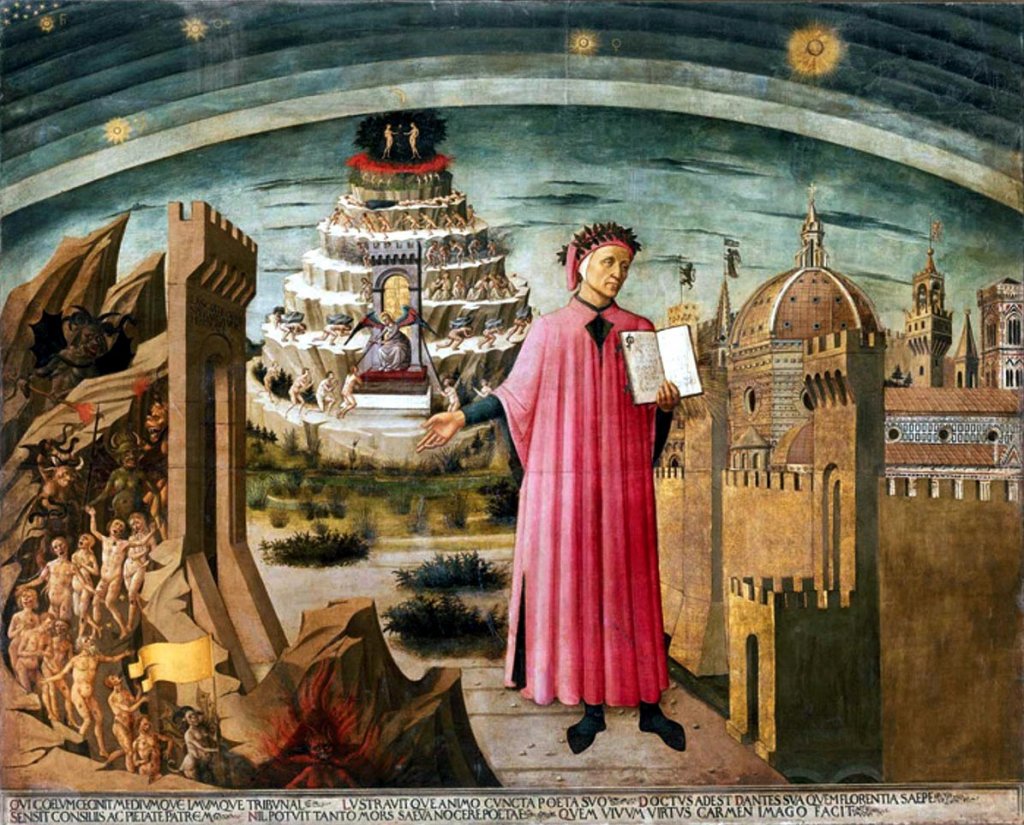
The Divine Comedy, Without The Divine?

Dante Large

Dreher wonders if atheists can “really get” Dante:

Without question many people read it and understand it deeply without converting to Christianity, but as I read Paradiso, with Inferno and Purgatorio behind me, I found myself genuinely mystified by what an atheist or agnostic reader would make of its illumination of the workings of divine love.  Paradiso is not a work of theology, strictly speaking, but if you do not accept the existence of God, and a God who is Love at that, the poem loses much of its power, or so it seems to me.

I know how defensive atheists and agnostics can get over claims like this, so let me hasten to say that the Iliad and the Odyssey remain imaginative works of staggering genius, even though none of us believe in the pantheon of Greek gods. You do not have to accept Greek religion to understand and be profoundly moved by these epic poems (though it is interesting to imagine how those who first heard the poems, as believers in those gods, experienced it).

Paradiso is different. It is utterly saturated with theology. In my personal experience, I do not think the Commedia would have worked its magic on me had I not believed that the God of Whom Dante wrote really exists, and that His love, as Dante characterizes it, is a real thing. The Commedia was a means of transformative grace for me, and a theophany, the likes of which I had not experienced since I was 17, and wandered unawares into Chartres cathedral – but I doubt it would have been had I not believed that such grace actually exists. What I don’t know is the extent to which that is a statement about my own subjectivity.

(Image of Dante and the Divine Comedy by Domenico di Michelino, 1465, via Wikimedia Commons)

Peering Into The Evangelical Mind

Reviewing Molly Worthen’s Apostles of Reason: The Crisis of Authority in American Evangelicalism, John Turner explores evangelicals’ complicated approach to the life of the mind:

In Molly Worthen’s witty and erudite retelling, evangelicalism is always on the verge of an intellectual meltdown. Fundamentalists-turned-neo-evangelicals traded in the presuppositions of strict inerrancy for the presuppositions of a [Reformed] Christian world view. Having once pretended that biblical authority alone could suffice as a guide for faith and action, they now pretend that Christians should be able to agree on what that world view looks like. Ultimately, evangelicals cannot live in the world of free inquiry and [secular] reason, so they curtail precisely those traits that would finally gain them the intellectual respect of non-evangelicals. “These habits of mind,” writes Worthen, “have crippled evangelicals in their pursuit of what secular thinkers take to be the aims of intellectual life: the tasks of discovering new knowledge, creating original and provocative art, and puzzling out the path toward a more humane civilization.” Of course, as Worthen herself notes, pursuing those tasks have never been evangelicals’ foremost goal. Instead, they want to win the world to Christ, and many of them fear that intellectual pursuits (even on evangelical rather than secular terms) will endanger that higher purpose.

In a review of the book last month, Michael Robbins zoomed out:

The key to understanding the anxieties that led conservative evangelicalism to such frantic action lies in [theologian Carl] Henry’s phrase “world-life view,” an awkward translation of Weltanschauung, a word that, in Worthen’s telling, obsessed the neo-evangelicals: “They intoned it whenever they wrote of the decline of Christendom, the decoupling of faith and reason, and the needful pinprick of the gospel in every corner of thought and action.” They picked up the term not from Kant but from Reformed theologians, and it came to represent a set of shared premises and guidelines that, once discovered and articulated, would reknit the dispersed body of faithful into a new Church Militant.

Apostles of Reason, then, is a chapter in the broader history of secularization, and as such it makes an interesting companion to Charles Taylor’s A Secular Age, which I happened to be reading alongside it. “It’s a commonplace that something that deserves” the title of secularization “has taken place in our civilization,” Taylor writes. “The problem is defining exactly what it is that has happened.” (The vulgar popular version has it that science in some sense proved religion to be false; this is simply another way of saying that scientism is the faith proper to late capitalism.) Regardless of the precise content of secularization, Worthen’s neo-evangelicals saw that a coherent picture of the world, a shared presumption of the truth of the Christian religion, had disappeared. And they set about trying to figure out how to restore it.

Recent Dish on Worthen’s work here.

The Secrets Of Online Dating

Just in time for Valentine’s Day, Wired analyzed data from OKCupid and Match.com to help online daters create the most appealing possible profiles. Their suggestions in a nutshell?

Learn to surf, listen to Radiohead, mind your grammar, use Tinder, OkCupid, Match, and Grindr on Sunday, watch Homeland, stop listing your eyes as your best feature (nobody cares), and please, please make eye contact with the camera and smile with teeth in your profile picture.

Amanda Hess notes that Wired‘s number-crunchers “found that both men and women gain popularity on the site when they play against gender stereotypes”:

On OkCupid, men who mention “my children” are rated as highly attractive, while women who discuss their kids are not. It’s good for women to talk about electronics and for men to talk about crafting, but not the other way around. It’s much better for women to mention The Matrix than it is for men to mention The Matrix, better for men to mention weddings than it is for women to mention weddings, and better for women to mention war than it is for men to mention war. The lowest-rated women talk about Twilight, poetry, and “chick flicks”; bottom-ranked men discuss zombies and C++. (More fun facts: The most popular women on the site call themselves “girls,” while the most popular men call women “women.” And it’s really hot for guys to use the word “whom.”)

Daisy Buchanan insists that profile pictures trump self-descriptions, however finely-tuned:

[T]he fact remains that a picture paints a thousand words and, as long as you look good in your photograph, you can fill the “about you” section with an extended essay about your passion for the works of cinematic auteur Michael Bay, and still get plenty of messages. This might be why image-based dating apps like Grindr and Tinder are so popular, with the latter increasing its user base by 25% a week at the last count.

Putting the image-first hypothesis to the test, comedy writer Alli Reed created a fake profile using pictures of a model-actress friend accompanied by text that indicated “she’s not just a bad person, she wants to ruin your life”:

Q: So you created a profile for a girl named AaronCarter’sFan who likes to party and knock over homeless people, or at least their cups, and she’s a racist, gold digging, fake pregnant-getting, 25 year old girl, white girl. How’d you do?

A: AaronCarterFan did very well. In the first 24 hours she got 150 messages. I had the profile up for two or three weeks, and she got close to 1000 men message her. … [A]fter so many messages started rolling in, the optimist in me decided that these men had just seen the pretty photo and had not read her profile. So my goal at that point became to convince them that she is just awful. That she is the worst woman on earth. If they asked what I was doing I said I was pretending to be a 14 year old on Facebook so I could bully my sister’s friends. I would threaten to pull out their teeth. With a lot of guys I could just, I wrote gibberish, just pounded on keyboard for a minute and sent it and the vast majority of them responded with that sounds great, what are you doing on Friday?

Maturing With Middlemarch

In My Life in Middlemarch, Rebecca Mead interweaves memoir and literary criticism, illustrating how George Eliot’s classic has affected her throughout her life.  In a review of the book, Hannah Rosefield describes why the novel endures:

Mead first read the novel aged 17, living in the southwest of England and preparing for university examinations, and she has read it every five years or so since. Middlemarch is, of course, not the only novel that changes with the age of its reader, but it does attract a particular kind of rereading. Writers, academics and non-specialist readers alike talk about a distancing from Dorothea as they grow older, a realization of the irony in Eliot’s portrayal of the girl who wishes she could have married Milton or any other great man “whose odd habits it would have been glorious piety to endure.” They discover their sympathy, especially if they are academics, for Dorothea’s elderly husband Casaubon, the scholar fixated on a project that he has neither the will nor the intellect to complete. To the young, Middlemarch is about the young; to the middle-aged, it’s about middle age.

Pamela Erens elaborates:

[Protagonist] Dorothea feels an inchoate longing to do or become something that the provinces don’t provide a ready picture of. Mead experienced this, too, although she had a better image of what might lie in the big world outside, and opportunities to reach for it.

The “it” in Mead’s case was Oxford University and a life of literature and journalism. But in Dorothea, Eliot was not writing simply about a woman born too soon for a career. Her portrait of youthful longing is more complex than that.

As Virginia Woolf put it, Dorothea and other Eliot heroines experience “a demand for something  —they scarcely know what — for something that is perhaps incompatible with the facts of human existence.” The book speaks, writes Mead, to the part of girlhood that asks:

How on earth might one contain one’s intolerable, overpowering, private yearnings? Where is a woman to put her energies? How is she to express her longings? What can she do to exercise her potential and affect the lives of others? What, in the end, is a young woman to do with herself?

In this sense, Eliot is a poet of youthful longing (not merely in women but also in men) — of what it feels like to suffer “the burthen of larger wants than others seemed to feel,” as Eliot writes of Maggie Tulliver in her earlier novel The Mill on the Floss — and one can see why Middlemarch has hypnotized sensitive, introspective, ambitious young women for many generations.

What The Asian Powers Can Learn From WWI

Robert Farley sees one major lesson:

As the centenary of World War I approaches, several commentators have argued that the emerging multipolar power structure of East Asia is coming to resemble that of Europe prior to 1914. Setting aside the wisdom of the political comparison for a moment, there is one way in which the comparison is apt. Just as real knowledge of modern, high-intensity warfare was limited in 1914, the emerging great powers of Asia have little experience with the forms of warfare they are planning to use.

Although most of the European powers had experience with colonial wars, they did not have the space or time to work out the implications of the technologies that would eventually characterize World War I (the machine gun, the dreadnought, the submarine, and the airplane). The degree to which military commanders of 1914 were surprised by these technologies has been wildly overstated, but the armies and navies had not developed the tactic, hands-get-dirty experience of how to fight in a new technological environment.

It bears repeating that we have very little sense of what contemporary air and naval warfare between peer or near peer competitors will look like. This is true not only of land warfare (the US invasion of Iraq in 2003 is probably the best model we have, but isn’t very helpful) but also of naval and air warfare. And in particular, the emerging East Asian powers lack recent combat experience. China last fought a land war in 1980, a naval conflict in 1974. The Japanese military has not engaged in combat since 1945. The Indian military is in better shape because of its anti-guerrilla efforts and constant sparing with Pakistan, but still has little recent experience with major combat.

“Skiing On Mass Graves”

1864 Protest

Why Circassians are none too happy about the Olympics this year:

The Circassians are an umbrella designation for many ethnic groups from the eastern coast of the Black Sea. In the first half of the nineteenth century, they waged a war against Russia’s expansion into the North Caucasus, which they lost. The Russian Empire annexed their territories, and then either ‘encouraged’ them to emigrate or simply expelled them outright. Nearly 90% of Circassians went into exile. Tsar Alexander II, known as the Liberator (of Russian peasants), proclaimed victory over the Circassian ‘rebels’ in 1864.

The date of 1864 makes 2014 the 150th anniversary of the Circassian expulsion. From the Sochi coast, ships loaded with Circassian refugees set sail for the Ottoman Empire. Circassians died in thousands on the journey, of hunger and disease. The triumphant parade of Russian troops, marking the end of the war, took place on May 21, 1864 in Krasnaya Polyana, site of the Sochi Winter Olympics.

Keating looks at the actions of the Circassian diaspora:

Today there are about 3 million to 5 million Circassians living abroad and about 700,000 in the Caucasus. The post-Soviet Russian government has been slow to recognize the extent of what happened to the group and has strongly resisted attempts to label it as genocide—the anti-Russian government of nearby Georgia did so in 2011— portraying Circassian nationalism as merely an outgrowth of the region’s Islamic radicalism. The global community commemorates Circassian Genocide Memorial Day every May 21.

However, the decision to hold the games in the symbolically important city of Sochi has focused new attention on the issue, with Circassian activists in New Jersey launching an international campaign against the “genocide Olympics.” The group has been protesting since Vancouver, and one of its pamphlets informs athletes that they’ll be “skiing on mass graves.” It’s possible that local activists may attempt to stage some sort of opposition at the games themselves, though the authorities have been coming down hard on protests of all kinds.

But the international protests haven’t gotten much attention:

[T]he only high-profile ally the Circassians have won is Doku Umarov, leader of the Islamist insurgence that has grown out of Chechnya’s shattered independence bid, and whose allies recently blew themselves up in the city of Volgograd. “They plan to stage the Olympic Games on the bones of the many, many Muslims who died and are buried on our territory along the Black Sea. We, the Mujahedeen, must not allow this to happen,” Umarov was quoted on his website as saying last summer.

The Circassians could do without such support, since they reject violence and activists’ long-term goal is to regain their homeland. It’s an ambitious aim, a kind of Caucasus Zionism, but the activists think it is feasible. “It might not be easy for the immigrants who are going to the Caucasus, that first generation, but their children are going to be fine. It’ll just be like when my parents came to the U.S.,” said Tamara Barsik, a Circassian-American who lives in New Jersey.

In the meantime, they’ll have to watch the Sochi Olympics on television, like everyone else.

(Photo: Circassians commemorate the banishment of the Circassians from Russia in Taksim, Istanbul. From Wikimedia Commons)