The idea would be roughly as follows: in criminal cases, we decide what the accused should be able to spend to defend themselves against a given charge—securities fraud, grand theft, manslaughter, etc. No one can spend more, even if she has the money, and those who can’t afford the limit would receive a subsidy for the full amount beyond what they would have spent on their own (say, beyond a certain percentage of their annual salary or net worth). In civil cases, we decide what the plaintiff should be able to spend to pursue an award of a particular amount, or to pursue a particular kind of claim, and what the defendant should be able to spend in response. The same subsidies would apply.
Posner calls the idea a “massive, unworkable nightmare”:
Suppose someone is charged with manslaughter after driving her car into a pedestrian and killing him. Suppose the government-set price for a manslaughter defense is $20,000. She uses most of her money to buy an excellent lawyer but nonetheless the jury convicts. She has some money left over for an appeal but in the meantime some new evidence emerges that the victim was at fault, or the prosecutor engaged in misconduct. Should she use the money to pay a lawyer to make a motion for a new trial? Save it for sentencing? Use it for appeal? One could complicate the regulatory scheme further by giving people the power to apply for new “grants” from the government for additional legal representation as unpredictable developments occur. But this would invite still more tactical behavior by clever lawyers skilled in gaming systems like Scheiber’s.
If it gets the buzz it’s intended to attract, perhaps Scheiber’s piece could stimulate some much-needed interest in the decline of subsidized legal services for the poor, one of the less-discussed victims of austerian budget policies. Or maybe it could help boost the already promising rise of bipartisan criminal justice reform initiatives, noting that unequal legal representation is one of the reasons we have prisons stuffed with poor people who are in many cases status offenders. But unless conservatives get excited about it as the Next Big Threat, I don’t think “socialized law” has much of an immediate future.
Last week, a white paper (pdf) from the USPS inspector general revived the idea of letting our post offices offer basic financial services:
The report suggests three types of potential products. First, it proposes a “Postal Card” that could make in-store purchases, access cash at ATMs, pay bills online, or transfer money internationally. Customers with paper checks could cash them at the post office or deposit them through their cell phones, loading them onto their Postal Card. Second, the USPS could offer an interest-bearing savings account, again through the Postal Card, encouraging savings from communities with little in the way of a personal safety net. Finally, the Postal Service could offer small-dollar loans, effectively an alternative to costly payday lending. The fees on all these services would be drastically lower than anything in the marketplace today.
Elizabeth Warren, naturally, loves the idea. So does Waldman:
Some people have referred to this as a “public option” for banking, which is an accurate description, but makes it more likely that Republicans will recoil in horror as they catch the whiff of the dreaded Obamacare about the proposal. But the big banks—the ones with all the power in Washington—should be perfectly fine with it, since they’re not interested in these customers anyway.
Turns out banks are not actually losing money on low-income Americans.
In fact, the less than wealthy have turned into a nice little profit center for the big banks. If these customers want to stay, the banks make them pay. The median overdraft charge is $34 at large banks and $30 at smaller financial institutions, according to a report from the Consumer Financial Protection Bureau. The result? Moebs Services, a financial research firm, estimated banks took in $32 billion in overdraft fees in 2012.
Salmon doubts the USPS can compete with payday lenders:
Non-banks compete on convenience, not on cost, and tend to be open very long hours; while the Post Office has the advantage that a lot of the underserved go there anyway, it’s still going to have real difficulty competing with Western Union, check-cashing stores, and all the other high-cost non-bank financial-services shops which do exist in the ZIP codes without banks.
In order to make a postal bank work, it needs to be a postal bank: it has to be able to take market share away from existing banks. That in turn means that the existing banks will fight tooth and nail to prevent such a thing from ever seeing the light of day.
On Sunday, I argued that Woody Allen’s “art and his craft is so extraordinary in its range and scope and creative integrity that it escapes the twisted psyche that gave birth to it.” Gracy Olmstead disagrees:
There are many artists, it is true, who lived with little to no morals. But there seems to me an important difference between the person whose sins are voluntarily indulged in, and the person who takes advantage of the young, the vulnerable, and the voiceless. This seems to be too horrific to ignore. Perhaps I am too sensitive. But I do not want to douse my mind in the artistic thought of a man with such inexcusable inclinations and actions. … Art changes us: it affects our perceptions and our world views. Can we really trust ourselves—our minds, eyes, and ears—to Allen’s hands?
Eric Sasson wants journalists to stop assuming that Allen is guilty of molestation:
Woody Allen’s defenders point out that he was never charged with molesting Farrow, and a team of child-abuse specialists concluded that she hadn’t been molested. His detractors note that a state attorney at the time said there was “probable cause” to charge Allen, but that he chose not to prosecute the case to avoid traumatizing the young girl. There are plenty of reasons to doubt both sides. For journalists to “react” to Farrow’s letter without acknowledging those doubts does the public a disservice, and for them to question the morals of those who remain in doubt does journalism itself a disservice.
Rebecca Buckwalter-Poza, on the other hand, considers why the rich and famous often get away with these types of crimes:
Celebrities are particularly effective at discouraging victims and witnesses from cooperating with law enforcement and prosecutors in cases involving sex crimes against underage victims. Their testimony is critical to securing a conviction, but the alleged victims and their families are understandably reluctant to weather public scrutiny and a high-profile trial indefinitely and at uncertain cost for an unknown outcome.
Drum agrees with me that Hillary’s achievements are underwhelming. He spots another possible weakness:
[B]y 2016 she will have been in the public eye for 24 years. That’s unprecedented. In the modern era, Richard Nixon holds the record for longest time in the public eye—about 20 years—before being elected president. The sweet spot is a little less than a decade. Longer than that and people just get tired of you. They want a fresh face. That’s largely what happened to Hillary in 2008, and it could happen again in 2016.
I’m less concerned with Hillary’s rationale for running than I am for my own sanity.
For the next three years she’ll play it safe on the ever-Clintonian middle ground, which for the last three years has been exhaustively played out by Obama. The reasons for the latter are many, and some are valid. My complaint about Hillary is that the exciting promise of new and aggressive management will be lacking.
Linker fears we’ll have a match-up between Jeb Bush and Clinton:
Since 1980, when I was 11 years old, a Bush or a Clinton has run for president or vice president in eight out of nine contests (with Obama’s 2012 re-election campaign being the only exception). Unless Hillary Clinton surprises everyone, 2016 is guaranteed to make it nine out of 10, which is bad enough. But the idea of the Republicans running a third Bush against her — it’s almost too much to bear.
Or rather, it’s almost enough to make me wonder why we don’t just scrap the pretense of the United States being a democracy at all and instead embrace the truth — that, at least when it comes to the nation’s highest office, we’re now a nepotistic oligarchy.
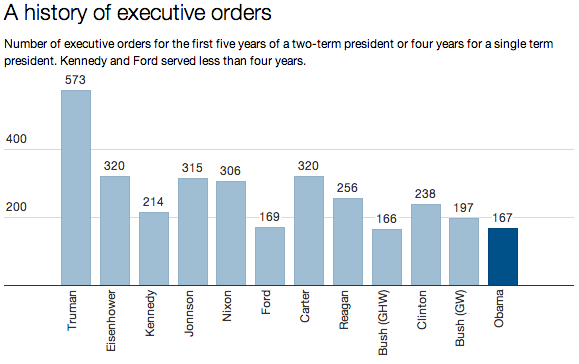
Noam Scheiber worries that Obama’s executive action agenda could backfire politically:
[These unilateral maneuvers’] only real value is signaling that Obama believes he can exert his will on the economy without Congress and is working really hard to do that. But if that’s the effect, then they only exacerbate Obama’s dilemma by further persuading voters he has influence over the economy we just agreed he doesn’t have.
Now maybe the economy will improve on its own, in which case no foul. As I said earlier, the chances that it will are reasonably good. But if the economy doesn’t improve, or god forbid it worsens, the new approach will be a disaster. It will stick Obama with an even larger share of the blame than he’d otherwise come in for. Since the point of a political strategy is to shape voters’ perceptions of events in a way that makes them look more favorable to you, not less, this doesn’t strike me as a step forward.
From a historical perspective, Posner argues, Obama’s embrace of executive power is neither unusual nor worrisome:
The president is kept in check by elections, the party system, the press, popular opinion, courts, a political culture that is deeply suspicious of his motives, term limits, and the sheer vastness of the bureaucracy which he can only barely control. He does not always do the right thing, of course, but presidents generally govern from the middle of the political spectrum.
Obama’s assertion of unilateral executive authority is just routine stuff. He follows in the footsteps of his predecessors on a path set out by Congress. And well should he. If you want a functioning government—one that protects citizens from criminals, terrorists, the climatic effects of greenhouse gas emissions, poor health, financial manias, and the like—then you want a government led by the president.
Also, as Jonathan Bernstein noted last week, the functions of the three branches of government have never been clear-cut:
Congress does things that look an awful lot like executing the laws (think oversight, and the Senate’s role in the nomination process) and even in some cases judging; the courts do things that look an awful lot like making and executing the laws; and, yes, the executive branch does things that look an awful lot like legislating and judging. In other words, separated institutions — president, legislature, courts — sharing the powers of legislating, executing the laws, and judging.
Those aren’t newfangled modern ideas; they’re really inherent in the way the Constitution is written, and they took root early in the republic as politicians learned to work according to the rule book that James Madison and others gave them. “Separation of powers” has always been just a very misleading description of how the U.S. political system is designed.
The revelation (NYT) that Afghan President Hamid Karzai has been secretly negotiating with the Taliban behind our backs helps explain his erratic behavior of late:
The reports confirm suspicions that Karzai’s recently-increased antipathy towards the U.S. is fueled by a desire to appeal to Taliban leaders. Last month Karzai went so far as to claim that suicide and other attacks, which the Taliban had already taken responsibility for, were actually orchestrated by the U.S. The insistence that Washington was behind the attack makes more sense as an attempt to justify a failing Taliban negotiation than an actual complaint against the U.S. government.
The kicker for Chotiner is that Karzai making no progress:
These actions have enraged American officials, as has the idea that Karzai would reach out to groups that are killing Afghans and American soldiers. But what’s truly embarrassing and maddening about Karzai’s unilateral initiative is that it is, er, absolutely pointless. As the Times reports: “The clandestine contacts with the Taliban have borne little fruit, according to people who have been told about them. But they have helped undermine the remaining confidence between the United States and Mr. Karzai, making the already messy endgame of the Afghan conflict even more volatile.”
Noah Feldman, however, thinks we should let him try:
Karzai’s efforts have a potential upside that the U.S. negotiations lack. For Karzai’s life to be spared and his presence to be tolerated would be a powerful signal to Afghans who allied themselves with the U.S. that Taliban rule will not come with vicious retaliation. The Taliban right now must be asking themselves whether to engage in de-Americanization in a post-conflict Afghanistan. A glance at U.S. efforts to de-Ba’athify Iraq, which led to bloodshed and chaos, may be all it takes for them to conclude that the benefits are not worth the costs. Why resort to a reign of terror if the people are already willing to accept your rule?
If the US truly cared about bringing peace to Afghanistan, an interesting new bargaining position would be to threaten both Karzai and the Taliban that they intend to stay in Afghanistan beyond the end of the year even if Karzai doesn’t sign the [bilateral security agreement (BSA)], but that if a peace agreement is reached, the US would leave and provide a portion of the funding that the US now dangles as incentive for signing the BSA. Such a position by the US would allow the Taliban and Karzai to unite behind their one common goal–the removal of all US troops. With public opinion of the US effort in Afghanistan at an all-time low, promoting a full withdrawal would be a welcome development in the US.
It’s the $64,000 question of the next GOP primary cycle. First up: let’s note a fascinating new development. Republican views of the wars in Afghanistan and Iraq have shifted quite dramatically. In the latest Pew poll (pdf), only 36 percent of Republicans now believe that the US achieved its goals in Iraq – basically the same as Democrats and Independents. Only 39 percent believe we succeeded in Afghanistan. So hefty majorities of Republicans now believe that both wars were failures. They haven’t yet fully absorbed the cost of those failures. But surely the fiscal blow will have some traction with Tea Partiers.
Larison, ever hopeful, believes that Rand Paul’s “greatest advantage over other Republican politicians is that he has reliably been an early and vocal opponent of unnecessary wars”:
Unlike every other Republican in elected office today, Paul was on record as an opponent of the Iraq war from the beginning. Today even most Republicans acknowledge that the war was a failure, and there is clearly no appetite for anything like that again. While other Republicans were berating Obama for intervening in Libya too slowly, Paul was opposed to the war, and he was likewise an early critic of attacking Syria and arming the opposition. This has put him on the right side of public opinion and distinguished him from the Obama administration on a few high-profile issues.
But Colin Dueck sees Paul’s foreign policy views as a liability:
A whopping 73 percent of Republicans believe Iran is “not serious” about addressing concerns about its nuclear weapons program. Some 80 percent of Republicans believe the United States is “less respected” than it was a decade ago. (It is unlikely that those Republicans view this as a good thing.) The highest foreign policy priority listed for Republicans was “protecting U.S. from terrorism.” Moreover, the December Pew poll found that 51 percent of all Americans view Obama as “not tough enough” on foreign policy and national security, 37 percent view him as “about right,” and only five percent view him as “too tough.” It is more than likely that the proportion of Republicans, specifically, who view Obama as “not tough enough” is well above 51 percent.
These findings are consistent with similar foreign policy polls by Pew, Gallup, and numerous other organizations. Over 70 percent of Republicans support drone strikes against suspected terrorists (Wall Street Journal, June 5, 2013); favor airstrikes against Iran rather than allowing that country to develop nuclear weapons (Haaretz, March 19, 2013); believe that U.S. military spending today is either about right or too low (Gallup, February 21, 2013); and think the “best way to ensure peace is through military strength” (Pew Center, June 4, 2012).
Last week, Paul is announced that he is against the Iran sanctions bill. Allahpundit wonders whether this will come back to haunt him:
It’s bound to figure in the debates next year, maybe prominently. If negotiations break down, it’s a cinch that the field’s more hawkish candidates will use his wait-and-see approach to bludgeon him for his dovish naivete. Paul will have defenses to that — he voted for Iran sanctions in the past, and he says here that he’d prefer to keep existing sanctions in effect until there’s proof that Iran’s complying with the Geneva terms (although Iran never would have agreed to that) — but no one knows if they’ll work. The whole thrust of his opponents’ criticism on foreign policy will be that he’s too much like his father to be trusted to defend the country robustly. They’re looking around for data points to support that thesis; if negotiations collapse, this’ll be seized eagerly.
Morgan Meis interprets the philosophy of the Coen brothers through their latest film, Inside Llewyn Davis, which he likens to “a light brush with evil, a stroll through the outermost circle of hell”:
The problem of having nowhere to be is actually the problem of evil. That sounds extreme, but it is something the Coen Brothers have always understood. The plot structure of Inside Llewyn Davis is the structure of an endless loop. Davis sings “Oh Hang Me” in the first scene of the movie. He is back singing the same song in the same place at the end of the movie. The same thing happens to him each time. His life is repeating itself. It is not hard to understand why. Llewyn Davis is trying to connect space and time in ways that don’t fit. He is trying to fit old wine into new wineskins. There is no traction. And so his life spins on its own axis. …
The theologian Stanley Hauerwas once wrote about Augustine and the problem of evil. Hauerwas wrote that, in his Confessions:
Augustine finally came to understand, paradoxical though it may sound, that evil does not exist because “existence” names all that is created and everything created is good. He observes that there are separate parts of God’s creation, which we think of as evil because they are at variance with other things.
The idea is that evil is not a force in and of itself, but a side effect of disconnection, of things being put together in a way that doesn’t fit. Evil isn’t some thing that opposes another thing: the good. Evil is when good things are rubbed up against one another in such a way that they produce nothing. Evil is reduction for the sake of reduction, nothing for the sake of nothing. It is thus hard to get your arms around evil, to understand it or even to see it for what it is.
Jeffrey Toobin suspects Bridgegate “will take longer than anyone expects to resolve”:
Ultimately, [U.S. attorney Paul] Fishman will probably give immunity to Kelly and Stepien, meaning that they will testify before a grand jury. At that point, they will be called before the legislative committee, because they won’t be able to take the Fifth anymore. By then, it will probably be summer at the earliest. If there are indictments, they probably will not be issued until fall—and trials, if any, would be held in 2015.
In short (or rather, long), Chris Christie can look forward to many months of investigations. News leaks will abound. Like most U.S. Attorney operations, Fishman’s investigation has been largely invisible to the public, but the legislators, especially the Democrats, live to embarrass the governor. And this is really the best-case scenario for Christie, one in which the investigators do not find anything that would seriously implicate him. Events are now firmly out of his control. All Christie wants to do is put this whole matter behind him. It will be increasingly apparent that he has a long road ahead of him.
Beutler bets that it will only get worse for Christie:
[T]he slowly effluviating nature of the scandal suggests that more and more stink will accrete around him over the coming weeks in the form of more bad actors for him to alienate. And he’s alienating former allies at such a rapid pace that he could easily end up having several more strange stories to tell about why all the people in his inner circle were obvious liabilities from the start.
What have been Hillary Clinton’s major, signature accomplishments in her long career in public life? What did she achieve in her eight years as First Lady exactly? What stamp did she put on national policy in her time as Senator from New York? What were her defining and singular achievements as secretary-of-state?
One response:
Hmm. Let’s see, she was a senator for the 8 years while W was President. Not a lot of opportunity there, but if you look at her sponsored or co-sponsored legislation during that period, she was amazingly productive. (I’m sure she had some help, but still.) About her record as First Lady, she attempted a wholesale reform of healthcare and was beaten back by the Republicans – not an “accomplishment” perhaps, but her experience in this area would be invaluable as the ACA matures. And she served as Secretary of State during a challenging time – that is certainly an accomplishment in itself and gives her experience that no other candidate has.
Weak. Lame. Notice the absence of any specifics. Because there aren’t any:
The first thing that came to mind was her work, internationally, on human rights: particularly women’s and LGBT rights. Here’s her 2011 speech to the United Nations on LGBT rights. This was really important! To say these kinds of things to the international community matters, even when we’re still sorting out the details at home. And she’s been doing this kind of thing since the beginning of her career in public life. Here’s her similarly historic speech as First Lady on women’s rights that she gave in China in the ’90s. I get that she doesn’t have a perfect track record on human rights, given US policy during her tenure as Secretary of State. That being said, it’s my opinion that women’s rights and LGBT rights have been her top priority whenever she’s had the chance.
There’s a difference between what she has said and what she has done. John Kerry has done more in one year than she managed in four at Foggy Bottom. A common retort from readers:
You ask for Hillary’s accomplishments? What does it matter? What were Barack Obama’s accomplishments in 2008? Voting against the Iraq War is not really a “major, singular accomplishment.” I think that being the first woman president along with her “long career in public life” will be enough.
But Obama had been in the national spotlight for only four years in 2008, while Clinton has had almost two decades to tally up specific accomplishments. She’s running on experience. And her record is close to invisible. Another reader:
Her signature issue, what she will run on, is her tenacity and defense of the Democratic principles. She will fight for her agenda, and it will be a classic Democratic agenda, but she will do so with the tenacity and will to win the President has not shown. The President is simply too willing to compromise and his default position is to be bipartisan. Clinton will be clearly and unabashedly partisan. She will be the Democratic’s Democratic. Honestly, if she needs to pull the still beating heart out of Chelsea’s chest on national television to pass a stimulus or extend unemployment insurance, I know she will do it. Essentially, her issue is she will kick Republican butt and not take prisoners.
Funny how I don’t remember the Clinton presidency as anything like that. Au contraire, actually. Another is more succinct:
Because, fuck Republicans.
I need no other reason. They’re going to hate and demonize whoever is occupying the Oval Office. Given that, I might as well have a president who will be fierce enough to fight back, who will take no prisoners, and who, to some extent, will probably deserve their hatred and fear. I want Clinton to brutalize them and make them think of 2008-2016 as the good ol days.
About that ferocity:
I would agree that her caution poses a real danger for her – something which can be gleaned in this NYT piece about AIPAC’s retreat on the Iran sanctions bill:
On Monday, 70 House Democrats sent Mr. Obama a letter backing his diplomatic efforts and opposing new sanctions. Former Secretary of State Hillary Rodham Clinton added her voice to those urging no legislation.
Clinton was silent on the AIPAC bill until it was safe for her to take a stand. A stand which – surprise! – is now the safe position within the Democratic establishment. For someone wanting to lead the country, this is (though characteristic of the Clintons) more than a little underwhelming.
But another reader liked her record in New York:
Two words for you: Bread and Butter. Hillary was my Senator, and I still remain impressed with her relatively quiet, modest, bread-and-butter focus. She was all over the GOP-leaning Upstate, where I am from, helping keep factories from moving, helping with Post 9/11 redevelopment in NY. She was a frequent visitor to Rochester, and was well-versed in the local economic issues (impressing my dad when he chatted with her at a small potatoes university engineering conference). She was really popular even in Republican areas, because she stayed away from the hot button issues, and just showed she cared about people of all stripes.
When you look at the Republicans running for Congress, it’s all about the big flashy issues, some of them popular, but how often do you ever hear of any of them actually helping people? Just like in Ohio in the last election for Obama, factory jobs trumped guns and God and race and all the rest of it. I mean, climate change, are you kidding me? Voters want better-paying jobs and growing economy. And as a woman, with the legacy of the Clinton economy, and a very successful small-bore bread-and-butter focus as a Senator, I think she is very well positioned.