Reality Check

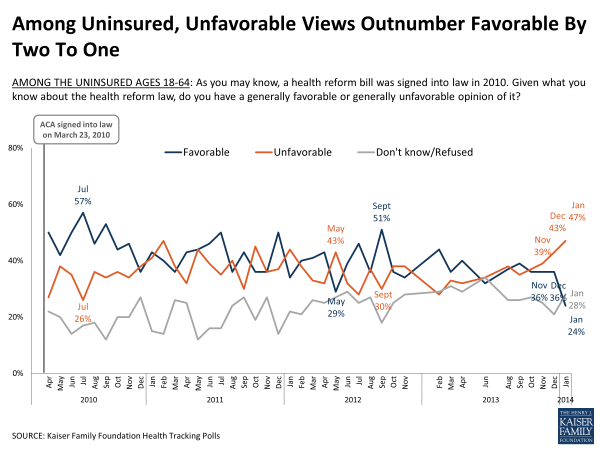
Obamacare Unfavorable

Suderman parses Kaiser’s latest numbers:

[T]he [above] latest monthly tracking poll from the Kaiser Family Foundation finds that opposition to the law amongst the uninsured has actually increased since December … This is the group of people the law was, in theory, supposed to benefit most. And yet even as the most prominent benefits start to kick in, their support is dropping. It’s possible, of course, that this could turn around at any time. But it’s not a very good sign for the future popularity of the law.

I too was gobsmacked by this result. But then you look and ask what the respondents actually think Obamacare is. And you get this result:

Roughly four in ten adults overall, and about half of the uninsured, are not aware that the law provides financial help to low- and moderate-income Americans to help them purchase coverage, gives states the options of expanding their Medicaid programs, and prohibits insurance companies from denying coverage based on pre-existing conditions.

That is such a massive indictment of the president’s messaging it beggars belief. Half of the uninsured have no idea that Obamacare offers them money to buy health insurance! WTF? No wonder the popularity of the law remains mired.

Look: the cognitive dissonance is real. But so is the ignorance. Obama’s approach to selling the ACA has been that of a classic defensive-crouch liberal. He sees the low popularity and decides not to tout the law so much. And by failing to tout the law effectively, relentlessly, persistently and clearly, he simply enables the ignorance-based opposition to grow.

Kliff notes how the media have also simply responded to this mood, rather than explaining the fuller story:

For many Americans – particularly the 68 percent who get coverage through their work, Medicare and Medicaid — the launch of the exchanges probably doesn’t affect their coverage situation. … So what’s driving the negative opinions of Obamacare? The Kaiser survey does point to one potential culprit: negative news coverage. More Americans say they’ve seen stories about people having bad experiences with the Affordable Care Act than good ones.

Waldman puts these numbers in perspective:

We spend so much time talking about politics that it’s easy to forget that politics are not an end in themselves, they’re a means to an end. Liberals advocated for comprehensive health insurance reform for so many decades not because it was politically advantageous (at some times it was, and at other times the voters didn’t seem to care), but because it was right. The fact that so many millions of Americans had no health security up until now was a moral obscenity. The ACA is beginning to fix things—slower and less completely than we might like, but it is a beginning. And if it never becomes the political boon you were hoping for, it was still the right thing to do.

Drum’s analysis:

27 percent now say that Obamacare has “negatively affected” someone in their family. That’s crazy. Even if you subtract the baseline of 18-19 percent who have been saying this all along, that’s an increase of nearly ten points over the course of 2013. Unless you take an absurdly expansive view of “affected,” this is all but impossible. Obamacare simply doesn’t have that kind of reach.

But we’ve been though a recent period in which every co-pay increase, every premium increase, and every narrowing of benefits has been blamed on Obamacare. These things have happened every year like clockwork for the past couple of decades, but this year it was convenient to blame them on Obamacare. Combine that with the PR disaster from the website rollout, and a whole lot of people now believe that Obamacare is hurting them.
Sticky Status

Economist Gregory Clark’s book The Son Also Rises traces social mobility rates over hundreds of years using surnames and concludes that government interventions aimed at increasing mobility have little effect. In an interview, Clark suggests that, because socioeconomic status is so hard to change, it may make more sense to focus on raising the minimum standard of living instead:

We already live in societies of massive social intervention in terms of the provision of education and health care. Yet we have not been able to raise social mobility rates above those of the pre-industrial era. Even the most interventionist societies such as Sweden have such low social mobility rates.

But if we’re learning that we can predict the majority of people’s outcomes at conception, that should lead us to reexamine our assumption that whatever income distribution comes out in society is fine. Because if it’s the case that a lot of this is determined before someone enters the game, it weakens the case for letting the market determine the distribution.

You’d be much more likely to favor a society with much less inequality. And that’s where Sweden’s system does provide advantages over the U.S.’s. They haven’t changed mobility rates, but they’ve changed the consequences, strongly, of ending up at various points in the distribution. It’s a much better place for people who end up at the bottom of the distribution.

Yglesias makes related points, arguing that the bipartisan obsession with equal opportunity “makes no sense whatsoever as a social objective”:

[W]hether the focus groups like it or not, an opportunity to climb is no real answer for people at the bottom. A perfectly fair race is, in at least one important way, the same as a rigged race: Both have a first-place finisher and a last-place finisher. The question of what happens to the person at the bottom genuinely matters. Whether you want to phrase that in terms of the gap between the bottom and the top—inequality, as such—or simply look at the absolute condition of the people at the bottom, you can’t escape the conclusion that outcomes matter, and not just in terms of procedural fairness. Today, even poor people are able to take advantage of things like electricity and antibiotics that were rare or nonexistent 100 years ago. That’s the kind of opportunity that matters—the opportunity for everyone to enjoy a better life. But over the past generation, progress has been slow for the nonrich. And over the past 10 years, it’s been essentially absent.

The Money In Wealth

Earlier this month, Ryan Avent examined Thomas Piketty’s new book, Capital in the Twenty-First Century, which Tom Edsall unpacked this week:

What Mr Piketty conveys most powerfully, in my opinion, is the fact that economics was once  centrally concerned with the question of distribution. It was impossible to ignore in the 19th century! Not least because economists of a market-oriented disposition and those more sympathetic to Marx both wondered whether capitalism was capable of generating a sustainable distribution of the gains from growth. We are all used to sneering at communism because of its manifest failure to deliver the sustained rates of growth managed by market economies. But Marx’s original critique of capitalism was not that it made for lousy growth rates. It was that a rising concentration of wealth couldn’t be sustained politically.

In a follow-up, he responded to Piketty’s critics who point out that inequality is shrinking globally. Yglesias added:

It’s true that it would be a mistake to get excessively hung up on any particular summary statistic of inequality. But the broad facts that stagnating living standards in rich countries are coinciding with a falling share of national income going to the bottom 80 percent or so of the population aren’t in serious dispute and they’re not “compensated for” in any policy-relevant sense by the success of Chinese development policy.

Drum’s suspects that taxes are going to rise on the rich:

My view is that the second half of the 21st century—assuming we manage not to blow each other up or fry the planet to a cinder—is likely to be an era of fantastically high growth thanks to robotics and artificial intelligence. That also produces problems related to the distribution of income, but they’re rather different from Piketty’s.

But in one sense it doesn’t matter. Piketty’s solution to the problem of this mismatch between growth and capital returns—which he considers an inevitable consequence of capitalism—is redistribution and plenty of it: “The only way to halt this process, he argues, is to impose a global progressive tax on wealth….an annual graduated tax on stocks and bonds, property and other assets that are customarily not taxed until they are sold.” That’s probably the eventual answer to the robotics revolution too. So regardless of which fork we take in the future, higher taxes on the rich seem pretty likely.

Millman wonders how such a tax work since “the incentives for a given state to cheat are simply too large – any state that had a lower tax on wealth than the cartel would attract enormous inflows of capital.”

Calculating The Coup Odds

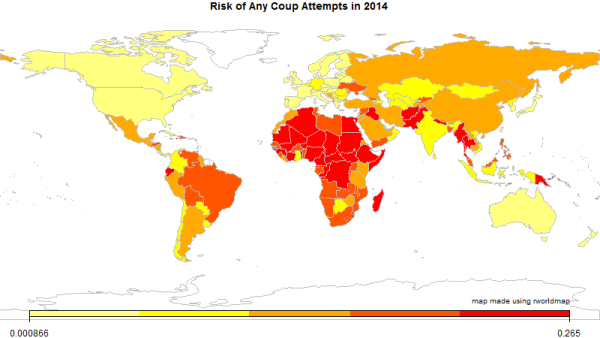
forecast-heatmap-2014

Opening with the caveat that “Coup attempts rarely occur, so the predicted probabilities are all on the low side, and most are approximately zero,” Ulfelder maps where they’re most likely to happen this year:

From cross-validation in the historical data, we can expect nearly 80 percent of the countries with coup attempts this year to be somewhere in that top fifth. So, if there are four countries with coup attempts in 2014, three of them are probably in dark red on that map, and the other one is probably dark orange.

Fisher takes a minute to “appreciate the luxury many countries have of not worrying about coups”:

A lot of democratic as well as authoritarian states, rich as well as poor, have strong enough rule of law and institutional norms that they don’t have to worry about coups. Ulfelder’s model predicts only a 0.15 percent chance in the United States; many Western democracies show similar scores. So do some countries experiencing political turmoil, such as Greece and Cuba (0.14 and 0.21 percent risk, respectively). Iran, for all its problems and political infighting, only rates a 1.43 percent chance of a coup. That’s probably great news for the United States: even if we don’t like the Iranian government, it’s preferable to chaos, and a government that can negotiate without worrying about a military coup has a freer hand to accept any U.S. nuclear deal.

La Vie En Rouge

Exploring the evolution of color perceptions, Elijah Wolfson considers how our ability to see red sets us apart from other mammals:

Most mammals, including most primates, are dichromatic, meaning they can only detect two color wavelengths: green and blue. Certain primates, though, have evolved to see a third: red. It turns out that these primates—humans, chimps, gorillas, and orangutans, to name some—all have one thing in common: bare-skinned faces. Based on this trend, experts have hypothesized that the development of trichromatic vision was, in fact, the result of an evolutionary advantage that certain primates had over others: namely, that it helped our ancestors better understand the emotional states, socio-sexual signals, and threat displays of their brethren.

The upshot was huge. Once we could actually see the red that coursed through our veins, it became a secondary communication tool: ovulating females would redden in the face and in their sexual organs to signal sexual readiness; angry males displayed dominance by reddening in the face. Modern humans might still get red in the face while angry, but we’ve also branched out to using signaling tools like cocktail dresses and soccer jerseys. While the medium has changed, the message remains: displaying red means you’re serious.

Should College Football Unionize?

Northwestern football players are petitioning the National Labor Relations Board for permission to form a union. Marc Tracy doesn’t see why not:

If the purpose of college is “an education,” then why in some cases do student-athletes have part or all of their tuition paid for on the explicit condition that they play sports? And if they are not professionals, then why the—what do you call it?—extracurricular activity that requires extensive travel, 40-plus hour weeks, and considerable risk to future earning potential? And if they are not  being paid for that—if that tuition shouldn’t count as payment and their participation is in fact “voluntary”—then why allow that tuition to be offered in the first place? What is it even being offered for?

But Jonathan Mahler points out that the players don’t want wages, at least not yet:

The players aren’t actually asking for much. Their “demands,” laid out on the website of the National College Players Association, include making college football safer by limiting contact at practices and adding independent concussion experts at games. They want schools to pay medical expenses related to sports-related injuries. They want athletic scholarships to cover the full costs of attending college, not just tuition but also expenses such as laundry or going home for vacation. They want a small percentage of the huge sums generated by college sports to be invested in continuing education for athletes who go pro before graduating.

He thinks the NCAA should jump at the deal:

College sports are a multi-billion dollar business. If the athletes who make it popular and lucrative — after spending countless hours training, traveling and playing — aren’t “employees,” then what does the word mean? There is growing scientific evidence about the dangers of football, yet the young men who fill their schools’ stadiums and coffers, selling branded merchandise and ensuring generous TV contracts, shouldn’t be given medical coverage and insured against long-term disability as the groundskeepers and athletic directors and coaches are?

Hampton Stevens worries about unintended consequences, noting that pay-for-play can’t be far behind:

How, for instance, would those in charge go about splitting the money? Should players at Alabama and Texas get paid more because their programs generate more revenue? Would starters get paid more than benchwarmers, or does everyone on the roster deserve the same rate? Should a player’s pay be based on performance year-to-year? After all, if college athletes want the benefits of professionalism, they must also expect the drawbacks—like losing salary because of sub-par performance.

What about basketball players, who similarly produce big bucks for everyone but themselves? Don’t they deserve a union, too?  What about sports that don’t produce revenue? Surely swimmers and volleyball players should also have their scholarships protected. And let’s not even get started on the Title IX implications. The legal requirement for gender equality adds yet another layer of bewildering complexity.

John Culhane considers that snowball effect as well:

[A] decision in favor of the Northwestern players will likely explode throughout college football. A tipping point will be reached once enough teams are represented by unions. When that happens, it will be much harder for every school—and the NCAA—to resist meeting players’ reasonable demands, even if players at some universities will be forbidden from unionizing. What elite player will want to attend, say, Oklahoma, if he’s assured of post-career health care at Notre Dame? Top-tier college programs will have to cough up benefits if they want to compete with their football brethren.

The Robots Took Er Jerbs! Ctd

Last week, a study identified the jobs most likely to be automated in the future. Derek Thompson looks at how the fastest-growing jobs will be impacted:

Here are the ten fastest-growing jobs and the odds that robots and software eat them:

1) Personal care aides: 74%
2) Registered nurses: 0.9%
3) Retail salespersons: 92%
4) Combined food prep & serving workers: 92%
5) Home health aides: 39%
6) Physician assistant: 9%
7) Secretaries and admin assistants: 96%
8) Customer service representatives: 55%
9) Janitors and cleaners: 66%
10) Construction workers: 71%

These ten occupations account for 3.85 million projected jobs in the next ten years, or 25 percent of the decade’s projected job haul. And six of them are at least two-thirds automatable, based on researchers’ projections of current computing power.

James Bessen takes comfort in historical precedents:

According to 60 Minutes“Bank tellers have given way to ATMs. Sales clerks are surrendering to e-commerce. And switchboard operators and secretaries to voice recognition technology,” arguing that digital technologies are leading to persistent unemployment. But, in fact, there are more bank tellers, sales clerks and receptionists and secretaries in 2009 than in 1999, according to the Bureau of Labor Statistics. The reason: demand.

For example, it takes fewer bank tellers to operate a bank branch, thanks to the ATMs. This makes it less costly to operate a bank branch, allowing banks to open more of them. With more branches, banks can expand their markets. But more branches mean greater demand for tellers, offsetting the loss in the number of tellers per branch. Bank tellers today perform different tasks than in the past – they do fewer simple jobs like counting cash and more of the customer interaction of “relationship banking.” These tasks require different skills, but ATMs have not eliminated teller jobs.

Miles Brundage joins the conversation:

[T]he tasks that are easy to automate aren’t necessarily the boring and repetitive ones, and the tasks that are hard to automate aren’t necessarily the fun and interesting ones. Consider, for example, the warehouses that power Amazon’s vast supply chains. As shown in a recent BBC documentary and a first-person account in the Guardian, the workers in these warehouses aren’t exactly living the dream—they are under constant pressure by their computerized overlords to meet impossible picking-and-placing targets, are physically exhausted at the end of work each day, and their working conditions may put them at increased risk of mental illness.

From a technological point of view, these warehouses are perfect examples of human-machine symbiosis in action. People have excellent dexterity and perception compared with robots, and computers can schedule workers’ movements around the warehouse efficiently, use their perfect memories to keep track of the locations of items, and set targets to motivate employees. From a subjective point of view, though, many of these workers report feeling like robots themselves.

What Does Snowden Deserve?

Some say it’s a Nobel Peace Prize:

A pair of Norwegian politicians hailing from their country’s Socialist Left Party have nominated Snowden, arguing that his actions have helped to preserve trust between nations.

Moyihan rolls his eyes:

Remember that flurry of reports in October that “Russian President Vladimir Putin was nominated for the Nobel Peace Prize by an advocacy group that credits him with bringing about a peaceful resolution to the Syrian-U.S. dispute over chemical weapons?”

In 2012, hundreds of news organizations reported on Bradley Manning’s nomination (one of those Norwegian parliamentarians who nominated Snowden also nominated Manning). In 2011, the wires were clogged with stories of a potential Peace Prize gong for Julian Assange. And my personal favorite, courtesy of a former Swedish deputy prime minister and parliamentarian, the 2006 nominations of former U.N. ambassador John Bolton and right-wing polemicist Kenneth Timmerman, author of books on Jesse Jackson, the Iran nuclear program, and how the French “betrayed” America. (On the cover of Timmerman’s book Countdown to Crisis: The Coming Nuclear Showdown with Iran, potential readers are told the book is written by “a Nobel Peace Prize nominee.”)

This happens regularly because so many individuals can submit nominations:

[A]ny member of a “national government or legislature” or, say, any philosophy professor—from a member of Hungarian parliament representing the neo-Nazi Jobbik party to the bonkers Slovenian professor Slavoj Žižek—can create fake news by legitimately nominating someone who might be considered illegitimate by reasonable people.

Weigel adds his two cents:

Moynihan follows these fake news explosions more regularly than I do, but I was turned on to them nine years ago. This was when Dr. William Hammesfahr appeared in Florida, describing himself (and allowing news organizations to describe him) as a Nobel Prize nominee as he argued against pulling Terri Schiavo’s plug. A Florida congressman had written a letter recommending him for the prize, and Hammesfahr didn’t possess the self-awareness that usually prevents people from saying they were merely nominated for things. (You can safely ignore any reporter or TED speaker whose bio leads with how he made the short list for something but didn’t win.)

Same Love, Different Genes?

In response to Macklemore and Ryan Lewis’s “Same Love,” the soundtrack to the cringe-worthy Grammy wedding, Brandon Ambrosino asks whether we can support equality without imagining sexuality as biologically predetermined:

One of the reasons I think our activism is so insistent on sexual rigidity is because, in our push to make gay rights the new black rights, we’ve conflated the two issues. The result is that we’ve decided that skin color is the same thing as sexual behavior. I don’t think this is true. When we conflate race and sexuality, we overlook how fluid we are learning our sexualities truly are. To say it rather crassly: I’ve convinced a few men to try out my sexuality, but I’ve never managed to get them to try on my skin color. …

Arguing that gayness is as genetically fixed as race might have bolstered our rhetoric a few years ago, but is it necessary to argue that way now? I understand that the genetic argument for homosexuality is a direct response to the tired “You weren’t born that way” rhetoric of religious people. But in my opinion, we could strip that religious argument of much of its power if we responded like this: “Maybe I wasn’t born this way. Now tell me why you think that matters.” I imagine many religious people haven’t really thought through the implications of their own rhetoric. (What, for instance, does a socially-constructed word like “natural” even mean?)

Sigh. The salient fact for a vast majority of gays is that we experience our sexual orientation exactly as straights do. We experience it as a given – and even the old-school reparative therapists believed it was fixed by the age of three. The pomo left doesn’t want this to be true, just as the Christianist right doesn’t either. But it is. John Aravosis makes the obvious point:

I’d love to see the Great Ambrosino in action, willing an attraction to a gender where, only moments ago, there was none.  It’s never happened in the history of the world.

Ambrosino is likely not formulating his thoughts terribly well (which happens when magazines hire people who can’t write).  He’s not describing gay people actually choosing their sexual orientation. He’s talking about either bisexuals (or people who are predominantly of one orientation, but still have enough attraction the other way that if the right person came along they could act on it), or he’s describing people who legitimately have seen their orientation morph over the years, through no causation of their own.  But all three of those categories are not people who “chose” to change their sexual orientation.  They are simply people who chose to act on the already-appealling meal placed before them.  Ambrosino didn’t choose to find men sexually attractive any more than I choose to love chocolate.  I can choose whether to partake in chocolate, but I can’t choose to turn on and off the underlying desire for the sweet.

Savage, meanwhile takes the gay outrage machine to task for bitching about Same Love:

The queers complaining about Macklemore & Ryan Lewis now remind me of the queers who used to bitch and bitch and bitch about how big beer companies didn’t advertise in queer publications or sponsor pride parades. (“Queer people drink a lot of beer! They want us to support them and buy their beer but they don’t want to support us and our community!”) But when big beer companies began advertising in queer publications and sponsoring pride parades… the exact same queers who had been complaining about how big beer companies weren’t advertising in queer publications or sponsoring pride parades immediately started bitching about how the beer companies were trying to profit off our sexuality. (“The pride parade is not for sale! We are a community, not a commodity!”) Blah blah bitchy blah.

I kinda hoped this lefty whininess and escape from reality would dissipate at some point. But no! At least at this point they aren’t actively sabotaging the case for gay equality and integration, as they did in the 1990s. But you’d think these fantasies about fluid male sexual orientation and the social construction of everything all the way down would have faded away by now.

A Good Death, Ctd

The thread reaches a climax:

About 20 years ago, my father suffered a massive heart attack. He had no prior symptoms other than a bleeding nose about three or so years earlier that had to be cauterized. He did have high blood pressure and was overweight, and like any stereotypical Irish-American cop, he drank.

What makes his death “good” (he’d died far too early at the age of 69), was that he and my mom were having sex when he passed.

Supposedly, and purely on the basis of what our mom related to my brothers and our wives, he was on top of her and she thought he had completed his part of the act and fell asleep. Well, he did fall asleep, but forever.

While my mom had no nightmares from that experience, I’m sure she remembered that night until she passed years later. If one were to lose one’s spouse while in throes of passion and it caused no harm, I’d consider it to be a good death. I always thought that this was the right way to go –quickly, no drawn-out health problems, no hospital expenses, with a loved one nearby, and one last good fuck.

Amen. Another story:

It was sometime in October. The Navy chaplain pulled me aside and said I had to go home immediately because my grandmother was dying from her five-year battle with lung cancer. When I arrived at the hospital, she looked like a shell of a person. The doctors told us this was it and we needed to say our last goodbyes.

My grandmother had other plans, however.

She made me promise I would be home for Christmas. I told her I would, thinking that she wouldn’t make it through the weekend. Sure enough, when Christmas rolled around, my grandmother was still alive, receiving hospice care in her home. The entire family gathered in her living room on Christmas Eve to exchange gifts like we did every year. She sat there, propped up in her bed smiling as she watched over us. She even threw her typical fit when the scratch off lottery tickets we gave her were all losers.

At one point I stopped what I was doing and just watched her. She sat there with the purest smile you can imagine looking over the entire room, taking in every second of her entire family together with her. Then she just closed her eyes. At about 5:30 in the morning my mom woke me up, saying it was time for me to say my goodbyes. After we all said goodbye and kissed her, my grandmother told my mom that she could see her two kids who had died and that she wanted to be with them. My mom told her it was okay for her to go to them. My grandmother said okay, took a breath, and passed.

That was 22 years ago. I still think about it often. I would not even begin to pretend I could capture in words the absolute beauty and power of that moment. I’ve cried many tears over my grandmother’s death, but none that day. Sadness just didn’t seem like the right emotion for what I witnessed. Surrounded by those you love absolutely convinced you are going to see those you so dearly miss is surely a good death.

Another adds:

I’ve been stalling on my renewal because I’m broke, but reading this reminds me of the beauty and the special-ness of the Dish. It’s us, the readers, a community, and the sharing of those stories that bring tears to my eyes.