Can You Repair A Shattered Glass? Ctd

A reader veers from the dissenters:

I’m a member of the Pennsylvania Bar Association’s Lawyers’ Assistance Committee. Our job is to help attorneys and law students with alcoholism, drug addiction (prescription and otherwise), mental health issue and gambling addictions. We get some pretty fucked-up cases: lawyers who shown up in court drunk or high, lawyers who’ve tampered with escrow accounts – pretty much anything you can think of, we’ve seen it. We get lawyers who have been suspended, disbarred, who’ve done state and federal time. And, whenever we can, we try to help them turn their lives around and help them become honorable members of the Pennsylvania Bar again. And, pretty frequently, we do. We see lawyers capable of great, profound changes.

The situation that Glass presents isn’t an easy one. I’ll grant you it’s a close case. And yes, the NY State Bar application discrepancies are troubling. But recovery and change isn’t a straight, unyielding line. People don’t just enter therapy or rehab and come out all sparkly and new. It’s tough work. But people do it. My colleagues all throughout Pennsylvania have done it. The lawyers who have watched him and supervised him for over a decade, and the doctors that have treated him, reached the conclusion that he could be trusted. I’ve seen people earn the shot at redemption. Stephen Glass has earned his. I’d give him the shot.

Another:

So, the California Bar won’t let Stephen Glass in, but they’re happy to keep Orly Taitz.  Right.

Another has “mixed feelings”:

On the one hand, I do believe in redemption, second chances, and the idea that a person shouldn’t pay forever for what they’ve done wrong. On the other hand, unless we are prepared to jettison the “character and fitness” component of the bar, why doesn’t this make sense? This is a person who has demonstrated, time and time again, that he is morally and ethically challenged – much more so than a person who has committed petty offenses or who has a drug conviction, in my opinion, but someone who literally cannot be trusted to tell the truth.

I think it’s important to understand just how committed to ethics the legal profession is. Despite the nasty jokes about lying, scumbag lawyers (and sure, every profession has their share of jerks), the law is one of the few professions with seriously high ethical and moral standards that all practitioners are required to meet.

Did you know that, at least in my state, it is considered a violation of legal ethics rules to not report a colleague who themselves has committed a violation? Did you know that an honest accounting mistake that results in loss to no clients and that is immediately corrected can result in the attorney losing his or her license to practice? This shit is no joke. So that quote from the NYT is not about “the pecking order”; it’s simply about the seriousness of ethics to the legal profession. I think it’s completely reasonable to pose the question: if we do not trust this individual to tell us the truth when he relays information, we do not trust him to be a lawyer!

And your comment about whether or not the inverse would be true? Well, I quite likely think it would be, if the nature of the ethical offense was relevant to journalism, as it is relevant here to law. An editor might not care if an applicant for a job at her news site had accidentally commingled funds in the past or failed to properly maintain contact with a client, but she would probably care if she learned that the applicant had, as a lawyer, wholesale fabricated evidence and repeatedly lied under oath.

Another lawyer:

This story does shed some light on the way you apply for the bar and how it can seem somewhat arbitrary. One state delayed a friend’s bar admission because she had listed on her background check that she took an antidepressant. The state bar wanted her to get a doctor to write that she was not a risk for her clients. None of her doctors knew what that meant, so they did not want to sign off on it. After much haggling and negotiation and letter-writing, they eventually admitted her.

Meanwhile, all the untreated depressed lawyers you know out there sailed through the process because they did not have to disclose the medications they should be taking. Another friend had to justify his debt load because he had been in a bad real-estate deal a while back, but unlike the Bob McDonnells of the world, he didn’t take bribes to cover it up. This kind of thing is not unheard of in the bar admissions process, and while Glass may have a high profile case, he is not the only one to be unjustly denied bar admission for something that people outside the profession may find silly. This case just gets added to the list of reasons for why the bar admission process needs adjustments.

Another goes deep into the debate:

I’m a law school graduate myself, so my opinions on this matter will obviously be colored by my own educational and life experiences. And it’s not that I don’t think that Glass deserves a second chance. I’m still ambivalent on that question, and I can empathize with both sides. What I really can’t STAND, though, is the smug condescension dripping from David Plotz’s post, which can be summarized as thus: more so than journalists, lawyers are dishonest and immoral and have an undeservedly high opinion of themselves, so it’s hypocritical that they won’t let Glass be one of them. In fact, Glass will probably make an even better lawyer than most because everyone, knowing his work history, is going to be watching him more closely anyway!

I don’t find these sorts of arguments to be helpful. First of all, yes, many lawyers are in fact dishonest and unethical pricks. Many escape the discipline and the disbarment they deserve (hello, Jay Bybee). None of that, however, means that the profession as a whole ought to drop the standards for entry, and Plotz makes no convincing argument for why this should be the case. Even if we accept his snide comments about the general superciliousness and immorality of lawyers, the obvious solution to that is to tighten the standards. Admit more honest attorneys; work even harder to keep out the ones who have proven themselves to be untrustworthy people.

And I’m not saying that an attorney’s work is any more “important” to society than a journalist’s, but Plotz is seriously underplaying the consequences of admitting bad apples here. You can argue that a dishonest lawyer who deceives his client is going to fuck up that individual client’s life on a far deeper and more profound level than a negative “lingering impact” on public perceptions of politics and race would.

Furthermore, Plotz fails to address the court’s finding that Glass’ deceptions and lack of remorse extended far beyond that mid-’90s period when he was churning out fabricated pieces. A huge part of the court’s decision was based on the fact that he continued to obfuscate his editors’ efforts to uncover all his deceptions well after the fraud had been discovered, misrepresented the extent of his cooperation on his New York bar application in 2002, failed to “full identif[y] his fabrications until the California bar proceedings” in 2007, and, even then, mischaracterized “the defects in his New York bar application.”

Pro-tip: As much as the bar frowns upon your lying to your employers and the general public, the bar hates it even more when you lie to it. To put this in legal terms, the “statute of limitations” on his misdeeds didn’t just start running once “nearly 20 years ago,” as Plotz says. Rather, the deception and lack of remorse California is so concerned about renewed itself each time that he failed to be completely forthcoming about his lies. Given that Glass had multiple chances to come fully clean and set the record straight – and did not do so – the court’s conclusion isn’t nearly as “bizarre and backward” as Plotz makes it sound.

Finally, I’ll end by responding to Bmaz’s post: Shon Hopwood’s story is indeed a touching one about second chances, but the analogy is imperfect. Hopwood does not need to be a member of a state bar in order to clerk, since clerks do not actually represent a client or argue in a court of law. (Glass himself clerked after law school, and if he wanted to do it again and a judge in California wanted to hire him, there is absolutely nothing that would stop him from doing so.) Now, I imagine that when the time does come for Hopwood to actually apply for admission to a bar, he will face much less opposition than Glass has, and this will be because (1) Hopwood served out his sentence in prison, so there is a perception that he has “paid his dues” to society, and (2) Hopwood did not spend years after the crime obfuscating and misrepresenting what had happened. Bmaz’s focus on the severity of the underlying offense (armed robbery vs. internet lies) as a barometer for deserved redemption seems misguided when you consider, again, that the California Supreme Court’s main concern was remorse.

Is Facebook Dying? Ctd

extrapolating

Pascal-Emmanuel Gobry chides the media for buying that paper predicting the death of Facebook. Why “any journalist with, not a science degree, but with a lick of common sense, could have figured out that the study wasn’t reliable”:

The study uses an epidemiology model. Many stories pointed this out, so they read this part! This tells you two things: 1) this study is based on a model, i.e. an abstract and formal representation of the world, not experimentation, which is the evidentiary gold standard in science. When you have a model, you have an idea and a spreadsheet. You don’t have evidence.  2) An epidemic is when lots of people get a disease. Facebook is a website that people sign up for. Those two things are not the same thing! At all! (Insert your own joke here.) You can apply an epidemiology model to Facebook. You can apply a macroeconomic model (what’s Facebook’s demand curve?). You can apply a financial model. You can really apply any model–a “model” is just a fancy word for playing lego with numbers. You can use all sorts of lego to do all sorts of things, but it doesn’t mean your lego “plane” looks anything like a plane, much less will fly.

Dish readers got there first. Nonetheless, Facebook does have legitimate reasons to be concerned about its declining popularity:

Kidding aside, there are other studies citing a decreasing interest in Facebook among young users. In 2013 approximately 45 percent of seniors aged 65 and older used Facebook, up from 35 percent in 2012, according to a survey published in December by the Pew Center for Internet and American Life. Approximately 71 percent of adults older than age 30 use Facebook, up from 67 percent in 2012, the survey added, while users on the site between the ages of 18 and 29 dropped by 2 percent between 2013 and 2012. The rise of older users on Facebook is leading teenagers in the U.K. to abandon the site now that their parents and relatives can see what they post, said Daniel Miller, a professor of material culture at University College London. Contenders poised to become more cool among younger users in the U.K. are Twitter, Instagram, Snapchat and WhatsApp, Miller said.

But these studies, Jon Russell points out, ignore the social network’s vast global market:

Facebook is far from in crisis. It has 1.1 billion active users. Yes, that’s people who use it every month. In fact, 728 million people use the site or its mobile apps every day, 507 million of whom do so from a mobile device.

That is huge and unprecedented. It dwarfs almost any other company on the Internet in terms of reach, perhaps only Google aside. But, more than just big figures, Facebook is still growing in many parts of the world where it is a key platform — even among competition from messaging apps and others. In parts of Asia, Africa and other emerging markets, Facebook is the Internet for the minority of people who have access (stats compiled by We Are Social show there is plenty of room for growth.)

(Image: xkcd)

The Republican Alternative To Obamacare, Ctd

James Capretta praises the Burr-Coburn-Hatch plan’s approach to pre-existing conditions:

The plan would solve the pre-existing problem, which is real but not nearly as widespread as the president would like Americans to believe it is, in a manner that is something like the opposite of the Obamacare approach.  The irony of Obamacare is that it makes insurance less desirable as a product by requiring insurers to sell it to anyone who comes in the door, regardless of their health status.  This means consumers have far less incentive to get coverage when they are healthy because they know they can sign up when they are sick without penalty.  The Obamacare solution is to try to compel enrollment through the individual mandate tax.

The Burr-Coburn-Hatch approach makes insurance attractive by attaching a new and unambiguous right to continuous insurance enrollment: anyone who stays insured will be allowed to move between insurance platforms without facing higher premiums based on their health status.

Scott Lemieux calls that proposal “horrible” and yet another Republican kick at the working poor, noting that not everyone who faces a lapse in their health insurance does so voluntarily:

The plan would protect people who have been continuously insured for 18 months. But if you’ve never had health insurance? You’re out of luck. If you’ve lost health insurance at some point in the last year and a half or haven’t had it at all because you’ve lost your job?  You’re out of luck.

The plan would offer a narrow one-time only enrollment period for those with pre-existing conditions, but anyone who missed that narrow window would not be guaranteed the ability to purchase insurance that contained the continuous coverage protections. This change is a classic illustration of Republican priorities: more protection for corporate interests, much less protection for consumers.

Olga Khazan points out that this provision serves the same purpose as the Obamacare mandate:

People might be more amenable to this setup, though, than they are to Obamacare’s tax penalty. Unlike under Obamacare, there would be no penalty for people who go without health insurance by choice—as long as they stick with that choice forever. But since few people are likely to want to make that bargain with their brittle, 62-year-old future selves, getting coverage and keeping it going would likely be a popular option, just like it has been under Obamacare. So what does the GOP proposal tell us about mandates? Whether you go about it the Obamacare way, or the GOP “CARE” way, there has to be some strategy for getting people to sign up for health insurance before they get sick.

Ramesh considers how the proposal shifts the focus slightly from employer-based to individual coverage:

The tax code has for decades favored employer coverage over individual coverage, which has had all sorts of negative effects on health markets. The plan partly remedies the problem by giving people without access to employer plans a tax credit to buy coverage on the individual market. This credit is means-tested, though, phasing out rapidly as people’s incomes rise. [Yuval] Levin thinks that’s a mistake:

“I also think a flat, universal tax benefit for coverage would be better in many respects, as noted here. And that means I think the phasing out of the credit at 300 percent of poverty is not ideal, as it does not extend the tax benefit to much of the middle class.”

Avik Roy, also writing in favor of the plan, thinks the plan’s means-testing is appropriate: It limits the budget impact of the tax credit, targets its help at those who most need it, and may not lead to as much political pressure for expansion. If the case for flatness were purely a matter of simplicity and political appeal, then I think that Roy’s counter-arguments would make it a close question. But the other problem with the phase-out of benefits is that it raises implicit marginal tax rates: The more you work, or the more raises and promotions you get, the fewer benefits you get, and thus your incentive to make the extra income goes down. For me, that consideration leads to Levin’s side of the argument.

But this change could disrupt the insurance market just as much as Obamacare has:

The great unknown of the GOP’s plan … is what it would do to the employer-based insurance market, which is how the vast majority of Americans receive coverage. To pay for its reforms, the GOP proposal would cap the currently unlimited tax exclusion for employer-provided health coverage at 65 percent of the average insurance plan’s cost.

Nobody knows exactly what that would do to the employer-based insurance universe, and the Congressional Budget Office hasn’t yet analyzed the new proposal. But analysts seem to agree that it would force some Americans to pay higher taxes by capping the tax benefits of employer-based insurance. If your plan is average, you’d pay taxes on 35 percent of its cost. [health law professor Tim] Jost said it could lead to “the biggest tax increase on the middle class” in decades.

It could also encourage employers to cut health benefits for millions of their workers, now that the tax upside of providing it is gone.

Edwin Park is against the plan’s block-granting of Medicaid. He says it wouldn’t cover the states’ needs and would likely lead to higher premiums:

In place of the Medicaid expansion and premium credits, the plan would establish a new tax credit that would be the same dollar amount for everyone below 200 percent of the poverty line (and would phase out between 200 and 300 percent of the poverty line).  That means that people with incomes between 300 percent and 400 percent of the poverty line, who are eligible for the ACA’s premium credits, would receive no help. Legal immigrants would be ineligible for the plan’s tax credit.  (In contrast, legal immigrants are eligible for the ACA’s premium tax credits.)

In addition, the tax credit wouldn’t be based on the actual cost of decent-quality coverage or fully account for differences in people’s premiums based on their age.  Nor would the plan offer any help with plan deductibles, co-payments, and co-insurance to replace the ACA’s cost-sharing reductions. The plan would also repeal the ACA’s requirement that insurers spend at least 80 percent of their premiums on health services rather than overhead and profit.  Individuals would likely pay higher premiums for less coverage.

Earlier Dish on the GOP plan here.

The Story Of Cory Remsburg

Gillispie hated how Obama “drew attention to a wounded warrior while eliding any responsibility for placing the young man in harm’s way”:

Obama’s gesture in the State of the Union will only accelerate the cynicism that already understandably dominates public opinion. There is no more serious decision that a government makes than to send its citizens a war. And there is nothing more disturbing than a president using soldiers’ sacrifices as a way of selling a grab-bag of domestic policy agenda items.

Cassidy agrees that on “one level, of course, it was a political ploy.” But he thinks highlighting Remsburg’s sacrifice served a larger purpose:

Ever since he ran for President, in 2008, Obama’s underlying message has been that too much of what happens in Washington is an insiders’ game that ignores, and often tramples upon, the wishes and interests of ordinary Americans. By inviting Remsburg—and DeMars and Shelley, too—Obama was taking part in what’s now a traditional ritual for speech-givers. But he was also trying to bridge the gaping chasm between politics and political decision-making as experienced by its practitioners in the nation’s capital and by the grunts out there in the factories, offices, and Army battalions.

He was also invoking the concept of public service, which, in Washington these days, is routinely subjugated to partisan advantage. And, finally, he was saying that we can do better, and we know we can—just look at this young man.

The detail that stood out for Charles Pierce:

When all the cheering for Cory Remsburg, the grievously wounded Army Ranger, died down didn’t you stop for a moment and think, “Damn, 10 deployments.” What the hell have we been doing there?

Marriage Equality Update

Sometimes, it’s the small things often below the radar that tell you the most. Three years ago, a constitutional amendment to ban civil marriages and civil unions for gay couples swept the Indiana legislature. This time: not so much. After a revolt by some Republicans in the Indiana House of Representatives, the wording of the amendment was stripped of its ban on civil unions and workplace benefits for same-sex spouses. And the vote to pass that diluted measure passed by a modest majority in the hyper-conservative state. The Senate will now consider the proposal.

The likely upshot? The ban is now unlikely to be on the ballot this year – and will be there, at the earliest, in 2016. By that time, I wonder, how many more Republicans will be queasy about it?

Update from a reader:

Not so fast. I wish I could be as sanguine about the Indiana constitutional amendment. Several factors are at play here:

1.  When it appeared that the amendment might not even make it out of committee, the Indiana Speaker of the House (who had, prior to the legislative session, led everyone to believe that the amendment was “not a priority” for the Republican caucus) moved the bill to a committee that was more favorable.  This despite the fact that every major employer in the state (e.g., Eli Lilly, Cummins) and every major state university (except Notre Dame, because, well you know, and Purdue, because Purdue’s president is Mitch Daniels, who is trying to preserve his future political viability with the crazies) has publicly opposed the amendment.

2.  Although the House stripped out the anti-civil union language, there is a very good chance the Senate will put it right back in.  And the House will likely pass it next time, with some rhetoric about “the will of the people” and the hope that no one notices.

3.  Indiana’s governor, the empty suit Mike Pence, has staked his credibility with his base of right-wing evangelicals on the passage of this amendment.  This is, politically, a mistake, since the governor has no role in amending the state constitution and he could have sat this one out.  But Pence, who has done virtually nothing substantive – good or bad – since taking office, is a true believer on this one.  (As a side note, he makes Mitch Daniels time in office look good, and I can’t stand Daniels.)

4.  The proponents of the amendment are couching the entire issue as “let the people vote” (i.e., put this on the ballot and let the people decide).  They refuse to respond to the argument that maybe it’s not a good idea to let people vote on whether minorities should have rights.

I grew up in the South in the ’60s and ’70s, so it’s not like I haven’t seen bigotry before.  But Indiana does it better – they wrap it up in Midwestern “niceness” and “Hoosier values.”   Here in Indiana, they don’t care if you’re gay – just don’t talk about it or let anyone else know.

Another:

Now hold the phone. Indiana has a strong red streak, but it went for Obama in 2008, too. Your reader’s comment about “niceness” was accurate. But look, Indiana is a complicated place like anywhere else, and I won’t stand for a DC/NYC-livin’ lovable elite like yourself broadstroking it as “hyper-conservative”.

I grew up in Indiana – Indianapolis, specifically. Indy is a word of difference from, say, Martinsville or Evansville, and Chicagoland Hoosiers would disown both in a heartbeat. Indianapolis is pretty blue, substantially more gay friendly than most the country, and has a a terrific liberal arts tradition. Indiana, though often still embarrassing to me, is in no way “hyper-conservative” in the same sense as the Western or Southern deep red states.

How Radical Is Francis?

-

In a deep-dive profile of the Bishop of Rome in Rolling Stone, Mark Binelli has some choice new details about Francis’ mindset and leadership stye. There were some nuggets that were new to me. On the famous “Who am I to judge?” interview, Binelli explains what Bergoglio specifically said:

What he actually says is, “Mah, who am I to judge?” In Italian, mah is an interjection with no exact English parallel, sort of the verbal equivalent of an emphatic shrug. My dad’s use of mah most often precedes his resignedly pouring another splash of grappa into his coffee. The closest translation I can come up with is “Look, who the hell knows?” If you watch the video, Francis even pinches his fingers together for extra Italian emphasis. Then he flashes a knowing smirk.

His sense of humor also comes through more potently in this profile. It has an appreciation of the absurd – and a propensity to self-mockery:

An interviewer once asked if he was a good cook, to which Bergoglio responded, “Well, no one ever died.” …

And this struck me as something you cannot imagine Benedict XVI or John Paul II ever doing: after the bruising fight over marriage equality in Argentina,

a private letter [Bergoglio] wrote describing gay marriage as “the total rejection of the law of God” leaked, bruising his image, though Vallely argues he wrote the letter as a strategic means of currying favor with the conservatives. Marcelo Márquez, a gay-rights leader in Buenos Aires, delivered Bergoglio an angry note – and received a call an hour later. “He listened to my views with a great deal of respect,” Márquez told The New York Times. They met on two occasions. Márquez told the future pope about his marriage plans, and departed with a gift: a copy of Bergoglio’s biography.

Francis has also developed ways to evade the Curia’s meddling and to keep the old (mainly Italian) guard off-balance:

While past popes maintained detailed public schedules, Francis handwrites his own agenda in a private datebook. “This is unheard of,” a senior Vaticanisti who wishes to remain anonymous tells me. “Aides who’d ordinarily know what’s going on have to piece things together by talking to other people.” Confirms Father Lombardi, the Vatican press secretary, with the hint of a sigh, “Before, I was in contact with the Curia and could ask them what the daily agenda is. Now, we have to discover what the agenda is. He is very free in organizing it.”

We also discover that Francis has few friends. He is at peace with the many and alone:

Vallely’s book describes a man who, when not out among the people, leads a solitary monklike existence in which “he looks after his interior life and doesn’t really have a social one.” Those are the words of one of his closest aides in Buenos Aires, who adds, “If you define friendship as having fun with people, then he has no friends. Friendship is a symmetrical relationship. His relationships are not like that. People believe they are his friends, but he never goes to dinner at their homes.”

Read my Deep Dish essay on Francis here.

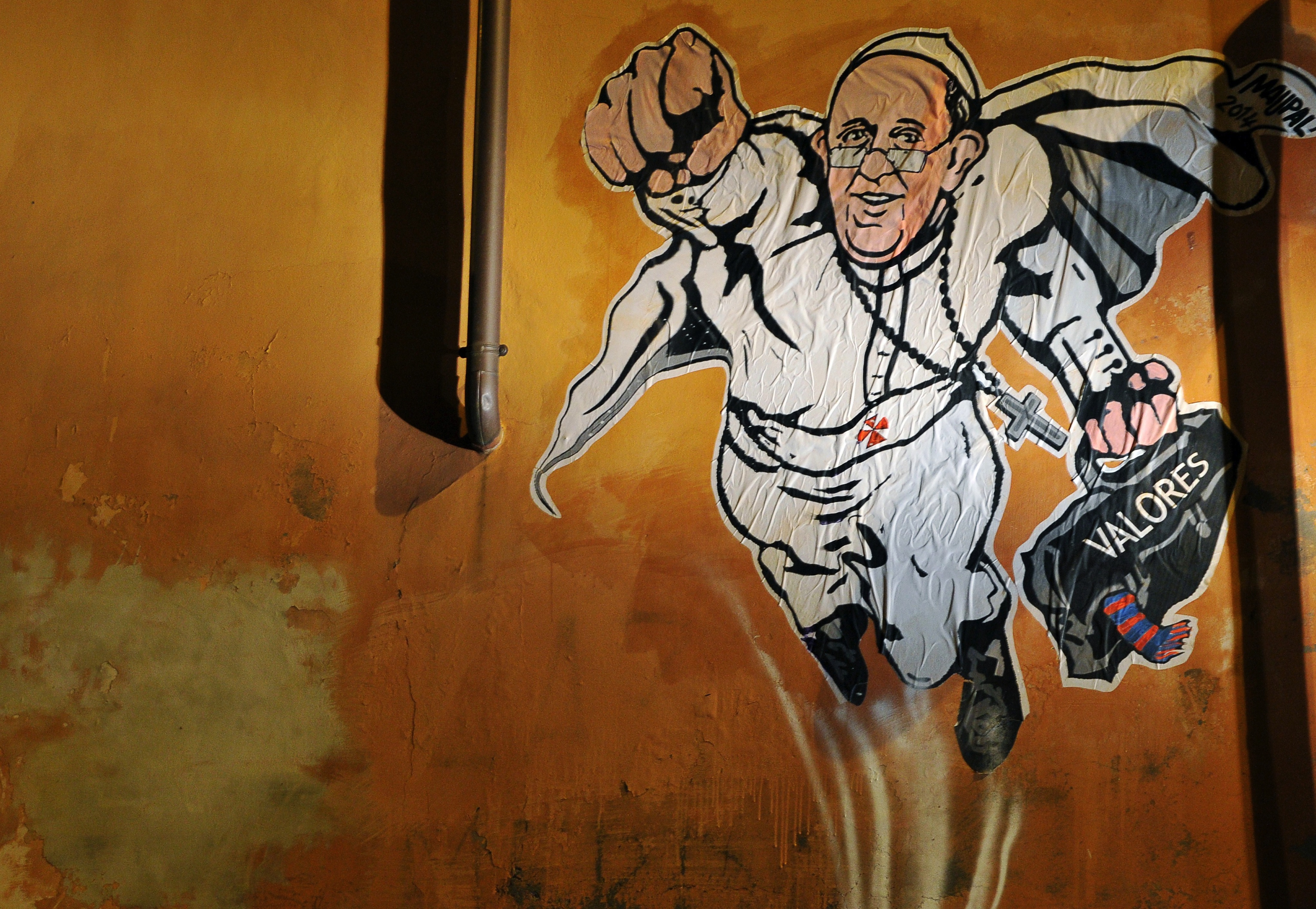
(Photo: A mural by Italian street artist Maupal depicts Pope Francis as a superman, flying through the air with his white papal cloak billowing out behind him and holding a bag bearing the word “Values” in downtown Rome near the Vatican on January 28, 2014. The image, created by Italian street artist Maupal, was tweeted today by the Vatican communication twitter account, @PCCS_VA. By Tiziana Fabi/AFP/Getty Images.)

Chart Of The Day

29edsal-chart-articleLarge

If you don’t follow Tom Edsall’s columns in the NYT, you’re missing some of the best deep-dive policy pieces on the web. When Ezra Klein speaks of integrating context into news, it sounds a little luftmenschy in the abstract. But Edsall does it all the time in a simple column. His latest is a must-read on a new, and potentially debate-changing book on the accelerating rise of inequality around the world. The book is Thomas Piketty’s Capital in the Twenty-First Century, due out in the US this March, but already a sensation in France. Piketty talks about his book here.

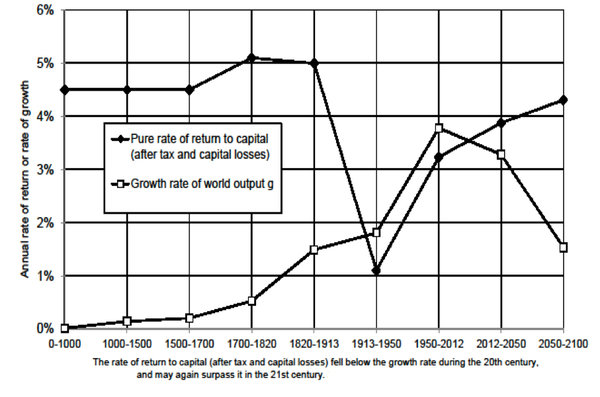
What Piketty is proposing is that the twentieth century was an anomaly in the history of global capitalism:

The six decades between 1914 and 1973 stand out from the past and future, according to Piketty, because the rate of economic growth exceeded the after-tax rate of return on capital. Since then, the rate of growth of the economy has declined, while the return on capital is rising to its pre-World War I levels.

“If the rate of return on capital remains permanently above the rate of growth of the economy – this is Piketty’s key inequality relationship,” Milanovic writes in his review, it “generates a changing functional distribution of income in favor of capital and, if capital incomes are more concentrated than incomes from labor (a rather uncontroversial fact), personal income distribution will also get more unequal — which indeed is what we have witnessed in the past 30 years.”

Edsall provides a variety of expert judgments on the book. I have a profound proclivity for exciting ideas that suggest we’re all doomed – so take my interest with a pinch of salt. But the book powerfully suggests a rather determinist view that capitalism constantly sows the seeds of its own destruction, by gradually and inexorably increasing social and economic inequality in such a way as to undermine the legitimacy of democratic politics that undergirds its existence. Let’s just say that Tom Perkins and Paul Ryan – as well as unreconstructed liberals who think government can truly defeat accelerating inequality – should read it.

Finding, Ctd

A reader continues the thread:

As a 36-year-old gay man who came of age in the ’90s, and who also happened to be interested in independent film, I was left so cold by cinematic portrayals of gay men in that era. And yeah, don’t get me started on Jeffrey. I once dated a guy who just raved and raved about how much he loved that movie, and when he finally convinced me to watch it with him, I nearly broke up with him right on the spot.  How could he and I possibly have anything in common?  I drifted towards the edgier stuff, which, somehow, while angrier, was also less overtly gay (more like coded gay).  Gregg Araki, Todd Haynes, that sort of thing. I liked it because of what it wasn’t (Jeffrey), but try as I might, I couldn’t get past the fact that most of those movies were just bad.

I was a programmer for a gay and lesbian film festival for a few years in a major city in the early 2000s, and the state of gay cinema depressed the hell out of me.

One in every 30 movies had anything at all I could grasp onto as being interesting, or in any way related to me, but I also soon came to see that’s just art in general.  Most of it is bad, aimed at the middle of the road, and not meant to ruffle feathers or be offensive in any way, or worse, have a point of view.

I used to rail against Will & Grace.  It perpetuated nasty stereotypes, it was de-sexualized, etc etc. Then I started watching it on syndication a few years ago at night during a particularly rough period of insomnia and realized it was actually hilarious.  Karen and Jack are a scream, while Will and Grace, ironically, are both deadweights to that show, totally uninteresting.  But comedy and stereotypes are always how minorities have ingratiated themselves into society.  If you can get past how utterly stereotyped it actually is, you might allow yourself to be amused by it.

The older I’ve gotten the less and less I want anything to actually be about being gay.  I much more readily appreciate entertainment that skillfully weaves a gay perspective into something else. As another reader pointed out, both Six Feet Under and The Wire had wonderfully and fully realized gay characters that were realistic, complex, and banal all at the same time.  I think that speaks far more powerfully to the gay experience than any show that purports to be about the gay experience.  My life as a gay man is not about being gay.  It’s about all the interactions I have with all kinds of people and contexts everyday.  I just happen to be a gay person doing it.

Another with experience in the area:

Thank you for your discussion about gays and films, as I find it very fascinating. Perhaps I can add some perspective on the issue as I was the operations manager for a gay and lesbian film festival here in Washington for almost 10 years.

I agree, many of the films we showed were cringe worthy, stereotypical or had ridiculous plots. Often times the acting was worse than wooden, in the direction amateurish. Nonetheless, over a ten day period, we would sell over 20,000 tickets. Partly that is because audiences were so hungry to see images of themselves on the big screen. Remember, it wasn’t until the late ’90s where regularly saw gay and lesbian characters in mainstream movies and TV. Where else could we find ourselves anywhere and be able to watch them in a safe place? For decades, gay characters have been presented as evil, perverted, or ended up dead. You cannot underestimate the importance of seeing our stories being told by our people on the big screen, especially for people who’ve been fed a steady diet that they are perverted or unwanted.

For minorities within the gay community this was even more important. If we showed a film that featured primarily black actors I can assure you the audience would be packed filled with blacks, and often times that was the only film they would come out to see. Movies from Asia were seen primarily by Asian audiences. Lesbians flocked to movies about lesbians.

Furthermore, there were indeed some films that were actually very done. Some of the very best films we ever showed were documentaries, and these told our stories in moving ways. If you missed those docs you really missed a major cultural impact, and I’m sure you missed important moments in our histories.

Our filmfest, along with the dozens of other filmfest held across the United States and the world, provided opportunities for up-and-coming filmmakers. Without our filmfests, there would be almost no opportunities for their films to be shown anywhere. We created a market for gay and lesbian films where there was none before. By creating that market we encouraged and nurtured young directors and filmmakers, who otherwise had no outlets for their talents. You have to start somewhere and we gave many filmmakers that critical boost early in their career.

Over the years the quality of the films dramatically increased. If you think the films are bad today you should’ve seen what was being shown in the early ’90s. Back then, there was very little to choose from and what was out there was poorly done. I believe that the role of these gay and lesbian film fests around the world played a significant part in increasing the general level of filmmaking.

If you want better filmmaking as an art form then you have to become a patron. It’s always easy to sit on the sidelines and criticize that no one is doing good work. But I can assure you, if no one supports an art form, no good work will ever arise. We need audiences and we need people to support the art, or else it will surely never improve. This is a virtuous cycle, and by being a patron you can be a part of it. Just being part of the audience helps these from the filmmakers immeasurably. If you can take on the role of being a true patron of the arts then quality filmmaking will be happen even faster.

Silver Fox

Frank Rich digs into the demographics of Fox News:

All three cable-news networks are hemorrhaging young viewers (as are their network-news counterparts) in an era when television is hardly the news medium of choice for Americans raised online and on smartphones. But Fox News is losing younger viewers at an even faster rate than its competitors. With a median viewer age now at 68 according to Nielsen data through mid-January (compared with 60 for MSNBC and CNN, and 62 to 64 for the broadcast networks), Fox is in essence a retirement community.

Derek Thompson thinks this largely explains Fox’s success, because the “entire cable news industry relies on building a product for ages 60 and up”:

[F]undamentally, Fox News is at an unassailable advantage on its turf because it’s selling a conservative political product to an older audience, which tends to be more politically conservative, anyway. Over the last three general-election cycles, the 65+ group voted for the GOP presidential candidate by an average of 9 percentage points.