The Last Of The Video Stores

832299876_36e55e849d_z

Jennifer M. Wood is excited they still exist:

Hop the F train from Kim’s final location to Brooklyn and you’ll find Video Free Brooklyn, a tiny storefront touting the tagline that “Video stores didn’t die, they just had to evolve.” Originally opened in 2002, the space was taken over by the husband-and-wife team of Aaron Hillis and Jennifer Loeber in 2012. While the decision to purchase a video store at the height of streaming’s assault on the traditional rental industry seemed counterintuitive, Hillis calls it “a labor of love that, surprisingly, also made economic sense.” …

Though the store measures just 375 square feet, basement storage allows Hillis—a noted film critic in his own right—to keep approximately 10,000 discs on hand. But rather than compete against the same wide-release films and television series that one can watch with the click of a button and an $8.99 streaming subscription, Hillis is curating a library of hard-to-find fare. “After the floodgates of the Internet opened, we’re now drowning in content and especially mediocrity,” Hillis says. “Video Free Brooklyn’s model is almost a no-brainer: My inventory is heavily curated, but so is my staff, all of whom work in the film industry and have extensive, nerdy knowledge about cinema. Coming into the shop is about nostalgia, the joy of discovery, and getting catered recommendations from passionate cinephiles. It’s a hangout, like the record store in High Fidelity.”

How others are surviving:

[T]alk to any two independent video storeowners in the city and they’ll offer a variety of reasons for their success. The common denominator? A deep understanding of their neighborhoods and customers.

That insight is what has allowed Video Room, an Upper East Side mainstay and Manhattan’s first video store, to keep going for over 35 years, according to its manager, Howard Salen. He has worked there since 1986, and describes the store’s customers as “intelligent Manhattanites” who tend to be older. So they curate to just that: offering a wide array of foreign and classic films, as well as new releases by the Woody Allens and Wes Andersons of the film industry as opposed to the Michael Bays. They also have a secret weapon–a video transfer service. Customers bring in home videos of their families that were filmed on VHS and Video Room converts them to DVDs or other updated digital formats. For Video Room, appealing to a younger clientele is a lost cause. They see video stores as antiques. “Ten years ago they’re everywhere,” said Mr. Salen. “Now they’re from a time capsule.”

Will Malitek, who opened his Greenpoint video store Film Noir about ten years ago, would disagree. His business survives off young customers – those of the artsy Bedford Avenue scene. Mr. Malitek is the type of cinephile who thinks Japanese director Yasujirō Ozu is mainstream, and his collection mirrors that mindset. Though he has the occasional big film–a copy of Cowboys & Aliens, for example–he specializes in cult movies and obscure foreign films. He used to have a new releases section but got rid of it once Netflix arrived. But he doesn’t see Netflix or on-demand as huge competitors since most of the films he offers simply can’t be found elsewhere. “Even if you do find some of them, you’re not going to find all the extras and that’s what my customers want to see,” said Mr. Malitek.

(Photo by Wally Gobetz)

You’ve Got Mailer

William H. Pritchard offers the context for Selected Letters of Norman Mailer, a newly published volume of the writer’s correspondence that stretches to nearly 900 pages:

Mailer wrote some 45,000 letters, and this selection amounts to less than 2 percent of the whole. For comparative epistolary output from other 20th-century writers, Lennon notes that Willa Cather wrote 2,700, Elizabeth Bishop a few thousand, Hemingway 10,000. When Lennon began work on the project in 2002, he figured it would take a few years; he was soon overwhelmed. By way of accounting for such an extraordinary output, Gay Talese observes that no writer of Mailer’s generation was more accessible: He wrote, by a rough count, to 4,000 individuals, and his typical letter is long rather than short. If letters piled up while he was at work on a book (which was always), then he would answer them in gusts of whirlwind energy. It’s safe to guess that most of those who wrote to Mailer got back at least as much as they put out.

Richard Brody points to one of the persistent themes of Mailer’s letters – the way he measured himself “on the yardstick of the Great American Novel”:

He harbored the thought that his 1965 novel “An American Dream” was “probably the first novel to come along since ‘The Sun Also Rises’ which has anything really new in it.” In 1971, he wrote that “it’s necessary to reestablish the right of the novel to exist in these profoundly unnovelistic times”; that “in a sense one has to invent the idea of the novel all over again”; and that “anyway I’m sick to death of my special brand of journalism.” But he had to keep going, to support his family and to pay back taxes—and he also was uncertain about the novel as a genre, as he wrote, to [J. Michael] Lennon, in 1972:

I have come to a place where I think it is almost impossible to go on with a novel unless one can transcend the domination of actual events—invariably more extraordinary and interesting than fiction. So if this new novel is good enough, it may serve to underline how hard it is to write a novel today and how journalism when it becomes an existential species of non-fiction can generally be superior to the novel, superior even on metaphysical grounds—but this last I don’t dare go near.

The novel in question, which took Mailer ten years to write, was “Ancient Evenings.” In 1975, he wrote to the film director Peter Bogdanovich, “I am set to write the great American novel but keep finding ways to tackle myself on the two-yard line.”

And Dwight Garner notices a particularly compelling letter about the sources of certain writers’ greatness:

In a 1960 letter to Diana Trilling, he argued that many great writers are thus because of their built-in limitations, the way they are hobbled. “Faulkner writes his long sentence because he never really touches what he is about to say and so keeps chasing it; Hemingway writes short because he strangles in a dependent clause; Steinbeck digs into the earth because characters who hold martini glasses make him sweat; Proust spins his wrappings because” a gay man “gets slapped if he says what he thinks.”

Read one of the letters in the volume, from Mailer to Henry Miller, here.

John Brennan Is Still Lying, Ctd

US-TORTURE-INTELLIGENCE-POLITICS-BRENNAN

[Re-posted from earlier today]

The CIA director made one small concession yesterday. Here is his Rumsfeldian rumination on whether torture gave the US any actionable intelligence that “saved lives”:

I have already stated that our reviews indicate that the detention and interrogation program produced useful intelligence that helped the United States thwart attack plans, capture terrorists and save lives. But let me be clear: We have not concluded that it was the use of EITs within that program that allowed us to obtain useful information from detainees subjected to them. The cause and effect relationship between the use of EITs and useful information subsequently provided by the detainee is, in my view, unknowable.

The key word there is “subsequently.” He’s arguing that some useful intelligence was later acquired from prisoners who had been tortured. What’s he’s conceding is that torture gave us no real intelligence – against the claims of his predecessors and Cheney. But he wants the broader question of whether torture played a role in prepping prisoners to give information in traditional, humane and legal interrogations to remain an open one. Well, let’s go through the report to see if he has a leg to stand on.

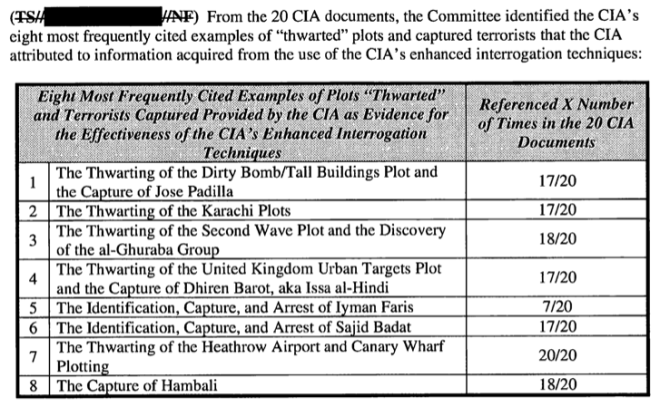
The Senate’s report lists the plots the CIA has relied most heavily on when making the case for the efficacy of torture:

CIA Plots

The report goes on to debunk torture’s role in each of these cases. Here are the key points:

Tall Buildings

So in this case, all the intelligence necessary to thwart a barely existent plot by utterly unserious criminals was discovered before torture was instigated at all.

Karachi Plots

Another claim eviscerated by the CIA’s own evidence.

Second Wave Combined

Again: torture was utterly irrelevant to this amorphous plot far from being operational.

UK Plot Four

Another phantasm of a plot revealed by sources independent of the torture program.

Faris

So this canary sang without any torture at all.

Badat

And so it goes. Notice that all of this evidence is taken from the CIA’s own internal documents. This is not the Senate Committee’s conclusion; it is the CIA’s.

Heathrow Combined

Yet another dud. And therefore yet another lie.

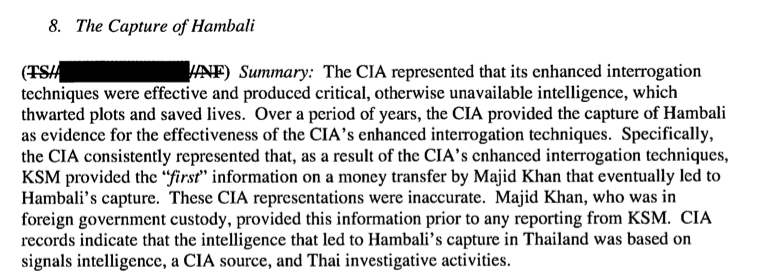
Hambali Capture

Look: if every single one of the CIA’s own purported successes evaporates upon inspecting the CIA’s own records, what’s left?

Does Brennan know of other cases of alleged plots disrupted by intelligence procured through torture? You’d think in all its strenuous efforts to prove that its program worked, the CIA would have mentioned other plots. But if they don’t exist, Brennan’s claim of “unknowability” evaporates into thin air. It’s total bullshit. As for the need to interview the torturers, why? When the CIA’s own documents show that these mainly unserious plots were foiled by other means entirely, what is left for the torturers to say? That some things discovered by legal means were also blurted out – among countless untrue things – after torture sessions? As for the details of all these cases, I recommend reading all the footnotes. They flesh out the summaries above.

This seems to me to be a crucial issue of truth and falsehood.

What Brennan said yesterday was, in contrast, spin: some kind of sad attempt to square a circle that is adamantly circular. There is no evidence in the entire CIA archive that shows that any prisoner provided truthful information “subsequently” to being tortured. None. All the information necessary to foil every single plot cited by the CIA was recovered by legal, moral and humane means. All of it. This is not an opinion, a judgment … but a fact.

And that means that on this critical, foundational question, one that gets to the heart of Western civilization, John Brennan is a liar. And his lies and deceptions matter. That a CIA chief can get up and tell us that something is unknowable when it is already fully known is someone who has forfeited the public trust in a profound way. He’s lying to protect what’s left of the reputation of the CIA. He refuses to discipline any war criminal in his ranks, and defends the bulk of them. And let us be perfectly clear: all of this is criminal activity. Committing war crimes and then refusing to acknowledge them as such violates the Geneva Conventions and the UN Convention of Torture and domestic law.

I want to move past this as much as Brennan does. But you cannot move past it without reckoning with it, without facing up the the facts, and bringing accountability to government. Obama and Brennan refuse to do it. And by refusing to come to terms with the facts, they have left this as some kind of open debate, when it is, in fact, closed. And that opening is all we need to see torture return.

On this one, the war criminals meep-meeped the president. And he didn’t even seriously try to stop them.

(Photo: CIA Director John Brennan takes questions from reporters during a press conference at CIA headquarters in Langley, Virginia on December 11, 2014.  By Jim Watson/AFP/Getty Images.)

Emails Of The Day

A reader writes:

From early 2006 to late 2009, I was a part of the post-9/11 corporate-security state serving as an intelligence analyst. This is not a fact in which I take much pride. When the Abu Ghraib scandal became augmented with the information that CACI contractors were involved – CACI being known where I’m from primarily as a tech services contractor – I started to question the incentives and structure of the intelligence contracting field in which I’d become enmeshed.

Over those years I followed the torture and spying revelations closely and I took the same position then that I do now: this is plainly illegal, immoral, and the result of caustic fear, overreaction, and hysteria. Though I was not involved with anything remotely connected to torture, one of the best days of my life was the last time I walked out of that office.

I’m attaching an image that’s been making the rounds on my Facebook feed and receiving aTortureTerrorists sobering amount of likes. The reason I’m sending it along is because the people posting it are my former coworkers, people who, as far as I know, are still involved in intelligence analysis work either through some contracting company or for the government directly.

It’s important to understand how, at least where I worked, the atmosphere was one of an assumed political stance – that 9/11 was an existential threat and perhaps the greatest faced ever in the country’s history, and that we were involved in this apocalyptic battle as foot soldiers. The views of many of my coworkers at the time were, to my mind, rather extreme.

I can see now that this hasn’t changed for many of them, despite all the evidence put forth this week. Yet unlike the rest of the American public, these are people doing the work for the government. They are the people down in the trenches, generating analysis and reports. They work for companies under contracts whose primary incentive is to get bigger, longer, more expensive contracts, and one way to do this is to constantly remind people how terrified we should all be.

And here’s the kicker: many of them came into this kind of work directly out of college and were paid pretty well for it. Their entire adult lives have been based on this type of work. They’ve known nothing else. One can’t expect that such a situation wouldn’t have an effect on their political views. A subset of an entire generation has been profoundly affected in ways we don’t discuss enough. To get a full understanding of this period of torture, surveillance, and bungled wars, one must consider the contracting aspect of it and the people for whom such work created the prosperous upper-middle class life that many Americans have come to expect but which fewer and fewer can achieve.

Another insider perspective:

In my personal assessment, the reason Brennan and Obama have fought this report is to protect the promise of legal protection for lawful actions upon which every employee depends. I believe my assessment has some value, as I work at the CIA.

I can tell you that the recently-remodeled exercise facility OHB is closed for cleaning from 10 to 11.   I can tell you that the Dunkin’ Donuts is more popular than the Starbucks.  I can tell you that for weeks after the portrait of Tenet was unveiled, his ashtray and cigar were left untouched.

What I cannot tell you about is the torture program, because I do not know anything more about this program than an other American.  And by revealing this information I reveal little of my identity because this characteristic of me is shared by the vast majority of the “blue badged” and “green badged” individuals who work here.

The CIA is composed of four directorates, which each consists of many offices, divisions, and branches.  The people who work here all do very different things. This includes everything from keeping worldwide, secure, communication-systems working, to digging through old copies of Iranian technical journals, to developing tiny chemical sensors, to writing hundreds of briefings for policy makers.  The opinions of those I work with regarding the torture program probably reflect that of the general American public.  Many, like me, are horrified.  Many think folks got what they had coming.

What everyone does understand, though, is the fundamental importance of legal protection. They have been assured that if they, in good faith, seek and receive legal guidance from the Inspector General that what they are doing is legal, they can rest assured that they will not be help responsible even if this legal ruling is incorrect.

Call this the Nuremberg defense if one wishes. However, it is the same legal protection that military snipers rely upon when they squeeze the trigger.  And a key aspect of this protection is the protection of identity. A person legally authorized to do things is protected from the vengeance of those who might not agree.

My assessment is that upholding this promise to leave no man on the battlefield is so crucial to the bond of trust upon which all those who have sworn an oath to the government that it is worth fighting for.

Amehrica

Aaron Blake passes along some downbeat news regarding the national mood:

1) A New York Times poll showed just 64 percent of Americans believe in the American Dream. That’s the lowest that number has been since at least 1996.12-11-2014_05

2) A Pew Research Center poll showed just under half — 49 percent — of Americans said they expect next year to be a better year than this year. That’s the lowest that’s been since the recession, and a couple years before, too.

3) An AP-GfK poll shows just 13 percent of Americans say they are confident that Republicans and President Obama can come together to address the country’s problems. (A similar question from Pew found just 20 percent expect Congress and Obama to “make progress” on important issues.)

So, to recap, Americans have hit low points on their belief in our country’s main economic principle, their general feelings about life and their faith in our government. That just about covers it.

Meanwhile, Paul Campos responds to a remark from the recent Chris Rock interview:

If poor people knew how rich rich people are, there would be riots in the streets. If the average person could see the Virgin Airlines first-class lounge,* they’d go, “What? What? This is food, and it’s free, and they … what? Massage? Are you kidding me? …

*Offers spa treatments, “expert mixologists,” and, at Heathrow, a “lodge and viewing deck” with an “après-ski vibe.”

Once a social system has moved all or nearly all of its members above the level of brute starvation, wealth and poverty soon become inherently relative concepts, but that doesn’t make them any less real. One of the consequences of living in an extremely rich country which features increasingly extreme wealth stratification is that people who would have been considered rich fifteen minutes ago are suddenly part of the “upper middle class.”

Take, for example, what has happened to economic relations within the American university.

It’s well known that American colleges and universities must increase their operating budgets every year at rates faster than inflation because of reasons, and therefore it becomes inevitable, given the contemporary economic structure of the country as a whole, that these institutions will spend enormous amounts of time and money currying favor with super-wealthy potential donors. Giving money to a “non-profit” educational institution provides the masters of the universe with sweet tax breaks, while allowing them to indulge in the ego-gratifying pleasures of plastering their names all over various buildings and centers and even whole schools and colleges.

Cillizza checks in on perceptions of social mobility:

It’s easy to believe there is direct correlation between people not believing in the American Dream and prolonged periods of economic struggle.  Which would explain the downward trend of the numbers in the Times poll over the last decade as the economy has sputtered. The question is whether the slowness of the current recovery is what’s to blame for the extended pessimism about hard work achieving results or whether we, as a country, have simply entered a different stage in our relationship with the idea of the American Dream.

There’s some reason to believe the latter explanation is more correct. Consider this, from the 2014 national exit poll: Almost half of all Americans — 48 percent — said they expected life for “future generations” to be “worse than life today,” while 22 percent said it would be better. Another 27 percent said life would be about the same. Do the math and you see that more than twice as many people are pessimistic about the future that they will leave their kids as those who are optimistic.

It’s easy to be downbeat about the state of the union this week, learning all of the horrific actions taken by the CIA in America’s name over the past decade. But this reader has it right:

I object to the Hong Kong newspaper’s characterization that “the report was a heavy blow to the credibility and global image of the U.S.” The Bush Administration’s actions described in the report are the disgrace. The Obama Administration’s unwillingness to investigate the torture program is a disgrace. But the Senate report is an affirmation of the credibility of the U.S. And hopefully it is just the first step in righting this horrific wrong.

Know hope.

Lumbersexuals, Ctd

Willa Brown reflects on the phenomenon:

Americans are currently enduring another prolonged bout of unease, stretching back at least six years. Since the Great Recession began, there has been a general handwringing in the media about the state of men—even the End of Men. The economic downturn disproportionately affected men, and it is clearer than ever that the single-breadwinner family is finally dead. The “traditional” role of the man as the primary provider is now firmly out of reach for most Americans. Which is why it seems particularly apt that (mostly) white, young, urban, middle-class men have once again picked up a symbol invented in the early twentieth century by men very much like themselves, a symbol that has long been gathering dust. …

At the turn of the last century, middle-class white men were, everyone seemed to agree, in crisis.

They were effete, anxious, tired, and depressed. Magazines and advice books worried that they had lost their vigor—the industrial economy and urban life demanded too much time inside, too much brain-work. Clerical jobs in dingy offices provided few opportunities for advancement to the ranks of the industrial elite, much less for feats of bravery and derring-do. Men trapped in cities began suffering from neurasthenia, a new disease that skyrocketed to almost epidemic status in the 1880s and 1890s. Neurasthenia was the overtaxing of the nervous system, a sort of male hysteria. Some wealthy and educated urban men suffered from what historian T. J. Jackson Lears called “cultural asphyxiation … a sense that bourgeois existence had become stifling and ‘unreal.’”

While women were ordered to bed rest for hysteria, the cure for men seemed to be just the opposite: They had lost their vital force, and they needed it back by getting in touch with their primitive, masculine nature. To do so, they looked westward.

Erik Loomis responds:

I don’t know. Is a bunch of bearded hipsters dressing like loggers really a crisis of masculinity? Are these guys really worried about a suppressed manhood that needs to come out? I’m skeptical. I agree with Brown that this is a middle-class romanticizing of working-class culture but I don’t think it’s that comparable to the Progressive Era. I think it’s really more about a broader desire for individualized authenticity among a larger group of people under the age of 35 or so that revolves around working with your hands, semi-opting out of the traditional work norms, and seeing the products of your work. It seems to me that this phenomenon is more closely related with women and the knitting craze and having backyard chickens than TR-style masculinity assertion. After all, do you feel like young hipster men today are really worried about what it means to be a man? Is that a big part of their conversation? I don’t see it in the public realm.

My thoughts on the lumbersexual here.

A More Complex Picture Of College Rape

Unreported_Crime.0

Contrary to the conventional wisdom, new data from the Bureau of Justice Statistics suggest that college women are actually less likely than their non-student peers to become victims of sexual assault:

The report estimates that 6.1 of every 1000 college students are raped or sexually assaulted every year; assault is slightly more common among college-age nonstudents (7.6 per 1000). Those rates are lower than other studies of college women, including federal studies, have found. The BJS says this is probably a difference of methodology: the crime victims study, which this report is based on, simply asks women about “unwanted sexual activity,” while other studies list specific behaviors or scenarios women might have experienced.

However, the BJS data also confirm that most rapes go unreported, as the above chart illustrates:

Sexual assault victims are typically much more likely not to go to the police than victims of other crimes … But reporting rates are especially low among college students.

Among young non-student women, according to the new report, 67 percent didn’t report their assaults to the police — that’s a little higher than the average for all sexual-assault victims (which is about 65 percent) but it’s about comparable. Among college students, however, 80 percent of victims didn’t go to the police.

Furthermore, it doesn’t look like college students are reporting assaults to college officials, either. 14 percent of nonstudents said that they didn’t report their assault to the police, but did report to another official (which the survey doesn’t define). But only 4 percent of students said they went to another official or administrator.

As Brandy Zadrozny observes, the data also show that college-aged men are significantly more likely to get assaulted than non-students in the same age group:

Though fewer college-age men are raped or sexually assaulted than women, it happens to about 9,400 men annually. Men ages 18 to 24 enrolled in college were more likely to become a victim. Men in college were raped or sexually assaulted at a rate of 1.4 per 1,000, almost five times the rate of non-students (0.03 per 1,000). Men made up 17 percent of rape and sexual assault victims in college and just 4 percent for nonstudents.

Libby Nelson explores why different surveys turn up such markedly divergent numbers on rape:

The Centers for Disease Control and Prevention’s study on intimate partner violence finds much higher rates of sexual assault in the general population than the crime victimization survey does. The difference lies in how the questions are worded. Researchers in other surveys, including the CDC’s, don’t necessarily use the term “rape” or “sexual assault” at all. Instead, they ask much more specific questions about what happened, such as “when you were drunk, high, drugged, or passed out and unable to consent, how many people ever had vaginal sex with you?”

Christopher Krebs, the lead researcher on the Campus Sexual Assault Study, a study of two colleges that led to the widely cited “1 in 5” statistic, says the term “rape” carries heavy baggage. “Women often think of rape as something perpetrated by a stranger, someone they don’t know, someone jumping out from behind a bush or behind a car,” he says. “They think of something that happens that’s violent: they had to be hit or kicked or threatened. They think of it as something that happens when you’re around people you don’t know.”

What Universal Healthcare Doesn’t Cover

Charles Kenny examines attempts to provide healthcare in the developing world:

A World Bank review of extending universal health coverage in developing countries found that providing subsidized or free care did increase access to those services, especially by the poorest people. Such schemes also reduced recipients’ out-of-pocket expenses associated with health care. There were also some successes related to health outcomes. Argentina’s Plan Nacer, for example, provided services to pregnant women and young children, which was associated with a 2 percentage point reduction in early newborn mortality.

Yet only five out of 18 studies of coverage roll-out found a positive impact on health indicators such as death rates or reduced sickness.

A big reason why:

In sub-Saharan Africa, the five leading killers are malaria, HIV, lower respiratory infections, diarrhea, and malnutrition. Further and growing causes of mortality across the developing world include traffic accidents, tobacco usage, and health conditions related to being overweight. Clean water, access to and use of toilets, condoms, soap, vaccinations, and and bed nets, alongside better nutrition, tobacco controls, and road safety measures can prevent the majority of these deaths. Doctors and nurses save thousands of lives a day, but infrastructure and public health interventions—neither requiring highly trained medical staff—save many millions each year. Often, the medical system can do little more than provide palliative care when these other approaches aren’t used or don’t work.

Tis The Season For Cheap Real Estate

Joe Pinsker flags research by L. Rachel Ngai and Silvana Tenreyro on why house are more expensive in the summer than the winter:

Ngai and Tenreyro haven’t built a model that explains exactly why prices vary with the season, but they can at least speculate. It might seem like weather would be a factor—it’s more pleasant to scope out properties during the warmer months—but prices vary significantly even in places where summer and winter are tougher to distinguish, such as Los Angeles and San Diego.

They guess that it has to do with the timing of the school year.

“We think parents of school-age children find it more convenient to search in the summer,” Tenreyro says. But, as she notes in her paper, that contingent is only estimated to make up less than a third of prospective home buyers at any given time—a substantial proportion, but not enough, it would seem, to determine when the majority of homes are sold.

This group’s disproportionately large impact gets to the heart of how Tenreyro and Ngai’s model works, in that it accounts for a snowballing effect. “Because there is this critical mass that prefers searching in the summer, then sellers put their houses on sale in the summer,” Tenreyro says. “And because there are more houses for sale, then other buyers also then prefer to search in the summer and so on and so forth. The effect gets amplified as a virtuous circle.” In this way, the unique preferences of a relatively smaller group of home buyers ends up dictating the market for everyone else.

Would You Report Your Rape? Ctd

A reader adds a new angle to the thread:

I was convicted in 2001 of embezzling more than a million dollars, for which I served 1-1/2 years in prison. I may come at this from a different angle, being a gay man who was raped in prison, rather than a straight women raped in college. I didn’t report my rapes (there were three). I didn’t even discuss them with friends.

First, if you think reporting a rape in a college environment is hard on the reporter, it is pure hell in prison.

The very first thing that happens is you’re transferred from your housing unit, so you lose your job and program. I was in a terrific program with one of the greatest teachers of my life, so the loss would have been substantial.

Second, why one was moved becomes common knowledge very quickly (in prison, gossip travels faster than the speed of light), so you will be a target, an known easy mark, wherever you’re put next. Third, the accused, at worst, suffers the loss of a few days good time. Most of the time, the event is found to be consensual sex (because I was gay, so of course I’d want to have sex with a man) and both are punished. I wouldn’t even be able to get medical care to ensure I did not seroconvert (I am HIV-). There was very little upside to reporting. So, I kept quiet and found ways to keep myself out of the situation.

I am sad to say that being raped was not the most traumatic thing to happen in prison. But even now, ten years later, every so often, I still wake in the middle of the night shaking with fear because of my stay there. On the other hand, I wouldn’t now report either. It is over with and done. I’ve moved on and don’t want to be involved in anything there. If this places others in danger, so be it. I don’t think the report would be fair to me or to anyone I accuse. After so long, even I don’t trust my memories of the events.

Thus, I don’t blame people for not reporting – it is a very personal decision. But I also don’t think accusations long after the rape are helpful either. Either go forward at the time, letting the chips fall where they may, or let it go.