Marriage Equality Update

Lyle Denniston unpacks yesterday’s news out of Oklahoma:

In ruling against the state’s ban on same-sex marriage, the judge declared that it violated the U.S. Constitution’s guarantee of legal equality.  He ruled that the Supreme Court’s ruling last Term in United States v. Windsor actually provided some support both for the challenging couple and for state officials defending the state ban.

The Windsor decision, the judge said, supports a plea for marriage equality because much of the reasoning of the Court majority about the purpose behind DOMA could also be applied to state bans on same-sex marriage.  It supports the state, the judge added, because of the lengthy commentary in the opinion about states’ primary power to define marriage.

In the end, however, the judge decided that Oklahoma’s ban was based on intentional discrimination, with a “stark” negative impact on gay and lesbian couples.  “This is not a case where the law has a small or incidental effect on the defined class; it is a total exclusion of only one group.”

Allahpundit chimes in:

If they want to discriminate against gay couples, they need to show some rational reason for doing so.

“Moral disapproval” isn’t a rational reason per the Supreme Court’s ruling in Lawrence v. Texas, the landmark case from 2003 that declared Texas’s anti-sodomy law unconstitutional. The upshot of Lawrence is that you can’t legislate morality when you’re targeting intimate relationships between consenting adults. You can regulate those relationships if you have some other rational reason for doing so, but the state couldn’t produce one here: “Encouraging procreation” doesn’t fly if you’re not also excluding straight infertile couples from marriage and “encouraging mother/father households” doesn’t fly if you can’t show how banning gay marriage would actually encourage the formation of those households. As I say, all of this is S.O.P. for federal SSM jurisprudence lately. The only real novelty is that, between this ruling and the ruling in Utah last month, the new legal battlefield over gay marriage lies in America’s reddest states. That may be an extra inducement for SCOTUS to deal with this sooner rather than later.

Telling The Truth About Iraq

Jeremy Lott hopes GOP presidential hopefuls will face reality:

Any Republican seeking nomination for the 2016 presidential election should at a minimum be willing to admit Iraq was a mistake.  It was an error that cost us upwards of $1.5 trillion, thousands of U.S. lives and hundreds of thousands of Iraqi dead, while seriously hindering our efforts to track down the real culprits of September 11. (The war, incidentally, helped pave the way for a Nancy Pelosi-controlled House and a Barack Obama-controlled White House, as well.)

Larison sees this as improbable:

There are some obstacles to what Lott proposes. Chief among them is the difficulty that many hawks in the party still truly don’t accept that the Iraq war was a mistake. Despite the fact that by virtually any measurable standard the Iraq war was a senseless waste of lives and resources, they don’t consider this to be the truth, so they won’t greet it with relief. At best, many hawks will agree that the there were flaws in the execution, but they remain convinced that the original idea was sound.

Readers know how terrible a mistake this was and is, in my judgment. Listening to what passes for “debate” about the continued sectarian warfare in Iraq – which never ended, and was never resolved by the surge, and is the core reason why Iraq as a country remains a democratic impossibility – has been a sobering moment. Men like John McCain have obviously not internalized for a millisecond the awful error they made. Their response has been either utter denialism or silence – which was roughly their position throughout the entire, horrifying experience.

And that helps explain a little the total bafflement of these old warriors at the possibility of a rapprochement with Iran. Because they haven’t yet absorbed the uselessness of military force to advance our interests in the region – indeed, its capacity to make our position measurably worse – they still see warfare as the natural response to a country now so crushed by sanctions it has allowed a relative moderate to take control. They cannot even see that the only real option to advance some kind of peace in Iraq is through Tehran, a natural ally against Sunni extremists in that “country”. And they cannot see that further polarization between the Muslim world (especially its most pro-American population in Iran) and the West does nothing but hurt us, and our standing in the world at large.

Meanwhile, Crowley wonders whether Clinton’s support of the Iraq War will become an issue in 2016:

If Clinton runs for president in 2016, she’s likely to emphasize the more dovish aspects of her record—including her public diplomacy to repair America’s international image, her focus on building ties in Asia, and her attention to women’s rights and development issues.

But at a time when fewer Americans support an active U.S. role in foreign affairs, Clinton’s comfort with the harder side of American power could be a vulnerability. A liberal primary challenger might well reprise Barack Obama’s 2007 line that Hillary’s record amounts to “Bush-Cheney lite.” One potential contender, Montana Governor Brian Schweitzer, has already been zinging her over her 2002 Iraq vote. “When George Bush got a bunch of [Democrats] to vote for that war, I was just shaking my head in Montana,” he said recently. Whether such attacks will hold even a fraction of the valence they did at the Iraq war’s peak remains to be seen.

Friedersdorf adds:

There is next to no chance I’d vote for a Republican who thought the Iraq War was prudent, or showed an eagerness for more military interventions. But neither is it enough for a Democratic candidate to claim that the problem with the Iraq was the way that the Bush Administration executed it. Habitual hawks like Clinton have to clear a particularly high hurdle. And no one should be elected president without showing, beyond any doubt, that they understand why the war was a mistake and how to avoid like mistakes in the future.

I’m with Conor on this one, unreservedly. Clinton gets no pass. I want to know how she understands her own responsibility for the fiasco. And how she accounts for it.

“No Discernible Impact”

Terrorism Cases

A New America Foundation study calls into question the government’s claims about the NSA’s metadata dragnet:

Surveillance of American phone metadata has had no discernible impact on preventing acts of terrorism and only the most marginal of impacts on preventing terrorist-related activity, such as fundraising for a terrorist group. Furthermore, our examination of the role of the database of U.S. citizens’ telephone metadata in the single plot the government uses to justify the importance of the program – that of Basaaly Moalin, a San Diego cabdriver who in 2007 and 2008 provided $8,500 to al-Shabaab, al-Qaeda’s affiliate in Somalia – calls into question the necessity of the Section 215 bulk collection program.

According to the government, the database of American phone metadata allows intelligence authorities to quickly circumvent the traditional burden of proof associated with criminal warrants, thus allowing them to “connect the dots” faster and prevent future 9/11-scale attacks. Yet in the Moalin case, after using the NSA’s phone database to link a number in Somalia to Moalin, the FBI waited two months to begin an investigation and wiretap his phone. Although it’s unclear why there was a delay between the NSA tip and the FBI wiretapping, court documents show there was a two-month period in which the FBI was not monitoring Moalin’s calls, despite official statements that the bureau had Moalin’s phone number and had identified him. This undercuts the government’s theory that the database of Americans’ telephone metadata is necessary to expedite the investigative process, since it clearly didn’t expedite the process in the single case the government uses to extol its virtues.

Meghan Neal is unsurprised:

This is hardly the first time experts have searched for a link between bulk metadata collection and foiled terrorist plots and come up empty-handed. So far, the only real value in collecting and monitoring billions of US phone records has been to provide extra support in investigations already underway by the FBI or another agency, or to verify that a rumored threat isn’t real (the “peace of mind” metric), the report found. But that hasn’t stopped NSA officials and the Obama administration from drumming up a connection between terrorist attacks and surveillance to defend the agency’s snooping.

Morrissey examines the pie chart seen above and asks if the program is worth it:

What has been the most effective method? Of those explicitly stated, it’s “if you see something, say something.” Community and family tips accounted for 17.8% of the origins of investigations, followed closely by 16% started by other informants. However, 27.6% are categorized as “unclear” — the largest single category, which makes the analysis much less reliable,  and might raise questions about how the NSA got those FISA warrants. Still, there were four cases unearthed through Section 215 (and possibly more in the “unclear” category). Is that enough to justify the program as a necessary evil to prevent worse evil from prevailing?

Zack Beauchamp thinks not:

NSA metadata collection isn’t totally useless; it’s just not very useful. When you start to look at the specific cases that metadata surveillance played a key role in, the picture gets grimmer for the NSA. The New America researchers found that metadata searches never led to an arrest that actually prevented a terrorist attack. Take, for instance, the arrest of Basaaly Moalin — the only case, according to NSA Director Keith Alexander’s sworn testimony, metadata surveillance may have sparked an investigation that stopped “terrorist activity.” All the government found on Moalin was $8,500 donated to Somali terrorist group al-Shabaab; “the case involved no attack plot anywhere in the world,” according to New America’s review. In almost all of the cases profiled by New America, metadata surveillance played a supporting role, unnecessarily displaced traditional investigative methods, or failed to uncover a serious plot.

Digby reminds us that for all it doesn’t do, this data program costs an awful lot of money:

And keep in mind this whole thing is happening in the context of an ongoing, long term austerity push that has us cutting off the long term unemployed and ending food stamp benefits. That Utah data farm alone cost 1.2 billion and is reportedly going to cost at least a couple billion more before it’s online. There was a moment in the early days of the NSA story in which we discussed the incredible boondoggle all this really was but it passed as the revelations unfolded. It’s good that the congress has decided to shine a light on that again, however briefly, in this budget process. After all, we have real people suffering in a stuck economy without enough jobs. We have a growing poverty rate. Our bridges and schools are crumbling. And yet the money for the military, police and all these attendant “intelligence” agencies has been kept secret until now. It’s only right that the people should at least know what the numbers really are.

Google Is Inside The House

Brian Ries sees Google’s $3.2 billion acquisition of the smart-home tech company Nest as part of a push for total data dominance:

No longer satisfied crunching data gleaned from the lives we lead on computers and smartphones, Google will soon have a hand in data that maps the patterns of our lives in our homes. Our home-data. Smart-thermostats will lead to smart-sinks. Smart-sinks will leak into smart-refrigerators. Smart-refrigerators to smart-stoves. Smart-stoves to smart-beds (already a thing). And so on. … The company, it can be surmised, could soon know the hours we sleep. The time we wake up. The amount of water we used when we bathe.

Madrigal’s take:

I think it’s easier to slot in this purchase with Google’s recent push into robotics, led by the former head of Android, Andy Rubin. Nest always thought of itself as a robotics company; the robot is just hidden inside this sleek Appleish case. Look at who the company brought in as its VP of technology: Yoky Matsuoka, a roboticist and artificial intelligence expert from the University of Washington. In an interview I did with her in 2012, Matsuoka explained why that made sense. She saw Nest positioned right in a place where it could help machine and human intelligence work together: “The intersection of neuroscience and robotics is about how the human brain learns to do things and how machine learning comes in to augment that.”

Joshua Gans worries that Google’s acquisitions are stifling innovation:

Some are concerned about the data. Nest have said that it will remain private. Frankly, that is the last of my concerns. The data is something that can be used to make things work better. In any case, my bet is that Google will provide an option to opt in to share data in return for some better features down the line. As with pretty much every other case involving privacy, people will give it up in a heartbeat without much in the way of negative consequences. That was inevitable — Google or no Google — and, in fact, Google has a reputation to stabilise with this and so is surely a better place for that data to reside.

My main worry is on the innovation front. I don’t want Nest to stop. But there are precedents for that happening with Google. My favourite example is GrandCentral. In 2007, GrandCentral had done the seemingly impossible — finally worked out a sensible way for people to have a single contact number. David Pogue described it quite perfectly and enthusiastically. Soon after Google bought GrandCentral. The hope is that they would bring it to scale and move it beyond the US. In other words, do what they are promising to do for Nest. It then lay dormant for 2 years before being relaunched as Google Voice. Apart from some basic integration, not much has changed. This was a service that should have replaced all others — including Skype — and it didn’t happen. It is hard to point the finger anywhere else but Google for that.

Henry Blodget wonders why Apple didn’t snatch up Nest first:

Nest makes connected thermostats and smoke detectors. It was founded by Tony Fadell, one of the guys who designed Apple’s iPod. Nest products look like Apple products. Nest products are beloved by people who love Apple products. Nest products are sold in Apple stores. Nest, in short, looked like a perfect acquisition for Apple, which is struggling to find new product lines to expand into and has a mountain of cash rotting away on its balance sheet with which it could buy things. But Apple didn’t buy Nest. Google did. And this appears to continue a pattern in which — in the bitter head-to-head battle between Apple and Google — Google is fixing its weaknesses (hardware) much faster than Apple is fixing its own weaknesses (software and services). At first glance, in other words, it appears that Google’s aggressiveness has once again caught Apple snoozing. And now a company that looked to be a perfect future division of Apple is gone for good.

Calling A Time Out On Recess Appointments

Yesterday, SCOTUS heard oral arguments for National Labor Relations Board v. Noel Canning, the case challenging Obama’s controversial recess appointments made during an intrasession Congressional break. Lyle Denniston observes that “some of the Justices whose votes the government almost certainly needs to salvage an important presidential power were more than skeptical”:

Perhaps the most unfortunate moment for presidential authority was a comment by Justice Stephen G. Breyer that modern Senate-White House battles over nominations were a political problem, not a constitutional problem.  Senators of both parties have used the Constitution’s recess appointment provisions to their own advantage in their “political fights,” Breyer said, but noted that he could not find anything in the history of the clause that would “allow the president to overcome Senate resistance” to nominees.

Serwer analyzes the case:

The question is how big of a headache the high court wants to give the Obama administration and future presidents–from either party.

Siding with the D.C. Circuit ruling entirely would make it much harder for the government to function, especially if the opposing party controls the Senate. With the filibuster nuked for presidential appointments, the stakes are lower because nominees can be confirmed by a majority vote. But the high court could rule that the Senate gets to decide when it’s in recess, ruling that only Obama’s recess appointments, made in defiance of unprecedented Republican obstruction, are invalid.

“If the Court does not allow the traditional recess appointments, you’ll have a federal bureau created by Congress but one that Congress won’t allow the president to staff,” said Adam Winkler, a law professor at the UCLA School of Law. It would also mean the recess appointment power would be all but useless to future presidents if the opposite party controls the Senate, because they could just keep it in session virtually all the time. That could be Obama’s fate if Republicans take back the Senate in 2014.

Ilya Sharpiro weighs in:

Justice Kennedy said that he was “in search of a limiting principle” to the government’s position—so as not to simply give the president sole discretion to determine when the Senate is or isn’t in recess. Justice Kagan was left asking both sides how the Court should rule given that the presidential practice—whose history prior to the Truman administration the parties dispute—seemed to so clearly contradict the constitutional text and structure.

And indeed that is the question: If it’s true, as an overwhelming majority of the justices seemed to think, that the president was only supposed to have the power to make recess appointments during intersession recesses, and only for vacancies that arose during such recesses, what does it mean that this correct interpretation has never been followed?

Last week, Eric Posner urged the Supreme Court not to rely on originalism when deciding the case:

[C]onsider what the originalist must ignore: the huge growth of the country, and the vastly expanded federal bureaucracy that allows the national government to be much more involved in the regulation of everyday life. In 1789, the president made do with a single part-time attorney general. Today, the Justice Department employs more than 100,000 people. The founders did not anticipate the party system, and could not foresee that opportunities for conflict between the president and Senate would multiply infinitely. They surely did not foresee all the opportunities for obstruction afforded to a Senate with 100 members (compared with 26 at the founding) that often operates by consensus, or supermajority rule.’

Andrew Rudalevige thinks Obama is in the wrong:

The basic issue facing the court is what counts as a “recess” — and, along the way, whether the Senate, or the president, gets to decide whether the Senate is sitting. Here I tend to agree that the Obama administration overstepped. In its memo in January 2012, the DOJ’s Office of Legal Counsel concluded that “the President… has discretion to conclude that the Senate is unavailable to perform its advise-and-consent function and to exercise his power to make recess appointments.” But as the D.C. Circuit responded, “Allowing the President to define the scope of his own appointments power would eviscerate the Constitution’s separation of powers.”  The president was acting rationally in the face of opposition obstructionism, seeking to activate the CFPB and rescue the NLRB from quorum-less impotence. But that doesn’t mean his actions were legal.

Bernstein approves of Rudalevige’s solution:

Presidency scholar Andrew Rudalevige runs though the issues involved, and suggests the Supreme Court should opt for a middle ground: Retain the president’s traditional recess appointment power, but allow senators to prevent recess appointments by remaining in session — even if “in session” means only holding pro forma meetings. That’s not a bad outcome. The Senate should have the ability to block presidential appointments; if a Senate under divided government really wants to refuse to staff the government, that desire is probably constitutionally protected, for better or worse. Those senators who refuse the president’s requests would risk the possibility of a backlash.

Earlier this month, Victor Williams hoped that the Court will decline to rule on the issue at all:

As I argued in amicus briefs to the DC Circuit and the Supreme Court [PDF], this case presents a non-reviewable political question. Throughout our Republic’s history, the court has recognized that some questions are committed by the Constitution’s text to the exclusive discretion of the elected political branches.

Allahpundit dismisses this argument:

Per Gabe Malor, there’s a chance that the Court could decline to rule at all on grounds that this is a political question, i.e. a dispute over powers between the executive and legislature on which the Constitution provides no meaningful guidance. Let the political process sort that out, not the courts. Two problems with that in this case, though. One: The plaintiff challenging O’s recess appointments in the NLRB case isn’t the Senate, it’s a corporation. Technically, this is a case about the executive’s power to regulate private entities by making appointments to regulatory bodies through dubious procedures.

Lastly, Harsanyi argues that, contra Andrew Rosenthal, that the extremism of the GOP is no excuse for abusing executive power:

“In this particular case” is the favored argument for ignoring tradition and the law. Neither party is innocent. I noticed John Yoo making a similar rationalization in a NRO piece criticizing Obama for executive overreach (snicker if you must) on NLRB appointments: “Presidents, I think, should make broader claims of presidential power when the stakes for the nation and the office are higher than whether Boeing should be allowed to open a plant in South Carolina,” he wrote.

If only Obama had a better imagination and loftier goals! Then, misusing executive power might be worth arguing for. For Yoo, The War on Terror trumps any concern about abuse. For Rosenthal, and many liberals, it’s Republican obstinacy to Obama’s agenda that is an unprecedented roadblock that excuses overreach.

Caught In An Instant

[vimeo 83664407 w=580]

Joshua Hammer profiles the photographer and video artist Adam Magyar, who creates stunning panoramas of urban life:

In a growing body of photographic and video art done over the past decade, Magyar bends conventional representations of time and space, stretching milliseconds into minutes, freezing moments with a resolution that the naked eye could never have perceived. His art evokes such variegated sources as Albert Einstein, Zen Buddhism, even the 1960s TV series The Twilight Zone. The images – sleek silver subway cars, solemn commuters lost in private worlds – are beautiful and elegant, but also produce feelings of disquiet. “These moments I capture are meaningless, there is no story in them, and if you can catch the core, the essence of being, you capture probably everything,” Magyar says in one of the many cryptic comments about his work that reflect both their hypnotic appeal and their elusiveness. There is a sense of stepping into a different dimension, of inhabiting a space between stillness and movement, a time-warp world where the rules of physics don’t apply.

The above video is from Magyar’s Stainless series, which captures fast-moving subway trains and waiting straphangers:

Magyar shot the footage at 56 times normal speed, turning 12-second blurs into nearly 12-minute films of excruciating slowness. His commuters stand, together yet apart, with the studied, three-dimensional grace of statues – only the twitch of a lip or a finger drawn toward an iPhone indicating that these people were caught in hyper-slow motion, inhabiting an elongated moment. Magyar extracts drama from an infinitesimal flash of time. “I want to capture something that happens in milliseconds, something that you don’t even realize took place,” he told me. “I’m extending the moments – the present, the now – because as humans we live only in the past and the future. But the only existence we have is now, and that is something that we don’t even consider.”

Carrying A Child In A Borrowed Womb

Nine women in Sweden have received womb transplants:

“This is a new kind of surgery,” Dr Mats Brannstrom said in an interview from Gothenburg. “We have no textbook to look at.” Brannstrom, chair of the obstetrics and gynaecology department at the University of Gothenburg, is leading the initiative. Next month, he and colleagues will run the first-ever workshop on how to perform womb transplants and they plan to publish a scientific report on their efforts soon. He said the nine womb recipients were doing well. Many had had periods six weeks after the transplants, an early sign that the wombs were healthy and functioning. One woman had an infection in her newly received uterus and others had some minor rejection episodes, but none of the recipients or donors needed intensive care after the surgery, Brannstrom said. All left the hospital within days.

Victoria Turk explains why the procedure is controversial:

[O]ne of the stickiest points in this particular study is the element of risk undertaken by the donors, and not just the receivers, of the transplant uteruses.

Because more blood vessels have to be taken from around the womb for it to have a better chance of functioning well, it’s a riskier operation than a regular hysterectomy. The question then, is whether it’s fair to let healthy people risk such medical complications for the non-life-saving benefit of someone else? The UK doesn’t think so, but there is a way around this. In a similar project planned for the end of 2014, doctors in Britain will instead use wombs from brain-dead donors whose hearts are still beating for transplants in five women. That’s more comparable to what usually happens in organ donation situations, and is a lot less controversial than asking a healthy person to go through the donation procedure.

Ultimately, however, all the risks for both parties—donor and recipient—must be weighed against the benefit of having a womb in the first place. Because the womb transplant won’t allow the women to have children the conventional way, and only through IVF, the only real advantage it offers is the chance to carry biological pregnancies. While that might seem a pretty slim benefit in itself, the problem is that right now, that’s pretty pivotal to having children at all. We’re not yet growing babies in Matrix-like pods. Sure, there’s adoption—but our widespread acceptance of IVF suggests we understand the desire to have our own biological children, so should women without a womb not also be given the same opportunity, if it’s at all possible?

George Dvorsky is more succinct:

This is all quite amazing — and it’ll truly be a major step forward for science and personal reproductive autonomy if and when the first baby is born as a result of this procedure. At the same time, however, it does feel a bit… privileged.

Nigeria Doubles Down On Terrorizing Gays

Homosexuality has been illegal there already, but for good measure, the government just enacted a new law criminalizing gay marriage and gay rights activism:

A new law in Nigeria, dubbed the “Jail the Gays” bill, is encouraging the persecution of gays and will endanger programs fighting HIV-AIDS in the gay community, said Dorothy Aken’Ova, executive director of Nigeria’s International Center for Reproductive Health and Sexual Rights. On Monday, President Goodluck Jonathan’s office confirmed that the Nigerian leader signed the Same Sex Marriage Prohibition Act that criminalizes gay marriage, gay organizations and anyone working with or promoting them. In Bauchi state, police entrapped four gay men and tortured them into naming others, Aken’Ova said. She said the police have drawn up a list of 168 wanted gay men, of whom 38 have been arrested in recent weeks.

Shackford is especially disturbed by the new restrictions on speech:

Any person who registers, operates or participates in gay clubs, societies and organizations or directly or indirectly makes public show of same-sex amorous relationship in Nigeria commits an offence and shall each be liable on conviction to a term of 10 years in prison.

That’s some scary stuff right there. Much like Russia’s ban on “gay propaganda” making it next to impossible to legally advocate for gays having the same rights as their heterosexual counterparts, this part of the law essentially criminalizes any sort of organizational efforts to ultimately overturn the law or attempt to change public opinion so that Nigerians don’t see homosexuals as enemies.

Robyn Pennacchia urges the Obama administration to reconsider US aid to Nigeria:

If we’re not going to support Russia because of their hideous anti-gay laws, I certainly don’t think we should be engaging with Nigeria either, terrorism or no. The reason we’re giving them support is because the Christian government is in danger of being overthrown by the northern Islamic population that seeks to implement Sharia Law. Which is bad, but this, quite frankly, is not the biggest step up. While the aid provided by France and other European nations may not be enough to convince Jonathan to repeal the law, the military and economic aid from the U.S. just might. In all likelihood, they probably need us more than they need to send people to jail for being gay. If he wants to fight terrorism, he can do it with all his oil money and perhaps some of his jaunty hat money, not ours. Because, quite frankly, this is terrorism. If we fund Nigeria while this law is in effect, we are funding terrorism of LGBT citizens.

If Not Christie, Who?

Beinart eyes the GOP’s shallow bench:

There are other potential Republican contenders who share some of Christie’s strengths. Like Christie, Wisconsin Governor Scott Walker can run as a tough, capable manager who isn’t from Washington. Like Christie, Rand Paul has defied his party on key issues—for instance, NSA surveillance—and may have somewhat greater appeal to the young. But of the potential candidates right now, only Christie can run as the bipartisan to Clinton’s partisan, the outsider to her insider, and the plain-speaking everyman to her scripted, poll-tested inauthenticity.

The weaker a political party, the more it requires a candidate of outsized reputation or unusual talent to overcome its deficiencies. That’s what that Republicans had in 1952, when a party still paying for its opposition to the New Deal changed the subject by nominating the general who oversaw D-Day. It’s what Democrats had in 1992, when a party hemorrhaging support among white voters found a governor gifted and ruthless enough to win some of them back. And it’s what the GOP had with Chris Christie, the rare national Republican who seems neither removed from the problems of ordinary Americans nor hostile to the cultural changes transforming the country.

Republicans had better hope Christie can still be that man. Because it’s hard to see who else in their party can.

I find it hard to disagree. Scott Walker as presidential timber? Seriously? Kilgore doubts Christie can recover:

Personally, I never saw Christie winning the nomination; his record on guns, his lack of ties to the Christian Right (his mockery of the “Shariah Law” obsession will infuriate them) and his support for Medicaid expansion would be terrible handicaps even when memories of his “treasonous” cooperation with Barack Obama on Sandy response late in the 2012 campaign faded. But whatever else transpires from the strange saga on the George Washington Bridge, Christie has very likely lost the talisman of being a certain general election winner for the GOP.

Chotiner agrees that Christie’s 2016 strategy is in shambles:

It will simply not be possible to view him in the same light. “Toughness” will come across as bullying; “straight-talk” will seem gimmicky; anger will appear thuggish.

What this means, most likely, is that he will have to reinvent himself into a different kind of politician: more buttoned-up, more responsible, less wild. This is a very difficult thing for even a skilled politician like Christie to do (especially if not all of his outbursts are planned). But it also defeats the entire purpose of his candidacy. Why not just nominate Marco Rubio or Scott Walker? (It also makes it impossible for him to paper over his differences with the Republican right; his plan was to do so by using his tough-guy demeanor.)

Drum’s bottom line:

I could see Christie winning if the country were undergoing some kind of horrific disaster, like the Great Depression. In a case like that, it’s possible that Americans would just want someone who’d kick all the right asses and wouldn’t much care about the other stuff. But 2016 seems likely to be a fairly ordinary year, with a decent economy and no huge foreign crises. If that’s how it turns out, I have a hard time seeing how Christie manages to win.

India Eradicates Polio

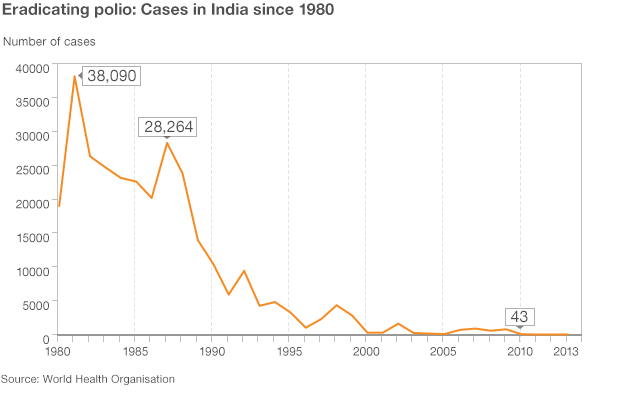
india_polio

Dylan Matthews details the good news:

More than 50 years since Jonas Salk discovered the first successful polio vaccine, the disease persists in developing countries. According to the Global Polio Eradication Initiative, 372 cases were reported in 2013, up from 223 in 2012. So it’s encouraging that India — which had 741 cases as recently as 2009 —  appears to have finally eradicated the illness, with the last reported case occurring three years ago.

Bill Gates applauds the diligence of the Indian government:

Five years ago, India was home to nearly half of the world’s new polio cases. At the time, if you asked any health expert, they would have said India would be the last place on earth to end polio.

India’s population density and high birth rate (27 million new children are born each year), combined with poor sanitation, was like a petri dish for polio. But the government of India, with help from the organizations that make up the Global Polio Eradication Initiative including Rotary International launched an all-out effort to stop the disease. The country deployed 2 million vaccinators to reach children who had never before been reached with polio vaccines or any other health services—children who live in flooded regions or hard-to-find rural towns, or are regularly in-transit with their families.

One of the most powerful images I’ve seen during my visits to India is that of parents proudly holding vaccination cards showing that their children were protected from deadly diseases for the first time. And now that these children have been found, health workers can supply them with much more than just polio drops. They can provide other critical health services like measles vaccines, clean water, and information about how to deliver their babies safely and care for them during their first weeks of life.

Keating examines how the disease still hangs on in some parts of the world, a problem the Dish recently highlighted:

Globally, there’s a strong link between polio and political instability. The disease has recently made a comeback in both the Horn of Africa and Syria, where years of brutal fighting have broken down national vaccination campaigns. There’s also a striking contrast between India, where 170 million children are immunized annually as part of a nationwide campaign involving hundreds of thousands of volunteers begun in the 1990s, and neighboring Pakistan, where a similarly aggressive campaign has been hampered by extremist attacks on volunteers. At least a dozen government vaccinators, whose efforts are portrayed by the Taliban as a Western conspiracy, have been killed or wounded in northwest Pakistan, in the past three months. Eighty-three new cases of the disease were reported in the country last year, making it one of only three in the world—along with Afghanistan and Nigeria—where polio remains endemic.

Francie Diep looks ahead:

Should the day come when polio is truly gone from the world, it would be the second vaccine-preventable disease that humans have eradicated. The only precedent is smallpox. The next, [epidemiologist Carol] Pandak thinks, may be measles and rubella. There are a couple of reasons those diseases are promising. Like polio and smallpox, they don’t have any animal carriers, which means no wrangling with microbes lying in wait in monkeys, bats or mosquitoes. There are also safe, effective vaccines for measles and rubella that work in children.