The Torture Doctors

Screen Shot 2014-12-12 at 5.49.36 PM

Michael Daly introduces us to the amateur goons who ran the torture freak show:

James Elmer Mitchell and John Bruce Jessen are not the first Americans to employ waterboarding and other “enhanced interrogation techniques” against our enemies. But they are almost certainly the only ones to get rich doing it.

They did so by employing what is widely dismissed as “voodoo science” based on misapplied principles in a program that CIA records suggest produced little, if any, intelligence of significant value. And they might have gotten even richer. The Senate Intelligence Committee report says they secured a contract with the CIA in 2006 valued “in excess of $180 million.” The CIA canceled the deal three years later, but by then the duo had received $81 million.

This is one reason I remain befuddled by the pro-torture right’s response to the facts in the report. If you are in favor of torture, you should be horrified that the CIA contacted it out to goons with no relevant experience or interrogation training. If you care about wasting government money, you should be appalled by this instance of total incompetence, rewarded by tax-payers. But the Republicans’ rank partisanship precludes them from being internally consistent and coherent. They’re just backing their own team – even as that team clearly betrayed any confidence the torture-supporters might have expected.

Then there is the question of whether qualified psychologists or doctors were implicated in these war crimes. Roy Eidelson and Trudy Bond question whether the American Psychological Association was involved:

Responding to the new Senate report, the American Psychological Association (APA) was quick to issue a press release distancing itself from Mitchell and Jessen. The statement emphasized that the two psychologists are not APA members – although Mitchell was a member until 2006 – and that they are therefore “outside the reach of the association’s ethics adjudication process.” But there is much more to this story.

After years of stonewalling and denials, last month the APA Board appointed an investigator to examine allegations that the APA colluded with the CIA and Pentagon in supporting the Bush Administration’s abusive “war on terror” detention and interrogation practices.

The latest evidence of that collusion comes from the publication earlier this fall of James Risen’s Pay Any Price: Greed, Power, and Endless WarWith access to hundreds of previously undisclosed emails involving senior APA staff, the Pulitzer-prize winning reporter concludes that the APA “worked assiduously to protect the psychologists…involved in the torture program.” The book also provides several new details pointing to the likelihood that Mitchell and Jessen were not so far removed from the APA after all.

Jefferson M. Fish also cites Risen’s book:

In the book, Risen documented the extensive contacts between APA and the U.S. government, both leading to and following the change in ethical Standard 1.02. Risen wrote:

Perhaps the most important change was a new ethics guideline: if a psychologist faced a conflict between APA’s ethics code and a lawful order or regulation, the psychologist could follow the law or “governing legal authority.” In other words, a psychologist could engage in activities that the U.S. government said were legal—such as harsh interrogations—even if they violated APA’s ethical standards. This change introduced the Nuremberg defense into American psychology—following lawful orders was an acceptable reason to violate professional ethics. The change in the APA’s ethics code was essential to the Bush administration’s ability to use enhanced interrogation techniques on detainees. (Pp. 194-195)

In December 2008, following a presidential election in which both Barak Obama and John McCain condemned torture, the APA proposed removing the offending sentence and replacing it with, “Under no circumstances may this standard be used to justify or defend violating human rights.” This change, which was subsequently implemented, would seem to imply that the sentence had been created for just the purpose described by Risen.

Relatedly, Steven Miles, author of Oath Betrayed: America’s Torture Doctorstalked to Julie Beck about the role of doctors in torture. Beck asks, “Why would people use medical knowledge and expertise learned to heal people for the opposite purpose?” Miles responds:

It’s pretty interesting, I’m writing a book on just that question. The docs who get involved in this, number one, are careerists. They get involved for rank and career, and the regimes never coerce them, or extremely rarely coerce them. Instead what happens is the regimes treat them as some kind of elite. The docs are generally not sadists. This is not the stuff of Saw, for example. They go along with the dominant political theme of the prison: “These are our enemies and we gotta squeeze them for the information.” The thing that’s so interesting is that there is research showing that force of interrogation does not work, that it’s counterproductive. These docs seem to be entirely unaware, not only of the ethics codes, but also of the ineffectiveness of these interrogation strategies, that they never mount a protest.

The banality of evil.

(Image via ABC News)

What Did Congress Know?

David Ignatius believes that the torture report “should have addressed Congress’s own failure to oversee these activities more effectively”:

A CIA review of “contemporaneous records” shows that [a 2002] briefing to Sens. Bob Graham and Richard Shelby and Reps. Porter Goss and Nancy Pelosi included “a history of the Zubaydah interrogation, an overview of the material acquired, the resistance techniques Zubaydah had employed, and the reason for deciding to use the enhanced measures,” along with a description of “the enhanced techniques that had been employed.”

Did the members of Congress push back hard, as we now realize they should have? Did they demand more information and set stricter limits? Did they question details about the interrogation techniques that were being used? It appears that, with rare exceptions, they did not.

I agree with David that the role of the Congress in acquiescing to torture needs far more attention. But, again, secrecy makes that very hard. I’d like to ask Pelosi on the record what she was actually told. When you absorb the full report and see the CIA’s relentless campaign of deceit about the program, it’s an open question whether they were lying to the Senators as well. There are euphemisms for torture techniques that do not convey the reality. That doesn’t excuse the Senators one bit. But maybe they did ask for more details. Maybe they wanted to stop it. But what options did they actually have? PM Carpenter asks:

The CIA’s “covert” torture program was by definition top secret. Had, for instance, Nancy Pelosi strenuously objected to the gruesome details she was hearing in the CIA’s briefings, just what, precisely, could she have done about it? She possessed no legal authority to go to the press and certainly none to effectively commit treason by blaring her horrified knowledge from the floor of the House–and taking complaints to the war-criminal Bush administration would have been like exposing unsavory extortion rackets to the Gambino family.

And it’s hard to imagine Congress g0t a complete briefing when even top CIA officials claim they were unaware of some of these abuses:

Working from CIA documents, the report said detainees were made to stand on broken limbs, or forced to take in food or water rectally. But Jose Rodriguez, head of the CIA’s Counterterrorism Center at the time, said the newly revealed abuses caught him off-guard, too. “I have no knowledge of people forced to stand with broken bones,” Rodriguez said in an interview the day after the Senate Intelligence Committee Democrats, led by Chairman Dianne Feinstein, released its report after five years of delays.

Nor was he aware of detainees being given water or food via their rectum. “Rectal hydration thing sounds like a medical procedure, but it was not part of the approved and sanctioned techniques that were given to us by our guys and approved” by the Justice Department, he said. (Former CIA Director Michael Hayden made similar remarks Wednesday on CNN, saying that he hadn’t heard of the practice, but that it sounded like a medical procedure.)

And the beat goes on.

The Torture Program’s Black Site At GTMO

6a00d83451c45669e20120a7e84fa1970b-500wi

Dish readers know of the three alleged “suicides” that occurred in a facility at GTMO kept firmly off the books. Scott Horton’s story on the deaths – given the National Magazine Award – has been dismissed by the usual suspects in the military and CIA as preposterous. But given what we have now learned of what happened at other black sites, is it so outrageous to suspect those deaths were actually a result of an experimental torture technique – stuffing prisoners’ throats with rags to induce the same suffocation experienced during waterboarding? At this point, let me just say, I believe nothing that the CIA says that cannot be backed up by its own records. They have long since forfeited any public trust.

The report has some new details on that facility – sometimes known as “Camp No” or “Camp 7”. It confirms for the first time that the camp was indeed run independently by the CIA under its torture program:

The release of 524 pages of the 6,700-page Senate Intelligence Committee report confirms for the first time that the CIA used Guantánamo as a black site — and continued to run the prison that held the alleged 9/11 mastermind Khalid Sheik Mohammed and 13 other men even as the Pentagon was charged to prosecute them … The report shows that Guantánamo had two of those secret CIA black sites — code named Maroon and Indigo — from September 2003 to April 2004 that held at least five detainees.

And this was kept secret from those supposed to oversee the torture program:

The report suggests all of Congress was kept in the dark about the dark site: “Because the Committee was not informed of the CIA detention site at Guantánamo Bay, Cuba, no member of the Committee was aware that the U.S. Supreme Court decision to grant certiorari in the case of Rasul v. Bush, which related to the habeas corpus rights of detainees at Guantánamo Bay, resulted in the transfer of CIA detainees from the CIA detention facility at Guantánamo Bay to other CIA detention facilities.” The CIA’s spokesman, Dean Boyd, also declined to say when — if ever — the agency relinquished control of Guantánamo’s most secretive prison.

Which means to say we do not know if the CIA is still in charge of that facility. This is the facility where paddy wagons came and went, whence screams could be heard during “aggressive questioning”, and whence three corpses are believed to have emerged in June 2006. Another nugget:

A footnote in the Senate report says that in early December 2006, three months after the CIA brought its prisoners back to Cuba, then-Director Michael Hayden visited Guantánamo’s “High-Value Detainee Detention Facility” — something not reflected in the prison’s official list of dignitary visits.

What was he doing there? Why was his visit kept off the official list of visitors?

The Government Keeps The Lights On

https://twitter.com/TheFix/status/543434538266157056

Despite fierce opposition from both the left and the right, the “Cromnibus” (a portmanteau of “continuing resolution” and “omnibus”) spending bill passed the House last night, averting a government shutdown by mere hours:

Thanks in part to a rare alliance between President Barack Obama and Speaker John Boehner, the House voted Thursday to pass a $1.1 trillion spending bill to fund the government, clearing a hurdle to avoid an otherwise imminent government shutdown. The House also passed a measure that will fund the government for two additional days in order to give the Senate time to approve the legislation before the government runs out of funding on Friday, according to NBC News.

At the eleventh hour, Obama and Boehner scrambled to salvage the bill – which passed by a vote of 219 to 206 – amid a Republican revolt over immigration and a Democratic revolt over provisions that would deregulate Wall Street and increase the amount that individual donors can contribute to national political party committees.

Ben Jacobs outlines what the respective revolts were all about:

The pill that Democrats had trouble swallowing was a provision rolling back Dodd-Frank that would allow major banks to carry out certain risky derivatives trades through funds insured by the FDIC.

The idea of weakening financial reform only years after a financial crisis that almost brought down the American economy alarmed many Democrats. … The opponents in the GOP caucus were the usual conservative suspects, upset about the fact that the bill did not defund Obama’s executive order on undocumented immigrants.

Republicans were also less than thrilled that the bill didn’t slash funding for Obamacare. The Democratic revolt was led by the party’s liberal populist wing, with Nancy Pelosi leading the pack and Senator Elizabeth Warren urging them on. Tim Fernholz has the details on what liberal Dems found so irksome about the Dodd-Frank rule change:

The big financial firms that dominate the swaps markets were particularly unhappy with rules preventing them from holding or trading derivatives within their federally insured bank subsidiaries—where they typically have an advantage. (That’s because the prospect of government bailouts arguably affords the bank subsidiaries higher credit ratings, which comes in handy when you’re playing in the swaps market.)

Facing the prospect of having their derivatives activities “pushed out” to subsidiaries unprotected by federal deposit insurance, the big banks pushed back. During the drafting of Dodd-Frank, they succeeded in keeping some categories of swaps in-house, including foreign-exchange, gold, silver, and interest-rate swaps. But the banks earned a bigger victory in 2013 by getting the Republican-controlled House of Representatives to pass a bill essentially written by Citigroup lobbyists to create large exemptions in the rule. It turns out the same language was slipped into the current spending bill[.]

Matt O’Brien weighs in:

This actually isn’t that big a deal, but the principle is. Think about it this way. If insured banks can’t make these bets, then uninsured ones will—and we’d still have to bail them out if they threaten to bring down the whole financial system. But as long as we’re talking about run-of-the-mill, and not end-of-the-world, losses, then we, as taxpayers, should clearly prefer for these swaps to happen in the uninsured banks. That way, we don’t have to foot the, admittedly small, bill. And this isn’t really a debate. There’s no real counterargument that I’m aware of why it’d be better for the mega-banks to be allowed to take more risks with taxpayer-insured money (other than it’d be good for their bonuses).

Sarah Binder questions whether the drama was worth it for the Democrats:

My hunch is that Pelosi is too smart a politician and knows her caucus too well to have been surprised by the outcome. True to form, Pelosi provided cover for Democrats seeking to show their anti-Wall Street bona fides, yet managed not to derail a bipartisan deal (that was bound to be better for Democratic priorities than kicking the can into the new Congress with a 2-3 month stop gap spending bill).

Did Warren’s gambit put the liberal wing on stronger footing in the coming Congress?  I’m skeptical.  Warren clearly put Democratic party leaders and her colleagues on notice that she will continue to oppose measures that unduly advantage Wall Street interests. But unless she can secure stronger backing from the White House (and her colleagues), I suspect that the liberal wing of the Democratic party will face a tough road ahead in a Republican-led Congress.

But Cillizza thinks Pelosi got her point across:

Pelosi — and Massachusetts Sen. Elizabeth Warren, who spoke out forcefully against it too — lost the battle on the spending bill.  But, they may have won the wider war — or at least scored a tactical victory that puts her and the party’s liberal wing in a stronger position come the 114th Congress.

What Pelosi’s revolt made clear is that while there will be more Republicans in the House and Senate come January, nothing can get done (or at least nothing can get done easily) without some portion of liberal Democrats on board.  This was a warning to the White House and Senate Democrats not to cut Pelosi out or take her  (or her liberal Democratic allies) for granted going forward. Point made.

Drum is relieved that bipartisanship worked in the end – albeit in its typical, clunky way:

This is one of those things that demonstrates the chasm between political activists and analysts on the one side, and working politicians on the other. If you take a look at the bill, it does indeed have a bunch of objectionable features. People like me, with nothing really at stake, can bitch and moan about them endlessly. But you know what? For all the interminable whining we do about the death of bipartisanship in Washington, this is what bipartisanship looks like. It always has. It’s messy, it’s ugly, and it’s petty. Little favors get inserted into bills to win votes. Other favors get inserted as payback for the initial favors. Special interests get stroked. Party whips get a workout.

That’s politics. The fact that it’s happening right now is, in a weird sense, actually good news. It means that, for a few days at least, politics is working normally again.

Would You Report Your Rape? Ctd

From the reader who shared in August her story of rape:

I’m writing you back on the topic of rape once again, but it’s important and I’m glad you continue to have this conversation and that you are focusing on the real issues, and dissecting them, especially now that the UVA story has muddied the waters for so many.

I also didn’t report my rape. If I could explain why in one simple sentence, I’d say this: because my brain didn’t have space for a fight, or a crusade, or a trial. It was too busy dealing with having just been raped. Believe me, that’s plenty to absorb. Living quietly in shame felt like the default, not going straight to the police.

To put it another way, I’ll refer you back to the marvelous essay “No. No. No.” you posted from the reader recounting her horrific rape:

Rather than openly confront what had happened, I tried to bury it. I couldn’t say anything. I wasn’t worried about what would happen to him; I was worried about what would happen to me. … I never wanted to be a victim, even though that’s what I was. It’s why so many of us don’t tell a soul, especially initially. You figure if no one knows they can’t look at you differently or treat you differently than they had before. You won’t receive their looks of pity, or even worse, some sense of skepticism or disbelief. They won’t see you as damaged, somehow less than the woman you were before. Even though that’s how you feel.

That’s exactly right. Or think about it in terms of cost vs benefits. The benefit of putting your rapist in jail, or at least getting him thrown out of school, is not small. It means knowing he will pay for what he did to you and that he will be less likely to do the same to another woman. That’s not nothing.

But the costs are also great, and it’s all of the things mentioned above and more. Add in the less than 50/50 chance you have of getting a conviction, or even having people believe you. The prospect of going through all of that (in my case, while I tried to get through my freshman year of college) without much of a chance of success, knowing it would turn into a he said/she said, tilted the balance for me – even if we pretend I was making calm, rational decisions at that point!

Then add in how the people around you, especially the men but also the women, will perceive you once you go public, how their opinions will change and how they need to treat you will change, and it tilts the balance toward not reporting further. I didn’t want to be “the girl who’d been raped.” I knew that I would be. So, from two bad options, and at a horrible, vulnerable time, I choose not to report.

To put it more accurately, it chose me. That brings with it another level of pain. Or as that woman put it:

And yes, part of the shame is knowing I did nothing to hold him to account, and that I may have put other women at risk by not doing so. …So, add that on to the shame of something I’m not guilty of, that I didn’t ask for.

Right again. Let’s not pretend that not reporting is some great weight off our shoulders. It wasn’t for me, and I know it isn’t for other women in these situations. Not reporting, not standing up, adds another layer of shame on to what’s already happened. It made me feel weak all over again. It still does. Do I sometimes wish I’d made a different choice? Yup, I do. I try not to second guess myself because it hurts too much, and because it’s over. Mostly.

Hope that helps. It’s one more story anyway. Much love to you guys. You’re the best site on the Internet!

We just have the best readers. More of their stories here.

Gun Control Continues To Lose Ground

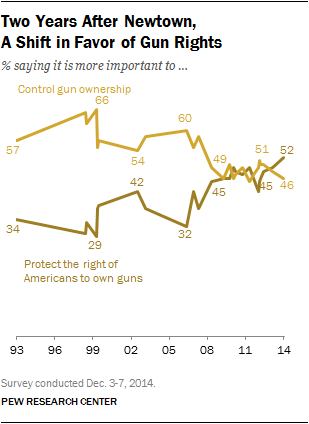
As the second anniversary of the Sandy Hook shooting approaches, Emily Badger observes that public opinion has shifted strongly in favor of gun rights over gun control:

For the first time since Pew began asking the question two decades ago, a majority of Americans now say that gun 12-10-2014-2-19-42-PMrights are more important than gun control — a striking shift in public opinion over both the last generation and just the last few years. As recently as December 2012, in the immediate aftermath of the Newtown, Conn., shooting, 51 percent of people surveyed by Pew said it was more important to control gun ownership than protect the rights of gun owners.

That consensus has since disappeared, confirming the fears of many gun-control advocates that outrage after Newtown wouldn’t last long.

What’s most striking in Pew’s new data is that views have shifted more in favor of gun rights since then among nearly every demographic group, including women, blacks, city-dwellers, parents, college graduates, millennials and independents. The two groups that haven’t budged? Hispanics and liberal Democrats.

Aaron Blake adds:

While the numbers are striking, this isn’t really all that new.

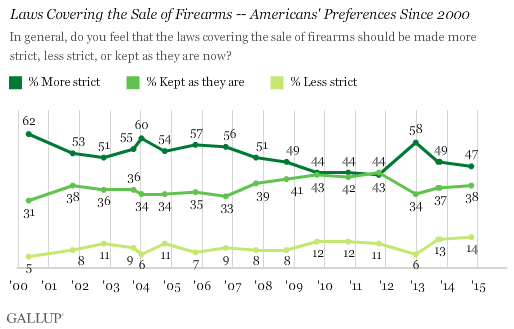
Guns12Polls have long shown this trend toward gun rights over gun control.

Here’s Gallup’s version. In 2000, 62 percent wanted stricter gun control. Today, it’s 47 percent, and 52 percent either want gun laws kept as their are or scaled back. Those numbers are essentially the same as Pew’s. You’ll notice the blip on Gallup’s chart in 2013. That was in the immediate aftermath of Newtown. For a short time, people wanted more gun control. But it was just a blip, and the underlying currents of the gun issue didn’t change.

As Mark Follman points out, school shootings haven’t stopped happening – they just don’t get as much press as Newtown did:

In the two years since the massacre at Sandy Hook Elementary in Newtown, Connecticut, no school shooting has claimed as many lives, nor ones as young, as on that terrible day. But fatal gun attacks at schools and on college campuses remain a fixture of American life. They have occurred once every five weeks on average since Sandy Hook, including two attacks—one in Santa Monica and another near Seattle—in which four or more victims were killed. With an investigation drawing on data from dozens of news reports, Mother Jones has identified and analyzed 21 deadly school shootings in the past two years. … During the same period, there have been dozens of other gun incidents on school grounds that caused injuries, as well as seven additional cases where someone committed suicide with a firearm, but no one else died.

Morrissey thinks Obama had a chance for a constructive compromise with the pro-gun camp but blew it by asking too much:

Had the White House and its activist allies limited their push to expanded background checks, they probably would have succeeded. The NRA doesn’t oppose background checks as long as they are not so onerous as to deny people the right to possess firearms responsibly. However, the White House and Bloomberg exploited Newtown to push for a renewed assault-weapons ban and restrictions on handguns and magazines, only retreating to background checks after those efforts largely failed. By pushing for a broad gun-control regime, the White House lost any support from Republicans they might have otherwise had, and poisoned the well for any future efforts.

How The Establishment Picks Its Candidate

Ponnuru takes us through the process:

Why do the donors and bigwigs settle on their candidate earlier than the activists do? Partly because they’re more concerned about picking a winner. Compared to Tea Party ralliers, their support is more of an investment and less of a statement. The most ideologically minded Republicans are willing to back longshot candidates like Herman Cain (the former Godfather’s Pizza executive, never elected to anything, who ran for the nomination last time). The big-money people in the party are less sentimental. They might have liked Jon Huntsman, the former governor of Utah, who also ran last time. But they never saw any signs he could win, and so they never helped him.

The donor class, as a rule, doesn’t seek a candidate with whom it can fall in love.

Hans Hassell presents his findings on candidate selection:

Can parties essentially limit the field of candidates presented to primary voters? My research suggests that they do. …

This isn’t to say that party coordination is easy. As one former Democratic party chair explained to me, “It’s more shifting coalitions, rather than a center, command and control type of model. As chair, I remember walking around often saying ‘Where’s the back room? Where’s the room where I get to go smoke cigars and make all the decisions, because I haven’t found the door.’”

Will a small group of elite GOP donors clear the 2016 presidential field for a particular candidate, whoever that may be?  That remains to be seen.  But it is clear that parties do have the ability to do so if they can agree on such a candidate.

Bernstein chips in:

Especially on the Republican side, you hear a lot of talk about “establishment” Republicans. There’s no guarantee, however, that any particular faction will win intraparty contests. It’s best to see previous winners, Bob Dole and John McCain and Mitt Romney, as having been acceptable to a broad range of party actors, rather than think of those three as having been anointed by a cabal of “establishment” insiders.

Can Southern Democrats Still Compete? Ctd

Sean Trende weighs in on the question:

There are no permanent majorities in politics.  An unpopular Republican president would move the needle. A Democratic fundraising base that chose not to go nuclear on a Democratic candidate who opposed Obamacare or the stimulus would have done it. A more culturally “red” Democratic nominee would help.

The voters who elected Phil Bredesen governor of Tennessee by 40 points are largely still around, as are the people who elected Mike Beebe governor of Arkansas by 30 points in 2010 and 14 points in 2006. The same goes for the folks who sent Landrieu and Hagan back to the Senate in 2008, or Blanche Lincoln in 2004. The people who elected a swath of moderate-to-conservative Democrats in 2006 and 2008 are still there.

The party just has to try to appeal to them, or at least give more latitude to its candidates to appeal to them, as Rahm Emanuel did in 2006.

The bad news for Southern Democrats is that Democrats aren’t likely to do this anytime soon, and if they did, they’d pay a price. Politics, again, is about tradeoffs, and by appealing to a more downscale coalition, Democrats would sacrifice enthusiasm gains among their new coalition. As I’ve said before, if Hillary Clinton had been the nominee in 2008, Mitch McConnell might not have been a senator in 2009, but Gordon Smith might have survived in Oregon. National Democrats don’t seem inclined to make this tradeoff anytime soon (plus, the wipeouts have left Democrats without much of a bench in these states), and the zeitgeist seems to be against it.

The South isn’t a lost cause for Democrats if they don’t want it to be one.  Their problem is that the national party doesn’t seem to care right now if it is one, and there are clear electoral benefits from focusing elsewhere.

But Tomasky continues to argue that the South is a lost cause:

[T]he way the Democratic Party can best help the poor people of Mississippi is to control Congress and the White House. So the point is to win those. With respect to the White House, no one can guarantee anything of course, but at least the Democrats do have these days a built-in Electoral College advantage.

As for congressional majorities, I say it’s far more likely they’ll win them in the North and on the West coast, and to some extent in the Midwest and Rocky Mountain states, than via the South. And if they ever get that majority, they will (one hopes) pass progressive laws, and those laws will benefit the people who live in the South.

So I’m not for abandoning the people of the South. I’m just saying the best way to help them is by building a congressional majority in the quickest and easiest way possible, and that, alas, is not through the South.

Neal Dewing disagrees with Tomasky:

Naturally, in light of what I know to be true about Southern people, Tomasky’s article struck me as peevish and small-minded. Yet beyond the offense to honor he intended with his unfair description of Dixie, Tomasky seemed to be advising Democrats to abandon all strategic electoral sense along with the South. Far be it from me to offer aid and succor to my ideological opposites, but this idea just seems too ill-conceived to be allowed to live. The following may be a reductive assertion, and I invite any professional political operatives to correct my ignorance, but:

1. If you allow your opponent to march unopposed to victory in one area,

2. Then he is free to commit the resources he might have spent there to other areas, where he has a real fight on his hands,

3. Therefore, it is unwise to simply abandon the field.

Kilgore’s take:

Yes, the realignment of southern rural and small-town whites is now virtually complete. The possibility of a “replacement” Democratic coalition depends on how many retirees, secular suburbanites, transplants, knowledge workers, and of course minority voters are in any one place, and sometimes it also depends on real-life events such as GOP misgovernment. That’s another reason I see no need for Democrats to “Dump Dixie,” though they’d be foolish to consider most of it anything other than missionary territory at the moment.

Update from a reader:

Tomasky is right. The South is a lost cause for Democrats for the foreseeable future. Whether or not Johnson actually made his famous quote after signing the Civil Rights Act in 1964, the prediction of a mass migration in the South from D to R was uncannily accurate. In fact, it was probably an understatement.

Having lived in the South for much of my life, I’ve witnessed the transformation, which I attribute to the entire civil rights movement from Brown v Board of Education to Engel and Abington to the Civil Rights Act to school busing to Roe v Wade (yes, I think that fits within civil rights) to more recent developments like gay marriage. Sure, it took a couple of generations, but that has more to do with the habits of the American voter than anything else. All those older voters who voted down party lines for Democrats and would never dream of voting Republican (like my grandmother) had to die off while the generations that followed began Republican and will probably be so for life. It took 100 years or so after the Civil War for the South to start moving towards the Republicans, and I expect the current party affiliation of the South will outlive all of us. Bill Clinton blurred the lines a little bit in the ’90s, but Obama has successfully righted the narrative just by his existence.

So, why did civil rights prompt such a transformation? Well, racism. But that’s a little too easy. More broadly, fear. Economic insecurity. Fear of “The Other.” Fear of change. Fear of losing what they see as their God given prominence. That’s why the typical Southern voter, now a Republican, embraces the following sentiments:

1. Public education is bad. It’s poor quality, it’s dangerous for my children to attend, and it is a front for Godless liberal indoctrination. How dare they call the extermination of Native Americans genocide. Why are they talking about slavery so much, it was like 200 years ago? Why are they talking about natural selection and not creation? I want charter schools and school choice.

2. Christianity is the foundation of America and should be more heavily codified in schools and government, but liberals and activist judges have undermined Christianity’s rightful place as the national religion.

3. Science is its own religion. Evolution and global warming are hoaxes.

4. Gay marriage threatens civil society and is only talked about because the gay agenda is so good at propaganda and is supported by the liberals who control the federal government.

5. The Feds want to take away guns in order to exert further control over the population.

6. Obama hates America and white people, so it’s okay to hate him without being able to name a single thing Obama has done to justify that hatred.

7. I’m not racist. I have a black friend or two. I just think black people are lazy and entitled, and they’re just not generally as smart as other races, but the government gives them advantages over me out of guilt and to buy their votes. Black people and self loathing white guilt liberals are the real racists.

8. I’m fine with disparities in capital punishment, race based disenfranchisement, and police shootings of unarmed civilians. Those only happen to “The Other” anyway, and they probably deserve it. People should stop whining about the little things.

9. Obamacare is a government takeover of healthcare and a giveaway to minorities.

10. The Democrats are responsible for all of the above.

Sounds silly, right? Overstated? It isn’t. They’re deadly serious. I know many otherwise reasonable people who believe the above. Fear does that to people, even if that fear is unfounded. That’s why Tomasky is right, at least until demographics overwhelm the South later this century.

Watching Cheney: He’s Got Nothing

[Re-posted from earlier today]

His interview last night is worth revisiting again. He says what he has previously said – adding nothing to the factual record, and addressing none of the specifics in the report. But he is also clearly rattled. He is used to proclaiming categorical truths about things he knows will never be made public. He is used to invoking what he says he knows from secret intelligence without any possibility of being contradicted. This interview is the first time he has made statements about torture that can be fact-checked by the record. And, he is proven to be a liar, as shown below.

When someone presents a public official with a large tranche of the CIA’s own documents and operational cables and internal memos, and that paper-trail contradicts previous statements by the public official, he has a couple of options. The first is to point out where any particular allegation is factually wrong, to show a flaw in the data, to defend himself factually from the claims presented. The second is to flail around, dodge any specifics and double-down on various talking points that evade the central facts at hand.

Cheney picked the second path. That tells you a huge amount, it seems to me. He doesn’t address abugrahib4_gallery-dish-SDthe mountain of evidence. He is simply ruling it out of bounds – after admitting he hasn’t even read it! If you had a two-bit tax evader who is presented by the IRS with a tranche of his own tax records proving he was delinquent, and he simply insisted that he hadn’t read them and still emphatically denies the charge, he’s self-evidently guilty. Why is this not self-evidently the case with Cheney?

His response to the facts as documented is simply: I know otherwise. He gives no specifics. He merely invokes other CIA official denials as an authority – when they too are charged with war crimes. That’s like a gangster claiming he is innocent on the basis of his gang-members’ testimony. He blusters on. In a court of law, his performance would be, quite simply, risible as an act of self-defense. It becomes some primal scream version of “Because I said it worked!”

Now look at what else he said. He describes this as a classic example of politicians throwing the “professionals” under the bus. One is forced to ask: what professionals? All the professionals in interrogation in the military and the FBI were kept out of the torture program, which was assigned to two contractors, who assessed themselves, who had never interrogated anyone in their lives, and who had no linguistic or interrogation backgrounds. What this report does is throw the amateurs under the bus, and among those rank amateurs is Dick Cheney.

When Cheney is asked about a prisoner chainedAbu_Ghraib_56 to the ceiling in a cell and forced to defecate on himself in a diaper, he says “I’ve never heard of such a thing.” As if that is relevant. If he hadn’t heard of such a thing, he should have. And if he hadn’t until this week, he could have read about it in the report. And then, revealingly, he immediately gets angry. He expresses no regret and no remorse about another human being’s unimaginable suffering. He cites the alternative to torture – legal powerful, effective interrogation that the report proves gave us great intelligence – as “kiss him on both cheeks and tell us, please, please tell us what you know”. Again, this is risible as an argument.

In fact, it is prima facie evidence that torture was used as a first resort, and it was a first resort because Cheney already knew it was the only way to get intelligence. How he knew we don’t know. No one in professional interrogation believed or believes it. So you have clear evidence that the decision to torture was taken early on – and nothing was allowed to stand in its way. This was an ideological decision – not a policy judgment based on evidence.

Here’s the truly revealing part. Cheney is told about a prisoner, Gul Rahman, who died after unimaginable brutality – beaten, kept awake for 48 hours, kept in total darkness for days, thrown into the Gestapo-pioneered cold bath treatment, and then chained to a wall and left to die of hypothermia. The factors in his death included “dehydration, lack of food, and immobility due to ‘short chaining.” This is Cheney’s response:

3,000 Americans died on 9/11 because of what these guys did, and I have no sympathy for them. I don’t know the specific details … I haven’t read the report … I keep coming back to the basic, fundamental proposition: how nice do you want to be to the murderers of 3000 Americans?

But Gul Rahman had nothing whatsoever to do with the 9/11 plot.

He had engaged in no plots to kill Americans. He was a guard to the Afghan warlord, Gulbuddin Hekmatyar, part of an organization that began by fighting the Soviets in occupied Afghanistan. It had alliances with al Qaeda at the time, but subsequently engaged in peace negotiations with the Karzai government. His brother claims Rahman was even involved in rescuing Hamid Kharzai in 1994.  To equate him with individuals who committed mass murder of Americans or who were actively plotting against Americans is preposterous. He was emphatically not a threat to the US. Yet we tortured him to death. And the man running the torture camp was promoted thereafter.

To put it more bluntly, Cheney’s response is unhinged. It is suffused with indiscriminate rage which is indifferent to such standards as whether the prisoner is innocent or guilty, or even if he should be in a prison at all. He is acting out a revenge fantasy, no doubt fueled in part by the understanding that 3,000 Americans lost their lives because he failed to prevent it – when the facts were lying there in the existing surveillance and intelligence system and somehow never got put together.

What we have here is a staggering thing: the second highest official in a democracy, proud and unrepentant of war crimes targeted at hundreds of prisoners, equating every single one of the prisoners – including those who were victims of mistaken identity, including American citizens reading satirical websites, including countless who had nothing to do with any attacks on the US at all – with the nineteen plotters of one terror attack. We have a man who, upon being presented with a meticulous set of documents and facts, brags of not reading them and who continues to say things that are definitively disproved in the report by CIA documents themselves.

This is a man who not only broke the law and the basic norms of Western civilization, but who celebrates that. If this man is not brought to justice, the whole idea of justice in this country is a joke.

(Photos: scenes from Abu Ghraib prison, showing the results of torture techniques pioneered by Dick Cheney.)

John Brennan Is Still Lying

US-POLITICS-OBAMA-INTELLIGENCE

I watched the CIA Director’s speech today, in which he actually described the CIA as an agency “speaking truth to power.” He got that the wrong way round. There is no organization in the US government that exercises the kind of power the CIA does – over the presidency, and the Congress, and the media. It is unimaginable that any other agency in government could commit war crimes, torture innocents, murder people, wreck this country’s moral standing … and yet escape any consequences for their actions. There is no other government agency that launches elaborate public relations campaigns to discredit and undermine its Senate oversight committee. There is no other organization whose head can tell blatant lies about spying on its overseers and receive the president’s wholehearted support. There is no other agency where you can murder someone already in your captivity and get away with it. That is incredible power – and there is no greater power than the power to torture.

As for the truth part, Brennan has to concede what the CIA has already conceded: that they lied to the president and to the Congress many, many times on the efficacy of torture. But Brennan describes these lies, as the CIA did in its formal response to the report, as “imprecision”. It was therefore merely “imprecise” that, to take one of many examples, the “Second Wave” attack was discovered thanks to torture. But either something was procured through torture, or it wasn’t. That’s not imprecise; it’s an either/or. And it was presented by the CIA as a categorical product of torture – which played a part in devising the legal memos that gave these crimes a patina of temporary formal legality. That is not imprecision; it is misrepresentation.

Here’s the most we’ll ever get from our dark side overlord:

CIA officers’ actions that did comport with the law and policy should neither be criticized nor conflated with the actions of the few who did not follow the guidance issued. At the same time, none of these lapses should be excused, downplayed or denied. In some instances, we simply failed to live up to the standards that we set for ourselves, that the American people expect of us.

Translation: the bulk of the torture was perfectly acceptable; a small part of it wasn’t. Have there been any consequences for those who committed the war crimes outside those allowed for by the spurious legal memos? Nope. Has anyone been fired? Not that we know. Are most of the people involved in these war crimes still walking the halls at Langley? You bet they are. And Brennan admitted today that he knew full well what was going on as the torture program was constructed.

Now this weird circumlocution on a central question:

I have already stated that our reviews indicate that the detention and interrogation program produced useful intelligence that helped the United States thwart attack plans, capture terrorists and save lives. But let me be clear: We have not concluded that it was the use of EITs within that program that allowed us to obtain useful information from detainees subjected to them. The cause and effect relationship between the use of EITs and useful information subsequently provided by the detainee is, in my view, unknowable.

So we are now in Rumsfeld’s post-modern universe. What Brennan has repeatedly said was that we got intelligence from those in the program, but now he is saying that the intelligence was not provably a result of the torture. What he is trying to insinuate is that long after being tortured, some suspects may have given intelligence under legal and humane interrogation that helped. All I can say is that the report meticulously demonstrates that this is not the case. Or let me allow Dianne Feinstein to put it succinctly:

This is a simple matter: before or after? In the coming days, the Dish is going to go through critical cases in the report to show that Brennan is still lying about this, seeking refuge in bullshit notions of “unknowability” because what we do know from the CIA’s own documents absolutely refutes his case.

And notice the only reason Brennan objects to torture:

I believe effective, non-coercive methods are available to elicit such information; methods that do not have a counterproductive impact on our national security and on our international standing.

Brennan goes on to lie again that torture helped us find Osama bin Laden. This is disproved – not challenged or questioned, but disproved – in the report. And continuing to suggest – against the evidence – that torture may have helped get that monster is an invitation for such an evil to be imported back into the the US in the future. And, indeed, Brennan concedes that it is perfectly possible that torture will return:

I defer to the policymakers in future times when there is going to be the need to be able to ensure that this country stays safe if we face a similar type of crisis.

We have a CIA whose head believes in the efficacy of torture, and that the only reason to refrain from it is that it hurts our national security and international standing. We have a CIA head who will not rule out the use of torture in the future. We have a CIA head who believes that much of the torture conducted in the Bush-Cheney years was legal. And we have a CIA head prepared to argue in public that the facts and documented evidence in a summary of the CIA’s own documents are untrue. Because he says so.

And he wants us to end this debate and move. He has to be kidding.

(Photo: Director of the Central Intelligence Agency John Brennan talks with the Director of National Intelligence James Clapper  before US President Barack Obama spoke about the National Security Agency and intelligence agencies surveillance techniques at the US Department of Justice on January 17, 2014. By Jim Watson/AFP/Getty Images.)