A Time Out For Zero Tolerance

New guidelines from the DOE seek to reduce zero tolerance policies. Jeff Deeney applauds:

As a social worker I’ve worked both in public schools and in the criminal justice system, so I’ve seen what it’s like at both ends of the pipeline. I remember arriving for the first time at the probation department and immediately thinking that it was uncannily similar to the public high school I worked in just before I took the job. The metal detectors, the barking security demanding removal of items of clothing and access to bags, beeping wands waved around in people’s personal space and the long line of black and Latino men and women stretching out the door all could have been transplanted from one institution to the other.  The bigger picture, from my perspective, concerns America’s continued struggle to get beyond its racially based fears and the impulse to monitor, control, discipline and punish black and Latino men for even the smallest infraction or else chaos will break loose in our cities. It starts as early as the first day of elementary school and for some will last until they get off parole. It makes one wonder how much of the problem we’re creating through the solutions we’ve crafted.

The guidelines are meant to address the disproportionate impact of over-discipline on black and disabled students. Nicole Flatow has the numbers:

One in five black boys have received an out-of-school suspension, according to 2012 Department of Education data. And black students with disabilities are three times more likely to be expelled, a punishment that sets kids in zero-tolerance systems up for later criminal punishment.

Other regional statistics tell a similar story. In Chicago, for example, three-fourths of kids arrested in public school were black. This disparate impact perpetuates a cycle of criminal justice over-exposure that follows many African Americans throughout their lives and yields astronomical incarceration rates. Research suggests almost half of all black males are arrested by age 23. Years of zero tolerance and over-policing policies have manifest themselves in data: an estimated 49 percent of all young black males now enter the job market with an arrest record, as well as 44 percent of Hispanic males. These arrests not only impose obstacles to a lifetime of success; they also clog the criminal justice system. In testimony before the Senate Judiciary Committee earlier this year, a juvenile county chief judge in Georgia lamented that one-third of cases before him were students arrested not because they posed a threat, but because they “make adults mad.”

Walter Olson, however, sees these guidelines as part of a pattern of government overreach:

The letter represents the culmination of a years-long drive toward imposing tighter Washington oversight on school discipline policies that result in “disparate impact” among racial or other groups. Policies that result in the suspension of differentially more minority kids, or special-ed kids, will now be suspect — even if the rate of underlying behavior is not in fact uniform among every group. (Special-ed kids, for example, include many placed in that category because of emotional and behavioral problems that correlate with a higher likelihood of acting out in misbehavior. Boys misbehave more than girls.) If the policy helps speed the correction of some overly harsh, mechanical school policies, both under the zero-tolerance rubric and otherwise, it may have some positive side effects. But the disparate-impact premise is a pernicious one that’s sure to create many new problems of its own.

Scott Shackford is also unimpressed:

[U]ltimately, this looks like a bunch of guidelines that will lead to the formation of school committees (funded with federal grants, perhaps?) that put more rules into place that will be pointed to the next time an official does something stupid like suspend a kid for chewing his Pop Tart into the shape of a gun. Can anybody provide an example of American jurisprudence where the institution of additional rules resulted in less callously managed punishment? Why should we expect any different from schools? What really needs to happen for significant change is that school districts need to be worried about the consequences to them for poorly managed school discipline. That’s why the Department of Justice’s emphasis on racial discrimination and the possibility of sanctions or lawsuits is so prominent – the DOJ has a stick to beat school districts with should they not comply. As for the “zero tolerance” nonsense, giving parents more choice and power on where their children attend school can serve as a useful pressure point to encourage school administrators to put an end to their petty tyrannies.
Putin’s Prison State

Masha Gessen profiles Nadezhda Tolokonnikova and Maria Alyokhina, of Pussy Riot, in their new role as prisoners’ rights activists:

“I was worried that no one would be interested in prisoners’ rights,” Tolokonnikova says. “I thought this might be just something Masha and I want to work on because we have experienced it.” But prison is an object of almost universal fear and interest in Russia. The country has one of the world’s highest percentages of its population behind bars—not as high as the United States, but a key difference is that in Russia the risk of landing in prison cuts across class lines. No one knows the exact figures, but human rights advocates estimate that more than 15,000 and possibly more than 100,000 of Russia’s roughly 700,000 inmates are entrepreneurs sent to jail by competitors or extortionists. And then there are the political prisoners, a population that is growing despite recent high-profile pardons. Opposition activists are arrested seemingly at random; many of them are not leaders but ordinary grassroots activists or even one-time participants in a demonstration.

The goal of this tried-and-true Soviet tactic is to frighten people away from any and all opposition activity. It’s effective, but its flip side is that when Alyokhina and Tolokonnikova speak about the abuse of prisoners, they grab the attention of millions of Russians who fear winding up behind bars themselves.

In an interview with Cullen Murphy, Gessen discusses her new book, Words Will Break Cement: The Passion of Pussy Riot:

While I was writing this part of the book [on prison conditions], I was also watching Orange Is the New Black, which was very helpful for two reasons: it refreshed my vocabulary (I wouldn’t have produced the word “commissary” without it) and it also presented a picture of how most readers would be likely to imagine a women’s prison. So my goal was very clear: I had to show the difference between Orange Is the New Black and hell. The difference is, again, best summed up by the word “torture.” Most, possibly all, Russian correctional institutions for women run sewing factories. Maria sewed bedding, while Nadya, like many Russian inmates, worked on police uniforms. Prison factories get government jobs because they offer low prices—and this they can do because they use slave labor. Inmates do not get paid (though by law they are supposed to); they are forced to work 12-, sometimes 16-hour shifts seven days a week, using outdated equipment. If they object to the work hours or fail to meet their production requirements, they are beaten, deprived of food, locked out of their barracks, and sent to do additional back-breaking labor on facility grounds. When I visited Nadya in prison last June, she told me they had recently been shown an educational American film about the importance of getting enough sleep—and the women watching it, who routinely slept no more than three hours a night, were falling off their chairs from laughter. Or perhaps from exhaustion.

Veiled Judgments

Headgear

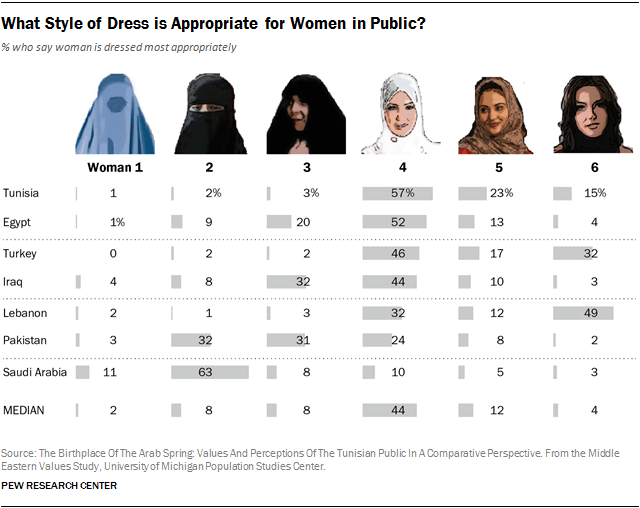
Fisher comments on the above chart showing how people in several Muslim countries think women should dress in public:

The result I found the most interesting is the one not on this chart:

how many people in each country say that women have a right to dress how they want. You might expect that countries where people answer “yes” to this would also be the ones where more people say women should go unveiled. But that’s not quite how it lines up. Saudis are much more supportive of this freedom for women than are Egyptians and Iraqis, for example, even though Saudis tend to approve of much more conservative clothing. Here’s how many poll respondents in each country said women should have a right to dress as they wish:

Tunisia: 52%
Turkey: 52%
Lebanon: 49%
Saudi Arabia: 47%
Iraq: 27%
Pakistan: 22%
Egypt: 14%

That last result should be a reminder for us that, even though we often equate the two in the West, a preference for veiling is not always the same thing as a belief that women shouldn’t have the right to choose their own clothing. Piety and feminism are not necessarily mutually exclusive forces. Still, it’s too bad that, even in the countries most supportive of this very basic freedom, only about half support it.

The Arab Spring’s One True Success

Michael J. Totten touts the resignation of Tunisian prime minister Ali Larayedh as further evidence of the country’s progress:

Tunisia’s Islamist prime minister resigned [yesterday] and ceded power to a caretaker government. He was not overthrown by guerrillas or by the army, but by peaceful and legal means familiar to citizens raised in democracies. Tunisia is still the model for post-revolutionary politics in the Arab world. I expected as much at the outset and explained why three years ago. Morocco is the only Arab country in the entire world as politically mature. Egypt is an emergency room case, Libya could turn into a failed state if it’s not careful, and Syria is suffering near-apocalypse. Iraq is…well, it’s Iraq.

Noah Rayman is more cautious, pointing to the challenges ahead:

Under the plan, the Islamist-led government will relinquish power to a cabinet of technocrats ahead of a new round of elections. … But a government of technocrats is no panacea for a country at a crossroads. In one of his last moves before announcing his resignation, Larayedh suspended a new tax hike on vehicles after two days of protests in several cities that stirred clashes with police, the latest in a series of demonstrations fueled by the poor economy. More than 15 percent of Tunisians are unemployed, and that figure is even higher in the country’s interior — including the city of Sidi Bouzi, where a disgruntled street vendor set himself on fire in Dec. 2010 and instigated the initial wave of protests that sparked the Arab Spring. International lenders are all the while demanding more cuts to the government budget, which reached nearly 7 percent of GDP last year, according to Reuters.

Tunisian authorities are also combating extremist Islamists who have gained a foothold in the country since the end of the police state under Ben Ali. The military is battling militants in the remote mountains along the Algeria border, and the government has linked the Islamist group Ansar al-Sharia – which the U.S. designated a terrorist group Friday – to a rare suicide bombing in the resort town of Sousse and to two political assassinations in the past year that shook the nation. To make matters more difficult, the technocratic interim government will not have the electoral mandate to tackle Tunisia’s most pressing issues. That means that while Tunisia’s secular opposition will welcome the demise of Ennahdha rule, the country may have to hold out for new elections, still months down the line, before it sees the reforms it badly needs.

Don We Now Our E-Apparel

Daniel Gross doubts the staying power of wearable tech (such as the Dish-covered Google Glass, Pebble, Fitbit, and, most recently, Durr and Tikker):

The real money in technology lies in creating entirely new classes of products, forging new markets, and making people realize they have been missing certain things in their lives. But it’s not clear that wearable technology can be that thing. Sure, the young market could blow to become the next smartphone—a mass industry that creates its own economic ecosystem. Or it could be develop into a series of niche products that add up to a bunch of good businesses and a bunch of failed ones. Or it could be a fad that will fade like the Macarena.

My money’s on the second option. Consider the smartphone.

Sure, skeptics abounded that the expensive iPhone and its imitators would become the new standard. But smartphones represented important innovations to a series of mass behaviors. Before the iPhone came along, people were carrying music around, making phone calls and taking photos, sending email, playing games, and accessing information and services on the internet with hand-held devices. Hundreds of millions of people were accustomed to toting these objects around, plugging them in to recharge them, and using them. Smartphones were just a much better, more convenient, all-in-one version of a bunch of popular devices. Switching to smartphones didn’t require a big change in consumer behavior.

But wearable technology promoters are asking much more of their customers. They are asking them to develop new habits very quickly, and to stick with them. The idea behind many wearable tech products is not simply to sell the hardware, but also to sell services like, say, diet and exercise advice to go along with your Up band. But that requires people to incorporate these gadgets into their daily lives in a way that they haven’t before.

Marcus Wohlsen argues that work, not leisure, is where these devices will make a lasting impact:

Take Eyes-On, the smart glasses Epson made with Evena Medical [featured in the above video]. Designed especially for nurses, the Android-based system lets the wearer, in effect, see through the skin of patients to get a precise real-time map of their veins. Health care workers no longer have to guess where to stick the needle when they set an IV or draw blood.

“It comes down to being relevant by vertical, by job function,” [analyst J.P.] Gownder says, noting Eyes-On is “definitely not” a consumer device. As soon as businesses find a specific way wearables can enhance the work they do, he explains, they will rush to adopt such devices.

Those uses aren’t limited to things so serious as medical care. Gownder gives the example of the cable guy who comes to fix a faulty connection. If a technician can’t figure out the problem, he or she typically has to come back for a second visit. With Looxcie’s Vidcie head-mounted camera, the technician can send live streaming video of the problem to other technicians and get real-time advice on how to fix it. Suddenly, two annoying days spent waiting for the cable guy have been cut to one.

What Climate Change Threatens

Gingrich served up a moronic comment this week:

The age of the dinosaurs was dramatically warmer than this is right now and it didn’t cook the planet. In fact, life was fine.

Ben Adler gets a response from climate scientist Ralph Keeling:

Climate change is not about survival of life; it’s about survival of civilization. Sure, the planet has been warmer than anything we’re probably going to bring about, but that doesn’t mean it’s good.

It has to do with adaptation to a world that’s extremely different than the world today or anything civilization has experienced. [Gingrich] has misrepresented the threat. It’s not that the Earth is going to go up in smoke, or melt down. Life will survive and humans will probably survive. The question is whether the pillars of our civilization will survive: the ability to grow food, the ability to live in peace with your neighbors. If you neighbors can’t live on their land any more because the climate is intolerable, you have a problem. He’s assuming that the transition to a warmer world is harmless and it’s just like picking a flavor of ice cream in a store. You have to live with the transition.

And to my mind, there’s an obvious difference. Humans created this situation. We are devastating countless other species and precious ecologies. And we have absolutely no right to. Our duty is to pass on the planet to the next generation in as livable and beautiful a state as we inherited. Speaking as Gingrich did is to defend vandalism, not conservatism.

Update from a reader:

To be fair to Gingrich, Van Jones’ “cook the planet” was implying runaway climate change wiping out life, and it is an argument that exists out there.  It is kind of important to know that we’re unlikely to hit some sort of geological tipping point that destroys life on earth with global warming; the fact that CO2 levels were much higher in the past is relevant to that; the experiment has actually been performed before.  Climate change will still be catastrophic, but it is worth making the point that we aren’t going to become Venus here.

The New Egyptian Police State

EGYPT-POLITICS-UNREST-MORSI-TRIAL

Lynch shakes his head at Egypt’s growing collection of political prisoners:

Egypt’s security services were able to tap into well-cultivated mistrust of the Muslim Brotherhood at home and abroad to justify its initial crackdown. But the intense animosity between the Brotherhood and many activists shouldn’t mask the reality that the campaign against the “terrorist” Muslim Brotherhood and the campaign against other political activists and independent voices are manifestations of the same political project. Both aim at crushing the culture of protest which overthrew former President Hosni Mubarak and restoring the “normality” of a carefully managed authoritarian regime. The arrests and public defamation campaigns aimed at restoring the fear and disengagement which has always been so vital to maintaining authoritarian regimes. The architects of the coup hoped to rebuild that barrier of fear which had been so famously shattered by the January 25 uprising.

He worries about where things are heading:

Right now, Egypt’s roadmap leads not towards anything resembling democracy or even stability but towards greater repression, escalating insurgency, and continuing political failure. Egypt’s current leadership may dream of becoming a something like a big United Arab Emirates, devoid of Muslim Brothers, street protests, or democratic politics. Instead, it is turning Egypt into a new Bahrain: dependent on Saudi Arabia, controlled by unaccountable security services, riven by increasingly irreconcilable polarization, and with political opponents branded as a vast international conspiracy of terrorists. Meanwhile, the military government seems to think that its problems are best met with public relations campaigns rather than genuine political engagement. Can a highly publicized visit by Kim Kardashian ogling the Pyramids be far behind?

Meanwhile, Mohammad Fadel thinks Egyptian liberals will ultimately regret calling in the military to oust the Muslim Brotherhood:

Responsibility for the revolution’s failure lies primarily with Egypt’s non-Islamist opposition. By appealing to the military to remove the country’s first elected parliament and to exclude the Muslim Brotherhood from political life, instead of organizing to defeat it in peaceful elections, they have sent two profoundly anti-democratic messages to the Egyptian people. First, that only the military is capable of solving Egyptians’ political differences. Second, that the Egyptian people cannot be trusted to elect responsible political leadership. Both of these messages, even more than Islamists’ attempts to impose limitations on rights and freedoms in the name of religion, represent a categorical repudiation of democracy’s fundamental premise: that people are capable of governing themselves, not perfectly, but adequately, and that the people, over time, manage their public life better than any authoritarian institution—military, civil, or religious. Rather than a celebration of democracy, the third anniversary of the January 25 Revolution will be a day for somber reflection.

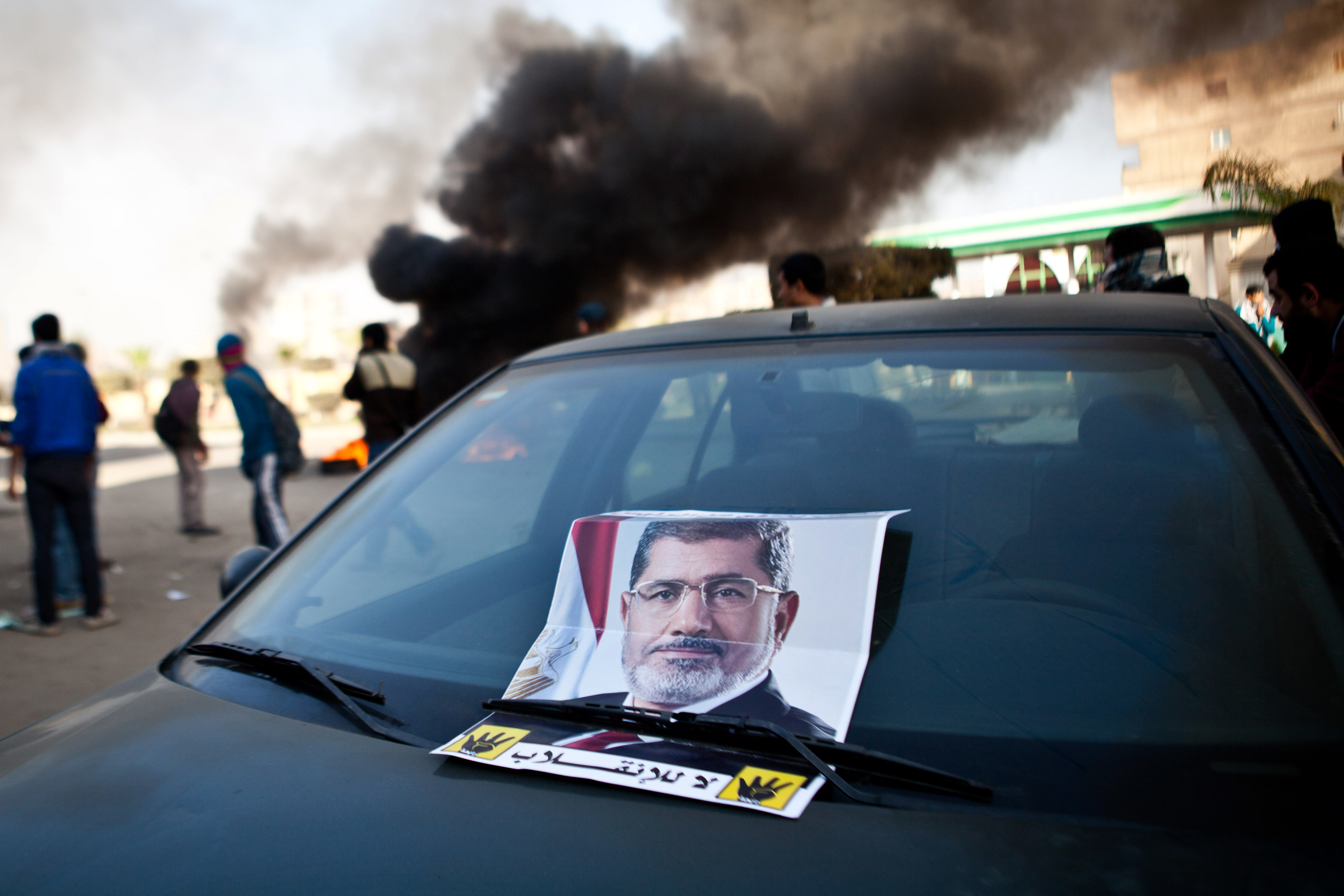
(Photo: A poster of ousted president Mohamed Morsi is seen on the windsheild of a car during clashes between his supporters and security forces in Nasr City, Cairo on January 8, 2014. An Egyptian court adjourned the murder trial of deposed president Morsi to February 1, citing ‘weather conditions’ that prevented his transport to court from prison. By Virginie Nguyen Hoang/AFP/Getty Images)

How Truthful Was Christie?

John Dickerson looks at the pickle the governor has put himself in:

The hope with this kind of press conference is that by showing that you have nothing to hide, you rebuild credibility. But as you let it all hang out, you also build a Jenga tower—an impressive structure that raises the stakes. Christie made a lot of promises Thursday afternoon: He didn’t know about the episode; he had been lied to; the bullying wasn’t indicative of his administration; he was simply a longtime acquaintance of David Wildstein, the Port Authority official who took part in the closure, not a childhood friend; he didn’t condone a culture of retribution; he didn’t know the exact details of the supposed traffic study that was used as cover for the lane closures. If one of those turns out not to be true, then the entire structure comes crashing down.

Cassidy makes a similar argument:

In apologizing and taking responsibility for what emerged from his office, he did what had to be done. But in simultaneously putting the blame on a single staffer and saying he had no involvement whatsoever, he staked his career on the belief, hope, desperate gamble—call it what you want—that no new information will emerge to challenge his version of events. If Kelly, or anybody else, contradicts Christie and provides evidence to back up his or her story, the governor is toast.

Beutler’s take:

My gut tells me it’s unlikely that Christie was genuinely unaware of and uninvolved, either in this specific lane closure or other scandalous acts of political retribution.

Remember, the breezy nature of the comically damning email exchange between his allies — “Time for a traffic problem in Fort Lee,” “Got it” — suggests this wasn’t a one-off kind of tactic. And when you look past Christie’s affect, and at the actual words he said during his press conference, you encounter a bunch of oddities and inconsistencies.

At the same time, Christie’s meta-handling of this whole thing — mocking the reporter who first asked about his involvement, brutally trammeling his advisers who are now free to dish, the abject apology and denial, the willingness to endure a nearly two-hour grilling — bespeaks either a real confidence in his innocence, severe denial or a pathological confidence that he can still get away with it.

David Graham imagines the best-case scenario:

If Christie is telling the truth—it’s hard to imagine he’d lie brazenly and publicly with a U.S. attorney and the state legislature breathing down his neck—he keeps his credibility. But what about his competence? How is it possible that one of his closest aides was running a rogue political vendetta out of his office, without the knowledge of the governor or any of his other top aides? That raises serious questions about Christie’s reputation as an effective, hands-on manager. How would such an executive function atop the federal government if he can’t even handle Trenton?

Tomasky has questions:

What was redacted (or can we just say censored?) from those emails and texts? Was this really “the exception, not the rule” in how the Christie administration tries to enforce political loyalty? We’ll presumably find out answers to these questions.

And if even Christie is telling the truth, that Wednesday was the first time he’d heard that the lane closures were a political act, all that means is that he went out of his way to make sure he didn’t hear it, which in turn means there was a grotesque abuse of political power that happened right under his nose and that he not only didn’t try to get to the bottom of, but tried to sweat it out until January 15. That’s some definition of leadership.

The Worst Jobs Report In Years

Net Jobs December

It’s ugly:

The new report from Bureau of Labor Statistics shows the U.S. economy added only 74,000 jobs in December, far below economists’ expectations. The unemployment rate dropped to 6.7% – its lowest point since October 2008 – but that appears largely to be the result of people dropping out of the workforce.

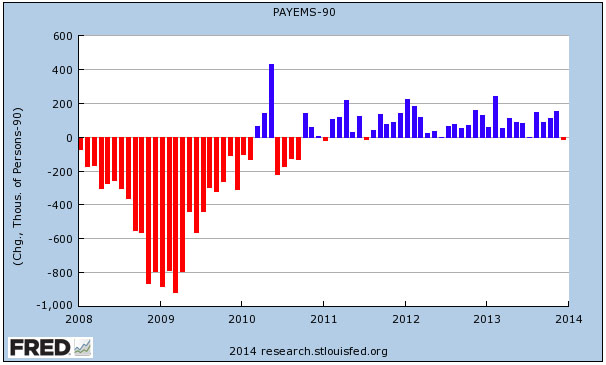
Drum created the above chart, which shows net job growth:

The American economy added 74,000 new jobs in December, but about 90,000 of those jobs were needed just to keep up with population growth, so net job growth clocked in at minus 16,000. There’s no way to sugar coat this: it’s pretty dismal news.

Matt Phillips suspects it was a fluke:

[S]omething doesn’t smell right about this report. For one thing, it jibes with hardly any of the other data we’ve been getting about the US labor market lately. … US stock futures are still in positive territory. And while there has been a bit of money flowing into US Treasurys, it’s not as if there’s a huge rush to safety driven by deep concerns about the economy. The market believes that this is a blip that’s better ignored. And for once, we’re going to say the market is right.

Felix Salmon blames the weather:

Once you take into account the weather … the December report wasn’t that bad.

A whopping 273,000 people were counted as “Employed – Nonagriculture industries, Bad weather, With a job not at work”, which is to say that they did not get counted in the payrolls figures even though they’re employed. Most of the time, that number is in the 25,000 to 50,000 range, and although it always spikes in the winter, this was the worst December for weather-related absence from work since 1977.

Greg Ip focuses on the bigger picture:

The more fundamental reason to worry is the ostensibly good news that unemployment had fallen to its lowest since late 2008. This was not principally due to the rise in employment but the fact that the number of people in the labour force (i.e. either working, or looking for work), tumbled 347,000 – even as the population grew 178,000. As a result, the labour force participation rate plunged to 62.8%, tying November’s figure for the lowest since 1978. The number of people who are not in the labour force but want a job – so called discouraged workers – jumped 332,000.

This is not a fluke. The labour force participation rate has been trending lower since before the recession. This remains by far the most vexing puzzle of the labour market.

Neil Irwin weighs in:

[T]he usual caveats around the jobs numbers — it is one month’s number, with a big range of error around it –apply more than usual in this one. Still, one doesn’t envy the policymakers who have to decide what to do based on this shaky data. The Federal Reserve’s policy committee meets at the end of the month and will have to decide whether to continue “tapering” their bond-buying program.

Kevin Roose adds:

The numbers are almost certainly going to be revised next month. But the initial signal is that we’ve been too hasty in calling this a healthy economy. The labor force participation rate fell by .8 percent, meaning that more people stopped looking for work altogether. And several key industries — construction and health care among them — lost jobs for the first time in months…. today’s report is a sign that we’re still dealing with a fragile economy, made more fragile on the policy side by threats of extending sequestration and letting unemployment insurance lapse.