The Enrollment Surge

December Enrollment

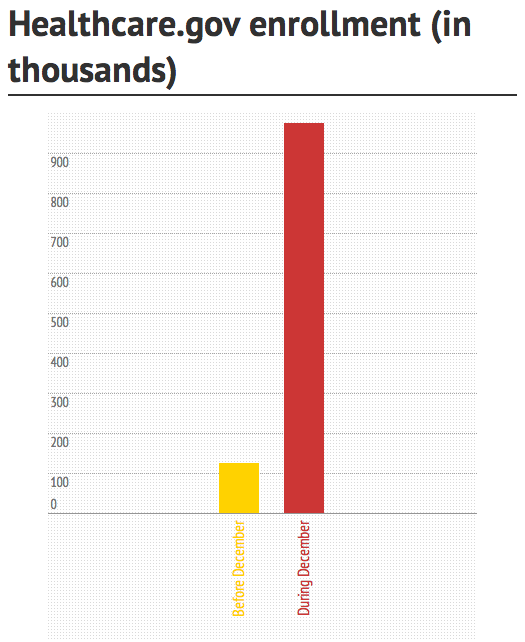
Kliff charts it:

Most health policy experts would expect enrollment to level off, or even fall, in January and February, when shoppers aren’t facing an imminent deadline. But they do foresee a big increase at the end of March, right before open enrollment closes. These next three months will be pretty important for seeing whether the law hits the Congressional Budget Office projection of 7 million enrollees in 2014 — or, as it has in the first three months of enrollment, continues to fall short.

What Cohn is hearing:

“What’s important now is that the systems are mostly functioning so that anyone who wants to get coverage can,” says Larry Levitt, senior vice president at the Kaiser Family Foundation. “The outreach campaigns and advertising by insurers likely haven’t peaked yet, so I wouldn’t be at all surprised if enrollment in March is even bigger than December.”

MIT economist Jonathan Gruber, an architect of reforms, has a similarly nuanced take. “Given the technical problems at the start, and given that the important deadline is March 31, what matters right now is the trend in enrollment.  In terms of overall enrollment, the trend looks quite good,” Gruber says. “What matters more is the mix in terms of the health of those enrolling, and we won’t have a clear answer on that until we see 2015 rates from insurers.”

Philip Klein wants more info on the health of enrollees:

CMS still hasn’t provided a demographic breakdown of those who have signed up for insurance through the exchange, which is a key metric for measuring the success of Obamacare, because the exchanges need a critical mass of young and healthy individuals to offset the cost of covering older and sicker enrollees and those with pre-existing conditions.

Avik Roy echoes:

What we need to know is: What is the breakdown of enrollees by age? What percentage have chronic conditions like Type 2 diabetes, high cholesterol, and high blood pressure? This is the kind of data that can help us compare the pool of enrollees in the exchanges to the normal U.S. population. It’s almost certain that, so far, this enrollment data is not encouraging. Because if it was encouraging, CMS would have released it.

Laszewski recommends looking at the exchanges yourself:

I suggest you do what the Democrats have been suggesting and visit HealthCare.gov. When you do, you will find that the entry page has a big icon on the left side, “See Plans Before I Apply.” Click on that and enter a sample age, state, county, and sample income. You don’t have to create an account or enter any personal information. You can take a look at any of the 36 federally run states. The site will show you all of the plans available, including the deductibles and co-pays with premiums that are net of subsidy. Unfortunately, most plans won’t let you checkout the provider network on the federal site.

Take a look. Put yourself in the shoes of lower middle-class and middle-class people who will likely have to pay 10% of their after tax income, net of the subsidy, for plans with an average Silver plan deductible of $2,567 and an average Bronze deductible of $4,343.

Will millions more buy Obamacare before March 31?
When Daddy Helps, Everyone Wins

Liza Mundy argues that paid paternity leave is an important tool for promoting gender equality:

[H]ere’s what men may not realize: While paid paternity leave may feel like an unexpected gift, the biggest beneficiaries aren’t men, or even babies. In the long run, the true beneficiaries of paternity leave are women, and the companies and nations that benefit when women advance. In October, the World Economic Forum released its latest global gender-gap report, showing that countries with the strongest economies are those that have found ways to further women’s careers, close the gender pay gap, and keep women—who in most nations are now better educated than men—tethered to the workforce after they become mothers. One strikingly effective strategy used by the highest-ranking countries is paternity leave, which, whatever else it may accomplish, is a brilliant and ambitious form of social engineering: a behavior-modification tool that has been shown to boost male participation in the household, enhance female participation in the labor force, and promote gender equity in both domains.

Arlie Hochschild makes the economic case:

Those who advocate for paternity leave resort to various kinds of appeals. Some invoke feminist values, noting that paternity leave encourages dads to share the workload at home. Others point out that men who take paternity [leave] continue to be highly involved as their children grow older. In one study, University of Michigan researcher Norma Radin found that three-to-six year old sons of highly involved fathers ranked higher on tests of verbal intelligence. U.C. Berkeley psychologists Carolyn and Phil Cowan found that children with involved dads were better at classifying objects and placing things in logical order. And according to a study by psychologist Abraham Sagi, Israeli kids of attentive fathers showed more highly developed empathy. These effects last: In one study, children of highly involved fathers were still more self-directed than other kids 20 years later. And such sons grow to became better fathers themselves.

But in all of these discussions, we’ve forgotten—or given up on—the appeal to business. In fact, there’s something in it for the bottom line. Paternity leave enables families to survive in an increasingly unpredictable economy. It’s hard to know whose salary—his or hers—will be higher, and paternity leave helps parents become more domestically interchangeable. Just as companies “cross-train” workers to meet shifting market demands, so spouses need to cross-train at home.

Noting that men aren’t always keen on staying home with their kids even if they can, Alexis Madrigal makes an important point:

Let me grossly generalize, based on my own limited friend group and set of associates: men are terrified of babies. (I know I was before I spent 1,500 straight hours with one.) We are scared of these creatures for good reason. Babies are tiny things that don’t talk. They’re fragile. Their hold on life is tenuous. And no one ever taught us what to do with them. No one taught us how to coo and rock, where to put our hands, or what the right way to hold a bottle is. What if the baby cries? What if I can’t get the baby to stop crying? What will it say about me if I can’t get the baby to stop crying?

This situation is exacerbated because men lack what is known in many households as “The Boob.” As in, “I don’t know why he’s crying. Maybe I’ll give him The Boob.” Men don’t have the go-to move of breastfeeding, which a very large percentage of women (at least in the American west) do. Under these circumstances, many men retreat into the default stance that they are “useless” during the first few months of a baby’s life. I can’t tell you how many well-meaning men have told me that they felt helpless dealing with a newborn. Many only found their purpose and parental commitment after many months, or even years.  Our midwife gave us a simple directive as we left the hospital. Turning to me, she said, “You do everything but breastfeed.” Turning to my wife, she said, “You breastfeed.”

TNC, who spent time as a stay-at-home father, doesn’t want a medal for it:

I felt a lot of things in those days—lonely, broke, sometimes frustrated. But what I didn’t feel in my allegedly hyper-macho black community was stigmatized. And I don’t think my dad felt that way either. If anything, I felt like I got a lot more credit than I deserved. I’d put the boy in the stroller, head down Flatbush, and a cheering section would damn near break out. The only people I felt stigmatized by were old black women, who were certain I was about to either direct the stroller into a cloud of influenza or the path of an oncoming train.

So rather than hear about the stigma men feel in terms of taking care of kids, I’d like for men to think more about the stigma that women feel when they’re trying to build a career and a family. And then measure whatever angst they’re feeling against the real systemic forces that devalue the labor of women. I think that’s what’s at the root of much of this: When some people do certain work we cheer. When others do it we yawn. I appreciated the hosannas when I was strolling down Flatbush, but I doubt the female electrician walking down the same street got the same treatment.

Mangling A Myth

Jordan Jeffers considers how J.R.R. Tolkien approached fiction in The Hobbit:

Tolkien is a storyteller, a myth maker, for he believed that myths demonstrated truth, that truth cannot actually be understood apart from myth. We can have no true vision of the stars unless we can first see them as “songs of living silver,” no true understanding of the earth until we can first understand it as our mother. Our myths matter a good deal, and how we think of elves is of vital importance to how we think of ourselves.

He goes on to argue that such an understanding of Tolkien’s work is what Peter Jackson fails to grasp:

Jackson is neither a communicator nor a mythmaker. He is a spectacle maker, a ringmaster, a showman. And he is very, very good at this. The Hobbit: The Desolation of Smaug manages to be both overwhelmingly big and manageably entertaining, balancing the actions of all the important characters quite deftly, allowing each of them just enough heroic moments to justify their presence in the movie. Basically, Jackson made The Avengers: Middle-Earth, and it is this very bigness that breaks the movie so forcefully from the books.

Tolkien’s book is not a story about superheroes. It’s a story about a hobbit named Bilbo Baggins, one of the smallest of folk, shorter even than the dwarves—a fat, ordinary person who does a lot of brave, ordinary things.

Ethan Gilsdorf unreservedly pans the movie:

As a fan of Tolkien and a fan of Jackson’s first trilogy, it’s difficult to distance myself from my desire for the movie that I’d hoped The Hobbit would deliver. This Hobbit Peter Jackson is less impressive than the Peter Jackson I came to know, respect and love in Lord of the Rings. This is an undisciplined director on display, showing no restraint. To me, The Hobbit: The Desolation of Smaug is too too loud, too fast, too much focused on action and distracting plot threads. I prefer the relative simplicity of Tolkien’s first Hobbit to the over-inflated, overblown, over-the-top epic Jackson aims his bow at here.

Larison also has brutal review, writing that “the second installment in this trilogy is a mockery of Tolkien’s story and insult to the audience”:

It is well-known that Peter Jackson has added a large amount of material to the story of The Hobbit in his quest to expand a short adventure story into a bloated would-be epic, but it is hard to appreciate just how silly and unnecessary these additions are until you see them. Thus we are treated to quite a few characters that never appear in the book, plotlines that have no relevance to the main story, villains that serve no purpose except to remind us of The Lord of the Rings, one pointless love story that functions at most as a lazy plot device, needless rewriting and mangling of key scenes, and frequent additions of battles that exist solely to fill up time in a movie that should never have been made.

But Cromercrox defends the director:

Jackson couldn’t possibly have made a film of The Hobbit that was ‘true’ to the original text – whatever that means, and leaving out the significant alterations Tolkien himself made to it. For, unlike The Hobbit‘s original readership, and unlike Tolkien himself when he wrote it, we can only come to The Hobbit backwards, as it were, through The Lord Of The Rings. There are those for whom nothing but a word-for-word treatment will do. I am not one of them. For one thing, I see no artistic merit in such faithful transliterations. What would be the point? For another, I think that to do have done a vanilla treatment of The Hobbit would be to have done Tolkien and his audience a grave disservice. Jackson’s treatment has its flaws, of course it does. But it’s much deeper, more honest and more Tolkienian in its spirit and execution than many people appreciate.

The Anti-Carb Dogmatist

Dr. David Perlmutter rails against carbohydrates:

The neurologist and president of the Perlmutter Health Center in Naples, Fla., believes all carbs, including highly touted whole grains, are devastating to our brains. He claims we must make major changes in our eating habits as a society to ward off terrifying increases in Alzheimer’s disease and dementia rates.

After reading Perlmutter’s best-selling book on the manifold evils of carbs, and after talking with supporters and critics of the Paleo diet in the medical community, James Hamblin is unconvinced by the anti-gluten crusader:

Even as someone who was seriously skeptical of Perlmutter’s story, after reading his 336 pages—and watching his whole YouTube channel and most every TV appearance—I have found myself hesitating around grain. His message is so ardently and unwaveringly delivered. That is how one-sided pop-science works, though. [Dr. David] Katz wrote a tongue-in-cheek case that the 1974 advent of the Post-it note was the cause of the obesity pandemic, to show how easily correlations can be spun. If I read 336 pages on the evils of Post-its, I might set our office supply room on fire. …

When a person advocates radical change on the order of eliminating one of the three macronutrient groups from our diets, the burden of proof on them should be enormous. Everything you know is not wrong. Perlmutter has interesting ideas that I would love to believe. I’d love it if a diet could deliver all that he promises. There is value in belief. It’s what the Empowering Neurologist literally markets. His narrative comes with the certainty that you are doing something to save yourself from cognitive decline and mental illness, which is probably the most unsettling of disease prospects. With that belief also comes guilt; an idea that something could’ve been done to prevent a mental illness, when in fact it was bigger than us. To think that every time you eat any kind of carb or gluten, you are putting your mental health and cognitive faculties at risk is, to me, less empowering than paralyzing.

Our Genetic Moral Code

Back in November, in an interview with Sam Harris, Paul Bloom explained the thesis of his new book, Just Babies:

Certainly some morality is learned; this has to be the case because moral ideals differ across societies. Nobody is born with the belief that sexism is wrong (a moral belief that you and I share) or that blasphemy should be punished by death (a moral belief that you and I reject). Such views are the product of culture and society. They aren’t in the genes.

But the argument I make in Just Babies is that there also exist hardwired moral universals—moral principles that we all possess. And even those aspects of morality—such as the evils of sexism—that vary across cultures are ultimately grounded in these moral foundations.

A very different misconception sometimes arises, often stemming from a religious or spiritual outlook. It’s that we start off as Noble Savages, as fundamentally good and moral beings. From this perspective, society and government and culture are corrupting influences, blotting out and overriding our natural and innate kindness.

This, too, is mistaken. We do have a moral core, but it is limited—Hobbes was closer to the truth than Rousseau. Relative to an adult, your typical toddler is selfish, parochial, and bigoted. I like the way Kingsley Amis once put it: “It was no wonder that people were so horrible when they started life as children.” Morality begins with the genes, but it doesn’t end there.

In an excerpt from his book, Bloom explores how toddlers make moral choices:

Children tattle. When they see wrongdoing, they are apt to complain about it to an authority figure, and they don’t need to be prompted to do so. In one study, 2- and 3-year-olds were taught a new game to play with a puppet; when the puppet started to break the rules, the children would spontaneously complain to adults. In studies of siblings between the ages of 2 and 6, investigators found that most of what the children said to their parents about their brothers or sisters counted as tattling. And their reports tended to be accurate. They were ratting their sibs out, but they were not making things up. …

Part of the satisfaction of tattling surely comes from showing oneself to adults as a good moral agent, a responsible being who is sensitive to right and wrong. But I would bet that children would tattle even if they could do so only anonymously. They would do it just to have justice done. The love of tattling reveals an appetite for payback, a pleasure in seeing wrongdoers  (particularly those who harmed the child, or a friend ofthe child) being punished. Tattling is a way of off-loading the potential costs of revenge.

Another excerpt looks at the other side of morality:

Not all morality has to do with wrongness. Morality also encompasses questions of rightness, as nicely illustrated by a study of spontaneous helping in toddlers, designed by the psychologists Felix Warneken and Michael Tomasello. In one condition of the study, the toddler is in a room with his or her mother present. An adult walks in, his arms full, and he tries to open a closet door. Nobody looks at the child, or prompts him or her or asks for help. Still, about half do help—they will spontaneously stand up, wobble over, and open the door for the adult.

This is a small example for a small individual, but we see this kindness writ large when people donate time, money, or even blood to help others, sometimes strangers. This behavior too is seen as moral; it inspires emotions like pride and gratitude, we describe it as good and ethical. The scope of morality, then, is broad, encompassing both the harsh, judgmental elements and the softer, altruistic elements.

Why Awe Is Awesome

Cayte Bosler unpacks a study that “shows there are residual health benefits to having your mind blown”:

“People increasingly report feeling time-starved, which exacts a toll on health and well-being,” states the study. Using three experiments, researchers Melanie Rudd and Jennifer Aaker of the Stanford University, and Kathleen Vohs of the University of Minnesota, examined whether awe can expand perceptions of time availability. They found that participants “who felt awe, relative to other emotions, felt they had more time available, were less impatient, were more willing to volunteer their time to help others, and more strongly preferred experiences over material goods.”

It can be hard to generalize what people consider jaw-dropping, but Vohs says research demonstrates what consistently creates an awesome experience. Travel ranks high. So does gazing at the cosmos on a clear night or watching a sensational film, as well as anytime we encounter massive quantities: colorful tulips in bloom, a bustling market in India, or a stunning school of fish. Novelty and perceptual vastness forces us into the present moment. The study underscores the importance of cultivating small doses of awe in the everyday to boost life satisfaction.

More on how “awe” works:

“The experience of awe is one where you are temporarily off-kilter in terms of your understanding of the world,” explains Vohs. “People mostly walk around with a sense of knowing what is going on in the world. They have hypotheses about the way people behave and what might happen; those are pretty air-tight. It is hard to get people to shake from those because that’s just how the brain works. We are always walking around trying to confirm the things we already think. When you are in a state of awe, it puts you off balance and as a consequence, we think people might be ready to learn new things and have some of their assumptions questioned.”

“The Clear Expression Of Mixed Feelings”

Recently the Dish featured the poetry of Mary Szybist, whose collection, Incarnadine, won the National Book Award in November. In an interview, she discusses the connection between her religious life and writing:

When I was young, spiritual faith had an enormous presence in my life. When I was a young adult, its absence, at times, felt enormous. Now my relationship to it is more complicated, and I try to let those complications into my poems. W. H. Auden once said that “poetry might be described as the clear expression of mixed feelings,” and my mixed feelings about faith and spirituality often drive my work…. I don’t think I was ever after spiritual clarity, at least not the kind that might be held as an enduring truth. An insight that helps me through the struggles of one day will not necessarily answer to the spiritual unrest of another. That is, I think, why artists keep creating and writers keep writing. We change; our world changes; what suffices one day will not necessarily suffice the next day. We need new visions. I like Robert Frost’s idea that a poem is a “momentary stay against confusion.” Clarity may be “momentary”—but that does not make it less valuable or needed.

She goes on to argue that the poems in Incarnadine could be seen as a feminist response to the Biblical tale of the Annunciation, when Christians believe an angel told Mary about her miraculous pregnancy:

Feminism means, in its most basic sense, a belief that men and women should have equal rights and opportunities. I do, of course, believe that. Feminism might also be described as activity in support of women’s interests, and I think Incarnadine does answer to that description. I grew up identifying with the icon of Mary, mother of God, since I was named after her. I also felt myself to be in her shadow. I think Mary is a problematic ideal to hold up to women for many reasons; she is celebrated for being both mother and virgin—an impossible ideal. It is particularly the virginity ideal that is held up to women (and not men) that I find problematic, and virginity is a concept and expectation that still has real and often dire consequences for women throughout the world. I wanted to complicate the figure of Mary and the way she relates to this “ideal.” So … I would say this is a feminist response.

Why Don’t We Talk About Jesus’ Sexuality?

Giovanni_Bellini_-_Madonna_and_Child_Blessing_-_WGA1774

Lee Siegel revisits Leo Steinberg’s classic work of art history, The Sexuality of Christ in Renaissance Art and in Modern Oblivion, which details the centuries-long effort to conceal and ignore that Jesus was a man with a penis:

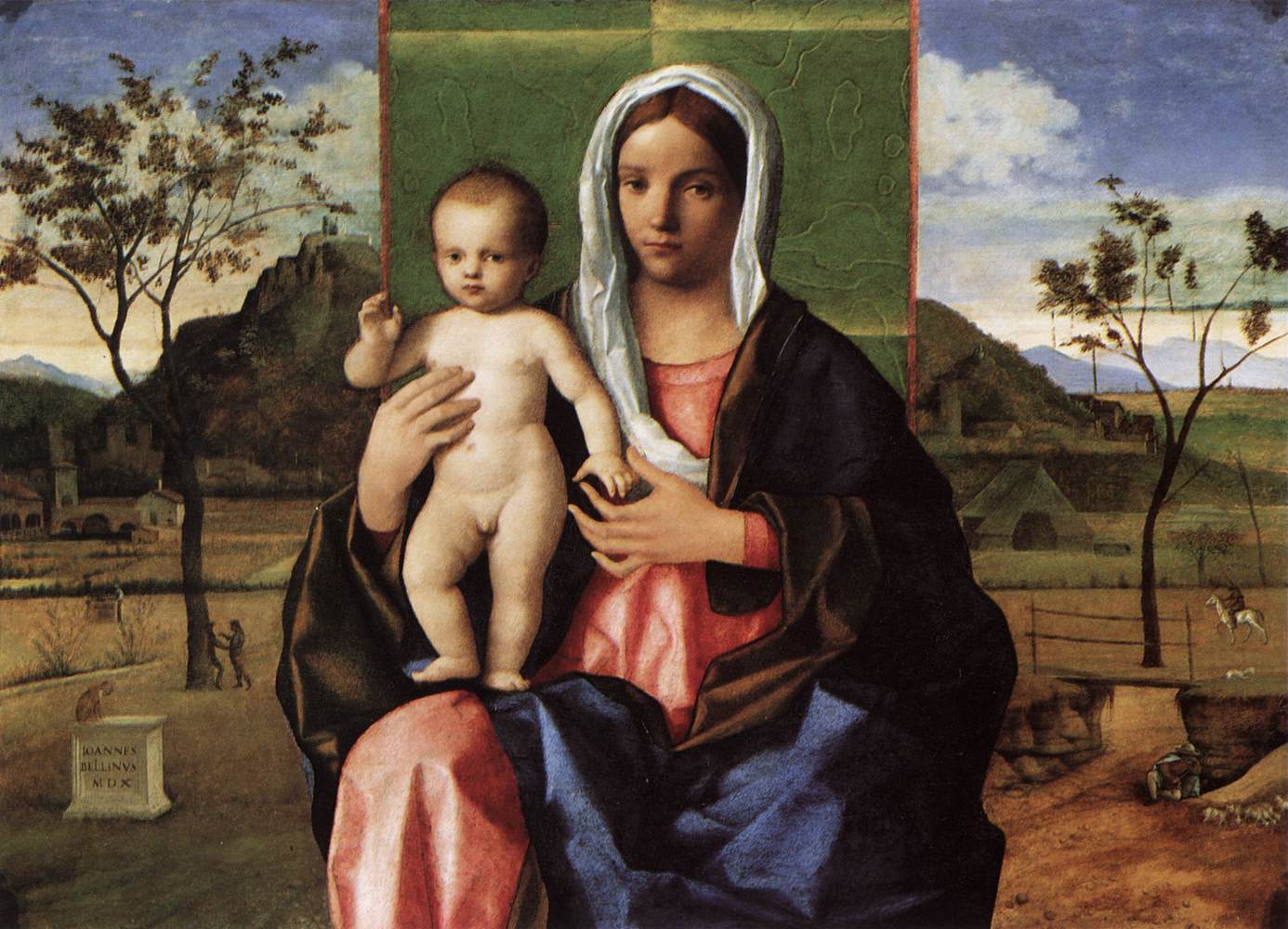
The “modern oblivion” of Steinberg’s subtitle was just that: centuries during which the central fact of Christ’s phallus in hundreds of Renaissance paintings was overlooked, denied, and, sometimes, bowdlerized. Steinberg adduces several examples of Christ’s genitalia being painted over or touched up to make them look like a mere blur. In one case, probably in the mid- to late nineteenth century, the Alinari brothers, famous for their photographic reproductions of paintings, blackened out the Christ child’s penis in their photograph of a fifteenth-century “Madonna and Child” by Giovanni Bellini. Such censorship, Steinberg believes, was meant as distraction from an uncomfortable theological premise: “A disturbing connection of godhead with sexuality.”

Steinberg’s point was more than prurient – it connects to theological debates about the meaning of the Incarnation, or God becoming man:

He held that artists used the evidence of Christ’s genitals to prove that Christ submitted to becoming human before returning to the godhead. The revelation of his penis demonstrates, as Steinberg puts it, Christ’s “humanation,” that moment of incarnation which proved Christ’s love for humankind. And the many representations of the Christ child’s circumcision are important as foretellings of his crucifixion—the blood of Christ’s penis is fulfilled in the blood from Christ’s wounds.

Entering with obvious relish the realm of Christian sexual hermeneutics, Steinberg relies on St. Augustine, who emphasized his surrender to and then escape from the “fleshpots of Carthage,” to argue that Christ’s erection was a singular way to demonstrate Christ’s chastity. Without the capacity to yield to lust, Christ’s triumph over carnal desire would have no human meaning. Unlike men after the fall of Adam, who fell victim to lust, Christ willed his erection; it was not an involuntary physiological event. By both willing and resisting it, he declared his victory over the stain of sin bequeathed to humanity by Adam and Eve, and over the death that their carnal weakness brought into the world. That, after all, is the significance of the resurrection.

(Image of Madonna and Child Blessing by Giovannia Bellini, 1510, via Wikimedia Commons)

Loving And Loathing Love Actually, Ctd

Many readers sound off on the polarizing film:

Love Actually is interesting because it is a story about the different aspects of love, not just romance. New love (Jack and Just Judy). Old love in a rut (Emma Thompson and Alan Rickman). Unadulterated lust (Collin). A parent’s love, as well as love for and duty to a deceased partner (Liam Neeson).  Siblings (Laura Linney). Unrequited love (Mark and Juliet). Love between friends (Billy Mack). Love with obstacles (Jamie and Aurela). Love you try to deny but can’t (HG and Natalie). I really like the fact that it isn’t a traditional love story.

Relating to the point of work required for a relationship, while Liam Neeson’s character displays this in the care and devotion he shows the son of his departed wife, it was best illustrated by a storyline left on the cutting room floor.  In the deleted scenes, there is a story about the principal of the posh elementary school where Emma Thompson’s children are enrolled.  The principal has her own love story, providing hospice care to her beloved longtime partner, and dealing with the grief over her loss.

Another reader:

The rabid fans of Love Actually I know are all chronically, unhappily single.  I know some coupled folks and happy singles who like the movie well enough. But it is the unhappy singles who spontaneously post their adoration of the movie on Facebook or will at the slightest provocation tell you their favorite scenes in great detail. Far be it from me to suggest that the inability of these people to form the sort of meaningful relationship they so desire and the movie’s unrealistic portrayal of how love is found, won, built and sustained is anything more than sheer coincidence.

Another:

It certainly isn’t a how-to for romance. Some of the relationships are entirely inappropriate. No one recommends buying an expensive piece of jewelry for a flirtatious coworker instead of your wife or declaring your love to your best friend’s new wife.

But I think the central running theme here is about allowing your heart to run and giving up self-censorship.

That’s the fundamental romanticism of the film. And like all romanticism it’s not realistic; it’s emotional. The one character who doesn’t release her self-censorship (Laura Linney) misses her chance. The others get the chance to at least express their emotions, which is refreshing in an emotionally stilted culture. I like the movie and I will probably watch it again in the next week, not because I need pointers on how to cheat on my wife, but because I want to enter into the emotion that causes these people to do profoundly stupid things.

Another:

I just love the movie and find it to be an uplifting paean to love and the yearning for connection.   It seems to me that this movie displays how the world does look to someone who is actually in love, particularly in the first flush of romance.  When in love, we see mostly good and as love matures, we are given the opportunity to work with the difficult as well as the easy.  This film does display some of the challenges that may occur in relationships, as reflected in the characters played by Emma Thompson and Alan Rickman, and what happens after the death of a loved one for Liam Neeson’s character.  Also we have Laura Linney’s character, her mentally ill brother, and her delicious co-worker, as another representation of love and yearning for connection but involving difficult choices.

One more point.  I find this movie especially interesting because it displays the pursuit of love mostly from a male point of view, one not often portrayed in films.  I do think that this film can be unsettling to some men since it does reveal that most men do have a deep sensitivity to love and a desire for real connection with someone, whether the preference be female or male.  This deep sensitivity carries with it an anxiety about potential rejection from the desired individual and, as revealed in this film, guys are as vulnerable to this as women are.  But most films do not display that aspect in men’s lives.  And most men have been culturally trained to not let this vulnerability show.  It is not macho.

So I would recommend that people just “lighten up” and try to balance joy with all of the intellectual analyses of this film. This film presents us with a beautiful invitation  to get out of our head and into our heart.

Another points to the above scene:

The best part of Love Actually is the last minute or so, where the filmmakers simply show real people meeting loved ones at the airport (to a soundtrack of the Beach Boys’ “God Only Knows”). I defy anyone not to be moved!

Previous debate on the film here.

“The Anti-Hef”

Al_Goldstein2

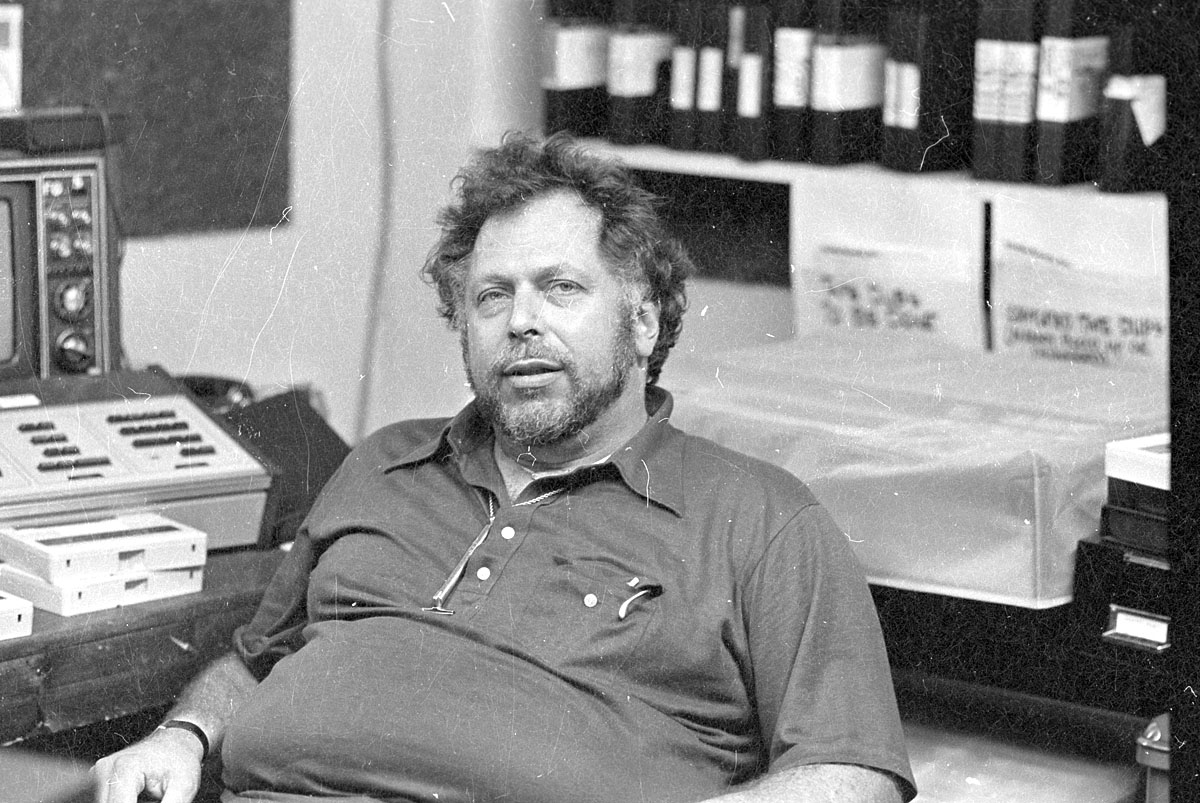
That’s what Will Sloan calls the creator of Screw magazine, Al Goldstein, who died earlier this month:

Goldstein launched Screw, his “weekly sex review” of New York, in 1968. United States courts were regularly redefining what constituted obscenity and what passed for “redeeming social value,” but from the beginning, Goldstein said, “a hard-on is its own redeeming social value.” Unlike Playboy, the publication to which Screw stood in contrast, there was no attempt to flatter the reader’s sense of sophistication, or to depict sex as anything but a physical act. “The word love is alien to us,” said Goldstein in his 1974 Playboy interview. “Who needs love? Yuck! We deal with masturbation, the most common sex activity for most people, in graphic words and pictures.” …

Playboy had the debonair, sophisticated WASP Hefner; Screw had the obese, crass, and very ethnic Goldstein. Hefner often shot the early Playboy pictorials himself, leaving articles of his clothing in the background to hint that he’d seduced the women; Goldstein admitted (or perhaps bragged) that he could rarely get laid unless he paid for it. Hefner lived a lifestyle that his magazine urged readers to strive for; Goldstein was proudly in the muck with the rest of us. Screw gained enough counterculture credibility in the late ’60s and early ’70s to score interviews with Henry Miller, Salvador Dali, and John and Yoko (during their Montreal bed-in), but Goldstein was the kind of interviewer who could bring anyone down to his level. He got Jack Nicholson to admit he used the magazine to masturbate.

(Photo via Wikimedia Commons)