The Transformation Of Judges Into Politicans

There is a case before SCOTUS on whether judges should be able to solicit campaign donations:

Mark Joseph Stern provides background on the case:

The dubious ethics of judicial elections hasn’t stopped 39 states from holding judicial races, but 30 of those states have at least tried to keep them as clean as possible by forbidding judges from personally soliciting contributions for their election campaigns. This seems like common sense: Judges aren’t politicians, and they shouldn’t be forced to act like them—especially when their donors could one day appear in their courtrooms.

But the court that brought you Citizens United v. Federal Election Commission is in short supply of common sense when it comes to campaign finance regulations. On Tuesday, the justices heard the case of Williams-Yulee v. the Florida Bar, a challenge to a Florida rule barring judicial candidates from personally requesting campaign contributions.

Lanell Williams-Yulee, a former candidate for county court judge in Hillsborough County, launched her campaign with a personalized mass-mail fundraising letter that asked for “an early contribution” to help her “raise the initial funds.” She promptly got charged with professional misconduct by the Florida Bar. The Florida Supreme Court upheld Williams-Yulee’s sanction. Now she’s appealing it to the Supreme Court, under the theory that the First Amendment protects her right to ask voters for campaign cash.

He expects that “Williams-Yulee will probably win this case.” AJ Vicens points out that judicial elections “are becoming increasingly more expensive”:

During just those two years, state high court, appellate and lower court judicial candidates raised more than $110 million, according to the National Institute On Money In State Politics (state judicial candidates raised just $83 million total in the 1990s). Justice At Stake, a nonpartisan judicial election watchdog group, points out that 20 states have surpassed records for judicial election spending since 2000. Independent spending on judicial elections is also booming, with more than $24 million being spent in the 2011-12 cycle compared to just $2.7 million a decade earlier.

Jeff Shesol looks at recent SCOTUS rulings on related issues:

It’s true that in 2009, in Caperton v. A.T. Massey Coal Co., Justice Anthony Kennedy joined the Supreme Court’s liberals in requiring a West Virginia Supreme Court justice to recuse himself from a case in which the defendant’s C.E.O. had spent three million dollars to get the judge elected. The decision showed at least some solicitude for judicial independence in the face of all that campaign money. Yet Kennedy, in the majority opinion, took pains to stress that the facts in this case were “extreme,” and less than a year later, in Citizens United, he made the blithe assertion that “independent expenditures, including those made by corporations, do not give rise to corruption or the appearance of corruption.” Indeed, he took it even further: “The appearance of influence or access,” he added, “will not cause the electorate to lose faith in this democracy.” This, as any legal scholar will recognize, is the doctrine of willful naïveté, a central element in all of the Roberts Court’s campaign-finance rulings.

Garrett Epps is disturbed by judges openly soliciting political donations:

I yield to no one in my appreciation for free expression, political or otherwise. But in the years since Citizens United, First Amendment dialogue has increasingly divorced itself from any practical considerations. When did preserving public confidence in the courts cease to be “compelling”? When did the appearance of unfairness become “mere”? Opponents of the rule argue that since states allow judicial campaign committees to raise funds, they have to allow judges to do the same. The logic of this argument is elusive; there is a difference between being asked by an employee to give money, and being asked by the judge himself. In addition, they argue, states that object to the influence of money can simply stop electing judges. They could, but in practical terms, judicial election is going to be with us for a long time. The question should be how states can retain their inherited systems and preserve some of the independence the federal judiciary guards for itself.

Noah Feldman wants to end judicial elections entirely:

In a perfect world, I think the justices would strike down judicial elections as inherently unconstitutional. Then they could make the whole problem go away. But the states are laboratories of democracy, as Justice Louis Brandeis once said. Within those laboratories, the experiment is allowed to go terribly wrong. Judicial elections have been with us for almost 200 years, and despite the efforts of retired Justice Sandra Day O’Connor, they aren’t going to disappear anytime soon. Until then, judicial elections are a classic example of a hard case. And you know what they say about hard cases: They make bad law.

Reity O’Brien hears that a narrow ruling is possible:

Ed Whelan, a former clerk to Justice Scalia and director of the conservative Ethics & Public Policy Center, said it’s possible that the court could leave the First Amendment question unresolved yet decide that Williams-Yulee did not actually violate Florida’s ban. The mass mailing was a decidedly impersonal solicitation and did not yield contributions, let alone the quid pro quo exchanges that judicial campaign donations may invite. It’s also possible the court could dismiss the case entirely, Whelan said. However, he noted, the court takes on cases “to resolve these grander issues, not to engage in error correction.”

Bloomberg View’s editors think there must be a better way:

As long as states elect rather than appoint judges, campaign contributions — no matter who does the asking — will allow interested parties to curry influence. Of course, moving to an appointed system of judges does not eliminate the potential for corruption. Governors can pick judges the same way that presidents pick ambassadors, with friends and fundraisers jumping ahead of more qualified candidates. But legislators can mitigate that threat by subjecting a governor’s appointments to their approval.

Legislators can also set judicial terms that are fixed and staggered, limiting any particular governor’s ability to stack the court. And they can impose mandatory retirement ages, which increases turnover. Mandatory retirement ages and fixed terms would give the public’s elected representatives more opportunities to influence the bench.

The Mossad Sides With Obama Against AIPAC And Netanyahu

After Boehner’s crass attempt to have Netanyahu get even more standing ovations from the Congress in order to kill the negotiations with Iran, there’s some delicious irony in what has come next – and not least in Eli Lake’s and Josh Rogin’s prose:

The Israeli intelligence agency Mossad has broken ranks with Prime Minister Benjamin Netanyahu, telling U.S. officials and lawmakers that a new Iran sanctions bill in the U.S. Congress would tank the Iran nuclear negotiations … Evidence of the Israeli rift surfaced Wednesday when Secretary of State John Kerry said that an unnamed Israeli intelligence official had said the new sanctions bill would be “like throwing a grenade into the process.”

But an initial warning from Israeli Mossad leaders was also delivered last week in Israel to a Congressional delegation — including Corker, Graham, McCain and fellow Republican John Barrasso; Democratic Senators Joe Donnelly and Tim Kaine; and independent Angus King — according to lawmakers who were present and staff members who were briefed on the exchange. When Menendez (who was not on the trip) heard about the briefing, he quickly phoned Israeli Ambassador to the U.S. Ron Dermer to seek clarification.

Wouldn’t you have loved to have seen McCain’s face when the Mossad told him they do not think another war against a Muslim state in the Middle East is the best idea right now, when far more workable alternatives are still available? But the truth is that many inside the sane Israeli defense and intelligence communities – which were opposed to the Iraq War – really do believe that negotiating constraints on Iran’s nuclear capacity is in Israel’s interest and that war is not.

They don’t believe that new threats of sanctions will do anything but scuttle any chance of a peaceful deal. And that the subsequent war would actually accelerate Iran’s now-stalled and frozen nuclear weapon program, rather than remove the threat. America’s intelligence community believes the same, as does the British prime minister:

The Israeli view shared with Corker and other senators also mirrors the assessment from the U.S. intelligence community. “We’ve had a standing assessment on this,” one senior administration official told us. “We haven’t run the new Kirk-Menendez bill through the process, but the point is that any bill that triggers sanctions would collapse the talks. That’s what the assessment is.” Another intelligence official said that the Israelis had come to the same conclusion.

Everything else is dangerous ideological posturing that could up-end years of painful diplomacy and manage to unite the Iranian regime with the vast majority of its otherwise pro-American opposition. It would be lose-lose-lose rather than a still live possibility of win-win. And when the Mossad is saying that AIPAC is out of control, someone on Capitol Hill should perk up and notice.

Why I’m Jittery About SCOTUS On Marriage

US-JUSTICE-GAY-MARRIAGE

I was too sick to grapple with the recently revealed fact that the Supreme Court is going to decide some foundational issues with respect to marriage equality this spring and summer. And maybe because I’ve spent so long worrying about a premature decision that I cannot quite believe that the Fourteenth Amendment will find one more minority to protect. The power of the language and arguments in the Windsor decision would be very hard to take back, and with 36 states now offering marriage equality, the ruling would not be another Roe (there’s already a budding national majority for equal marriage rights and a huge generational shift, unlike abortion). I largely defer to those Court watchers and constitutional experts who seem to assume a done deal.

But I still have some jitters. Our post exploring some of the nuances is here. And Garrett Epps basically voices my concern thus:

[E]ven if Justice Anthony Kennedy’s vote seems foreordained, he must choose between the rights of gays and lesbians—an issue on which he has fashioned a historic legacy—and the prerogatives of the states, about whose “dignity” and honor he has often rhapsodized. He might be tempted to split the baby by holding for the states on the “celebration” issue but for the challengers on “recognition.” (The Court’s grant of review was careful to split the two questions.) That is, he might say, a state could refuse to perform marriages itself, but could not refuse those legally married out of state the benefits of marriage under state law.

In other words, the rapidity of the social change and the now hefty majority of states with marriage equality can cut both ways, it seems to me. The speed of change could indicate the Court could fudge the issue somehow, confident that democracy will continue to work its magic in the states. This was part of the Jeffrey Sutton ruling that occasioned the split in the circuit courts:

A principled jurisprudence of constitutional evolution turns on evolution in society’s values, not evolution in judges’ values. Freed of federal-court intervention, thirty-one States would continue to define marriage the old-fashioned way. Lawrence, by contrast, dealt with a situation in which just thirteen States continued to prohibit sodomy, and even then most of those laws had fallen into desuetude, rarely being enforced at all. On this record, what right do we have to say that societal values, as opposed to judicial values, have evolved toward agreement in favor of same-sex marriage? …

In just eleven years, nineteen States and a conspicuous District, accounting for nearly forty-five percent of the population, have exercised their sovereign powers to expand a definition of marriage that until recently was universally followed going back to the earliest days of human history. That is a difficult timeline to criticize as unworthy of further debate and voting. When the courts do not let the people resolve new social issues like this one, they perpetuate the idea that the heroes in these change events are judges and lawyers. Better in this instance, we think, to allow change through the customary political processes, in which the people, gay and straight alike, become the heroes of their own stories by meeting each other not as adversaries in a court system but as fellow citizens seeking to resolve a new social issue in a fair-minded way.

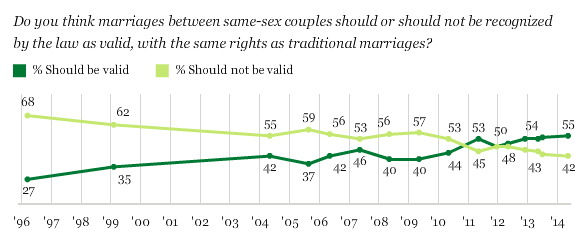
My italics. You have here a Burkean defense of federalism – something that will very much appeal to Anthony Kennedy, it seems to me. The problem, however, is that the pace of change has quickened so much after Windsor that Sutton is already out-dated. It’s now 36 states, not 19, representing 70 percent of the population, not 45. So his analogy to sodomy laws rather evaporates. If sodomy was upheld as a legitimate zone of privacy, when only 13 states retained such laws, why could not marriage for all couples be upheld as a constitutional right, when only 14 states ban it? Here’s the state of public opinion in the last two decades:

Screen Shot 2015-01-22 at 11.02.14 AM

The generational shift reveals nearly 80 percent support for marriage equality among the under 30s, and an even split among the over 65s. So whatever else a federal right to marry for gays would be, it sure wouldn’t be a judicial fiat of a fringe minority view. It would be a judicial confirmation of a major shift in public mores and beliefs. That’s the other Burkean argument that judicial intervention at this point is not premature.

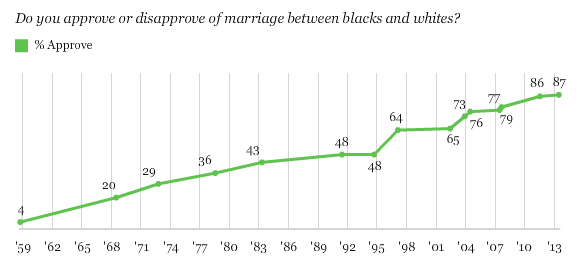
Consider the analogy with inter-racial marriage. In 1967, when Loving vs Virginia was decided, fifteen states retained active bans (about the same as those states that now ban gay marriage). But the polling back then was far more hostile to inter-racial marriage than to gay marriage in 2014.

While over 50 percent of Americans have backed marriage equality over the past few years, a mere 20 percent of Americans approved of miscegenation, when it was ruled unconstitutional. Approval of inter-racial marriage would not get above 50 percent until the mid-1990s, thirty years later:

Screen Shot 2015-01-22 at 11.07.13 AM

But what about the states’ rights argument? If public opinion is moving so fast, why not let federalism take its course? That’s my worry. Could Kennedy fashion a ruling that keeps marriage equality in those states that already have it, allow the minority to retain bans, but insist that any valid civil gay marriage in one state be recognized in any other? I don’t know how constitutionally you could do this – but I don’t doubt figuring out a balance between federalism and civil rights is what Kennedy (and maybe Roberts) will be assessing. A non-Fourteenth Amendment decision that nonetheless insisted on recognition, if not celebration, of same-sex marriages in every state might be a tempting middle way.

The case against this, it seems to me, is a simple one: confusion and complexity and timing. When a debate has been won so clearly in public opinion, when 36 states and DC already have marriage equality, and when the core dignity and equality of gay citizens is really at stake, why not just get it over with? To have your civil marriage in doubt when you travel across one country would be utterly unacceptable (and rightly so) to every heterosexual married couple). Why give the republic and gay citizens this kind of headache, when the argument is all but over? It wouldn’t be judicial over-reach; it might even be greeted with relief by many Republicans; and it would cement Kennedy’s standing as the champion of civil rights in our time. John Roberts might even be tempted to join Kennedy, if he wants to the Court to gain some respect from the next generation and exultation from millions of gay people and their families.

So maybe I’ve just talked myself out of a serious worry that something could go wrong. Or maybe I’m just jittery when so many seem to believe a triumph is a foregone conclusion. Or maybe I’ve been at this too long and am still psychologically unable to believe we have finally arrived. But as a Burkean federalist who believes in the value of slow incremental change through an emerging public consensus, but nonetheless believes that the right to marry is indivisible from core civil equality and basic human dignity, I think I can see Kennedy’s conflicts on this. But I also sense where his logic and his soul are: it’s time for a final decision. And a clear endorsement of a federal right to marry is the only one that really currently makes sense.

(Photo: Jewel Samad/Getty.)

The Popularity Of Paid Leave

Sick Time

Christopher Ingraham finds widespread support for paid sick leave. He flags a 2010 survey that “asked respondents how they felt about paid sick time, and then presented them with a battery of arguments for and against such legislation”:

[A]fter hearing these arguments, respondents’ views on sick leave legislation were unchanged — 75 percent supported mandatory sick time before hearing the arguments, while 74 percent supported it afterward. Even more telling, respondents rated the appeals about lower wages among the least compelling of the con arguments.

So, let’s take sick leave’s detractors at their word: If it really comes down to a choice between paid sick time and higher wages, Americans overwhelmingly choose the sick time. So why not give them that choice?

Talbot takes a closer look at research on family leave. She uses California and New Jersey as examples, states that “have both instituted six-week, partially paid family leave, funded by employees in the form of a small payroll tax”:

The New Jersey law went into effect in 2009, and three years later the Center for Women and Work at Rutgers conducted a study that showed some remarkably robust and positive results. Women who had taken the leave were far more likely to be working nine to twelve months after the birth of their child than new mothers who had not; they were also thirty-nine per cent less likely to be on public assistance, and fifty-four per cent more likely to have seen an increase in their wages. This finding is important: in some of the European countries that offer very long leaves—of a year or more—women who take advantage of the policies often pay a price in promotions and earning potential. But, based on the evidence here, shorter leaves seem to boost women’s wages.

In California, “people there took more and longer leaves”:

Meanwhile, most of the businesses surveyed in California reported either positive or no noticeable impact from the family-leave law. Presumably, their employees came back to work happier, healthier, and less distracted.


Keg Stands Manned By Women?

There’s been a growing chorus of bloggers arguing that an approach to lowering sexual assault on campus shouldn’t just target frats, but also empower sororities – to throw their own parties. Anna Merlan is onboard:

The advantages are pretty clear: the sorority would have a far greater ability to control the alcohol, including keeping an eye on what’s in the mixed drinks. And they’d be able to control who enters the house, as at Sigma Delta, who also appoint sober monitors to keep an eye on the scene. And many, many other people have made that argument from every side of the political spectrum: Robby Soave at the Libertarian magazine Reason, sociology professor Michael Kimmel writing for TIME , Charlottesville’s alt-weekly C-Ville. … Plus, the greatest benefit of all to having a party in your own house: at any point, you can lock your door, put on your pajamas, fire up Netflix and cease all social interaction, the best part of any night out.

Juliet Lapidos also sees sorority parties as a good path: “Telling fraternities not to throw parties is overbearing; telling undergraduates not to attend frat parties won’t work; and telling undergraduates to control their drinking at frat parties probably won’t work, either.” So what’s getting in the way?

As The Times’s Alan Schwarz explained on Monday, most national Greek-letter sororities do not throw keggers. They are, in fact, barred from serving alcohol at their residences. Julie Johnson, an officer at the National Panhellenic Conference, said in an interview that the point of the ban was to “ensure safety” as well as compliance with drinking-age laws. She also said she did not foresee the rule “changing anywhere in the near future.”

But Amanda Hess counters:

For the national organizations and local chapters, banning alcohol is a financial calculation, not a moral one:

staying dry helps them to avoid the legal liabilities shouldered by raucous fraternities. Drinking contributes not just to campus rape but also to physical fights, accidents, poisoning, and other destructive behaviors. James R. Favor & Company, an insurance company that covers more than a dozen fraternities, told the Times in 2012 that one national fraternity was paying an average of $812,951 in annual settlements until it went dry, at which point its annual payout dropped to $15,388. An officer with the National Panhellenic Conference told the Times that “she preferred to preserve the relative calm of sorority houses, and continue to let fraternities assume the cost, risk and cleanup of house parties.”

Jenny Kutner, on the other hand, doesn’t think sorority parties would make any difference:

[I]t simply fails to address the problems at the root of the campus rape crisis: binge-drinking and lack of education (about healthy alcohol consumption and sexual consent). But what also goes unaddressed are the perceptions of rape culture as a “so-called rape culture,” as the Cornell student described to the Times. The problematic attitude toward partying and sexual assault that persists on many campuses is embodied in Williams’ words — specifically, in the failure to question why any woman should ever have to “wonder how to get out” of somewhere she doesn’t want to be. So long as attitudes such as Williams’ remain, it’s unlikely that shifting a perilous party culture from one house to another will do much to increase women’s safety.

But there’s also the question of how much sororities really will do to protect their own. While anecdotal evidence might indicate that the organizations will go further to protect the interests of individual members, sororities are businesses — just like fraternities, institutions that have been repeatedly charged with protecting their own best interests when accidents happen.

Robby Soave likes the idea of sorority parties but acknowledges that “there’s always the risk that moving the party into the sorority will have a corrupting effect on the girls, rather than a civilizing effect on the scene.” Olga Khazan elaborates:

[Sorority parties] could further the flawed assumption that women are the more dutiful sex; that we are naturally better at policing inappropriate behavior. The Responsible-Lady-Fixes-Everything paradigm is why we have TV commercials where a size-two mom cheerily Lysols every inch of the house while her gross husband watches TV. (Or, more generally, the thinking that women do more chores because they like things cleaner.)

This reasoning is evident in how some of the Times‘ sources explained why they don’t think sorority sisters should have parties: “Mr. Pendleton said that because sororities tended to be smaller and more intimately decorated, members should hold events with alcohol at outside venues like dance halls.” You see, the women’s intricate doilies and knick-knacks simply will not withstand the constant, salty spray of a “Natty Boh” keg.

Meanwhile, on the fraternity front:

Last week, just in time for the start of rush, University of Virginia fraternities signed a new set of rules intended to prevent excessive drinking as well as sexual assault at frat parties. The new rules prohibit punch and kegs (beer must now be served in cans; liquor, by a licensed bartender) and require that parties be supervised by sober fraternity members, which seems like a step in the right direction.

Obama Has Changed The Debate

Douthat imagines how the left and right will respond to the president:

[Obama’s] influence over Clinton’s campaign will depend on economic trends and foreign policy developments as well as her own choices: If he’s climbed to a 47-48 percent approval rating by early 2016, I wouldn’t expect there to be any daylight between his agenda and her platform; if he falls back toward 40 percent (or drops below) amid some unlooked-for crisis, then no presidential speech is likely to constrain Hillary from trying to charting a more post-Obama course.

Meanwhile, the future relevance of his stab at a middle class agenda will be determined in part by whatever the G.O.P. comes up with for its post-Obama blueprint. If you contrast what was on offer last night with some of the ideas that, say, Utah Senator Mike Lee has proposed, there’s a very interesting right-left debate to be had around higher education reform, tax reform (family-friendly and otherwise), and other issues as well. But maybe the eventual Republican nominee will have a very different game plan, and the big clashes will end up happening elsewhere. Or maybe the mere fact that Obama has touched these issues will prompt the right to retreat to “safer” (that is, staler) ground.

Joe Klein appreciates Obama’s political deftness:

There were twin sources of the white flight from the Democratic party. One was the sense that Democrats were only interested in taking money from people like the Erlers and giving it to deadbeats, or feeding the government bureaucracy, personified by the post office stereotype: slow-moving, sullen, entitled. The other was a matter of values: the Democrats were the counterculture party, an argument that is evaporating as the culture has moved on, accepting homosexuality, premarital sex and, soon, marijuana. The first argument remains strong, though. It was what propelled the Republican victory in 2014. Obamacare was perceived as classic “liberalism”—it took money from hard-working Americans and gave it to unhealthy deadbeats. Only it didn’t: it gave subsidies to the working poor; the indigent were already covered by Medicaid.

The striking thing about Obama’s latest round of proposals is how targeted they are: the centerpiece tax reforms take money from the wealthy and give it to middle-class taxpayers, people like the Erlers. You have to actually pay taxes to benefit from tax credits (except for the child care deduction, which becomes a stipend for those who don’t). Even his free community college proposal might have been a boon to Rebekah, as she struggled to learn accounting. This is quite the opposite of offering health insurance to a country that was already 85% covered. It is middle-class populism: money is taken from the wealthy and given to a broad swath of the population whose incomes have been stagnating for 30 years.

Alec MacGillis feels that Obama has called “the bluff of the Republicans now claiming the mantle of inequality warriors”:

The [Obama tax] proposal has led them into a political trap, prompting them into an instinctual, reflexive defense of the wealthiest Americans. And it has thereby clarified the discussions to come on the campaign trail over the next year and a half. Talk all you want about restoring shared prosperity, Obama is saying, but this is the kind of reform it will take to bring balance to an economy that has gotten so top-heavy and out of whack. The proposal will implicitly admonish not only Republicans but also Hillary Clinton, should her own Wall Street sympathies and upper-bracket aspirations keep her from adopting an aggressive platform to tackle inequality.

And Beinart detects a “fracturing of the GOP message”:

Mike Huckabee looks determined to run on cultural decline. Jeb Bush and even Mitt Romney want to focus on using government to help the poor. Every potential candidate except Rand Paul will likely promise defense hikes and a more aggressive, militaristic foreign policy. And every potential GOP candidate, including Rand Paul, will likely unveil a big tax cut, probably unmatched by real reductions in spending.

What’s In A Black Name? Ctd

A reader writes:

An experiment I’ve always wanted to see: mail out resumes with African (e.g. Nigerian) names and see what the response would be. I’d be also curious to see if resumes were sent with photos attached of the same person with the same resume with only the names changed, say Michael Smith vs. Jamar Smith, if there would be any difference. Basically what I’d like to know: is this an actual of pure racial bias, or this more of a cultural bias against people with more stereotypically black names?

Another reader:

One plausible explanation for the discrimination identified by the Gaddis study, other than naked racial animus/aversion, is that employers “discount” the educational achievement of black applicants based on the assumption that affirmative action gave them a boost along the way.

As your previous coverage of racial preferences in college admissions reflects, this is not an entirely unreasonable assumption, though many people do overestimate the effects of such racial preferences. As a quick proof-of-concept, I did a rough comparison of SAT numbers for one of the university pairs Gaddis highlights – Harvard vs. UMass Amherst.  This article from the Harvard Crimson indicates that the average SAT score for all incoming Harvard freshman last year was 2237 (on the 2400 point scale), but only 2107 for incoming African-American freshman.  For incoming White freshman, by comparison, it was 2233 (i.e., roughly the average for all freshman).

The UMass website, meanwhile, indicates an average SAT score for all incoming freshman of 1218 (on the 1600 point scale), which, assuming comparable performance on the essay section, translates to 1827 on the 2400 point scale.  I couldn’t find a racial breakdown of UMass scores, but let’s assume that incoming white students scored roughly the overall average, just as they did at Harvard.

So, when comparing Harvard students to UMass Amherst students in a race-blind hiring process, the average SAT gap would be 410, but when comparing a black Harvard student to a white UMass Amherst student, the average SAT gap is only 280.  That’s roughly a 30% reduction of the achievement premium supposedly signaled by the Harvard name.

Given that the potential employers in Gaddis’ study seemed to discount the achievement premium for African-American Harvard students all the way to zero, there’s obviously more going on here, but given that other studies have shown people tend to significantly overestimate the effects of racial preferences in admissions, I wouldn’t be surprised if somehow controlling for that factor eliminated a meaningful portion of the apparent hiring discrimination.

Email Of The Day

Screen Shot 2015-01-21 at 2.02.05 PM

A reader quotes Byron York from this post:

Indeed, it’s widely conceded that part of the reason the unemployment rate has fallen is because a core of discouraged workers dropped out of the job search altogether. So for many listeners, Obama’s “turn the page” declaration will seem as out of touch as his claim that Islamic State’s advance has been stopped.

The Bureau of Labor Statistics has multiple ratings for measuring unemployment. The official rating is the U3 rating, which is currently 5.6%. It was 7.8% when Obama took office and reached 10.0% at the height of the recession. It has always been the rating everyone references, but now that the economy is recovering, the Obama haters want to throw out an asterisk.

What York describes is measured by the U4 rating.

The U4 measures the U3 plus those who have stopped looking for work because current economic conditions make them believe that no work is available for them. That number is currently at 6%. It was 8.3% when Obama took office and reached 10.6% during the height of the recession.

Finally, there is another rating, the U6 rating. The U6 is probably the most accurate measurement of unemployment. It is a combination of all ratings plus part-time workers who wish to be full-time. That number is currently 11.2%. It was 14.2% when Obama took office and reached 17.1% during the height of the recession.

Under the Obama administration, every rating of unemployment is better than it was when he inherited an economy hemorrhaging jobs.  To say that the economy turned the page isn’t out of touch; it’s factual. To be out of touch is to want to go back to the incompetence of the Bush administration. He inherited a U3 of 4%, a U4 of 4.2%, and a U6 of 7.1% and managed to double unemployment.

(Chart, and all the aforementioned stats, from Portal Seven, sourced from the Bureau of Labor Statistics)

Update from a reader, who counterbalances the previous one:

Your reader who discusses alternative measures of unemployment – U3, U4, U6 – misses something important: people who have not looked for work in the last 12 months are NOT counted in ANY of these measures.

U6 includes all “marginally attached workers.” “Discouraged workers” are a subset of the “marginally attached.” “Marginally attached” have not looked for work in the past four weeks, but HAVE looked for work in the last 12 months.

So if you have not looked for work in the last 12 months, you’re not even “marginally attached,” which means you’re not counted in ANY of U3, U4, U5, or U6. The BLS is not “cooking the books,” as the right-wing conspiracy theorists routinely assert. Instead the BLS is using statistical formulations designed to convey useful data in normal times – but these simply aren’t normal times.

The key to sorting out the lies from the damn lies from the statistics is this:

Yes, there are more jobs now than there were when Obama took office. But the jobs growth has not nearly caught up with the population growth since January 2009. Thus there are more jobs, but not nearly enough jobs to employ the same % of the population. (Graph, and explanation, here.) Thus the labor force participation rate has dropped. That’s the real upshot of the graph, and that’s what the BLS unemployment measures don’t capture.

If you Google “long term unemployed” you’ll find that they form a historically high share of the unemployed. But it’s not clear these articles are really catching the full extent of the problem -because it’s not clear whether they’re starting with the Bureau of Labor Statistics measures of unemployment, like your reader. Any discussion that starts with the various BLS categories is missing those who haven’t looked for work in the last 12 months. For those, you have to look at the labor force participation rate – which remains historically low, and shows no sign of improving.

The aging of the Baby Boomers accounts for about 40% to 50% of the drop in the labor force participation rate (links here, here, and here). The most likely reason for the other 50% to 60% of the decline: lack of work.

Finally, simple supply and demand. If a significant number of people were dropping out of the labor force for ANY reason other than lack of work, then we’d see wages rising significantly. But inflation-adjusted wages remain flat to barely growing.

That’s why people are unhappy: wages are flat and there’s still not enough work to go around. The relatively good BLS unemployment statistics can’t change this.

Leo Strauss, Man Of Peace?

That’s the argument of Robert Howse’s recent book, which portrays the controversial philosopher as something of a liberal internationalist rather than the progenitor of warmongering neoconservatism. Samuel Goldman isn’t so sure; he claims Howse should have included “a detailed consideration of the role of Zionism in Strauss’s thought about violence”:

In his intellectual autobiography, Strauss describes his earliest political decision as a commitment to “simple, straightforward political Zionism” at the age of 17.

Throughout the 1920s, he was active in the Revisionist movement led by Vladimir Jabotinsky. In the 1930s, Strauss endorsed the “the principles of the Right, fascist, authoritarian, imperialist principles…” as the only basis for defense of Germany’s Jews. In the 1940s, he offered a moral defense of the British Empire partly because of the mercy it offered to the vanquished—including the Jews settled in Palestine. In the 1950s and 1960s, Strauss lectured and wrote extensively on Jewish themes, rarely failing to voice his admiration and gratitude for the foundation of the State of Israel.

These facts are barely mentioned in Leo Strauss: Man of Peace. In fact, the only explicit reference to the State of Israel that I have found comes in the conclusion, when Howse mentions Strauss’s 1957 letter to National Review defending Israel from accusations of racism. As part of his polemic against the neoconservative appropriation of Strauss, Howse assures readers that, “This was an act of loyalty to the Jewish people, not to the political right.”

Howse may be correct about Strauss’s intentions. But Strauss’s personal relationship to the American conservative movement is not the most important issue. Strauss’s lifelong commitment to Zionism tells us something important about his views on political violence. In this decisive case, he endorsed the politics of national self-assertion that Howse contends he had rejected by end of his career.

The Returns On Low Capital Gains Taxes

Chris Edwards insists that “low capital gains tax rates are not some sort of unjustified loophole”:

We’ve had reduced rates virtually the entire time we have had an income tax, and for very good reasons. Low capital gains tax rates are crucially important for spurring entrepreneurship, investment, and growth.

Mike Konczal disagrees. He cites a recent paper by economist Danny Yagan on Bush’s massive capital gains tax cut. Yagan’s research compares S-corporations, which “don’t pay a dividend tax and thus didn’t benefit from the big 2003 dividend tax cut” to C-corporations, which “do pay them and did benefit”:

So that allows Yagan to set up S-corporations as a control group and see what the effect of the massive dividend tax cut on C-corporations has been. Here’s what he finds:

yagan

The blue line is the C-corporations, which should diverge from the red-line if the dividend tax cut caused a real change. But there’s no statistical difference between the two paths at all. (Note how their paths are the same before the cut, so it’s a real trend in the business cycle.) There’s no difference in either investment or adjusted net investment. There’s also no difference when it comes to employee compensation. The firms that got a massive capital tax cut did not make any different choices about things that boost the real economy. This is true across a crazy-robust number of controls, measures, and coding of outliers.

The one thing that does increase for C-corporations, of course, is the disgorgement of cash to shareholders. Cutting dividend taxes leads to an increase in dividends and share buybacks. This shows that these corporations are in fact making decisions in response to the tax cut; they just happen to be decisions that benefit, well, probably not you. If right now you are worried that too much cash is leaving firms to benefit a handful of investors while the real economy stagnates, suddenly Clinton-era levels of dividend taxation don’t look so bad.

Yglesias admits that Yagan’s study has its limits:

Any empirical study can be nitpicked in a variety of ways. But the big thing Yagan’s research methodology doesn’t cover is venture capital and startups.

Most business investment is undertaken by established businesses, and established businesses don’t rely on the stock market to fund their investments. But some firms do. Brand-new companies — and especially brand-new companies built around unproven technologies or business models — usually have their early investments financed by venture capitalists. These VCs are hoping to earn a long-term return after the company goes public, and the size of that return depends, in part, on the tax treatment of dividends and capital gains.

Consequently, higher taxes on investment income might depress VCs’ willingness to finance startups.