Cheney Is Lying

In his deeply revealing interview on Fox News last night, former vice-president Dick Cheney was asked which plots were foiled using torture, thereby saving thousands of lives. The first and only case he cited last night was the “West Coast” “Second Wave” plot against buildings in Los Angeles. He’s cited this many times before. And here’s the thing: It’s a lie. It’s not true. And we now know it’s not true, because the CIA itself admitted it last year, after a decade of lying about it.

Cheney hasn’t read the report, although he knows it’s “full of crap.” What that tells you about this man’s integrity and honesty I’ll leave to you. But here is what he hasn’t read.

The CIA, from the beginning, cited this case as a critical piece of evidence for the efficacy of torture, in all its briefings to officials. To take one random example, here is a legal memo from Steven Bradbury, at the OLC, conveying what the CIA was telling him:

Screen Shot 2014-12-10 at 7.23.26 PMSo torture gave us the existence of the Guraba cell, which foiled the plot. The CIA told Bush the exact same thing:

Screen Shot 2014-12-10 at 7.30.58 PMThis was a lie. How do we know? Because CIA operational cables and internal documents tell a different story. The FBI arrested two operatives in August 2001, including a “suspected airline suicide attacker” and that provided the leads for further identification of al Qaeda operatives involved in the Gubara version of the attack. Another plot on similar lines by some Malaysian nationals, coordinated by KSM, was foiled when one Misran bin Arshad was arrested in January 2002, revealing, by the way, that the attack had already been canceled the month before. Arshad spilled the beans after legal and non-coercive interrogations. So, according to the CIA, torturing KSM gave us nothing that we didn’t already have; and agents deduced that what intelligence they did get from KSM about this was because he knew that Arshad had already been captured – not because he had been tortured.

And the CIA admitted as much last year:

The CIA’s June 2013 Response acknowledges that “[t]he Study correctly points out that we erred when we represented that we ‘learned’ of the Second Wave plotting from KSM and ‘learned’ of the operational cell comprised of students from Hambali.” Here’s the full section:

Screen Shot 2014-12-10 at 7.49.17 PMBut notice that they cannot quite admit what they have admitted. They accept that they misled the president, but called it “imprecision,” rather than untruth. Then they bizarrely continued to “assess this was a good example of the importance of intelligence derived from the detainee [torture] program.” Then they threw in another claim – that the capture of another figure, Hambali, had been critical to foiling the plot as well, and that his capture was a function of the torture program. But the CIA’s own documents show that Hambali’s capture was unrelated to to the program. After a while, when you read this report closely, you cannot avoid seeing that they’re flailing around. They’ve got nothing but bluster and bluff. And when you watch the amazing Cheney interview, you realize he has nothing else either. All he has is bluff. But what he said last night was wrong. The CIA itself has said it was untrue.

We have a former vice-president going on cable news and continuing to say things in defense of the CIA that the CIA itself admits are untrue. This is his p.r. strategy: asking the American people who they are going to believe: Dick Cheney or their own lyin’ eyes? More on the Cheney interview to come.

Team Torture

Noah Millman believes that our reasons for torturing weren’t based on torture’s effectiveness:

Willingness to torture became, first within elite government and opinion-making circles, then in the culture generally, and finally as a partisan GOP talking point, a litmus test of seriousness with respect to the fight against terrorism. That – proving one’s seriousness in the fight – was its primary purpose from the beginning, in my view.

It was only secondarily about extracting intelligence. It certainly wasn’t about instilling fear or extracting false confessions – these would not have served American purposes. It was never about “them” at all. It was about us. It was our psychological security blanket, our best evidence that we were “all-in” in this war, the thing that proved to us that we were fierce enough to win.

Larison agrees:

Because of the bias in our debates in favor of hard-line policies, preventive war and torture not only become acceptable “options” worth considering, but they have often been treated as possessing the quality–seriousness–that they most lack. The belief that a government is entitled to invade a foreign country and destroy its government on the off chance that the latter might one day pose a threat is an outstanding example of something that is morally unserious. That is, it reveals the absence or the rejection of careful moral reasoning. Likewise, believing that a government should ever be allowed to torture people is the opposite of what comes from serious moral reflection.

Update from a reader:

Thank you for your superlative torture coverage.  I am a writing to let you know of a revealing exchange I had recently on National Review Online. In reply to an article yesterday by David French accusing the torture report of being a “partisan mess,” and insisting on the usefulness of torture, I wrote the following:

If torture works, we want to be sure it works in the long run, not just the short run. I worry that even if via torture we foil a particular bomb plot in the short run, in the long run we will have just succeeded in making many more bombers, since the terrorists will successfully use the fact of American torture to recruit new terrorists.

One reply might be: so we should torture in secret. But that implies that everyone we torture must never tell about it. And the only way to guarantee THAT is to silence those we torture forever, by killing them or imprisoning them for life without trial. Is that where we really want to go as a country?

In reply, “Nightscribe” wrote:

I realize this is a waste of my time, but, the Republicans and I do NOT think interrogation/torture (if you like that word) is a recruitment tool for Islamic terrorists! It’s the WEAKNESS we show the world that we are willing to throw our military and their tactics under the bus for feeding them Ensure! For God Sake! Wake up!

And who gives a flying F*** if they tell anybody about it? We’re trading them off for deserters by the handful! They’re no doubt laughing so hard they can barely keep the blade straight on the next journalist’s neck!

I only hope the next torture tactic we use is eyeball with a grapefruit spoon! With VIDEO!

The rest of the comments contain many equally disturbing and deranged “hurray for torture!” claims. One common argument that crops up is the following:  (i) We are civilized; (ii) our enemies are not; so (iii) we should torture them.

Do such people really not see that (iii) refutes (i)?

The Torture Report Blowback

So far, it consists mostly of tweets:

One day after the release of the report, massive riots and violent attacks on American installations abroad have yet to materialize.

However, the less immediate fear that the Senate report could provide recruiters from jihadist groups, including the Islamic State, with additional propaganda material is being realized. On Wednesday, the SITE Intelligence Group, which monitors Islamic extremist activity online, collected a series of tweets from apparent jihadist supporters and sympathizers who sought to frame the torture report as proof that Americans are waging a global war against Islam. SITE also noted jihadist calls for retributive attacks against specific targets.

Erica Chenoweth can find “no real systematic evidence to suggest that revelations of brutality lead to more violence”:

There is considerable evidence, however, that actual brutality (i.e. human rights violations, military invasions, and other forms of state violence during occupations) is associated with subsequent increases in terrorist attacks. Many people have referred to this effect in Iraq and Afghanistan—cases where foreign invasions and human rights violations clearly exacerbated rather than reduced violence. But plenty more scholarly studies indicate that states that rely on violence (especially indiscriminate and/or extrajudicial violence) to combat terrorism almost always end up prolonging terrorist campaigns rather than rooting them out.

Research by James Piazza and James Igoe Walsh show that states that violate physical integrity rights experience higher levels of subsequent terror attacks. Seung-Whan Choi finds a similar effect with regard to civil rights practices in general. Laura Dugan and I find that in the Israeli case, from 1987-2004 indiscriminate repression generally increased Palestinian violence, whereas more conciliatory counterterrorism measures (such as offers of negotiation or even public admissions of government abuses of Palestinians) tended to reduce subsequent violent incidents. And several others have shown that while British military strategies in Northern Ireland generally increased dissident violence, negotiations effectively ended it. Still other studies convincingly argue that criminal justice measures against those who have actually committed criminal acts are perfectly adequate in combating and deterring terror attacks.

In other words, brutal state strategies to counter “terrorism” are usually unnecessary – and they are more likely to backfire than to succeed.

Would You Report Your Rape? Ctd

Several readers open up:

You didn’t ask for answers to your question, but I’ll give you one, since McArdle’s doesn’t really do that. You can try to relate, but you can’t put yourself into the mind of someone who has been traumatized by sexual assault. I often reflect on why I didn’t report being raped by two men 15 years ago and what I would do differently if it happened today. I’ve thought a lot about this recently, as the story told in Rolling Stone bore some striking resemblances to my own. There are many reasons why I didn’t report my rape:

I just wanted it to go away, to forget it, to not talk about it. I felt ashamed, I blamed myself. While I was in shock from the trauma I had experienced and talking myself out of telling anyone outside my close circle of friends, those same friends helped to reinforce my decision. They reminded me that I had been drinking the night before and that I had kissed one of the men, willingly, earlier in the evening. These things were true and I would have to explain them to cops, lawyers, judges, my family, possibly my employer and I would be judged by them.

One comment from a friend that day haunts me still. She said, “You can’t go to the cops, T is on probation and could go back to prison”. It haunts me because it made perfect sense at the time, in the mental state I was in, I didn’t want to be responsible for someone going to prison. I was already blaming myself for their crime and its consequences.

Couldn’t this kind of reaction also help explain why a person’s memory of an assault could become warped over time? Just as forgetting key details is said to be the result of a coping mechanism, so could exaggerating details as a way to overcome feelings of guilt and shame. You were scratching your head over this yesterday, so it’s one possible explanation.

I’d like to think that if faced with the same decision today, I would be stronger, that I would “be the girl reporting it, sitting on a witness stand and pointing a finger”, that I would know that what mattered was what they did to me against my will and not what I did to deserve it – because I didn’t deserve it, and no one deserves to be violated in that way.

It’s been very difficult to read your blog lately, and I think that’s okay. Some of your posts on feminism and the Rolling Stone story have weighed on me in a way that those on other topics in which we disagree do not. Ultimately I appreciate your perspective, even as I dissent, because it forces me to check my biases, especially the ones that I know are emotionally driven and (hopefully) it helps me see with a bit more clarity.

Another reader:

I wrote once before (in the context of race and criminality) about being sexually assaulted by a man who was later convicted on multiple counts and sentenced to a long prison term.  What I didn’t mention was the attitude of the police when I first reported it.  They were extremely skeptical that I’d actually been attacked in my own apartment at 3 a.m.  They asked if I was in a relationship, and I said I’d recently ended one but was still friends with my ex – whereupon they tried to convince me that he (the least violent of humans) was the man who’d “showed up” in my bed, and therefore it couldn’t be rape, so it really wasn’t a matter for the police.

It was only months later, when the pattern of a serial rapist became blindingly clear (with a dozen victims in my area) that they finally took me seriously.  If being raped by a stranger at knifepoint can be spun away by police, think how they might treat an eighteen year-old who was drunk when she was raped by her date.  If police believe you when you report your car stolen, shouldn’t they extend the same benefit of the doubt to a woman who reports a rape?  Her claim may or may not hold up under investigation, as with any reported crime, but that’s no reason to assume a woman is lying or exaggerating.  Yet all too often police do.

Another:

I completely agree with Megan McArdle’s comments: I have never been sexually assaulted, but I find it 100 percent easy to believe that a victim of a traumatic sexual encounter (even one that might not rise to the level of rape) would not report it or report a somewhat confused story with lots of second-guessing herself.

At the wedding of some friends several years ago, I had the surreal experience of being weirdly groped by a married friend of mine while we were in the middle of a conversation with another friend: the three of us were talking, and friend A kept running his hands up and down my thigh (I was on  a barstool) and I was just drunk enough and just confused enough by the weirdness of what was happening that all I did was push his hands away each time (but he kept coming back!) and friend B didn’t do or say anything.

In my retelling of it to a friend who knew all the parties, I kept second-guessing myself: why would anyone do that?? He seems like such a normal guy! Maybe I was imagining it? Maybe it wasn’t as bad as it seemed? Maybe I’m making too much of this super weird situation. Especially when you’re a little buzzed, or tired, or whatever, I can completely understand not wanting to subject your brain and psyche – which are already confused and traumatized enough – to the skeptical questioning of some cop or campus security who might just see some drunk, slutty girl who’s angry at some guy.

From “Duck” To “Babe”

Jen Doll offers a history of terms of endearment:

Babe and baby as used to describe a romantic partner (rather than a small child or immature person; those usages began in the 1400s and 1500s) can be traced to usage that began in the 19th and 20th centuries in America. Initially, the words were simply used as a form of address (men were calling each other baby in 1835, sans any romantic connotations; in the 1996 movie Swingers, Vince Vaughn’s character employs the word for just about everybody).

The Oxford English Dictionary gives the first romantic use of babe as 1911, exampled by the Rodgers and Hart lyrics, “Oh, ma babe, waltz with me, kid. Gee, you’ve got me off ma lid.” In 1684, there’s an isolated use of baby by Aphra Behn: “Philander, who is not able to support the thought that any thing should afflict his lovely Baby, takes care from hour to hour to satisfie her tender doubting heart,” but the word doesn’t pop up again as a romantic descriptor until the 1860s: “Dear, dear, dear Baby, how often, how incessantly I think of you,” writes General H. M. Naglee. Baby is also used around that time to refer to “attractive young women,” and babe follows in that role in 1915, though it takes until 1973 for babe to apply to a man: “He’s a real babe … Mr. America!”

Before those two little b-words, though, came handfuls of nicknames you might apply to your lover, including cinnamon (1405), honeysop (about 1513), heartikin (1530), ding-ding (1564), pug (1580), sweetikin (1596), duck (1600), sucket (1605), flitter-mouse (1612), nug (1699), treat (1825), hon (1906), sugar (1930), and lamb-chop (1962). According to Katherine Connor Martin, head of U.S. dictionaries at Oxford University Press, “Really common endearments involved sweetness, sugar, and animals and birds. This baby concept is not something that has a long history. We can thank American English for innovating this particular strand.

The Truth About Torture, Revisited

[Re-posted from earlier today]

Nine years ago, Charles Krauthammer wrote an essay in The Weekly Standard defending the use of torture by the United States. I responded with the essay excerpted below in The New Republic. I went back and read that debate this morning, just to see how it holds up in the wake of the mass of evidence we now have from the CIA itself about the torture that the US actually authorized and practiced under the Bush administration.

And what strikes me is how admirably emphatic Charles was about the gravity of the issue nine years ago. Here is a sentence and a sentiment I have yet to read in the various commentaries on the right since the report was published yesterday:

Torture is a terrible and monstrous thing, as degrading and morally corrupting to those who practice it as any conceivable human activity including its moral twin, capital punishment.

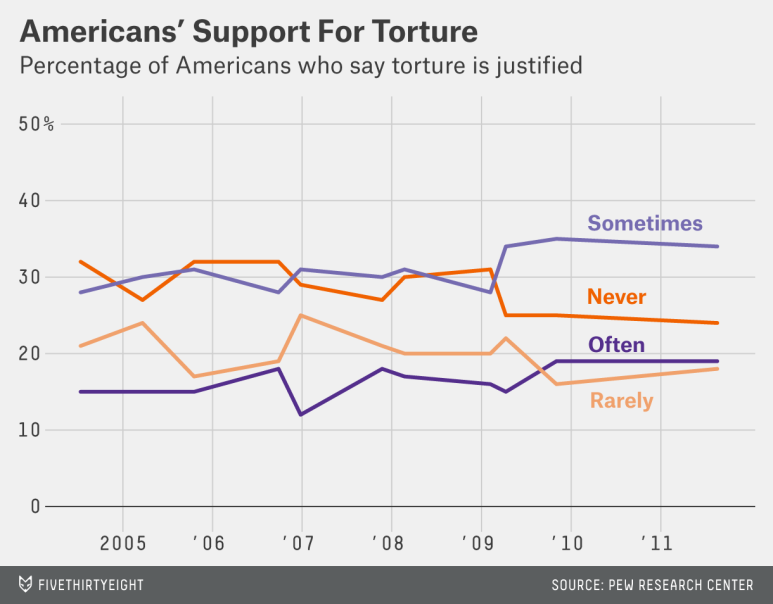
It seems to me that in a civilized and decent society, this is not something open to much caviling. Even if you believe, as Charles did, that torture was defensible in some very exacting circumstances, it is still a monstrous, morally corrupting evil. And yet that sentiment is strangely nowhere to be found on the current right. Which is itself proof of the statement. What we once instinctively regarded with moral horror has, over the years, become something most Americans are comfortable with. This is what torture does. In the words of Charles Krauthammer, it degrades and morally corrupts those who practice it. And so it has:

Torture Support

Notice that Krauthammer’s maximal position in 2005 is now dead last in public opinion: his view that torture should be used extremely rarely commands less than 20 percent support and is beaten by those Americans who now believe that torture should be employed often. Yes: often. And this, of course, is not an accident. When a former president and vice-president openly back torture, and when the CIA has been engaging in a massive p.r. campaign to argue – against what we now know are incontrovertible facts from the CIA’s own records – that it saved thousands of lives, it will affect public opinion. There are always atavist and repellent sentiments in war time. The difference now is that a huge section of the elite endorses them.

Whom should we torture? Krauthammer rules torture out of bounds for prisoners of war; permits it in the case of very few high-value terrorists; and then offers up a difficult category of torture victims – those with information about a “ticking time-bomb”:

Third, there is the terrorist with information. Here the issue of torture gets complicated and the easy pieties don’t so easily apply. Let’s take the textbook case. Ethics 101: A terrorist has planted a nuclear bomb in New York City. It will go off in one hour. A million people will die. You capture the terrorist. He knows where it is. He’s not talking … Question: If you have the slightest belief that hanging this man by his thumbs will get you the information to save a million people, are you permitted to do it? Now, on most issues regarding torture, I confess tentativeness and uncertainty. But on this issue, there can be no uncertainty: Not only is it permissible to hang this miscreant by his thumbs. It is a moral duty.

Now consider what we now know about whom we tortured under the torture program under Bush and Cheney. First off, we tortured 26 people who were cases of mistaken identity. We tortured 26 innocent people. This is so far outside any of the parameters that even Krauthammer allowed for that it beggars belief. Amy Davidson:

Footnote 32, the same one that outlines the motives for holding Nazar Ali, has a devastating litany, starting with “Abu Hudhaifa, who was subjected to ice water baths and 66 hours of standing sleep deprivation before being released because the CIA discovered he was likely not the person he was believed to be,” and including many others, such as,

“Gul Rahman, another case of mistaken identity.… Shaistah Habibullah Khan, who, like his brother, Sayed Habib, was the subject of fabrications.… Haji Ghalgi, who was detained as “useful leverage”…. Hayatullah Haqqani, whom the CIA determined “may have been in the wrong place at the wrong time”…. Ali Jan, who was detained for using a satellite phone, traces on which “revealed no derogatory information”.… Two individuals—Mohammad al-Shomaila and Salah Nasir Salim Ali—on whom derogatory information was “speculative”.… and Bismullah, who was mistakenly arrested … and later released with $[redacted] and told not to speak about his experience.”

It seems to me that proponents of torture should be horrified by this revelation. If torture is a monstrous thing, if it corrupts all who do it, as Krauthammer believes, what incalculable damage has been done by the US torturing innocents, in one case to death? Where was there any remorse – yes, remorse – expressed by the CIA yesterday for this compounding of a crime and a mistake?

Now consider Krauthammer’s view of who should be doing the torturing:

The exceptions to the no-torture rule would not be granted to just any nonmilitary interrogators, or anyone with CIA credentials. They would be reserved for highly specialized agents who are experts and experienced in interrogation, and who are known not to abuse it for the satisfaction of a kind of sick sadomasochism Lynndie England and her cohorts indulged in at Abu Ghraib.

We now know that the CIA contracted out the torture to two individuals without “specialized knowledge of al Qaeda, a background in counterterrorism or any relevant cultural or linguistic experience.”  They had never interrogated anyone – yet they got a $181 million contract to run the program. They were sadists:

John Rizzo, the acting CIA general counsel who met with the psychologists, wrote in his book, “Company Man,” that he found some of what Mitchell and Jessen were recommending “sadistic and terrifying.” One technique, he wrote, was “so gruesome that the Justice Department later stopped short of approving it.”

They had a pecuniary interest in the criminal enterprise. And they were making things up as they went along:

One email from a CIA staff psychologist said “no professional in the field would credit” their judgments. Another said their “arrogance and narcissism” led to unnecessary conflicts in the field. The director of interrogations for the CIA called their program a “train wreck” and complained that they were blending the roles of doctor and interrogator inappropriately.

So the architects of the torture program also violated a core part of Krauthammer’s defense of torture. And shockingly so. Why aren’t the defenders of torture horrified by this amateurism? Where are the Republican voices of outrage that a serious torture program was handed out to amateur contractors who had no idea what they were doing and no moral compass at all?

Krauthammer also described two torture techniques he would approve of. One was the injection of sodium pentathol – which, given the rank brutality of the actual torture sessions – would have been a mercy, but was not widely used (so far as we know). The second technique was waterboarding, the torture perfected by the Communist Chinese, and for which previous US servicemembers were prosecuted. But notice what Charles says waterboarding is:

Less hypothetically, there is waterboarding, a terrifying and deeply shocking torture technique in which the prisoner has his face exposed to water in a way that gives the feeling of drowning. According to CIA sources cited by ABC News, Khalid Sheikh Mohammed “was able to last between two and 2 1/2 minutes before begging to confess.” Should we regret having done that? Should we abolish by law that practice, so that it could never be used on the next Khalid Sheikh Mohammed having thus gotten his confession?

We now know that those CIA sources were lying. KSM was waterboarded 183 times over a matter of weeks. And the waterboarding was not just 2 1/2 minutes of panic. It was full-fledged, endless, soul-breaking, body-destroying torture of a kind practiced in the past by totalitarian or authoritarian police states:

Within days of the Justice Department’s approval to begin waterboarding the prisoner, Abu Zubaydah, the sessions became so extreme that some C.I.A. officers were “to the point of tears and choking up,” and several said they would elect to be transferred out of the facility if the brutal interrogations continued. During one waterboarding session, Abu Zubaydah became “completely unresponsive with bubbles rising through his open, full mouth.” The interrogations lasted for weeks, and some C.I.A. officers began sending messages to the agency’s headquarters in Virginia questioning the utility — and the legality — of what they were doing. But such questions were rejected.

Krauthammer argued that the torture should “not be cinematic and ghoulish.” I wonder if he regards the following as non-ghoulish:

The interrogators didn’t know the languages that would have been useful for real intelligence, but they did come up with a lexicon of their own: “walling,” which meant slamming a person against a wall; “rough takedown,” in which a group would rush into a cell yelling, then drag a detainee down the hall while punching him, perhaps after having “cut off his clothes and secured him with Mylar tape”; “confinement box,” an instrument to make a prisoner feel he was closed in a coffin (the box came in large or small sizes); “sleep deprivation,” which might mean being kept awake for a hundred and eighty hours before succumbing to “disturbing hallucinations”; the ability to, as the report put it, “earn a bucket,” the bucket being what a prisoner might get to relieve himself in, rather than having to soil himself or being chained to a wall with a diaper (an “image” that President Bush was said to have found disturbing); “waterboarding,” which often itself seems to have been a euphemism for near, rather than simulated, drowning; “rectal rehydration as a means of behavioral control”; “lunch tray,” the assembly of foods that were puréed and used to rectally force-feed prisoners.

This is what the talk of family could look like: “CIA officers also threatened at least three detainees with harm to their families—to include threats to harm the children of a detainee, threats to sexually abuse the mother of a detainee, and a threat to ‘cut [a detainee’s] mother’s throat.’ ” The interrogation of Abd al-Rahim al-Nashiri included “implying that his mother would be brought before him and sexually abused.”

What this report proves – not asserts, but proves – is that the torture the US inflicted on prisoners was of an uncontrolled, nightmarish quality whose impact was so great that even the junior grunts on the night beat at Abu Ghraib knew what they were supposed to do. Remember what so many Republicans said after Abu Ghraib? They were horrified, when they could blame it on someone at the very lowest rung of the totem pole. But when it was sanctioned by the very highest levels of the CIA – and inflicted on two dozen innocents – it was kosher.

In a civilized society, there really would be no debate over this. And before 9/11, there wasn’t. Ever since, this country has slid and then fallen out of the civilized world and out of the core American traditions of humanity and legal warfare. Krauthammer can be seen as emblematic of that slide – someone whose early abhorrence at torture and defense of it only in its mildest and rarest forms has slowly succumbed to a full-fledged defense of a program that violated every rule he said should be in place to protect us from the abyss. This is not surprising. When you start to torture, the sheer evil of what you are doing requires that you believe ever more in its value. You can never admit error, because it would mean you have committed crimes against humanity without even the defense of acquiring any useful intelligence. You are revealed as monsters – and you cannot accept that of yourself or of those you know. And so you insist – with ever-rising certainty – that the torture worked – even though that’s irrelevant as a matter of morality and of law, and even though your own internal documents prove that it didn’t.

And so you become the monster you were supposed to be fighting. And if you gaze long enough into an abyss, the abyss will gaze back into you.

Katherine Bigelow, Propaganda Tool

A reader writes:

Please take a minute if you haven’t already to watch the segment on the Daily Show last night where Jon Stewart asks Zero Dark Thirty director Katherine Bigelow about the Senate report on torture (she was scheduled to be on the show to promote her new documentary on the ivory trade and terrorism – the timing was a coincidence as far as I know).  When asked for her reaction to the revelation of the CIA’s lies and misrepresentations (particularly about whether the information gleaned from torture was of any use) her two word answer was: “It’s complicated.”

That’s it.

Nothing else from her.  No apology for the damage her movie did in conveying the idea to the average American that torture “works”.  No attempt to explain how she was deceived (of course it was public knowledge even then that the salient information came from un-tortured sources but many/most people don’t know or understand that), and no attempt at a defense by her either. And then no follow up from Jon Stewart. Just her “It’s complicated” and then on to something new (with new bad guys who aren’t us).

She was had. And she’s not strong enough to admit it. Her movie does show some of the milder torture the US inflicted on prisoners, and it has some worth for that. But its subtle attempt to say that it somehow played a role in getting bin Laden … well, we now know that is not true. Another scowls at Stewart:

I’ve never thought of Jon Stewart as a journalists. But you guys have often written about him in those terms. If Stewart is a journalist, he was David Gregory during the Bigelow segment.

Don’t be too rough on him. A reminder of the facts of the Senate report as it relates to bin Laden:

Did waterboarding and other coercive interrogation techniques that were used on al Qaeda detainees in CIA custody eventually lead to the Navy SEAL operation that killed Osama bin Laden in Pakistan early in the morning of May 2, 2011? The Senate Intelligence Committee report released Tuesday has a simple answer to that: Hell, no!

According to the Senate report, the critical pieces of information that led to discovering the identity of the bin Laden courier, Ahmed al-Kuwaiti, (Ahmed the Kuwaiti) whose activities eventually pointed the CIA to bin Laden’s hiding place in Pakistan, were provided by an al-Qaeda detainee before he was subjected to CIA coercive interrogation, and was based also upon information that was provided by detainees that were held in the custody of foreign governments. (The report is silent on the interesting question of whether any of these unnamed foreign governments obtained any of their information by using torture.)

Further critical information about the Kuwaiti was also provided by conventional intelligence techniques and was not elicited by the interrogations of any of the CIA detainees, according to the report.

Even worse for the CIA — which has consistently defended the supposed utility of the interrogation program, including in the hunt for bin Laden — a number of CIA prisoners who were subjected to coercive interrogations consistently provided misleading information designed to wave away CIA interrogators from the bin Laden courier who would eventually prove to be the key to finding al Qaeda’s leader.

Update from a reader with further media criticism:

I listened to “Morning Edition” this morning, very curious to hear their coverage on this important story. I was quite disappointed. First, they continued with the “enhanced interrogation” euphemism, refusing to call it torture. (She kept referring to it as “what some would call torture.”) But even more problematic was Renee Montagne’s interview with John Rizzo, former CIA General Counsel.

Their entire conversation centered on the specific practices that went beyond the authorized practices, with Rizzo emphasizing that when people exceeded the boundaries, they were reported (and punished). Montagne never asked him about the practices that were authorized, which is the much bigger problem at issue. Rizzo made it seem like there were two types of practices: (1) authorized practices that were effective (according to him); and (2) unauthorized, excessive practices. Montagne never asked him how or why practices like waterboarding, sleep deprivation, and keeping prisoners in stress positions were actually permitted, given that they have been legally prohibited previously. Nor did she ask if some of the other practices that were revealed in the report, such as “anal feeding,” were permitted (or were considered excessive according to the CIA guidelines he was defending).

Whitewash doesn’t even begin to capture what a lame interview it was (as most of the comments on NPR’s website point out).

Always Believe The Accuser?

Zerlina Maxwell makes the dubious argument that alleged rapists should be presumed guilty until proven innocent, at least in the court of public opinion:

We should believe, as a matter of default, what an accuser says. Ultimately, the costs of wrongly disbelieving a survivor far outweigh the costs of calling someone a rapist. Even if Jackie fabricated her account, U-Va. should have taken her word for it during the period while they endeavored to prove or disprove the accusation. This is not a legal argument about what standards we should use in the courts; it’s a moral one, about what happens outside the legal system.

The accused would have a rough period. He might be suspended from his job; friends might defriend him on Facebook. In the case of Bill Cosby, we might have to stop watching his shows, consuming his books or buying tickets to his traveling stand-up routine. But false accusations are exceedingly rare, and errors can be undone by an investigation that clears the accused, especially if it is done quickly.

Freddie is aghast at Maxwell’s belief that public opinion is entirely separate from the judicial system and that such an attitude won’t lead to serious miscarriages of justice:

I find it particularly disturbing that, in a country with a long legacy of using spurious claims of sexual aggression as a weapon against black men, many of those who consider themselves the most committed opponents of racism are endorsing a deeply simplistic and idealistic notion of how the pursuit of justice actually happens in the non-ideal real world we live in. A brief consideration of American history will show you some examples of rape claims that were automatically believed, and the consequences are a terrible stain on our country.

When we talk about carceral feminism, this is what we mean:

allowing the great moral duty to oppose rape to allow us to develop credulous attitudes towards the police state. People keep insisting to me that this doesn’t happen, but how can Maxwell’s assumption of a necessarily impartial judicial system, unmoved by public opinion, represent anything else? We’re living through righteous, mass protests of an unchecked, deeply racist police system. That so many are failing to apply that analysis consistently and thoroughly is deeply discouraging. We owe support and attention to the victims of rape. Developing a false credulity to the notion of judicial impartiality does neither them nor the rest of us any favors.

McArdle piles on, adding that Maxwell’s “always believe” approach would actually result in making all rape victims less believable:

One cost of minimizing false negatives is to the false positives who get hurt. But another cost is to the credibility of all rape reports. People who responded to the problems with the Rolling Stone story by saying that this didn’t have anything to do with the real problem — the culture of rape on college campuses — were missing something important. Actually, two important things.

First, that deciding what to do in the face of these trade-offs between false positives and false negatives is actually a vital matter of public debate in all areas of policy, and this story cast important light on how those trade-offs may have been made outside of the public eye.

And second, that by declaring that this story, which just a week before was a grave matter demanding the urgent attention of the nation, somehow became trivial and irrelevant when it started to look as if it might be false, writers and activists were suggesting that they simply didn’t care about false positives. Which undercuts the very public trust they need to advance their cause.

Brendan O’Neill sees an emerging culture of credulity gone haywire:

If Erdely nodded along to Jackie’s story while robotically thinking “I believe,” she isn’t alone. Automatically and uncritically believing allegations of rape is all the rage today. Where for most of the Age of Enlightenment it was considered civilized to believe that those accused of a crime were innocent until proven guilty, now it appears the way to show that you are a good and caring person is to do pretty much the opposite. You should believe instantly the alleged victim’s every word, and by extension to believe instantly that the accused is guilty as hell.

So when Dylan Farrow claimed she was sexually abused as a child by Woody Allen, the meme “I Believe Dylan” spread like a pox across the internet. #IBelieveDylan trended on Twitter. At IndiewireMelissa Silverstein said “There are a few fundamental beliefs that I hold, and one of them is that I believe women.” All women? All the time? Including, say, Condoleezza Rice when she said Saddam had loads of weapons of mass destruction?

This is silly. Women are just as capable as men of making stuff up.

But Maya Dusenbery, a former fact-checker, argues that it was the biases of journalism, not feminism or advocacy, that led Rolling Stone to do Jackie the tremendous disservice of not fact-checking her story:

One of the main purposes of fact-checking is to correct journalism’s bias toward a “good story” above all else. … [I]f Rolling Stone was so eager to keep Jackie’s story in the piece that they were ready to run it against her will, that suggests their willingness to bend their fact-checking standards may have had less to do with some feminist “sensitivity” to a survivor’s request and more to do with not wanting to risk losing a particularly shocking tale of a gang rape that would help their article go viral in the way it ultimately did.

I do not know if that’s the case — perhaps Rolling Stone genuinely, if very mistakenly, believed they were doing the right thing for the right reason — but I think it’s plausible, and I’d like to see all the journalists rushing to pontificate about how to do “good reporting” on sexual violence acknowledge the possibility that it was journalism’s bias towards a good story that’s to blame here. That in chasing the “perfect victim,” Rolling Stone pressured a traumatized rape survivor to tell her story, ditched their fact-checking standards, and then threw her under the bus when the account — totally predictably — was challenged.

But, of course, the one thing that journalism refuses to question is its own ability to reveal the truth. It clings fast to its central conceit: that it has no biases of its own, and if followed correctly, its standards and conventions are enough to magically correct our cultural biases and lead us to some “objective” truth — or at least get us closer than anything else will.

Uber Comes Under Fire Abroad

Vlad Savov sums up this week’s bad news for the ride-share company:

In Madrid, a judge has ruled that Uber should cease all activities in Spain because its drivers are unregistered and thus act as unfair competition to existing taxi services. … Authorities in Thailand have reached a similar conclusion, deeming Uber’s operation of unlicensed and uninsured taxi services to be unlawful, and have also asked the company to cease business — at least until it starts using properly accredited drivers rather than private cars.

India has already instituted a ban on Uber in Delhi following the rape of a female passenger, but now the country is broadening its prohibition and advising all its state governments to enforce it. It specifically bans the use of web-based taxi-hailing apps, meaning the ban will have an impact on others beyond Uber, but the focus on the California company is intensifying with the Delhi Police “also exploring the issue of possible legal liability of the taxi service Uber in the crime committed,” according to Home Minister Rajnath Singh.

To Jason Koebler, the incident in New Delhi demonstrates that Uber doesn’t care about riders’ safety:

Uber’s entry into in India show that the corporation’s sensibilities and values—that is, to crush existing taxi services and its tech savvy competitors like Lyft—haven’t changed a bit, even if some high-profile cases (like the​ time it called a several-hour abduction of a woman an “inefficient route”) in the US have forced the company to take a modicum of responsibility for its drivers. Now, we get at least a basic background check and nonsense like the “Safe Rides Fee” (which only exists in Canada and the​ US, according to the company).

But in developing countries, Uber is making the same mistakes with rider safety that it made in the United States. It’s treating these countries like the Wild West until it’s forced to change: “If [Uber] can bully its way in the US, and not care about law and regulations there, then it has absolutely nothing to worry about in India,” wrote o​ne internet commenter who claimed to have experience with the company there. “The law enforcement is weak, to say the least.”

But Danny Vinik blames the Indian authorities, not Uber:

Uber offers a new transportation option that offers users at least some ability to hold their drivers accountable for their actions. That doesn’t mean it’s a cure-all. In many cases, Uber’s ability to ensure the safety of its user will rely on the infrastructure already in place. Ultimately, improving that infrastructure is up to the local communities and officials, not Uber. That doesn’t mean Uber is blameless, but their cars offer one of the safest traveling experiences in India. At least the company has a background check system to speak of, and users have the ability to rate their drivers. With other transportation optionsrickshaws or local taxis, for instancethat isn’t necessarily the case. Uber’s not perfect, but it’s an improvement. This brutal incident doesn’t change that.

And as Amanda Taub points out, Indian cities are often unsafe for women to get around in, whatever mode of transportation they choose:

I saw this effect firsthand during trips to India in the past year. Everyone had different advice for me about how to stay safe, which meant that in the aggregate I was warned against using every possible form of transportation. (Only use radio taxis, they’re safer, never use local taxis. Don’t use radio taxis, you don’t know who they’ll send, better to rely on these local taxi drivers, we know them. Don’t take autos during the nighttime. Don’t take autos during the daytime. Come with us in the auto, it’s safer than going on your own. Don’t walk, take a bicycle rickshaw from the train station. Don’t take bicycle rickshaws. Don’t take the train.)

Given the choice between taking all of that advice and never leaving my apartment, versus selectively ignoring it and getting on with my day, I chose the latter. But finding safe and reliable transportation where and when I needed it was still always a challenge. That challenge is of course far more significant for Indian women, who have to face it every day, usually without the resources that I had at my disposal.

That was the problem that Uber needed to solve. But the facts surrounding this alleged assault suggest that they have failed to do so.

Mallika Dutt expects the Uber ban to make that problem worse, not better:

The quick decision to ban Uber is important in that it sends a message to all companies operating in this space that they need to follow regulations with seriousness. However, it is already unsafe for women to get around in Delhi. The metro has separate compartments for women—but what do they do when they step off the train? That’s partly why Uber and other private cab companies are in demand in the first place. Decreasing access to multiple modes of alternative transportation for women is a short-term and limited solution. Rather than further limiting the options available to women, how about increasing women’s safety not only by enforcing regulations and providing safer modes of operation, but by also increasing the number of men who hold themselves and others accountable for their behavior and actions?

The way Leonid Bershidsky sees it, the incident “highlights one of the web-based car service’s biggest problems: In some places, there is little to distinguish it from the anarchic system it seeks to replace”:

Those who live in the U.S. and other rich countries find it hard to understand the near-irrelevance of Uber’s ride-sharing model in Eastern Europe, Asia and Latin America. Many countries in these regions have time-honored unregulated gypsy cab traditions. In Argentina and Uruguay, people call or text for a trucho. In Russian cities, if you raise your arm by the roadside, a car — almost never a licensed taxi — typically pulls up within minutes, unless it’s the dead of night.

His bottom line:

In emerging economies with shaky taxi regulation, Uber can’t be disruptive if it is as lax as the incumbents. Its offering can only be of value if it tries to be more like a traditional Western taxi service, obeying strict rules and convincingly projecting an image of safety and reliability. That is something it isn’t equipped to do now.

Remember When They Opposed War In Iraq?

What a difference a decade makes. As the Senate Foreign Relations Committee yesterday finally began debating an authorization for the ongoing war against ISIS, the secretary of state urged them to grant the White House a much wider berth than the draft bill would:

Specifically, Kerry asked his former colleagues not to limit the use of military force to those two countries where Obama already has launched airstrikes, nor to bar the president from deploying combat troops on the ground, despite his repeated assurances that he will not do so. “In our view, it would be a mistake to advertise to ISIL that there are safe havens for them outside of Iraq and Syria,” Kerry said. On the use of ground troops, the secretary reiterated Obama’s policy that “U.S. military forces will not be deployed to conduct ground combat operations against ISIL.”

But he doesn’t want Congress to put that in writing [in the Authorization for Use of Military Force (AUMF)]. “That does not mean,” Kerry said, “we should pre-emptively bind the hands of the commander-in-chief—or our commanders in the field—in responding to scenarios and contingencies that are impossible to foresee.” As examples, he said the administration needed flexibility to execute hostage rescues or respond if ISIS acquired chemical weapons outside the region.

And while Kerry was very clear on what the administration didn’t want in the AUMF, he had nothing to say about what powers they actually did want. The White House, after all, still refuses to put forth its own draft AUMF, so we still have no idea what constraints, if any, the administration envisions for this war. Jack Goldsmith analyzes Kerry’s testimony:

What the administration appears to be seeking is an open-ended IS AUMF akin to the one that Congress gave the President for al Qaeda and affiliates in the 2001 AUMF. In addition to the features noted above, the administration would like an “associated forces” extender but (apparently) not a reporting requirement about covered groups or places.  This would replicate the problem under the 2001 AUMF of Congress (and the American people) not necessarily knowing who we are fighting against, or where. …

Pretty amazing coming from an administration whose Chief Executive said in his NDU speech 18 months ago (i) “Unless we discipline our thinking, our definitions, our actions, we may . . . continue to grant Presidents unbound powers more suited for traditional armed conflicts between nation states,” (ii) that he “look[ed] forward to engaging Congress and the American people in efforts to refine, and ultimately repeal, the [2001] AUMF’s mandate,” and (iii) that he “will not sign laws designed to expand this mandate further.”  I view Kerry’s testimony as the final repudiation of this element of the NDU speech, and as an acknowledgment that the “Forever War” is not close to over.

Morrissey is even less charitable:

Obama got elected by promising to end the war in Iraq, and then got re-elected by bragging that he’d done so by pulling out. All he did was set the stage for the war to expand exponentially, and with it the threat to the region and the West. Now Obama wants to avoid the political consequences of the failure of his policy by trying to get Congress to step in front of him while Obama prepares to re-enter the war he left behind. Republicans aren’t going to take the bait no matter how much they see the need for a forward strategy against ISIS, and neither are Obama’s Democratic allies.

The defining characteristic of this administration’s foreign policy has always been a failure to lead. It’s just becoming a lot more obvious these days.

Karl Vick rolls his eyes at yesterday’s proceedings:

The entire exercise, in a Lame Duck session, was academic at worst, and at best a dress rehearsal for the new year, when the Republicans will take control and — given the hawkish tenor of the GOP members — likely give Obama all the freedom he asks. Except for Paul, who scolded the administration on strict constructionist grounds, the harshest words were from Sen. John McCain, who called the hearing “kind of a charade.” The Arizona Republican stormed out after refusing to concede Kerry’s suggestion that more moderate Syrian rebels the administration has promised to arm are not, in fact, being left to die — owing, Kerry hinted, to secret measures that could not be discussed in a public setting. “More is being done, and more is being done than I can talk about in this hearing,” he said.