The Truthiness Of Virality

Facebook Upworthy

Neetzan Zimmerman, the master of viral content, makes an astute observation:

I’d argue that most viral content demands from its audience a certain suspension of disbelief. The fact is that viral content warehouses like BuzzFeed trade in unverifiable schmaltz exactly because that is the kind of content that goes viral. People don’t look to these stories for hard facts and shoe-leather reporting. They look to them for fleeting instances of joy or comfort. That is the part they play in the Internet news hole. Overthinking Internet ephemera is a great way to kill its viral potential.

In response, Felix Salmon observes that there’s “now so much fake content out there, much of it expertly engineered to go viral, that the probability of any given piece of viral content being fake has now become pretty high”:

If your company was built from day one to produce stuff which people want to share, then that will always end up including certain things which aren’t true. That’s not a problem if you’re ViralNova, whose About page says “We aren’t a news source, we aren’t professional journalists, and we don’t care.” But it becomes a problem if you put yourself forward as practitioners of responsible journalism, as BuzzFeed does.

It has become abundantly clear over the course of 2013 that if you want to keep up in the traffic wars, you need to have viral content. News organizations want to keep up in the traffic wars, and so it behooves them to create viral content — Know More is a really good example. But the easiest and most infectious way to get enormous amounts of traffic is to simply share the stuff which is going to get shared anyway by other sites. Some of that content will bear close relation to real facts in the world; other posts won’t. And there are going to be strong financial pressures not to let that fact bother you very much.

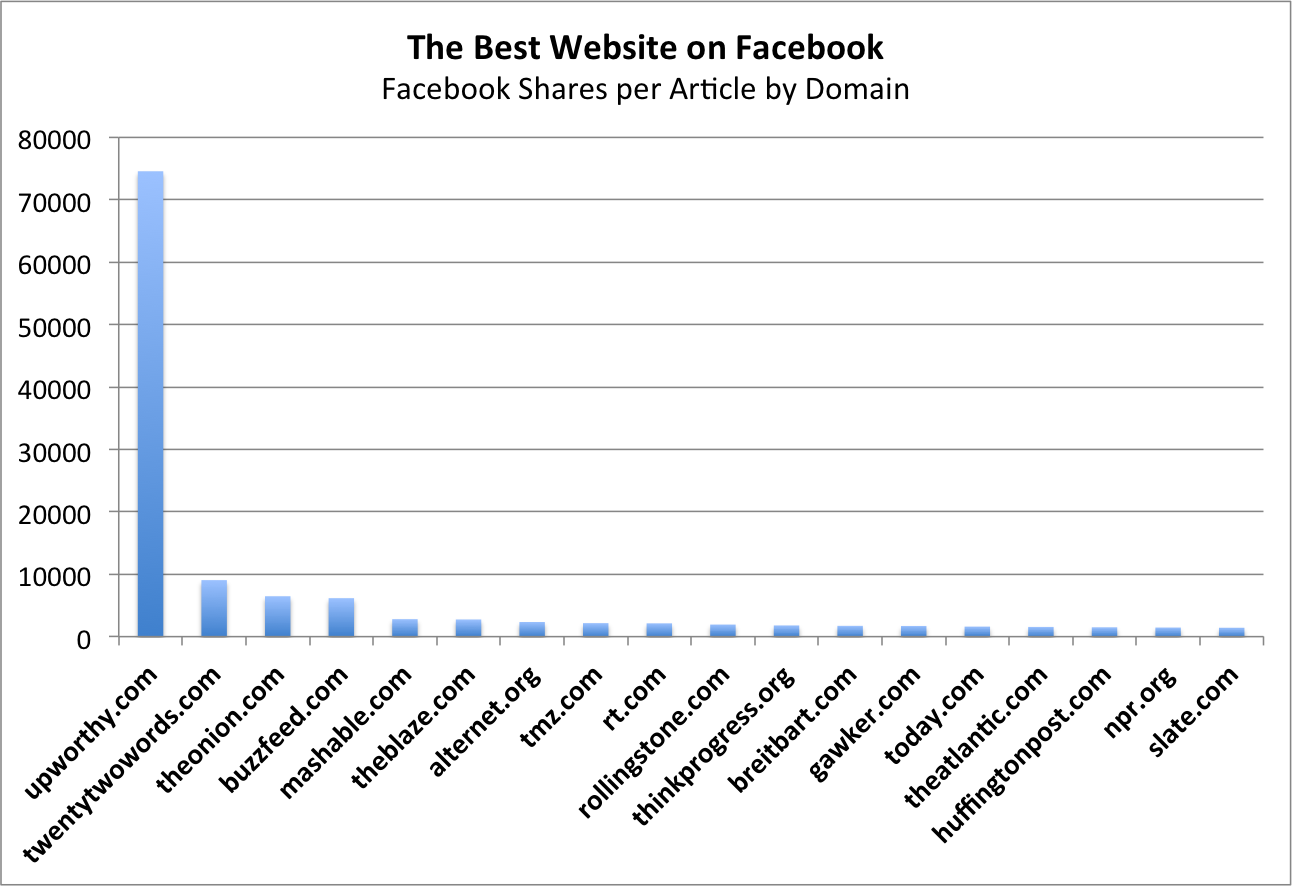
Derek Thompson passes along the above chart on viral traffic:

The most impressive thing about Upworthy is that it publishes just 225 articles a month, according to this data. That’s one for every 508 articles on Yahoo! The site is so much more dominant than other news sites on Facebook that when you graph its Facebook-shares-per-article, it looks like a skyscraper dropped into a desert. Upworthy averages about 75,000 Facebook likes per article, 12x more than BuzzFeed.

Ezra Klein ponders this fact:

The question Upworthy’s success raises is whether there are negative returns to posting so much content. Perhaps the time spent producing thousands of articles, most of which have very slight readership, would be better spent producing hundreds of articles more thoughtfully because more will go wildly viral. Lower content expectations give writers more time to find amazing stories, to get amazing quotes, to come up with amazing headlines.

Or so goes the theory. Certainly a lot of writers would like to believe that. But what Upworthy is doing isn’t giving writers a lot of time to create content that may or may not cohere into something that could go viral. They’re giving writers a lot of time to find content that they’re pretty sure will go viral. If you want to find something that will go nuts on Facebook, time spent sorting through what already exists is likely a lot more efficient than time spent creating something from scratch. It’s entirely possible that if a place like The Post attempted to ratchet back on content expectations they would end up both with less content and less virality.

Drum notes that Upworthy’s much remarked upon headlines are often misleading:

Upworthy’s headline-writing black magic has become endlessly talked about as the apotheosis of our modern, millennial, warp-speed, social-media driven culture. But you know what it reminds me of? Supermarket tabloids.

The supermarket tabs aren’t what they used to be, but back in their heyday this was their meat and drink. Every issue featured half a dozen titillating headlines on the cover that sucked you into a story on page 24 that was….usually kind of meh. They did their best to hide this, of course, but most of the time their headlines turned out to be come-ons that ultimately ended in disappointment. Still, you never knew if the next one might be the real deal. Hope springs eternal, so you kept coming back for more.

Other things in the same category: The New York Post. Modern movie trailers. Ron Popeil infomercials. British tabloids. Porn spam. TED talks.

Yglesias zooms out:

From a business viewpoint, I think an important point to make about this is that “viral” basically just means “is popular on Facebook” since Facebook is really the only host for viral content that matters. And that in turn means that all the viral traffic a website gets is really Facebook‘s traffic. It’s been clear for a long time now—like going back to well before there was an Internet—that journalism just isn’t that popular. Most households in the New York City metro area never subscribed to the New York Times, for example. Facebook, by contrast, is something that people really like. So since Facebook is so much more popular than journalism, it turns out that the most popular kind of journalism is Facebook content.

But this is still really Facebook’s traffic. Not just in the sense that Facebook can always tweak the algorithms that determine what plays well on Facebook, but in the sense that whatever economic value is created by “viral” content will ultimately be captured by Facebook. If you want to advertise to an audience of people eager to consume Facebook-friendly content, after all, the logical place to do that is on Facebook.
What Obamacare Doesn’t Cover

Steinglass unsurprised that many Obamacare plans have high out-of-pocket costs:

Obamacare’s design all but guaranteed limited choice and high out-of-pocket expenses. The insurance sold on the exchanges must comply with many rules: plans must cover a long list of “essential health benefits”, must not charge more to sick patients and must have a set “actuarial value”. (An actuarial value of 60% means that, for an average person, the health plan will cover 60% of health costs. The patient will have to cover the rest from his own pocket.) Obamacare plans are classified as bronze (60% actuarial value), silver (70%) or platinum (90%). These standards make it easier to compare one plan with another. But they also give insurers relatively little room to differentiate their products. To compete on sticker price, they have to cut costs. They typically do this by restricting choice and bumping up deductibles and co-payments.

Cohn worries about these costs:

The trend towards higher out-of-pocket expenses is nothing new. As the Kaiser Family Foundation’s Larry Levitt pointed on Monday, via his Twitter account, it’s been happening even in employer plans, although the amounts are typically lower. And people always have the option of getting policies with lower out-of-pocket expenses. Those policies, which typically fall into the “gold” and “platinum” categories, will cost more in premiums. That’s the fundamental trade-off here: You can pay more upfront, in premiums, or risk paying more later, in out-of-pocket expenses. Of course, that’s difficult for many people at low incomes, even with subsidies, which is why lawmakers should bolster the law’s subsidies and tighten those out-of-pocket limits even more.

What are the chances of that happening anytime soon? Pretty slim. Partly that’s because bolstering the law’s protections would require money, which would require either raising taxes or pushing harder on the health care industry—both defensible, but both difficult politically. The other is that most conservatives don’t actually have a problem with insurance that leaves people exposed to such high medical bills. In fact, this has been one of the most aggravating parts of the Obamacare debate: Conservatives frequently criticize Obamacare because, they say, it forces people to buy more insurance than they want. The minimum requirements, they say, should be lower. But, as the new Avalere analysis should remind everybody, the standards are already weak. How much more threadbare could the minimalist plans be?

A Godless President?

Atheist Vote

Isaac Chotiner suspects that America is ready for an atheist candidate:

A Gallup poll from 2012 … showed that only 34 percent of Americans know Barack Obama’s religion. (Some people think he is Muslim; others are not sure.) If that’s the case—and there has been a lot of coverage of the president’s faith—isn’t it at least possible that an atheist could be elected? I agree that there will be challenges, and while it wouldn’t be smart to go after someone directly for their atheism, perhaps “values-based” attacks would have more currency. Moreover, I think this imaginary atheist politician would have to be someone well established—someone the American people felt comfortable with. But if, say, John McCain or Hillary Clinton announced that while they respected Christianity and faith, they no longer believed in God, well, I think they could still get elected. (Winning a Republican primary would be the problem for McCain.) And remember, despite my caveat about the politician having to be well-known and not at all mysterious, it was also assumed that the first black president would be someone “proven” like Colin Powell. Five years before his election, Barack Obama was virtually unknown.

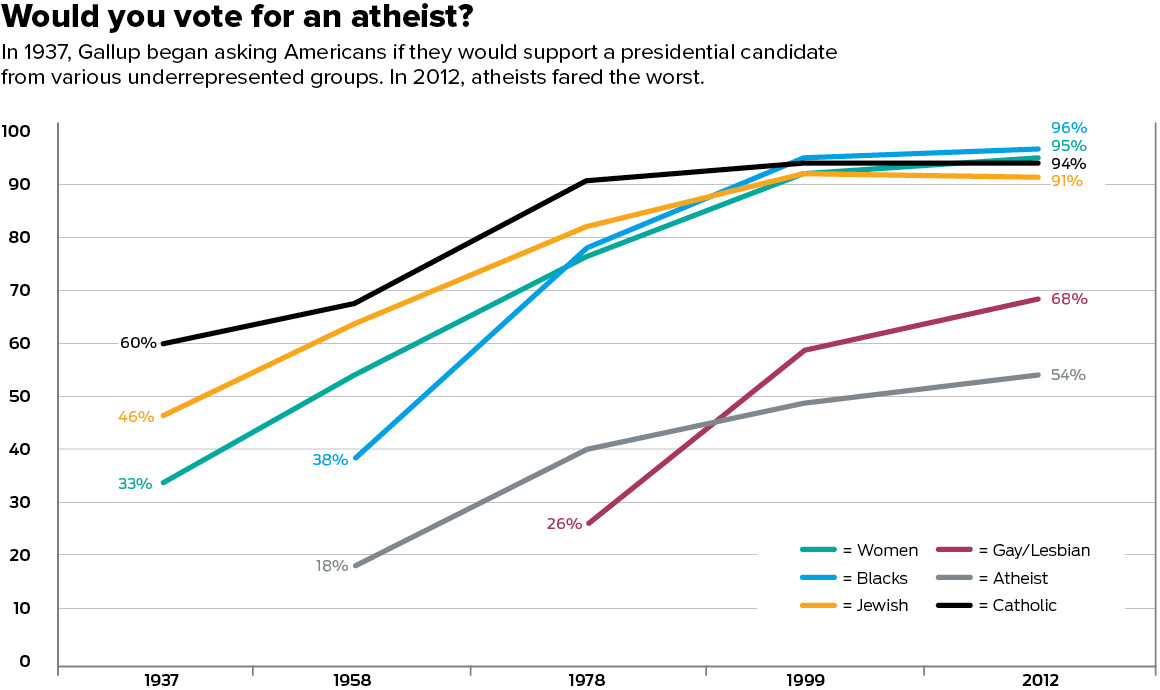
Jennifer Michael Hecht, who provides the chart above, wants atheist politicians to speak up:

Melody Hensley, the chief executive of the Washington, D.C.-based nonprofit Center for Inquiry, says she knows closeted atheists in Congress and believes it would help immensely for some of them to come out. We had a near miss with Rep. Kyrsten Sinema (D-Ariz.) when she was elected a year ago, Hensley sighs. Although 10 other members of Congress declined to specify their religious affiliation, Sinema was the only one to list “none.” Atheist groups celebrated—prematurely, it turned out. Sinema’s office quickly issued a clarification: “Kyrsten believes the terms non-theist, atheist, or non-believer are not befitting of her life’s work or personal character.”

Hensley shared with me a Facebook exchange she had with Sinema shortly thereafter, in which Hensley told the congresswoman her statement seemed to denigrate atheism and that the statement seemed cowardly. Sinema replied that she would not use that language in the future but protested: “I am not a theist, nor am I a nontheist. I don’t like labels.”

A Deal To Keep The Lights On

Suzy Khimm analyzes the budget deal proposed by Democratic Senator Patty Murray and GOP Congressman Paul Ryan:

Ryan and Murray had more maneuvering room as Congress has been almost entirely consumed with the fight over Obamacare. But their new comity was also possible because the bar was set so low. Congress and the White House have all but given up on reaching a long-term deficit reduction deal that it was originally aiming for. Instead, they entirely avoided touching major entitlement and tax programs—the biggest and most controversial sources of deficit reduction.

J.P.P. at The Economist chimes in:

There is one politically difficult thing in the agreement: federal workers will have to contribute more towards their pensions. But for the most part this is a deal that succeeded because it does not require either side to make meaningful compromises, in the sense of giving up something which is dear to them. The process that led to the deal is welcome. This is the first budget conference since 2010: in the intervening years there seemed no point in holding one as the two sides were so far apart. The substance, though, is not much more than an agreement to keep the lights on. That ought to mean it can get past Congress, where House Republicans are unlikely to bring on another government shutdown while they are having such fun with Obamacare.

Josh Green is unsure what Congress will do:

[T]his deal could easily fall prey to the same forces that wrecked earlier agreements: hardline conservatives.

The Ryan-Murray deal would raise 2014 spending to $1.012 trillion, instead of $967 billion. It also includes $23 billion in additional deficit reduction meant as a sop to hardliners, although this doesn’t appear to be doing the trick. The conservative pressure group Heritage Action called the agreement “a gimmicky, spend-now-cut-later deal will take our nation in the wrong direction.” Mark them down as a “no.” And because the Ryan-Murray deal is an ordinary bill, and not a special resolution, it’s subject to a filibuster. So Texas Sen. Ted Cruz may already be warming up his vocal chords.

Tomasky’s view:

Right now, the arbiters of the conventional wisdom are agreed that the Republicans under no circumstances would risk or permit another government shutdown. They’re probably correct. But the drumbeat on the right, especially on the talk-radio right, is likely to be that this deal is a win for the big-spending Obamabots, and if that’s the message, then support in the GOP House could vaporize pretty quickly. January 15 is a long way away. Will the hard right risk another shutdown over $45 billion? That is going to be the question. Don’t believe—yet—anyone who tells you they know the answer.

Suderman’s two cents:

Republicans on the Hill are still familiarizing themselves with the details, and they’ll no doubt find more than a few elements they dislike. But they may learn to live with it anyway. As I heard one GOP legislator describe it shortly after the announcement, the deal is simulataneously not so great and likely the best deal that Republicans can get.

Ezra wishes the deal included an unemployment insurance extension:

Democrats wanted to add unemployment insurance to the deal but found Republicans implacably opposed. Which is to say that Republicans were able to add extra deficit reduction to the deal but Democrats weren’t able to add help for the long-term unemployed to the deal. It’s a reminder of where the political system’s priorities are — and a reminder that they’re grossly out of line.

And Sarah Binder skeptical that this deal will lead to more deals:

[W]ill the bipartisan spirit that produced this deal portend additional bipartisan deals around the corner?  I’m doubtful.  Breaking the cycle of budgetary brinkmanship does not yet seem to have resolved bicameral differences elsewhere on the Hill.  Even a pared back defense bill (cobbled when GOP senators blocked progress on a broader annual bill) faces an uphill battle towards enactment.  More likely, the mini-deal is emblematic of legislative battles in polarized times: Parties come to the table only when the costs of blocking an agreement are too great to shoulder. And even then, parties will give up as little as necessary to avoid the sometimes painful consequences of stalemate.

Stopping The Next Crisis Before It Starts?

Yesterday, regulators finalized the Volcker rule, which is intended to prevent banks from engaging in certain types of risky behavior. Neil Irwin explains the rule:

It is part of the Dodd-Frank financial reform act that passed in 2010 that aims to prevent giant banks from engaging in speculative trading activity. The idea is that, while it is important for banks to support the economy by lending to consumers and businesses, when they get into the realm of making bets in exotic financial markets — known as proprietary trading — they aren’t really doing anything to support the economy. But trading for their own accounts does risk their own solvency in ways that could lead them to fail and necessitate a costly government bailout. In short, the theory is: You can speculate on financial markets. Or you can have a government safety net. But you can’t have both. …

The rule isn’t enough to prevent any future crisis, certainly. Banks have shown plenty of ability to get into trouble with strategies that have nothing to do with proprietary trading. For example, nothing about these rules would stop a bank from making crummy mortgage loans. But it is certainly plausible that this will choke off one route by which the biggest banks could come into danger of triggering another financial crisis.

Matt Levine weighs in:

The Volcker rule was supposed to shut down proprietary trading desks, and it basically already has. The Volcker rule was not supposed to shut down market making and hedging, which are risky and proprietary and complicated and all that good stuff, but which are also both economically important and specifically allowed by Congress. That’s a simple sentence to write, but a hard thing to make happen. The final rule is 978 pages long, but it’s not a bad effort at achieving that simple result.

Mike Konczal defends the rule:

The problem there is that lending to households and businesses is the core function of banking. And there are good reasons why banks provide this service instead of other types of firms. For instance, funding increases as relationships between firms and creditors evolve (for more, see Fama 1985 or Petersen and Rajan 1994). So other firms can’t easily do what banks do when it comes to lending. But other firms can definitely engage in proprietary trading—including hedge funds, mutual funds, sovereign wealth funds and others. So if proprietary trading does have any benefits to society at large, there’s nothing to worry about. It will still take place. On the other hand, if banks are prohibited from lending, it’s not clear that other institutions could pick up the slack.

Simon Johnson is withholding judgment:

The Volcker Rule could be a major contribution to financial stability. Or it could still flop. The devil now is in the details of implementation and compliance – and how much of this becomes public information and with what time lag.

David Dayen also looks at implementation:

“The truth is that this is kind of the end of the beginning,” said Marcus Stanley of Americans for Financial Reform. The regulators must now set out guidelines for market-making, hedging and other bank activities, collecting data and developing more specific parameters for what gets prohibited. And they agreed to delay actual enforcement of the rule until July 2015. This gives banks time to open more loopholes, adjust to the requirements and ready lawsuits. Already, loopholes have been uncovered allowing banks to trade foreign sovereign debt and invest in small hedge funds, which could result in risky trading merely shifting to other areas rather than being stamped out.

Stanley worries that, as the fight shifts to implementation, regulators could shield the data from public view, designating it “confidential supervisory information.” That means we may not really know whether or not the Volcker rule is working.

Jonathan Weil expects the rule to have little effect:

[T]here’s some merit to having a ban: Lots of people dislike the idea of banks gambling with federally insured customer deposits, because they might blow themselves up and either cause damage to others or require a taxpayer bailout. But once you get into the weeds, there’s always a workaround or a nasty, unintended consequence of one sort or another. Old-fashioned lending often may be riskier than betting it on prop trades anyway. It could take years before regulators figure out the full effects of all the wonderful little loopholes that well-paid bank lobbyists worked into the language. Even if the rules were flawlessly written — and they never are — there is the matter of whether they will be enforced consistently, which they tend not to be from one administration to the next.

Yglesias bets that the rule will be weakened over time:

The way the regulatory state works is that first congress writes a law, then regulators write a detailed rule, and then people who think the rule is unfair to them get to sue and get judges to throw the rule out. If you’re some kind of bank regulation junky who thinks the rule is too kind to banks, you do not get to sue and get judges to make the rule stricter. This is one of a dozen of reasons why “judicial nominations” matter for more reasons than “the Supreme Court rules on abortion rights.” There’s an ongoing fight in Congress about appointees to the D.C. Circuit Court which is rich in regulatory implications, of which the Volcker Rule battle is one.

And Stephen Mihm notes that it could take a long time to see whether the rule is working:

And therein lies a lesson about post-crisis regulation. In the chaos of a financial crisis, never mind its aftermath, it’s easy to jump the gun and impose regulations that satisfy the urge to “do something” yet achieve little to address the underlying causes of the disaster. The resulting regulation can deliver benefits, or it can be counterproductive. Or both. But neither outcome is dependent on a correct reading of the causes of the crisis. This will probably be true of the Volcker rule, too: It will be judged not on whether it was a logical response to what happened, but whether it ushers in a new era of financial stability. On that question, we may have to wait years for a clear answer.

The Ghost On The Page

Alex Mayyasi explores the economics of ghostwriting and ends up defending the practice:

Jay Leno does not write his own jokes and a team of writers work on sitcom scripts. Even if books have been a more independent pursuit, every writer depends on the help of an editor whose impact on the book – cutting large sections, reorganizing, suggestions plot changes – can be substantial. Researchers are also a regular part of writing a book in both fiction and nonfiction. Ghostwriting may be an extreme case, but every book is a team effort and few writers are responsible for every single word and idea in their books. Is it more deceitful to name someone who did none of the writing an author or to give so much credit to the author in the first place?

A major benefit of ghostwriting is that it allows stories to be told that would not otherwise.

Few major public figures could write books themselves – their stories are only published because professionals step in to write them down. Even if the existence of multiple Justin Bieber memoirs does not feel like a service to the publishing world, it at least helps the bottom lines of the same publishers taking a chance on the next David Mitchell or Cormac McCarthy. It is also an open question whether ghostwriting denigrates the actual writers or celebrates their skill. Nondisclosure agreements and cryptic mentions in the acknowledgements are not signs of respect. But established ghostwriters are recognized as skilled professionals. And while ghostwriters often get asked to write at below a living wage, ghostwriting can also be one of the few ways to make a good salary writing full-time short of being a perennial bestseller.

It can also be quite enjoyable. William Novak described himself as “spoiled” by all the “wonderful people [he’s] worked with.” Michael D’Orso, who dislikes the term ghostwriter but collaborates with major figures, described in an article how “you can’t be more alive than when you’re climbing into other lives in other worlds.” Sally Collings told us that ghostwriting allows her to focus on the writing and editing part that she enjoys without having to deal with the marketing aspects that she does not. “People often ask when I will write my own book again,” she told us. “I feel like I do all the time. I have a secret sense of ownership.”

Animal Elders

256706773_4d8f868250_b

Virginia Hughes marvels at a new paper that compares how 46 species – including humans – grow old:

For folks (myself included) who tend to have a people-centric view of biology, the paper is a crazy, fun ride. Sure, some species are like us, with fertility waning and mortality skyrocketing over time. But lots of species show different patterns – bizarrely different. Some organisms are the opposite of humans, becoming more likely to reproduce and less likely to die with each passing year. Others show a spike in both fertility and mortality in old age. Still others show no change in fertility or mortality over their entire lifespan.

That diversity will be surprising to most people who work on human demography. “We’re a bit myopic. We think everything must behave in the same way that we do,” says Jones, an assistant professor of biology at the University of Southern Denmark. “But if you go and speak to someone who works on fish or crocodiles, you’d find that they probably wouldn’t be that surprised.

What the new study didn’t find, notably, is an association between lifespan and aging.

It turns out that some species with pronounced aging (meaning those with mortality rates that increase sharply over time) live a long time, whereas others don’t. Same goes for the species that don’t age at all. Oarweed, for example, has a near-constant level of mortality over its life and lives about eight years. In contrast, Hydra, a microscopic freshwater animal, has constant mortality and lives a whopping 1,400 years.

This is a problem for the classical theories of aging that assume that mortality increases with age, notes Alan Cohen, an evolutionary biologist at the University of Sherbrooke in Quebec. “The traditional idea is that this is what most things do, and that there were a few weird creatures out there that were exceptions,” he says. “But there are actually a lot of exceptions.” The question that the classical theories try to answer – How could aging evolve? – is no longer the most interesting question, Cohen adds. “What we really need to explain is why some things age and some don’t.”

(Photo by Stephanie Carter)

An Ice Cold Imagination

Reviewing a new collection of interviews, Richard Brody takes a shot at Hannah Arendt’s most famous work, Eichmann In Jerusalem. Brody writes, “Arendt’s charge that Eichmann suffered from a ‘lack of imagination’ is actually the essential flaw of her own book”:

BM-Hannah-Arendt2006Her mechanistic view of Eichmann’s personality, as well as her abstract and unsympathetic consideration of the situation of Jews under Nazi rule, reflect her inability to consider the experiences of others from within. … [In her 1964 interview with Günter Gaus,] Arendt explains that what she found most intolerable in Germany at the time [of her escape in 1933] wasn’t the overt hostility of anti-Semites but the compromises of “friends”—of fellow-intellectuals—with the Nazi policy of Gleichschaltung (“coördination”), the conformity of all German institutions to the Nazi party line: “Among intellectuals Gleichschaltung was the rule, so to speak,” she says. Arendt doesn’t ascribe their compromise to any personal failings, like cowardice or careerism, but, rather, to the particular flaws inherent in intellectualism:

I still think that it belongs to the essence of being an intellectual that one fabricates ideas about everything. No one ever blamed someone if he “coordinated” because he had to take care of his wife or child. The worst thing was that some people really believed in Nazism! For a short time, many for a very short time. But that means that they made up ideas about Hitler, in part terrifically interesting things! Completely fantastic and interesting and complicated things! Things far above the ordinary level! I found that grotesque. Today I would say that they were trapped by their own ideas. That is what happened. But then, at the time, I didn’t see it so clearly.

This is an astonishing passage, for several reasons.

First, Arendt reveals the ground for her belief that Eichmann was no ideological Nazi but, in fact, was just a blind functionary. Not being an intellectual, he couldn’t have had “ideas” or “terrifically interesting things” to think about Hitler, and, therefore, he couldn’t have “really believed in Nazism.” … It’s a strange badge of intellectual honor to ascribe true belief in Nazism solely to intellectuals, and it is yet another sign that the passions and the hatreds on which the movement ran were essentially beyond Arendt’s purview. Second, her charge against the intellectual class—that they invent “completely fantastic and interesting and complicated things” and get “trapped in their own ideas”—is the perfect description of her own heavily theoretical and utterly impersonal view of Eichmann.

Previous Dish on Hannah Arendt here, here, and here.

(Image of Arendt on a stamp via Wikimedia Commons)

The Latest Sign Of Martian Life

It’s been a good week for the rover:

The lake, found at a spot called Yellowknife Bay in the Gale Crater, existed around 3.6 billion years ago and could have lasted for hundreds of thousands of years. The Curiosity rover’s analysis discovered sedimentary rocks with evidence of carbon, hydrogen, oxygen, nitrogen, and sulfur, elements that suggest the lake could have sustained life. The findings were published Monday in a series of six papers in the journal Science.

This isn’t the first time scientists, or Curiosity rover for that matter, has found evidence of large bodies of water on Mars. But it is one of the first times scientists have specifically outlined an environment in which life could have survived.

The lake would have been “suitable for a wide range of microbial lifeforms” – specifically, oddball microbes known as chemolithoautotrophs:

Chemolithoautotrophs do not need light to function; instead, they break down rocks and minerals for energy. On Earth, they exist underground, in caves and at the bottom of the ocean. … “For all of us geologists who are very familiar with what the early Earth must have been like, what we see in Gale really doesn’t look much different,” Curiosity chief scientist Prof John Grotzinger told BBC News.

Joseph Stromberg sees the latest discovery as “yet another vindication of Curiosity’s mission, which is to determine the planet’s habitability.” NASA also has good news for anyone hoping to see the Gale Crater firsthand:

The risk of radiation exposure is not a show-stopper for a long-term manned mission to Mars, new results from NASA’s Curiosity rover suggest. A mission consisting of a 180-day cruise to Mars, a 500-day stay on the Red Planet and a 180-day return flight to Earth would expose astronauts to a cumulative radiation dose of about 1.01 sieverts, measurements by Curiosity’s Radiation Assessment Detector (RAD) instrument indicate. To put that in perspective: The European Space Agency generally limits its astronauts to a total career radiation dose of 1 sievert, which is associated with a 5-percent increase in lifetime fatal cancer risk.

“It’s certainly a manageable number,” said RAD principal investigator Don Hassler of the Southwest Research Institute in Boulder, Colo., lead author of a study that reports the results in the journal Science. A 1-sievert dose from radiation on Mars would violate NASA’s current standards, which cap astronauts’ excess-cancer risk at 3 percent. But those guidelines were drawn up with missions to low-Earth orbit in mind, and adjustments to accommodate trips farther afield may be in the offing, Hassler said.

Leaving The Fundamentalist Bubble

Kathryn Joyce interviews members of the ex-homeschooler movement – which consists largely of individuals who where raised by fundamentalist families:

The closest parallel to transitioning from strict fundamentalist families to mainstream society may be an immigrant experience: acclimating to a new country with inexplicable customs and an unfamiliar language. “Mainstream American culture is not my culture,” says Heather Doney, who co-founded Homeschooling’s Invisible Children with [Rachel] Coleman. Doney, who grew up in an impoverished Quiverfull family in New Orleans, felt for years that she was living “between worlds,” never sure if her words or behavior were appropriate for her old life or her new one. She didn’t understand what topics of discussion were considered off-limits or when staring at someone might be disconcerting. She couldn’t make small talk, wore “oddly mismatched clothes,” and was lost amid pop-culture references to the Muppets or The Breakfast Club. When public-school friends talked about oral sex, she thought they meant French-kissing.

More than a decade later, Doney still finds herself resorting to a standard joke—“Sorry, I live under a rock”—when people are taken aback by her. “It’s a lot easier to say that,” she says, “than to explain that I was raised hearing that you’d be allowing demonic influences into your house if you watched Teenage Mutant Ninja Turtles. I feel like an expat from a subculture that I can never go home to, living in one that is still not fully mine.”

Chris Jeub disputes Joyce’s “hasty generalizations”:

Joyce’s book Quiverfull: Inside the Christian Patriarchy Movement (which I’ve read) attacked Bill Gothard’s ATI, Doug Phillips’ Vision Forum, and other groups who saw it their duty, I suppose, to populate the world with a patriarchal society. Her latest book The Child Catchers: Rescue, Trafficking and the New Gospel of Adoption (I haven’t read this one) apparently exposes abusive adoptive parents and builds a sinister case against the adoption movement.

I see a routine here. It appears that Joyce generalizes an entire population of people by focusing on the heartbreaking abuse of some. A skilled debater sees through this. In debate lingo, this is called anecdotal evidence, poor argumentation that is only surface deep in proper persuasion. Emotional appeals will work for some, but to really persuade most people, debaters know enough to dig deeper, gather evidence with substance to help build the case that will change minds and hearts and even influence legislation.

Joyce’s article has no statistics, no cited convictions, no vindictive story beyond one-sided testimonials. She digs deep into the “extremist roots of fundamentalist homeschooling,” as if public education didn’t have its own extremist roots in its history. At best this article uncovers civil unrest in homeschool families. Civil unrest is a worthy topic, by the way, but this article can be read as an indictment on the entire homeschool movement.