How Cockfighting Changed History

dish_cockfighting

Andrew Lawler, author of Why Did the Chicken Cross the World?: The Epic Saga of the Bird That Powers Civilization, suggests that the vicious sport “may be responsible for creating the bird that today is the world’s single most important source of protein”:

Pitting two roosters against one another may seem barbaric and arcane, but it may be why the bird became so ubiquitous. Biological evidence suggests that thousands of years ago in South Asia, its ancestral home, the chicken existed only in small numbers. In other words, chickens weren’t kept for producing meat and eggs; there weren’t enough of them for that purpose. They must have had a specialized use, and some scholars believe that use was cockfighting.

It may have begun, like bull fighting, as a religious ritual. A clan or village may have pitted its sacred rooster against another group’s bird. In northern Thailand, for example, the faun phi ceremony honoring ancestral spirits entails cockfighting of a religious nature that may reflect ancient practices. And in Indonesia’s Bali, few religious rituals take place without a cockfight that spills blood into the soil, satiating earth demons.

As the chicken spread, so did its use in ritual and gambling. One of the earliest recorded cockfights took place in China in 517 B.C. The match was held in Confucius’ home province of Lu during the philosopher’s lifetime. The earliest unequivocal evidence of cockfighting in the West comes from this same era. In a tomb just outside Jerusalem, excavators found a small seal that shows a rooster in a fighting stance. The seal was owned by Jaazaniah, who is called “the servant of the king.”

(Image of cockfight in Tamil Nadu, India, via Wikimedia Commons)

Orwell Everywhere

Robert Butler remarks on the ever-expanding influence of the great writer 65 years after his death:

In his office in Holborn, overlooking the Family Courts, [Orwell’s literary executor, Bill Hamilton] describes the onward march of “1984”. “We’re selling far more. We’re licensing far more stage productions than we’ve ever done before. We’re selling in new languages—Breton, Friuli, Occitan. We’ve recently done our first Kurdish deals too. We suddenly get these calls from, say, Istanbul, from the local publisher saying, ‘I want to distribute a thousand copies to the demonstrators in the square outside as part of the campaign,’ and you think, good grief, this is actually a political tool, this book. As a global recognised name, it’s at an absolute peak.” A new Hollywood movie of “1984” is in the pipeline, “Animal Farm” is also in development as a feature film, and Lee Hall, who wrote “Billy Elliot”, is writing both a stage musical version of “Animal Farm” and a television adaptation of “Down and Out in London and Paris”. It’s boom time for Orwell: “total income”, Hamilton says, “has grown 10% a year for the last three years.”

His enduring impact is particularly noticeable online:

Type “#Orwellian” into the search box on Twitter and a piece in the South China Morning Post says the Communist Party mouthpiece, the People’s Daily, has attacked the pro-democracy demonstrators in Hong Kong on the Orwellian grounds that they are “anti-democratic”. An article in Forbes magazine warns of an Orwellian future in which driverless cars catch on and computer hackers track “rich people in traffic and sell this information to fleets of criminal motorcyclists”. A story in the Wall Street Journal reports the Supreme Court judge Sonia Sotomayor warning that unmanned drones will create an Orwellian future. In a piece in Politico, Timothy Snyder, professor of history at Yale, advises, “To understand Putin, read Orwell.” …

Barely a minute goes by when Orwell isn’t namechecked on Twitter. Only two other novelists have inspired adjectives so closely associated in the public mind with the circumstances they set out to attack: Dickens and Kafka. And they haven’t set the terms of reference in the way Orwell has.

Interactive Intersections

Traffic Light That Lets You Play Pong with Person on the Other Side Officially Installed in Germany video games urban intervention safety public interactive Germany

Christopher Jobson presents a new way to kill time while waiting for the light to change:

Back in 2012, a trio of interaction design students from HAWK University unveiled a concept for StreetPong, an interactive game of pong installed at a street crossing that allows you to play opponents waiting on the other side. The concept video (above) was viewed a bajillion times around the web, compelling designers Amelie Künzler, Sandro Angel, and Holger Michel to work with design firms and traffic experts to build a fully-functional device. After two years of waiting, the game units have been designed and approved for use by the city of Hildesheim, Germany where they were installed two weeks ago.

Chris Mills considers the practical implications:

Called ActiWait, the idea is reasonably simple: rather than the usual push-button to cross the street, you’ve got a touchscreen unit. It lets you play Pong with whoever’s waiting across the street, rather than losing yet again at Candy Crush. Pong is just the start, though: the developers want to enable all sorts of apps, like speed dating, or traffic safety eduction for children.

Apart from the obvious benefits to humanity of spontaneous Pong games, ActiWait has actual, tangible benefits. It could reduce jaywalking (and thus increase road safety), by providing something fun to do whilst waiting for the lights to turn. It’s also an interesting use of public space, both making it more interactive, and giving complete strangers a moment of connection.

Plus, Pong.

The Right Pre-Spins The Torture Report

According to media reports, the report concludes that we tortured terrorists.

These are the same terrorists who blew up the World Trade Center, bombed the Pentagon, and tried to level the U.S. Capitol. These are the same terrorists that today have beheaded Christians, Westerners and, just this past weekend, another American citizen.

So … we did torture terror suspects, right? But they apparently deserved it. Which is a good summary of the reptilian brain in many neocons. Stephen Hayes tries another route:

Such matters should be subject to tough, dispassionate, fact-based investigation. Actual failings should be condemned by both Republicans and Democrats, by supporters of the program as well as opponents. That’s not what happened here. Instead, the report was produced by the Democratic staff of the Senate Select Committee on Intelligence, chaired by Dianne Feinstein. Republicans declined to participate.

Feinstein required former CIA directors and deputy directors to sign nondisclosure agreements in order even to see the accusations made against them. Despite the fact that virtually all of the 500-plus-page report has been declassified for release, the Feinstein committee also imposed, as a condition of access to the report, severe restrictions on what those officials may say in their own defense. Michael Hayden, former director of the CIA, told The Weekly Standard: “Based on the nondisclosure agreement I signed, I cannot talk to you about the details of the Feinstein report, the Republican rebuttal, or the agency response—all as a condition of my being able to see it.”

In the clearest evidence that the committee was interested in blame rather than truth, the staffers did not seek to interview those involved in the interrogations.

The committee restricted itself to the CIA’s own documents not because they were trying to rig the results, but because those were the terms of the investigation, and because the millions of pages of documents they had to fight through were more than enough to handle. They did not interview the CIA agents because of an ongoing DOJ investigation into the same material. This was a self-consciously limited investigation. It was not set up to assign blame or responsibility for anything (and doesn’t). It collects the CIA’s own facts and documents with respect to the torture program in the various black sites. It was not tasked with coming up with the definitive account of the much bigger criminal apparatus that the Bush-Cheney administration set up to torture prisoners. It covers nothing in the military or JSOC or GTMO. It does nothing but examine the CIA’s own internal record.

As for the notion that the Republican refusal to participate somehow reveals the bad faith of Feinstein, et al, you just have to laugh. It merely highlights the appalling partisanship of the contemporary GOP, a party whose last nominee, Mitt Romney, was an enthusiast for torture. It demonstrates just how extreme the current GOP is, and how obstructionist they have been to a very basic act of oversight and due diligence. It doesn’t show Feinstein’s corruption; it exposes the GOP’s.

Then there is Nicolle Wallace, who played the 9/11 card this morning:

On Tuesday’s “Morning Joe”, former Bush administration spokesman Nicolle Wallace offered a heated defense of the torture techniques, arguing that she “didn’t care” what officials did because it was in order to protect Americans.

“Months after 9/11, there were three people we thought who knew about imminent attacks and we did whatever we had to do and I pray to god that till the end of time that we do whatever we have to do,” Wallace said. “The notion that this somehow makes America less great is asinine and dangerous.”

No it’s not. It’s a matter of basic human decency and a minimal adherence to American values as they have been espoused from George Washington onwards. Wallace is directly attacking the West by her remarks. And all Western civilization has achieved.

How The CIA Won The Beltway Battle … Till Now

by Scott Horton

US-POLITICS-CONGRESS-CIA-BRENNAN

[SPECIAL GUEST POST BY SCOTT HORTON]

There’s a simple, foundational question behind the publication of today’s report on CIA torture: Are the people and Congress entitled to know about these programs and the legacy they have left behind? The conflict between the right of a democracy to know what’s being done in its name and the necessary secrecy of intelligence services is what’s really being tested right now. And looking back on the struggle between the Senate Select Committee on Intelligence and the CIA over the report due to be released today tells us a lot about the state of play.

On this score, the report is likely to document, without highlighting, an embarrassing failure of oversight during the period from 2002-2006, when the core programs were in effect. That failure is almost certainly a combination of misdirection and misinformation from the CIA to SSCI, a desire by the White House not to share certain information, and a failure by the SSCI itself to probe with sufficient determination to find the facts. But the report should help us weigh these considerations.

The history of the production of the SSCI report already suggests very strongly that the CIA has been far more skillful player in the struggle than the Senate. In her now-famous speech on the Senate floor, Dianne Feinstein set out many of the historical steps. These make clear that from the outset to the last stages, the CIA has played a subtle and effective game of slow-down designed to stretch the process out. It has been fighting for time, and taking the view that every week of delay is a victory. Some of the tactics used included:

• Insisting on internal review prior to disclosure to SSCI, and then hiring outside contractors (who would not otherwise have had access to the documents) to do the review;
• Raising claims of privilege and relevance to disclosures;
• Insisting that review occur in CIA offices, using equipment that was owned and provided by the CIA;
• “Disappearing” documents once they had been provided;
• Bringing accusations of security breaches by SSCI staff;
• Requesting a Department of Justice probe of their allegations;
• Demanding aggressive redactions from the text of the report designed to make the report itself incomprehensible.

These tactics were successful at least in that they slowed down the report by several years.

In my mind, it is utterly unsurprising that the CIA would reach to these tactics—that is precisely the conduct I would expect from officers loyal to their institution, who are struggling to avoid disclosure of information which they believe will prove harmful to the institution’s interests. What is truly surprising is the indulgent, understanding posture of Senator Feinstein and her staff, who gave ground to the CIA on point after point, in derogation of the Senate’s rights and powers. Perhaps Feinstein thought that being deferential would help her with the CIA. If so, that was exceedingly naïve.

Chalk this up, then, as a huge win for the agency over its overseers. The CIA demonstrated a mastery of the politics of the Washington Beltway that far outstripped its investigators. So far at least it has only won them time—but it has gotten them close to their mark. Another week of delay and the report could have been buried for ever.

The final gambit in the delay game was the claim that American personnel abroad may face danger as a result of the disclosures. But the SSCI report is not likely to make entirely new disclosures on the key points. These disclosures occurred in a steady trickle from April 2004 through early 2009. The use of torture and the creation of black sites did indeed have consequences abroad for the United States—it fueled recruitment for terrorist groups on one hand, it helped inspire the Arab Spring and the cries of “dignity” that accompanied it on the other. In any event, it greatly complicated U.S. operations in Afghanistan, Iraq and other theaters of operation. However, the consequences that the SSCI will have for U.S. personnel are likely to be different. It is likely to have consequences precisely for the persons who are today heard most loudly objecting to its release: George W. Bush, Dick Cheney, Michael Hayden and Jose Rodriguez. Their reputations will be tarnished further, and, no doubt, demands for accountability will be renewed. And there are plenty of U.S. citizens, and U.S. intelligence officers, who reckon that a very good thing.

[THIS WAS A SPECIAL GUEST POST BY SCOTT HORTON]

(Photo: CIA director John Brennan testifies before a full committee hearing during his nomination hearing in the Hart Senate Office Building in Washington, DC, on February 7, 2013. By Jewel Samad/AFP/Getty Images)

Awaiting The Torture Report

Glenn Greenwald and his team will be live-blogging (and we’ll be devouring and analyzing it as fast as we responsibly can):

[T]his will be by far the most comprehensive and official account of the War on Terror’s official torture regime. Given the authors – Committee Democrats along with two Maine Senators: Agnus King (I) and Susan Collins (R) – it’s likely to whitewash critical events, including the key, complicit role members of Congress such as Nancy Pelosi played in approving the program (important details of which are still disputed), as well an attempt to insulate the DC political class by stressing how the CIA“misled” elected officials about the program. But the report is certain to lay bare in very stark terms some of the torture methods, including “graphic details about sexual threats” and what Reuters still euphemistically and subserviently calls “other harsh interrogation techniques the CIA meted out to captured militants.”

Micah Zenko wants us to remember how widespread the support was for these heinous actions:

When reading the executive summary, Americans should try to look beyond these specific abuses and ask the fundamental question: How could senior officials at the CIA, White House, and the Department of Justice have unanimously approved the use of torture?

According to officials’ memoirs and historical accounts examining the four months between March 28, 2002, when al Qaeda operative Abu Zubaydah was captured in Pakistan, and Aug. 1, when the Office of Legal Counsel (OLC) memo authorizing the enhanced interrogation techniques was completed, not one senior official aware of the program registered an objection to it. Current CIA Director John Brennan, who was the agency’s deputy executive director in 2002, later claimed he had “personal objections” to “waterboarding, nudity, and others,” but he never made this officially known, not even to the CIA’s top lawyer, John Rizzo, whose office was just 15 feet away.

Dafna Linzer previews the spin from the CIA and the Senate:

The report is likely to blame CIA leaders for false portrayals of the value of the interrogations or for keeping details from congressional leaders and even the White House. Expect every named former CIA official to deny it. And expect to never know the truth. The Senate didn’t investigate itself. There is no gathered evidence of what the committee – which routinely meets behind closed doors – was told exactly, what it authorized or what CIA leaders believed they were authorized by Congress to do.

How Massimo Calabresi frames the debate over the report:

What effect will assigning blame have? The CIA says it is so burned by the EIT program that it is permanently out of the business of interrogation and Dianne Feinstein, the hawkish head of the Senate Intelligence committee, says that’s fine. The purpose of her report, she says, is to ensure such a program is never again acceptable to Americans.

But plenty of others, from ex-CIA officer Jose Rodriguez, to former Vice President Dick Cheney, to former CIA chief Michael Hayden, say the program should be available for use if there is another major attack on the U.S. Even Obama’s CIA chief says only that the EIT program is not now “appropriate,” suggesting it might be in other circumstances.

Ultimately, the report’s value lies in answering that simple question: should we ever do it again?

The people who approved torture had the means of knowing — should have known — it would elicit false confessions. It’s just that no one can prove whether that was the entire point or not. … It’s not just a question of whether torture is “effective” at obtaining intelligence. It’s also whether the entire point of it was to produce spies and propaganda.

The report is essential because it makes clear the legal, moral, and strategic costs of torture. President Obama and congressional leaders should use this opportunity to push for legislation that solidifies the ban on torture and cruel treatment. While current law prohibits these acts, US officials employed strained legal arguments to authorize abuse.

A law could take various forms: a codification of the president’s 2009 executive order banning torture, for example, or an expansion of the 2005 Detainee Treatment Act so that key protections in it would apply to the CIA as well as the military. However it’s designed, a new law would help the country stay true to its ideals during times of crisis and guard against a return to the “dark side.”

Resuscitating The Rust Belt

1086018398_d49f6a0ffd_b

Joel Kotkin and Richey Piiparinen posit that America’s erstwhile industrial heartland “could well be on the verge of a major resurgence, one that should be welcomed not only locally but by the rest of the country”:

Two factors drive this change. One is the steady revival of America as a productive manufacturing country, driven in large part by new technology, rising wages abroad (notably in China), and the development of low-cost, abundant domestic energy, much of it now produced in states such as Ohio and in the western reaches of Pennsylvania.

The second, and perhaps more surprising, is the wealth of human capital already existent in the region.

After decades of decline, this is now expanding as younger educated workers move to the area in part to escape the soaring cost of living, high taxes, and regulations that now weigh so heavily on the super-star cities. In fact, more educated workers now leave Manhattan and Brooklyn for places like Cuyahoga County and Erie County, where Cleveland and Buffalo are located, than the other way around. …

The rustbelt revival relies not on mimicry but on embracing the regional culture that values production of things over simply their mere consumption. Cities like San Francisco, Portland and Seattle may have started with industrial roots, but their recent success has been tied to such factors as attractive geographies and, to Midwest sensibilities at least, mild climates. These regions have been enriched for decades by the migration of people from the rustbelt—Microsoft’s former President Steve Ballmer (suburban Detroit), venture capitalist John Doerr (St. Louis), and Intel co-founder Andrew Noyce (Iowa) are just a few examples.

But the cost of housing, among other factors, is changing the calculus:

Housing prices in most rustbelt cities, adjusted for incomes, are one-third those of the Bay Area and at most one-half those seen in the Los Angeles, New York, or Boston areas. This can be seen not just in distant exurbs or suburbs, but in prime inner-city neighborhoods. Whatever dreams millennials have are likely to center around affordable single-family housing, as they begin to marry and start families. The rustbelt offers this younger generation the kind of choices, and middle class standards, that are increasingly unattainable in the superstar cities.

(Photo: Monessen, Pennsylvania, 2007. By Flickr user christine592)

On Quitting The Radical Left

A blast of sanity and intellectual honesty:

I don’t have any criticism for radical leftism in general, at least not here, not today. What I feel compelled to criticize is only one very specific political phenomenon, one particular incarnation of radical leftist, anti-oppressive politics.

There is something dark and vaguely cultish about this particular brand of politics. I’ve thought a lot about what exactly that is. I’ve pinned down four core features that make it so disturbing: dogmatism, groupthink, a crusader mentality, and anti-intellectualism. I’ll go into detail about each one of these. The following is as much a confession as it is an admonishment. I will not mention a single sin that I have not been fully and damnably guilty of in my time.

First, dogmatism.

One way to define the difference between a regular belief and a sacred belief is that people who hold sacred beliefs think it is morally wrong for anyone to question those beliefs. If someone does question those beliefs, they’re not just being stupid or even depraved, they’re actively doing violence. They might as well be kicking a puppy. When people hold sacred beliefs, there is no disagreement without animosity. In this mindset, people who disagreed with my views weren’t just wrong, they were awful people. I watched what people said closely, scanning for objectionable content. Any infraction reflected badly on your character, and too many might put you on my blacklist. Calling them ‘sacred beliefs’ is a nice way to put it. What I mean to say is that they are dogmas.

The author is not just whining; she’s making the case for an alternative form of leftism, and revels in the new freedom after leaving this cult behind:

The aftermath was wonderful. A world that seemed grey and hopeless filled with colour. I can’t convey to you how bleak my worldview was. An activist friend once said to me, with complete sincerity, “Everything is problematic.” That was the general consensus. Far bleaker was something I said during a phone call to an old friend who lived in another city, far outside my political world. I, like a disproportionate number of radical leftists, was depressed, and spent a lot of time sighing into the receiver. “I’m not worried about you killing yourself,” he said. “I know you want to live forever.” I let out a weak, sad laugh. “When I said that,” I replied, “I was a lot happier than I am now.” Losing my political ideology was extremely liberating. I became a happier person. I also believe that I became a better person.

Know hope.

It Doesn’t Pay To Be A Millennial

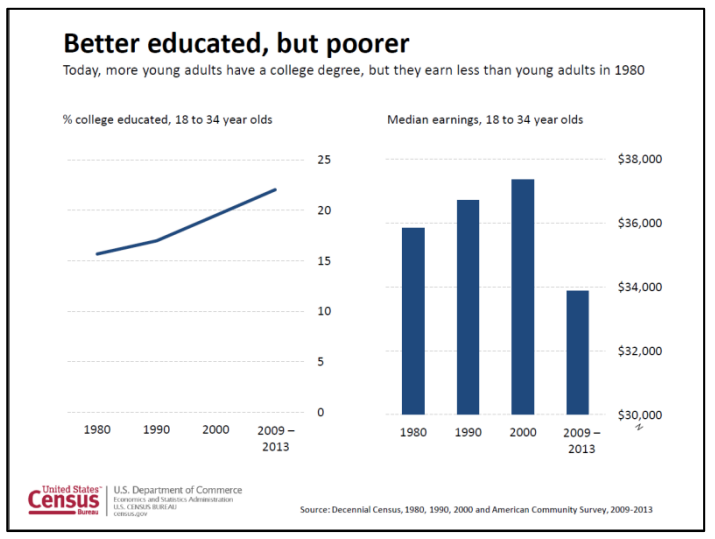
Screen_Shot_2014-12-03_at_4.48.03_PM.0

Danielle Kurtzleben explains why more education hasn’t meant higher incomes:

The Census Bureau [on Thursday] released new data from its American Communities Survey, showing that today’s 18-to-34-year-olds are earning less today than the same age group in 1980, 1990, or 2000. …

[E]veryone thinks of college as the ticket to prosperity, so America’s young people have increasingly invested in college degrees. And it’s true that those graduates are doing way better than those without degrees, both in terms of income and employability. But it’s mostly paying off because the economic situation just keeps getting worse for people with only a high school diploma. For millennials, this means investing four or more years, plus tens of thousands of dollars, to get a degree whose value isn’t really increasing much. The whole generation has been stuck on a sort of cruel economic treadmill: working harder and harder without really getting much further ahead.

Derek Thompson also absorbs the Census findings:

In retail, wholesale, leisure, and hospitality—which together employ more than one quarter of this age group—real wages have fallen more than 10 percent since 2007.

To be clear, this doesn’t mean that most of this cohort are seeing their pay slashed, year after year. Instead it suggests that wage growth is failing to keep up with inflation, and that, as twentysomethings pass into their thirties, they are earning less than their older peers did before the recession. …

Why are real wages falling across so many fields for young workers? The Great Recession devastated demand for hotels, amusement parks, and many restaurants, which explains the collapse in pay across those industries. As the ranks of young unemployed and underemployed Millennials pile up, companies around the country know they can attract applicants without raising starter wages.

But there’s something deeper, too. The familiar bash brothers of globalization and technology (particularly information technology) have conspired to gut middle-class jobs by sending work abroad or replacing it with automation and software. A 2013 study by David Autor, David Dorn, and Gordon Hanson found that although the computerization of certain tasks hasn’t reduced employment, it has reduced the number of decent-paying, routine-heavy jobs. Cheaper jobs have replaced them, and overall pay has declined.

The Ongoing Garner Tragedy: Your Thoughts

Readers push back on these two:

Your dissenter said, “…while Garner is still conscious and speaking, tries to restrain him by holding his head in place.” Yeah, he was speaking alright. He was speaking, “I can’t breathe!” What the part of that does this reader not understand?

Another also quotes that reader:

It is hard to tell from the video, but it does not appear to me that the officer continued to apply the “chokehold” (a label that may have been inaccurately applied to this case) after Garner said he could not breathe. It looks to me as if that officer grabs him around the neck for only a few seconds, and then, while Garner is still conscious and speaking, tries to restrain him by holding his head in place.

The autopsy report stated that the death was caused by “compression to the neck, compression to the body, and prone positioning”. It doesn’t matter that the officer stopped choking him, because he continued to hold him down.

An expert weighs in:

I’m coming from the viewpoint of being a retired paramedic with over 20 years experience, the last few in executive level management. I also have a blue belt in Brazilian jiu-jitsu, so I am familiar with applying and receiving choke holds.

My impression of the takedown and restraint is that he was one big guy and that the choke hold was never fully applied. If it was, he would have been rendered unconscious in a matter of seconds.  I also noticed that before and after he was handcuffed, he did not receive any sucker punches or kicks.

On to the medical care, an area that I can speak about with some authority. The police have received plenty of criticism about letting him lay until the ambulance arrived. Well if you are someone with basic first aid training, there is nothing you can do for a person in respiratory distress except keep a eye on them. I counted two to four officers with him until EMS arrived, so they were doing that.

Why no CPR? Because he had a pulse and was breathing. CPR is only for pulseless and non-breathing patients. The female EMS worker is clearly shown checking for a pulse and we can safely assume breathing in the second video. Even though I see plenty to criticize about the EMS response, I would think they are competent enough to start CPR immediately if indicated.

My criticism of the EMS response shown in the video is the cursory initial examination, were they seemed to have missed how severe his distress was. I would have liked to seen at least oxygen being administer in the video. Perhaps his care improved once they got him into the ambulance, but it seems not as I have read that the EMS workers had been suspended.

Lastly, how they manhandled him onto the stretcher. It wasn’t pretty, but I have seen worse.  Picking up a limp human being of his size without manhandling him is very difficult without the right techniques and equipment. It has nothing to do with the color of his skin. My best case would have been to log-roll him onto a backboard and to lift him using the backboard onto the stretcher. My impression was that the EMS workers failed to properly control and supervise the lift of him from the ground to the stretcher. It happens sometimes. The firemen or in this case the policemen start moving the patient on their own.

Another reader:

I’ve been talking through the case with an acquaintance of mine in law enforcement, and he pointed out to me that, when the decision to arrest is made, you escalate force to whatever level is necessary to get the suspect into custody. You can’t just back out if you’re overmatched. You get backup, and you’re bound by procedure to continue to increase force until the cuffs are on. People who resist arrest can die; it’s a possible outcome. You can debate the chokehold versus the headlock, but the scenario could just as easily have resulted in a routine arrest.

So maybe the fault lies with Pantaleo’s decision to arrest on such a small misdemeanor, and/or the fault lies with Garner resisting. I keep thinking that there must’ve been an alternative to arrest for such a petty crime, but Garner had 31 priors, so it would seem a justifiable arrest. But they could have just told him to move along and revisited the scene later to see if that was sufficient.

If there is a racial issue here, it’s a systemic one. It’s just another example of black petty criminals being singled out. Garner was basically evading taxes in a city where tax evasion is a competitive sport in lower Manhattan among white collar criminals. Is that fair? No, but beat cops can’t arrest what they can’t witness. They had shop owner complaints about Garner, supposedly, so they were responding to that.

Another notes:

Garner wasn’t selling anything that day, and had no loosies on him. Did he have a record? Yes, but so did the officer:

Pantaleo was the subject of two civil rights lawsuits in 2013 where plaintiffs accused Pantaleo of falsely arresting them and abusing them. In one of the cases, Pantaleo and other officers ordered two black men to strip naked on the street for a search and the charges against the men were dismissed.

Another wrote just prior to this post showing similar polling to the ones he cites below:

I wrote on Friday to indicate I expected a slew of polling early this week backing up my assertion that the Eric Garner grand jury decision would polarize the electorate along more or less the same racial lines that the Ferguson case did. I predicted that the videotape would make little difference to whites who were using a popular racial narrative (thug vs. hero) as a lens through which to view this and other deadly encounters like the Ohio John Crawford and Tamir Rice shootings.

I stand corrected, at least at this juncture. Polling from Fox News and Bloomberg seems to indicate a much more lopsided view of the Garner killing, with less than half the number (Bloomberg) of Americans supporting the Garner decision as supported the Ferguson decision. It is true that a disturbing 32% of white Americans still, in the face of that video, support the grand jury in Staten Island. But 32% is close enough to South Park’s famous “a quarter of Americans are retards” trope to safely choose to draw no conclusions from that result.

It remains to be seen whether this is truly some kind of watershed moment, or if Eric Garner will join Sandy Hook in the annals of public tragedies that compel the spilling of much ink, and then no corrective action whatsoever. But if the polling had come out as I expected I would have been back here banging out a smug email regarding my prescient pessimism, so honesty demands I eat my portion of crow. Rarely have I been so happy to be so wrong. Thanks.

Another reader:

Regarding your take on the Washington Post poll of opinions towards each decision:

This suggests, does it not, that the gloomiest assessments of America’s ability to see through race are too dire. If we were truly racially polarized, we’d see similar responses to similar white-cop-black-victim scenarios. Which means we have some common ground to stand on.

You’re making a giant leap here, in my opinion.  You’re conflating peoples opinion on a decision regarding excessive force by law enforcement, not racial bias.  I would like to see the opinions on whether these people believe race played a part in either of these acts.  I’ve had several debates with conservative friends who strongly disagree with the Garner decision, but think race had absolutely nothing to do with it.  So I don’t think this speaks to your note about America’s ability to see through race.

One more:

I’ve been a NYC prosecutor for just under ten years. When I heard there was no indictment I was shocked, and I said at the time to a colleague that I certainly would have found something to charge those guys with based on those facts and with that video. The big story that I’m not seeing as widely reported as it should be is that it turned out that the Staten Island DA didn’t present any of the lesser charges. No one is saying that they tried to murder Garner, but I’d bet that even a Grand Jury in conservative Staten Island would vote for an indictment on Reckless Endangerment as a misdemeanor and probably as a felony. Just not presenting these counts is beyond not doing your job; it’s making sure that there is no indictment, and that seems very irresponsible to me.

Read all of our coverage of the Garner tragedy here.