What’s A Bisexual Anyway? Ctd

Ann Friedman is distressed by some of the reactions to Tom Daley’s coming out:

“Of course I still fancy girls,” said British diver Tom Daley last week. “But, I mean, right now I’m dating a guy and I couldn’t be happier.” There were some standard-issue homophobic reactions (which Buzzfeed and HuffPost obligingly collected), but Daley also elicited a more specific sort of disapproval from certain fans – biphobia, the Advocate called it. These were the people who assumed Daley was gay but unable to fully admit it, or unwilling to relinquish the privileges of being straight. He was called greedy and accused of trying to have it all. (Which is baffling. It’s not as if he’s dating six people at once.)

By contrast, a few days before Daley’s announcement, actress Maria Bello published an op-ed revealing she was in love with a woman after years of dating (and marrying) men. While the headlines were conflicted – some said she’d come out as gay, other said she was bi – her son summed it up best: “Mom, love is love, whatever you are.” The idea of a woman being legitimately attracted to both men and other women was heartwarming rather than confusing.

Let me place a bet with Friedman: Daley will never have a sexual relationship with a woman again, because his assertion that he still fancies girls is a classic bridging mechanism to ease the transition to his real sexual identity. I know this because I did it too.

Maybe we’ll check back in in a few years’ time, and see which one of us has turned out to be right.

Her broader point is the rather tired and utterly uncontroversial notion that “a tiny multiple-choice list of sexual identities doesn’t capture the breadth and depth of the human sexual experience”:

I know women who married men, then divorced them and are now partnered with women. I know women who were in serious relationships with women throughout high school, college, and their twenties, only to meet and marry men in their mid-thirties. I know women who get off on lesbian porn but only sleep with men. I know women who are happily married to men but have an open relationship that allows them to sleep with women occasionally. Some of these women call themselves bisexual, but many don’t.

I know far fewer men who transcend traditional sexual categories this way, but I don’t think this will be the case forever. Traditional definitions of masculinity – which tend to go hand in hand with homophobia – are going through a real shake-up. More hetero men are tentatively admitting that they’re turned on by certain sex acts associated with gay men. And Daley’s ambiguous coming-out had some mainstream sports sites sounding like a Gender Studies 101 classroom. “In truth, there should be no need for him to declare his sexuality,” wrote a blogger at BleacherReport. This is progress.

Not much evidence of fluid sexuality among men there, is there? And a reality check: just because straight guys would totally be into rimming their girlfriends (I can write that on the Dish) doesn’t mean they are somehow in any way gay. They’re just using gay men’s sexuality to get their hetero on. And there’s nothing wrong that that either.

I suspect, pace Friedman’s dreams, that there will always be far fewer men who transcend traditional sexual categories – because male sexuality is much cruder, simpler and more binary than female. It’s much more nature than nurture, even though the precise balance has always been close to unanswerable. So, as the cultural constraints recede, we may soon find out a lot more. Or not very much at all, as I confidently predict.

Read the rest of our popular thread on bisexuality here.
The Longterm Politics Of Obamacare

Avik Roy susses them out:

Now, thanks to the colossal foul-up of the Obamacare exchange software, we might not get to 24 million exchange enrollees by 2017. But let’s say it’s half that. That’s still 12 exchange plus 12 Medicaid equals 24 million Obamacare enrollees by 2017. Is the Republican nominee for President in 2016 really going to run on a platform of taking health coverage away from 24 million Americans? Especially after the Republicans ran in 2014 on ensuring that Americans can keep their health plans? …

It’s hard to imagine a Republican winning the 2016 GOP primary by stepping back from the party’s insistence on repealing Obamacare. But it’s also doubtful that a Republican can win the 2016 general election by throwing 24 million Americans off of their health plans. And therein lies the rub.

Indeed it does. But the GOP hardly has a reputation for thinking ahead, does it? The party that gave us Gitmo and no post-invasion plan for Iraq and no adjustment on taxes, even as the debt ballooned, tends to wing it, then hunker down in compounded error. It’s a way of life for them. Greg Sargent flags the above ad, from the GOP primary for a Georgia Senate seat. The ad attacks Rep. Jack Kingston for suggesting that Republicans fix Obamacare. The whole concept of responsibility, dealing with reality, or coming up with constructive solutions to emergent problems … well, that’s not the Republican way. The Republican way is to keep mouthing the same slogans of late-Reaganism until their jaw muscles seize up.

And, of course, as Greg notes, “Kingston is now furiously walking back his apostasy, pointing to his dozens of votes to repeal the law as proof that his zeal to get rid of it knows no bounds”:

Democratic lawmakers and candidates at least have some flexibility to deal with problems as they arise — they can call for fixes while defending the law’s broader goal of expanding affordable health coverage. Republicans don’t have any flexibility. Remember, a recent CNN poll showed that only Republican voters believe the law should already be pronounced a failure, while moderates and independents still think its problems can be solved. Republican lawmakers and candidates must continue to insist on full repeal and nothing else, even as the number of people gaining coverage continues to mount.

Dems will seize on this to argue that Republicans are only interested in sabotaging Dem solutions and are unwilling to engage in constructive governing. They will contrast this with their own “keep and fix” stance, noting that one side wants to fix the health system, and the other wants to go back to the way things used to be.

Charlie Cook wonders whether Obamacare will doom Democrats during the midterms. Bernstein pushes back:

The opening of the exchanges was a natural media event, and when Healthcare.gov opened with catastrophic problems, it’s not surprising that the result was a press frenzy. But the exchanges are no longer in total disrepair; whether the experience is now pretty good, or sort of okay, is not the kind of story that drives a lot of press coverage. Nor are there all that many news hooks remaining. …

The fundamentals of the 2014 cycle suggest small Republican gains. Gains, because the president’s party usually loses seats in second-term midterms; and small, because in the House, Republicans already hold most of the seats they normally can compete for. It’s still too early to know if those expectations will be met, but there’s nothing in the numbers so far that would indicate anything unexpected. Either way, it’s unlikely that health care reform will move a lot of votes this time around.

I just don’t know.

In Mandela’s Shadow

South Africa Holds A National Day Of Prayer For Nelson Mandela

Eve Fairbanks sizes up Mandela’s successors:

People are deeply, deeply disillusioned with the leaders who’ve followed Mandela, both official African National Congress politicians and emotional leaders like Mandela’s offspring. Mandela’s relatives seem to have bucked his example entirely; some have banked millions in mining, an industry against which the apartheid-era ANC railed against as the heart of South Africa’s satanic injustice, while others have cashed in with a reality TV show.

The allegations against the politicians in actual office are more troubling. The country’s second democratically-elected president, Thabo Mbeki, was bitterly criticized for denying South Africa’s AIDS epidemic. Mbeki’s successor, President Jacob Zuma, was prosecuted for both rape and racketeering; he was acquitted of the former, and the latter charges were dropped on technicalities, but recently a huge scandal around taxpayer-funded upgrades to his massive home dominated the papers until Mandela’s—for Zuma, very propitiously timed—death. Daily, the whole black political class is accused in the media of corruption in the awarding of government contracts and greed in treating itself to swanky vacations and flashy vehicles.

“They were heroes,” one of the students standing beside me on the police line mused grimly, “but then they started buying cars.” As they buy cars, economic growth has slowed, basic education has fallen into disrepair, and inequality has deepened. This fall, The Economist concluded in a cover package pessimistically titled “Cry, the Beloved Country” that South Africa “is on the slide both economically and politically” and that the ANC’s “incompetence and outright corruption are the main causes.”

Applebaum argues that Mandela’s death should “should cause South Africans to look critically at the state he helped create and, above all, at the ANC, the party he led”:

There are reasons why the ANC continues to win elections, legitimately, even while failing to deliver much in the way of economic growth to its supporters. So far, rival parties have failed to capture the national imagination, even if some have done well in some regions. So far, the ANC has persuaded black voters that they would be “outsiders,” even traitors, if they voted for others. But Mandela’s aura—the patina of history and glamour he lent to the party—were also part of the explanation. During its last elections, in 2009, one South African journalist wrote that it felt as though the ANC were still “overseen by a pantheon of deities, including Mandela.” …

If South Africans really want to honor Mandela’s memory, they should deepen South Africa’s democracy, and vote for somebody else.

Reihan examines South Africa’s economy:

One of the key reasons for South Africa’s weak performance is that while high-growth countries saw large numbers of workers shift from low-productivity sectors, like subsistence farming, into high-productivity sectors like export-oriented manufacturing, South Africa’s high-productivity sectors have seen little growth. There are many theories as to why this has been the case. Some will attribute this to the rigidity of South Africa’s formal labor market while others will attribute it to a failure on the part of South Africa’s government to pursue a more ambitious industrial policy. Regardless of the answer, what is striking is that despite South Africa’s economic woes, the same political party keeps winning election after election.

He follows up in a later post:

[T]he ANC has made expansive commitments to its poorest citizens, which have often been cast in terms of racial justice. South Africa’s weak economic performance has thus engendered a great deal of bitterness, and a political and social climate that has led large numbers of educated young South Africans of all ethnicities to emigrate. The tragedy is that the South African economy had many advantages relative to other countries in its economic weight class, including a relative large English-speaking minority well-suited to thriving in a knowledge-intensive economy and relatively good infrastructure. Despite the ANC’s economic policy failures, it has not faced a serious political challenge, at least not yet.

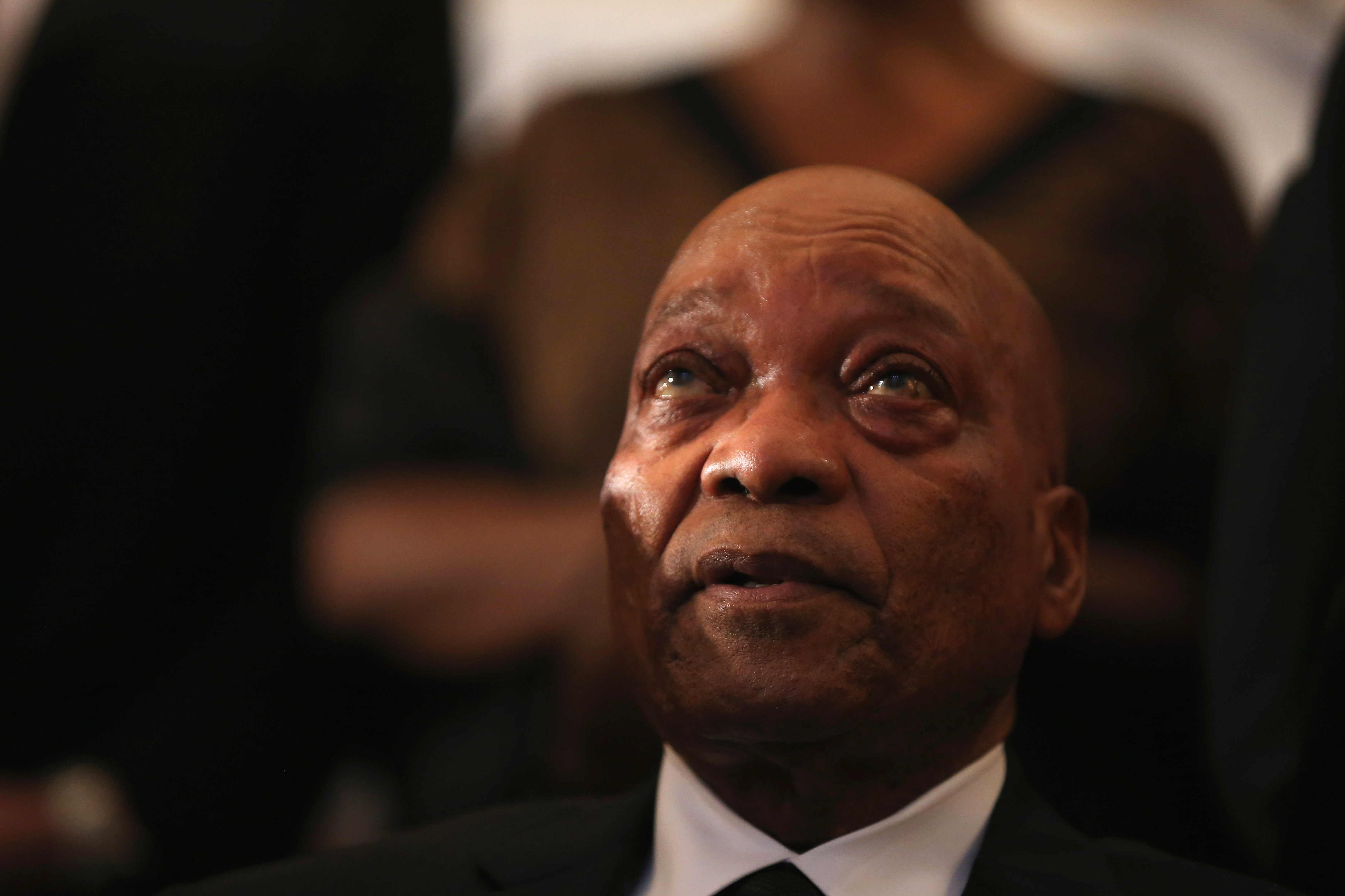
(Photo: South African President Jacob Zuma attends a service at Bryanston Methodist Church during a national day of prayer, on December 8, 2013 in Johannesburg, South Africa. Mandela passed away on the evening of December 5th, 2013 at his home in Houghton at the age of 95. By Christopher Furlong/Getty)

Vermeer’s Dirty Little Secret

Curiosity turned into a major discovery in the art world when inventor Tim Jenison stumbled into proving that the celebrated, hyperrealistic paintings of 17th century master Johannes Vermeer were achieved not through pure genius but through the aid of the camera obscura, a device that projects a perfect image of its surroundings onto a screen:

[Jenison] traveled to Delft again and again, scouting the places where Vermeer had painted. He learned to read Dutch. He paid for translations of old Latin texts on optics and art. Much later, he did a computer analysis of a high-resolution scan of a Vermeer interior, and discovered “an exponential relationship in the light on the white wall.” The brightness of any surface becomes exponentially less bright the farther it is from a light source—but the unaided human eye doesn’t register that. According to Jenison, the painting he digitally deconstructed shows just such a diminution from light to dark.

But still, exactly how did Vermeer do it? One day, in the bathtub, Jenison had a eureka moment:

a mirror. If the lens focused its image onto a small, angled mirror, and the mirror was placed just between the painter’s eye and the canvas, by glancing back and forth he could copy that bit of image until the color and tone precisely matched the reflected bit of reality. Five years ago, Jenison tried it out on the kitchen table. He took a black-and-white photograph and mounted it upside down, since a lens would project an image upside down. He put a round two-inch mirror on a stand between the photo and his painting surface. He immediately found that “when the color is the same, the mirror edge disappears,” and you’re through with that bit. Five hours later, he had painted a perfect duplicate of the photo, an astounding proof of concept by someone who can’t draw and had never painted a thing. Then he used his mirror trick to copy a color photo. Again, perfect. “I couldn’t believe my eyes,” he says.

[Illusionist and entertainer] Teller, who with Penn Jillette made a documentary of Jenison’s project, doesn’t believe it spoils the legacy of Vermeer or any artist who made use of the method:

“One of the things I learned about the world of art,” Teller says, “is there are people who really want to believe in magic, that artists are supernatural beings—there was some guy who could walk up and do that. But art is work like anything else—concentration, physical pain. Part of the subject of this movie is that a great work of art should seem to have magically sprung like a miracle on the wall. But to get that miracle is an enormous, aggravating pain.” To see Vermeer as “a god” makes him “a discouraging bore,” Teller goes on. But if you think of him as a genius artist and an inventor, he becomes a hero: “Now he can inspire.”

MFAs Aren’t Worth It

Jerry Saltz urges all but the wealthiest young artists to stay away from MFA programs, which after two years are “hovering near a quarter-million dollars” in cost. And besides, students have to deal with “a lot of bullshit”:

Iffy artist-teachers wield enormous artistic and intellectual influence over students, favors are doled out in power cliques. Zealous theoreticians continue to scare the creativity and opinions out their third generation of young artists and critics. Too many students make highly derivative work (often like that of their teachers) and no one tells them so. A lot of artists in these programs learn how to talk a good game instead of being honestly self-critical about their own work.

… I’ve taught at institutions across the prestige spectrum. Truthfully? Students who go to high-profile schools get a subtle eighteen-month bump after they graduate, in part because dealers and collectors (oy) see their MFA shows. However, once this short-term advantage dissipates, the artist becomes one in a crowd, with a mountain of debt, and may need to have a full-time job indefinitely to pay it off. There’s no surer way to throw away that early advantage than getting a job that saps their art-making energy.

Saltz also recommends a new essay by artist Coco Fusco, who “pulls back the curtains on the risky business and chancy racket of the Master of Fine Arts degree.”

Emigration Reform

Charles Kenny proposes that we export the growing ranks of unemployed Americans to other countries that need more workers, pointing to Chile, Hong Kong, Indonesia, Mexico, and South Korea as potential destinations:

According to the State Department, only about 6.3 million U.S. citizens live abroad, or around 2 percent of the domestic population. In relative terms, that’s pathetic. About 5.5 million British people live permanently abroad, almost five times the U.S. level in per capita terms. Maybe they’re trying to escape the lousy weather, but it isn’t like Brits have natural advantages over Americans as travelers. British people are almost as bad at speaking other languages as Americans are, and in terms of haughty isolationism and disdain for foreigners, surely Brits are worse. (I’m allowed say this — I’m British.) So why shouldn’t America send out some huddled masses for once?

But would these other countries want American workers?

It is true that Gallup polls suggest only 14 percent of U.S. citizens claim they can speak Spanish well enough to hold a conversation. Look at any other language and the numbers become truly dire… The good news is that English has official or special status in countries that are home to 2 billion people, and one in four of the world’s people speak English to some level of competence. And though it’s true that jobs are hardest to come by for the least educated Americans, it’s still not a pretty picture for recent grads. The unemployment rate for those ages 20 to 29 who had graduated from college in 2011 was 12.6 percent as of October 2011. But even young Americans who haven’t made it to university have received a quality of education considerably higher than that of most people in emerging economies.

Who’s Afraid Of The Truth?

Allow me to recommend Jim Fallows’ latest post on freedom of speech and Max Blumenthal’s grueling book about the extremist elements in contemporary Israel, Goliath. The core point is that, whatever you believe about the arguments of the book, or of its author, it remains a powerfully reported account of actual people currently living in Israel, their attitudes and beliefs. You might imagine that Blumenthal’s selection of racist, extremist elements in Israeli culture obscures a larger truth, as we noted recently. But, even then, it is still a lesser truth that should be engaged, not ignored. He marshalls facts. He talks to people directly. The idea that a book that delves into such empirical questions must somehow be repudiated or ignored is a deeply illiberal idea.

Jim argues:

[Blumenthal] has found a group of people he identifies as extremists in Israel—extreme in their belief that Arabs have no place in their society, extreme in their hostility especially to recent non-Jewish African refugees, extreme in their seeming rejection of the liberal-democratic vision of Israel’s future. He says: These people are coming, and they’re taking Israeli politics with them. As he put it in a recent interview with Salon, the book is “an unvarnished view of Israel at its most extreme.” Again, the power of his book is not that Blumenthal disagrees with these groups. Obviously he does. It comes from what he shows.

To see for yourself, just watch a few minutes of the video Blumenthal and his associates made a few months ago, about recent anti-African-immigration movements. The narration obviously disapproves of the anti-immigrant activists, but that doesn’t matter. The power of the video comes from letting these people talk, starting a minute or so in.

I don’t know how you can watch the video above without thinking of previous attempts in human history – a “cancer on our body!” – to demonize, persecute and expel marginal minorities in defense of a racially homogeneous country. Period. In a particularly glaring twist, the New York Times commissioned the video then simply refused to air it.

Now I know I can be tedious about this kind of thing, and one shouldn’t engage a book merely because some want it branded anathema. But nonfiction is at its most urgent when forcing us to confront uncomfortable reality.

You can and should criticize that reality for being untrue, or deceptive, or simply false. But not engaging it at all on empirical grounds is a sign of fear, not wisdom. That was my argument for airing “The Bell Curve” a couple of decades ago; it’s my argument for presenting Steve Jimenez’s reporting on the tragedy of Matthew Shepard on the Dish. It’s why my instinctive response to those who want a book ruled out of the discourse, is to read it as a human being or air it as an editor.

It’s staggering to me that the New York Times, for example, has not reviewed (even critically) either Goliath or The Book of Matt. Why not? Either because they are cowards or because they genuinely believe that examining arguments that undermine core factions or lobbies – gay or Jewish – is somehow offensive in itself. Neither of these is a good argument. Both sustain denial.

What Is Catholic Literature?

In the midst of a searching rumination on the current state of Catholic writing, Dana Gioia offers a description:

Catholic literature is rarely pious. In ways that sometimes trouble or puzzle both Protestant and secular readers, Catholic writing tends to be comic, rowdy, rude, and even violent. Catholics generally prefer to write about sinners rather than saints. (It is not only that sinners generally make more interesting protagonists. Their failings also more vividly demonstrate humanity’s fallen state.) John Kennedy Toole’s A Confederacy of Dunces, for example, presents a huge cast of characters, lost souls or reprobates all, who, pursuing their assorted vices and delusions, hilariously stumble toward grace and provisional redemption. The same dark comic vision pervades the novels of Evelyn Waugh, Anthony Burgess, and Muriel Spark. Ron Hansen’s Atticus begins with the investigation of a murder. Flannery O’Connor’s fiction is full of resentment, violence, and anger. “Good and evil appear to be joined in every culture at the spine,” she observed, and violence is “strangely capable” of returning her characters “to reality and preparing them to accept their moments of grace.” When Mary Karr titled her poetry collection Sinners Welcome, she could have been describing the Catholic literary tradition.

Much of Gioia’s essay grapples with the decline of Catholic art and literature from its heyday in the mid-20th century. One reason he cites for the current impoverishment? A growing obsession with politics:

What absorbs the Catholic intellectual media is politics, conducted mostly in secular terms—a dreary battle of right versus left for the soul of the American Church. If the soul of Roman Catholicism is to be found in partisan politics, then it’s probably time to shutter up the chapel. If the universal Church isn’t capacious enough to contain a breadth of political opinion, then the faith has shriveled into something unrecognizably paltry. If Catholic Christianity does not offer a vision of existence that transcends the election cycle, if our redemption is social and our resurrection economic, then it’s time to render everything up to Caesar.

Wallace Stevens remarked that “God and the imagination are one.” It is folly to turn over either to a political party, even your own. If American Catholicism has become mundane enough to be consumed by party politics, perhaps it’s because the Church has lost its imagination and creativity.

Recent Dish on denominational prose here.

Savior And Savant

How Jay Parini, author of, Jesus: The Human Face of Godunderstands the man Christians worship:

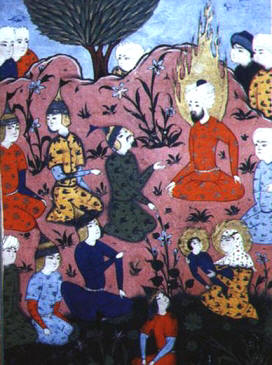
In my view, he was a kind of religious genius born in a fertile place and time: on the Silk dish_sermon Road, when Hellenistic ideas about body and soul had begun to take root in the Middle East, and when the winds of eastern mysticism—with the idea of karma, for instance—blew in from Persia and farther afield. Jesus grasped these concepts, and weaved them into his teaching, overturning traditional Jewish assumptions though building on some of them as well. The Sermon on the Mount offers a unique blend of western and eastern thought, summarizing his ideas. Here he puts forward his radical notions about nonviolent resistance to evil. In the gospels, he spoke in challenging aphorisms and parables. As he walked and taught in Galilee, he modeled behavior that shocked those in who met him.

By his death and crucifixion, he modeled suffering and death as well as life. He understood that his life was symbolic, even mythical. And by his resurrection—which was not the Great Resuscitation but a kind of magical transformation into a new form of life, eternal life, he offered humanity hope.

In an excerpt from his book, Parini elaborates on the significance of the resurrection, noting that when Jesus first appeared to Mary Magdalene, she didn’t recognize him:

Nobody recognized Jesus at first — a point of huge significance, as it underscores the difficult and mysterious nature of the Resurrection, which defies all norms and defeats rationalization.

The embodied spirit of the Messiah returning from the dead was not exactly the same person who died but some altered version of Jesus, transmogrified more than restored to his former state. In reality, the manifestation of Jesus after his death beggars the imagination: he acquired a spiritual body, as we read in I Corinthians 15:44: “It is sown a natural body; it is raised a spiritual body.” There is a subtle teaching here: We should not expect to recognize Jesus at first, even as he wakens within us.

In August, Parini spoke to Ron Charles about how his account differs from Reza Aslan’s controversy-stirring Zealot:

While expressing admiration for Aslan as a writer, Parini takes issue with Aslan’s thesis in “Zealot” that Jesus was a “politically conscious Jewish revolutionary” who advocated overthrowing the Roman Empire. “The core of the Jesus message is what has made him relevant for 20 centuries,” Parini said. “That message — embodied in the Sermon on the Mount — is one of passive resistance to violence. Turn the other cheek. It’s the essence of Christianity. One has to cherry-pick a few odd remarks by Jesus, then read them out of context while ignoring the vast bulk of the Gospels to think Jesus was a zealot, and then — if he were — would anyone care about yet another violent rebel from Galilee, most of whom are now forgotten?”

(Image of Persian Jesus (Isa) miniature of the Sermon on the Mount, date unknown, via Wikimedia Commons)

Original Sin’s Family Tree

Noting that “genetic diversity in the human population is not consistent with what we would expect if all humans had descended from a single pair of individuals,” Loren Haarsma grapples with what that means for the Christian understanding of original sin:

A variety of scenarios are being proposed by Christian scholars today for how we might understand the Adam and Eve of Genesis 2, and their disobedience in Genesis 3, in light of modern science. Some scenarios propose Adam and Eve as two individuals living in Mesopotamia just a few thousand years ago, acting not as ancestors but as recent representatives of all humanity. As our representatives, their disobedience caused all of humanity to fall into sin. Other scenarios propose Adam and Eve as two individuals, or as literary representations of a small group of ancient representative-ancestors, selected out of a larger population, living in Africa over 100,000 years ago at the dawn of humanity; they were ancestors—but not the sole ancestors—of all humans today; they fell into disobedience against God over a relatively short period of time with a fairly distinct “before” and “after.” Other scenarios propose that Adam and Eve’s disobedience in Genesis 3 is a symbolic retelling of the story of every human who, over our long history, became aware of God’s claims on how they ought to live, and then disobeyed.

Jerry Coyne snarks:

Adam and Eve couldn’t have been the literal ancestors of all humanity. Normally, such a scientific trashing of scripture could be absorbed, at least by liberal theologians. They’d just reinterpret Adam and Eve as metaphors. But that causes big trouble on two counts.

First, if there really were 2,000 or more ancestors, then all of them must have transgressed to bring original sin into the world. That is hard to fathom: did everyone do something bad at the same time? Second, if Adam and Eve were metaphors, and the source of original sin is mysterious, then we have no idea why Jesus died. After all, his death and Resurrection occurred precisely to save us sinful humans from the transgressions of Adam and Eve. If you have to turn that story into a metaphor, then Jesus died for that metaphor. That’s not too palatable to Christians.

An easy and sensible way to solve this conundrum is to assume that the whole scenario is concocted: humans don’t have original sin; there was no Adam and Eve; and the Resurrection and divinity of Jesus were fictions. But Christians won’t have that, for the meaning of Jesus’s life, death, and resurrection is the final, non-negotiable “truth” of Christianity. You can see everything else as metaphorical, but not that. For if you metaphorize Jesus, you’re basically abandoning Christianity.

Recent Dish on original sin here.