Learning What’s Critical

Daniel Mendelsohn, the classicist and essayist, reflects on the rudiments of good criticism:

One of the courses I like to teach is a Great Books course that’s mandatory for first year students, and after I read their first papers it’s always very clear to me that they have no model, no template for what a critical essay is supposed to do—what (or how) you’re supposed to be arguing when you’re writing about a text or a movie or anything. They don’t understand there is a rhetoric of criticism—that there’s a stance you have to have, that you have to position yourself, that you don’t just blather about your impressions or your “opinions” or, worse, your “feelings” about a work. They literally have no idea, at first, what the point of being critical is—no doubt because, in part, they are being raised in a culture where a bland, everything-goes, multi-culti niceness is the paramount virtue. You have to know who you are—as a person, but also as a member of a given civilization—in order to speak about a work.

I always tease them at the beginning of the semester about their writing—I say, “Whenever you write me at 11 o’clock on a Thursday night begging me for an extension on the paper, the prose is always so beautiful and the email is so wonderfully structured.”

It’s a joke, but it’s also not a joke—in that situation they understand the rhetoric of the form to which they’re committing themselves: They understand who they are as a writer and a beseecher, they understand who I am as the person in charge, they understand what evidence to adduce in their favour—their dog died, their computer broke or whatever. Which is why the email begging for the paper extension is always a well-written piece. But whenever they have to write three paragraphs about women in Genesis or whatever—when they have to make an argument—it’s basically “word salad,” because they’ve never read anything that presents a text, wrestles with it and comes up with some conclusions. For that reason, I think it’s better that they should be reading Pauline Kael reviews in the New Yorker than Derrida.
Reel Life

Mairead Case contemplates Beckett’s 1958 work Krapp’s Last Tape, a one-act play “about power, ritual, sound, and men, set on a ‘late evening in the future'”:

It is small, a punch: Krapp, a desk, a banana, a closet with a light, a tape recorder, some reels, and some fart jokes. Every year on his birthday, Krapp records a tape about his thoughts and whatever’s happening in his life. Then he listens to it and the ones he made earlier. The play is very funny and very sad and still beautiful. It is barely half an hour — all power, no clutter. There is no one else, not even a dog or a landlady, and since Krapp doesn’t seem cold or hungry or locked in we think yes, okay this is how he wants it. …

The first five minutes — or ten or fifteen — of the play are silent. Krapp shuffles around the stage; he eats a banana, pours himself booze. When he finally speaks — “spool” — it’s funny, like blowing a raspberry at a funeral to make a baby laugh. First Krapp listens to older reels — here he is, throwing a ball for a little white dog; and there in a boat, with a lady who has gooseberry scratches on her thigh — and next he records a tape for this year, his sixty-ninth. He has to restart it a couple times. He is freaking out about his dogs loose in the desert. “Everything there, everything on this old muckball, all the light and dark and famine and feasting of… the ages!” Krapp says. “Yes! Let that go! Jesus!” He is passionate and so crabby.

Case imagines a conversation between Krapp and Gertrude Stein:

In all ten years I’ve been reading it though, Krapp never once gets up from that table for real. I want to put Gertrude Stein next to him. Maybe her head is in her hands, or maybe her chin is out, defiant. “If everybody did not die the earth would be all covered over,” Stein tells Krapp, like she says in Wars I Have Seen (quoted also in Claudia Rankine’s Don’t Let Me Be Lonely). “And I, I as I” — I as I! I can be someone else a while — “could not have come to be and try as much as I can try not to be I, nevertheless, I would not mind that so much, as much as anything, so then why not die, and yet and again not a thing, not a thing to be liking, not a thing.” I don’t think Krapp would get up, even then.

Recent Dish on Beckett here.

(Video: Part 1 of Krapp’s Last Tape, from a 2006 performance featuring Harold Pinter as Krapp)

A Short Story For Saturday

A long excerpt from David Foster Wallace’s “The Depressed Person” (pdf), which first appeared in the January 1998 issue of Harper‘s:

The feelings of shame and inadequacy the depressed person experienced about calling members of her Support System long-distance late at night and burdening them with her clumsy attempts to describe at least the contextual texture of her emotional agony were an issue on which she and her therapist were currently doing a great deal of work in their time together.

The depressed person confessed that when whatever supportive friend she was sharing with finally confessed that she (i.e., the friend) was dreadfully sorry but there was no helping it she absolutely had to get off the telephone, and had verbally detached the depressed person’s needy fingers from her pantcuff and returned to the demands of her full, vibrant long-distance life, the depressed person always sat there listening to the empty apian drone of the dial tone feeling even more isolated and inadequate and unempathized–with than she had before she’d called. The depressed person confessed to her therapist that when she reached out long-distance to a member of her Support System she almost always imagined that she could detect, in the friend’s increasingly long silences and/or repetitions of encouraging cliches, the boredom and abstract guilt people always feel when someone is clinging to them and being a joyless burden. The depressed person confessed that she could well imagine each “friend” wincing now when the telephone rang late at night, or during the conversation looking impatiently at the clock or directing silent gestures and facial expressions communicating her boredom and frustration and helpless entrapment to all the other people in the room with her, the expressive gestures becoming more desperate and extreme as the depressed person went on and on and on.

The depressed person’s therapist’s most noticeable unconscious personal habit or tic consisted of placing the tips of all her fingers together in her lap and manipulating them idly as she listened supportively, so that her mated hands formed various enclosing shapes – e.g., cube, sphere, cone, right cylinder – and then seeming to study or contemplate them. The depressed person disliked the habit, though she was quick to admit that this was chiefly because it drew her attention to the therapist’s fingers and fingernails and caused her to compare them with her own.

The story also can be found in DFW’s collection, Brief Interviews with Hideous Men. The Dish recently featured other short stories here, here, here, and here.

Back Into The Wild

Eva Holland recounts her journey to the site where Christopher Johnson McCandless, the idealistic hiker depicted in Into The Wild, died in the Alaskan wilderness in 1992. Admirers of the young adventurer – some of whom Holland met in the above video – still retrace McCandless’s steps to see the abandoned bus where he spent his last days:

Fairbanks City Transit System Bus #142 has become a shrine, its rusting shell etched with motivational phrases left by visitors. But the pilgrimage is risky. One hiker died while crossing the Teklanika [River] in 2010, and dozens more – 12 in the summer of 2013 alone – have become lost, hurt or stranded by the rising river and have needed to be rescued by local authorities. …

The trail is nobody’s idea of a lovely hike – one of many things that mystify the Alaskans who watch the McCandless pilgrims set off each year. (“Of all the places you could hike in Alaska …” one local had said to me two nights earlier, shaking her head in disbelief.) The Stampede Trail is a boggy thoroughfare for motorized off-roaders. During the day that I spent on it, I counted seven bus-bound hikers, 22 four-wheeling moose hunters, two guided Jeep tours and one guided ATV [all-terrain vehicle] tour. Hiking there today is no way to capture the solitude and engagement with nature that McCandless was seeking. As I slogged back to my waiting car, I could not see the point of the pilgrimages. Nor could I fathom how the loss of more young lives honored his memory.

The pilgrims, of course, see the journey differently.

A spiral notebook left in the bus by the McCandless family when they visited by helicopter in 1993 has since been filled with handwritten entries, each praising McCandless and the impact his story has had on the writer’s life. One 2002 visitor left a poem: “I came up here to get away / It’s the last frontier they say / I came across this bus today / It’s gorgeous here I think I’ll stay.” Another entry, left by a man in 1999, reads: “I started my journey here hoping for two things, one that somewhere out here I would find myself, and two that I would find some hope for the future. Now I am here at the bus, and I am happy because the future looks up and I know who I am.”

One undated entry, written in pencil, is addressed directly to McCandless: “Christopher J McCandless, AKA Supertramp, I envy the ability you had to put this world aside and live out your dream, something so many of us lack. If your spirit still looms here, if this is your eternal paradise and you watch us come and go year by year season by season, I hope you help instill some of your awesome qualities in each of us that make the grueling trip to your resting place.”

Middle Class And On Food Stamps

vara_04

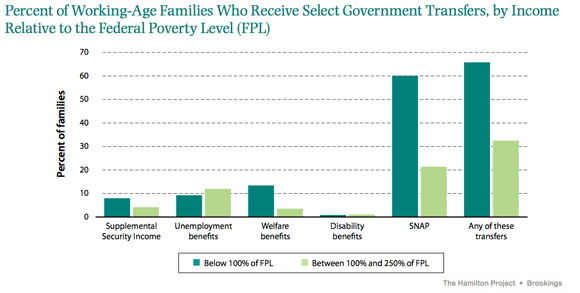
Vauhini Vara draws attention to the plight of the lower-middle class – families who make between $15,000 and $60,000 a year:

Compared with the poorest families, lower-middle-class families are more likely to be headed by married couples and to benefit from two incomes. They are also more likely to include a family head who has attended college. So far, so good: studies have shown that children who live with two parents are more likely to be more economically secure and to be healthy, as well as to graduate from high school; other studies show similarly positive effects for children of college-educated parents. And parents benefit, too.

And yet, many of these lower-middle-class families are still struggling to get by. About 60 percent of families below the poverty line receive food stamps (shown in the chart [above] as SNAP, for Supplemental Nutrition Assistance Program); so do more than 20 percent of lower-middle-class people. All told, more than 30 percent of lower-middle-class people receive food stamps, unemployment benefits, welfare, or other benefits.

This matters for a couple of reasons.

It reframes how we think about the people who access government benefits. Many of them, it turns out, are married, college-educated, and working – that is, people whose choices reflect traditional values and whose plight should inspire sympathy from both the political left and right. And it highlights the structural problems that make it difficult for lower-middle-class families to make ends meet and to rise into a higher income bracket. If you’re a married, stay-at-home mom who wants to work, for instance, you face a dilemma: if your husband’s salary is low enough to qualify your family for government benefits, getting a job could actually cost your family more in taxes and lost benefits than staying out of the workforce.

Hamilton Nolan comments:

The lower class is the most important class. But the lower class has the advantage of at least being obvious in its wretchedness. The lower middle class, by contrast, is easy to forget. On the one hand, it’s easy to assume that they are doing okay, because they’re working; on the other hand, they don’t make enough money to assert any real political influence. And all the time, they teeter on the edge of economic oblivion.

The Loss Of Alt-Weeklies

Reflecting on the demise of three alternative weekly papers in Connecticut – the New Haven Advocate, Hartford Advocate and Fairfield County Weekly – Brian LaRue laments “the loss of opportunity for journalists, particularly young journalists” it reflects:

Oh, sure — it’s 2013, and there’s no shortage of outlets for a young, loud, opinionated dish_altweekly2 writer to be loud and opinionated in media. But oftentimes — and I’ve written about this before, talking about the shift in media from the all-hands-on-deck newsroom to these networks of isolated bloggers — you lose the wisdom of the tribe that comes from being part of an editorial staff at a decades-old publication. And beyond that, working at an alt-weekly teaches a journalist so many important lessons. For reasons I’ve already laid out, when you report for an alt-weekly, you have to go deep. You have to figure out the not-obvious story. You have to become an engaging storyteller, not just a sharp transcriber. The editorial staff is small. (When I worked at the New Haven Advocate, the most full-time editorial staffers we ever had was seven, and that didn’t last long.) Your beat is broad. You need to learn your history, fast, so you know what to ask about and who to talk to. In general, you need to get really good. Really. Goddamned. Good.

He goes on to argue that alt-weeklies aren’t just important, “they’re also fun“:

They kind of have to be. The salaries are typically atrocious, the hours are long and the benefits are slim. … In his excellent appreciation of Boston Phoenix upon that esteemed alt-weekly’s shuttering, former Phoenix editor S.I. Rosenbaum pointed out how “the job itself had to be the reward.” You work for an alt-weekly because, every week, it feels like some combination of a public service and a tremendous prank you can’t believe you’re getting away with. You spend countless days in which you work from the moment you wake up to the moment you go to bed again because you know you’re helping to create an ongoing community institution, something thousands of people rely on for an experience they can’t get anywhere else, and you have to bring your A-game for them.

But there’s at least one state where the alt-weekly still thrives: Vermont.  In September, Jim Fallows spotlighted Burlington’s Seven Days, a print newspaper that:

  • Has a three-times-larger print distribution now than it did at its inception in the mid-1990s;
  • Has a healthy print-and-digital classified-ad section, including a robust set of recruitment ads and “help wanted” listings (400+ when I checked this afternoon, in a city of 40,000+ and a surrounding metro area several times that large);
  • Employs more people now than it ever has before; and
  • Is on pace for its best year ever in total revenue, up by more than 20% from its high before the crash of 2008.

Fallows offered “two comments from its publisher, co-founder, and co-editor Paula Routly”:

1) On the print business overall: “My biggest problem is the ‘death of print’ doom and gloom talk, which scares advertisers into thinking no one will see their ads. But as long as people keep picking up our paper, which they do, the ads get seen.”

2) On a reason why this paper is working, when many others aren’t (apart from the un-wired status of much of Vermont, which impedes online growth): “People look at our paper and it makes them happy and interested to be here. That motivates them to do something, and participate — which makes it more a community, and gives us something to cover. It’s a cycle that works.”

(Image of New Haven Advocate from March, 2008, via Aaron Gustafson)

How Cats Can Control Us

James Hamblin digs into what’s really going on with Toxoplasmosis gondii, a parasite spread by cats, and its effect on the human mind:

Toxo has been all over the news in recent years, since it became known that the parasite manipulates people’s behavior. Maybe most interestingly and notoriously, it seems to make men more introverted, suspicious, unattractive to women, and oblivious to the way others see them. Infected women, inversely, have been shown to be more outgoing, trusting, sexually adventurous, attractive to men, and image-conscious. Infected men tend to break more rules than their uninfected peers, and infected women tend to pay them more heed. Infected men and women are 2.5 times more likely to have traffic accidents, more likely to develop schizophrenia, and more likely to engage in self-directed violence. …

Tyrosine hydroxylase is involved in production of the normally-occurring neurotransmitter dopamine. More of the enzyme means more dopamine. This changes behavior of mice, and Webster and Stock extrapolate, people. That explanation means that Toxo infection increases dopamine in our brains. It’s different, though, from the kind of dopamine boost we usually hear about in pop neuroscience likened to a runners’ high. “When you’re doing something rewarding—drinking a cup of coffee, talking to a friend, having sex, whatever—you have a boost of dopamine specifically in the limbic regions of your brain,” she said. “But Toxoplasmosis spreads all over your brain, infecting dopamine-producing neurons in many pathways. Given that the dopamine-based system is complex and influences many aspects of cognition and behavior, there is a plethora of effects that might be observed.”

How to avoid infection:

Indoor cats pose no threat, he says, because they don’t carry the parasite. As for outdoor cats, they shed the parasite for only three weeks of their life, typically when they’re young and have just begun hunting. During that brief period, Flegr simply recommends taking care to keep kitchen counters and tables wiped clean. (He practices what he preaches: he and his wife have two school-age children, and two outdoor cats that have free roam of their home.) Much more important for preventing exposure, he says, is to scrub vegetables thoroughly and avoid drinking water that has not been properly purified, especially in the developing world, where infection rates can reach 95 percent in some places. Also, he advises eating meat on the well-done side—or, if that’s not to your taste, freezing it before cooking, to kill the cysts.

Blogs That Cry “Click!”

Paul Waldman wonders about the moment when click-bait burnout sets in:

Once you’ve clicked on a few posts that promised to make you cry or change your view of the world forever but didn’t deliver, your default assumption will become that when you see Screen Shot 2013-12-05 at 4.53.34 PMsomething like that, it means somebody’s trying to get you to be a part of something artificial. It’s one thing to send something truly inspiring or outrageous to your friends or Twitter followers and brighten their day for a moment, but nobody wants to be a tool of someone else’s phony marketing campaign or mean-spirited hoax.

And I think that’s the danger for these ventures. The more conscious people become that by passing something along they’re not so much participants in a beautiful collective celebration of our shared humanity, but are instead part of an intentionally constructed attempt at content viralization, the less they’ll want to be a part of it. Because after all, one of the hallmarks of not just Millennials but the couple of older generations going back at least as far as Generation X is media savvy, or at least the desire for media savvy. We all want to think we’re immune to advertising’s manipulations and we don’t get suckered by even the cleverest marketing campaigns.

Rob Horning’s related musings:

The fact that virality can be “reverse engineered” without fear of shortages of viral-worthy content is interesting enough. “Amazing” and “heart-warming” or “surprising” content is a matter of form, not extraordinary incident. These words trigger likes the way old novels triggered tears – you didn’t want to seem unfeeling so you did it. But the fact that “everyone on the Internet” has become so good at “emulation” suggest the appeal of viral content is in the model it provides for self-memeification. Are we all starting to premise our self-worth on being as viral as Neetzan Zimmerman’s content? Is the pursuit of virality becoming hegemonic, as online “engagement” metrics that track viral content are taken also for reliable measures of self-esteem?

The point of viral content, in part, is not to learn about “little girls in Afghanistan who are better at skateboarding than you’ll ever be” or other such stories (which often turn out to be untrue) but to be the person who responds correctly to them and who tells someone else about them.

(Screenshot from Huffpo’s front-page)

Sanctioning Ourselves

Paul Pillar points out the costs to the US of applying sanctions to foreign countries, particularly countries like Iran:

The formidable, fear-inducing enforcement of U.S. sanctions against Iran entails substantial costs for U.S. companies. Not only are these companies excluded from some major opportunities for new business; they have to jump through additional hoops to make sure they do not run afoul of the enforcers in areas where they still are doing business. A Washington Post story concerns how this fear leads American companies to report to government regulators in excruciatingly minute detail anything they do that could conceivably brush up against the sanctions. Citibank, for example, felt it necessary to report that it made four dollars in profit from ATM transactions in Bahrain that involved a joint venture that included two Iranian-owned banks.

It is remarkable that some members of Congress who otherwise do not hesitate to preach that onerous government regulations and the administrative burdens they impose are bad for the American economy are also enthusiastic backers of the sanctions.

Earlier this week, Beinart railed against any new Iranian sanctions:

If today’s conservatives actually studied Reagan, instead of deifying him, they might find a useful model in the way he handled the Soviet Union.

Early in his presidency, Ronald Reagan brought massive pressure to bear on Moscow. But when that pressure helped bring to power Mikhail Gorbachev, a man genuinely interested in ending the Cold War, Reagan moved decisively to buttress Gorbachev at home. He did so even though it required American concessions in the 1987 Intermediate-Range Nuclear Forces Treaty that outraged Reagan’s hawkish base. And Reagan’s strategy of supporting Gorbachev worked. “If Reagan had stuck to his hard-line policies in 1985 and 1986,” wrote longtime Soviet ambassador to the U.S. Anatoly Dobrynin, “Gorbachev would have been accused by the rest of the Politburo of giving everything away to a fellow who does not want to negotiate. We would have been forced to tighten our belts and spend even more on defense.”

Today, America should make a similar investment in Hassan Rouhani, not because Rouhani will give America everything it wants, but because if he fails, America will get far less. Legislating new sanctions now, even if they don’t immediately take effect, could destroy Rouhani’s nuclear diplomacy. If that happens, we may have to wait years more for leaders willing to cap Iran’s nuclear program and end its cold war with the West. And by the time they come along, who knows how many centrifuges Iran will have?

Is Superman A Fascist?

Richard Cooper worries that “comic-book movies are all about superior beings dominating everybody else”:

SupermanThe main problem is force: sheer physical force, which lies at the heart of the superhero myth, something Steven T.Seagle observed nicely in “It’s a Bird…”, his poignant autobiographical graphic novel about his reluctance to write for a Superman comic, in which he points out that Superman triumphs by being able to move faster and hit harder than everyone else: essentially a fascist concept. … Fascism also relies on people who must be crushed. The Batman films — and indeed the entire Batman mythos — are based on the idea that what criminals really need is a damn good thrashing, because it’s the only language these punks understand. The vicarious thrill in seeing Batman yell “Swear to me!” at some pitiful creep who swears to God he doesn’t know anything is for the nasty-minded child in all of us: an innocent pleasure until you start to think about the politics.

Chris Yogerst is unimpressed by this argument:

This reading of superheroes is common but wrong, a symptom of trying to impose political ideology on a universal, fictional myth. Superheroes do say something about the real world, but it’s something pretty uncontroversial: We want to see good triumph over evil, and “good” in this case means more than just defeating the bad guy—it means handling power responsibly.

The “fascism” metaphor breaks down pretty quickly when you think about it. Most superheroes defeat an evil power but do not retain any power for themselves. They ensure others’ freedom. They rarely deal with the government, and when they do it is with wariness, as in the Iron Man films, where Tony Stark refuses to hand over control of his inventions.

Devin Faraci adds that not all superheroes are alike:

It’s telling that Batman and Superman predate WWII; they both come from an age when little guy America wanted to be seen as tough. The Marvel heroes, though, come from a time when America was trying to juggle its self-image as the underdog with the reality of being the biggest, toughest kid on the block. These heroes were created during the Vietnam War – Iron Man’s first origin is explicitly set in Vietnam – and they reflect the cognitive dissonance we feel as ‘good guys’ who could also wipe out the Earth at a moment’s notice. If anything there’s a discomfort with power and force inherent in the Marvel heroes that is anti-fascist. … [In the X-Men franchise, w]e have the hated mutants working to change society’s view of them, working to remove institutionalized racism and, at the same time, doing it peacefully. The X-Men come into conflict almost exclusively with their own kind, and that conflict is about stopping violence, even when that violence is a reaction to hate. And they’re led by a guy who is so physically unsuperior he can’t even fucking walk.

(Image by Josey Wales)