Obama’s Nuclear Focus

David Kenner contends that the president’s foreign policy is best understood as a drive toward nonproliferation:

Obama’s non-proliferation agenda got off to a fast start in its first year, as the administration negotiated the New START treaty; held the Nuclear Security Summit, which included delegations from 47 countries across the world; and released a new Nuclear Posture Review, which called for reducing the role of nuclear weapons in U.S. national security strategy. In some of the global hotspots that concerned the United States, the focus on nuclear non-proliferation also took precedence over concerns about human rights or democracy promotion.

In Russia, Obama prioritized non-proliferation over concerns about Vladimir Putin’s crackdown on his domestic political opponents. “The nuclear issue is really important to his background,” Michael McFaul, the current U.S. ambassador to Moscow, told Mann for The Obamians. “He thinks you need a New START treaty, no matter whether the Russians are a democracy or an autocracy, because these are dangerous weapons and we’ve got to control them-and in a way, that’s a legacy from this 1980s era.” …

With the wind at the back of the president’s nuclear agenda, the stakes could extend far beyond Damascus or Tehran. The one notable exception to Obama’s non-proliferation agenda — so far – has been Israel, where this administration’s refusal to push for nuclear disarmament has led to charges of hypocrisy among both Arabs and Iranians.

Zachary Keck adds that it looks as though, despite some scary cases, nukes are not spreading very quickly:

[T]here has been an undeniable decline in the number of states interested in acquiring nuclear weapons.

Harald Muller and Andreas Schmidt have documented this well. In their comprehensive study of states with nuclear weapons activities between 1945 and 2005, they find that “states with nuclear weapons activities were always a minority, and today they are the smallest minority since 1945.” Specifically, in 2005 they identified 10 states as having nuclear weapons activities (including those with nuclear weapons), which constituted less than six percent of UN members. Today the only non-nuclear weapon state (NNWS) that might be interested in an atomic weapon is Iran.

The fact that states have by and large been uninterested in nuclear weapons is somewhat perplexing from a historic perspective. After all, what other revolutionary military technology hasn’t elicited strong interest from most states competing in the international system? At the same time, when one examines the properties of nuclear weapons more closely, the lack of interest is easier to understand. Nuclear weapons have basically served one purpose for states possessing them; namely, they have deterred others from challenging that state’s survival and other fundamental interests. But the nuclear era has also been characterized by a sharp decline in warfare and today fewer states face fundamental external threats to their existence. Given the high costs of building and maintaining a nuclear arsenal, it makes little sense to acquire nuclear weapons without such an existential threat.

No Shelter For Gay Syrians

Haley Bobseine documents their plight, which includes horrific threats from both sides of the civil war:

As the violence in Syria continues unabated, many have retreated into their ethnic and religious communities for protection. Unlike other minority groups — such as Christians, Kurds, and Alawites — sexual minorities, notably gay men, do not enjoy the protection of any political, ethnic, or religious institutions. For gay Syrians, nowhere is safe: Across the country, they have been the target of attack by pro-regime militants and armed Islamist militias alike — at times because of their sexual preference; at other times simply because they are perceived as weak and easy to extort in the midst of a chaotic war …

Gay Syrians still in the country must not only evade discovery themselves — the capture of one of their acquaintances can also present a mortal threat. Amir recounts how one of his gay friends, Badr, was kidnapped this summer by Jabhat al-Nusra, which extracted information from him about other gays before executing him. “Several days later, Jabhat al-Nusra gathered people in the square and denounced another guy as a faggot,” says Amir. “They chopped his head off with a sword.”

Last month, Hannah Lucinda Smith interviewed gay Syrian refugees living in Beirut:

Life as a gay man in Beirut, where the gay scene is far more visible than in Syria, may be easier in many ways, but the city’s open and, at times, extravagant scene can also come as a culture shock. “Although Syria and Lebanon are neighboring countries, they are very different socially,” [psychologist] Patricia [el-Khoury] told me. “These guys have suddenly found themselves in a completely different environment. They are in a freer place, but often they are not prepared for it, so there is a tendency to go to extremes. There is a lot of prostitution on the gay scene in Lebanon, as well as drug use.”

A School Without Walls

This embed is invalid


Emily Bazelon thinks American parents and educators could learn a thing or two from an outdoor school in Switzerland for children ages four to seven, profiled in the new documentary School’s Out: Lessons from a Forest Kindergarten:

It’s autumn. A few kids splash through a muddy creek. One boy falls down in the water, gets up, squawks, keeps going. A larger group sits and jumps in a makeshift-looking tent that consists of a tarp hung over a pole, with low walls made from stacked branches. A teacher tootles on a recorder. Later, the teacher describes the daily routine: Singing, story time, eating, and “then the children can play where they want in the forest.” … This is so intuitive to me, given my own kids’ need to move their bodies every other minute, that begging for more outside time is my main refrain at my 10-year-old’s school. I’m mystified by the Atlanta superintendent who said, in scrapping recess, “We are intent on improving academic performance. You don’t do that by having kids hanging on the monkey bars.” Actually, yes you do.

Rupert Neate talked to an educator in Germany, which has 1,500 such schools, about safety concerns:

Ute Schulte-Ostermann, president of the German Federation of Nature and Forest Kindergartens (BVNW), says there have been no serious injuries beyond the occasional broken leg in the organization’s 20-year history. “There are far fewer accidents than at regular indoor kindergartens because we have fewer walls and softer floors — leaves and mud,” she says. Schulte-Ostermann, who is also a teacher trainer at Kiel’s University of Applied Sciences, says life outdoors toughens the children up, reducing incidents of colds and flus. Head lice outbreaks are also significantly reduced because the children are not confined in an enclosed space. There is however, a much greater risk of contracting Lyme disease from tick bites. Schulte-Ostermann says the risks are outweighed by the “massive” mental and physical benefits of playing outside. “Children who have attended a Waldkindergarten have a much deeper understanding of the world around them, and evidence shows they are often much more confident and outgoing when they reach school.”

Public Pensions On The Chopping Block, Ctd

A reader writes:

I have mixed feelings on the bankruptcy situation in Detroit. On the one hand, I don’t want retired public workers to be thrust into poverty because their pension vanished or was severely cut. On the other hand, it has always bothered me when some retiring public employees were able to game the system by working tons of overtime the last three years on the job to up the salary on which their pension was then based. I also feel for the current residents of Detroit who are currently paying the pensions for a pool of retired public works that is vastly disproportional to the current size of the city.

In the end, it will all depend on how humanely and rationally the cuts to the pensions are made. Go back and recalculate the pensions based on non-overtime and bonus pay. Figure out a minimum pension amount for everybody and then apply a percentage cut on pension amounts over the newly set minimum. I’d even say they should reduce the pension amounts less than other kinds of debt, but there will have to be some cuts, especially for those who are living well on the defaulting city’s dime.

A critic of the cuts points out:

Your post didn’t mention the big, glaring issue behind these pension cuts:

1.  Public school teachers weren’t covered by Social Security until the late ’60s.
2.  Firemen and policemen still aren’t covered by Social Security.

Which means that these former municipal employees aren’t getting a pension in addition to Social Security and living the high life – the pension, for many of them, is all they have.

Another elaborates on the Social Security factor:

Those who want to cut pensions should consider a few things. First, pension plans are usually presented in the recruitment phase as an incentive to work for an employer. Pension benefits are part of an employee’s compensation. Many who earn pensions are not paid especially well, despite the whopping, headline-catching pensions of former fire and police chiefs and other top city, county, and state officials. The average worker gets something like half their average salary at full vesting after 25 to 30 years, with the benefit pro-rated based on their years of service and typically a three-year average of their top salary. Pension benefits are taxable like any other income.

At the same time, the Social Security Administration imposes on pensioners the Windfall Elimination Provision, which reduces Social Security benefits by 60 percent if a person has a pension. This is probably fair if a pensioner has worked many years for the pension, but in many systems you can vest in the pension plan for partial benefits at, say 10 years. By doing so, you forfeit 60 percent of your Social Security benefits even if you worked much longer at a Social Security-eligible job.

Cutting benefits across the board punishes people who had no say in how municipal or county or state budgets were planned and executed. Many pensioners will be reduced to penury if broad cuts in pensions are permitted by the courts when local governments are so badly managed that they wind up declaring bankruptcy. Better to cap pension benefits at the higher end while leaving lower-end pensions minimally impacted. Penalizing pensioners for the incompetence or misbehavior of others is the height of unfairness.

An expert on the subject sounds off in detail:

As a law student currently staring down the barrel of a bankruptcy exam, I have to take issue with Heather Long’s characterization of the “best interest of creditors” test. Although Section 943(b)(7) says that the plan must be in the best interest of creditors, this test isn’t as rigorous as it sounds. In other sections of the Bankruptcy Code (the sections applying to private parties) the “best interest of creditors” is determined by reference to what the creditors would get in a Chapter 7 liquidation proceeding – that is, if all the debtor’s assets were sold, how much would the creditors get? Usually this isn’t much – if it’s anything at all – since secured creditors are allowed to take the full value of their secured claim, and very often so much of the debtor’s property is used as collateral for secured debt (by security agreements placing a lien on all the debtor’s unencumbered property, or on the debtor’s inventory or equipment) that there’s virtually nothing left to sell. Even then, there are priority claims – listed in Section 507(a) – that must be paid in full to the extent possible before any general unsecured creditors get paid. Except for benefit-plan contributions to be paid out for services rendered in the 180 days before filing [under Section 507(a)(5)], pensions are not priority unsecured debts and can only be paid after priority debtors are fully satisfied.

What this means is that the “best interests of creditors” in most private bankruptcy plans is “the creditors receive more than nothing.”

Now, I could be wrong – the part of Chapter 9 incorporating provisions of Chapter 11 by reference specifically excludes Section 1129(a)(7), which specifically states that the plan must be better than Chapter 7 for each particular creditor, and replaces it with the much vaguer 943(b)(7), so there is room for the court to improvise there. On the other hand, the idea that “the best interests of creditors” test requires a comparison with a hypothetical liquidation is firmly entrenched in the precedent of the Bankruptcy Courts.

Bottom line: “Best interest of creditors” may prove to be of much less value to Detroit’s pensioners than it sounds.

Cannabis Isn’t So Green, Ctd

Brian Anderson investigates the energy and environmental costs of commercial pot grows. He flags a 2011 study (pdf) by researcher Evan Mills:

Mills looked at energy consumption within the cannabis industry, and found that indoor pot production uses about $6 billion worth of energy annually, or enough electricity to power two million average-sized homes. That accounts for one percent of total national energy usage, and spews as much greenhouse gases as three million cars.

But LEDs could be changing that:

Cary Mitchell, a horticulture professor at Purdue University whose heading up a $5 million project to audit and improve LED lighting capabilities in America’s “specialty crop” (see: greenhouse grown fruits, vegetables, nursery plants, etc.) industry, thinks mainstream commercial agriculture has a lot to learn from the pot industry’s gradual embrace of LED tech. He tells the Guardian that specialty crops net about $50 billion a year, and that their growers are seeking out ways to slash energy costs while increasing yields, much like cannabis farmers.

“They’ve undoubtably been doing this for years and years,” Mitchell explains, referring to pot grower’s LED usage. “Since they don’t publish their research, we don’t really know how far they’ve taken the optimization. They probably are ahead of the specialty crop commercial production industry.”

Earlier Dish on marijuana’s environmental impact here.

The UN’s Robotic Peacekeepers

The UN launched its first drones on Tuesday to aid in surveillance as part of its peacekeeping mission in the Democratic Republic of the Congo. Allen McDuffee covers on the development:

“It is another validator of the new ‘normal’ of this technology and its use,” said Peter Singer, director of the Center for 21st Century Security and Intelligence at the Brookings Institution. ”Some 87 countries are using military robotics of some sort, so why should we be stunned that the organization they are members of and supply its forces would use them too?”

“Drones are a technology that are here to stay,” said Singer. “There are so many ‘debates’ now where the people call themselves ‘pro’ or ‘anti’ drone, which is like being pro or anti computers, quaint but irrelevant. Its all about how you use the technology, not the widget itself.”

The drones are unarmed, but Adam Clark Estes calls the move “a bit of an about face”:

Despite having expressed skepticism over some countries’ use of drones—albeit often the ones used for targeted killings—the UN now feels like the technology is necessary. “This is a first in the history of the United Nations that such an advanced technological tool has been used in peacekeeping mission,” Hervé Ladsous, Under-Secretary-General for Peacekeeping Operations, said at the unveiling. “The UN needs to use these kinds of tools to better perform its mandate.”

Simon Allison has mixed feelings about the announcement:

Deploying drones in the DRC does make a good deal of common sense. In the areas where the drones are to be deployed, roads are poor or non-existent; the terrain affords plenty of cover; and foreign peacekeepers trying to gather information don’t exactly blend in. This makes it exceptionally difficult to gather accurate information – a problem that drones, with their all-seeing monitors, could solve, or at least alleviate. …

It’s difficult, however, not to feel some unease at the introduction of a new and possibly dangerous element into the Congolese conflict, which has reached a (still very tentative) détente over the last couple of months. ‘Surveillance’ sounds relatively innocuous, but that’s exactly how America’s drone warfare program started life. It’s worth remembering what that has become: a widespread, unaccountable series of targeted killings (some would say assassinations) in foreign countries, responsible for the deaths of at least 2,227 people in Pakistan alone.

Updating Our Family Tree

Human Family Tree

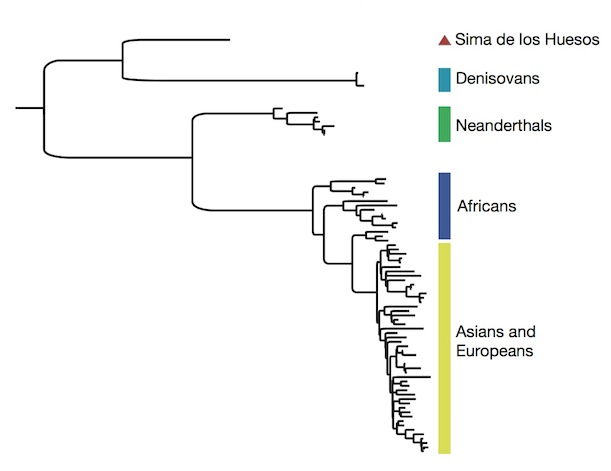
A DNA analysis of a 400,000-year-old femur from the Sima de los Huesos excavation site in northern Spain revealed an evolutionary surprise. Carl Zimmer explains (NYT) :

In a paper in the journal Nature, scientists reported Wednesday that they had retrieved ancient human DNA from a fossil dating back about 400,000 years, shattering the previous record of 100,000 years. The fossil, a thigh bone found in Spain, had previously seemed to many experts to belong to a forerunner of Neanderthals. But its DNA tells a very different story. It most closely resembles DNA from an enigmatic lineage of humans known as Denisovans. Until now, Denisovans were known only from DNA retrieved from 80,000-year-old remains in Siberia, 4,000 miles east of where the new DNA was found. The mismatch between the anatomical and genetic evidence surprised the scientists, who are now rethinking human evolution over the past few hundred thousand years.

Joseph Stromberg runs through various theories:

To explain how a Neanderthal-looking individual could come to have Denisovan mtDNA during this time period, the scientists present several different hypothetical scenarios. It’s possible, for instance, that the fossil in question belongs to a lineage that served as ancestors of both Neanderthals and Denisovans, or more likely, one that came after the split between the two groups (estimated to be around 1 million years ago) and was closely related to the latter but not the former. It’s also a possibility that the femur belongs to a third, different group, and that its similarities to Denisovan mtDNA are explained by either interbreeding with the Denisovans or the existence of yet another hominin lineage that bred with both Denisovans and the La Sima de los Huesos population and introduced the same mtDNA to both groups. …

For now, the researchers believe the most plausible scenario (illustrated [above]) is the femur belongs to a lineage that split off from Denisovans sometime after they diverged from the common ancestor of both Neanderthals and modern humans.

In a follow-up post, Zimmer unpacks that finding:

The combined evidence from fossils and DNA suggests that Neanderthals, Denisovans, and Homo sapiens share an ancestor that lived in Africa about 500,000 years ago. Our ancestors stayed in Africa while the ancestors of Denisovans and Neanderthals moved out to Europe and Asia. Homo sapiens evolved in Africa about 200,000 years ago, and then humans expanded out of Africa 60,000 years ago, after which they interbred with Neanderthals and Denisovans. So, yes, many people on Earth today are have direct ancestors that were Neanderthals. Some have direct ancestors that were Denisovans. But in both cases, most of these people’s ancestors were Homo sapiens.

Ewen Callaway passes along other speculation:

“I’ve got my own twist on it,” says [Chris Stringer, a palaeoanthropologist at London’s Natural History Museum], who has previously argued that the Sima de los Huesos hominins are indeed early Neanderthals (C. Stringer Evol. Anthropol. 21, 101–107; 2012). He thinks that the newly decoded mitochondrial genome may have come from another distinct group of hominins. Not far from the caves, researchers have discovered hominin bones from about 800,000 years ago that have been attributed to an archaic hominin called Homo antecessor, thought to be a European descendant of Homo erectus. Stringer proposes that this species interbred with a population that was ancestral to both Denisovans and Sima de los Huesos hominins, introducing the newly decoded mitochondrial lineage to both populations (see ‘Family mystery’).

This scenario, Stringer says, explains another oddity thrown up by the sequencing of ancient hominin DNA. As part of a widely discussed and soon-to-be-released analysis of high-quality Denisovan and Neanderthal nuclear genomes, Pääbo’s team suggests that Denisovans seem to have interbred with a mysterious hominin group (see Nature http://doi.org/p9t; 2013).

The situation will become clearer if Pääbo’s team can eke nuclear DNA out of the bones from the Sima de los Huesos hominins, which his team hopes to achieve within a year or so.

The Stigma Of “Diet Doctors”

There’s evidence that FDA-approved diet drugs actually work, so why don’t physicians prescribe them very often? The answer may have to do with our complicated views about obesity:

Obesity is potentially, in part, a neurological disease. Jeffrey Flier, an endocrinologist and dean of Harvard Medical School, has shown, like others, that repeatedly eating more calories than you burn can damage the hypothalamus, an area of the brain involved in eating and satiety. In other words, Big Gulps, Cinnabons, and Whoppers have altered our brains such that many people—particularly those with a genetic predisposition to obesity—find fattening foods all but impossible to resist once they’ve eaten enough of them. Louis J. Aronne, director of the Comprehensive Weight Control Program at New York-Presbyterian/Weill Cornell Medical Center, explained to me, “With so much calorie-dense food available, the hypothalamic neurons get overloaded and the brain can’t tell how much body fat is already stored. The response is to try to store more fat. So there’s very strong scientific evidence that obesity is not about people lacking willpower.”

But this message has not found its way into society, where obese people are still often considered self-indulgent and lazy, and face widespread discrimination.

Several obesity experts told me they’ve encountered doctors who confide that they just didn’t like fat people and don’t enjoy taking care of them. Even doctors who treat obese patients feel stigmatized: “diet doctor” is not a flattering term. Donna Ryan, who switched from oncology to obesity medicine many years ago, recalls her colleagues’ surprise. “I had respect,” she says. “I was treating leukemia!”

George Bray … of the Pennington Biomedical Research Center, thinks that socioeconomic factors play into physicians’ lack of enthusiasm for treating obesity. Bray points to the work of Adam Drewnowski at the University of Washington, who has shown that obesity is, disproportionately, a disease of poverty. Because of this association, many erroneously see obesity as more of a social condition than a medical one, a condition that simply requires people to try harder. Bray said, “If you believe that obesity would be cured if people just pushed themselves away from the table, then why do you want to prescribe drugs for this non-disease, this ‘moral issue’? I think that belief permeates a lot of the medical field.”

The recent Dish thread on weight loss is here.

Where Government Is And Isn’t Gridlocked

This Congress has been among the least productive ever:

Laws by Congress

Why this has happened:

Polarization is important but I would argue that it should take a back seat to another explanation: inter-chamber disagreement. Research has shown that House and Senate ideological differences are probably the most important indicators of gridlock. Even in instances of unified congressional control policy differences between the chambers can significant increase gridlock. In Binder’s book, Stalemate, she illustrates that bipartisan context is the largest substantive indicator of gridlock and productivity – outperforming both polarization and traditional divided government. The further the chambers are from one another, the more difficult it is for Congress to pass bills.

The state level is a very different story:

[S]tatehouses are the place to watch the battles that will be dominating the country’s political discussions in the coming years. Health care reform, campaign finance laws, gun ownership rules and other contentious political issues all started at the state level before they became subjects of national debate. This is why state governments have often been referred to as laboratories of democracy: They are the testing grounds for new ideas.

One of the main reasons those laboratories have been so busy lately is that the 2012 elections produced a record number of state governments under single-party control. As The New York Times reported, there are now the fewest states with mixed-party governments (split-chamber control or a governor of one party and a legislature of another) since 1952. According to Governing magazine, which reports on state governments, one party controls both legislative chambers in 43 states — the most since 1944.

Why this is important:

One consequence of all this activity is that life in one state is starting to look really different from life in the next state over. If you are considering moving to another state for a job, you need to pay attention to the public-policy climate of that state more than you used to. If you want access to Medicaid to help pay for your health care, if you are gay and want to enjoy marriage and parenthood, if you are Latino and are concerned about being harassed as a possible undocumented immigrant, if you want your teenage daughter to have full access to reproductive health services — or not — politics is not just a distant Capitol Hill exercise. It is something that will materially and directly affect your life.

Where Space Aliens Are More Believable Than Climate Change

The GOP-controlled House:

Lawmakers held a free-ranging and sometimes bewilderment-inducing hearing Wednesday on the search for extra­terrestrial life, gradually working around to the question of whether humans are alone in the universe. At the end of the 90-minute session, that issue remained unresolved. Called “Astrobiology: The Search for Biosignatures in Our Solar System and Beyond,” the House Science Committee’s hearing featured three PhD-credentialed witnesses who are prominent in a scientific field that once was considered speculative.

Rebecca Leber rolls her eyes:

Rep. Lamar Smith (R-TX), House Chair of the Science, Space, and Technology Committee, has no tolerance for climate change science but he is willing to talk about aliens. … One day before discussing extraterrestrials, Smith blasted the Environmental Protection Agency’s rules for carbon pollution from new power plants for lacking scientific grounds. In a letter to the EPA, Smith wrote that the proposed standards are “based more on partisan politics than sound science.”

Still, George Dvorksy describes the hearing as “refreshingly pro-science,” while Alex Rogers notes that “rarely in this Congress are there moments of childlike wonder, and members seemed to enjoy the break from partisan sniping.” Meanwhile, committee chair Lamar Smith noted that space exploration “attracts bipartisan interest and bipartisan support,” leading Tom McCarthy to dub outer space “the ultimate purple state.” Abby Ohlheiser defended the hearing as “the best thing Congress has done in months”:

Because the House has just seven days of work left before the end of the year, this hearing idea has generated some pretty harsh criticism. But laments about an unproductive Congress finding time to look for aliens of all things are sadly misguided. [The] hearing is a great idea, and it’s doing something remarkable: getting the Republican-led, scientifically challenged committee to seriously discuss an important field of research – and the funding needed to keep it going. So stop making fun of it.

She adds:

The subject matter of the hearing was so cool, it seems, that the Republican committee members forgot to grill the panelists on why it deserves money in the budget at all. Rep. Chris Stewart, a Republican, asked the scientists “Let’s assume that we find life? What do we do then? How does that change things with us in the way we view ourselves?” Rep. Bill Posey, also a Republican, noted, “You’ve pretty much indicated life on other planets is inevitable. It’s just a matter of time and funding.” … These are not the most sophisticated questions and statements in the world. But they are exciting ones, and ones that betray a curiosity and engagement with what science does that is not customarily seen in this wing of Congress.