Why Was Orwell A Socialist?

Reviewing the recently released Orwell: A Life in Letters, David Pryce-Jones bizarrely calls the question “a puzzle that none of his biographers or critics have been able to solve.” His own answer? That a “sense of enjoying unfair advantages was enough to make rebels of a good number of Eton scholars,” including Orwell, which led to the “social masochism” that Pryce-Jones goes on to describe:

In the intensive effort to be déclassé, he well and truly put himself through it. Changing his real name of Eric Blair to George Orwell OrwellBurmaPassportsuggests the manufacture of a new and different personality fit for writing. A disturbing glee emerges from the accounts he gives of the hack journalism and flawed novels he is obliged to publish, all the while sinking lower and lower among down and outs. Cheap housing, grime and dirt, bad smells, and horrible duties in a kitchen are to him what country house settings and their trappings were to Jane Austen. Describing how close to death he was at one point in a Paris hospital, he makes sure that the reader is more attentive to the slumminess of the ordeal rather than the fact of his survival.

Uncomfortable and deprived of basic amenities, the houses he lived in were riddled with health hazards to someone with chronically weak lungs. Wherever he settled in the countryside, he set about growing vegetables and raising hens—Was this out of a genuine feel for nature, or role-playing about being poor and needy? Did he enjoy fishing for the sport, or because it is supposed to be how English proletarians spent their leisure time? As to money, he wrote to his friend the social anthropologist Geoffrey Gorer, “it will always be hand to mouth as I don’t see myself ever writing a best-seller.” Meeting up with him, [Cyril] Connolly was appalled that hardship had left “ravaged grooves that ran from cheek to chin” on his old school-friend’s face.

And, of course, he died far too young of untreated bouts of pneumonia that all but destroyed his lungs. But Pryce-Jones, I think, is being absurdly obtuse. There’s no mystery here at all. Orwell made it plain why he was a socialist in countless articles and reviews and books.

He viewed capitalism as horribly predatory for the poor and cared about them; he believed that ending private education could reduce all the quotidian cruelties that a rigid class system entails; he felt that only socialism could truly face down fascism; he was still naive enough to want to abolish the stock exchange because he wanted an economy that benefited the many and not the few; he passionately supported a robust welfare state on the lines of the post-war Labour government out of a patriotic love of his fellow countrymen and women. He despised Toryism, privilege and jingoism in all their manifestations. He was also, of course, a serious anti-Communist, which is why some now on the neoconservative right cannot fathom him.

Above all, I think, he believed that class numbed people to the lives of their fellow citizens. It wasn’t masochism that prompted him to slum it in London and Paris; it was a desire to understand what was actually going on by living more fully on the margins and writing about it with candor and freshness. His project was the fore-runner of the new journalism, as well as so much else. I don’t share Orwell’s socialism a bit, even though it is much more understandable from the viewpoint of someone surviving the 1930s and the war than it would be today. But I love him despite that, even as I read him in my Thatcherite teens. Because he was so much more than ideology. And so much more than just a writer.

Previous Dish on Orwell’s letters here.

Racism Isn’t Over

That tweet reminds me again of how anti-Christian contemporary Republicanism is. The notion that racism can “end” misreads a core Christian truth about human nature. Our vulnerability to hatred, condescension, fear of others, resentment, and generalizations about “the other” are intrinsic to what it means to be human. Racism, like greed or envy or pride, will never end. We are all always susceptible to these flaws, to what Christians have called “original sin,” and which is perhaps better expressed in the concept of the “The Human Propensity To Fuck Things Up.” Of course, these core sentiments that are part of our primate inheritance can wax and wane, they can be unleashed or restrained, and they can be instantiated in institutions and laws and customs, or not. But hatred is for ever. It knows no geographical or historical boundaries. It is intrinsic to being human, which means it is intrinsic to being American.

What Parks and so many others did was chip away at the legal architecture of institutionalized hatred and loathing. This matters – because we humans are an impressionable herd and can be encouraged to acts and thoughts of great evil by authoritative permission. So slavery was not just an evil in itself; but an incalculable fomenter of evil. Ditto segregation.

Ending these abominations can severely reduce the lazy hatred of tribe for the other – but they will never extinguish it from the human soul. The same should be said for ending the legal architecture that kept gay people in the category of “the other”. I have no illusions whatsoever that gay kids will ever be free from the taunts of others – because they are so very different at a time in life when groupthink is so overwhelming and cruel. Which is why the only long-term effective response to these hatreds is forgiveness, not revenge, to escape the cycle by self-esteem, not more anger, however justified. Eradicating hatred is a utopian folly, still entertained on the left (as in the absurdity of hate crime laws), but now also embraced by the right as a way to deny any power to history or to the fallenness of humankind. It is a Christian heresy. Which is why it has taken root in today’s “exceptionalist” far right.

For them, simply being American is itself absolution from sin. I remember once hearing Newt Gingrich actually claim that America had abolished envy. He was serious. And how can one forget that Michele Bachmann truly believed that the Founding Fathers ended slavery in their lifetimes? Once a country has replaced God as an object of worship, it can, of course, do no wrong. And history must be rewritten to account for that. This is a fantasy and a lie, and conservatism, properly speaking, should have nothing to do with it.

How Obamacare Will Reshape American Politics

The last two days have apparently seen a surge in ACA enrollments on Healthcare.gov – in two days as many new Obamacare beneficiaries as in the whole of October. David Corn sees Obamacare’s introduction as make or break for both parties:

[W]ithin months, it may well be that abstract arguments over the nature of Obamacare will be trumped by the realities of the Affordable Care Act. Eventually, there will be stats and facts to consider: how many people receive insurance through the exchanges, what happens with premiums, the direction of health care costs, customer satisfaction, and the like. Though the results may be open to debate for a while, it is distinctly possible that one side or the other will be proven right (or wrong). If the website functions, President Obama Visits Boston To Talk About Health Caremillions sign up, and the health care market doesn’t crash, and premiums don’t zoom up—and this will be on top of the already existing benefits of Obamacare, including removing preexisting conditions restraints, allowing young adults to remain on their parents’ policies, reducing out-of-pocket prescription drug costs for seniors, and forcing insurance companies to devote a higher percentage of premiums to health care coverage—where will the Republicans be? Not only will they be failed doomsayers; they will have lost the No. 1 item on their why-you-should-vote-GOP list. Their anti-government crusade will be derailed. They will be a train without a motor.

Should Obamacare not work, then Obama’s vision—which reflects the progressive tradition of the past century—will be a flat tire. He will no longer be able to advance the cause of government activism. Expand Head Start? Create an infrastructure bank? Why should government be allowed (or trusted) to increase its reach? He can talk about helping the middle class. But how? The failed rollout of the website was a problem in so many ways but especially because it suggested that government cannot perform competently. A more extensive failure with Obamacare would suggest that government cannot be used in the manner Obama wishes to see it utilized.

What’s at stake in this never-ending debate over Obamacare are the foundational premises of each party. The success of Obamacare could be close to a death blow to the GOP. Ditto for Obamacare and the Democrats, should it collapse.

Yes and no. I don’t really want to see government expand from its current size and cost and ambition. I’m not a progressive and backed Obama because of his pragmatism. The reason I support the ACA is partly moral – if I can’t in good conscience employ anyone without health insurance, I can’t in good conscience acquiesce to a system that leaves millions out in the cold; part fiscal – I don’t believe in free-riding and see the need to reform a system that has close to no effective cost controls; and part because of all the possible proposals to end the cruelties of the past – bankrupting people with pre-existing conditions, yanking insurance from people just when they need it – Obamacare squares the most circles. So I wouldn’t mind very much if Obamacare both addressed these core problems better than the past and nonetheless prevented liberalism from going after any more lofty progressive objectives. In fact, that would be my ideal result. But, of course, I may be a parish of one again.

Drum, for his part, is optimistic for his side:

By the middle of 2014, Obamacare is going to have a huge client base; it will be working pretty well; and it will be increasingly obvious that the disaster scenarios have been overblown. People with employer health care will still have it and very few will notice even a minor change in their normal routine.

Given all this, it’s hard to see Obamacare being a huge campaign winner. For that, you need people with grievances, and the GOP is unlikely to find them in large enough numbers. The currently covered will stay covered. Doctors and hospitals will be treating more patients. Obamacare’s taxes don’t touch anyone with an income less than $200,000. Aside from the tea partiers who object on the usual abstract grounds that Obamacare is a liberty-crushing Stalinesque takeover of the medical industry, it’s going to be hard to gin up a huge amount of opposition. And that’s doubly true since, as Sargent says, the Republican Party will have no credible alternative for a benefit that lots of people will already be getting.

Bernstein expects Obamacare to eventually fade away as an issue:

That doesn’t mean that health care won’t be an issue. Expect, for example, Republicans to eventually fight over subsidy levels (and, perhaps, both parties to try to refashion subsidies to avoid perverse incentives on earnings). Expect, too, Republicans to eventually try to reduce ACA-connected taxes. There’s been some of that, but so far it’s mostly been restricted to things that could be outright repealed. Expect, too, plenty of oversight by this and future Congresses over all phases of it. After all, there’s more to oversee now.

The point is that even as the debate about “Obamacare” eventually fades away, we shouldn’t expect health care to vanish as an issue. Indeed: expect it to be more central to U.S. politics going forward.

The Cheney Principle

Reviewing a number of new books on Machiavelli, Michael Ignatieff argues that the author of The Prince was “hardly the first theorist to maintain that politics is a ruthless business, requiring leaders to do things their private conscience might abhor.” So what set him apart?

He believed not only that politicians must do evil in the name of the public good, but also that Pope Francis Meets Russian President Vladimir Putinthey shouldn’t worry about it. He was unconcerned, in other words, with what modern thinkers call the problem of dirty hands. The great Princeton philosopher Michael Walzer, borrowing from Jean-Paul Sartre, describes the feeling of having dirty hands in politics as the guilty conscience that political actors must live with when they authorize acts that public necessity requires but private morality rejects. “Here is the moral politician,” Walzer says: “it is by his dirty hands that we know him.”

Walzer thinks that we want our politicians to be suffering servants, lying awake at night, wrestling with the conflict between private morality and the public good. Machiavelli simply didn’t believe that politicians should be bothered about their dirty hands. He didn’t believe they deserve praise for moral scruple or the pangs of conscience. He would have agreed with The Sopranos: sometimes you do what you have to do.

But The Prince would hardly have survived this long if it was nothing more than an apologia for gangsters.

With gangsters, gratuitous cruelty is often efficient, while in politics, Machiavelli clearly understood, it is worse than a crime. It is a mistake. Ragion di stato [reason of state] ought to discipline each politician’s descent into morally questionable realms. A leader guided by public necessity is less likely to be cruel and vicious than one guided by religious moralizing. Machiavelli’s ethics, it should be said, were scathingly indifferent to Christian principle, and for good reason. After all, someone who believes he has God on his side is capable of anything.

In other words, Machiavelli’s innovation was not to teach evil, but to remind us that agonizing over it was the real mistake:

He insisted that when tough or risky political decisions have to be made, Christian charity or private empathy simply will not serve. In politics, the polestar must be the health of the republic alone. Following the querulous inner voice or tacking to and fro when moralizers on the sidelines object is just weakness, and if your hesitations put the republic at risk, it is contemptible weakness. Machiavelli’s ethics valued judicious decisiveness in politics over the anguished search for rectitude.

He was the original person who regarded torture, for example, the same way that Dick Cheney did: as “a no-brainer.” Previous Dish on Machiavelli here, here, and here. A reader adds:

I’ve always loved this statue of Machiavelli in Florence, and it’s the very first thing that came to mind when I saw your FOTD of Putin [seen above, via Getty].

The Culture War’s New Front

Beutler compares Obamacare to abortion:

An astute friend remarked to me on Tuesday that the GOP’s position on Obamacare is coming to resemble its position on abortion in one key way: loudly, consistently, uniformly opposed, but ultimately not really driven to eliminate it. The backlash they’d face would be brutal, but they might stand to gain by fighting it on the margins and keeping the issue alive.

The comparison holds at a state level too. The most effective Obamacare saboteurs have been GOP governors and legislatures who resisted the opportunity to create their own exchanges and have refused to expand Medicaid with federal dollars, as the law allows.

More generally, conservatives are wielding Obamacare the way they wielded culture war issues in the 1990s. The particulars are enormously different, but the political objectives are similar: pick an issue that both unites conservative voters and appeals to the discontent of moderates and use it first and foremost to fracture the Democratic coalition.

I don’t think they’re going to fracture the Democratic coalition. But I can imagine the issue remaining an effective mobilizing tool for an otherwise agenda-less party through the end of Obama’s presidency.

The Truthiness Of Buzzfeed

Over Thanksgiving, TV producer Elan Gale live-tweeted a lengthy, outrageous confrontation with a fellow airplane passenger. It became a viral sensation, understandably amped up by Buzzfeed’s viral algorithms. Pity the entire thing was a complete hoax, designed, according to Gale, to prove that whether something is, you know, true or not matters little in the era of lucrative viral posts. He got his proof. Buzzfeed got 1.3 million pageviews on the hoax. Which is why I’m relieved that Dave Weigel is happy to take a tiny bit of time to wonder why no one checked the story at Buzzfeed, and when the hoax became obvious, why they simply switched out their previous story with another post praising the “epic” scam. Weigel notes:

This is fairly fucked. Yes, people on the Internet want to believe salacious stories. Reporters want to publish stories that people read. If there’s a great reward, and little downside, to be had in publishing bullshit, the Internet’s going to get more bullshit. As one of my colleagues put it, “‘Too good to check’ used to be a warning to newspaper editors not to jump on bullshit stories. Now it’s a business model.”

It sure is – and, along with advertizing deliberately designed to deceive readers into thinking it’s editorial, it could bring $120 million in revenue next year for the entertainment and public relations site. In due course, it appears Buzzfeed came up with a response to Dave. Money quote from BuzzFeed news director Lisa Tozzi:

We used the word “claiming” to describe Elan’s tweets, and updated our post several times as it appeared to unfold—but we should have make that skepticism clearer. We’re not in the business of publishing hoaxes and we feel an enormous responsibility here to provide our readers with accurate, up-to-date information.

Well that’s a relief, until you think some more about it. By gleefully running unchecked hoaxes, and then insisting that they really do care about truth, Buzzfeed muddies the waters still further.  What’s striking to me about Buzzfeed is that they haven’t really sufficiently thought through what it means to deliberately deceive readers by running advertizing as editorial, or what it means to be both an instant entertainment provider whose success is measured in jumping on viral waves seconds before their competitors, and to claim to be journalism.

In trying to be both under one brand, they are unwittingly doing a lot of damage both to a generation’s core understanding of what journalism actually is – the viral hoax was “reported” by “reporter” Rachel Zarrell – and to any understanding of how journalism is any different from copy-writing.

There are many excellent reporters at Buzzfeed doing their best, which is often very good. I don’t like writing posts like this that may seem to them like personal attacks. They’re really not. All I can say is that I don’t think they have fully grasped how being part of an entertainment/public relations site whose core mission is making money can in any way be compatible with the profession formerly known as journalism. Just because you wish it to be so does not make it so. Only when they put their actual journalism in a clearly separate space than their entertainment, and only when they stop deliberately blurring advertizing with editorial, will they be able to retain a journalistic soul. But that, of course, would end their business model entirely.

Previous Dish on the Buzzfeed model here, here, here and here.

A Prescription For Bad Medicine

Theresa Brown points out that “every drug with two names — and that means practically every drug in use — is a medication error waiting to happen”:

[W]e have recently seen a proliferation of look-alike, sound-alike meds. For example: Zantac is used to treat heartburn, while Xanax is an anti-anxiety medication. A list of these sound-alikes fills a full eight pages on the Institute of Safe Medication Practices website. Data on medication errors is not collected systematically in the United States, so it is impossible to say accurately how many errors result from such confusion. Whatever the number, and the attendant misery the most serious mistakes generate, it seems undeniable that the potential for error is increased by the dual naming of all drugs.

Her suggestion:

All drugs now being sold could use either their brand name or the generic name. That name, and the manufacture of that medication, would be patent-protected for 20 years. Thereafter, any other producer of that drug would append it with a “-G,” indicating that it is a generic formulation. Acetaminophen sold as a generic would become Acetaminophen-G, and Plavix, a brand name blood thinner, would be sold as Plavix-G in its generic form. Combination drugs like the brand name inhaler Duoneb might have to use generic names (albuterol and ipratropium) to avoid confusion.

The End Of DIY DNA Testing? Ctd

A reader writes:

I wonder how many folks, like me, had thought about buying the 23andme kit, hadn’t gotten around to it, and now, because of all the recent FDA publicity and worried they might miss the opportunity, went ahead and submitted their order. My kit should arrive in the mail today, and I plan to get it back to them ASAP, because I suspect they have received a flood of orders, thanks to the FDA. Because the genealogy part of the results are also those of my three sisters, they will be receiving those results from me as their belated Christmas gift.

Another gets an uneasy feeling:

I want to bring up another angle that I think has been under-appreciated. Anne Wojcicki, a co-founder of 23andMe, is married to Sergey Brin of Google (although they are now separated). Her sister Susan is Google’s director of marketing, and was also the person who rented her garage to Larry and Sergey when they started the company. Why is this important? Because 23andMe collects genetic data from people, along with their family and medical histories.

In a recent interview, Wojcicki said they hoped to reach a million customers by next year. Their stated business plan includes using this genetic data to find associations between genes and diseases. To my knowledge, no other entity can come close to amassing this amount of data, and people are voluntarily giving it to them as part of the service. To me, the $99 testing service is almost an inconsequential part of their business. It simply allows them to collect the data and turn it into biomedical discoveries. Despite the recent Supreme Court ruling that genes cannot be patented, there is still plenty of room to monetize therapies using this approach. All they need is a partner with the ability to process huge amounts of data and extract relevant gene/disease associations, and with Google they would have that. Presumably customers’ identities are kept private, and the data are analyzed anonymously. But of course there is always the concern that with big data, nothing is truly anonymous.

Update from another:

One thing that most people probably don’t realize is that the genetic information that 23andMe collects is not covered by federal healthcare privacy laws (HIPAA) because 23andMe’s customers pay out of pocket. For HIPAA to apply, the healthcare provider has to bill for reimbursement electronically. There are probably state laws that apply, but there is not federal protection for that information.

Why Polio Is So Hard To Wipe Out

Afghanistan Struggles to Eradicate Polio

Matthieu Aikins investigates the “all-out, very expensive effort to eliminate the last few problem areas in some of the most troubled and undeveloped parts of the final three countries where polio is endemic: Afghanistan, Pakistan, and Nigeria”:

The poliomyelitis virus has likely been living with humans for millennia. Archaeological excavations of prehistoric burial grounds, as well as paintings in ancient Egyptian monuments, show limb paralysis that is probably the result of polio. The virus, part of the enterovirus genus, is extremely contagious and spreads through two routes—oral-oral, through saliva, or more commonly fecal-oral, like when an infected person’s feces contaminate the water supply. In the crowded, unsanitary cities of antiquity and medieval times, this meant that virtually everyone would have been exposed to the virus in childhood. For most people, this wasn’t a problem:

The virus typically infects only the mucosal tissues of the gastrointestinal system for a few weeks, where the immune system clears it before any harm is done. After that, the infected person would be immune to future infections from the same strain. However, in less than 1 percent of infections, the virus attacks the central nervous system and causes paralysis. Typically this affects just the legs. But in 5 to 10 percent of paralytic cases (that is, 0.05 percent of total infections), polio paralyzes the breathing muscles, meaning that without artificial respiration the patient will suffocate.

All this explains why polio is so difficult to annihilate. For every one person who actually gets sick, nearly 200 are carrying the virus and infecting others.

(Photo: Fawad Rahmani, 11, makes his way home using his crutches and special braces fitted from the ICRC Orthopedic clinic in Kabul, Afghanistan on September 26, 2009. Fawad has had polio since he was two years old. Health care is one of many problems facing Afghanistan, eight years after the war began to oust the Taliban regime, even as the country receives billions of dollars in international aid. Afghanistan is still fighting to eradicate polio to which they are one of the few countries still dealing with the disease. Earlier this month UNICEF launched an immunization campaign targeting 1.2 million children with an aim is to immunize every child under five. By Paula Bronstein/Getty Images)

“The Highest-Luxury Goods Man Has Ever Known”

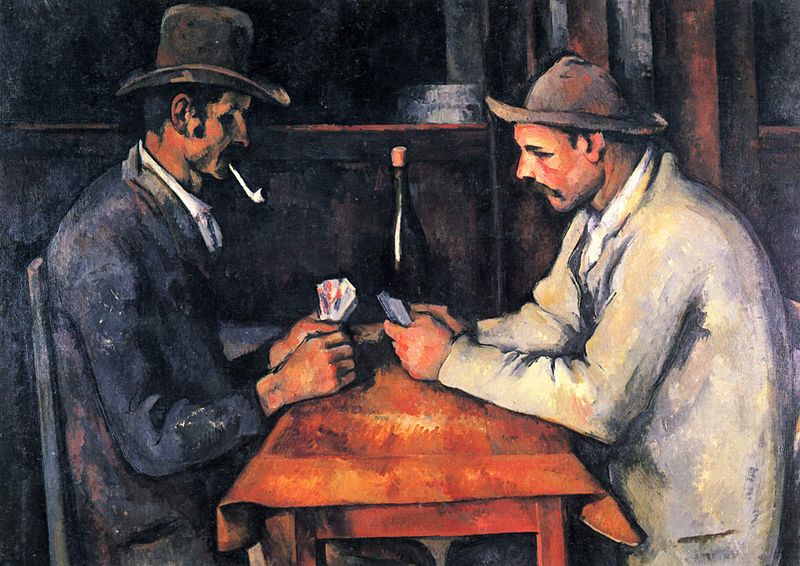
800px-Paul_Cézanne_222

Nick Paumgarten dives deep into the forces driving up the prices of fine art:

You meet a lot of people in the art world who are exhausted and dismayed by the focus on money, and by its dominance. It distracts from the work, they say. It distorts curatorial instincts, critical appraisals, and young artists’ careers. It scares away civilians, who begin to lump art in with other symptoms of excess and dismiss it as another garish plaything of the rich. Of course, many of those who complain—dealers, artists, curators—are complicit. The culture industry, which supports them in one way or another, and which hardly existed a generation ago, subsists on all that money—mostly on the largesse and folly of wealthy art lovers, whether their motivations are lofty or base.

Since the doldrums of the early nineties, the market for contemporary art, which has various definitions (work created after the Second World War, or during “our” lifetime, or post-1960, or post-1970), has rocketed up, year after year, flattening out briefly amid the financial crisis and global recession of 2008-09, before resuming its climb. Big annual returns have attracted more people to buying art, which has raised prices further. It is no coincidence that this steep rise, in recent decades, coincides with the increasing financialization of the world economy. The accumulation of greater wealth in the hands of a smaller percentage of the world’s population has created immense fortunes with a limitless capacity to pursue a limited supply of art work. The globalization of the art market—the interest in contemporary art among newly wealthy Asians, Latin Americans, Arabs, and Russians—has furnished it with scores of new buyers, and perhaps fresh supplies of greater fools. Once you have hundreds of millions of dollars, it’s hard to know where to put it all. Art is transportable, unregulated, glamorous, arcane, beautiful, difficult. It is easier to store than oil, more esoteric than diamonds, more durable than political influence. Its elusive valuation makes it conducive to extremely creative tax accounting.

(Painting: The Card Players by Paul Cézanne, purchased for more than $250 million in 2011, making it the most expensive painting ever sold. A list here.)