Did Jackie Not Want Her Story Told?

Rape survivor Jade Reindl argues that “Jackie”, the victim at the center of Sabrina Rudin Erdely’s disputed Rolling Stone piece about rape at the University of Virginia, was violated a second time when she asked Erdely to remove her from the story and Erdely refused:

Here’s the thing about rape that most people seem to get: it’s violating. It requires a lack of consent. It’s an event full of pain and regret. Here’s the thing about sharing a rape victim’s story without their permission that most people don’t seem to get: It’s violating. It requires a lack of consent. It’s an event full of pain and regret.

If someone agreed to have sex with you earlier in the day, but when it came time to actually do it they no longer consented, and you had sex with them anyway, was it rape? When you share the story of a rape victim without her consent, even if she formerly consented, it is a complete re-violation of her personal space and narrative. It doesn’t matter why Jackie, the subject of Rolling Stone’s article about UVA and sexual assault, later retracted her statements. And the aim of this article is not to justify or analyze her hesitation. What I’m saying is this: By publishing an article that the victim retracted her support of, Rolling Stone essentially violated Jackie, and every other survivor, all over again.

Sarah Kliff also considers this an ethical violation on Erdely’s part:

Publishing a story about a rape victim against her will is dangerous, and arguably unethical, journalism.

It goes completely against the DART Center for Journalism and Trauma, a respected advisory group at Columbia University’s Journalism School, guidelines for how to report on sexual assault. There is an entire section that directs reporters to “respect a potential interviewee’s right to say no.”

“Be fair and realistic. Don’t coerce, cajole, trick or offer remuneration,” the guidelines instruct. If Rolling Stone published the story against Jackie’s will, that is a terrible mistake on the magazine’s part — and a violation of the ethical guidelines reporters should follow when reporting difficult, and sensitive stories about rape. And it’s coupled with the fact that Rolling Stone didn’t track down the accused rapists.

In Hanna Rosin’s view, in a post we noted last night, one of Erdely’s biggest errors was in making a promise to Jackie that she, as a journalist, should not have kept:

Jackie told the Post that she felt “manipulated” by Erdely. She said that she was “overwhelmed” by sitting through interviews with her and asked to be taken out of the story, but Erdely said it would go forward anyway. Jackie said she “felt completely out of control of my own story.” Erdely has implied that she made an agreement with Jackie that she would tell her story but not try to contact her assailants. Rolling Stone explained in their statement today: “Because of the sensitive nature of Jackie’s story, we decided to honor her request not to contact the man she claimed orchestrated the attack on her nor any of the men she claimed participated in the attack for fear of retaliation against her.”

Such agreements are apparently not uncommon. In survivors’ groups, advocates advise victims to strike these kinds of deals with reporters so they don’t lose control of their own stories, or anger their assailants, both of which they consider paramount to healing. But this creates an impossible situation for journalists: Ask too many questions and you lose your source. But don’t ask enough and you end up in this situation, with a story that’s falling apart.

But what really puzzles Rosin is that the account Jackie’s friends gave to the WaPo last week, though very different from the one Jackie told Erdely, was more than horrible enough to get the point across:

The baffling thing here is, if what Jackie told Andy is true, that would have made an explosive enough story about campus sexual violence. A group of men force a freshman to perform oral sex. She reports it to the university and they don’t investigate. That’s a disturbing story. But if Andy is to be believed, that means Jackie told an exaggerated story to Erdely, and that Erdely was all too happy to create an even more perfect victim, one who was brutally gang raped and then left at the curb by her so called friends, thus further traumatizing her, and leaving her to fend for herself in a culture too backward for progressive thought.

Too-good-to-leave-unembellished. Libby Nelson wonders if Jackie was properly informed of what she was getting herself into:

If a journalist were completely honest with a source about what it means to be interviewed for this sort of story, it would go something like this: you are going to tell me about the worst day of your life, because you think there is value in sharing that story with the rest of the world. You need to trust me, but you need to know I am not your friend. I will seem as sympathetic as I can be, but I will also note the exact moment you start crying so I can write about it. I will ask questions that might make you uncomfortable. I will call other people and tell them what you’re saying about them. I will open you up to the judgment of the entire world. And then I will walk away. And if you aren’t ready to deal with that, you shouldn’t talk to me.

I don’t know if anyone would consent to that. And I don’t know if I could really shoot myself in the foot with that much honesty. No decent human wants to appear to doubt the word of a rape victim. But if you don’t do that work in private, you make it that much easier for the rest of the world to do it in public. That’s what Rolling Stone — and Jackie — are about to learn.

Like Rosin, Peter Suderman suspects Erdely of erasing the line between journalism and advocacy:

Advocates for rape victims and sexual assault awareness understandably tend to prioritize support, communication, and community building; they do not have a great responsibility to doubt, to verify, and to rigorously check all the minute details of the accounts they hear or share. But journalists do. To be sure, this sort of checking is almost always difficult, time-consuming, and stressful. Inevitably, some mistakes will be made (I’ve certainly made a few regretful errors of my own). There are tradeoffs between time and accuracy. But the more sensational the story, the more shocking and potentially consequential its allegations, the more that effort is necessary—especially with a long-form account that is not under the pressures and deadlines of daily journalism, and especially when the subject and major source of the story tries to back out, as Jackie apparently did.

The way Morrissey sees it, that’s the core of the problem:

[T]he damage wasn’t limited to just “Jackie.” The fraternities at UVa got shut down for no good reason, the one fraternity named got vandalized on top of that, and several men came under suspicion for a crime that they not only didn’t commit but maynot have happened at all. That is what happens when activists hijack journalism to further their agenda at the expense of the truth, a value which clearly wasn’t a high priority for either Erdely or anyone at Rolling Stone. If the truth had been their agenda, they would have doubled their efforts to make sure their story was solid, rather than simply act as stenographers for someone who told Erdely what she not only wanted to hear, but actively campaigned to find.

Natasha Vargas-Cooper, on the other hand, blames Rolling Stone and the magazine industry writ large for preferring sensationalism over facts:

There are few industries as cynical and craven as magazine publishing. They love a good sex scandal or true crime story. You can watch out for the next longform piece of a college campus rape story that’s corroborated. Do not believe for A SECOND that Rolling Stone did not speak to alleged rapists because they were trying to be “sensitive”. It was because they were abiding by a bad promise they made to “Jackie” to not contact her alleged assailants. If they did contact those supposed assailants, they would lose a sensational and lurid first person account of a gang rape. If Jackie rescinded her claims, then the magazine would lose its hook to lure readers into a story about the much-reported — and possibly inflated — “epidemic” of sexual assaults on campus.

Where Are The Sugar-Daddies Of Yore?

unnamed-2

Chris Hughes wants to turn a profit:

At the heart of the conflict of the past few days is a divergent view on how the New Republic — and journalism more broadly — will survive. In one view, it is a “public trust” and not a business. It is something greater than a commercial enterprise, ineffable, an ideal that cannot be touched. Financially, it would be a charity. There is much experimentation in nonprofit journalism – ProPublica and the Texas Tribune are proving the model — and that may be the right path for certain institutions. At the New Republic, I believe we owe it to ourselves and to this institution to aim to become a sustainable business and not position ourselves to rely on the largesse of an unpredictable few. Our success is not guaranteed, but I think it’s critical to try.

This is relatively new in the history of persons of sugar. And I don’t think it’s because Hughes is somehow a different sort of mogul than those in days gone by, just that the incentives have shifted rather dramatically in a very short period of time. The truth is: when there were only a handful of magazines that had a monopoly on opinion journalism, owning one gave you a real cultural gate-keeper power. It was worth losing money for the huge gains in influence you received in return, the social status, access to the powerful and pursuit of a cause. You could shape the discourse around your pet causes, and alter and shape the debate in ways no one – outside the Kochs and liberal ad-buyers – now can. This was a bad thing in some respects – the debate about Israel, for example, was far less open and diverse than today – and a few men (and they were almost all men) really shouldn’t be able to wield that kind of influence in a democracy. But it also provided a way for great writing and sharp thinking to endure. As a simple formula, it worked. And owners were relatively happy.

Fast-forward to today and the benefits of owning TNR or the Atlantic or the Nation have all but evaporated. There is no incentive for cultural gate-keepers any more, because there are no gates to keep. Anyone with an Internet connection can reach a mass audience, and the power and prestige that once accrued to a publisher are thereby eviscerated. You end up where Hughes ended up: spending millions to fund ornery, if talented, writers, and wondering what’s in it for you. Sure, you get to interview the president once in a while. Maybe you can get Nancy Pelosi to come to your wedding. But, once that thrill is gone, what’s left … but a giant headache and a company that hemorrhages money?

In response to my hankering for the TNR of old, Dreher argues that there is “no way to be that kind of magazine today and make money. Maybe there never was”:

[W]hen people like Freddie de Boer, a true leftist, sneer from a left-wing perspective at the demise of TNR, I understand where he’s coming from and don’t begrudge him his opinion. But I think he shouldn’t be quite so confident, because the same dynamic that’s brought TNR down threatens all small magazines of opinion in this country. I would be surprised if any of us could pay our bills on subscriptions and ad sales alone. We depend on the generosity of donors — many of them wealthy and public-spirited — who believe that the work we do is important, even if it is not money-making.

Somebody said yesterday that TNR doesn’t need a better business model, it needs a better owner. Yes, exactly. I don’t know how many rich people are willing to subsidize a money-losing journalistic operation out of principle and for the common good, but we sure need to find them.

Chait makes related points in response to Ezra:

The odd thing about Klein’s column is that, other than this small disagreement about TNR’s character, I cannot find anything in it with which I disagree. He straightforwardly described the problem of highbrow magazines that serve a public-interest function and have always lost money. He proceeds from that accurate description straight to the conclusion in his headline — TNR must change — without explaining why. One could just as easily conclude that TNR will always lose money, and its value should be assessed in non-market terms and subsidized accordingly by a willing donor.

That unacknowledged leap of logic contains nearly all our disagreement. It seems to be rooted in a deep faith in the power of the free market when it comes to media. Klein has always been very explicit about his view that media functions that earn money are good …

That sort of market fundamentalism is largely associated with the political right. You can find traces of it on the center-left among the winners of the new media economy, like many otherwise-liberal winners of other sectors of the new economy. They implicitly associate success with virtue. They may understand that an institution like The New Republic creates externalities that are not captured through market value, but this factor does not intrude upon their model.

Yet the fact that TNR does not meet a market need does not mean it serves no purpose. The main thing it needed to change was its owner.

There is a middle ground, of course, and it seems to me that TNR’s staff were prepared to find it. A magazine that has no interest in paying its way becomes a sad vanity publication. But a magazine that can pay for the bulk of its operations but still needs some sugar-money to keep it afloat is a perfectly good model for a place whose standards and intellectual heft will never make it a mass publication. And it remains a good model. It’s just that few of the super-rich today really respect that model, or have even a crude interest in sustaining it.

(Image from The Federalist)

A World Awash In Cheap Oil

Michael Specter fears that low oil prices will persist:

Many environmentalists had assumed that if neither fear nor reason helped us to lessen our reliance on oil, then at least we could count on scarcity. But scarcity is not an economic or environmental policy. Humans have long had a habit of expecting the sky to fall. Yet from Malthus to Paul Ehrlich, predictions that the planet was on the verge of starvation have never come to pass (or at least not as broadly as expected). Nonetheless, the drop in oil prices comes at a terrible moment. Last month the Intergovernmental Panel on Climate Change reported that our only chance to halt the rising temperature of the Earth, and to prevent the calamity that rise will cause, would be to eliminate fossil-fuel emissions by the end of the century.

A plan to end U.S. fossil-fuel dependence would be an unlikely goal in any case, but, if oil remains easily accessible, it becomes politically impossible. “It is technically feasible to transition to a low-carbon economy,” Youba Sokona, the co-chair of one of the I.P.C.C.’s working groups, says. “But what is lacking are appropriate policies and institutions. The longer we wait to take action, the more it will cost to adapt and mitigate climate change.”

Ronald Bailey hears that oil may remain cheap:

During the last decade, even as alarums about the advent of “peak oil” grew ever more frenzied, world oil production actually increased from 77.6 million barrels per day in 2003 to 86.8 million barrels per day in 2013. Lynch’s book The “Peak Oil” Scare and the Coming Oil Flood, scheduled for publication this coming spring, predicts even larger leaps in the global production of crude. Lynch thinks world oil production will increase to around 110 million barrels per day during the next decade. In the meantime, global oil prices will hover around $60 per barrel over the next couple of years and conceivably drop to $40 per barrel in five years. At $40 per barrel, the price of oil would, in inflation-adjusted dollars, just about equal the annual average price of $17 per barrel in 1998.

I asked Lynch if this meant oil markets might be in for a replay of the price collapse that occurred in the 1980s. He replied that he thought so. In inflation-adjusted dollars, the price of oil reached its peak annual average of $106 per barrel in 1980 and then collapsed to an annual average of $30.80 per barrel in 1986.

Jordan Weissmann sees some advantages to the low prices – beyond more money in the pockets of consumers:

Right now, the band of small and midsized oil companies that have fracked their way to riches aren’t the most efficient or strategic bunch. As one executive put it in 2010, the early days of the boom were mostly driven by “brute force and ignorance” as drillers tried to get crude out of the ground as fast as possible. That approach has led to lots of poorly structured wells that quickly run dry on oil and wasted effort fracking shale deposits that don’t produce much to begin with. When prices for oil were lofty, the industry could afford to be that sloppy. With prices sinking, however, it will be forced to improve its methods. That could be good for the environment. Fracking involves pumping a toxic mix of water, chemicals, and sand into shale deposits to crack them, and the more sparingly it’s used, the fewer problems it creates. A more cautious industry could also be good for investors, who would see less of their money sunk into failed wells.

When Silicon Valley Dabbles In Journalism

In response to TNR’s implosion, Lucia Moses considers why applying tech solutions to media so often ends in tears:

“They’ve arrived from Mars with the typical arrogance of a tourist, over-noticing the wrong things,” said Jason Pontin, editor in chief and publisher of MIT Technology Review. “If there were a simple solution, smart people like me would have done it. Publishing is an extremely fidgety business with a direct cost, a base that is in many cases unwilling to pay for the product, and an indirect audience in marketers and advertisers who have found increasing efficiencies, which have driven down CPMs.”

Apart from that, it’s a great industry to work in! McArdle compares media and tech industries:

In many ways, a company such as Facebook and eBay is the opposite of a media company.

Those companies have huge network effects, and they get their content for free or nearly free. Making a lot of money out of a business like that is hard — many more attempts have failed than succeeded. But a prestige media company makes expensive content that has zero network effects; you can’t copyright a fact. In the new digital world, hours after your expensively reported story is out, dozens of other outlets will have re-reported the same facts and taken some of the traffic. Making a lot of money out of a business like that is much more difficult. Chris Hughes was not insane to think that he could make something like a New Yorker for Washington. It was, however, pretty crazy to think that you could do so without losing a bunch of money.

You need only read the stories about FirstLook and The New Republic to understand how badly tech-style management assumptions translate into media. When that approach failed, spectacular public meltdowns ensued. So the new moguls now learn another key difference about the media business: You are always being closely watched, so communications, and effective crisis management, are supremely important. A spectacular HR crisis translates more directly into loss of reputation, and sales, than it does almost anywhere else.

Drezner is in the same ballpark:

I’ve heard a lot of nonprofit sector folk complaining that Silicon Valley investors want to revolutionize their field without really understanding it.

The pattern in each of these cases is that a fabulously wealthy and successful investor enters a new and not-terribly-successful sector and tries to apply the lessons learned from the investor’s past successes to this new area. Except that there’s not a ton of evidence that those lessons are truly generalizable. One almost wonders if there is an extension of the Peter Principle for investors.

Leaving The Farm

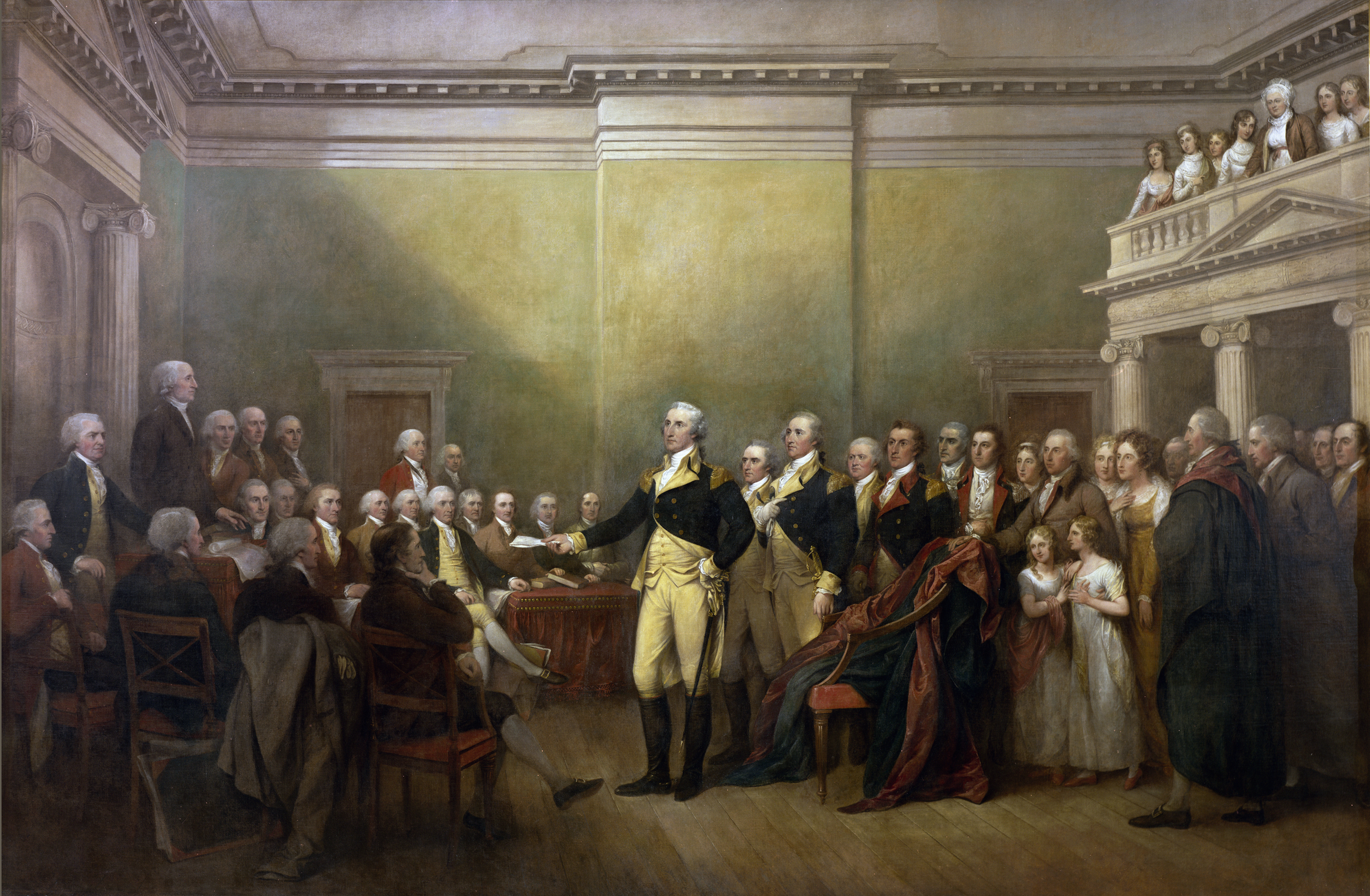
General_George_Washington_Resigning_his_Commission

Alec D. Rogers reviews Edward Larson’s The Return of George Washington: 1783-1789, a portrait of our first president from the end of the Revolutionary War until he took office. Unlike many accounts that portray “a Washington who emerges from Mount Vernon only with the greatest reluctance to play out a script written by James Madison,” Larson gives us “a much more active and politically engaged Washington, who did as much as anyone during these years to bring the new republic into being”:

[Larson] shows us how Washington’s political savvy helped ensure that the Constitution would gain acceptance. The result was a product that closely resembled what, for years, Washington had been advocating in private.

At the crux of the story, though, is Larson’s explanation for why Washington ultimately abandoned a retirement from political life that he earnestly desired.

Larson makes the case that the political class of the time was sold on the need for reform of the Articles of Confederation, and that all agreed Washington’s active support was essential. But the key connective element is Washington’s own political thought and understanding of republican duty. As Glenn Phelps has noted in his study of Washington’s constitutional thought, Washington’s concept of republicanism was that of Greece and Rome: “Republican hagiography demanded that its heroes always be willing to defend the republic against corruption and decay. As much to confirm his own virtue as to attain specific reforms, Washington determined to end his public ‘retirement.’”

In an earlier review of the book, Steve Donaghue expressed regret regarding Larson’s “unwillingness to pin down this less-than-selfless side of his hero”:

His Washington is generally a Washington of whom Washington would have approved, with the man’s baser motivations kept discreetly in the background. This extends even to the choosing of the site for the seat of the national government; Washington and Madison worked hard to make sure the location of that new capital city was on the banks of the Potomac River, near Mount Vernon. As Larson somewhat innocently reports: “It lay at the midpoint of the country’s north-south axis and, if Washington’s company could open the upper Potomac for commercial navigation, at the terminus of the main route west.” It’s about as neutrally phrased as it could be.

Rather than being motivated by grubby financial concerns, Larson’s Washington is always the dispassionate and far-sighted statesman. He refuses to comment publicly during the new constitution’s lengthy ratification process, for instance, not because his personal vanity outweighed his respect for its republican virtues, but because “the Cincinnatus ideal demanded that he not seek power and taking sides now might limit his ability to serve as a unifying leader later”.

(Image: General George Washington Resigning His Commission by John Trumbull, via Wikimedia Commons)

Keeping Excessive Punishment In Check

Reihan sketches out a plan to do so:

What government routinely fails to do is account for the costs the criminal justice system imposes on the civilians who get caught in its web. Mark A.R. Kleiman, a public policy professor at UCLA and author of When Brute Force Fails, made this point vividly in a Democracy Journal essay published last spring. Instead of fixating on the dollar costs of running the criminal justice system, he asks that we also account for “the suffering inflicted by arrest, prosecution, conviction, and incarceration, including all of the residual disabilities that go with the label ‘ex-convict,’ and the fear created by overaggressive policing.”

Imagine if, as Cardozo Law School professor Richard A. Bierschbach has suggested, we had in place a “punishment budget.”

Given such a budget, we would accept that the criminal justice system would cause some degree of suffering. At the same time, we’d insist that if you pass some measures that increase suffering in some way—say, by making more arrests—you’d have to reduce the sum total of suffering in some other way, for instance by reducing prison sentences for nonviolent offenders. This would impose a useful check on the creep of new laws, rules, and regulations that steadily increase the government’s coercive powers, as if on autopilot.

He also recommends getting “better, more reliable data on policing so that communities have a clear sense of what local law enforcement agencies are doing in their name.” Along the same lines, Josh Voorhees wants the president to “call for all law enforcement agencies to keep an accurate count of how many people the police kill each year”:

Without a formal and comprehensive reporting system, the president, lawmakers, and everyone else have no way of knowing the true scope of the problem. Even if the government is willing to believe that police officers are almost always justified when they kill suspects in the line of duty, Washington still owes the nation a full accounting of those killings that it has implicitly sanctioned. How can the president hope to limit the number of lives lost if he has no way of knowing how many lives are actually lost? How will Congress evaluate whether policies aimed at curbing police shootings are successful if it has no way of tracking the success or failure of those policies?

Buried In Berries

dish_berries

Josh Barro registers a shift in Americans’ eating habits:

According to statistics published by the United States Department of Agriculture, per capita consumption of fresh raspberries grew 475 percent from 2000 to 2012, the most recent year for which data are available. Blueberry consumption is up 411 percent, and strawberries are up 60 percent.

He notes, to his surprise, that “the main factors changing what fruits we eat are on the supply side”:

If people are eating more of some kind of fruit, it’s probably because farmers have figured out how to deliver more of it, at higher quality, throughout the year. Of course, there is the “superfood” factor:

Both raspberries and blueberries have been praised for their nutrient value. But Chris Romano, who leads global produce procurement for Whole Foods, attributes the boom in berries largely to taste and availability. “Techniques in growing raspberries, blueberries and blackberries have gotten much better over the last 15 years,” he said. Growers are planting better breeds of berry, with higher sugar content; they’re using pruning and growing techniques that extend the season, including growing berries inside greenhouse-like structures called tunnels that retain heat; and most important, they’re growing berries in places they didn’t used to, where production is possible at different times of year.

Update from a reader:

I don’t know why Josh Barro is so surprised by this. I lived in Ithaca, NY, when the farmers market got started. There were already several farms in the area where people could pick strawberries and other crops. After a few years in the 1970s, we went to one farm that had more than a one-week strawberry season. When we asked, it turned out that they were starting some berry plants earlier using protection from the weather and Canadian varieties more accustomed to cooler weather. I think they experimented with Southern varieties to extend the season later.

Over the years, vendors selling in the farmers market pushed to extend their seasons or get two seasons out of cool weather crops, including some greens, broccoli, and peas. There were probably more crops that I can’t remember or that came after we got transferred out of town. I miss the Ithaca farmers market a great deal. I was delighted to buy fresh produce that was locally grown “out of season”.

Where I live now in Pennsylvania, I see the season for fresh corn being extended through early and later planting and some careful management. But it’s also getting harder to get fresh corn right out of the field at some farm markets, which have added refrigeration facilities to hold the corn. The supersweet varieties do have pretty good quality when they’re refrigerated right away, but the ones grown locally are not candy-sweet. Frozen corn in bulk packages at grocery stores is now so sugary I can’t stand the brands I’ve tried. I’ve gone back to home freezing and otherwise avoiding corn.

The downside of all this sugaring up is that with corn and also with winter squash – at least for me – is that I don’t like eating them as much. I don’t want to eat corn that is as sweet as a banana. I want to be able to add a little brown sugar to the squash to perk up the flavor but add that molasses overtone – and acorn squash has gotten so much sweeter adding brown sugar makes it cloying. In addition, some of the squashes I used to buy seem to be unavailable. In Ithaca when I was first married, I’d bake a mixture of acorn and buttercup squash because the buttercup was drier and the combination could be run through a food mill and frozen, and the result reheated nicely and wasn’t watery. Buttercup squash, confusingly, looked more like acorns with the big cap and protruding cup-shaped base. I haven’t seen it in a farmers market or store in years.

One thing I’d like to know about the increased sale of raspberries is what the rate of waste is. I am very cautious about buying berries and inspect carefully. A fair number of packages of blueberries show a bit of white mold or squashed berries on the bottom, and blueberries are fairly sturdy compared to raspberries. Raspberries spoil really easily, so I wonder if more are discarded at the store and if more are discarded at home because of mold or other deterioration. I do appreciate getting the berries in clear plastic containers, because I can visually inspect them, but berry sales, unlike banana sales, depend on a lot of plastic – which also gives me pause.

(Photo by Flickr user swong95765)

Liberalism, Conservatism, Skepticism

Thanks to the Washington Post, Tom Maguire and Hanna Rosin, we have a glimpse of what might have actually happened to UVA’s “Jackie”:

A group of Jackie’s close friends, who are advocates at U-Va. for sex-assault awareness, said they believe that something traumatic happened to her, but they also have come to doubt her account. A student who came to Jackie’s aid the night of the alleged attack said in an interview late Friday night that she did not appear physically injured at the time but was visibly shaken and told him and two other friends that she had been at a fraternity party and had been forced to have oral sex with a group of men. They offered to get her help and she said she just wanted to return to her dorm, said the student, who spoke on the condition of anonymity because of the sensitivity of the subject.

That’s a horrific story, if it pans out. The failure of the school to investigate more assiduously remains salient. The climate for young women on a campus where many readily believed the gang-rape-broken-glass-“grab it by its leg” version does not cease to be a pressing issue. The truth could be damning enough.

So why did an inflammatory, lurid, and apparently fallacious story get into print – with only one source and no corroboration – breaking most basic journalistic rules in a serious publication? Rich Bradley is surely right: it was a too-good-to-check story that echoed what many truly wanted to hear. It managed to suggest that the “rape culture” we are now told is endemic is even worse than you could possibly imagine, and ignored in plain sight. It implicated individuals in various stigmatized groups (among many journalists and activists) – i.e. the dreaded evil trifecta of “white”, “men” and “Southern”. Its details – from the shattered glass and the beer bottle sodomy – had an irresistible allure. Questioning it was like questioning whether Saddam Hussein actually did have WMDs – it seems as if you are excusing an evil figure, or being terminally naïve, or minimizing the danger. We believe what we want to believe – and, in our public debates, we also keep searching for the perfect anecdote or fact or story to refute our opponents for good and all.

Both sides do this. Republicans couldn’t accept the already-damning and uncontested facts about Benghazi – that the danger to the consulate was under-estimated, security was lax, and people died as a consequence. They had to make the story fit a bigger narrative – of treachery and betrayal at the highest levels, a story that could dispatch Obama and Clinton in one news cycle swoop. And so they have made an ass of themselves as much as Rolling Stone has. I’ve done this too – in 2002 and 2003, when I simply did not see what was in front of my nose on Iraq. So I don’t think that the lesson of this latest embarrassment is that we do not have a grave problem of campus rape; or that anything more than a tiny fraction of those claiming rape are fraudulent. I think the lesson is to be more skeptical of things you want to believe than of almost anything else.

This is difficult, especially when you believe you are in the vanguard of social justice – and the ends can justify the means. It is much easier, for example, to believe that the vicious murder of Matthew Shepard vindicates a worldview where every straight man is a gay-basher until proven otherwise, and that the hatred of gays is close-to-pathological in its fury. It is much harder to absorb a still-terrible but much more complicated story of a horrible mixture of homophobia, the meth subculture and petty criminality.

This is why liberalism matters as much as progressivism, which is on my mind a little as the demise of TNR has sunk in. For many, TNR’s legacy of airing internal dissent, its controversial questioning of progressive shibboleths, its inclusion of some conservatives in its ranks, its constant sallies against liberals as well as conservatives, and its airing of taboo subjects, make it a risibly racist/sexist/homophobic/classist institution that deserves to die. I dissent. What it long represented was the spirit of liberalism in the American tradition – a spirit of fearless inquiry, serious argument, and a concern for the truth. That TNR failed in some of these attempts does not damn it. Not to try to confront feelings with reason, or ideology with fact is a far worse inclination. In fact, as so many instant hysterical and self-serving stories flicker across our screens and phones, we need TNR’s beleaguered liberal spirit as badly as we always did. We need it among publications on the right as well as the left. In these polarized, self-cocooning days of Facebook “likes” and doxxing, of intensifying groupthink and moral posturing, of Twitter lynch-mobs and instant fads, we need  more voices willing to question their own “side”, more turds in more punchbowls, more writers willing to be open to facts that undermine their own ideology, to express skepticism precisely in those areas where dogmatism is creeping in.

We try to do that every day here at the Dish – because, in part, I was trained and influenced and formed by some of the best minds in this great liberal tradition in American letters, and because I have tried to learn from my own errors. It isn’t easy and it isn’t fool-proof. But that tradition must not die; or, sooner rather than later, our democracy will.

(Thumbnail image cropped from a photo by Bob Mical)

God, Aliens, And Us

7309213060_d585413262_b

If intelligent life was discovered elsewhere in the universe, could monotheistic faiths successfully adapt? Damon Linker is pessimistic:

Think of it as a theological Copernican Revolution. Just as the scientific Copernican Revolution destabilized and downgraded humanity’s place in the cosmos by substituting heliocentrism for a geocentric view that placed the Earth and its inhabitants at the center of creation, so the discovery of advanced life on other planets would imply that human beings are just one of any number of intelligent creatures in the universe. And that, in turn, would seem to imply either that God created many equally special beings throughout the universe, or that God cares for us more than he does for those other intelligent beings.

How the latter view could be rendered compatible with basic tenets of monotheism (including divine omnipresence, omnipotence, and omnibenevolence) is beyond me. Did God create those other intelligent creatures, too, but without an interest in revealing himself to them? Or did they, unlike human beings, evolve all on their own without divine origins and guidance?

How believers answer those questions will be a product, in part, of what the extraterrestrials look like. If the aliens have symmetrical body structures — two legs, two arms, two eyes, two ears, two nostrils — then it may be plausible to assume that they were created in the image and likeness of the same God as we were. But if they look nothing like us at all, the case for separation between “our” God and these alien intelligences would grow much stronger.

Noah Millman, however, offers a more sanguine take:

Religions do not grow and shrink in response to reasoned analysis. Their origins are mysterious and their subsequent trajectories are the function of too many variables to be easily teased out. Why did Mohammed’s conquests lead to the formation of a new world religion, while Genghis Khan’s did not? Why did Jesus beat out Mithra in the contest to succeed Roman paganism? Why was there any such contest in the first place? What, for that matter, do the Abrahamic religions offer that is so appealing that they continue to grow at the expense of non-Abrahamic traditions that, objectively speaking, require much less of a leap of faith, much less suspension of disbelief in the objectively absurd?

I don’t know the answer to these questions. But they have more bearing on the prospective future of Christianity – and what that future will look like – than the possibility that Christianity will seem absurd in the face of this or that scientific development. Even so revolutionary a development as the encounter with extraterrestrial intelligence.

(NASA’s Hubble shows the Milky Way is destined for head-on collision)

The Science Of Sibling Rivalry

Peter Toohey mulls it over:

[Animal behaviorist Scott] Forbes describes how herpetologists, ornithologists, and mammalogists found that “infanticide – including siblicide – was a routine feature of family life in many species,” most commonly seen in birds. Some birds lay two eggs “to insure against failure of the first egg to hatch. If both hatch, the second chick is redundant to the parents, and a potentially lethal competitor to the first-hatched progeny.” The healthy older chick often kills the younger to eliminate the competition, and some parents actually encourage siblicide when the death of the nest-mate doesn’t naturally occur.

After all, if resources are scarce, it’s better that the strongest offspring survive and that their potential efforts go to ensuring that happens. (It’s the old story of genetic replication again: Surviving offspring are more likely to have the strongest genes, and they are the ones that have the best chance of reproducing later and passing those genes on.) Forbes thinks that such extreme jealous reactions are not common in the human species, but “the more modest forms of sibling rivalry that are ubiquitous in species with extensive parental care – the scrambles for food and begging competitions – resemble more closely the dynamics that occur in human families.”

Update from a few readers:

That Youtube video of the two kids just sent me back about 30 years.

My older daughter and her brother had been fighting a lot one day and my husband made them sit on the couch and hold hands for five minutes. Somehow holding hands didn’t seem quite as hard to get done as hugging, but after about two minutes the giggles started and by the time the timer went off, they became again the power of two against the power of parents and ran off to play … not nearly as dramatic but just as successful. The two of them still talk about it once in a while. I have to admit my husband was much more creative in making certain that our kids suffered the consequences of their actions much better than I did.

Another is dismayed:

That gruesome Youtube of children forced to hug each other made me ill.  The boy was obviously overtaxed and needed rest.  The daughter has obviously learned her parents’ game well enough to work the problem.  But there is no love here. Neither child cares about the other; in the end, they only want to make it stop.  And the parents are nasty control freaks who have no empathy for either child.  That was billed on Youtube as “funniest punishment ever.”  It was actually one of the most manipulative and unkind representations of parenting I have ever seen.  I wonder what messes these children will become as adults, but I can guess.  The daughter will be able to game any situation and be a master of manipulation and control, having learned well from her parents.  The boy will finally catch on to how to work it, especially when he gets some testosterone and becomes aggressive, but he will always be a needy, dependent mess underneath.

When a hug is punishment, then black is white and up is down.