The Conspiracy Theory Narrative

Benjamin Wallace-Wells runs through the past 50 years of conspiracy theories:

The seduction of conspiracy is the way it orders chaos. In the summer of 1964, the English philosopher and logician Bertrand Russell—past 90 years old then and possibly the most famously rational person on the planet—read the early accounts of the Warren Commission Report with mounting alarm. None of the important questions, he thought, were being answered. There was the matter of the parade route being changed without explanation at the last minute, so that the motorcade passed Lee Harvey Oswald’s workplace; the geometrically confounding arrangement of entry and exit wounds; the curious fact that an alibi witness who helped get an alternate suspect released from custody turned out to be a stripper at Jack Ruby’s club.

The logician went to work. Meticulously, Russell documented the discrepancies between each first-person account and the divergences between each report in the media. He gave his document a modest, scientific-sounding title (“16 Questions on the Assassination”) and a just-the-facts tone. This strange hybrid method, through which a literary genre convinces itself it is a science, has become not just a template for ornate conspiracies but a defining way in which American stories are told. In the English tradition of mysteries, the screen­writing guru Robert McKee explained a few years ago, “a murder is committed and the investigation drives inward: You know, you’ve got six possible murderers. In the American tradition, a murder is committed, we start to investigate, and it turns out to encompass all of society.”

William Saletan reviews a variety of polls regarding belief in conspiracies. Among them:

In 1996, near the 50th anniversary of the supposed UFO crash in Roswell, N.M., Gallup asked Americans whether UFOs had “ever visited earth in some form.” Forty-five percent said yes. But when Gallup asked, in the same questionnaire, “Does the US government know more about UFOs than they are telling us,” 71 percent said yes. Surveys of registered voters by Fox News found a similar gap between belief in the legend and general distrust of the feds.

His takeaway:

[C]onspiracists aren’t completely isolated. They’re surrounded by a substantial number of deep skeptics—people who aren’t drinking the Kool-Aid but don’t trust the government to tell the whole story. On average, these people seem to represent about a quarter of the population. In many cases, when combined with the conspiracy believers, they add up to a majority. We need to understand more about these skeptics. We need to keep them from falling into the arms of the conspiracy-theory peddlers. If they’re suspicious by nature, earning their trust may be difficult. But the best way to win them over is simple. Tell the truth.

Recent Dish tackling the “magic bullet” theory here. Update from a reader:

Check out the official Johnny Carson YouTube channel. Today they released portions of Johnny’s interview with Jim Garrison, a District Attorney from Louisiana who may be the biggest reason the conspiracy theories have lasted so long. Part 1 here and Part 2 here. Carson’s skepticism, even at that time, is really interesting given how long these theories have lasted.  And while Carson lets Garrison lay out his case, he doesn’t pull any punches when he disagrees with Garrison either.

The Risk Of Leaving Your Bed

This embed is invalid


Noah Davis considers his chances of dying today:

First, some of the obvious risks. I have to take the subway to Harlem later tonight. In 2012, 55 people died on the tracks (up from eight in 2011), but there were 1,654,582,265 total riders. That’s about one death for every 30 million riders and about one death per week. I might take a taxi back from Harlem. Seventy-three people lost their lives in traffic accidents in New York City in 2012, which, while tragic, is a low number considering there are more than 27 million taxi rides alone in a single year. That doesn’t include the number of regular cars, livery cabs, buses, etc. Odds of dying in a traffic fatality today are well into the millions to one. It’s actually considerably more dangerous to walk, as 148 pedestrians died in 2012, but that is still extremely unlikely. Biking would be another risk, with 18 cyclists dying in 2012, but biking is actually getting safer as awareness grows. …

Odds of dying in a given year from choking on food are one in 370,035. Multiple that by 365 and I have a roughly one in 135 million chance of dying today from choking on food. But, again, I’m kind of dumb that way and have a history of choking, so let’s bump it up to one in 100 million. Still not likely.

Earlier this year his colleagues interviewed the authors of The Norm Chronicles, a book calculating the risk of everyday scenarios:

What people mean when they say something’s risky is also often packed with other values and preferences for things like a feeling of control (at the wheel of a car rather than as a passenger in a plane, for example). On top of which, their own behavior can make, say, crossing the road, more or less risky than the current average probabilities of being run over. So risk is also contingent. For these and other reasons, a large part of people’s sense of risk has to be subjective. In fact, we’d go so far as to say that objective risk for an individual, thought of as an independent property of the world out there, doesn’t exist. We prefer to think of risk as typically more like an uncertain bet on a horse using scraps of imperfect information mixed with your own judgment: the horse might come in, or it might not….

The Inevitability In Beauty

Theoretical physicist Nima Arkani-Hamed and novelist Ian McEwan recently discussed the relationship between art and science, often agreeing that what might unite them is beauty. Here’s how Arkani-Hamed thinks about the aesthetics of his work:

We often talk of the idea of beauty in theories. And I think if this is interpreted loosely you won’t get really a sense of what we mean. We have to be a little more specific. Ideas that we find beautiful are not a capricious aesthetic judgment. It’s not fashion, it’s not sociology. It’s not something that you might find beautiful today but won’t find beautiful 10 years from now. The things that we find beautiful today we suspect would be beautiful for all eternity. And the reason is, what we mean by beauty is really a shorthand for something else. The laws that we find describe nature somehow have a sense of inevitability about them. There are very few principles and there’s no possible other way they could work once you understand them deeply enough. So that’s what we mean when we say ideas are beautiful.

A year ago I ran into this great lecture on YouTube by Leonard Bernstein about the first movement of Beethoven’s Fifth. And Bernstein used precisely this language – not approximately this language – exactly this language of inevitability, perfect accordance to its internal logical structure and how difficult and tortuous it was for Beethoven to figure out. He used precisely the same language we use in mathematics and theoretical physics to describe our sense of aesthetics and beauty.

And here’s how McEwan describes his writing’s debt to science:

I would like to feel that we could think about science as just one more aspect of organised human curiosity rather than as a special compartment. And it has, as has been very clear from this discussion, a powerful aesthetic. I think we need to generalise it. We need to absorb it into our sense that we can love the music of Beethoven without being composers and we could love science as a celebration of human ingenuity without being scientists.

Science has had a huge effect on my own sense of the world. It certainly has helped me along the way to a general global scepticism about religion. The world of faith is inimical to the world of science and in that sense science has helped me want to write books every now and then that celebrate a full-blooded rationalism. It’s one of our delightful aspects and it informs what we try to do with our laws and social policy.

We don’t succeed a lot of the time. And we despair of human relationships at the most private level when they’re irregular or contradictory. We demand even of our lovers a degree of coherence and behind that lies a notion of consistency and rationality. Enduring Love was actually a novel wishing to oppose the romantic notion that abstraction and logic and rationality and science in particular was a cold-hearted thing, a myth I think which began with Mary Shelley’s Frankenstein. We need to reclaim our own sense of the full-bloodedness, the warmth of what’s rational.

You can watch the whole interaction between McEwan and Arkani-Hamed here.

The Senate Partially-Nukes The Filibuster: Reax

Molly Ball explains why the Senate blew up part of the filibuster today:

Why did Reid pull the trigger? He was tired of making deals with McConnell, only to see their spirit violated by yet more obstruction, allies say. The two reached an informal agreement in January that was supposed to lead to fewer filibuster threats, and another deal in July that paved the way for several executive-branch nominations, including Richard Cordray to head the Consumer Financial Protection Bureau and Thomas Perez to head the Department of Labor. But none of these bargains affected the overall trend of blockage, and Reid finally had enough.

Patrick Caldwell provides more details:

The real reason Democrats were so eager to confirm Obama’s DC Circuit nominees, and Republicans were so desperate to block them, is that the court’s current conservative majority has repeatedly blocked the president’s agenda. Since most of the federal bureaucracy resides in DC, the DC Circuit is tasked with assessing the constitutionality of federal rules and regulations. Conservatives on the court have neutered much of Dodd-Frank, the post-recession financial reform bill that was meant to keep banks in check. The court also overturned Obama’s ability to appoint staff while Congress is out of town and struck down state environmental rules that would have regulated emissions from other states.

Chait adds that “main reason for this odd, partial clawback of the filibuster is that President Obama has no real legislative agenda that can pass Congress”:

President Obama’s second-term agenda runs not through Congress but through his own administrative agencies. His appointees are writing rules for financial reform, housing policy and — the potentially enormous one — climate emissions. Senate Republicans have tried to stymie this agenda by blocking executive-branch appointments, most recently filibustering the nomination of Mel Watt to run the Federal Housing Finance Agency. The executive-branch filibuster has become a primary Republican weapon against Obama’s agenda.

Bernstein puts the change in context:

This is a major, major, event. It changes how the nation is governed in a significant way. That said, it’s not as if the Senate has been static since the last time filibuster rules were changed (at least in a major way) almost 40 years ago; most reform is incremental, and one could argue that the rules change today returns nominations closer to how things were done in the 1970s than they have been for the last decade, and especially during the Obama era.

Bouie doesn’t take Republican criticisms seriously:

Republicans will spin this as an unprecedented power grab. Already, Mitch McConnell has warned this will backfire on Democrats when they are in the minority, John McCain has predicted it will put a “chill” on the “entire” chamber, and Louisiana Sen. David Vitter has said that this is “a shame for the Senate” and “scary and dictatorial” for the country. But there’s nothing undemocratic about changing the rules to allow a majority to prevail, or—in this case—robbing a minority of a tool to obstruct without consequence. Indeed, if there’s anything undemocratic, it’s the GOP’s war on President Obama’s ability to make nominations, and to nullify one consequence of the 2012 elections.

Waldman also pushes back against GOP spin:

Iowa senator Chuck Grassley recently threatened, “So if the Democrats are bent on changing the rules, then I say go ahead. There are a lot more Scalias and Thomases that we’d love to put on the bench.” In other words, without the restraint of the filibuster, the next time Republicans have the White House and the Senate, which will happen eventually, they’ll go hog-wild, appointing the most radical conservatives they can find. But there’s one big reason that argument fails:They would have done it anyway. 

You can make an argument that Democrats should have taken the high road and not changed the filibuster rule today. But if you think Republicans wouldn’t have changed the rule to benefit themselves at the first chance they got—no matter what Democrats did—then you haven’t been paying attention.

Weigel considers why this happened now:

Democrats had no interest in cutting a deal; no Republican was emerging to craft one. In one year, even in the best circumstances, they were likely to lose a few Senate seats and fall below the majority needed for a rule change.

Beutler hopes for judicial nominees to get more liberal:

Over the course of several decades, the right has nurtured what essentially amounts to a shadow judiciary, composed of conservative legal scholars who disagree, juridically and ideologically, with the post-New Deal consensus. Republican presidents draw upon this class of activists to fill judicial vacancies, creating a modern antipode to liberal judicial activists of previous decades.

As that movement has matured, and in part because that movement has matured, politics has shrunk the ideological sphere from which Democratic presidents have been able cull liberal jurists. Outspoken progressives, on the periphery of the sphere, have been marginalized. The liberal legal establishment is so scrutinized and subject to so many litmus tests that it has self-selected for timid or self-censoring thinkers, at least in part because it was assumed “liberal activists” would be blocked.

That limiting force is gone now. And the hope is its absence draws a new generation of legal minds out of the shadows and on to the bench sooner than later.

David French throws some cold water:

I look forward to the speedy confirmation of President Cruz’s or President Paul’s nominees, beginning in January 2017.

Kilgore examines the vote count:

The only Democrats who didn’t go along were long-time “nuclear” opponent Carl Levin and two red-state senators of wandering loyalty, Joe Manchin and Mark Pryor. It took a lot of GOP obstruction to create this level of Democratic loyalty.

And Drum thinks “Republicans missed a bet here”:

[B]y refusing to compromise in any way, they’ve lost everything. Just as they lost everything on health care by refusing to engage with Democrats on the Affordable Care Act. Just as they lost everything on the government shutdown and the debt ceiling. Just as they lost the 2012 election.

Hard-nosed obstinacy plays well with the base, but it’s not a winning strategy in the end. Republicans never seem to learn that lesson.

Worrying Over A Wonder Drug

Deborah Sontag reports (NYT) that a relatively new maintenance drug for opiate addicts has made its way to the streets:

Buprenorphine has become both medication and dope: a treatment with considerable successes and also failures, as well as a street and prison drug bedeviling local authorities. It has attracted unscrupulous doctors and caused more health complications and deaths than its advocates acknowledge. It has also become a lucrative commodity, creating moneymaking opportunities – for manufacturers, doctors, drug dealers and even patients – that have undermined a public health innovation meant for social good. And the drug’s problems have emboldened some insurers to limit coverage of the medication, which cost state Medicaid agencies at least $857 million over a three-year period through 2012, a New York Times survey found.

Alec MacGillis defends the treatment and slams its media coverage:

Buprenorphine – bupe for short – has proven so successful at allowing opiate addicts to feel normal and go about their lives that advocates hail it as something of a wonder drug.

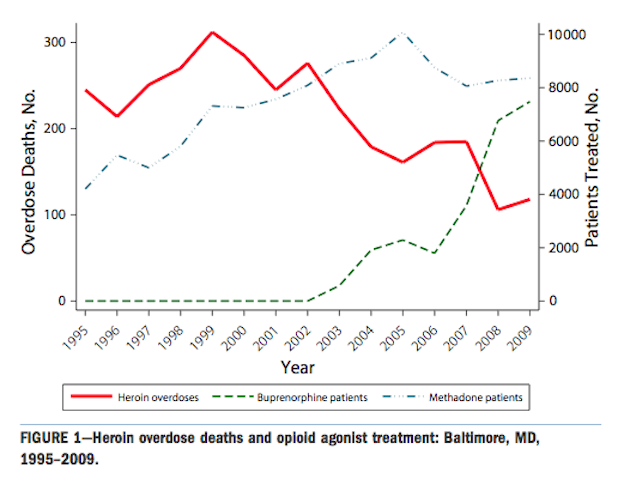
And the benefits multiply – less painkiller and heroin abuse means less HIV transmission, less hepatitis C, and, yes, fewer fatal overdoses. Check out the recent trends in buprenorphine use and heroin overdoses in Baltimore, which has embraced bupe as a weapon against its deeply entrenched heroin problem. No, correlation does not equal causation—for one thing, Baltimore was over the same period also expanding the use of naloxone, medication used by drug users and EMTs to reverse overdoses as they’re occurring. Still, it’s hard not to draw certain conclusions from these lines displayed in a recent article in the American Journal of Public Health, which echo the plunge in overdoses in France, an early adopter of buprenorphine.

overdose-chart

So what’s not to like? Why are we not shipping as much buprenorphine as possible into small towns in Maine and eastern Oregon and eastern Kentucky and all the other places reporting surges in abuse of painkillers and now, increasingly, heroin? Well, partly because bupe has gotten stuck with its own stigma—not as strong as methadone’s, but damaging nonetheless. … The Times cites data showing 402 fatal overdoses linked to buprenorphine in the United States reported to the F.D.A. from spring 2003 through September. As the article notes, this pales in comparison with the 2,826 attributed to methadone over roughly the same period and the more than 19,000 fatal overdoses from opioids overall in 2010 alone.

The fact is, there is no silver bullet for the country’s growing opiate addiction problem. And any approach is going to seem tainted, to bourgeois eyes, by the inherently chaotic and desperate nature of the milieu in which opiate addiction is rooted (though not confined to – painkiller abuse has been on the rise in tony suburbs, too). It would be deeply unfortunate if fraught portrayals in the media with decidedly oversimplified, alarmist headlines had the side effect of dulling one of the best tools we have in this fight.

Should Bikers Be Forced To Wear A Helmet?

Motorcycle Laws

The Economist argues yes:

When states repeal or weaken motorcycle-helmet laws, as dozens have, helmet use falls, fatalities rise and head-injury hospitalisations soar. Biker deaths rose 18% after Michigan repealed its all-rider helmet law in 2012. A rule obliges unhelmeted Michigan riders to carry at least $20,000 in medical-payments coverage. That does not even cover initial stabilisation in intensive care after a nasty crash.

Helmet-haters claim that increased deaths merely reflect a jump in miles ridden after laws are repealed, as bikers enjoy the wind in their hair. Not so. Some studies measure death rates by motorcycle-miles travelled: deaths-per-bike-mile rose 25% when Texas scrapped helmets, for instance.

But Ben Richmond feels that “statistics just don’t work against an emotional appeal of comparing laws to tyranny”:

[T]he trend as of late is against mandatory helmet laws. Today, 19 states and the District of Columbia have universal helmet laws. Only three states have no helmet requirements—Illinois, Iowa, and New Hampshire—while the rest have age-specified requirements. The American Journal of Public Health points to the laws that protect minors, saying that they prove “that legislators and some antihelmet law forces have accepted a role for paternalism in this debate.”

Some but not much, it seems. Since 1997 seven states have repealed their universal helmet laws. No state has enacted a universal helmet law since Louisiana reinstated the law in 2004.

Why The Nuclear Option Is On The Table

Last week, Bouie argued that Democrats “can nuke the filibuster and defend the president’s prerogative, or, they can let the GOP establish a new precedent, where the Senate only confirms Republicans nominees”:

Yes, at several points during George W. Bush’s tenure, Democrats filibustered his judicial nominees. But the issue isn’t filibustering as much as it is the GOP’s categorical opposition to Obama’s nominees. His nominations have faced an unprecedented level of obstruction, leading to widespread vacancies and judicial emergencies. Overall, Obama has had fewer federal judges confirmed than either Bush or Clinton.

Beutler weighed in:

Republicans could just agree to confirm some of Obama’s judges. I think Democrats would probably drop the nuclear threat if Republicans cleared two of Obama’s three D.C. circuit nominees. Maybe Republicans could secure the confirmation of a third, more conservative judge, or get the remaining seat on the court eliminated legislatively.
But their current position — daring Dems to go all the way nuclear or cave completely — gives Dems almost no choice but to pull the trigger. If Republicans had meritorious objections to any of these nominees, the nuclear threat would be a disproportional escalation. Obama could find other judges. What they’re doing instead is a judicial replay of their unacceptable bid to unilaterally gut Wall Street’s consumer watchdog office and void the National Labor Relations Board. Democrats didn’t stand for that, and won. Republicans caved and confirmed several waylaid executive branch nominees over the course of just a few days. They should run the same play again. And if Republicans don’t fold, they should go nuclear.

Ramesh pushed back:

One of the vacancies Democrats are trying to fill used to be held by John Roberts. After he became chief justice, Bush nominated the impeccably qualified Peter Keisler for the spot. The Democrats filibustered him, and the seat has gone empty ever since. A reasonable case can be made against filibustering judicial nominations, or for it. What can’t reasonably be argued is that Democrats should be able to use the tactic to keep a judgeship open until they have the power to fill it with a liberal, at which point Republicans have to stand down.

Chait countered:

The judicial war, like the Israeli-Arab conflict, can be dated back to nearly any starting point, but as good a place to begin as any is 2005. That year, Senate Democrats began dramatically ramping up the use of the filibuster to block George W. Bush’s judicial nominations, whom they deemed ideologically extreme. That is the episode National Review’s Ramesh Ponnuru refers to recently in his defense of the current Republican Senate: “So when Democrats mounted an unprecedented series of filibusters against Bush’s appeals-court nominees,” Ponnuru writes sarcastically, “that was just normal politics.”
But Ponnuru omits what happened next. Republicans, outraged over the tactics, threatened to use the “nuclear option,” to change Senate rules and end the judicial filibuster. The two parties huddled and agreed that Democrats would stop filibustering judges except in the case of “extraordinary circumstances.” The Democrats then dropped filibusters even for highly ideologically nominees, like Janice Rogers Brown. That agreement held, more or less, ever since. As recently as this past June, Republican senators like John McCain agreed that Republicans would not filibuster Obama’s nominees, because “There has to be extraordinary circumstances to vote against them.”
For reasons that remain unclear, Senate Republicans have since decided to block Obama’s nominees to the D.C. Circuit Court, the country’s second-most-powerful court, en masse.

Sarah Binder looks at a larger data set:

First, most observers note that the GOP’s judicial blockade is unprecedented. I’m not so sure. Jonathan Chait observed in New York magazine on Wednesday that the Republican filibusters represent a “difference of degree that amounts to a difference of kind: They [the GOP] have declared their intent to impose permanent vacancies in Obama’s administration and in three swing seats in the crucial D.C. Circuit Court.” Others are bolder: Brian Beutler argues in Salon that the GOP’s “nullification strategy is radical, and entirely new.” The GOP’s rationales for blocking Obama’s D.C. Circuit appointees are certainly brash (and arguments about the circuit’s caseload have been effectively challenged). But along one dimension at least, GOP targeting of the D.C. Circuit reflects a more enduring partisan tactic in the wars over bench: Both parties for years have aggressively opposed nominees slated for appellate courts that are “balanced” between the two parties’ appointees.

Since 1981, 70 percent of nominees for circuits bending in favor of either Democratic or Republican appointees have been confirmed; over the same period, only 58 percent of nominees to evenly or near-evenly split courts have made it to the bench. Even if we control for the other forces that tend to depress the chances of confirmation (such as divided party government or the run up to a presidential election), nominations to split circuits are still less likely to be confirmed.

Selfie Defense

Silvia Killingsworth responds to Oxford Dictionaries choosing “selfie” as “Word of the Year”:

photo-35Strictly speaking, the modern-day selfie is a digital affair, but it’s a novel iteration of an old form: the self-portrait (a friend on Twitter joked, “was Lascaux the first selfie?”). As Kate Losse points out in her excellent primer, a notable point of inflection in the selfie’s recent meteoric rise was the addition of a front-facing camera to the iPhone 4. A selfie doesn’t even have to be of one’s face; my colleague Emily Greenhouse described Anthony Weiner as “a distributor of below-the-waist selfies.” Jack Dorsey, arguably the pioneer of the mass-distributed selfie, also introduced us to selfie Vines, six-second videos shareable on Twitter. Indeed, the selfie is nothing if not a visual shorthand for Dorsey’s initial vision for Twitter as a status updater—“here’s where I am, here’s what I’m doing.”

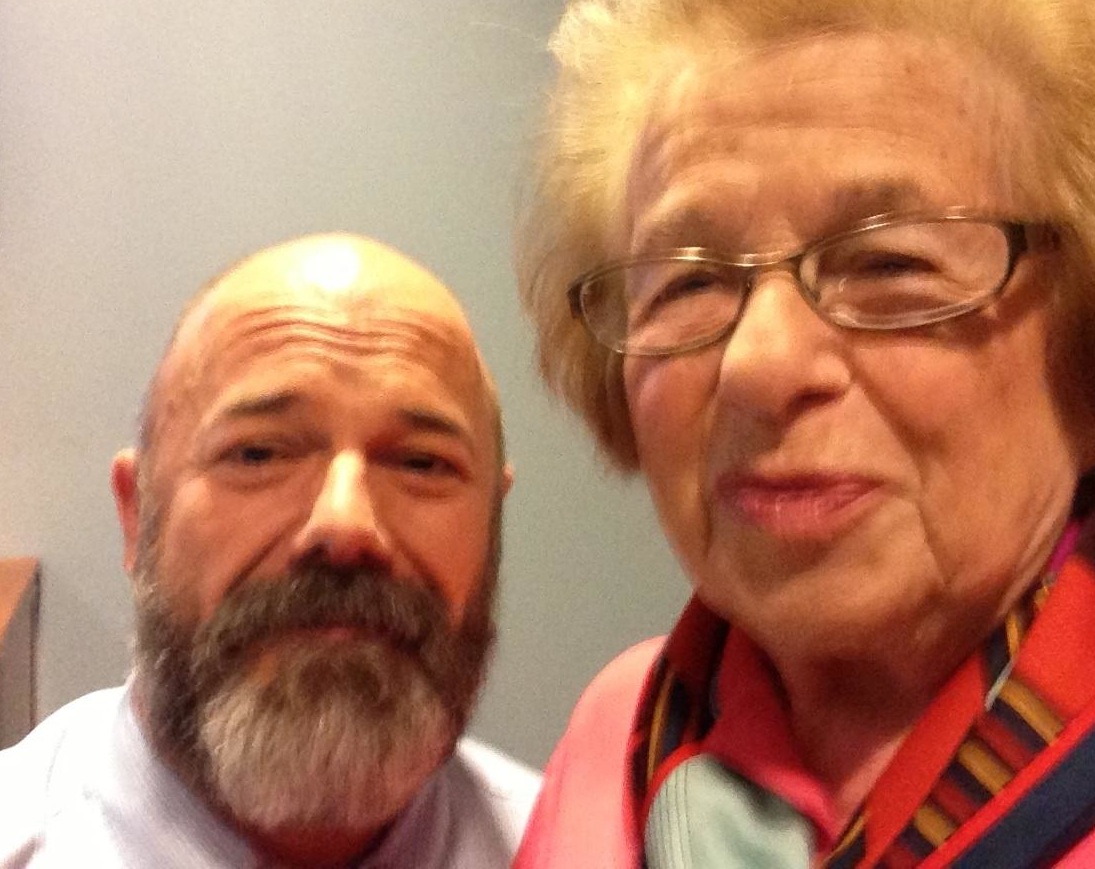
That selfie with Dr Ruth was taken last night in the green room of AC360 Later. Good times. OUPblog rounds up various scholarly reactions to the concept of the selfie. From José van Dijck, author of The Culture of Connectivity: A Critical History of Social Media:

Are all selfies the same? I don’t think so. There is quite a difference in taste and message between selfies on various social media platforms. Facebook selfies tend to be the most ordinary self-portraitures; they are pictures posted by people who want to look normal, happy, nice. Instagram is for ‘stylish’ selfies or ‘stylies’. On Instagram, you don’t portray yourself; you paint a desirable persona.

The apex of good taste may not be a self-portrait but an artistic picture of your most coveted object, such as an expensive bracelet on your wrist or four pairs of shoes representing you, your trendy husband, and your two adorable kids. Snapchat selfies are more like funny postcards: look at me, see how waggish I am, how abrasive I look, you’re not going to catch me in a snapshot. Snapchat selfies are meant to fade away like a dream as they vanish in less than ten seconds. So each selfie peculiarly reflects the flair and function of the platform through which it is posted, perhaps even more so than its sender’s taste. The medium is a big part of the message.

Poulos suggests that selfies “beam our conscious self-regard back at ourselves”:

[W]hat is it we see when we look back at ourselves again and again? Have you tried staring in the mirror for five minutes? (I have.) Try it. It’s like staring into a stranger’s eyes … much in the way that staring into a stranger’s eyes, nose to nose, quickly becomes strangely similar to staring into … your own.

Yep, it’s true. The deeper you look at anyone, including yourself, the more you see just another human. It might take a while, but selfies are on track to restore for us some of Narcissus’s innocent love for humanity. He was so gorgeous he couldn’t get on with his life. But that’s not true of any of us. And the longer we stare that fact in the face, the more our selfies will come to reflect what they so often already contain: the simple joy of being alive.

Or the eternal urge to get laid. Just keeping it real here. Update from a reader:

Ah, your “selfie” with Doctor Ruth brought back some funny memories. Before she became famous, Dr Ruth had a live call-in sex advice radio show in NYC, on Sunday night at 10 pm. I remember listening to her show with the volume turned way low so my mother wouldn’t catch me listening. Dr Ruth took her role as an educator so seriously, and knew how important it was in a suppressed society such as ours. And she would handle the people who called in as a goof with such grace. I recall a teenage girl who called in saying her boyfriend was pressuring her to perform oral sex, but she was afraid because she thought that boys ejaculated a gallon and she would choke. Dr Ruth calmly assured her that it would only be a teaspoon or so. The caller sounded so relieved, I’m guessing the boyfriend got his blowjob soon after.

Previous Dish on selfies here, here, and here.

Toying With The Nuclear Option, Ctd

There are reports that Reid may reform the filibuster today:

Democratic aides confirm to First Read that they’re expected to vote today to change the rules to eliminate the 60-vote threshold for all executive appointments, except to the U.S. Supreme Court. Such a move requires just a 51-vote majority, so Democrats could lose four of their colleagues and still win the vote. Senate Republicans counter that if Democrats go through with this change, they’ll reciprocate the next time they control the White House and the Senate — including for Supreme Court picks. “If [Senate Majority Leader Harry Reid] changes the rules for some judicial nominees, he is effectively changing them for all judicial nominees, including the Supreme Court,” Sen. Chuck Grassley (R-IA) said yesterday, per the Washington Post. But Harry Reid believes he does have 51 votes, especially since he convinced Sen. Dianne Feinstein (D-CA) to climb on board this nuke-option train. She had been an influential holdout in the past.

Waldman notes that Reid’s threats “could be just a negotiating tactic” :

The outcome Democrats would probably most prefer is what happened the last time we went through this, in 2005. In that case the controversy was over a group of Bush appointees who were true radicals, none more so than Janice Rogers Brown, who calls the New Deal a “socialist revolution” and says things like, “In the heyday of liberal democracy, all roads lead to slavery.” That controversy ended with an agreement in which Bush got his nominees—Brown now sits on the D.C. Circuit—and Democrats promised to use the filibuster only in “extraordinary circumstances.” In other words, it was a complete win for the Republicans. The biggest difference between then and now is that Democrats never questioned whether Bush had the right to fill judicial vacancies; they had specific objections to particular nominees.

Jonathan Adler argues that “filibuster of judicial nominees is bad for the courts”:

It was a bad thing when first used against Miguel Estrada, and it is bad now.  Of course it’s rich for Senator Reid and his colleagues to complain about the use of a tactic they themselves deployed with relish (and used to defeat just as many nominees), but that’s politics (and Kerr’s law).  I have no idea how Senate Republicans are likely to respond if Senator Reid pulls the trigger, and how this could effect the ability of the Senate to conduct other business, but I won’t shed a tear for the end of judicial obstruction.  So go ahead Harry, make my day.  I am sure the next President will appreciate it.

Ezra explains the Democrats’ thinking

The main reason filibuster reform typically fails is that the majority party is scared of what will happen when the minority party gets into power. But Senate Democrats just watched Republicans mount a suicide mission to shut down the government. Their confidence that Republicans will treat the upper chamber’s rules with reverence is low, to say the least.

This has led to some fatalistic thinking about filibuster reform: If Republicans are going to blow the filibuster up anyway, Democrats might as well take the first step and get some judges out of the deal.

Ed Morrissey predicts the GOP ‘s response:

We’ll see what happens, but if Reid does pass this, expect Republicans to retaliate — and expect them to end the rest of the filibuster as soon as they have the majority. After all, if it’s not good for confirmations, why should it apply to legislation?

That’s such a stupid statement I can barely believe it. Obviously confirmations are, in part, about the executive branch’s ability to do its job. Legislation is rightly understood as a Congressional duty, in which a Congressional minority has much more of a stake. I find what the GOP has done in this recent case – a kind of inverse packing of the court – to be appalling. Earlier Dish on the nuclear option here.

The Drug Double-Standard

Matt Steinglass presents “everything you need to know about the absurdity of America’s war on drugs”:

When Trey Radel, a congressman from Florida, was charged with cocaine possession on Tuesday, he released a statement that began as follows:

I’m profoundly sorry to let down my family, particularly my wife and son, and the people of Southwest Florida. I struggle with the disease of alcoholism, and this led to an extremely irresponsible choice. As the father of a young son and a husband to a loving wife, I need to get help so I can be a better man for both of them.

This is a perfectly reasonable and entirely sympathetic statement from somebody with an addiction problem. The queer bit is that in making this plea for understanding, Mr Radel feels on solid ground ascribing his misbehavior to alcoholism, but isn’t willing to talk in the same way about his drug use. Alcoholism, apparently, does not carry the type of stigma that would prevent Americans from empathizing with or, potentially, re-electing Mr Radel. He expects that his readers will share his view of alcoholism as a disease.

In contrast, he terms his cocaine use “an extremely irresponsible choice.” Alcoholism is a disease; cocaine possession is a choice. Because, after all, something can’t be evil or criminal if it’s involuntary. How can it be a crime to have a disease? Right?

This is ridiculous. People who develop substance-abuse problems need treatment. Whether the substance they’re abusing is cocaine or alcohol carries no moral weight, and it shouldn’t carry any legal weight either. Trey Radel should not be able to excuse his cocaine use by pointing to his alcohol use; neither is any better or worse than the other. The same goes for Toronto’s Rob Ford: we, the public, should not have the synapse connections that make it possible for Mr Ford to say he may have used drugs while “in a drunken stupor” and expect that to serve as an excuse.

Barro’s related thoughts:

Radel says he is seeking “intensive in-patient treatment” for alcoholism. If he has a substance-abuse problem I wish him all the best in getting it treated. But I’d also note that politicians who get in trouble for drugs feel public pressure to seek rehab even if they never had an addiction.

Radel wouldn’t be allowed to say “I do coke because it is fun and I don’t have any problem requiring treatment” even if that’s an accurate description of his situation.