“Beginning In Damnation, Bound For Deliverance”

Kathryn Schulz profiles Cheryl Strayed, author of the memoir Wild (recently made into a motion picture, seen above), which recounts her experience living alone in the woods for three months. Schulz connects Strayed to a tradition of religious pilgrimage – “the Muslim walking to Mecca, the Buddhist to Bodh Gaya, the Hindu to Puri, the Catholic to Lourdes”:

Religious pilgrims walk outdoors, but their fundamental journey is inward, undertaken to improve the state of their soul. So, too, with Strayed. The subtitle of Bill Bryson’s book is Rediscovering America on the Appalachian Trail. The subtitle of hers is From Lost to Found on the Pacific Crest Trail.

Like Dante, then, Strayed is on a spiritual journey, beginning in damnation, bound for deliverance. That makes Wild a redemption narrative — and that, in turn, helps explain its popularity, because redemption narratives are some of the oldest, most compelling, and most ubiquitous stories we have. We enshrine nature writing in the canon — you were probably assigned Thoreau and Emerson et al. in high school — but it is redemption narratives that dominate our culture. Among other things, you can hear them in religious services all across the land and in AA meetings every day of the week.

Wild embodies this ancient story. Or, more precisely, it embodies the contemporary American version thereof, where the course is not from sin to salvation but from trauma to transformation: I was abject, dysfunctional, and emotionally shattered, but now I see. This version has more train-wreck allure than the traditional one (being a mess is generally more spectacular than merely being an unbeliever), and it is also more inclusive. Identifying with it requires no particular faith, beyond the faith that a bad life can get better.
The Art Of Democracy, From Athens To America

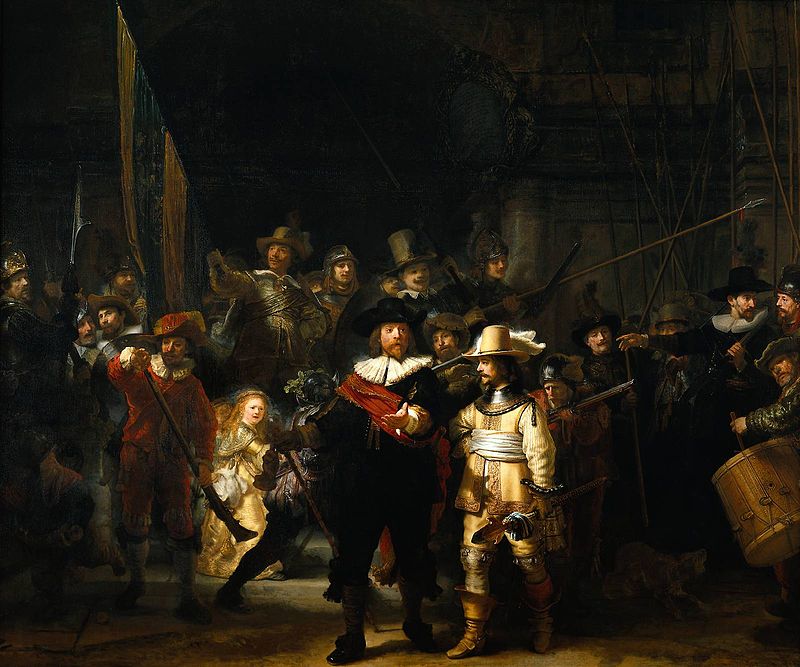
The_Nightwatch_by_Rembrandt

Victoria Coates asserts that throughout history “democracies have demonstrated a special capacity to produce extraordinary self-referential works of art.” Her examples:

The Parthenon and David are examples from a larger series of works of art and architecture inspired by democracy. There is the bronze portrait of Brutus that legendarily portrays the founding hero of the Roman Republic’s stern features. St. Mark’s Basilica in Venice is a splendid jewel adorning a city-republic that built its own solid ground and grew fabulously wealthy through maritime trade. Rembrandt’s Night Watch honors the citizen militias that proudly defended the liberty of the Dutch Republic, which, like Venice, reclaimed land from the sea and prospered far beyond its size. InThe Death of Marat, Jacques-Louis David memorialized the tragic sacrifice of the revolutionary “Friend of the People” in the turmoil surrounding the first effort to establish a French republic. By salvaging the marble sculptures from the decaying Parthenon and putting them on permanent display in London, Thomas Bruce, Seventh Earl of Elgin converted the work of Phidias into a proclamation that the British constitutional monarchy was the worthy modern heir of democratic Athens.

Albert Bierstadt’s Rocky Mountains, Lander’s Peak conveys the huge potential of a young democracy in the untamed spaces of the New World, even while a brutal civil war threw the whole American project into doubt. Claude Monet offered his Nymphéas (“Water Lilies”) to the French Third Republic to commemorate the hard-won victory of his friend, Prime Minister Georges Clemenceau, over imperial German aggression. Finally, Picasso’s harrowing Guernica is a stark reminder of the existential threats to democracy, such as Fascism, that gathered in the twentieth century.

Each object is part of its own nationalistic narrative and gives us a snapshot of a particular point in the trajectory of the state. All of them provide tangible pieces of historical evidence that are in some ways more reliable than texts (although texts abound in this line of study) and offer powerful insight into successive efforts to establish and sustain a democracy. They are not isolated aesthetic objects; part of their value as historical evidence derives from their active roles in the public life of the communities that produced them.

(Rembrandt’s The Night Watch, 1641, via Wikimedia Commons)

Pope Francis, Still Complicating The Culture Wars

Last month the Vatican hosted a colloquium on “The Complementarity of Man and Woman,” during which Pope Francis asserted, to the joy of both conservative Protestants and Roman Catholics, that “Children have a right to grow up in a family with a father and a mother.” Brandon Ambrosino unpacks the nuances that make the line anything but a simplistic defense of traditional marriage:

As many theologians and commentators are pointing out, the most important part of Francis’ lecture was this:

When we speak of complementarity between man and woman in this context, let us not confuse that term with the simplistic idea that all the roles and relations of the two sexes are fixed in a single, static pattern. Complementarity will take many forms as each man and woman brings his or her distinctive contributions to their marriage and to the formation of their children — his or her personal richness, personal charisma.

According to [Fordham theologian Patrick] Hornbeck, these words signal a departure from Francis’ predecessors. For one thing, Hornbeck notes, Francis didn’t go out of his way to condemn homosexuality. Second, Francis’ comments display a certain level of openness often lacking in discussions about complementarity.

“What Francis tells us in his address is complementarity is not about a rigid demarcation of gender roles,” said Hornbeck.

In other words, Francis has displayed a more nuanced understanding of sex and gender than we’ve seen from a recent pope. He understands that human sexuality is complex and that it resists easy categorization, which is why his lecture warns against simplistic, static, reductionistic ways of looking at it.

In an interview, Hornbeck further delineated a more expansive understanding of what complimentarity can mean, especially as it connects to gay relationships:

What I like about his statement is, first of all, how he uses Scripture. He uses I Corinthians 12 to talk about spiritual gifts: “Saint Paul tells us that the Spirit has endowed each of us with different gifts so that – just as the human body’s members work together for the good of the whole — everyone’s gifts can work together for the benefit of each.” Now, there’s no gender associated with those gifts. Those are unique to each individual.

The way those gifts complement each other is the second point. Francis says, “To reflect upon ‘complementarity’ is nothing less than to ponder the dynamic harmonies at the heart of all Creation.”

When we think about the harmony of sexuality, one of the fundamental aspects that defines that harmony is sexual orientation. So heterosexual relationships are harmonious for people with a heterosexual orientation. And homosexual relationships are harmonious for people with homosexual orientations. I think it’s correct to say, as Francis does, that all complementaries were made by the Creator, and sexual orientation is part of that creation. (Even though the Church uses the language of “disordered,” I and many other theologians would challenge that language.) But I think there can be harmony for gays and lesbians in sexual relationships, just like there can be harmony for heterosexuals in sexual relationships.

Not Having The Patience Of Job

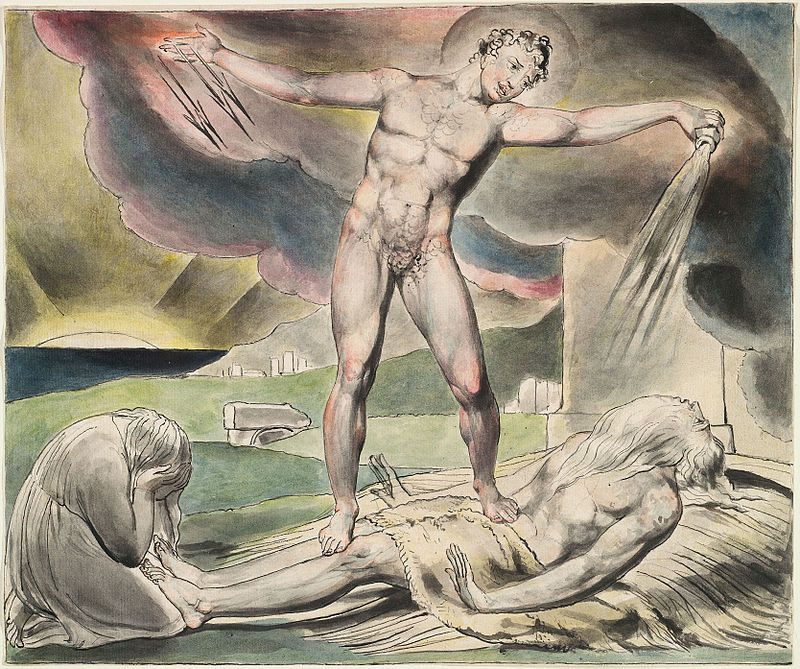
800px-Blake_Book_of_Job_Linell_set_6

The sociologist of religion Peter Berger posits that modern atheism emerged as “a rebellion against the monotheistic faiths that originated in the Middle East – Judaism, Christianity, Islam,” and that, as such, it “makes much less sense in a non-monotheistic environment”:

The rebellion is triggered by an agonizing problem: How can God, believed to be both all-powerful and morally perfect, permit the suffering and the evil afflicting humanity? This is the problem called theodicy, which literally means the “justice of God”; in the spirit of the rebellion it is also a demand that God has to justify himself. The most eloquent expression of this atheist rebellion in literature is by Dostoyevsky’s Ivan Karamazov rejecting God, because he allowed the cruel murder of one child.

Within the Hebrew Bible the problem of theodicy is of course confronted in the Book of Job. Its happy ending (Job’s restored good fortune) is probably a later redaction, intended to assuage the outrage at Job’s innocent suffering. If one brackets the ending, the message is one of submission to God’s will, whatever it may be. The most radical version of this theodicy (if one can call it that) in the history of Christianity is that of Calvinism. God, in his inscrutable will, has ordained from eternity who will be the elect destined for heaven, and who the damned going to hell–and nothing an individual can do or fail to do can change the divine edict. There is a certain (if perverse) grandeur in such faith.

On a related note, Shalom Carmy reviews Mark Larrimore’s The Book of Job: A Biography, which marks when the problem of evil came to dominate readings of that Biblical text:

For Larrimore the medieval and early modern periods mark the rise of the Book of Job as disputation, with Maimonides, Thomas Aquinas, and Calvin as his chosen representatives. These writers see the book through the prism of the question of evil. Maimonides is the first of them to ascribe specific philosophical views to Job and to the other speakers in the dialogue. For the sake of argumentative consistency and focus, Maimonides dismisses many powerful emotional passages as philosophically irrelevant digressions. Other theologians, in the service of Job’s pious image, play down his pungent sayings. Calvin, for whom Job is a vehicle for communicating the transcendence and inscrutability of God, cites some of Eliphaz’s utterances as if they were Job’s, assuming, as did other Jewish and Christian writers, that all Scripture delivers the same message, irrespective of the speaker.

With the modern problem of theodicy, the readings of Job that attract Larrimore’s attention are increasingly embedded in larger philosophical, literary, or academic projects. Perhaps the most thought-provoking element in this book is Larrimore’s emphasis on the importance of Kant, more than Leibniz, as the hinge around which the history of theodicy revolves.

(Image: Satan pours on the plagues of Job in William Blake’s The Examination of Job, via Wikimedia Commons)

How To Write Tall Tales

Nick Ripatrazone riffs on Andre Dubus’ essay on the craft of short story writing, “The Habit of Writing,” in which he reveals how and why he “changed his method while writing a story, ‘Anna,'” which is told from the perspective of its eponymous female character:

“At my desk next morning I held my pen and hunched my shoulders and leaned my head down, physically trying to look more deeply into the page of the notebook. I did this for only a moment before writing, as a batter takes practice swings while he waits in the on-deck circle. In that moment I began what I call vertical writing, rather than horizontal. I had never before thought in these terms. But for years I had been writing horizontally, trying to move forward (those five pages); now I would try to move down, as deeply as I could.”

Horizontal writing is focused on amassing pages and words.

When Dubus wrote horizontally, he wrote convinced that fiction was created through aggregation. Vertical writing, in contrast, values depth over breadth. Stories are written when they are ready to be written; they are not forced into existence by planning or excessive drafting. Horizontal writing seeks to move across the page; vertical writing seeks to dig into the page, to value the building of character and authenticity over the telegraphing of plot. The folly of horizontal writing is that it convinces writers that fiction writing operates on a production model. If they simply sit at the desk and pound out page after page, the story will come. That might be true, but Dubus argues that such forced work creates a lot of “false” fiction. Curiously enough, by seeking to undermine the stereotype that writing is the result of inspiration, writers have fallen for the other, no less romantic opposite: that writing is factory work, and daily devotion is rewarded with final drafts. Both approaches are magical thinking. Vertical writing is no less work, but it is better work, work at the right time. It requires patience in the willingness to wait for a story to feel ready to be written, as well as the attention and focus necessary to inhabit the story once gestated.

Read last weekend’s Quote For The Day from Dubus here. Check out all the Dish-love for Dubus here.

A Smaller Screen For Sex

NSFW, but safe for NSFW Saturday:

Adam Sternbergh asks why there’s a “tendency in modern mainstream movies to treat sex as something that happens elsewhere, offscreen and unspoken of”:

Part of the reason is because of the internet, that perpetual digital orgy, which has busted the movies’ monopoly as the place where we go to glimpse naughty things. (That sexy scene in Moscow on the Hudson? The whole movie’s currently streaming on Hulu.) And part of the reason is because Hollywood, in the blockbuster age, has succumbed to the self-neutering gospel of the four quadrants — by which the world is split up into increasingly gory R-rated action and horror films; fun-for-the-whole-family superhero epics (superheroes, it’s well known, have no genitalia); animated films for the kid in all of us; and movies by Nicholas Sparks.

In the era of Top Gun, The Big EasyBody Heat, or other steamy Hollywood thrillers, the goal was to appeal to both men and women with the promise of (among other things) onscreen sex.

(Ergo the fabled “date night” movie.) Now the goal is to appeal to adults and their 12-year-old kids with the promise of the absence of sex. As for more serious films, flipping back through the Best Picture nominees from the last few years — films like Argo and The King’s Speech and Inception — the only ones with truly memorable sex scenes are Black Swan and The Wolf of Wall Street. Yet in the former, the sex (between Natalie Portman and Mila Kunis) plays out like a nightmare; and in the latter, the sex feels like a porno directed by Hieronymous Bosch.

But the real cultural shift — as any with a pay-cable subscription will tell you — is that the small screen has finally steamed over. After decades spent as Hollywood’s prudish country cousin, TV now brings televised sex of near-Caligulian variety and inventiveness into our homes. There’s even a term, sexposition, created specifically for moments when characters are communicating information while also having, or watching, sex. TV, in particular pay cable, has claimed this ground in part because it can — there’s no MPAA threatening to slap censorious NC-17s on True Blood every week.

Of course, Dan Savage has been trying to reverse this trend for years with his amateur porn festival:

Worst Sex Of The Year

In fiction, anyway. This year, Ben Okri has been awarded the Literary Review Bad Sex in Fiction award for a passage in his tenth novel, The Age of Magic:

“When his hand brushed her nipple it tripped a switch and she came alight. He touched her belly and his hand seemed to burn through her. He lavished on her body indirect touches and bitter-sweet sensations flooded her brain. She became aware of places in her that could only have been concealed there by a god with a sense of humour.

Adrift on warm currents, no longer of this world, she became aware of him gliding into her. He loved her with gentleness and strength, stroking her neck, praising her face with his hands, till she was broken up and began a low rhythmic wail … The universe was in her and with each movement it unfolded to her. Somewhere in the night a stray rocket went off.”

Okri faced some, er, stiff competition for this year’s award:

The winner of this year’s Booker, Richard Flanagan, with The Narrow Road to the Deep North, was a contender with: “Hands found flesh; flesh, flesh. He felt the improbable weight of her eyelash with his own; he kissed the slight, rose-coloured trench that remained from her knicker elastic, running around her belly like the equator line circling the world.”

Haruki Murakami’s Colorless Tsukuru Tazaki and His Years of Pilgrimage resorted to naturalistic metaphors: “Shiro’s were small, but her nipples were as hard as tiny round pebbles. Their pubic hair was as wet as a rain forest. Their breath mingled with his, becoming one, like currents from far away, secretly overlapping at the dark bottom of the sea.”

Pulitzer Prize-winner Michael Cunningham’s The Snow Queen weighed in with: “He hears himself gasp in wonder. He falls into an ecstatic burning harmedness, losing, lost, unmade. And is finished.”

Beauty In The Eye Of The Digital Artist

Josh Dickey lifts the curtain on “beauty work” in the movie industry, which he describes as “a digital procedure of sorts, in which a handful of skilled artists use highly specialized software in the final stages of post-production to slim, de-age and enhance actors’ faces and bodies”:

As Photoshop is to magazine photography, digital beauty has become to celebrities in motion: a potent blend of makeup, plastic surgery, muscle-sculpting, hair restoration, dental work and dermatology. Even the most flawless-in-real-life human specimens are going under the digital knife. Because they can. Because in this age of ultra-high definition, they have to. …

The technique made its “out” debut when Lola [Visual Effects] aged Brad Pitt backwards for Benjamin Button in 2008. As it turned out, the most striking visual in David Fincher’s epic wasn’t Button the shriveled, elderly man-child. It came toward the end of the film, when Pitt emerged into the golden light of a dance studio as a naturally radiant, strapping 20-something — this, at a time when Pitt, in his mid-40s, was just beginning to age into his real-life role as the sexiest man alive.

Dickey writes that, though few performers cop to it, beauty work is de riguer in Hollywood:

A recent comedy hit featured a top actress in her 40s who required beauty work on every single shot she was in — some 600 total. With artists working around the clock, seven days a week, the beauty work alone took close to three months.

The payoff? Nearly everything written about the film remarked at how fit and young the actress looked. No one suspected it was anything but good genes and clean livin’.

The Consolations Of Poetry

From the Poetry archives, this essay from the late, great American philosopher, Richard Rorty, stands out as a lovely paean to verse. When Rorty learned he had the inoperable pancreatic cancer that would take his life, he reflected on what especially resonated in his reading:

Some months after I learned the bad news, I was sitting around having coffee with my elder son and a visiting cousin. My cousin (who is a Baptist minister) asked me whether I had found my thoughts turning toward religious topics, and I said no. “Well, what about philosophy?” my son asked. “No,” I replied, neither the philosophy I had written nor that which I had read seemed to have any particular bearing on my situation. I had no quarrel with Epicurus’s argument that it is irrational to fear death, nor with Heidegger’s suggestion that ontotheology originates in an attempt to evade our mortality. But neither ataraxia (freedom from disturbance) nor Sein zum Tode (being toward death) seemed in point.

“Hasn’t anything you’ve read been of any use?” my son persisted. “Yes,” I found myself blurting out, “poetry.” “Which poems?” he asked. I quoted two old chestnuts that I had recently dredged up from memory and been oddly cheered by, the most quoted lines of Swinburne’s “Garden of  Proserpine”:

We thank with brief thanksgiving

Whatever gods may be

That no life lives for ever;

That dead men rise up never;

That even the weariest river

Winds somewhere safe to sea.

and Landor’s “On His Seventy-Fifth Birthday”:

Nature I loved, and next to Nature, Art;

I warmed both hands before the fire of life,

It sinks, and I am ready to depart.

I found comfort in those slow meanders and those stuttering embers. I suspect that no comparable effect could have been produced by prose. Not just imagery, but also rhyme and rhythm were needed to do the job. In lines such as these, all three conspire to produce a degree of compression, and thus of  impact, that only verse can achieve. Compared to the shaped charges contrived by versifiers, even the best prose is scattershot.

Taking A Stand On The Can

4999435769_d937a7a842_z

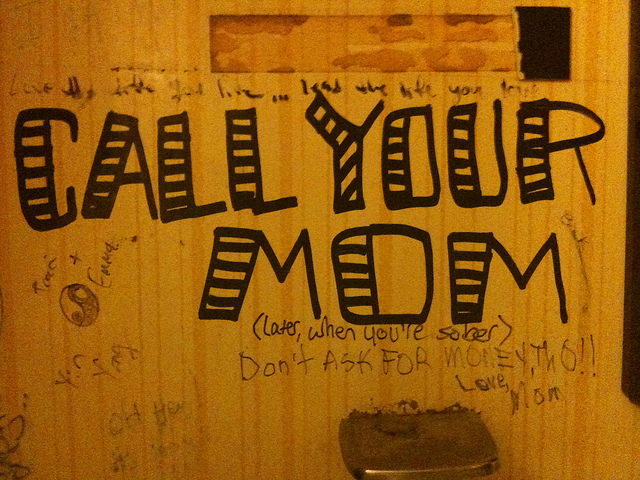
Julie Beck looks at latrinalia, or bathroom graffiti:

While it would be impossible to come up with a comprehensive unified theory of why people write poop jokes and names with hearts around them while they’re on the pot (other than the perhaps scientifically unsatisfying “Because it’s fun”), there are several factors that seem to be at play. One is that bathroom graffiti is a forum for anonymous, often-inappropriate expression, not unlike an Internet comments section, except with the added bonus of creating something tangible that exists in the real world. Plus, as Matthews notes, “It’s still illegal. It’s deviant, but it’s a low-cost deviant thing to do.” There’s a low likelihood of getting caught, and it’s usually something that can be washed off, or painted over.

Toilet graffiti also offers an interesting contrast to the way people typically behave in the bathroom. The unspoken rules of keeping to oneself, not making eye contact, and avoiding talking to strangers, all contribute to a sometimes-tense environment with the goal of shifting focus away from what’s actually happening behind stall doors. But the graffiti on the stall doors does not ignore it one bit. It crudely acknowledges and pokes fun at what we all go to the bathroom to do, and flouts the politeness surrounding it as well.

(Photo by Flickr user liquidsunshine49)