Social Media Is Becoming Less Free

In response to Twitter going public, Benjamin Kunkel pens a manifesto arguing that “social media can either be profitable or it can be social. In the end, it can’t be both”:

The IPOs of Facebook and Twitter should therefore be reversed, through the socialization of both companies and other social-media services that attain a similar scale. The time has come, in other words, to socialize social media. Keynes long ago called for “a somewhat comprehensive socialization of investment” in modern economies, while leaving room for the skill and inventiveness of entrepreneurs “(who are certainly so fond of their craft that their labor could be obtained much cheaper than at present), to be harnessed to the service of the community on reasonable terms of reward.” The broader question can await another day. But large social media companies particularly invite socialization—that is, going public in the sense of public ownership—for the reasons that follow.

One of the reasons he outlines:

Social media should be socialized because attaining profitability (through ads or fees) is impossible without degrading the service.

So far executives hope to turn a profit by providing ad space and/or by data-mining users so that information can be sold to advertisers to use more broadly. The more social-media services are infiltrated by ads, the less the user enjoys the fundamental social right of choosing her own company. On Twitter I follow who I want and don’t follow the others. On Facebook, as IRL, I choose my friends as well as those people I find it socially convenient to call “friends.” And as with social life generally, there are no directly assessed fees for participation, any more than I have to pay a toll to walk down the street with a friend (or follower).

Advertising degrades this freedom. I don’t get to choose whose ads I see, or whether I want to see any. Some people may enjoy corporate advertisements—and they should be able, accordingly, to follow Burger King or Pfizer. But I have something to advertise as well: my opinions, the articles I write, the books by other people I think you should buy, et cetera. That is my freedom, just as it’s yours to follow or block or unfriend me. We only lack this freedom when it comes to corporate entities with the budgets to override our choices. And everything suggests that as Facebook and Twitter try to increase revenues and share value, they will pollute social media with ever more ads.

Meanwhile, Kentaro Toyama argues that social media is less and less a liberating force:

[W]hat both Chinese censorship and American surveillance show is that there is nothing inherently democratizing about digital networks, at least not in the political sense. Far-reaching communication tools only make it easier to impose constraints on the freedom of expression or the right to privacy. Never before have Chinese censors had it so easy in identifying subversive voices, and never before has the NSA been able to eavesdrop on the private communications of so many people.

Silicon Valley feeds us a myth of technology trumping politics, but if anything, it’s the other way around. How else would the NSA have been able to strong-arm nine tech giants like Apple, Facebook, Google, and Microsoft into cooperating with its PRISM program? What’s telling was the embarrassed semi-apology that these firms issued to the public – their excuse came down to, “We didn’t want to. What we did wasn’t so bad. They made us do it.” Meanwhile in China, Internet companies are a seamless extension of the government’s censorship machine.
Fighting Pop With Pop?

Alyssa ponders Lily Allen’s new music video:

The video is simultaneously pastiche and critique, referencing everything from Robin Thicke’s discussions of his anatomy in balloon writing to Miley Cyrus’ use of twerking African-American backup dancers as objects, and linguistically playing off Three 6 Mafia’s “It’s Hard Out Here For a Pimp.” And as apt as the song and video feel now, it’s also part of a long tradition of female pop stars whose brands rely on the idea that they’re different from their fellow pop tarts making music and videos that explicitly swipe at the conventions of their industry.

But she has misgivings:

The truth is that, as much as I adore Pink and Lily Allen in particular, artists like them and songs like these effectively function as a pressure valve for Big Music. By giving these women money and a platform to critique the industry in which they’ve succeeded, large labels prove exactly how tolerant and expansive they are, while continuing on their merry way to make the kind of music and images Allen, Jewel, and Pink deplore.

Prachi Gupta is much harder on Allen:

Allen opted to just stuff some sexist shit into a box, wrap it in a bow that says, “The contents of this box are sexist, so fuck this box, but also, go ahead and open the box.” Lily Allen is smart enough and talented enough that she doesn’t need to repackage that shitty box. She can throw it out and make something better.

Ayesha Siddiqi brings race into the debate:

It is not feminist to mock talented dancers of color for exercising skills Allen doesn’t possess. It is not feminist to claim that women who cook and dance provocatively are as damaging as a manager barking at her to lose weight. It is not feminist to remain blissfully colorblind in a world that functions along race.

Allen responds to critics:

The message is clear. Whilst I don’t want to offend anyone. I do strive to provoke thought and conversation. The video is meant to be a lighthearted satirical video that deals with objectification of women within modern pop culture. It has nothing to do with race, at all.

Selling Out Can Be Smart

Yglesias is pleased by Snapchat’s refusal to sell to Facebook for $3 billion:

The company’s founders and investors may or may not be making a terrible mistake. But from the sidelines, I think one should almost always root against the acquisition exit. It’s boring. It’s lame. The bet when you turn down $3 billion is that there’s some chance that in the future your company will be worth $30 billion or $300 billion and you want to reach for those stars and dare to dream.

Joshua Gans calls this “jaw droppingly bad analysis”:

Ultimately, while it is easy to pull apart these arguments, the actual real history of entrepreneurial firms tells us that most of them succeed by cooperating with established firms rather than competing with them as Yglesias is cheering here. As a person responsible for much of that research (see herehere,here and here to name but a few), let me tell you that the struggle in getting acquired is getting a big payout from stronger incumbents; something Snapchat, like Groupon before them, seem to have overcome. To be sure, there are companies like Google and Dropbox (who each turned down a small amount), that end up doing quite well. But they are the exceptions rather than the rule. Snapchat may prove me wrong but I have to say, kids, you should have taken the money.

Obama’s Obamacare Fix: Reax

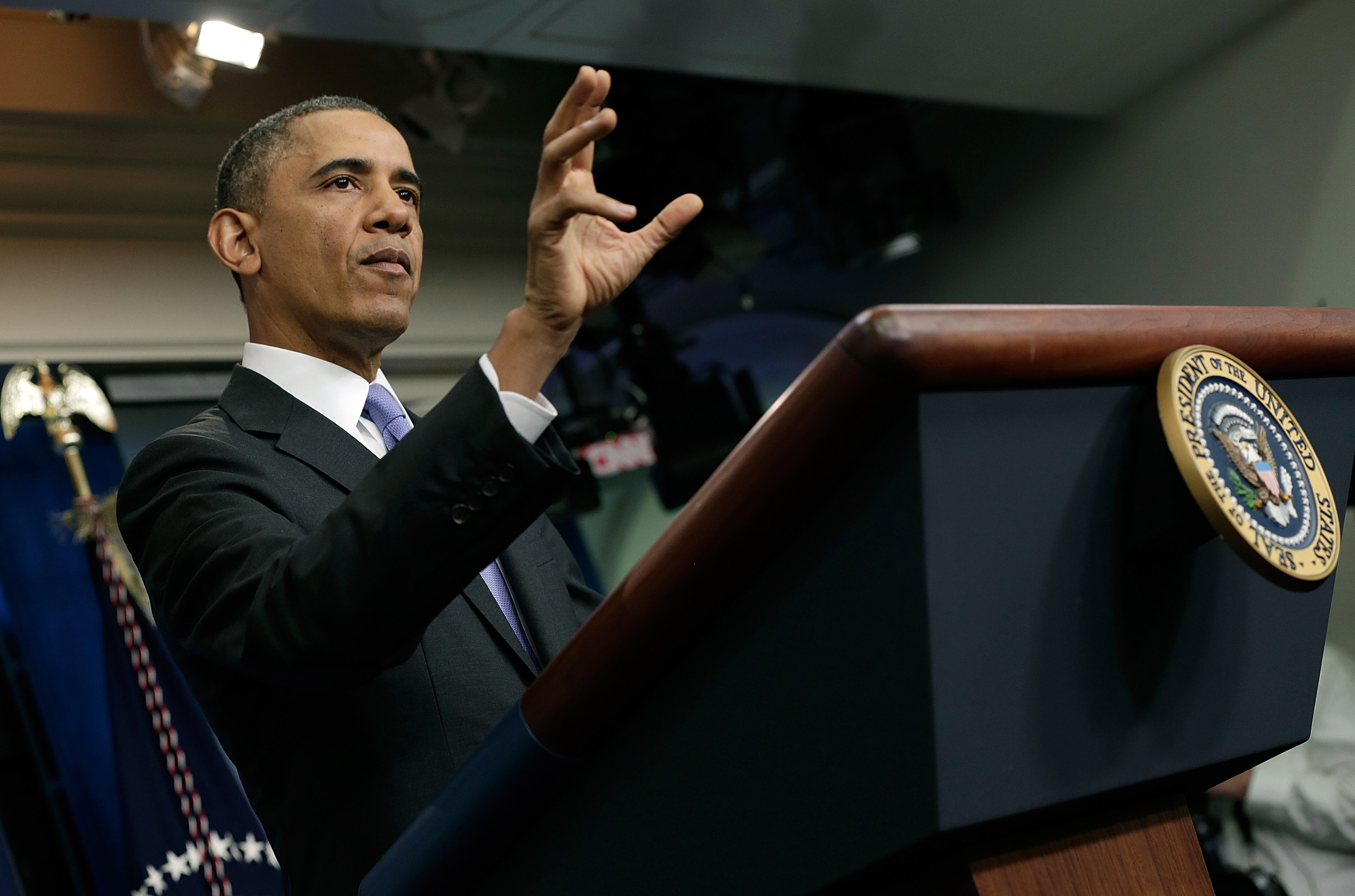
Obama Speaks On The Affordable Care Act In White House Briefing Room

Robert Laszewksi explains what Obama’s announcement means for insurance companies:

This means that the insurance companies have 32 days to reprogram their computer systems for policies, rates, and eligibility, send notices to the policyholders via US Mail, send a very complex letter that describes just what the differences are between specific policies and Obamacare compliant plans, ask the consumer for their decision —  and give them a reasonable time to make that decision —  and then enter those decisions back into their systems without creating massive billing, claim payment, and provider eligibility list mistakes.

Sarah Kliff considers insurers’ options:

[I]nsurers are in a bit of a tricky spot. It will look pretty bad if they don’t allow people to keep enrolling in their 2013 plans; as the president said, its a whole lot harder to blame the cancellations on Obamacare. But if they do allow that to go forward, it could screw up the risk pool in the new insurance marketplaces by letting the younger and healthy people (who would likely stick with their skimpier plans) stay out of the exchange. They’d essentially be siphoning off the exact same customers they were hoping to woo into the exchanges.

Beutler has no sympathy for insurers:

Obama’s remedy is a justified comeuppance for carriers who defaulted beneficiaries into obscenely expensive plans, which they characterized as “comparable” to the canceled coverage, without apprising them of their options, and blamed the whole disruption on Obamacare. It’s a scolding reminder to particular insurance companies that their lack of integrity exacerbated a problem that might have been contained if they hadn’t acted with such avarice. They are now reaping the whirlwind.

Drum echoes:

I think that most of the canceled policies have been canceled because insurance companies wanted to cancel them. They were designed in the first place to entice buyers away from their old grandfathered policies, and insurance companies did this explicitly so that they would be free to cancel them when 2014 rolled around. This allowed insurers to replace them with more expensive policies without taking any heat for it. They could just blame it on Obamacare.

This is just speculation on my part, so don’t take it to the bank. But I think Obama’s main goal here is to remove this handy excuse.

But, as Suderman points out, the administration needs the cooperation of insurance companies if the law is going to succeed:

Obama is creating a long-term policy problem in order to solve a short-term political problem. Even if this temporarily reduces some of today’s political pressure, those long-term policy problems will rebound to create additional political problems as time goes by. Premiums will rise, and if consumer demand turns out to be lower than expected as a result, plans may withdraw from the market. At the same time, insurers, who have been targeted by the administration for blame and had their assurances about the state of the law (and thus their business plan) upended, will be less likely to cooperate with the administration. They are already frustrated with the administration, and this will hasten the break between them. The opposition of insurers will add a new layer of opposition that the administration must contend with in order to make the law—which is built around the goal of making insurance coverage accessible—work.

Rich Lowry questions the legality of the administrative fix:

In attempting to stem the panic of congressional Democrats, Obama has thrown the insurers who had bought into Obamacare under the bus, a move that itself could harm the law’s long term prospects. He has once again acted unilaterally and (presumably) lawlessly rather than going to Congress, but he has undercut his own spin that Obamacare is the immutable “law of the land” and in his press conference, admitted that many of the law’s failures are on him rather than the result of Republican sabotage. We’ll see now whether the president has at least stabilized his position on Capitol Hill. Regardless, a bad day for him and the law.

Nicholas Bagley reviews relevant law and finds that “the administrative fix may be vulnerable to even sharper claims of illegality than the delay of the employer mandate.” Ramesh expects the change to only make the law worse:

In recent weeks, proponents of Obamacare have been arguing that we shouldn’t make too much of its early troubles, because President George W. Bush’s prescription-drug program saw early fumbles, too. (The people behind Obamacare may not be good at building websites, but they’re great at manufacturing excuses.) It’s perverse, of course, to suggest that the difficulties of a smaller, far less complex program are a good omen for Obamacare. But the bigger problem is that Obamacare is vulnerable to adverse selection in a way that Bush’s program was not.

Weigel anticipates the GOP’s new spin:

Whatever Obama does, it won’t restore all the canceled plans. Republicans (and anyone who’s talked to any insurer, ever) know this is not the case. After this week, Republicans will be able to react to any new stories about canceled plans by pointing out that, hey, they wanted to fix this, but the president arrogantly refused them and went with his own plan.

Chait’s bottom line:

Obama’s announcement mainly leaves the law in the same place it’s been for a month and a half: waiting to see if the administration can fix the website.

(Photo: U.S. President Barack Obama speaks on the Affordable Care Act in the White House briefing room November 14, 2013 in Washington, DC. By Win McNamee/Getty Images)

Alec Baldwin Is A Homophobic Bigot

(The video below is NSFW!)

We knew that already, of course. His instinctive, reflexive recourse to homophobic slurs is now well established. Let us review the previous evidence. This is what he said about a vile Daily Mail dirtbag who offended him:

“George Stark, you lying little bitch. I am gonna fuck you up … I want all of my followers and beyond to straighten out this fucking little bitch, George Stark. @MailOnline … My wife and I attend a funeral to pay our respects to an old friend, and some toxic Brit writes this fucking trash … If put my foot up your fucking ass, George Stark, but I’m sure you’d dig it too much … I’m gonna find you, George Stark, you toxic little queen, and I’m gonna fuck … you … up.”

Staggeringly, Baldwin insisted that that rant was not a sign of his homophobia. That’s how entitled he thinks he is. Now we have an almost identical outburst against another indefensible photographic stalker – but after Baldwin won a suit against another stalker. The video is here. The key expletive is the term “cock-sucking fag” which Baldwin utters under his breath as he is walking away from the hack who was harassing him, his child and his wife.

Look: Baldwin’s anger in both cases was thoroughly merited. But he continually resorts to this kind of homophobic poison when he’s angry. Just as Mel Gibson revealed his true feelings about Jews in his drunken rant, so Baldwin keeps revealing his own anti-gay bigotry. These outbursts reveal who he actually is.

I should add that this is a free country and he has an inviolable right to use these words. But he has no right to pretend in any way to be a tolerant liberal when he is anything but, when it comes to gay people.

So many liberals, of course, give him a pass when they would never dream of doing so with anyone who was conservative or Republican. Even after his bigotry was on full display, MSNBC hired him for a new show as a liberal pundit. For too many of them – especially gay establishment liberals, like the tools at GLAAD or the terminally naive like Hilary Rosen – there is a glaring double standard here. It seems to me that this double standard cannot stand any more. And this raging, violent bigot cannot be defended any longer.

We’re Gayer And More Homophobic Than We Think

That’s what Cass Sunstein concludes after looking at new research:

When people are assured of anonymity, it turns out, a lot more of them will acknowledge that they have had same-sex experiences and that they don’t entirely identify as heterosexual. But it also turns out that when people are assured of anonymity, they will show significantly higher rates of anti-gay sentiment. These results suggest that recent surveys have been understating, at least to some degree, two different things: the current level of same-sex activity and the current level of opposition to gay rights.

Consider one study of 2,500 people involving a standard “best practices” survey and an anonymous “veiled” survey:

In the best practices survey, 11 percent of the population said that they didn’t consider themselves to be heterosexual. In the veiled report, that number jumped to almost 19 percent – an increase of 65 percent.

Did participants believe that discrimination on the basis of sexual orientation should be illegal? In the standard survey, only about 14 percent said no. That number increased to 25 percent in the veiled report.

In best practices, only 16 percent of participants said they would be uncomfortable having a manager at work who was lesbian, gay, bisexual or transgender (LGBT for short). The number jumped to 27 percent in the veiled report.

However, there’s one more reason to think the kids are fine:

The effect of assuring anonymity varied significantly across demographic groups. The veiled survey had no effect on the answers of young people to questions about their sexual orientation, apparently because social norms don’t much discourage young people from revealing the truth.

Obama’s Iran-Contra Moment

Listening closely to the president’s noontime presser, I couldn’t help but be reminded of Ronald Reagan’s famous address to the nation in March 1987. Reagan had been caught in a lie – his declaration that he had never traded arms for hostages in his attempt to reach out to Iran (yes, neocons – he was trying to reach out to Iran!). For months, he languished as investigations revealed that he had indeed done such a thing, and his credibility – long his strong point – was at stake. Here’s the address:

The most famous line – addressing his clear statement to the American people that he “did not trade arms for hostages” – was the following:

My heart and my best intentions still tell me that’s true. But the facts and the evidence tell me it is not.

Today, Obama said something very similar about his statement that “if you like your plan, you can keep it, period.” I love the guy, as I loved Reagan, even though I have not exactly held back when I thought he was screwing things up. And the yawning discrepancy between that unequivocal statement and the “facts and the evidence” of the cancellation of individual market insurance policies these past few weeks was startling, to say the least. Had I misjudged the man? Had he unequivocally peddled a focus-group line that he perfectly well knew was untrue, in order to overcome resistance to healthcare reform? Was he a bullshitter – or something worse, a liar?

As I heard him today, he explained it this way. He says he was focused on the large majority of Americans who get their insurance policies through their employer. And for them, the statement is true, even though, of course, insurance policies are fluid and subject to change. What he ignored was the 5 percent of people in the individual market, whose plans did not meet the standards of the ACA. He said he believed that the grandfather clause would help the majority of those people and that those whose policies could be canceled would see, once the website was up and running, that they now had access to better plans at a similar cost. He also says he believed that the constant churn in the individual market – which cancels or changes policies dramatically and unpredictably all the time – would make cancellations due to the ACA seem like business as usual. He now says he realizes his statement was wrong and irresponsible but that he didn’t fully grasp that at the time, as focused as he was on the 95 percent, and as he believed the grandfather clause would help the rest.

So the key question remains: Is this plausible?

I can’t answer that for you. But it was to me, just as it was plausible to me that Reagan basically did not absorb the full consequences of what he was doing in the Iran-Contra affair, and so lied without really meaning to lie. I think that’s what Obama is trying to say as well: he lied without really meaning to lie. In both cases, the two presidents had to come clean at some point in a very messy situation. Many dismissed the Reagan line as hooey, and a further deception. I didn’t and still don’t. But the important fact is that both Reagan and Obama took ultimate responsibility for the de facto deception. “It’s on me,” the president said today. Reagan, of course, couldn’t do much to redress it, except cooperate in investigations. Obama has offered a temporary administrative fix for a year to retroactively make his promise valid, while retaining the core of the ACA.

The other difference? Reagan had a better grasp of theater. His speech was intimate, direct, and his confession not mediated by a journalist or a press conference. Obama – under acute pressure from the Congress – had to act quickly. But in my view, his mea culpa would have been better served by exactly the kind of personal televised address that Reagan made. Americans are ready to forgive presidents who cop to their mistakes. To break through the chatter, Obama should, in my view, have used the Reagan approach – and still can, of course.

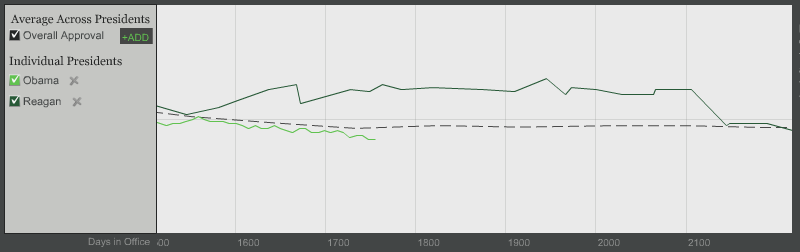
But some other context. Obama’s approval ratings have tumbled because of this credibility gap. They have declined, in Gallup’s measurement, from 45 percent approval to 41 percent in a few weeks. What people forget is that Reagan’s slide was much more dramatic. His approval rating collapsed from 63 percent to 47 percent in one month. That’s the biggest collapse in approval for any president since Gallup began polling. And after that, Reagan came back to the historical average approval rating for all presidents, which is where Obama now is as well. That dotted line is the average for all presidents:

Screen Shot 2013-11-14 at 1.28.13 PM

Obama now is where Reagan was – but sooner in his second term. But Obama, unlike Reagan, can still do something tangible to improve his position: he can make the ACA work and he should soon begin to make a much more aggressive, positive case for the reform. He has an administrative task right now. But he must soon also engage in a critical political task: to get off the defensive and onto the offensive; to make the case for the good things the ACA can do, and is doing; to remind people of the radical uncertainty of the past, and to demand that the Republicans offer more than just cynical, partisan spitballs to address the unfair, unjust and grotesquely inefficient mess that the ACA was designed to reform. That was the gist of his presser today. It needs to become a stump-speech. He needs to get out of his White House administrative mode as soon as he gets a grip on the reform, and launch a campaign mode against a return to the wild west of the past in healthcare and to expose the Republicans as cynical, opportunist critics who refuse to offer any alternative and any constructive reform.

But soon he needs to channel the core argument of this presser into a face-to-face talk with Americans. He needs to be as crisp and candid as Reagan was:

“I screwed up. I’m sorry. I didn’t think it was a lie, but it was. And I’ve changed the law to address the false promise. Now let’s make this reform work.”

Yes, he can.

The Worst Days Of Obama’s Presidency

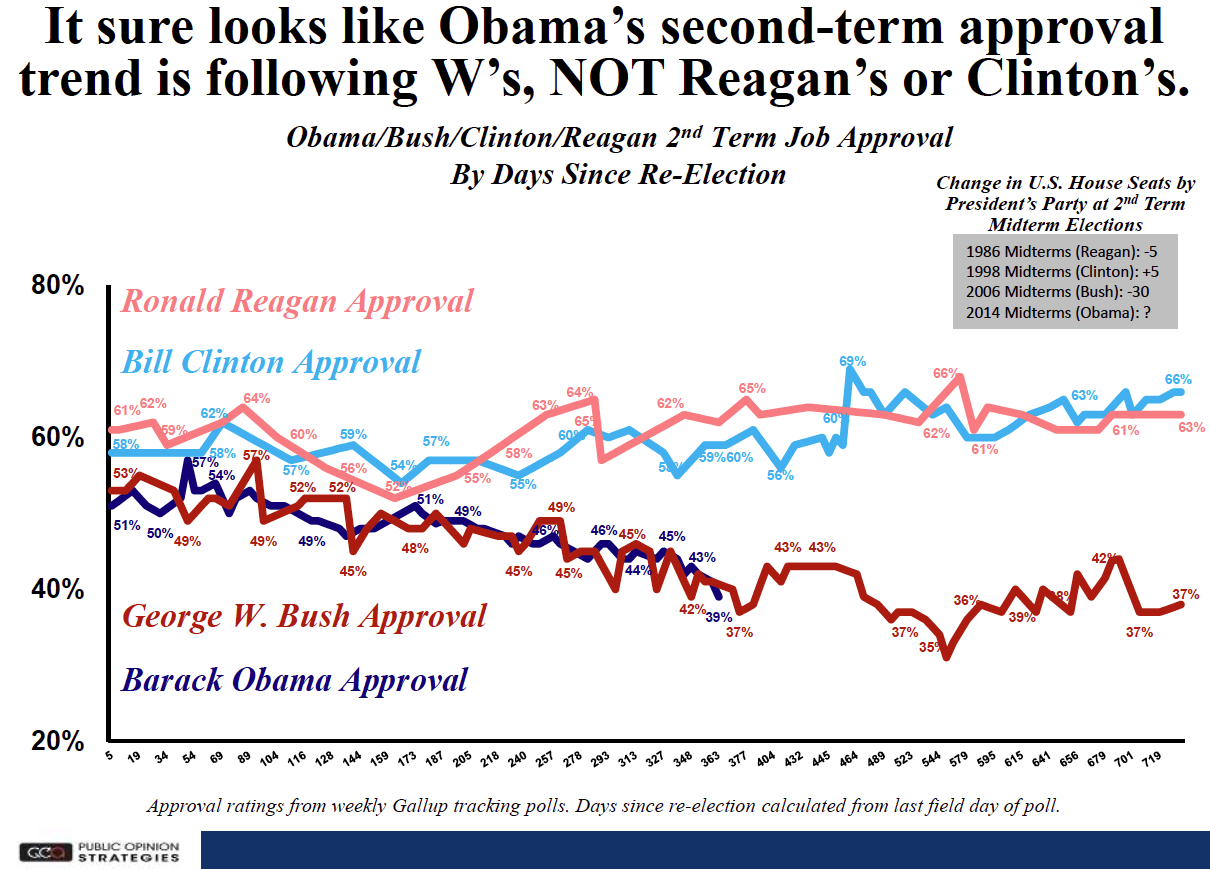
The Fix passes along a depressing chart “from Robert Blizzard, a Republican pollster at Public Opinion Strategies, that details the arc of presidential approval in second terms”:

Obama Chart

Ezra assesses the situation:

Politically and substantively, this is a low for the administration. “Things suck right now,” says one Senate Democratic aide. “They suck unbelievably much, considering where we were six weeks ago.”

The question is whether it’s rock bottom. Perhaps soon HealthCare.gov will improve, congressional Democrats will relax, and the narrative will shift to “comeback” mode. In that world, it’s even plausible that Republicans could underperform in 2014 and decide to take another look at immigration reform before their standing with Hispanics dooms them in 2016, too.

It’s also possible, however, that the Web site will continue to fail, the Obama administration’s agenda will continue to flounder, and the damage will simply mount, leading to a disastrous 2014 for Democrats and an early end for the White House’s second-term ambitions.

Given how volatile our politics is right now – remember the conventional wisdom only six weeks ago? – I wouldn’t jump to conclusions. Except this one: a president can survive a judgment of incompetence in a critical area – like the website clusterfuck. And a president can survive being exposed as a focus-grouped liar on a political promise. But both at once? That could be a fatal combination. And Obama really has no one to blame but himself.

This does not mean an indictment of an entire presidency, or even the sign of a failed presidency. In their second terms, Clinton and Reagan were both exposed as liars – in the Lewinsky mess and the more serious Iran-Contra arms-for-hostages scandal. They were deeply wounded by both dramas, but were retroactively deemed successful nonetheless. The average approval ratings for all presidents (via Gallup) makes Obama look typical at this point, not an outlier, and actually more approved than he has been for much of his presidency:

Screen Shot 2013-11-14 at 11.57.04 AM

I’m not saying this isn’t his worst crisis yet. It is. He may get pummeled some more in the polls. But if the ACA avoids a death spiral, if the GOP overplays its hand or is exposed as having nothing to propose to fix or replace the ACA, if the media shifts from pile-on to come-back mode, then things shift a little. I stick with my recent judgment: if Obama hangs in for stronger economic growth next year, if the ACA eventually works out, and if he can get to a breakthrough on Iran – so near, yet still so vulnerable – then he remains a transformational president.

He is beleaguered on both fronts – but that is partly because he is attempting two hugely ambitious and history-changing projects. We’ll see now, perhaps more than at any point in his presidency, if he has the mettle to endure. And that’s what this is about right now: endurance, and a battle of wills.

When Art Is An Evil Temptress

A reader asked Rod Dreher for his thoughts on a “theology of engagement with rock and rock culture,” prompting these ruminations on the ethics of art:

[W]hen I listen to the Rolling Stones sing in “Sister Morphine” about the desperate haze of drug addiction, I don’t take it as a recommendation to inject morphine, or to introduce myself to “sweet cousin cocaine,” but rather as a darkly potent representation of the power of drug addiction to consume a life — something that Keith Richards knew about. Similarly with the Velvet Underground’s “Heroin.” Neither are moralizing songs; they just describe the experience, and draw a kind of beauty from the bleakness. …

The danger here is that you might also come to sympathize with the sentiment, seduced by aesthetics, and thereby be corrupted. There is no way around this risk, not with real art. It is also possible that genuine art that embodies and communicates the Good could “corrupt” a soul, and lead them toward goodness and light. That’s what the art of the Chartres cathedral did for me. So, when I consider what my “theology” of engaging with rock music might be, or ought to be, I consider that to encounter true art always involves the possibility of conversion, one way or another.

Millman responds by riffing on a 2010 interview Jay-Z did with the Wall Street Journal:

WSJ: What would you change about hip-hop if you could?

Jay-Z: We have to find our way back to true emotion. This is going to sound so sappy, but love is the only thing that stands the test of time. “The Miseducation of Lauryn Hill ” was all about love. Andre 3000, “The Love Below.” Even NWA, at its core, that was about love for a neighborhood.

We’re chasing a lot of sounds now, but I’m not hearing anyone’s real voice. The emotion of where you are in your life.

“The emotion of where you are in your life” – that isn’t always love, and may not always stand the test of time, but it’s something we, as a species, are not very good at living in. If great art enables us to do that, connecting us more deeply to ourselves by connecting us to somebody else who has connected deeply to him- or herself, then I’m for it. And if we can’t make moral sense of that experience, well, sometimes it’s hard to make moral sense of life. But we can’t escape that problem by not living.

The Bloated Bureaucracy Of Private Contracting

A reader writes:

The email from the government contractor is so right on it’s sickening. In an effort to reduce the size of government, Republicans – and some Democrats, but can we all agree that the thrust of the PRIVATIZE EVERYTHING argument comes from the Rs? – have us paying twice as much for the same work, and often the work is totally unnecessary. In many cases, the government actually hires contractors to supervise other contractors – this is insanity. Much like the disturbing loop of Hill staffers who work for a few years then move on to become high-paid lobbyists, government workers who move on to become contractors are just doing what makes the most sense for them, but their goals then change to become what is best for the company they now work for, not the government program or taxpayers.

Similarly, agencies are now hiring managers not for their ability and expertise in the field, but for their perceived ability to deal with contractors. Or the opposite happens and agencies have situations like the Federal Protective Service where (among many, many other problems) law enforcement officers are acting as contracting officer technical representatives and spending hours each day conducting contract guard paperwork checks instead of responding to incident calls and patrolling federal facilities. The Government Accountability Office has done tons of reports on the problems of contracts at specific agencies and the federal contracting world in general. All of this is even more scary when you consider that a single contract can be worth more than $5 billion per year, in the case of a contract issued for support services in Iraq and Afghanistan.

Another reader:

IT is what the government and its contractors do worst. Remember the shock of discovering, post 9/11, that the FBI didn’t have a functioning computer system? The kinds of things your reader highlights are exactly why. Not sure if that ever got settled. The biggest shock in the unfolding NSA revelations is that it apparently has capable hardware and software systems.

Of course nothing will happen to improve federal contracting and oversight because the corporations with these contracts are filled with revolving-door politicians, and they employ the usual army of lobbyists. Ironically, Congress has no one to blame but itself for the mess.

Another:

That person with the epic rant was speaking the truth. I also work for a government contractor and find the process very frustrating, to say the least. The ranter is absolutely right about the many flaws in the process.

Our clients are not in the defense industry and our budgets are much smaller than what the “big guys” see. But the waste is still appalling, most often because of poor management by the government officials. They never, NEVER, approach a project as a business would: with clear goals, established benchmarks and metrics, firm deadlines and a willingness to take steps to either meet those goals, benchmarks and deadlines or to make the necessary corrections if they aren’t met.

Contractors almost never get fired and government staff never do. In most cases, they aren’t screwing up because they’re evil, they just don’t have the mindset of “we need to get this to market now, make sure it meets the needs of the audience, and then fix it if it doesn’t.” I think because in most cases the project in question is designed to “do good” that provides them in their minds with a built-in excuse: so we’re behind schedule and over budget and this isn’t exactly doing what it was supposed to do, it’s helping some people.” So that’s good enough.

What really startles me is how many contracts are awarded because one employee at a mid-management level thinks it’s a good idea. It may well be but in many cases, they leave or no one else shares their interest, so money is spent and nothing is done, or projects wither on the vine for years.

I happen to believe in a large, active government because I believe that if the government doesn’t do it, the private sector will not pick up the slack and the country will suffer. But I hate to see our money wasted, especially as we focus on the deficit and debt. Forget the debate over small vs. large government, the real debate should focus on what steps would our leaders take to make sure the government operates efficiently and effectively.

Now, back to work for me.