A cartoon (after the jump because of its length) that will probably put a lump in your throat:

Stories of three-legged pups from readers here.
A cartoon (after the jump because of its length) that will probably put a lump in your throat:
Stories of three-legged pups from readers here.
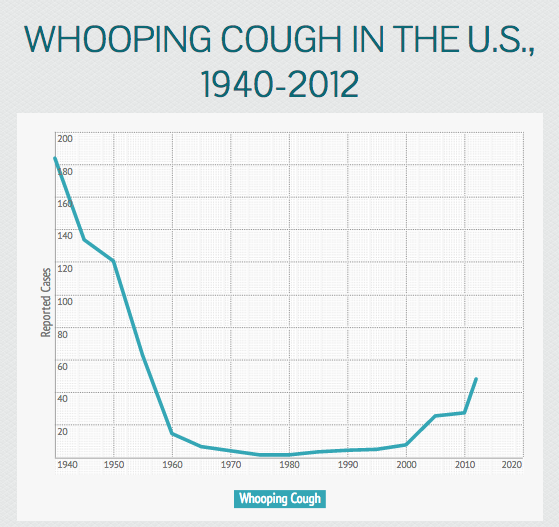
Julia Ioffe describes what it’s like to have whooping cough:
At this writing, I have been coughing for 72 days. Not on and off coughing, but continuously, every day and every night, for two and a half months. And not just coughing, but whooping: doubled over, body clenched, sucking violently for air, my face reddening and my eyes watering. Sometimes, I cough so hard, I vomit. Other times, I pee myself. Both of these symptoms have become blessedly less frequent, and I have yet to break a rib coughing – also a common side effect.
Unsurprisingly, she has some choice words for vaccine denialists:
How responsible are these non-vaccinating parents for my pertussis? Very. A study recently published in the journal Pediatrics indicated that outbreaks of these antediluvian diseases clustered where parents filed non-medical exemptions – that is, where parents decided not to vaccinate their kids because of their personal beliefs. The study found that areas with high concentrations of conscientious objectors were 2.5 times more likely to have an outbreak of pertussis.
Yes, she was vaccinated in childhood:
The problem, in part, is that the protection offered by the pertussis vaccine wears off by the time you reach adulthood. Until recently, however, this was not a problem. Back in those halcyon days when we vaccinated our children, the disease was not bouncing around our population and so it was okay that adults did not get re-immunized. (That’s the whole point of herd immunity: it’s hard to get sick from people who aren’t sick.)
Razib applauds Ioffe for her strategic shaming:
Over the past few years I’ve become much more aware of cultural streams in public health, and the public’s reaction to that health advice, because I have become a father. More specifically, when my wife was pregnant with my daughter, and after she was born, we encountered major pressure from peer networks to not vaccinate. In the social circles in which we were embedded, “progressive,” “crunchy,” and “alternative,” vaccinating one’s child was the heterodox decision. It was rather obvious to us that one of the major reasons that many people do not vaccinate their children is that many of their friends, and vocal people whom they trust, do not vaccinate their children. … [T]his groundswell of denialism must be countered by public opprobrium, and yes, shaming. Peer pressure kills, but it can also save lives.
(Infographic: Jen Kirby)
Tomasky gets real about the ACA:
Obamacare will never be a raging success. This is another error much of journalism is prone to make—looking for it to be an overwhelming success. That won’t happen because at the end of the day we’re still talking about private health insurance, and private health insurance was a pain in the tuchus before Obamacare and will remain one after it. People will always complain about their coverage. But by early 2016, I have little doubt, there will be millions more Americans who’ll be doing the complaining, and they’ll be happy to have the opportunity to do so.
Along the same lines, Beutler expects the GOP’s latest Clinton-seconded reform proposal to backfire:
The Keep Your Health Plan Act would be immensely damaging to Obamacare if it ever became law, and preventing it from becoming law will require Senate Democrats and President Obama to sustain real political damage over the next few weeks. But looking ahead, it will be useful for them to have Republicans on the record against forcing people off of their insurance.
Suderman is much more pessimistic:
[I]t’s time to start considering the worst-case scenarios: that the exchanges continue to malfunction, that plan cancellations go into effect, that insurers see the political winds shifting and stop playing nice with the administration, and that significant numbers of people are left stranded without coverage as a result. Rather than reforming the individual market, which was flawed but did work for some people, Obamacare will have destroyed it and left only dysfunction and chaos in its wake.

Many members are welcoming Bowie and me:
Congrats on the new family member. You said about the missing leg: “it is, of course, the first thing you notice about her”. Not necessarily. We have a three-legged labrador. Time after time, we’ve had people over for dinner, only to have them exclaim at the end of the evening, “Wow, I just realized your dog has three legs!”
Another:
Congratulations on finding Bowie, who “runs like the wind.” Shortly after adopting our three-legged dog, Ceiba, my wife and I were walking with Ceiba and our other dog, Chloe, along the C&O Canal towpath outside D.C. Both dogs were off leash. When a deer ran past in the nearby woods, it was Ceiba who led the charge, leaping over fallen trees and crashing through the brush. Both dogs were soon out of sight, their barking growing ever fainter. So much for the handicap.
Fortunately, the deer was faster than the dogs. On another walk along the canal, Ceiba charged into the brush and reappeared with a freshly caught squirrel between her jaws. Hopping along ahead of us (there was no way she was going to give up that rodent), she proceeded to devour the animal, starting by crunching into its skull.
Dog paddling seems to be the only thing our girl can’t do; it’s tough when you’re missing a front leg. At the local park, she’s got dozens of fans, especially kids – “Look, the three-legged dog!” Ten years on, she remains a joy and an inspiration.
Another:
Welcome to the three-legged beagle club! Jake came to my wife Sharon and me via a beagle
rescue organization near Nashville (where we live) several years ago. His previous owners had him tied to a chain in the yard. While they were mowing the yard, the chain had become wrapped around the shaft of the mower and Jake was pulled under, mangling his left front leg beyond saving. Afterward, they were planning to turn him over to a shelter before the rescue organization took him in.
The two things that are most amazing about Jake (it’s hard to narrow down to just two!) are that his default setting is happy – he wakes up wagging his tail every morning – and, as you note about Bowie, he is utterly oblivious to his handicap. Nobody has ever told Jake that missing a leg is a problem, so for him it isn’t. He digs massive holes in the yard, he runs after squirrels and plays with his “sisters” – our two other dogs – and never gives a thought that there is some sort of problem with his curious, hoppy gait.
He is also, of course, nothing but trouble. As Bowie will be.
Another:
One of our older greyhounds got bone cancer in his right rear leg. Instead of putting him down as everybody suggested, a vet surgeon removed his leg and he happily lived for three more years as a tripod … until the cancer returned with a vengeance. But those three years were glorious and happy for him. He could go for long walks and run on the beach and splash in the water and swim though waves. He was also one heck of a draw (and a ham); people would cross the street to say hello to him and give him an ear rub.
And another:
Welcome to the world of a 3-legged rescue dog. We got Lego (formerly Rambo, but he’s no Rambo) about a year and a half ago. A lab mix, he is the sweetest, most joyful dog I’ve ever known. I couldn’t be happier that my wife took him in.
Another asks:
Who is rescuing whom?
The news agency is under fire for allegedly killing stories that would upset the Chinese government. Gwynn Guilford and Gideon Lichfield have details:
The New York Times reported last week that Bloomberg had scrapped an investigative report linking China’s richest man with top party officials, as well as another article on children of Chinese leaders working at foreign banks. The Financial Times followed up today (paywall) with similar allegations. According to both papers, Matt Winkler, Bloomberg’s editor-in-chief, spiked the reports after they had already been fact-checked and vetted by lawyers; he allegedly told reporters on a conference call that if Bloomberg ran stories of that nature, it risked being “kicked out of China.” Winkler and other senior executives say he made no such claim, and suggested that the stories had not been scrapped but merely weren’t yet good enough to publish.
CJR’s Dean Starkman fears the worst:
News “employees” (as the Times calls them) don’t usually put their jobs on the line to talk about stories they feel are being spiked (or “postponed,” as Bloomberg puts it), no matter how bitter the internal arguments. …
There is rarely a “smoking gun” in such matters, so to speak, and it’s a difficult argument to win outright, so most frustrated reporters don’t go public on such matters, even through leaks. Plus, generally there aren’t that many people involved in an internal controversy like this, so sources are more vulnerable to exposure than they might be in your usual inside-the-newsroom stories, like, for instance, Politico’s gossipy piece on Jill Abramson. The allegations there were so vague and catty that anyone could have been the source. That’s not the case in the Bloomberg affair. And yet whomever the sources were leaked the dispute anyway, in some detail and at considerable career risk – with little upside. That’s unusual and, in my opinion, it tips the scales in their favor.
Fallows thinks through the company’s motivations:
The less-damaging rationale for this decision is Bloomberg’s concern that its reporters might be kicked out of China. The more-damaging suspicion is that the company was worried that it would lose subscribers in China for its cash-cow Bloomberg financial terminals.
But he adds that the real story here is China itself:
[L]et’s not lose sight of the larger point: Bloomberg is (apparently) wrong for acquiescing, but the real problem is obviously with the parts of the Chinese government that are afraid of what domestic and international reporters would say. Which brings us to the day’s second bit of downbeat news: the Chinese government’s refusal to renew a visa for Paul Mooney, a well-respected reporter who has spent his career covering Asia. Apparently the government didn’t like his tone about Tibet. This is part of a much more widespread pattern of making it hard for international journalists to get into China.
This is not the way a confident, big-time government behaves.
Noah Berlatsky suspects that artist David Trumble’s efforts to satirize Disney princess imagery – by depicting real-life feminists in that style – may have the opposite effect:
The point here is supposed to be that, contrary to what Disney might be suggesting, strong, inspiring women—female role models—don’t need to be princesses, and that turning them into
princesses trivializes them. Heroes don’t need sparkles, and sparkles distract from the heroines. In fact, though, Trumble’s drawings don’t so much satirize princesses as, rather wonderfully, validate them.
In some cases the satire works. Turning Anne Frank into “The Holocaust Princess” (later changed to “Diary Princess”) is, baldly tasteless, as Trumble intends. The princess narrative of wealth, prestige, and gutsy triumph sits very uncomfortably next to the persecution and mass tragedy of the Holocaust. The cute, sparkly, flowery dress and big-eyed cheer comes across as inappropriate, ghoulish irony; her blank cheer almost seems to mock Frank’s real life. …
But, as it turns out, making Gloria Steinem a princess is not silly and artificial. Instead, it is awesome. Which suggests, first of all, that femininity is, or can be, awesome. It can be smart, or fierce, or courageous, just like masculinity can. In his caption for Princess Malala Yousafzai, Trumble writes, “She risked all for what she believed in, for education and equality for young girls everywhere! But never mind that … Look! Sparkles!” In the drawing itself, though, those feminine sparkles don’t make Yousafzai less determined. On the contrary, they seem part of the determination and the commitment. Gloss them as cynically as you will, but if you put stars on Malala Yousafzai’s dress, those stars mean hope.
(Image courtesy of David Trumble)
It’s called MafiaLeaks, naturally:
Despite the inevitable comparisons to WikiLeaks, the framework of the site is based on the open source project GlobaLeaks, and bears similarity to the New Yorker’s Strongbox project, as well as the late Aaron Swartz’s SecureDrop. All three emphasize the anonymity of the whistleblower: not even the recipients of the information know their identity, nor can they ever find it out. Once submitted to MafiaLeaks, the data remains on their server for 20 days, encrypted with a key which is only visible to the whistleblower and their chosen confidant. … The time, more than two weeks and less than a month, was chosen because repeat visits to an internet café could become suspicious.
Meghan Neal asks:
What if a hacker manages to exploit some security hole and trace your message back to your real identity? You’re probably getting murdered. This risk isn’t lost on the project’s founders – who obviously wish remain anonymous themselves. They write on the website’s FAQ: “We are not asking you to trust MafiaLeaks. Indeed, please do not trust MafiaLeaks! Send your information anonymously, do not leave your name, do not leave anything in the data that can be traced back to your person.”
Joe Kloc sizes up the site:
In many ways, [MafiaLeaks] presents a less controversial application of the WikiLeaks model than revealing state secrets.
Using the anonymity provided by encryption may prove an effective way to combat crime while protecting the identities of those fearing reprisal. However, the comparison between WikiLeaks and MafiaLeaks isn’t perfect. In the former’s case, there is relatively little incentive for governments to leak falsely incriminating evidence. With MafiaLeaks, there’s a considerably higher risk that the platform’s anonymity will allow it to be manipulated and exploited by organized crime family members. Further, WikiLeaks accepts primary government documents that can be verified. It isn’t entirely clear how the leaked information on MafiaLeaks will be authenticated, or whether it will be admissible in court
But documents aren’t everything:
Lirio Abbate, an Italian journalist who has reported on Mafia for years, warns that it will be hard to obtain documents since Mafia organizations don’t issue meeting minutes or receipts for murder hits. But the site could find success if it can gather video or audio evidence. “That would be devastating, that would create an enormous anti-Mafia revolution,” Abbate told Mashable.
A reader reflects:
I worked at a Blockbuster for about three years, starting in high school and continuing when I was in college. As a budding filmmaker and rabid cinephile, it was pretty much the perfect job for me. Sure, the pay sucked, but the bottom line was I was being paid to indulge in my number one passion.
Blockbuster had an inventory management system whereby if a particular video had not been checked out within the past year, it would get flagged by the system for resale. We’d actually take the video off the shelf, price it, and put it in the used video sale bin. As a movielover, this greatly upset me. So I made it my mission to look up movies that I cared about and check them out under my employee account if they were in danger of being weeded. David Lynch, Jim Jarmusch, and Wim Wenders owe me big time. (Here’s a post I wrote about one of my encounters as a Blockbuster employee.)
Another was there at the beginning:
The recent announcement of the closure of Blockbuster brought back some fond memories for me. I worked at the original Blockbuster in Dallas – the Medallion Store, as we called it (it was located in a strip mall that was then known as the Medallion Center).
I’m sure Jason Bailey’s descriptions of know-nothing employees is accurate, but not in the beginning, certainly not at Medallion. We knew our stuff. I suppose the difference between my 1985 Blockbuster experience and Jason Bailey’s was that, in 1985, we still were a mom-and-pop enterprise. I think by the time I left the store for the real world, there were still only seven stores. And we had employees who loved movies.
We had SMU film majors like Todd, who would occasionally answer the phone in character (Jack Nicholson: “Blockbuster Video, what the hell do you want?”). We had working local actors and actresses like Laurel, keeping a day job in a field she loved that had hours flexible enough for her to ply her craft on the weekends. We had writers like Betsy who was a staple in Dallas-area TV and radio. And we knew our movies; we knew the shit out of them. I had customers who would come directly to me for all of their movie recommendations; I remember pointing a man to a little-known new movie by a couple of then-unknown brothers and winning his loyalty for life (Blood Simple). I remember impressing a girl so much with my foreign film knowledge by pointing her to the films of Jean-Jacques Beineix that we ended up watching Betty Blue together on the couch in her one-bedroom apartment and doing it on that same couch before Betty had even poked her eye out. And we even got the occasional celebrity: I met Chris Evert, NBC sportscaster Bill Macatee (dating Evert at the time, allegedly), and the writer Calvin Trillin (whom I surprised simply by knowing who he was).
Blockbuster had obviously grown too big for its own good; it couldn’t keep pace with modern technology and its passing was inevitable. But I for one will mourn that passing.
Another reader:
I clerked at Blockbuster off and on for four years. It was a part-time college job, and every time I’d leave and come back they’d have a new store manager and would want me to go through training again because they’d changed some insignificant procedural detail of the job like a new step in the nine-step checkout process. Yes, they wanted you to go through all nine steps of a carefully scripted upselling routine, and even though most of us didn’t follow it, every clerk had little printouts of the process taped to our computer monitors.
I tended to only observe steps 1, 8, and 9 because I’m a big fan of not slowing down the line, although we’d often add in the all-important “negotiation over and removal of late fees” steps. Those weren’t in the official process for some reason, but the district manager once told us “it’s not worth losing a customer over a late fee under $10.” I didn’t ask for any clarity beyond that, as it seemed like cart blanche permission to remove all my friends’ fines, and if they racked up larger ones I could just take them off in installments.
The point of sale system that I used in my last year there (2004) was DOS-based and probably hadn’t changed since the early-’90s. It had severe limitations on memory, meaning that transaction-level data would drop off after six months. The system would retain records of old late fees, but we wouldn’t have a way of referencing the original transactions. This meant that one easy way to avoid paying a fee was to just wait a few months and then ask a clerk what movie the fee was for.
Unlike most libraries, the systems were not networked, so I had no way of checking inventory at other stores without calling them. This often played out on busy Friday night shifts with a long line and a popular new release that everyone wanted and no one had in stock. And naturally we’d often get tied up with an insistent customer who wanted us to call every Blockbuster within a 30-minute drive.
Blockbuster settled a class-action lawsuit over late fees in 2001, and for several months we were printing out information about it onto everyone’s receipt. The receipts stretched beyond 3-feet (yes, we measured), and there was a phone number that people could call to get a couple of coupons for free rentals and $1 off candy. Another consequence was that clerks were no longer allowed to refer to these controversial charges as “late fees.” They were now “extended viewing fees,” but the policy didn’t change.
The perks of the job included the free rentals and the exposure to the eclectic mix of customers in the Delmar Loop neighborhood of St. Louis. The Loop is a stretch of bars and restaurants near a university, so you could count on a steady stream of the inebriated from mid-evening to midnight on most nights. I’m also a firm believer working at least one retail or restaurant gig during a holiday season builds character. We found ways to have fun with it all. For my part, I always made sure that Die Hard made its way to the special display of holiday movie rentals.
In hindsight, the only things working against Blockbuster were the ridiculous pricing model, widespread hatred from the customer base over late fee policies, auto-charging of credit cards for said fees, traditional competition from Hollywood Video and indy stores (which could carry porn), new competition from Netflix, Redbox, BitTorrent, YouTube, Amazon, premium cable channels, OnDemand, Dish, and Hulu, and massive cultural shifts in media consumption patterns caused by widespread adoption of the internet and the move away from removable media formats in general. But other than those things, Blockbuster’s business model was completely sound.
Jeremy Gordon examines the reliance on the collective pronoun in making an argument:
Over time, the “royal we” has made its way from the mouths of Queen Victoria and Margaret Thatcher into our writing. At best, it seems a crutch, while at worst it’s an assumed arrogance. Here’s but one example from The New Yorker’s Sasha Frere-Jones, writing a jeremiad against Jay-Z:
However thick the darkness, we drag ourselves into arguments, up to lecterns, because we have not let go of each other yet. We still think we can fix a thing that shows no sign of ever being fixed.
… [I]t’s clear this isn’t a literal case of the royal “we.” (It’s hard to imagine any music writer being that arrogant.) Instead, it’s a rhetorical trick to make the reader say “I guess I do drag myself into the argument despite the thickness of the darkness!” Because with his “we,” who is Frere-Jones speaking for?
Himself, trying to avoid the English class no-no of using first person? The New Yorker, with the “we” a formal endorsement of what’s being discussed? Is it even more far-reaching than that, leaping off the screen to presume how the reader is supposed to feel? Without some kind of clarification, there’s really no way to know.
Writing in Personal Pronouns in English Language, English professor Katie Wales notes the irony: “‘We’ itself is often used, out of modesty, for example, to resist the egocentricity of a potential ‘I’; yet an egocentric ‘meaning’ will often be re-asserted.” In hiding the individual author, a consensus opinion is born. No one person thinks this thing; we do. And because the entire reason of why you’re reading is because you think the writer has something to say, you’re subconsciously agreeing before you’ve even thought otherwise.
Noting a series of populist victories among Democrats, Scheiber suggests that such forces could pose a serious obstacle for Hillary. He thinks Elizabeth Warren could prove to be a formidable opponent:
It’s hard to look at the Democratic Party these days and not feel as if all the energy is behind Warren. Before she was even elected, her fund-raising e-mails would net the party more cash than any Democrat’s besides Obama or Hillary Clinton. According to the Times, Warren’s recent speech at the annual League of Conservation Voters banquet drew the largest crowd in 15 years. Or consider a website called Upworthy, which packages online videos with clever headlines and encourages users to share them. Obama barely registers on the site; Warren’s videos go viral. An appearance on cable this summer—“CNBC HOST DECIDES TO TEACH SENATOR WARREN HOW REGULATION WORKS. PROBABLY SHOULDN’T HAVE DONE THAT”—was viewed more than a million times. A Warren floor speech during the recent stalemate in Congress—“A SENATOR BLUNTLY SAYS WHAT WE’RE ALL THINKING ABOUT THE OBNOXIOUS GOVERNMENT SHUTDOWN”—tallied more than two million views.
Warren would have her work cut out for her; Harry Enten calls Clinton “the most formidable presidential frontrunner in the modern era”:
The only candidate anywhere close to Clinton was Al Gore for 2000. Gore had long been in the upper 40s to mid 50s. Gore went on to waltz to the nomination in the single strongest non-incumbent performance in the modern era. He won every single primary and took 76% of the primary vote.
Clinton’s numbers look a lot more like an incumbent. Bush was in the low 70s for 1992. Clinton was in the low 60s to low 70s for 1996. Obama mostly was in the low to mid 60s for 2012, even when matched up against Hillary Clinton.
Moreover, Clinton’s edge extends to the early caucus and primary states. Your national numbers can be amazing, but if you don’t win either Iowa or New Hampshire, you’re likely not going anywhere. Clinton is in the mid 60s in New Hampshire and the low 70s in Iowa.