Dogs in wide definition:
But South Park got there first:
Dogs in wide definition:
But South Park got there first:
After her mother died, the poet Joy Katz stopped reading verse – it “felt false” to her, and she distrusted the ability of words to capture what she was experiencing, words that too often “reduced death to a salvo.” And then she stumbled upon Sarah Ruhl’s play, Eurydice:
The play said: elegies are false. They think they can talk to the dead, but dead people speak in the language of the dead, and we can’t.
Eurydice is about the playwright’s own bereavement. After dying and traveling to the underworld, Eurydice sees her father, but she does not recognize him. An ocean of sadness opened up in me as I watched. This play understood what the loss of a person means. I couldn’t speak to my mother not because I didn’t know where she was, and not because I had too little faith or imagination to envision where she was. I couldn’t speak to her because I could not recognize the Her she had become.
For me, the vital part of grieving was not to try to “resolve” or cross this distance. It was the distance. Eurydice led me back to poetry because it is not an elegy. It is about being left behind.
What all this taught Katz about poetry and grieving:
In the years since, I have found poems into which I can take my remnant grief. It took me a while to sense what kind of writing I could trust with it, because my relationship to poetry was shifting. Owing to my mother’s death, I had become uneasy with closure and impatient with poems that offer epiphanic “truths.” Poems of sorrow, especially, needed to do something else.
The ones that sustain me, I find, have to do with living people, humans who mourn, rather than with the departed. These poems are not “like” grieving—they are not lamentations—but instead open up the isolating process of mourning. They translate sorrow through poetic form rather than confining it to a metaphor.
In an interview, the theologian Nigel Biggar, author of In Defence of War, a new book about the Christian just war tradition, answers with a qualified yes:
Forgiveness is a moral category before it’s a religious one. Nevertheless, it’s a virtue that
features with distinctive prominence in the Christian tradition. This is partly because Jesus made it a primary characteristic of God, of course. But it might also be because eschatological hope that God will intervene to rectify un-righted wrongs at the end of time makes forbearance in the face of injustice here and now more psychologically possible, because it’s more rational.
Since the paradigms of forgiveness, repentance, and reconciliation are interpersonal — think Rembrandt’s Prodigal Son — when we talk about such things in the context of political or international relations, we’re talking about something analogous and weaker. Can nation-states forgive? Yes, but only in an attenuated fashion. Nation-states are not likely to embrace their enemies — certainly not in the midst of conflict — but they can and should have compassion for them, where compassion is due. And compassion is the matrix of forgiveness.
Biggar offers this example of what he’s describing:
[I]t would have been absurd for the United States to react to the attacks of 9/11 by declaring to al-Qaeda that it would continue to treat it as a friend. But it would not have been absurd for it to react by — among other, retributive things — straining to understand what motives had driven young, well-educated, middle class Arabs to sacrifice themselves in such a horrendous manner. Perhaps in the rank undergrowth of their deeply distorted worldview there lay some grievances that were justified and that deserved redress — say, the running sore of the unresolved plight of the Palestinian people. In that case, a complete response to 9/11 would have involved moments of rectification, as well as moments of retribution. Righteous hostility would have been tempered by a measure of compassion.
(Rembrandt’s The Return of the Prodigal Son, circa 1664, via Wikimedia Commons)
James Parker puts Flannery O’Connor’s youthful prayer journals in context, describing her time at the Iowa Writer’s Workshop as where “spiky, brainy Mary Flannery O’Connor from Milledgeville, Georgia, became Flannery O’Connor, writer”:
Arriving in 1945 as a postgraduate student at the University of Iowa, she promptly homed in on the creative-writing classes run by the poet Paul Engle. Women were a minority at the time: by 1946, more than half of Engle’s pupils were returning servicemen,
many of them writing stories about their experiences during the war. On the surface, as O’Connor’s biographer, Brad Gooch, tells it in Flannery, she was a quiet but significant classroom presence: “She scared the boys to death with her irony,” remembered one visiting lecturer, Andrew Lytle. Beneath the surface, as recorded on the 47 and a half handwritten pages to which we now have access (A Prayer Journal includes a facsimile), she was refining her vocation with the muscularity and spiritual ferocity of a young saint-in-waiting. The first page or pages of the notebook have been lost, and it begins—how poetic is this?—mid-sentence, with “effort at artistry.”
“Smash the ego,” wrote Peter Schjeldahl in a 1979 poem called “I Missed Punk,” “which always reconstitutes / (and if it doesn’t, well, / your worries are over).” For O’Connor, the space left by the destroyed ego—we can imagine it as a kind of humming vacancy, drifting with pieces of burned paper—was holy because it belonged to God. And she wanted it. Or, more precisely, and more poignantly, she wanted to want it. “Dear Lord, please make me want You. It would be the greatest bliss … to have the want driving in me, to have it like a cancer in me. It would kill me like a cancer and that would be the Fulfilment.” Electric with literary ambition, she prays to be erased. A paradox? Hardly. “Don’t let me ever think, dear God,” she pleads, “that I was anything but the instrument for Your story.”
About that irony – and how it connected to the deepest themes in her writing:
O’Connor’s was not the shifty, reactive, and merely local variety that passes for irony today: sitcom irony, skinny-jeans irony. It was vertical and biblical: the irony by which the mighty are lowered, the humble exalted, and the savior dies on a cross. And she would shortly be required to submit to it herself, in full. Within three years of leaving Iowa, where she had prayed for desire of the Lord to claim her like a disease, she was diagnosed with lupus. Stricken, she returned to her mother’s farm in Milledgeville, her base of production for the novels Wise Blood and The Violent Bear It Away, and the short-story collections A Good Man Is Hard to Find and Everything That Rises Must Converge, the latter published posthumously. Health and sex and adventure had been taken from her, and in their place was a vision, her world, blast-lit and still reeling under the first shock of creation. “The air was so quiet,” she wrote in “The River,” “he could hear the broken pieces of the sun knocking in the water.” It was a gift. And we are left with a question: Without this terrible narrowing-down, would she have achieved the greatness she prayed for?
Previous Dish on O’Connor’s prayer journals here and here.
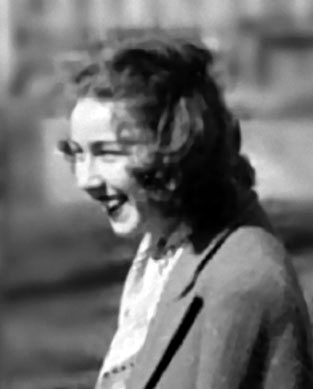
(Image of O’Connor in 1947 via Wikimedia Commons)
Laura Keynes praises Kate Cooper’s Band of Angels, a new book that details “the largely unknown role of women in shaping the early Church”:
Cooper understands that women’s power doesn’t always come through formal institutional roles. Rather, it’s the “informal happenings of daily life” — sharing a meal, caring for the vulnerable, offering hospitality — that provide a framework for the transmission of culture. Christianity lacked a formal structure in its earliest years: meetings took place in courtyards or households, communities formed around converted families. Women were often at the centre of things, providing hospitality and shelter for new converts and creating what Cooper calls a “tide of female networking.”
If all that sounds rather boring, think again:
Band of Angels is not a dry work but a pacy tale of heroines, martyrs, virgins, mothers and sisters. … Early Christianity from a woman’s point of view is not a tale of domestic drudgery. These are women of spirit who “discover a blazing fierceness of purpose when faced with the impossible”. Women like Thecla, for example, who turned away from her expected role as wife and mother, leaving fiancé, home and family to follow Paul and preach the gospel. This kind of thinking didn’t go down too well with the imperial authorities and many early Christian women met sticky ends in Roman arenas, thrown to the lions in gladiatorial games.
Commenting on the book in August, Lucy Winkett wrote:
That women figured so prominently as Christianity was being formed makes their institutional silence in later centuries more poignant and casts new light on today’s debates about women and religious authority. … Reading about these first 500 years with the following thousand in mind makes the words of these early women all the more powerful, because we know that their successors were shut out of public office, banned from teaching and martyred for suggesting that their voices should be heard. Cooper’s rediscovery of these women rescues them from a fate as silent pastelled saints and virgins in the frescoes of many churches. The members of the “band of angels” in this book are not perfect, but they are witty, flawed, compassionate, loving and brave – as those of us who are women know we can be.
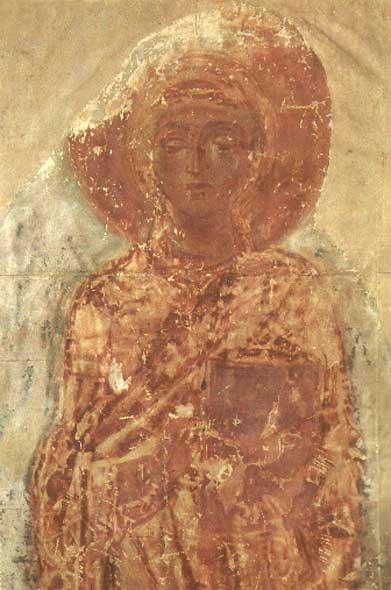
(Image of fresco of Saint Thecla via Wikimedia Commons)
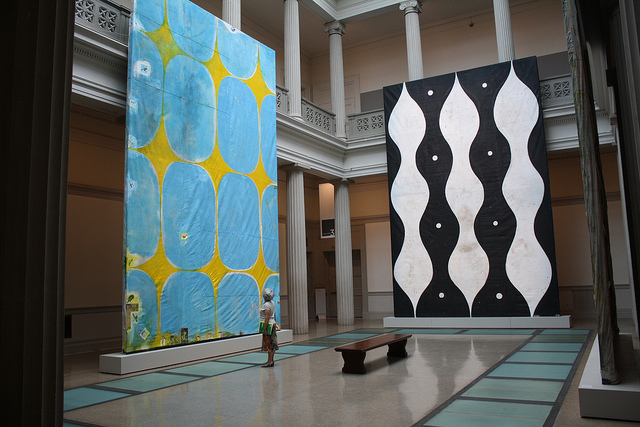
In an interview with The Believer, artist Chris Martin shares his thoughts on how the idea of “spirituality” applies to his work:
BLVR: The term spirituality is mentioned a lot around your paintings and I’m curious whether you agree with that connection.
CM: I think the word spirit comes from the Latin word for “breath”—spiritu—and I think the origin of the word spirituality has to do with breath and life force, the mysteries of the ancients and all this. The word is very suspect in much of the art world—the Western art world, now. Certainly, spirituality has become divorced from religious.
BLVR: Some people talk about how the art world is comparable to religion. It has a community, a shared language about something ineffable, a sort of icon worship.
CM: When people have a hard time with the word spirituality they’re assuming spirituality is something extra-mystical on top of what we all know to be true.
But that’s just a big pile of steaming shit, because really what’s at stake here is a question of what’s real, and when one tries to engage with serious questions about what is real, then things can get very mysterious and spooky. I hate the word spirituality but I… um, sure, why not use that word? We can think about the breath rather than think about some kind of empirical, material, formal idea of what this society thinks is real. And the word mystical is an even worse word than spirituality—that artists take drugs, and then they add some crazy extra thing to what we all know is real. But our job as artists or as human beings is to investigate what we really think is real, and to come back to the tribe and say, this is what the world feels like to me.
(Photo of works by Chris Martin from his 2011 exhibition “Painting Big” by Elvert Barnes)
David Auerbach reviews the autobiography of science writer Martin Gardner:
Gardner is at his most emotional describing what seem[s] to have been a classically happy marriage — he recalls sitting on the subway with his wife and newborn as one of the happiest moments of his life, a moment of peace and accomplishment, not ambition or prestige — and describing a very traditional sense of religious awe. While Gardner had no patience for supposed evidence of anything supernatural, he remained a firmly nondenominational monotheist for most of his life. He baldly admits that this is a matter of faith and flies in the face of all available evidence, and that it is a choice he has made for the sake of his own happiness. I suppose you could say he proselytizes a bit, but since he knows that his case is weak, he doesn’t come off as particularly confrontational: “I managed to retain faith in a personal God and a hope for an afterlife.” Gardner writes:
Philosophical theism is based unashamedly on posits of the heart, not the head.
It freely admits that atheists have all the best arguments. There are no proofs of God or of an afterlife. Indeed, all experience suggests there is no God. If God exists, why would he so carefully conceal himself? All experience suggests that when we die, our body rots and nothing in our brain survives. […] It’s a lasting escape from the despair that follows a stabbing realization that you and everyone else are soon to vanish utterly from the universe. It is an effort, perhaps genetic, to relieve the anguish of believing the universe is nothing more than the tale of a blind idiot, full of sound and fury and signifying nothing.
A weak case seems to make for a more robust faith.
Natasha Geiling relates the story of Veuve Clicquot, the champagne named for the woman who “created the modern champagne market” in the early 1800s:
Champagne is made by adding sugar and live yeast to bottles of white wine, creating what is known as secondary fermentation. As the yeast digests the sugar, the bi-products created are alcohol and carbon dioxide, which give the wine its bubbles. There’s only one problem: when the yeast consumes all the sugar, it dies, leaving a winemaker with a sparkling bottle of wine–and dead yeast in the bottom. The dead yeast was more than unappetizing–it left the wine looking cloudy and visually unappealing. The first champagne makers dealt with this by pouring the finished product from one bottle to another in order to rid the wine of its yeast. The process was more than time-consuming and wasteful: it damaged the wine by constantly agitating the bubbles.
Barbe-Nicole [Clicquot] knew there had to be a better way.
Instead of transferring the wine from bottle to bottle to rid it of its yeast, she devised a method that kept the wine in the same bottle but consolidated the yeast by gently agitating the wine. The bottles were turned upside down and twisted, causing the yeast to gather in the neck of the bottle. This method, known as riddling, is still used by modern champagne makers.
Barbe-Nicole’s innovation was a revolution: not only was her champagne’s quality improved, she was able to produce it much faster. Her new technique was an extreme annoyance to her competitors, especially [vintner] Jean-Rémy Moët, who could not replicate her method. It wasn’t an easy secret to keep, since Barbe-Nicole employed a large number of workers in her cellars–but no one betrayed her secret, a testament to her workers loyalty, [The Widow Clicquot author Tilar] Mazzeo explains. It would be decades before any of them became wise to the method of riddling, giving Barbe-Nicole another advantage over the champagne market. … Veuve Clicquot helped turn champagne from a beverage enjoyed solely by the upper-class to a drink available to almost anyone in the middle-upper class–a seemingly small distinction, but one that vastly increased Barbe-Nicole’s market.
From a new study on videogame violence:
Christian Happ and his colleagues recruited 60 students (20 men) with varied video gaming experience and had them spend 15 minutes playing the violent and bloody beat-em-up game Mortal Combat vs. DC Universe on the Playstation 3. Some of the participants played the morally good character Superman, while the others played the Joker, the baddie from Batman. Apart from that, the game experience was the same for all participants – their time was spent in hand-to-hand combat against a variety of other computer-controlled game characters.
Another twist to the experiment was that before the game began half the participants read a bogus Wikipedia article about their character, designed to encourage them to empathise with him. For those playing Superman, the article said how he’d come from a loving family. The Joker article described how he’d suffered abuse in his childhood.
After playing the video game, the participants looked at grids of faces on a computer screen and indicated how hostile they looked. Some of the grids contained angry faces, but the crucial test was how hostile the participants rated the grids that contained all neutral faces. The key finding here was that participants who’d played the Joker were more likely to perceive hostility in neutral faces (a marker of an aggressive mindset), as compared with the participants who played Superman.
Another test was an old favourite known as the “lost letter technique”. As the students left the lab, they saw a stamped and addressed envelope on the floor outside. Those who’d played Superman in the violent game were 6.2 times more likely to post the letter or hand it in to the researchers, as compared with those who played The Joker (the rates were 20.7 per cent vs. 3.3 per cent, respectively).
Previous Dish on videogames and violence here, here, and here.
(Video via Devour: “From Wolfenstein 3D to Battlefield 3, here’s a look at how first person shooters have changed since 1992.”)
Matthew Hutson describes the work of psychologist Kurt Gray, whose research into how people objectify each other has yielded intriguing findings:
In one experiment, subjects saw a photograph and a short description of a man or a woman. The photo showed either just the head or also the shirtless torso. When presented shirtless, targets were seen as having less competence. This is just what you might expect from research on objectification: we’re easily induced to see others as mere objects, pieces of meat without thoughts of their own. But it wasn’t that simple. Shirtless targets weren’t seen as devoid of all thought. They were actually seen as being more capable of emotions and sensations than their less exposed selves. They didn’t have less mental life but a different mental life. Objectification is apparently a misnomer.
To explore the issue further, the researchers turned to the book XXX: 30 Porn-Star Portraits:
The photographer Timothy Greenfield-Sanders had shot 30 stars, first fully clothed, then naked, in the same position and with the same expression. The researchers used these images in a series of experiments and … [i]t turned out that naked porn stars are also seen as having less competence but more sensitivity than their clothed selves. And when one actress was shown in an especially sexual pose, the trend only increased, presumably due to greater focus on her body and its pleasures. True objectification, as traditionally conceived of, just did not happen. …
What emerged was that we see the capacity for feelings, whether pleasure or pain or happiness or anger, as distinct from the capacity for intellectual thought and planning. Namely, that we treat those we objectify as less intelligent, yet simultaneously we endow them with a greater ability to feel things. … In most cases, thinking of a person as a body does not lead to objectification in a literal sense, in which the person becomes an object. Rather, he’s dehumanised — he becomes a sensitive beast.

 The Dish


