Would You Take A CompSci Course Taught By Matt Damon?

Some MOOC providers hope so:

“From what I hear, really good actors can actually teach really well,” said Anant Agarwal, CEO of EdX, who was until recently a computer-science professor at MIT. “So just imagine, maybe we get Matt Damon to teach Thévenin’s theorem,” he added, referring to a concept that Agarwal covers in a MOOC he teaches on circuits and electronics. “I think students would enjoy that more than taking it from Agarwal.”

Casting Damon in a MOOC is just an idea, for now: In meetings, officials have proposed trying one run of a course with someone like Damon, to see how it goes. But even to consider swapping in a star actor for a professor reveals how much these free online courses are becoming major media productions—ones that may radically change the traditional role of professors.

Jeffrey Young notes that one MOOC provider, Udacity, already employs scriptwriters who turn lecture notes into productions “complete with demonstrations and suggested jokes.” He adds, “At least one long-time distance education expert argues that it makes sense to look for acting talent rather than deep content knowledge to appear on camera”:

“Having people who are really good at explaining ideas and putting the right graphics and videos around them can create a pretty darn good learning experience,” said Russell Poulin, a researcher with the Western Interstate Commission for Higher Education. “I’m assuming Matt Damon wouldn’t be answering the questions from students,” he added.

In fact, he argued that one benefit of online learning is that the various parts of the professor’s role can be “pulled apart.” In an online course, he argued, there’s no reason to have the same person develop the content, deliver it, and run assessments, when people with skills in each of those areas can work together to create clearer and more effective lessons.

That essentially argues for treating the development of a MOOC like a Hollywood production, with long credits at the end of the many specialists who teamed up on a shared vision. There’s a director running the show, but no one expects the same person to also act all the roles.

Previous Dish on MOOCs here, here, and here.

The Problem With Palm Oil

dish_oilpalm

Hillary Rosner warns that “palm oil is one of the planet’s most destructive ingredients”:

It is largely responsible for the massive deforestation of Borneo. As companies slash, burn and bulldoze rain forest to plant uniform rows of oil palm trees, they’re decimating the island’s legendary biodiversity, driving up greenhouse gas emissions and destroying the livelihoods of local subsistence farmers. …

World markets are ravenous for palm oil, and demand shows no sign of waning.

Production doubled in the 2000s and is expected to double again by the end of this decade. In Asia, it’s used for cooking; in Europe, it’s feedstock for biofuel (a particularly egregious example of bad policy-making). In the U.S., it’s an ingredient not just in foods and health and beauty products, but in the ingredients that make up those products — vitamin A palmitate, sodium laurel sulfate, stearic acid. That means palm oil is often absent from the label, leaving consumers in the dark about what they’re actually buying and its impact. …

Today, most consumers remain unaware either that they’re eating palm oil or that there’s anything wrong with it. A recent campaign by talk show host Dr. Oz even encouraged consumers to buy more palm oil, touting its health benefits. Palm oil may be the ultimate icon of globalization — an ingredient directly responsible for some of the world’s most pressing environmental problems that has nonetheless permeated our lives so stealthily we barely noticed.

(Photo of oil palm nursery in Borneo by Flickr user DrLianPinKoh)

A Dangerous Mission

Christian evangelists are flocking to a special investment zone in North Korea:

For nearly two years, Kenneth Bae, an undercover missionary from Lynnwood, Wash., safely shuttled groups of Christians in and out of North Korea’s Rason Special Economic Zone. In November 2012, Bae’s crusade ended abruptly. The owner of Nations Tour, a China-based front company he formed as a cover to evangelize in the world’s last Stalinist state, Bae was arrested by North Korean agents as he passed through the Wonjong border crossing with a small group of European travelers. The 44-year-old Korean-American was charged with possession of “anti-DPRK literature,” convicted of encouraging foreigners to  “perpetrate hostile acts to bring down [the] government,” and sentenced to 15 years hard labor.

It is relatively rare that North Korea arrests a foreign national, even rarer when one considers that a company like Nations Tour is hardly unique.

The so-called “Business as Mission” movement, which instructs devout Christians to set up companies as vehicles for spiritual outreach, dates back to the 18th century but found new life at the beginning of the 21st. It’s a missionary model that, by definition, assumes a certain amount of risk for those setting out to reach the “unreached.”

But the risks haven’t dissuaded the faithful from taking up the cause. Today, there is an extensive, well-financed network of for-profit missions, using shadowy front companies to evangelize in North Korea. Though precise numbers are impossible to pin down, missionary-businesspeople have set up a staggering breadth of enterprises, including tour agencies, bakeries, factories, farms, even schools and orphanages, all in the name of spreading the Good Word.

Justin Rohrlich and Chad O’Carroll describe the 300-square-mile Rason Special Economic Zone as “ground zero for these modern apostles”:

Generations of central planning and Soviet-style inefficiencies have left North Korea in dire need of food, fuel, and just about everything else. The nation’s largest trading partner is neighboring China, from whom it buys much and sells little. With no rational person likely to accept Pyongyang’s terms for foreign direct investment, Kim Jong-un’s regime has few options. “The only people willing to do business in North Korea are ones who don’t really care if they make money or not, ones that have other reasons for being there,” says economist and investment strategist Patrick Chovanec, who has visited and analyzed North Korea extensively.

Auden’s Approach To Nature

Robert Archambeau explores it:

When the wind, in an Auden poem, says “come,” we are not getting a representation of nature as something different from ourselves: we are getting a glimpse of human temptation and desire. When the water in “Streams” comes across as playful, we are not being told about the quality of nature so much as about certain human moods and capacities—Auden’s personification of water is much closer to a Greek naiad than to the streams above Wordsworth’s ruined abbey. When Auden gives us a landscape, he is less interested in it as a place or an ecosystem or as a physical reality—like Schiller’s Greeks, he rushes past its otherness and uses it as a way of describing human psychological states. …

The critic G.S. Fraser once remarked that Auden, unlike many of his contemporaries, was always interested in the moral rather than the sensuous element in his images, writing,

“Lay your sleeping head, my love, / Human on my faithless arm” where most poets would have written something more like, “Lay your golden head, my love / Heavy on my cradling arm.” There is truth in this—Auden’s is a world of psychology and morality rather than of creaturely sentimentality. And, despite his love of a particular kind of landscape, full of disused mines and scarred limestone cliffs, he is never a particularly visual poet, preferring to allegorize, personify, and psychologize where a more usual sort of modern poet would concentrate on physical detail and specificity. Even “In Praise of Limestone,” a poem whose title seems to promise an evocation of a specific natural landscape and its otherness, quickly turns back to the human: “examine this region / Of short distances and definite places,” he writes,
“What could be more like Mother?” You see the pattern: Auden turns to nature to find something specific to the human psychological drama.

Previous Dish on Auden here, here, and here.

Popular Science

Joseph Stromberg explains why scientists draw on pop culture when naming new species, citing the genus of ferns named for Lady Gaga and the jellyfish and bee species named for a character from “The Big Bang Theory”:

“Mostly, when you publish research about termite gut microbes, you don’t get much interest—even most of the people in the field don’t really give a crap,” says David Roy Smith, a scientist at University of Western Ontario who studies these and other types of microorganisms for a living. Recently, though, he saw firsthand that this doesn’t always have to be the case: His colleagues discovered two new species of protists that lived inside termite guts and helped them digest wood, and the group named them Cthulhu macrofasciculumque and Cthylla microfasciculumque, after the mythical creature Chtulhu, created by influential science fiction writer H.P. Lovecraft.

“I remember Erick James, who was the lead author on the study, telling us that he’d named it something cool right before we submitted it, but we didn’t really pay him much attention,” Smith says. “Then, afterwards, day after day, he kept coming into the lab telling us he’d seen an article on the species on one site, then another. By the second week, we were getting phone calls from the Los Angeles Times.” Eventually, James was invited to present work on the protists at an annual conference of H.P. Lovecraft fans, and a search for Cthulhu macrofasciculumque now yields nearly 3,000 results.

Can’t Argue With That

Thomas Frank proposes retiring the phrase “I would argue”:

I’m familiar with this particular cliché-formation because in the early 1980s, when my friends and I were high school debaters, we talked this way all the time. Arguments were what allowed us to keep score back in those days: one team argued for something, the other team argued against it, and the argument was won or lost. But high school debate was a game – a game for teenagers. The point wasn’t for an individual debater actually to believe any particular argument and win the room over with the radiance of his faith; it was for him to be able to argue anything. Insincerity was essential.

For the commentator class, the usage has a similar distancing effect. It’s a sort of shortcut to objectivity, which suggests that the pundit in question doesn’t actually believe something – oh heavens no! – but is merely reporting that the belief might be held by someone, somewhere. So when Nina Easton appears on Fox News and says (in a sentence I have chosen for its utter averageness) that “one could argue that Barack Obama’s smartest political move was putting Hillary Clinton in his cabinet so that she wasn’t outside with Bill Clinton causing mischief,” she isn’t actually asserting this as the truth. She’s only reporting that one might assert this, were one so inclined. Modifying “argue” with “could” or “would,” as Easton does here, distances the wise person even further from the forbidden stuff of opinion.

New York City: Under New Management

New York Commemorates The 12th Anniversary Of The September 11 Terror Attacks

Kevin Williamson worries that Bill de Blasio, New York’s new mayor, will to cause the rich to flee the city:

His tax-the-rich program overlooks that an ever-dwindling number of high-income people and firms have a strong financial attachment to New York. You meet a lot more hedge-fund guys in Dallas these days than you used to. The headquarters of a fair number of Manhattan-based financial firms already have over the years followed their employees to Connecticut or beyond.

The super-rich may or may not mind that much — especially given that their income tends to come in the form of capital gains, which receive preferential tax treatment — but your $100,000-a-year midlevel workers already have discovered the roads to Charlotte and Salt Lake City. And as Mike Bloomberg was lambasted for pointing out, you can’t ignore the super-rich, either, given that fewer than 100,000 New Yorkers pay half the city’s taxes, and 500 of them pay 15 percent of the city’s taxes. That is problematic in and of itself, but it’s not like everybody else gets off the hook — de Blasio’s tax hike on those who make $500,000 or more will have real consequences for people in less rarified income brackets. When your landlord, vendors, or customers get a tax hike, their problems have a way of becoming your problems, which is why a fair number of people who will never have incomes approaching that cutoff point understand that they will nonetheless be affected by it. That and a great deal of skepticism about de Blasio’s commitment to sustaining Mayor Giuliani’s crime policies have a fair number of New Yorkers across the income spectrum rethinking their leases.

Richard Schragger strongly disagrees:

If a city’s economy is otherwise healthy, then redistributive fiscal policies are unlikely to make much of a difference. And mayors probably cannot control the size of the local economy as much as they claim anyway. But mayors can fight inequality by channeling resources to those who need them most. To those who believe that society has an obligation to pursue social justice, the moral benefits are obvious. The economic benefits of having an urban, healthy, educated workforce are obvious, too.

If a revived urban liberalism is possible, then its time is now, while cities like New York can take advantage of their privileged position as highly desirable places to live. Not all cities are in that enviable position. Many cannot afford what Mayor de Blasio proposes. But if New York City’s new mayor succeeds, he will advance an idea that has mostly gone out of fashion: that cities can play a significant role in creating an urban middle class by providing the kinds of resources necessary for upward mobility. Those resources are basic and obvious: security, education, transportation, health, and shelter. Expanding access to those kinds of municipal goods will create a more equal city. And it may teach us that a progressive city is still possible.

Barro argues that de Blasio will have to become “New York’s most pro-development mayor in decades” if he wants to accomplish his goals:

If he hopes to buy labor peace and fulfill his progressive missions, de Blasio will have to find another way to get more money coming into the city’s coffers. That’s where development comes in. To the untrained ear, de Blasio has run as a critic of developers, complaining that too many “luxury condos” are going up in New York. But he has also been clear that more development is a key to growing the city’s economy and addressing the affordability crisis. And while many of the city’s business elites are freaking out about de Blasio’s “class warfare,” he’s maintained good links with (and raised a lot of money from) the real estate industry.

Drum attacks another part of Williamson’s argument – the idea that crime is suddenly going to skyrocket:

I almost don’t care anymore if you accept the hypothesis that reductions in childhood lead exposure are primarily responsible for America’s dramatic decline in violent crime over the past two decades. But can we at least get our facts straight? Lots of big cities have seen drops in their violent crime rate. At least three others—Chicago, Dallas and Los Angeles—have seen declines as big as New York’s. Others, like Phoenix and San Diego, now match New York’s crime rate. They did this without Giuliani and Bloomberg. They did it without CompStat. They did it without broken windows. Hell, even New York did it for four years without these things: Its crime rate started plummeting in 1991, long before these reforms showed up.

(Photo: Bill de Blasio stands near New York Mayor Michael Bloomberg during the 9/11 Memorial ceremonies marking the 12th anniversary of the 9/11 attacks on the World Trade Center on September 11, 2013. By Adrees Latif-Pool/Getty Images)

The Rape Double-Standard, Ctd

The thread takes another turn:

I think one of your readers, when talking about all kinds of distinctions between different kinds of “rape” – inadvertently mentioned something that is a huge distinction between when a female is the aggressor and when the male is the aggressor. He wrote:

There is a double standard, or a multiple standard, and one of the key factors is penetration. I think I would have felt differently had there been a digit or object inside me than I felt waking up inside her.

Exactly.  I think rather than trying to draw an analogy between female-on-male rape and male-on-female rape – perhaps a closer analogy is male-on-male rape to male-on female rape. I don’t know if it makes sense or not, but having somebody insert a body part into your body it certainly seems different that someone using your body part to insert it into them.  (Even more so when something gets ejaculated into your body).

Ask a man how he feels about getting raped by a woman?  No: ask a man how he feels about getting raped (orally or anally) by a man.  That might be a better analogy.

Another reader:

Your thread on rape is fascinating, but let me add a gay perspective. We often define rape in rather surreal and erotic ways. As an older guy, I have taken on the “daddy role” (I’m now 50), and I can’t tell you how many men – younger and older – have told me about their “rape fantasy” involving a guy (or guys) forcing them into sex.

Through the years, I have gladly made the fantasy come true for some of these men, but I also know that I may be putting myself at risk by unknowingly picking the wrong guy. Having a rape fantasy and getting it fulfilled can often elicit two conflicting emotions. I often warn guys of this when sober, but I’m not as coherent about it when both of us may be under the influence of alcohol. I had that happen a few years ago. I met a young guy (early twentysomething) at a bar, who wanted me to “make him my sex bitch.” He was hot and I was more than willing. We went back to his place, and I immediately immersed him into his fantasy by talking dirty and forcing him to his knees to blow me. He loved it.

As we got further into it, he began to push back more, but I thought that still was part of his fantasy. It wasn’t until he pushed me off and told me to leave that I realized his reality had crashed into his fantasy.

Did I “rape” him? No, of course not, but he could have easily told someone I did. Just as women get the default position of “victim” over a man, an older gay person automatically is assumed to be the aggressor over a poor, naïve younger guy – even when the latter initiates the encounter.

Maybe the lesson here is don’t act upon something when you are drunk, but such a thing goes by the wayside when you are kicking back beer. This is also why I understand the debate over the drunk-vs.-sober aspects of a man who picks up a woman at a bar. Alcohol certainly increases your sex drive and drops your inhibitions. But both men and women have to be aware that the perception of the encounter could feel different after the alcohol-fueled buzz leaves you.

The Long Game Of Obamacare

President Obama Visits Boston To Talk About Health Care

The current conventional wisdom is that the ACA is a disaster. Democrats up for re-election in 2014 are running away from it, there remain, according to Sebelius, hundreds of fixes still to be made to the website, the stories of canceled policies have dominated the headlines and the president has rightly been lambasted for grotesque mismanagement of the federal government. He had one core domestic goal for his second term, it seems to me, and he flunked it. Worse, he cannot even admit that he simplified the sale so badly he repeated something untrue. If the website’s functionality is not substantially fixed by December 1, all bets are off.

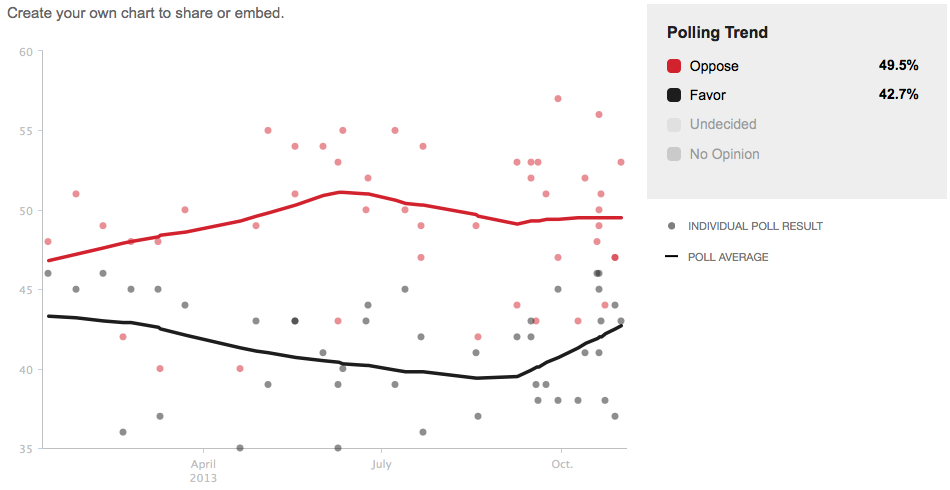
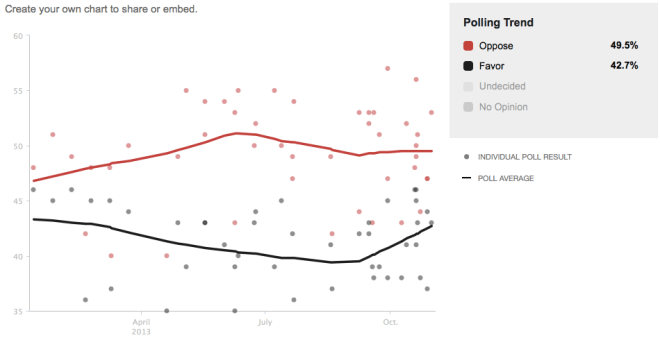
And yet … Americans have not changed their minds on the ACA much over the last few months. Here’s the poll of polls on it since January of this year:
Screen Shot 2013-11-07 at 12.43.21 PM

Since September, support has actually risen, while opposition has remained flat. Given the fiasco of the website, that’s a surprise. This week’s elections also didn’t prove that it is a huge liability. Opposition to the ACA remains very strong in the GOP base, which doubtless helped Cuccinelli in the final week. But McAuliffe ran explicitly on Medicaid expansion and won. Then there’s the calculation of Ohio governor John Kasich in embracing Medicaid expansion. Consider too the relative success of the law so far in a state like Kentucky of all places. Now along comes a poll from Reuters-Ipsos:

The uninsured view the 2010 Patient Protection and Affordable Care Act, commonly known as Obamacare, more favorably since online marketplaces opened – 44 percent compared with 37 percent in September. It found that 56 percent oppose the program compared with 63 percent in September. A higher proportion of the uninsured also said they are interested in buying insurance on the exchanges, with 42 percent in October, saying they were likely to enroll compared with 37 percent in September.

I don’t want to overstate the case but I think it’s also foolish to understate the impact on many people who will get health insurance for the first time in their lives. This reality will matter politically in the end. See Byron York’s take on the number of winners versus the number of losers in pure monetary terms – and Ed Kilgore’s response. People are also not dumb enough to think that cancellation of their policies or sudden premium hikes started with the ACA. It was a constant in the private sector for years. Yes, disruption will tick a lot of people off. But Obama still has three years to get this entrenched – and once in place, it will be mighty hard to remove for the exact reasons that people are so upset right now. Disruption is always unnerving, especially in an area like your health.

We all take this issue personally, as we should. And I’ve been very lucky to have had excellent employer-based healthcare for years. But always at the back of my mind was the fear that I might leave a job with that kind of security, like at TNR or the Atlantic and the Beast, and be stranded and bankrupted by my pre-existing condition, HIV. We’re looking into our own health insurance plan right now for the Dish in the next year, and I’ll let you know how the process goes. But like many, we haven’t been in a mad rush, we have an insurance broker to help us through the process, and it is hard to express the relief I feel that I cannot be denied coverage because I am a survivor of the plague. If we have to pay more, it’s well worth the relief.

I can’t believe I’m the only one who feels this way.

It’s not the health insurance reform I would have wanted – I’d prefer ending the employer subsidy, mandating no exclusion because of pre-existing conditions and creating a more vibrant individual market, including the option of catastrophic insurance. But the GOP never offered that and are still not offering it.

I also feel – call me a squish if you want – that baseline health security, while not a right, is an enormous social good, and that social insurance against the random vicissitudes of life in no way compromises free market principles. I also realized when I started a small business that I could not personally employ anyone and not provide insurance, without violating my conscience. The step from that to embracing universal care is obvious.

So count me among those who suspect the current fiasco is just the beginning of this story. To listen to the Republican critics, you’d think the previous system was wonderful – whereas we all know it wasn’t, that the private health sector was grotesquely inefficient, and that its costs kept soaring, and free-riders were undermining the entire enterprise. At some point – especially when the GOP has to find a nominee who can appeal beyond the base – the Republicans will have to shut up or put up. And I suspect a platform of repealing what Obama is constructing without replacing it with something very similar will be a big vote-loser.

I may be wrong, of course. I have been in the past. But the long game is always worth keeping in mind.

(Photo: By Yoon S. Byun/The Boston Globe via Getty Images)

Police State Watch

After being pulled over for not making a complete stop at a stop sign, David Eckert was suspected of hiding drugs because a police dog alerted and because Eckert was allegedly clenching his buttocks. What happened next:

1. Eckert’s abdominal area was x-rayed; no narcotics were found.

2. Doctors then performed an exam of Eckert’s anus with their fingers; no narcotics were found.

3. Doctors performed a second exam of Eckert’s anus with their fingers; no narcotics were found.

4. Doctors penetrated Eckert’s anus to insert an enema.  Eckert was forced to defecate in front of doctors and police officers.  Eckert watched as doctors searched his stool.  No narcotics were found.

5. Doctors penetrated Eckert’s anus to insert an enema a second time.  Eckert was forced to defecate in front of doctors and police officers.  Eckert watched as doctors searched his stool.  No narcotics were found.

6. Doctors penetrated Eckert’s anus to insert an enema a third time.  Eckert was forced to defecate in front of doctors and police officers.  Eckert watched as doctors searched his stool.  No narcotics were found.

7. Doctors then x-rayed Eckert again; no narcotics were found.

8. Doctors prepared Eckert for surgery, sedated him, and then performed a colonoscopy where a scope with a camera was inserted into Eckert’s anus, rectum, colon, and large intestines.  No narcotics were found.

The police dog, Leo, had made this same mistake before. Jacob Sullum notes that, “if police say a dog is properly trained, they can get a search warrant based on nothing more than the animal’s purported alert, and that search will be upheld unless a defendant can present evidence showing the dog is unreliable”:

Hence if it turns out that Leo’s alerts frequently lead to fruitless searches, that does not necessarily mean he will be deemed unreliable, even if he is wrong more often than he is right (which is often the case with drug-detecting dogs). According to police (and the Supreme Court, which essentially has adopted their point of view), dogs that seem to be making mistakes may actually be alerting to traces of drugs so minute that their existence cannot be confirmed. Hence you can never definitively say that a police dog erred, even though there are many possible sources of error, including distracting smells and conscious or subconscious cues by handlers. Not to mention the fact that cops who want to search someone can always falsely claim a dog alerted.

The upshot is that if a cop wants to explore a motorist’s anus, stomach, intestines, and feces, all he needs is a dog and a judge who takes to heart the Supreme Court’s unjustified faith in canine capabilities.

Mark Perry is repulsed by this violation of civil liberties:

[H]ere’s maybe one of the worst parts of David Eckert’s ordeal:

The Gila Regional Medical Center has billed Mr. Eckert for the “services” it provided without his consent (two forced X-rays, two forced digital penetration exams, three forced enemas and a forced colonoscopy) at the request of local law enforcement officers, and he still receives medical bills for thousands of dollars for these illegal, invasive and painful medical procedures, according to his lawsuit.

Doesn’t this case of forced anal probing and a forced colonoscopy of an innocent victim illustrate that America’s War on Drugs has maybe gone too far, and doesn’t it illustrate that one of the costs of the War on Drugs is that it’s a direct assault on the civil liberties of Americans like David Eckert?