A Child’s Uncertain Identity

Erin Siegal McIntyre tells the gripping story of a child caught between two sets of parents, Timothy and Jennifer Monahan of Missouri, who adopted her from Guatemala, and Loyda Rodríguez and Dayner Hernández, who say she was abducted from their home when she was a toddler. Though Guatemalan officials have ordered that the girl, known as Karen to her American parents, be returned to her Guatemalan family, she remains in the US. From McIntyre’s recounting of the legal quagmires surrounding the case:

The Monahans made it clear that they didn’t believe the results of the DNA test that showed a match between Karen and Loyda Rodríguez. They implied that the little girl in their home wasn’t the same child whose DNA had been tested in 2007. In Guatemala, Jennifer Monahan said, “DNA is sort of viewed as a title, and we strongly feel that Karen isn’t property.” … [The Monahan’s lawyer Jared] Genser … declared that the Guatemalan court ruling had no jurisdiction in the US.

Yet the original issuance of Karen’s orphan immigrant visa, necessary to enter the US, and her American citizenship both depended on the authenticity of certain identifying documents—the same documents that had been voided by the Guatemalan judge. Essentially, US citizenship had been granted to a girl whose identity was in dispute.

When asked what they would do “if it is proven that Karen is Mrs. Rodríguez’s daughter,” Timothy Monahan answered, “It’s really very difficult to say.” He added that they’d been “trying to work with authorities all through this process.” But Guatemalan authorities said they’d never been contacted by the Monahans.

The same day the Monahans made their TV appearance, thousands of miles south, two women intimately involved in Karen’s adoption were sentenced in court for human trafficking, document fraud, and criminal enterprise related to the buying and selling of the child. [Guatemalan adoption lawyer Susana] Luarca’s nursery director and the lawyer who facilitated Karen’s adoption were both found guilty of all charges, and were sentenced, respectively, to sixteen and twenty-one years in prison.

Keep reading about the case here.

The Un-tortured Artist

Harold Bloom once snarkily quipped that John Updike was “a minor novelist with a major style.” After reading Adam Begley’s biography, Updike, Daniel Ross Goodman seems to agree, noting the writer’s “lack of intense passion.” He speculates the deficit “was because Updike did not experience the deep suffering of many other literary geniuses”:

Updike was not forced to labor for a lifetime before achieving literary success, as George Eliot did. He did not face death threats (Salman Rushdie), outrage directed at him from his own ethnic group (Roth), devastating poverty (Edgar Allan Poe), crippling physical illness (Anton Chekhov), disabling mental illness (David Foster Wallace), relentless addiction (John Cheever), or a lifetime of being forced to conceal his gender (the Brontë sisters) or sexual orientation (E.M. Forster). Nor was he ever the tortured artist á la Franz Kafka, David Foster Wallace, or Virginia Woolf.


Wallace was a prodigy, but the battles he waged with his personal demons rendered his career more compelling and, on a certain level, more approachable.

While Updike was not born into literary nobility, he did not exactly grow up in a culturally impoverished family. His mother was well-read and was herself an aspiring writer who encouraged John’s artistic pursuits. Nonetheless, Begley expends copious amounts of energy recounting Updike’s alleged “challenges” and “setbacks”: he got into Harvard quite easily, but was rejected by Princeton (boo-hoo); he had to move away from his hometown (who doesn’t?); some of his stories were rejected by The New Yorker. (Whose aren’t? Well, Updike’s, that’s whose. After sending many stories to The New Yorker during college, when he graduated, not only did his stories begin to be accepted by the storied magazine, but he was given a job at the magazine. No modern writer, not even F. Scott Fitzgerald, Begley admits, landed such a plum position so early in his life.)

Updike’s setbacks were not in the league of David Foster Wallace’s clinical depression, Roth’s hellish marriage, Cheever’s alcoholism, or Shakespeare’s loss of a son. Nor did Updike ever truly grapple with the classical writerly tortures: writers’ block, tortured artistry, failed ambitions, unpopularity in his lifetime, lack of critical success, or any sort of literary demons. Updike’s literary setbacks were those of a lottery winner who stubs his toe on the way to the bank and then has to wait in line before he can cash his check.

Previous Dish coverage of the much-discussed Updike biography here.

Corporate Concubine Culture

Dan Kois praises Helen DeWitt’s 2011 novel Lightning Rods – the first selection for the Slate/Whiting Second Novel List – as “a sex comedy that pursues a single dirty joke much, much further than it ought to and, in doing so, skewers American capitalism with a purer, more invigorating hatred than any novel I can remember.” The satire figures female employees as “lightning rods” specially hired to relieve the libidos of their male coworkers:

Women were being molested in the workplace,” [character] Joe reasons, “solely because their colleagues did not have a legitimate outlet for urges they could not control.” Worse, due to expensive sexual-harassment complaints, “men who worked hard and had a valuable contribution to make were being put at risk, through no fault of their own.”

Once per day, a male employee with privileges can press a button on his computer to order a lightning rod. One of the firm’s lightning rods will then receive a discreet message on her computer; she is expected to report immediately to a stall in the ladies’ room, where she will replace whatever she’s wearing on her lower half with a short skirt and no underpants. She will then lay in a specially-designed contraption which will slide her lower half through the wall into a stall in the adjacent men’s room, where the male employee, condom on, will sate his carnal desires, the better to go back to his office refreshed and focused and ready to make money. The women, too, handsomely remunerated for their additional tasks during the workday, go back to their desks, where they can plan for the glorious futures their fat paychecks will help them enjoy. (One former lightning rod, the book tells us, is now a justice on the Supreme Court!)

In a 2012 review, William Flesch described the novel’s take on a sales-minded society:

Salesmanship is all about acknowledging, about seeing, that there are different ways to look at the world. When you tell other people how you see the world, you can hope to encourage them see it your way. Encouragement becomes the medium of social interaction. Tolerance and friendliness become synonymous, which means that not too much strain is put on tolerance. And the lightning rods — by dissipating sexual tension, turmoil, anxiety, and disgust — contribute to the sense of tolerant friendliness.

DeWitt isn’t contemptuous of that tolerance, which her novel often frames as a social achievement. We see Joe making real moral advances in the course of the narrative. There is progress to his story: “It’s important to remember that there’s more to life than being a success. Sure, if you do something it’s important to give it your best shot. But it’s also important to be a good person.” Though the lightning rods are a literalized commodification of women, these women, just as much as their uni-functional peers in the office have ways of looking at things too. Some even prove themselves to be good salesmen.

In an earlier review, Garth Risk Hallberg applauded DeWitt for “luxuriat[ing] in the eloquent dumbness of the corporate idiom.” He suggested that the novel’s satire extends far beyond corporate culture:

Lightning Rods is no more “about” sexual tension in the workplace than A Tale of a Tub is about the tub. But if Joe’s “Lightning Rods” are the vehicle, what is the tenor? What, exactly, is being skewered? By the end of the book, the answer, wonderfully, seems to be “everything”: bureaucracy, sexual politics, the objectification of the female body, the sanctification of same, political correctness, political incorrectness, etiquette, boorishness, ambition, laziness, late capitalism, and even logic itself.

DeWitt brings to satire what Roberto Bolaño’s 2666 brought to the detective story: purity of means, ineffability of ends. This is not to say that Lightning Rods shares that novel’s epic sweep. It is, by design, a minor work. (DeWitt says she began writing it, and several other books, in 1998, “to pave the way for” The Last Samurai.) But it so emphatically aces the tasks it sets for itself, and delivers such a jolt of pleasure along the way, that it reminds me of just how major a minor work can be. I wish the other leading American novelists would produce more books in this vein. Come to think of it, I wish Helen DeWitt would, too. At any rate, as one of her endearingly flummoxed characters might say, I literally cannot wait to see what she does next.

A Poem For Saturday

Dish poetry editor Alice Quinn writes:

100914strand14LSMark Strand was (even for a poet) exceptionally captivated by a cat-and-mouse game – whimsical and profound – with the subject of death. He left this realm on Saturday, November 29th, to the great sorrow of his many, many dear friends and admirers. He was, I reckon, mostly cat in this fluidly shifting contest, empowered by the strength of his indelible and charming artistic wiles.
His poem “2002” from the collection Man and Camel, begins:

I am not thinking of Death, but Death is thinking of me.
He leans back in his chair, rubs his hands, strokes
his beard, and says, “I’m thinking of Strand, I’m thinking
that one of these days I’ll be out back, swinging my scythe
or holding my hourglass up to the moon, and Strand will appear
in a jacket and tie, and together under the boulevards’
leafless trees we’ll stroll into the city of souls. . . .”

The above photograph of Mark Strand with Charles Wright, our current U.S. Poet Laureate, was taken by Lawrence Schwartzwald on Thursday, October 9th, when nineteen poets—lifelong friends like so many in the audience—joined his daughter Jessica on stage at the New School’s Auditorium at 66 West 12th Street to celebrate his 80th birthday and his new Collected Poems, just published by Alfred A. Knopf. No one present will ever forget his wit, sweetness, and radiance that night.

“My Death” by Mark Strand:

Sadness, of course, and confusion.
The relatives gathered at the graveside,
talking about the waste, and the weather mounting,
the rain moving in vague pillars offshore.

This is Prince Edward Island.
I came back to my birthplace to announce my death.
I said I would ride full gallop into the sea
and not look back. People were furious.

I told them about attempts I had made in the past,
how I starved in order to be the size of Lucille,
whom I loved, to inhabit the cold space
her body had taken. They were shocked.

I went on about the time
I dove in a perfect arc that filled
with the sunshine of farewell and I fell
head over shoulders into the river’s thigh.

And about the time
I stood naked in the snow, pointing a pistol
between my eyes, and how when I fired my head bloomed
into health. Soon I was alone.

Now I lie in the box
of my making while the weather
builds and the mourners shake their heads as if
to write or to die, I did not have to do either.

(From Selected Poems by Mark Strand © 1979, 1980 by Mark Strand. Used by permission of Alfred A. Knopf, an imprint of the Knopf Doubleday Publishing Group, a division of Random House LLC. All rights reserved.Random House, LLC. Photo of Strand and Charles Wright courtesy of Lawrence Schwartzwald.)

The Numbers On Police Encounters

Steven Malanga argues that “significant crime declines have been accompanied by a leveling off and then a reduction in confrontations with the police, as reported by Americans of all races”:

In 1996, [DOJ researchers] produced a preliminary report on police/citizen interactions that broadly estimated that some 45 million Americans had some type of contact with law enforcement during the preceding year. Of those 45 million, the study found, slightly more than half a million reported that the police had used force against them. This initial study, regarded as experimental, wasn’t detailed enough to say much more and was subject to large margins of error, but it led to a series of more comprehensive and in-depth reports, produced from 1999 through 2011.

What’s striking in the progression of these later studies is a steady decrease in the number of people having interactions with the police—from about 45 million in 2002 to 40 million in 2011—or from about 21 percent of the 16-and-older population to about 17 percent.

One clear reason for the decline has been the corresponding drop in crime: the number of people reporting crimes or other problems to the police fell by about 3.6 million from a peak in 2002. More important, perhaps, was that reports of use of force by police also fell, from 664,000 in 2002 to 574,000 in a 2010 report. Those declines occurred across all races. The number of African-Americans reporting that police used force against them fell from 173,000 to 130,000. Among whites, the number has dropped from a peak of 374,000 to 347,000.

But those interactions appear to have gotten more deadly. Douthat spotlights three data points:

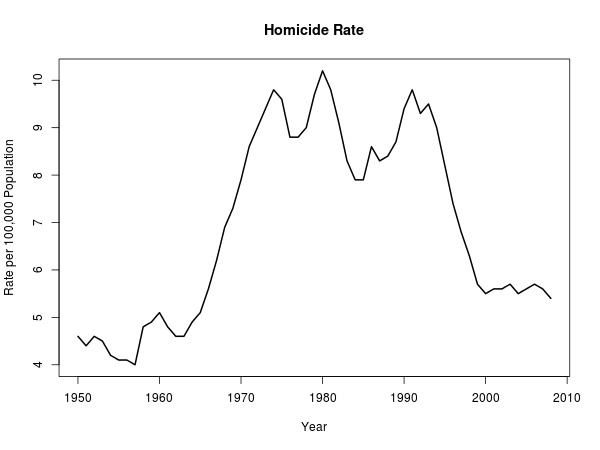
The first is the overall crime rate, which (as many, though not enough, people know) has been falling since the 1990s, with homicide rates basically back to pre-1960s crime wave levels. The second is the level of mortal danger faced by policemen in the line of duty, which has been declining steadily since its most recent, 1970s-era peak; according to one estimate, American cops are less likely to be killed in the line of duty than at any point since the 1870s. The third is the rate at which civilians are killed by police officers, which has been … well, there the data gets extremely cloudy, because we don’t have good official statistics on the subject. (Which is why “collect better statistics” reasonably topsa list of plausible reforms.) At the very least, though, we know that the overall number of homicides has dropped over the last decade, and the (again, problematic) statistics we do have show an increase in policemen killing civilians over the same period.

If you assume that a free society needs to strike a balance, needs to grant the police sufficient latitude to keep public order without granting them so much latitude that their powers are too easily abused, then these three numbers provide a decent heuristic for figuring out when the balance has tipped too far in one direction or the other.

Did The Nanny State Kill Eric Garner? Ctd

US-CRIME-POLICE-RACE-UNREST

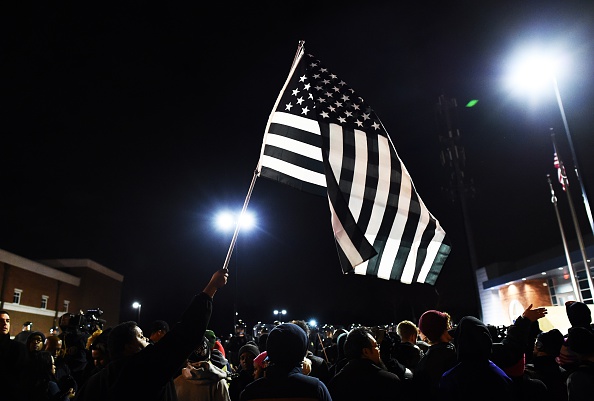
All of our coverage of Eric Garner this week can be read here. Readers aren’t buying these arguments over the nanny state:

This is NOT about taxes.  This is about a guy being an unlicensed middle man.  For people who are poor, paying $1 for cigarette might be doable even though that’s double the price they’d pay per unit if they bought a pack.  If the pack only cost $2, someone could still pull a profit selling loosies at 25 cents each.  People would still buy them, people would still sell them. People sold loosies even when cigarettes were cheaper.

I live in California, in a few convenience stores (poor neighborhoods) I’ve seen a cup set up with “loosies” for sale.  It’s against the law.  I haven’t heard of any big arrests.

Another focuses on class:

So this is basically a guy who was trying to avoid paying taxes. How many people in suits are walking around free who do just that? I’m not even sure this is a race thing but more a class thing. Al Sharpton owes millions, but there are no cops throwing him down in chokeholds.

Another goes on a tear:

The non-indictment in the Eric Garner case makes me furious. People responding to it by claiming that cigarette taxes are the problem might make me even more furious.

It makes no difference whether we agree with the law Garner was breaking or not. It is the law, and he was breaking it (allegedly). The problem is not that the cops were trying to arrest him. The problem is that he died. If Garner had shoplifted and the cops had then confronted and killed him in this way, would that make it okay? The arguments of the conservative bloggers you quote seem to imply that it would. Which makes me want to vomit.

A friend suggested to me that maybe the people complaining about cigarette taxes could be a good thing, as it might be the only way to get white conservatives to pay attention to dead black men. Actually, I think it’s exactly the opposite of getting white conservatives to pay attention to dead black men. It’s a way for them to ignore that problem and pretend that the real problem here is “nanny state” taxes. “If we just get rid of those taxes, the whole issue goes away! Problem solved! Good job, guys! What, you think there’s still a problem? You think the problem is unchecked racism and brutality by the police? What a pathetic liberal loser, get out of here, all we need to do is get rid of cigarette taxes.”

On the other side, my own representative, Keith Ellison (I’m a huge fan generally), has been sort of hijacking this police racism/brutality/unaccountability conversation to talk about his own pet issues of poverty, inequality and raising the minimum wage. To the extent that he falls back on these issues as a way of avoiding addressing the real issue of police reform, I’m equally bothered by this response.

However, I think Ellison has more ground to stand on here, because the issues of economic inequality and inequality of treatment by law enforcement are undeniably intertwined. As Ellison points out, a lot of the same people are protesting both low wages and police injustices right now, which makes sense, because a lot of the same people are most negatively impacted by both of those things. That interconnection isn’t there with cigarette tax policy. If it wasn’t selling untaxed cigarettes, Garner could have been harassed/arrested/killed for a million other petty offenses. Like carrying an airsoft gun. The specific offense he was arrested for was not the issue.

Another points out:

The UK and many other European countries are far more of a nanny state. On just about every aspect of US life, there are dozens of examples of countries that are more regulated.  But it is uniquely in the US that those interactions between citizen and enforcer of the law ends up with a dead citizen.

This guy is selling loose cigarettes?  Write him a ticket. Issue a misdemeanor citation. Require him to show up in court in five days to answer the charge at a preliminary hearing.

The cop instead went for an illegal – illegal and forbidden by policy! – chokehold. And Staten Island gave him the ok. It is the relationship between the enforcer and citizen that is fundamentally flawed, not that laws exist. Someone trying to make it about taxes is frankly insulting; they are butting in to the conversation to talk about an unrelated hobby horse.

Another diverges from the others:

The bigger story in the Eric Garner case is one of Freedom, or lack thereof. Why the hell is it “illegal” to sell a fucking loosey? Quit taxing so much shit already.  Quit making so many fucking things illegal. Dismantle the damn regulatory state.  Without the pretense of so many government regulations and laws, Eric Garner would never have been harassed in the first place.

Live and let live and leave us the fuck alone!  Let us enjoy some of the “freedom” that America supposedly promises to us! That’s a message the white and black community should get behind.  But of course the Politicians would never allow it because there isn’t enough room for graft, power and corruption.

(Photo by Jewel Samad/AFP/Getty Images)

Remembering Mark Strand

Last Saturday, the Pulitzer Prize-winner and former US poet laureate died at the age of 80. William Grimes looks back to his early work:

His first poetry collection, “Sleeping With One Eye Open,” published in 1964, set the tone. … Echoes of Wallace Stevens and Elizabeth Bishop could be heard in his compressed, highly specific language and wintry cast of mind, as could painters like Giorgio de Chirico, René Magritte and Edward Hopper, whose moody clarity and mysterious shadows dovetailed with Strand’s own sensibility.

“He is not a religious poet on the face of it, but he fits into a long tradition of meditation and contemplation,” said David Kirby, the author of “Mark Strand and the Poet’s Place in Contemporary Culture” and a professor of English at Florida State University. “He makes you see how trivial the things of this world are, and how expansive the self is, once you unhook it from flat-screen TVs and iPhones.” Reading Mr. Strand, he said, “We learn what a big party solitude is.”

Dan Chiasson asserts that Strand’s poems were “often about the inner life’s methods of processing its social manifestations”:

At least since “Reasons For Moving” (1968), his second volume, Strand surveyed his outward circumstances—relative health and prosperity, growing fame, the undeniable good fortune of being alive—from a peephole cut into the exterior wall of his solitude. The weirdness was all out there, where a suave and handsome man named Strand moved among other columns of flesh and bone; in here, alone with the moods, the mind, our memories of childhood and love, we found what Strand called, in his book-length poem of this name, “The Continuous Life.” It could be harrowing, but it was never proprietary: we all shared the same secret; Strand’s poems of the inner life were sometimes like expressions of our own: “some shy event, some secret of the light that falls upon the deep/Some source of sorrow that does not wish to be discovered yet.” (“Our Masterpiece Is the Private Life.”)

“The Continuous Life” continues after death, whose abrupt appearance, breaking up the party, Strand often described. Life is a waltz, a “Delirium Waltz,” as he called it in his greatest poem—collected in his best book, one of the finest of the past fifty years, “Blizzard of One”—which ends when the music ends. It is in the nature of waltzes that we cannot foretell their duration ahead of time. Waltzing to delirium, we might think that they never end. And then the music stops. It happened on Saturday for Strand, a great poet and a kind man.

In a 2012 interview, Strand considered poetry’s place in contemporary society:

It’s not going to change the world, but I believe if every head of state and every government official spent an hour a day reading poetry we’d live in a much more humane and decent world. Poetry has a humanizing influence. Poetry delivers an inner life that is articulated to the reader. People have inner lives, but they are poorly expressed and rarely known. They have no language by which to bring it out into the open. Two people deeply in love can look at each other and not have much to say except “I love you.” It gets kind of boring after awhile—after the first ten or twenty years. I don’t expect that from heads of state; I don’t expect them to look at each other after reading a lot of poetry and say “I love you,” but it reminds us that we have inner lives.

When we read poems from the past we realize that human beings have always been the way we are. We have technological advancements undreamt of a couple thousand years ago, but the way people felt then is pretty much the way people feel now. We can read those poems with pleasure because we recognize ourselves in them. Poetry helps us imagine what it’s like to be human. I wish more politicians and heads of state would begin to imagine what it’s like to be human. They’ve forgotten, and it leads to bad things. If you can’t empathize, it’s hard to be decent; it’s hard to know what the other guy’s feeling. They talk from such a distance that they don’t see differences; they don’t see the little things that make up a life. They see numbers; they see generalities. They deal in sound bytes and vacuous speeches; when you read them again, they don’t mean anything.

Strand had this to say about death, one of the great themes of his work, in his Paris Review interview:

It’s inevitable. I feel myself inching towards it. So there it is in my poems. And sometimes people will think of me as a kind of gloomy guy. But I don’t think of myself as gloomy at all. I say ha ha to death all the time in my poems.

We’ll be featuring Strand’s poetry all weekend.

Dissents Of The Day

A rare sentiment from the in-tray:

I am having trouble understanding why you and many of my friends are so exercised about this case. Yes, it is a tragic accident, but, when I watch the video, I don’t see a murder, or even manslaughter. What I see is a big man resisting arrest and a police officer trying to restrain him. It is hard to tell from the video, but it does not appear to me that the officer continued to apply the “chokehold” (a label that may have been inaccurately applied to this case) after Garner said he could not breathe. It looks to me as if that officer grabs him around the neck for only a few seconds, and then, while Garner is still conscious and speaking, tries to restrain him by holding his head in place.

There have been a lot of comments online about whether the officer should have been trying to arrest someone for selling “loosies” on the street. The fault for that doesn’t lie with the officer, but the politicians who wrote the law and the officer’s superiors who insist that the law be enforced in this particular way. Imagine you’re that officer, and your job is to arrest someone twice your size who is resisting arrest. How would you do it? Pepper spray or a taser? We know how controversial that is. Is it fair to send this guy to jail for honestly trying to do his job? I don’t think so.

Another reader quotes me:

But there was no way to interpret [Megyn] Kelly’s coverage as anything but the baldest racism I’ve seen in a while on cable news. Her idea of balance was to interview two, white, bald, bull-necked men to defend the cops, explain away any concerns about police treatment and to minimize the entire thing. Truly, deeply disgusting.

I didn’t see Kelly that day. But I caught her show yesterday and she was very forthright in condemning the police. The only point she made is that she didn’t see proof that the excessive force used against Garner was motivated by racism. I tend to agree with her.

The police made clear their intent to arrest Garner for legitimate, albeit minor reasons. At that point Garner started arguing loudly, and he clearly had no intention of submitting. If he was going to be arrested, it was going to involve a struggle. He pretty much said exactly that.

I don’t know what the law is regarding the rights of people about arrested to quarrel with the cops, or physically resist. But I do know, from a purely common sense standpoint, that there’s no way to win that fight. You can’t argue with cops. Talk yes, argue no. If you argue like Garner did, you’re going to jail no matter what race you are.

I believe a white, Asian, or Hispanic male (of his size) would have been treated the same way. Maybe that’s wrong, but that’s the way it is. Everyone knows it. I’ve never understood why a lot of black men don’t get this fairly ordinary bit of common sense. Given the minor nature of the charges, Garner might have been able to talk his way out of arrest. But the minute he raised his voice, he was headed for the station. Most likely he would have been i-bonded out soon after arrival.

Of course, nothing excuses the subsequent use of clearly excessive force.

Will The FDA Ever Get Over Its Hemo-phobia? Ctd

A reader shifts the focus away from the risk of HIV among gay Americans:

What about the ban on British blood, due to fears of mad cow disease?  I’ve not been able to give blood for over 10 years due to this ridiculous ban.

Another is also barred:

It’s annual Xmas blood drive time, and I’m again reminded that I can’t give, because I lived in the UK for more than three months between 1980 and 1996. (Hard not to have done so, since I was born there.) The reason is Variant Creutzfeldt-Jakob Disease, better known as mad cow – a scourge which has affected 229 people in all of recorded history. British beef appears to be the vector. The net cast to prevent vCJD transmission is extremely wide, and among things it rules out just about every adult European now living in the U.S. and just about every American servicemember who was stationed in Europe during the last decade of the Cold War. That’s surely millions of people.

It really seems – on vCJD, gay sex, and other risk factors – the Red Cross uses an awfully big hammer to bury some awfully small nails. With all our medical advances, there must be better tools available today than these blanket bans.

Relatedly, Brian Resnick explains the importance of veterinarians in preventing disease in humans:

“Often, infectious diseases circulate in animals for a long time before they cause outbreaks in humans,” says Wondwossen Gebreyes, the director of Global-Health Programs and a professor of molecular epidemiology at Ohio State University. “To prevent disease in humans, we should be able to address what’s happening in the animal world and what is happening in the environment,” Gebreyes says. Human and animal health are irrevocably linked. As a veterinarian, he says, “I’ve always been interested in saving human lives.”

Seventy-five percent of newly emerging diseases are zoonotic, meaning they can be spread between animals and humans. And they wreak havoc: People fall ill having no natural defenses, and there is often no medicine to fill the gap. It’s estimated that between 1997 and 2009, the cost of these diseases amounted to $80 billion worldwide. Every year, there are 2.5 billion cases of zoonotic illnesses in humans, resulting in 2.7 million deaths.

This concept – connecting human medical and veterinary science – is called One Health. And in this framework veterinarians are the sentinels, monitoring the animal kingdom for potential threats to humans.

Occupy Central On Its Last Legs

https://twitter.com/ajam/statuses/540896096302944256

Leaders of Hong Kong’s protest movement are mulling whether to keep going, shift tactics, or retreat after two months of street demonstrations failed to persuade authorities to hold an open election for the city’s leadership in 2017:

The Hong Kong Federation of Students will decide in the next week whether to call on protesters to pull up stakes from camps which straddle some of the Chinese-controlled city’s main thoroughfares and have tried residents’ patience. Chan Kin-man, joint founder of the “Occupy Central” protest movement that has called for the students to pull back, said the federation had a “very major decision” to make. …

Benny Tai, another joint founder of Occupy Central, reiterated calls for students to leave and pondered where the disobedience movement could go next. “Blocking government may be even more powerful than blocking roads,” he wrote in the International New York Times. “Refusal to pay taxes, delaying rent payments by tenants in public housing … along with other such acts of non cooperation, could make governing more inconvenient.”

Whichever way the movement goes from here, Rachel Lu calls this round for Beijing:

Everyone in Hong Kong will probably emerge from the Occupy movement a bit bruised, either physically or mentally, but some in Beijing might be smiling. China’s central government has stood fast on the core issue — that Beijing will vet the slate of nominees for Hong Kong’s chief executive in the 2017 election. Years (if not decades) of “united front” work, a term used by China’s ruling Communist Party to describe efforts to hew non-party elites close to its goals, seem to have paid off. Beijing has proven that it knows how to pull the right levers in Hong Kong to wield considerable influence — all of the local government officials toed the line, tycoons spoke out against the occupation, and grassroots groups staged counterprotests. When one businessman took the position that Leung should resign, he was swiftly removed as a delegate to the Chinese People’s Political Consultative Conference as a form of discipline and censure.

The ranks of the pro-establishment camp will likely tighten, while the opposition pro-democracy camp is left in disarray amid infighting.