Inside America’s Concentration Camps, Ctd

A few readers from our Facebook page react to these videos of pig cruelty:

I am wounded by this to the depths of my soul. I am an omnivore, but this sort of thing makes me question how I justify it. It also makes me question fellow Christians that are so committed to the ” pro-life” movement. This is a creature that is fully conscious of its suffering; how can you consider this to be of less consequence than a fetus that had not developed a fully developed brain?

Another:

I eat meat; the fish I catch or my family catches. I know the farmer who raises the beef I eat. The deer we hunt every fall live good wild lives and then a bullet ends their life; a whole lot better than starving, getting hit by a car or be torn to bits by a pack of dogs/wolves. I do my best to know where my food comes from and how it lived before it came to feed me and my family. Everything dies and becomes food to another living thing, even we humans. I do my utmost to never buy much of anything from Walmart, especially meat, fish or eggs. I support each person’s right to choose what kind of diet best suits their lifestyle and moral choices. Please respect mine, because at the end of the day I know we want the same result: I believe that by consuming only humanely raised animals and sustainable crops I can do more to keep animals safe while supporting the health of my family.

Another responds to my call to contact Dave Warner, the director of communications for the National Pork Producers Council (and his response is below):

Hello Andrew:

I have never in my life written anything like the email below to anyone, on any subject of public attention.  Thank you for getting me off my arse!

Dear Mr. Warner:

I got your email address from Andrew Sullivan’s “Daily Dish” blog, where I have been following his recent excellent coverage of the use of ‘gestation crates’ and other factory farming techniques in pig farming.  He has thoughtfully presented the moral issues from a Roman Catholic perspective and in the context of the respect for life and stewardship of nature that form a central part of that faith (which I share).

I am a lifelong lover of bacon, ham, and almost every other pork product!  But in light of what I have now learned about the treatment of pigs in American factory farms I can no longer, in good conscience, continue to consume pork.  While I have no moral objection to the consumption of meat, I will not remain complicit in the unspeakable cruelty apparently routinely inflicted on pigs by American pork producers.

Please convey to your members that I, and many consumers like me, ask that American pork producers discontinue practices like the use of gestation crates and make some concerted effort to provide pigs a life that approximates the natural life an intelligent mammal should be entitled to.  Until that time, I will not purchase any pork product other than those that I can satisfy myself came from farms that treat their animals with dignity and (at a minimum) allow them to move around outside.  I am prepared to pay a premium for such well-sourced meat.

Thank you for your kind attention.

Warner responds to the Dish:

Andrew Sullivan Monday posted a couple of videos from hog farms and wrote about the “brutal impact of keeping pigs in gestation crates.” But the videos’ images and, more importantly, the narrative that accompanied them don’t tell the accurate story of how America’s family hog farmers raise and care for their animals.

Providing humane and compassionate care for their pigs at every stage of life is one of the ethical principles to which America’s family hog famers adhere. They are passionate about caring for animals in a way that protects their well-being. In fact, housing sows in gestation stalls is one of the ways to ensure their well-being. Those individual pens allow farmers to give sows individual food rations and veterinary care; they also protect sows from aggressive sows.

Janeen Salak-Johnson, an associate animal science professor at the University of Illinois, has studied gestating sows in various housing systems, monitoring their stress, environmental physiology and well-being. She has found that individual pens work well for pregnant sows and that, contrary to claims made by opponents of the housing system, they don’t cause health problems for the animals.

The American Veterinary Medical Association and the American Association of Swine Veterinarians (AASV) recognize gestation stalls as appropriate for providing for the well-being of sows during pregnancy. In fact, the key factor that most affects animal well-being is husbandry skills – that is, the care given to each animal. There is no scientific consensus on the best way to house gestating sows because each type of housing system has inherent advantages and disadvantages. One of the disadvantages of allowing sows to roam freely, for example, is that they will attack each other, with severe injuries and even death often the result. It’s also harder to ensure proper veterinary and nutritional care to sows in group or open housing systems.

Pork producers didn’t just wake up one day and decide to put sows in individual pens. Individual housing came about after years of working with the animals, observing their behaviors and determining what worked best to provide them the best possible care. Why would hog farmers want to abandon a system that provides that?

One practice (blunt force trauma) shown on one of the videos, while a method accepted by the AASV as a way to euthanize nonviable piglets, is being phased out – research on better methods is on-going – by the pork industry.

Certainly, there have been a few instances of animal abuse on hog farms, and that abuse has been condemned by the pork industry and by the farmers at whose operations the abuse occurred. Workers involved, including the worker in one of the videos posted yesterday, have been fired and, in one case, criminally prosecuted.

But most of the videos offered by animal-rights groups do not show any abuse, and even in the videos that do, the majority of the footage does not show abuse despite the groups’ narratives and claims to the contrary. Just because someone asserts that something is abuse – gestation stalls, for example – doesn’t make it so.

Hog farmers around the country are very concerned about the well-being of their animals, but they’re also concerned that the lies being told about how they raise and care for them could win the day and that, then, the United States would go the way of Europe, with animal well-being suffering, farmers going out of business and food prices skyrocketing.

Warner adds that the following video “(at about 1:50) explains why many hog farmers use gestation stalls, if you want to include it with the post”:

Another reader:

I just sent a polite but direct e-mail to Dave Warner. I told him that from now on my family will stop buying pork products and ordering pork in restaurants unless it is clearly marked as humanely raised.

On a tangential note, my parents lost a dear friend to mad cow disease here in the US earlier this year. You may already know this, but it is still possible for humans to contract mad cow disease in this country due to gaps in inspections and other loopholes. So now we only eat and order beef that is clearly labeled as having been fed grass or vegetarian feed. I swear, this nation’s meat industry is slowly turning me into a vegetarian.

Another:

Because you have such a large readership, I am pleased you are reaching a large audience on this topic – Thank You! I can never watch these videos; I suspect I would cry and be depressed the rest of the day.  My husband, daughter, and I eat very little meat and when we do, it is from humane sources.  As a society, if we reduced our demand for meat by half, our health, the environment, and the lives of animals would improve! Whether it’s “Meatless Mondays” or “Vegan Before 6”, so much good from one small step. Please continue this important topic.

We won’t let go.
The Tea Party’s Biggest Gripe With Christie

US-POLITICS-OBAMA-SANDY

Dickerson identifies it:

[T]o dissect the issues puts too much emphasis on them. The overarching worry among conservatives will be that no matter what the issue, a man who makes such a fetish of his ability to work with Democrats is going to sell out conservatives in the end. This tension has been at the core of the fight between the Republican Party establishment and grassroots since the 1940s. Sometimes that fight is about policy, but often the candidates are so close in their positions that the fight is more about personality and tactics.

A quote from Michael Bowen’s Roots of Modern Conservatism: Dewey, Taft, and the Battle for the Soul of the Republican Party brings this home. “It is important to bear in mind that the major political controversies today do not center about objectives,” said a Republican staffer, “but mainly about methods of attaining objectives.” That was a quote from more than 60 years ago, but could just as easily apply to last month’s fight over defunding Obamacare.

If Christie runs, and the egomania of last night makes it all but inevitable, he will at some point have to encounter and beat a serious Tea Party candidate. It could be Ted Cruz or Rand Paul or both. It will not just be a personality battle. Christie’s positions on climate science, Medicaid expansion, gun control and immigration reform – cited by Chait – are red flags to the base Christianists and extreme libertarians. Given Christie’s temperament, I’d say it will be a very entertaining but brutal battle for the soul of the party. Christie’s embrace of Obama during Sandy, his state’s marriage equality, his Northeastern roots, and the big establishment money behind him will also polarize the elites and the base. And his political style is not exactly to pour oil on troubled waters. He’ll say something mean and nasty at some point, and it could either cement his stature or make him look very small.

I can see him trashing Paul as someone who’s never run anything and who’s a surrender monkey in foreign policy. I can also see him lambasting Cruz for his recklessness and extreme partisanship. I guess what I’m saying is that I doubt he can win the nomination without a deep and damaging divide emerging – and maybe even a third Tea Party candidate. That’s not a good starting point for a general election, however wide his appeal in the country at large.

Don’t get me wrong.

I think Christie’s pugnacity will resonate in the South – especially with his unreconstructed, Jacksonian neoconservatism and Cheney-style view of civil liberties. I think he can reach what’s left of the Reagan Democrats. I think he can appeal to the populist anti-Washington mood. I think he is the perfect foil to Obama’s temperament – and voters tend to like a candidate who is a corrective to the president he succeeds. I think he could beat Hillary Clinton quite easily if that were the match-up, and if he doesn’t do or say something against her that alienates female voters.

But I also see his massive ego doing a great deal of internecine damage in the primaries, and deepening some of the base’s fear of supporting – yet again – someone who is not one of their own. The GOP’s best candidate may be their most divisive. But of course, these are distant speculations – to be dragged up in the future, I’m sure, when they are proven completely wrong.

But he’s a force all right. And one the Democrats under-estimate at their peril.

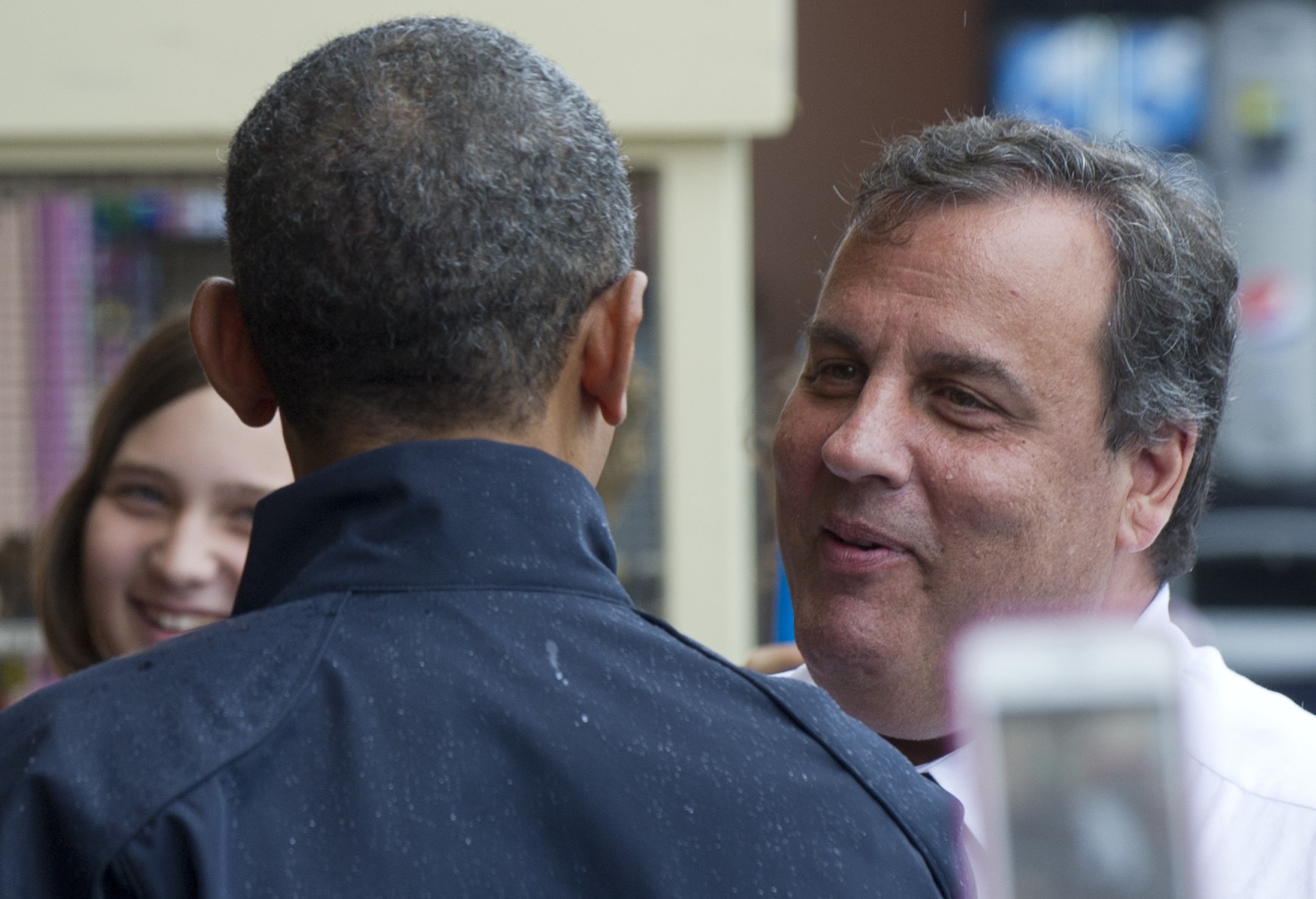
(Photo: US President Barack Obama and New Jersey Governor Chris Christie talk on the boardwalk as they view rebuilding efforts following last year’s Hurricane Sandy in Point Pleasant, New Jersey, on May 28, 2013. By Saul Loeb/AFP/Getty.)

Chart Of The Day

VA Exits

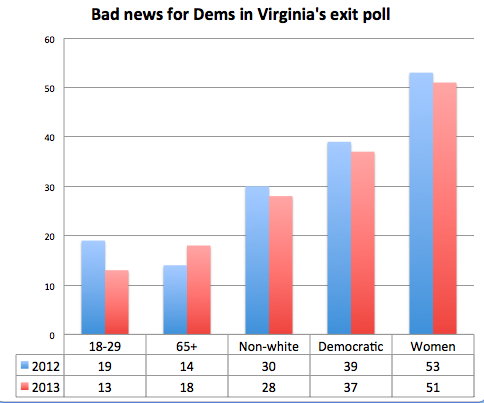
Ezra, who posts the bar graph seen above, finds “worrying signs” for Democrats in Virginia’s exit polls:

[T]he exit polls out of Virginia give Republicans some reason to cheer heading into the 2014 midterms. Though Virginia’s GOP chose a candidate who turned off moderate Republicans and motivated Democrats, and though the Democrats had vastly more money, the exit polls still showed the kind of demographic drift that could help Republicans make gains next year. … One cautionary note here is that exit polls, of course, are imprecise, and 2013′s exit poll has a margin of error of four percentage points — so some of these differences might just be noise. But some, like the age gap, aren’t, and all the movement is in the same direction — towards the Republicans. Remember, too, that the cold logic of statistical uncertainty means the Republican tilt could easily be sharper than these results indicate.

Nate Cohn is on the same page:

McAuliffe couldn’t win by a wide margin in all but ideal conditions. Most significantly, McAuliffe made few, if any, inroads into GOP territory. McAuliffe did as bad as President Obama in coal country and western Virginia, the exact sort of places where Democrats need to rebound to retake the House. In comparison, Tim Kaine won significant chunks of Republican-leaning terrain in 2005. That’s exactly what Democrats need to win back the House, and if a perfect storm couldn’t produce those gains, then there’s plenty of cause to question whether Democrats can retake the ground necessary to win the House in twelve months.

Sean Trende reads the Virginia numbers differently:

There was a bounce-back from 2009 lows, as expected, but the demographic shifts were probably about more than a bounce-back. To use racial crosstabs as an example, the 2012 electorate was 70 percent white, while the 2009 electorate was 78 percent white. The 2013 electorate was 72 percent white. Most of that difference came from increasing the African-American share of the electorate vis-à-vis 2009. This is probably the most encouraging data point for the Democrats for the night.

Meanwhile, Waldman resists reading too much into yesterday’s elections:

The point is, unless something truly spectacular occurred, the next year or two of American politics would play out exactly the same way no matter what happened in Virginia and New Jersey. You may have found one or both of them to be interesting races on their own terms. But if you’re going to make an argument about what’s going to happen in the future, you’ll have to do better than citing the explanatory power of these elections.

Was Virginia A Referendum On Obamacare?

Kilgore shakes his head:

Yes, we all play the expectations game, and Terry McAuliffe only won by two-and-a-half percent, which is less than most of the late polls anticipated. But to read this morning’s spin, you’d think he (and the Democratic Party) actually lost. The results are being widely read exactly as Ken Cuccinelli wanted them to be read: a negative “referendum on Obamacare.” Politico’s James Hohmann, in a piece entitled “Why Terry McAuliffe barely won,” draws bright red arrows pointing to an exit poll showing that 53% of voters said they opposed Obamacare. That’s entirely in line with about three years of polling about the Affordable Care Act, and doesn’t indicate any last minute “surge” against the law.

Sargent’s examination of the exit polls backs up Kilgore:

Indeed, it’s hard to look at last night’s results as a definitive declaration of public opinion on Obamacare either way — whether for or against.

The only conclusion I think you can begin to draw from the results is that an absolutist position against the law doesn’t command sufficient support to win statewide in Virginia, a state that is widely seen by observers as a key indicator of national demographic and political trends. The law is probably still on probation with many voters, but the law’s most ardent foes are wrong — they just don’t represent a majority or mainstream position.

According to the exit polls, only 27 percent of Virginia voters saw the health law as the top issue, and among them, only a bare plurality (49-45) supported Cuccinelli. Far more (45 percent) named the economy.

Josh Marshall sorts through the evidence:

[P]ollsters seem to have somewhat underestimated the share Cuccinelli would get of the Republican vote. So there might be a reasonable supposition that hammering Obamacare, in this hellish climate, helped him consolidate Republican voters. It’s not conclusive evidence but it is suggestive of that theory.

Barro adds his perspective:

Even in an election that the Republican candidate was deeming to be a “referendum on Obamacare,” in a state where Obamacare is not popular, against a Democratic nominee whose key career accomplishment is unusual success at influence peddling, the Republican nominee lost.

What lesson should Republicans take away? One is perhaps that, while the public is wary of Obamacare, scorched-earth opposition to it is not a winning electoral strategy.

Bridging The Gap

A reader writes:

My husband and I live in Houma, Louisiana, which is 60 southwest of New Orleans. Houma is staunch Republican territory. People have asked how we can live in such a very red state and in such a very red community. My reply is always, “Because of the people. I love them.”

I moved here when I was a teenager in junior high school back in 1977.  As a former Navy brat who grew up moving from state to state, moving to Cajun country was like moving to a foreign outpost. I’ve been enchanted ever since. I’ve lived here off and on for over 26 years. The times I’ve been away were when I was in the Army and when I attended seminary and was a Southern Baptist minister. I’ve always been drawn back and returned 16 years ago. I came out over ten years ago, divorced, and eventually remarried three years ago. This time I got it right.

How does an openly gay married couple survive in this bastion of conservatism?

Actually, it’s been easy. What we have determined is that as people get to know us, they discover that we’re very much like them. We love our families as much as they love theirs. We love our kids (my daughters from a previous marriage) as much as they love theirs. We love spending time with our granddaughter. We have an excellent friendship with my ex-wife and her husband (who I refer to as my step-husband). In fact, as strange as it may seem for some, our families get together for holidays and vacations.

My husband and I love attending football games in Death Valley and watching our beloved LSU Tigers play.  We were on Canal Street in New Orleans celebrating with the record crowd when the New Orleans Saints won the Super Bowl and had their victory parade. We know first-hand the impact that had not only on New Orleans, but on our region after Hurricane Katrina.

As an Army veteran, I’ve never had anybody question my loyalty to our country. As a public servant in our community and somebody involved in numerous nonprofit organizations, I’ve never had anybody question my love and loyalty to our community. As a former Southern Baptist minister, I’ve never been directly questioned about my faith, although I’ve been compelled to write numerous letters to the editor of our local newspaper respectfully and thoughtfully responding to anti-gay letters, relaying my views on spiritual matters and asking serious questions of those who hold different views concerning gays.

I’ve been fortunate to live in an area that has been influenced by a number of gays who have been successful in business or in the public sector. They stepped up to the plate long before I came out and made my transition as an out gay man much easier.

I think that’s the key not only in the South, but everywhere. As more gays come out and more people cannot help but be around gays, people discover that we’re not the ogres the Christian “Right” has portrayed. Yes, it takes longer down here and, yes, it can be frustrating when seeing how other areas of the country and other states have become more “gay friendly.” Yet, our roots are here and they run deep. It is home and I see it changing for the better. I know hope because I see changing perspectives in those I know and those I meet and get to know.  One person at a time. How else can you change a community? How else can you change a state? We’ve chosen to be a part of change.

Another reader:

I’m responding to this request from you:

If readers have their own stories to tell – not family but friend stories – we’d love to hear from you about bridging the gap. That goes for Republicans engaging Democrats as well, of course.

We live on the central coast of California, out in the country, on a private road with seven other homes.  When one of our neighbor families moved in about eight years ago, we were determined to welcome them, as we’d had a lot of problems with their predecessors, and wanted to ensure that we got off to a fresh and good start with this family, whom I’ll refer to as the Ds.

We liked them immediately. They’re younger than us by fifteen or so years, and at that time had a baby son.  The Ds had met and married in DC, where he had worked all his professional life for the government (including time in the Clinton White House), and she had worked at a couple of jobs, speaking bureaus, NGOs, and the like.  They are both bright, well-traveled, and he currently works for the government and travels a great deal for the Department of Defense (non-military).  She’s a stay-at-home mom with two children and has her own consulting marketing company, working from home.

At first we thought they were sort of like us: fairly sophisticated, politically interested, socially liberal, me a little more liberal, my husband a little more fiscally conservative, lapsed Episcopalians, and, as is commonly used these days, “spiritual, but not religious.”  But as we soon found out, they are Christians with a capital C. Upon moving here, they joined the local mega church (a former Baptist church that changed its name, I suspect, to attract more members since we live in a pretty liberal area).  We found this out when the local newspaper profiled them on the 10th anniversary of 9/11 – he had been at the Pentagon when it was struck, and described himself as having survived “by being in the arms of God.”  At first, when we read this, we were dumbfounded.  This was a neighbor of ours?  How could we possibly continue to be their friends?  How could he believe he had some special relationship with God, that ensured survival of 9/11, but not all the others who perished that day?  How could such an intelligent person (with a Stanford degree, no less) utter something so simplistic?

But we continued to see them, because they are utterly decent human beings.  We see them often, having dinner at each other’s homes, sharing wine and recipes, thoughts on the world, on DC, and laughing at just about everything, including our local politics.  Over the years, they have become increasingly disillusioned with the Republican Party because it is so mean.  But back in 2008, and again in 2012, they voted against Obama.  Again, it dumbfounds us.  But we continue to see them.  We’ve talked about everything we do not agree on, and it has been a real lesson for us, and for our two adult sons, both of whom are pretty cynical and don’t even pretend to have any religious affiliation.  But they love the Ds as do we.  I never would have thought I would have such close friends with whom I have such profound differences.  I think too it’s been an eye-opener for them, to have so many of their deep beliefs challenged.

A good example of this is a discussion we had about the age of the earth.  When challenged with the fact of carbon dating, Mrs. D. finally sort of threw up her hands, and said, “Well, I’m no scientist.”  So this I guess is an example of faith trumping reality, but still difficult to understand from our perspective.

Sometimes after a little too much wine, when the hour is late, we’ve come close to getting a little too personal, but we’ve never crossed the line, I think, because we all value our friendship so much.  In short, there’s more that holds us together than separates us.  But it has been a real education in “bridging the gap.”

Could “Anti-Rape” Underwear Really Help?

This embed is invalid


AR Wear, or Anti-Rape Wear, is a crowdfunded line of undergarments designed to “frustrate an assault effectively.” Amanda Hess snarks, “The ‘AR’ stands for ‘ARe you kidding?’—no, sorry”. Jia Tolentino feels that “to some women, this product could feel tremendously welcome,” but she has reservations:

Many parts of the video for AR Wear really grind my gears … and it’s very upsetting to think of $50,000 going to a product that plays on fear, a wildly inaccurate and persistent definition of “real” rape (“This isn’t for domestic rape, or rape by people you know,” stated one of the creators. “This is for those situations when you’re on a blind date, or in unfamiliar places”), and of course the why-won’t-it-die idea that rape prevention falls on anyone except the rapist. And there are so many offensive fear-mongering ways in which I can imagine this product being deployed: an overprotective mom buying a whole set of these for her daughter who’s about to travel Amongst Foreigners, a girls’ cross-country team forced to wear these when they’re running through the “urban” part of town.

Audra Schroeder sees a dead end:

[T]hese ideas for anti-rape clothing never go anywhere, and that’s because preventing rape has nothing to do with what a woman is wearing, or not wearing, and everything to do with the rapist and a culture of victim-blaming. Are panties with thigh locks really making us safer, or is every woman’s fear simply being exploited for profit?

On that note, a reader adds to a recent thread, “The Pitfalls Of Rape Prevention”:

So it seems that Emily Yoffe has set off a firestorm of debate. There are also several points of view in a recent NYTimes “Room For Debate“. I really don’t understand the problem here.

Of course we have to educate women about the dangers of binge drinking.  When I was young, I just accepted it as something fun to do with my friends.  How is this advice equivalent to telling victims they “asked for it” by wearing a miniskirt? How you are dressed does not affect your brain’s ability to function.  (But really, as a woman, I know that what I wear sends a message, and we need to know that too, damn it!)

It’s not about “blaming the victim”; it’s about arming women with knowledge they need to protect themselves.  I only wish someone had given me this advice in middle school.  It might have saved me a lot of trouble.  And of course we should educate men about respecting women’s wishes, etc. But women can’t express their wishes or even be aware of what they want when they are wasted. Geez, it’s not that hard to figure this out.

A longer discussion thread on rape, “The Rape Double-Standard”, is here.

Secret Agent Ma’am

5416825098_9b6a279270_b

Tasneem Raja revisits the early days of women in the CIA:

A few years ago, four veteran CIA officers, with more than a 100 years of collective experience over four decades, were asked to speak frankly about serving in the agency as women. The taped conversations, used for internal review by the CIA, reveal encounters with male attitudes from the officers’ early years that aren’t surprising—it was indeed a Mad Men world, albeit with security clearances. The transcripts, part of a trove of recently declassified CIA documents, also contain wry, Peggy Olson-esque recollections in which being a woman proved an asset—and hardly in the “femme fatale” vein of intelligence gathering.

Carla, who joined the agency in 1965 and was Deputy Chief of the Africa Division by the time she retired in 2004, recalled a time when male higher-ups in the agency warned that women would be ineffective for recruiting agents and gathering intel abroad. She recounted a successful assignment debunking that notion:

I never actually had to pitch the guy. I [played] sort of the “Dumb Dora” personality, and “Golly” “Gee!” and “Wow!” He would tell me, “I just love talking to you because you’re not very bright.” And I would just sit like this [makes an innocent expression]. The recruitment ended because he told me about a plot to go bomb the embassy in [redacted] and we arrested him and his gang of merry men as they crossed the border. He just told me everything and I got tons of intel out of him because I was just a woman who wasn’t very bright.

An internal survey from 1953 dubbed “The Petticoat Panel” shows that while women accounted for 40 percent of the agency’s employees at the time—better than the overall US workforce then, which was 30 percent female—only one-fifth of those women were above the midlevel GS-7 on the government’s salary grade, which went to GS-18. Meanwhile, 70 percent of men in the CIA were higher than G-7, and 10 percent topped GS-14, a grade no women had reached at the time. …

Yet, while men made up the lion’s share of highly paid roles in the agency, women accounted for 60 percent of the agency’s jobs in statistical analysis. Linda McCarthy, a CIA historian and former agency analyst, says that’s unsurprising: “During World War II, when it came to numbers, the war department went after women,” she told Mother Jones. “Same with maps and codework: They specifically wanted to find women for that kind of work. They were simply better at it.” McCarthy said the prevailing notion in the agency at the time ascribed women’s aptitude for stats, geography, and code breaking to maternal instinct. “They figured, you have to be patient to raise children, and you have to be patient to make maps by hand, so it must all be connected.”

For more on this subject, a reader recommends Sisterhood of Spies: The Women of the OSS, a book about a World War II intelligence agency called the Office of Strategic Services.

(This CIA device, designed to look like a makeup contact, features a code that’s revealed by tilting the mirror at the correct angle. Photo: The Central Intelligence Agency)

The Separation Of Haves And Have Nots

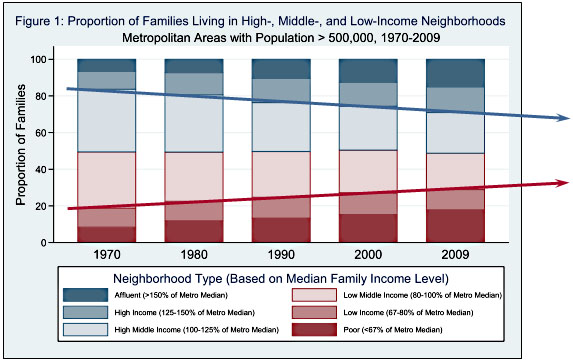
A recent study (pdf) finds that segregation by income is growing:

Neighborhood Types

Drum comments:

This is yet another sign of the collapse of the American middle class, and it’s a bad omen for the American political system. We increasingly lack a shared culture or shared experiences, and that makes democracy a tough act to pull off. The well-off have less and less interaction with the poor outside of the market economy, and less and less empathy for how they live their lives. For too many of us, the “general welfare” these days is just an academic abstraction, not a lived experience.

Mark R. Rank’s findings complicate Drum’s argument:

Put simply, poverty is a mainstream event experienced by a majority of Americans. For most of us, the question is not whether we will experience poverty, but when.

But while poverty strikes a majority of the population, the average time most people spend in poverty is relatively short. The standard image of the poor has been that of an entrenched underclass, impoverished for years at a time. While this captures a small and important slice of poverty, it is also a highly misleading picture of its more widespread and dynamic nature. The typical pattern is for an individual to experience poverty for a year or two, get above the poverty line for an extended period of time, and then perhaps encounter another spell at some later point. …

Just as poverty is widely dispersed with respect to time, it is also widely dispersed with respect to place. Only approximately 10 percent of those in poverty live in extremely poor urban neighborhoods. Households in poverty can be found throughout a variety of urban and suburban landscapes, as well as in small towns and communities across rural America. This dispersion of poverty has been increasing over the past 20 years, particularly within suburban areas.

Those Eyes

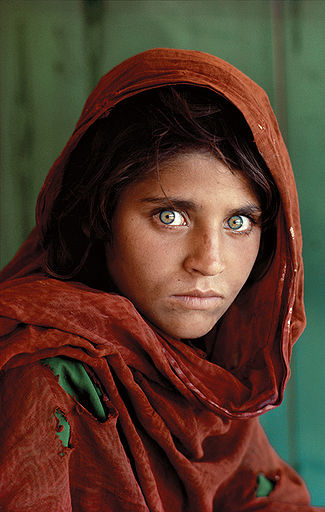
Steve McCurry’s portrait of Sharbat Gula, the “Afghan Girl”, electrified the cover of National Geographic in June 1985. He recently spoke to The Economist about the indelible image:

Why did you think Sharbat Gula, the “Afghan Girl”, was so special? Did you have any dish_sharbatgula idea that the photograph would become so iconic?

I knew it was a powerful image. I knew that she had a powerful presence. She was very striking. I knew all that, but I never dreamed it would be on the cover of the magazine, much less become an icon of the [Soviet] war in Afghanistan or Afghan refugees. The power of the picture has to do with her eyes and the ambiguity of her expression. There are a lot of emotions in that picture; on the one hand she seems a bit traumatised, but there’s a real sense of dignity and fortitude and perseverance. She’s a beautiful little girl, but there is also dirt on her face and her clothes are torn, yet she holds a direct gaze at the camera.

How was your reunion 17 years later?

It was extraordinary. It was astonishing that she and her husband agreed to meet with us, which was really unusual in that culture. We were thrilled that she was still alive, that she had a good life, that we were able to finally give back to her and help her. I think she was a bit bewildered by the whole thing initially. She didn’t understand that her picture has been published all over the world. But in time she learned—we provided her with a television so she could see the documentary [“Search For the Afghan Girl” (2003)].

We keep in touch with her every month—myself, National Geographic, my sister plays a very important role in maintaining this relationship and assisting her with all sorts, whether it’s medical assistance, education, housing or anything we can do. We’ve helped to buy her a home that she’s able to have ownership of. It’s been great to help her. I believe that this has made her life better.

McCurry has a new book out, Untold – The Stories Behind the Photographs, and you can follow his latest work here. Below is the documentary of McCurry and Gula’s reunion, “Search For the Afghan Girl”:

The documentary continues here. Photo used with permission.

Custom-Made Kids, Ctd

A reader writes:

Thanks for posting on preimplantation genetic diagnosis (PGD). I’d like to offer my perspective as both someone who enjoys thinking about the social implications of technology (graduate degree in Technology & Policy, big Kurt Vonnegut fan), and as a parent who has used this technology. I have actually pondered for many years about the morality of choosing the sex of a child, or screening for diseases, or tailoring a child’s appearance and traits. The problem of course is that there is a slippery slope at work (which the Gattaca clip you posted makes very clear), and it seemed to me that it was not our place to play god. Not being a religious man, I tended to think of this more in terms of the risks to humanity from deliberately reducing the biodiversity of the gene pool, and what that might mean for the ability of the human race to evolve in response to changes in their environment.

Enter reality.

My wife is a carrier for X-linked retinitis pigmentosa, a more or less untreatable degenerative eye disease caused by a mutation on the X chromosome. Her father and her uncle both began to lose their eyesight at age three, and were legally blind by early adulthood. When we had our son three years, ago, we knew that my wife was an obligate carrier of the mutation and that our son had a 50% chance of inheriting the disease from her.

We began taking him to an ophthalmologist to monitor his eyesight. I can hardly express how painful it was to watch our little boy discovering the world and know that there was an even chance that he would soon be losing his sight. We soon learned that there are genetic tests for the two most common mutations that cause X-linked RP, and we proceeded to have my wife, her uncle, and our son tested. I recall getting the phone call from the geneticist with the good news and how I cried with relief when we learned that our son had tested negative for the mutation. Not only had we dispatched with the sword of Damocles, we could now forego many costly visits to the ophthalmologist for ongoing monitoring.

At the same time, we were having trouble conceiving our second child. We visited a fertility clinic, and in the process heard about PGD. At that point, all of the old hypotheticals, thought experiments, and moralistic navel-gazing went out the window. For us, it was a no-brainer. Since we were undergoing IVF anyway, we were more than happy to pay the extra few thousand dollars to ensure that our child would not suffer from this disease. We did not want him to deal with what his grandfather and great-uncle had dealt with, and we did not want to go through the stressful ophthalmologist visits again.

At the same time, we knew that by default we would also have the opportunity to choose the sex of our child. This gave us more pause, especially when considering that we might have to choose between an unaffected male and a carrier female. We wanted a girl, and while a carrier female would never be affected by the disease herself, like her mother she would have a 50% chance of passing the mutation on to her children. (In the end, we were spared this choice: all of the embryos for which they could get a clear PGD result were female.)

None of this obviates the moral questions in play here. I just mean to point out that as with so many contentious issues, where you stand depends on where you sit, and what seems mildly unsettling for society in the abstract can be a godsend for an individual family.