A World Without Any Eric Garners

Protests Continue Across Country In Wake Of NY Grand Jury Verdict In Chokehold Death Case

Tomasky doubts it will arrive:

Ask yourself: What would it take, really, for your average white cop not to see your average black male young adult as a potential threat? Because we can pass all the ex-post facto laws we want, and we can even convict the occasional police officer, which does happen from time to time. But that’s not where the problem starts. The problem starts in that instant of electric mistrust when the cop reaches for his gun, or employs a homicidal chokehold. That moment is beyond the reach of legislation, or of any punishment that arrives after the fact.

McWhorter rejects such pessimism:

Are we trying to create a humanity devoid of any racist bias, or are we trying to stop cops from shooting black men?

The two aren’t the same. A world without racism would be a world without dirt. A world where episodes like what has happened just this year to Garner, Brown, John Crawford, Akai Gurley, and Tamir Rice is much more plausible. We need special prosecutors, body cameras, and, if you ask me, an end to the war on drugs.

As such, we must be pragmatic. I know the people protesting Michael Brown’s death nationwide are sincere. But it’s easy to forget that in cases like this, sincerity is supposed to be forward-focused. It’s all too human for people to end up mistaking the heightened emotions, the threats, the media attention, the catharsis, as progress itself. But drama alone burns fast and bright. Think about how Trayvon is already—admit it—seeming more like history than the present.

He insists that “Ferguson was the spark, but Garner was ‘it'”:

Here is where I am quite sure Reverend King and Bayard Rustin would be planning not just statements and gestures, but boycotts. The recording of Garner’s death has the clear, potent and inarguable authority of the Birmingham newsreels. We must use that. Yes, use—we are trying to create change, not just perform.

A reader points to a performance:

I’ve never emailed you, though I am a long-time reader and admirer (and, more recently, a subscriber). But if you want something to lift your spirits a bit about Garner, take a look at this. It’s a protest organized by the Black Law Student Association at Yale Law School and joined by much of the law school community. During this silent protest, hundreds of students, faculty, and staff joined hands and created a human chain between the law school and New Haven’s Courthouse.  Everyone then staged a “die in” for 4 1/2 minutes.  It was a remarkably moving event, all the move moving given that it was organized entirely by young people who’d been buffeted by the news of Ferguson and the Garner verdict and are doing their best to be successful law students at a top law school.  Want to know something else? Not only did the New Haven police facilitate the protest, but the Chief of Police showed up in support, cheering the dean of the law school as he passed.

(Photo: On December 4, 2014 in Oakland, California Michaela Pecot wears a sign on her hat that reads ‘I can’t breathe’ in front of City Hall on the second night of demonstrations following a Staten Island, New York grand jury’s decision not to indict a police officer in the chokehold death of Eric Garner. By Elijah Nouvelage/Getty Images)

Thoughts On Affirmative Action, Ctd

Our Asian-American Harvard grad writes back:

1. Let’s look at DeBoer’s core argument:

I have no doubt that Asian Americans suffer from racism and oppression in this country. No doubt at all. However, they don’t suffer from systematic exclusion from American colleges in general or from elite colleges specifically. On the contrary: in both cases, Asian Americans represent a higher percentage of college students than they do the population writ large.

This is, frankly, codswallop. DeBoer ignores the fact that Asian-Americans admitted to selective schools must have higher academic qualifications than Whites! This, not crude proportional representation, is the very essence of discrimination.

Of course, DeBoer’s “out” is that he doesn’t believe in academic qualifications or merit, because he doesn’t believe that “standardized tests and grades can be objective and separated from socioeconomic context.” But the fact is that test scores/grades are the most accurate predictor of academic success that we have. The fact that they correlate with socioeconomic status doesn’t change this fact. Far less does it mean that anyone, least of all Asian-Americans, simply absorb academic ability through some sort of magical force field that permeates their homes.

There is a subtle subtext to being Asian-American in this country that goes something like this:

even if you were born in the Midwest and speak English without an accent, mainstream American will always consider you somewhat of an outsider, a foreigner, or, at best, robotic, automaton-like, part of an undifferentiated mass. Therefore, you must work very hard to excel in areas in which your ability will be obvious and objectively verifiable. Under no circumstances should your prospects depend on people (read: White people) liking you personally or finding you relatable (e.g. sales, entertainment, middle management, or even practicing law in front of a judge or jury).

This (fading) subtext, in part, explains the high prevalence of Asians-Americans in technical and STEM fields and in higher education in general. It may also have socioeconomic benefits for Asian-Americans, on average. But it is perverse to visit race-based collective punishment on the basis of hard work. This, frankly, is part of what grinds my gears: DeBoer’s sanctimonious, hand-wringing concern for “real people” over “abstractions.” We are real people.

2. It is true that good universities (including my alma mater among many others) have world-class academic departments while practicing affirmative action on an university-wide admissions-level. But the critical point is that no physics, chemistry, or any other rigorous academic program practices affirmative action at a departmental level – classes are graded and standards applied without taking race into account. This inevitably generates racial disparities.

This is why STEM graduates, as an overall class, are demographically different from university graduates in general (in a way that makes them, yes, more closely resemble the student body of Cal Tech). This is also a large problem with affirmative action practiced at the admissions level: at some point, the race-based, thumb-on-the-scale must be lifted, with predictable results. Advocates rarely acknowledge this.

For example, passage rates for medical board exams show racial disparities for underrepresented minorities – this on top of the fact that medical schools don’t practice strong affirmative action (Blacks and Latinos are significantly under-represented at med schools to begin with). Thus, if we look at the data, it seems that the ability to earn a medical license cannot be “objective and separated from socioeconomic context,” under Freddie’s criteria. Should affirmative action apply here as well?

The standard liberal position on this issue is untenably crude and not comprehensively thought through.

Another reader joins the debate:

A number of comments suggested that Caltech could easily implement affirmative action without compromising the rigor of their program. Harvard has some of the nation’s best science departments and they practice affirmative action, so why can’t Caltech?

I have no idea if the broader point stands, but this argument isn’t particularly convincing. Remember: everyone at Caltech has to take a core curriculum of mathematics and physics. The relevant question is not how diverse Harvard is, but how diverse the math and physics majors at Harvard are.

There is a relatively well-known phenomenon of women and minorities who begin college with plans to major in a STEM field sorting out of these fields as they progress towards their degrees. Here is one recent paper. There are undoubtedly many forces at work here: discrimination and a lack of role models to name a few. But at the margin, it’s at least possible that affirmative action could play a role.

If you enter university less mathematically well-prepared than your peers, it’s inevitable that you’ll struggle in certain courses. We’d like to think that we grade against an objective standard, but there’s always an implicit curve: we determine what is reasonable to expect of an undergraduate from the undergraduates we teach!

I would by no means characterize the humanities as “soft” or “easy” subjects: indeed my classics and philosophy courses as an undergrad were extremely challenging. But it is certainly true that some majors are less demanding than others and the easier majors tend not to have a quantitative focus. If minority students know they will be disadvantaged relative to their peers in certain disciplines, they may well switch majors. The end result may be fewer minorities in the sciences: at a slightly lower-ranked institution, say a top state school or liberal arts college, these students very well might not have switched out of the sciences. Indeed, the overall quality of instruction is likely higher at such schools than it is at Harvard. (On a personal note, I am extremely glad that I didn’t attend a brand-name undergrad institution; if I had, I sincerely doubt that I would have become a professor.)

If using affirmative action to increase the number of minorities with Harvard degrees means fewer minorities in the sciences, which should we choose? I honestly don’t know, but it’s a question worth thinking about.

A Pogonophilic Polemic

Daniel Engber reviews The Philosophy of Beards, a recently reissued 1854 manifesto:

Described by its U.S. distributor, the University of Chicago Press, as a “truly strange polemic” from 1854 that’s “[s]ure to be popular in the hipper precincts of Brooklyn,” it contains a lecture on the beauty and importance of the whiskered chin. The volume’s author, an Ipswich muck-a-muck and chief bank cashier named Thomas S. Gowing, lays out a vigorous Victorian defense 141203_BOOKS_BeardPhilosophyCOVER.jpg.CROP.original-originalagainst “the unnatural custom” of the razorblade. The beard “has in all ages been regarded as the ensign of manliness,” while “the absence of Beard is usually a sign of physical and moral weakness.” His argument appeals at times to history and liturgy, dwelling on a dictum in the Bible, thou shalt not mar the corners of thy beard, that’s often cited by Hasidic Jews in support of growing sidelocks. But Gowing’s just as wedded to claims by certain doctors that beards prevent sore throats and filter filthy moisture from the air. More than that, he says, the beard provides a natural framing for the manly face, “covering, varying and beautifying, as the mantling ivy [does for] the rugged oak.”

Since the book will be given and received in jest, perhaps one needn’t worry that it’s racist. Gowing holds the white man as a paragon of beardliness and contrasts him with the smooth-faced men of certain “degenerate tribes wholly without, or very deficient.” (These latter have “a conscious want of manly dignity, and contentedness with a low physical, moral, and intellectual condition.”) Nor should readers be upset by Gowing’s fulminations on the “effeminate Chinese.” Remember that he put this down on paper just two years before the British navy launched its largely unprovoked bombardment of Canton.

What’s The Point Of Body Cams? Ctd

A reader writes:

I take issue with the view that the Garner case is a rebuttal of the argument for body cams. Isn’t it compelling that we have this video to show us all what really happened? The public can now make up its own mind what it means. We don’t have to rely on eyewitnesses who are historically unreliable. From the scene with Garner, we would probably have at least six different descriptions from civilians of how he was taken down and two or three different ones from cops. But we don’t need that; we have the video.

Just because the grand jury returned no indictment doesn’t mean the video was a failure. Without the video, can’t you imagine that there would be plenty of pundits calling Garner a thug, emphasizing that he resisted arrest? But there is only a smattering of that. Instead we get things like Bill O’Reilly saying that Garner “didn’t deserve that.”

Another adds:

Three or four more videos like the Garner video? I guarantee we will get some legislation passed.

Another runs through other reasons why cameras would be a net benefit:

First, the most important goal of body-cam reforms is not to provide evidence of police abuse after it happens. It is to change the culture of policing so that the police, knowing they will be held accountable for their actions, will not commit the abuse in the first place. It also changes the behavior of the citizens being policed, making things less likely to escalate all around.

This is not a fantasy. These positive effects have been observed in reality in places where body-cam reforms have been implemented. For example, the Rialto, CA police New York City Public Advocate Displays Police Wearable Camerasdepartment found a 50% reduction in use-of-force incidents and a 90% reduction in citizen complaints after implementing body cameras. Those are astounding results.

In Garner’s case, I’m sure you noticed how hostile the police were to the man with the camera. They did not want to be videotaped. They did not think they should be videotaped. I think it is entirely probable that officer Pantaleo would have acted differently if the camera in question had been on his lapel, rather than in the hands of a bystander being aggressively shooed away by the cops. People act differently not just when they know they’re being recorded, but when they know that they are supposed to be recorded. It changes the culture.

Second, imagine that we had no video of this incident – not even from the bystander. Is there any doubt that it would now be just as murky a case as Ferguson? There would not have been nearly as much public outcry, and what objections there were would have been waived away by people taking the police’s word as gospel and sliming Garner as a violent thug who made the cops fear for their lives. Just compare the video of Tamir Rice’s killing to the police’s account of the incident before they knew there was video if you doubt that cops will lie their asses off in the absence of a video.

Video evidence can only be a good thing in these cases. The widespread consensus that Garner’s killing was wrong would not exist without this video. In all likelihood, neither you nor I would have even heard about the incident. It would have been just another of these everyday injustices that go unnoticed and unpunished every day.

More on the Rialto example here. One more reader:

Perhaps you can remember another recent incident in which there was a horrific attack but a perpetrator got off virtually scot free. People attacked the system, people defended the system, but in the end nothing changed. The there’s a video, and there’s talk of a coverup, of the grave injustice, of the callousness of a system that would fail to punish the person who did such an obvious thing.

I’m talking of of Ray Rice. It was patently obvious that Rice was guilty of assault. You don’t need to see a video to know that his fiancee was knocked unconscious – it was part of the story. But apparently if you’re Roger Goodell (or other defenders of the slap on the write), that’s more or less ok until the public sees the tape.

This is precisely the problem that I have with some folks on the right now suddenly discovering that the police are capable of extraneous violence. The facts are so clear, so obvious, yet since there’s not a video, “I stand with law enforcement”. All you have to do is – and I don’t think I’m exaggerating here – talk to a person of color in any minority neighborhood in literally anywhere USA to hear stories just like Eric Garner’s, minus the asthma and videotape. They could look at the claims of police brutality, instead of waving it away with claims of “race baiting”. But if there’s video, somehow now they’re the great defenders of the public from an out-of-control police force.

Update from a reader with a gloomy cynical take:

Busy afternoon, but a brief response to your reader who wrote: “Three or four more videos like the Garner video? I guarantee we will get some legislation passed.” Sadly, I disagree. The point of the Albert Burneko piece you excerpted yesterday, as well as many contributions by Ta-Nehisi Coates, is that the system that failed to bring the Garner case to trial is not broken, but working exactly as designed. The system was designed by politicians to do exactly what it is doing, and the politicians were elected by the people, who intended that they design precisely this system.

Fox News is covering this matter in a way you describe as “the baldest racism I’ve seen in awhile on cable news.” They are doing so because they are the cable news network of the people who elected the people who designed the system that failed to achieve an indictment in Staten Island. I believe that we will see polling, probably early next week, that indicates a division of public opinion in the Garner case, and that this division will fall more or less along the same racial lines as the polling on the Ferguson matter.

I believe the existence of a videotape presenting exactly what happened will make little difference here, as I believe the exact circumstances in any given case make little difference to the holders of these opinions. The video in question may have stiffened the spine of a few folks like Charles Krauthammer and Andrew McCarthy, but Fox News knows its audience. They don’t need a videotape to decide what happened when a hero met a thug in the hellscape of urban NYC.

We don’t need more videotapes. Conor posted plenty in his excellent summation. Later the same day as that post, the Tamir Rice video was released. Here’s the one from the John Crawford Wal-Mart shooting in August in Ohio that Connor missed. This video did not persuade the grand jury in that case to order up any indictments either. This isn’t a matter of three or four more tapes. Everyone knows what’s on the damn tapes.

This too shall pass. We will move onto something else, so much more quickly than seems possible. Like Sandy Hook, we will scream and we will rend and we will finally change the subject, having achieved nothing. The politicians want nothing achieved, because the voters want nothing achieved. And the beat, as you say, will go on.

(Photo of a police cam from Getty Images)

One Step Closer To Mars

NASA’s Orion spaceship, which failed to launch yesterday, successfully made it today – watch the launch and journey here. Nicholas St. Fleur describes its significance:

During its grueling four-and-half-hour test mission, NASA’s Orion space capsule must shoot 3,600 miles away from Earth, orbit the planet twice, and brave a thick belt of cosmic radiation. Upon re-entry it must withstand a 4,000-degree Fahrenheit fireball created by atmospheric friction decreasing its speed from 20,000 miles per hour to 300 mph. Once it slows to that speed, the craft must deploy 11 parachutes in order to slow down to 20 mph, before plunging into the Pacific Ocean.

It’s a mouthful of challenges, but if Orion triumphs it may one day take astronauts on adventures beyond Earth’s orbit—and potentially to Mars. … This mission is the first of three trial runs that the Orion mission must overcome before NASA deems it safe enough for human space travel.

Jesus Diaz is psyched about this mission and other recent ones:

We sent an amazing rover to Mars in a seemingly impossible mission that had the entire world watching with baited breath. A few weeks ago, we landed on a comet. This week, we sent another spaceship to return material from an asteroid. Today we launched the spaceship that will take humans back to the Moon, asteroids, Phobos, and Mars.

So yes, I look at Orion rising against the deep blue, I hear the cheers coming out of my mouth and countless others, I see the millions of people watching this apparently insignificant event—just a spacecraft that is empty going up and splashing on the Atlantic Ocean—and it feels like the 60s all over again. The path is open again, a sunbeam illuminating its gates, now clean of the vines that had grown through all these years of abandonment.

Joe Pappalardo offers a more critical take:

The Orion launch has been be a triumph of engineering, hiccups and delays aside. But the Empire may not love the sequel. SpaceX is planning a historic launch of its own next year – the rocket is called the Falcon Heavy. Yes, Musk named his rocket after the Millennium Falcon of Star Wars, and he promises it will take twice as much payload into space as the one Nasa launched on Friday, and at one-third the cost. So far his claims about SpaceX have come true, and soon he’ll be fighting, with the lobbyists and the politicians who play favorites, for satellite contracts worth hundreds of billions of dollars. Combine that kind of force with Elon Musk’s capsule full of actual people returning to space – under a Nasa contract to deliver astronauts to the International Space Station – and you have a private startup that can beat Nasa or any other government agency back to the moon, if it so chooses.

Return of the Jedi, indeed.

Update from a reader:

The quote you included from Joe Pappalardo betrays a deep misunderstanding about SpaceX’s role in space exploration and its relationship to NASA. I work for a nonprofit space advocacy organization – The Planetary Society – and I direct its Advocacy and Space Policy program. I do this sort of stuff for a living.

The idea that SpaceX is a purely private, Silicon Valley-esqe startup is fueled by our society’s current swoon for tech culture, frustration at the lumbering pace of NASA, and Elon Musk himself. But it’s not true. SpaceX is a contractor whose business depends almost exclusively on NASA money. NASA provided hundreds of millions of dollars of crucial development money for SpaceX’s Falcon-family of rockets and Dragon crew capsules, and billions of more dollars in contracts for delivering crew and supplies to the space station. Without NASA, there would not be a SpaceX today.

Orion costs more than SpaceX’s hardware because it is tasked with carrying humans far deeper into space than anything SpaceX is developing. You get more radiation. You need to carry more life support. Your heat shield needs to be bigger for reentry. Your safety requirements are higher. And so forth. You can’t really compare the two, because they’re built for entirely different goals and under entirely different contracting regimes. SpaceX is doing what has been done before. Orion is pushing the envelope.

This isn’t to diminish SpaceX’s capabilities and achievements, but to baldly state that SpaceX can send humans to the Moon or Mars for cheaper than NASA, without any actual proof of capability (not to mention a business model, which is conspicuously absent at the moment), undermines the difficulty of what NASA is trying to do. It’s also just flat-out wrong.

Another notes:

Jesus Diaz may have been psyched, but he put Orion down in the wrong ocean; it was the Pacific, 250 miles west of Baja, California. Just rocket science, Jesus.

A Bang-Up Jobs Report

nov_jobs.0

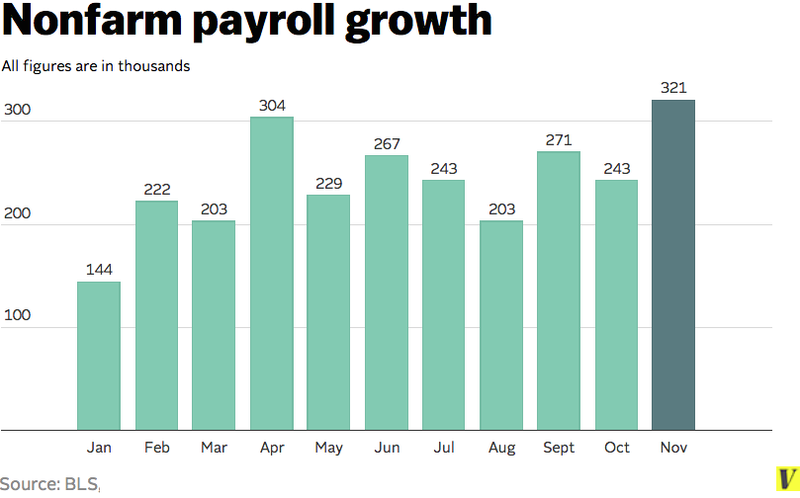
Can we get a meep-meep? The economy added 321,000 jobs in November, topping off “the best three-month period of labor market expansion since the financial crisis”:

The unemployment rate kept steady at 5.8 percent, its lowest mark since July 2008, according to the report from the U.S. Department of Labor. Some economists said that November’s data — across-the-board job creation, coupled with a slight uptick in wages — has put the American economy in its best position in years. The country has also been buoyed by plummeting global oil prices, which translate to a de facto raise for American consumers, who are now spending far less at the pump. …

So far this year, the United States has added some 2.65 million jobs — an average of about 241,000 a month. November marked the best single month for job growth since January 2012 and well exceeded the projection of economists surveyed by Bloomberg, who predicted that the economy had added about 223,000 jobs for the month. For 10 straight months now, the economy has added at least 200,000 jobs. That hasn’t happened since 1994.

September and October’s numbers were revised upward, adding another 44,000 jobs. Wages also ticked up a bit, but Ben Casselman cautions against getting too excited about that:

Average weekly earnings rose 2.4 percent from a year earlier, their fastest pace in a year. Note that’s weekly earnings. Hourly earnings are up a more modest 2.1 percent, only a bit faster than the rate of inflation. The growth in weekly earnings was driven by companies asking their employees to work more hours — a good sign for the economy but not evidence that employers are being forced to offer raises to hold on to workers. In any case, one month of solid wage growth isn’t enough to declare victory.

But let’s call a spade a spade: This month’s jobs report crushed it.

Robert Stein digs into some other encouraging details:

First, the median number of weeks of unemployment fell to 12.8, the lowest so far in the recovery. Second, the share of quitters among the unemployed increased to 9.1 percent. This indicator is important as Fed Chair Yellen has used it in the past as a sign of worker confidence. Third, and perhaps most important, was a 0.4 percent increase in average hourly wages, the largest gain in 17 months. Some analysts have been saying the Fed needs to see faster wage growth before it starts raising short-term rates. Well, there they go.

Combined with a 0.6 percent increase in total hours, total cash earnings were up 1 percent in November, the most for any month since 2006, and are up 4.8 percent versus a year ago. These gains are much faster than the roughly 1.5 percent increase in consumer prices and show growing consumer purchasing power.

But Neil Irwin curbs his enthusiasm:

The usual caveats have to come into play here. It’s one month. It will be revised multiple times. There is a wide error band around these numbers, and all this may turn out to be an aberration. Average hourly earnings are still up only 2.1 percent over a year earlier, just barely faster than inflation. And, lest we get too cheery, it’s worth at least pointing out a weaker spot in the report. The survey of households on which the unemployment rate is based painted a more stagnant picture of the economic situation, with the proportion of the population in the labor force and the proportion of the population with a job both unchanged.

And Matt O’Brien worries that numbers like these will inspire the Fed to raise interest rates, slowing down the jobs recovery:

The question now is whether this kind of job growth, if it continues, will get the Federal Reserve to start raising interest rates before they’re expected to next June. And the answer, unfortunately, is: maybe? Labor slack, after all, is declining pretty fast. Part-time workers who want full-time jobs fell by 177,000 last month. And so did long-term unemployment by another 101,000. Add in the possibility of people getting raises, which, again, is still in the nascent stage at best, and it’s clear that the economy is picking up speed.

But, as I said, it’d still be unfortunate to raise rates too soon, because there’s still a pretty deep hole to dig out of. It’s just that the hole we were in before was so cavernous that this seems normal-ish now. Remember, 2.1 percent wage inflation, which everyone is trumpeting as a sign of a real recovery, is still nothing.

(Chart via Danielle Kurtzleben)

A Witness To A Police Shooting

David Corn recounts his experience as one:

I went to the courthouse at the appointed hour and waited to be called into the grand jury room. My time in the drab conference room with the grand jury was brief. The jury was, as they say, a diverse group. But most of the jurors looked bored. A few seemed drowsy. The prosecutor asked me to identify myself and certify I had filed the statement. He asked me to describe where I had been and whether I had seen the full episode. But he never asked me to provide a complete account.

The key portion of the interview went something like this:

Prosecutor: You saw him start to run?

Me: I did.

Prosecutor: Did you see anything in his hand?

Me: No.

Prosecutor: Did you see him holding a knife?

Me: No. But I….

Prosecutor: Thank you.

I had wanted to say that I had seen him drop the heavy rock and bolt and that it was unlikely he had been able to grab and brandish a knife while sprinting. And I thought the grand jurors should know that he had not charged at any of the officers; he had been trying to dash through an opening between two of the cops in order to flee. And if they were interested in my opinion regarding the necessity of firing on him, I would have shared that, too.

But the prosecutor cut me off. He didn’t ask about about any of this. And not one of the jurors asked a question or said anything.

I left the room discouraged. This was not a search for the truth. It appeared to be a process designed to confirm an account that would protect the officer who had killed the man.

TNR RIP

Well, one thing you could always say about TNR. It has always done drama really well – and this morning’s editorial meeting could probably have been written by Aaron Sorkin. The mass resignations – nine of the twelve editors are out – are effectively the end of TNR. What will emerge in the future will be another new media start-up with close to no continuity with its recent or distant past. It’s as if the owner wanted to kill it, and the staff decided to commit pre-emptive suicide instead. Lloyd Grove provides lots of inside quotes, while portraying Chris Hughes as King Joffrey:

The New Republic was always a small political magazine that was trying to change the world,” said senior editor John Judis, who was trying to figure out late Thursday night if he could continue to work for the magazine. “My impression of what happened is Hughes and Vidra have decided to transform the magazine into a profit-making media center that is entirely different from what the magazine historically has been and what it has represented and entirely different from what The New Republic has been at its core–and this has led to this cataclysm where Frank and Leon have both left. I liked the old New Republic. I thought it had a really important role to play in America and I’m sorry if it’s no longer going to play that role.”

According to Lizza’s above tweet, Judis is among the second wave of resignations. Ezra puts TNR’s troubles in context:

Behind this fight is a deeper tension in digital journalism: the pressure for convergence is strong. We feel it at Vox, and sometimes give into it. It’s easy to see which stories are resonating with readers. It’s obvious that John Oliver videos do big numbers. And that’s fine. Right now, almost all successful digital publications are partially built on internet best practices and partially built on that publication’s particular obsessions, ideas, and attitude. Digital publications need to be smart about their mix of what everyone else does and what no one else does.

But what made the New Republic and its peer policy magazines so great was how restlessly, relentlessly idiosyncratic they were — that’s how they drove new ideologies and new ideas to the fore. They were worse at covering policy than their digital successors, but probably better at thinking. Part of this was because they simply cared less what the audience thought — they saw their role as telling their audience what to think, and they expected a readership in the low six or high five figures, not the mid-eight figures.

And isn’t there a place for just that – for a group of writers and thinkers to put out a publication that doesn’t seek to maximize pageviews or generate profits, but which dares to believe it has something to say, a point of view to fight over, and just gets on with it and hopes for the best? That was the formula we followed in the decade I worked there as editor and before. If you build it, they will come … and when I left it, we had over 100,000 subscribers. It didn’t matter that it wasn’t a million, or even 105,000. They were the right 100,000 – and built a shared community of ideas and a heritage to fight over. That’s what’s missing in this era of pageviews and clickbait and sponsored content: a self-confident team that, at some level, doesn’t give a shit what others or even readers believe, as long as the debate itself is rigorous, fair, open and reasoned. I remember Michael Lewis throwing back his head and giving that barking laugh of his as he marveled: ‘The is the first magazine I’ve ever been a part of that never asks what its readers want.” Where is that kind of publication now?

Yes, the era in which a handful of magazines were the effective gate-keepers for an entire national conversation is gone – and that is a good thing for the discourse and for the democracy. But only if what TNR did can be replicated in the new era. Josh Marshall notes that the “key is that 30 years ago, if you wanted to read meaty, smart and incisive writing about politics, policy and the political culture of the United States – written for people who were really into those things – there just were not many places to find it”:

TNR was also really good. Sometimes better than others, sometimes fantastic, other times pretty terrible. With the digital revolution, though, even if TNR were just as good as it had ever been there was just an avalanche of stuff out there that was a lot like it. And that made a huge, perhaps finally fatal, difference.

I’m not here to bewail what happened today. Maybe it’s a travesty; maybe it’s bowing to the inevitable; or maybe it’s a great thing. I’ve met Chris Hughes a couple times and enjoyed talking with him immensely. I’ve known Frank Foer quite well for at least 15 years. I may say more about these things and these guys later. But for now it’s simply worth saying that the changes Guy Vidra plans to make – with Hughes’ full backing – almost certainly mean the end of The New Republic as we’ve known it, as anything like how we’ve known it, for 100 years.

And what will replace it? Think of Vox, a young media start-up for the policy left and beyond. It has many skilled writers, has swift and shrewd pieces, and does indeed “explain” and add context to many news stories. For all those reasons, it’s a great addition to the discourse. But it is also, like most other new media outfits,  an ad agency, in which sponsored content revenues are now the alternative to a rich benefactor. Is that really much better? Does a magazine full of bloviating corporate p.r. campaigns made to look as indistinguishable from editorial as possible have a better chance at changing people’s minds and changing the broader culture than the earlier model? Do you get any sense from Vox that its editors are actually struggling to figure out the world, that there are battle-lines over policy and politics, that high culture and low culture are critical complements to a nothing-but-politics-and-policy view of the world? Say what you like about Marty Peretz – but there was more diversity of thought in one issue of TNR than there has been in one year of Vox. That’s what I’ll miss. Along with the contrarian refusal to go along with the latest left-liberal fad, or to cover for Democrats in office, for fear of giving “the other side” ammunition.

Ben Domenech sees the news as illustrating the danger “of being at a publication which is little more than a rich person’s hood ornament”:

Within the media experience, it’s always nice to have money. Being lean and frisky is all well and good, but who doesn’t want some rich backer to make everything easier, to fund the acquisition of big name talents, and eliminate the need to chase investors or respond to the whims of the marketplace? (Finally, we can get into video!) But inevitably they get the idea that they’re not a philanthropist backing an endeavor out of interest in the impact it will make on the country or the world, but that they’re someone with ideas too, good ideas, not dumb like people say. They take a few meetings and decide that they want to do something completely different with their toy, and before you know it you’re telling Leon Wieseltier that if he’s going to write about Walt Whitman again, he needs to use more cat gifs. And that’s no way to publish.

Jack Goldsmith simply sighs:

I am sad because book reviews are a dying art, Leon’s were the best, and now the back-of-the-book is certainly dead forever – probably along with the magazine as we knew it, which Hughes is moving to New York, cutting to ten issues per year, and turning in to a “vertically integrated digital media company.”

TNC tweeted his thoughts about TNR’s reputation among African Americans. Here’s a collection of his tweets strung together:

Sorry whenever [journalists] lose jobs, but some of us colored folk will always remember TNR with mixed feelings. In all seriousness, I understand people who worked at TNR feeling sad, it’s human and understandable. Some of us had a very different relationship, we also have our feelings. We will be as considerate of TNR as TNR was of us. When TNR wrote about felt like someone talking about you as though you weren’t in the room–because you literally weren’t. … When you hire fabulists to conjure stories about lazy black people who won’t work as cab drivers…it has effects. When you call tell people that the lives of their families and nation are cheap, it has effects. When you run cover stories questioning the intelligence of 40 million people, because of their skin color, some among them tend to remember.

Or misremember. That issue of the magazine had 20 separate pieces in it, and only one of them was a re-crafted excerpt from Charles Murray’s and Richard Herrnstein’s “The Bell Curve.” The rest were biting critiques. What TNR always did was debate questions others on the left would regard as taboo – because the debate was the thing, airing the questions was essential, and because a liberal sensibility is not the same as a progressive or leftist one. Noah Millman refuses to be a nostalgist:

Chris Hughes sounds like he’s trying to make TNR into something without much of a distinctive sensibility at all. I would have liked to see what TNR would have become with a fierce but critical young radical at the helm, someone who would recall the magazine’s younger years. That’s not what it has been for a very long time, and it’s not what it sounds like it’s going to be in its next incarnation.

But if it’s not going to be that, I still don’t want it to be what it was in the 1980s and 1990s. That time is gone. Chris Hughes seems determined to follow the extant media trends into the future. I’d prefer to see TNR lead than follow, but the future is where it has to go, one way or another.

And maybe that fierce but critical young radical deserves a magazine of her own to found.

Now This Will Get A Rise Out Of Seniors

Jason Millman highlights an effort in Congress to strip Medicare coverage for penis pumps:

So why did the federal government cover these devices in the first place? For one, penis pumps are a legit medical treatment for people with erectile dysfunction, especially as an alternative to taking pills.

As a result, Medicare covers the penis pumps — or vacuum erection systems (VES), if you want to be all scientific about it — under its durable medical equipment program, known as DMEPOS. The Inspector General report explains: “Because VES are used to treat impotence, and because impotence is a failure of the body part for which the diagnosis, and frequently the treatment, requires medical expertise, VES constitute a type of DMEPOS eligible for coverage under [Medicare] Part B.” …

As much as many people might not want to think about it, old people are having sex — and a lot more than you might imagine. A comprehensive 2007 New England Journal of Medicine survey on seniors’ sex lives found that more than half of people 64 to 75 reported having sex with a partner in the previous year, while it was 26 percent for people ages 75 to 85. For sexually active older men, their most commonly reported issue was erection trouble (37 percent).

We eagerly await Rush Limbaugh’s tirade against the federal government for subsidizing promiscuity among old men.

Don’t _______ While Black

In the wake of the Garner tragedy, Ijeoma Oluo tweeted out many examples of actions that prompted officers to use lethal force against African-Americans. A round-up of her tweets:

Don’t play in the park with toy guns and maybe they won’t kill you. Don’t ask for help after a car accident and maybe they won’t kill you. Don’t wear a hoodie and maybe they won’t kill you. Don’t cosplay with a toy sword and maybe they won’t kill you. Don’t shop at Walmart and maybe they won’t kill you. Don’t take the BART and maybe they won’t kill you. Don’t ride your bike and maybe they won’t kill you. Don’t reach for your cell phone and maybe they won’t kill you. Don’t go to your friend’s birthday party and maybe they won’t kill you. Don’t sit on your front stoop and maybe they won’t kill you. Don’t “startle” them and maybe they won’t kill you. Don’t “look around suspiciously”and maybe they won’t kill you. Don’t walk on a bridge with your family and maybe they won’t kill you. Don’t play “cops and robbers” with your buddies and maybe they won’t kill you. Don’t work in a warehouse repairing instruments and maybe they won’t kill you. Don’t stand in your grandma’s bathroom and maybe they won’t kill you. Don’t pray with your daughters in public and maybe they won’t kill you. Don’t go to your bachelor party and maybe they won’t kill you. Don’t have an ex boyfriend who might be a suspect and maybe they won’t kill you. Don’t call for medical help for your sister and maybe they won’t kill her. Don’t hang out in the park with your friends and maybe they won’t kill you. Don’t get a flat tire and maybe they won’t kill you. Don’t park in a fire lane and maybe they won’t kill you. Don’t reach for your wallet and maybe they won’t kill you. Don’t let your medical alert device go off and maybe they won’t kill you.

I’m done for today. My heart can’t handle any more.