Red States’ Gift To Blue States

As Republican Governor John Kasich bravely goes rogue in Ohio, Don Taylor runs the numbers on the Medicaid expansion:

By choosing not to expand Medicaid, the poorer, mostly politically “red” states are redistributing money toward the richer, mostly politically “blue” ones (there are exceptions; red Kentucky is both expanding Medicaid and has one of the best functioning State exchanges). Further, those States that are expanding Medicaid have also tended to set up state-based insurance exchanges, which are currently operating much better than the federal one, meaning that income based subsidies associated with the purchase of private health insurance may flow less freely to poorer states, at least in the short term. And there is a court case that could stop the flow of such subsidies to states not operating their own exchange all together. I have not tried to estimate the magnitude of these sources of redistribution from poor to rich states under different scenarios because things are so fluid, but the Medicaid numbers outlined are potentially just the start.

The bottom line is that if the current State Medicaid expansion decisions persist, the unintended story of the ACA will turn out to be the redistribution of money from poorer States, to richer ones, an outcome imposed by the poorer states, upon themselves.

Drum thinks the red states are going to have to come around eventually:

No matter how, um, passionate the tea partiers are about Obamacare, at some point it’s going to be clear that it’s here to stay. Maybe that’s a year from now, maybe it’s two. And when that finally happens, the scorched-earth opposition is going to deflate and all those red states are going to start taking another look at all the money they’ve given up. It may take a while, but I suspect that within a few years virtually every state will finally decide that there’s not much point in continuing to hold out. One by one, they’ll all belly up to the bar and sign up.

Reihan reluctantly agrees:

Rejecting the Medicaid expansion may well be the right policy, as Avik Roy and Grace-Marie Turner have argued. A number of states, including Arkansas and Wisconsin, have sought to use the insurance exchanges as an alternative to the Medicaid expansion, and the case for doing so seems fairly strong.

But the political cost of rejecting the Medicaid expansion will prove very high, for advocates will, as [Michael Greve anticipates], argue that rejection represents a senseless “loss” of federal dollars. Given that taxpayers in states that reject the expansion won’t get back the federal taxes they pay to finance the expansion, states will forgo a tangible (if flawed) benefit in exchange for the intangible satisfaction of possibly helping to unravel a deeply problematic law. This might seem like a decent trade while the future of Obamacare is in doubt. It won’t seem quite as attractive if the law proves durable.

Trende sizes up the politics of the court case Taylor mentions:

Here’s where the proponents of the suit may be too clever by half. It’s assumed that, if the courts block the subsidies for people on the federal exchange, Republicans will dig in, the government will have to declare hardship exemptions from the mandate for those who can’t afford insurance without subsidies, and that the framework will collapse.

But a different approach is at least as plausible: This is an election year, and Democrats will likely mount a full-bore assault on state legislators, governors, and congressmen in states without exchanges. The arguments would almost write themselves: Why won’t you let people in our state have the same benefits that people get in New York? Why won’t you set up a marketplace where our citizens could get insurance for one-tenth the price? I’m not sure such a campaign would be as unsuccessful as a lot of Republicans imagine.

Spy vs Spy, Ctd

How credible is it that Obama was unaware that the NSA was tapping the phones of 35 world leaders? I don’t know. But the evidence is mounting that it is not credible. Ed Morrissey, for one, doesn’t buy it:

[W]ho exactly would be the customer of this data, once collected?  Here’s a hint: It’s not going to be the undersecretary of agricultural development at the USDA.  The only reason to surveil Angela Merkel is to provide real-time intelligence to the highest level of government about the intentions of the German Chancellor. Furthermore, that intelligence would have to be specified as to its source for the policymaker to validate it for its consideration. If that policymaker is not Barack Obama, then perhaps we should be asking who exactly is making decisions at the top level of government.

The idea that Obama didn’t know about this program is absurd on its face.  That doesn’t mean it started with Obama, and it’s almost assured that it didn’t.  However, more than four years after taking office, Obama can’t seriously think that anyone will believe that he just found out about this NSA effort from the funny papers.

Jack Goldsmith is also highly skeptical:

I have a hard time believing that the President in his many hundreds of intelligence briefings – scores of which surely involved intelligence about allied leaders in run-ups to various diplomatic and political meetings – did not know that some of the information was gleaned through collection against the leaders themselves.  (I am not saying that the White House is lying about what the President knew – only that its statement about the President’s ignorance is extraordinary, and that I suspect that someone in the White House knew.)

A new LA Times story backs him up:

The White House and State Department signed off on surveillance targeting phone conversations of friendly foreign leaders, current and former U.S. intelligence officials said Monday, pushing back against assertions that President Obama and his aides were unaware of the high-level eavesdropping.

Ambers thinks is possible that Obama wasn’t told about the NSA’s activities:

If no one at NSA ever presumed that the flap potential from an operation like this was huge enough to notify the new president, then those who accuse the NSA of buying into its own hubris are in good standing. The NSA has not thought strategically about the geopolitical and real-world ramifications of the enormous post-9/11 expansion of its power and capabilities, and the agency is going through hell right now because one of its own employees, for whatever reason, decided to call its bluff. …

Bugging the phones of foreign leaders is not illegal, and there may have been a time when the risk of doing it was worth the reward to the policy-makers who ordered it. But the NSA, for whatever reason, never reassessed this risk calculation, perhaps assuming that the secret would never get out, and so there really wasn’t any need to tinker with a communications channel that might be important in the future.

And then it leaked.

And now, President Obama, the policy-maker, is screwed.

Shafer expects the story to blow over:

It may be that Merkel’s public carpet-calling of Obama is just for domestic show, as she tries to figure out what the country’s next government will look like. Or maybe in a weak moment, she said something in a text message that she forgot could be monitored. Who among us hasn’t? And if we haven’t, it’s only a matter of time before we do. But as scandals go, this seems like a Snapchat moment: it’s designed to disappear.

The Gains Of The Godless

Herb Silverman, founder of the Secular Coalition for America, steps back to appreciate the recent progress of nonbelievers:

Some groups are primarily interested in lectures and book clubs, some in socializing, some in good works, some in protesting, some in political action, and some in all of the above. There are also many virtual atheist groups, who enjoy discussions even though they never meet. … However, the movement has become larger than formal organizations alone, perhaps because of the increasing number of “nones,” those who don’t identify with any religion. According to a recent Pew Survey, this demographic has risen to 20 percent, and even higher among millennials.

Emily Suzanne Clark surveys the historical advance of atheism in the public square:

The first [landmark] moment was the revolutionary deism of the late eighteenth century and into the early American republic. Thomas Paine and later tributes to Paine were more of a diffuse threat to Protestant hegemony than an organized force but these later tributes testify to the lingering influence of Paine.

In the earlier colonial era, there was both a legal and a social privileging of belief, namely Christian belief. One need only think of Paine’s influence and how his lack of “proper” belief and his association with the French Revolution cost him his reputation. The bridge between this first period in public atheism to the next could be easily seen in the visual culture tributes and memorializations to Paine, specifically in Watson Heston’s cartoons in the Truth Seeker. One particular cartoon contrasted Paine as the defender of liberty and a tyrannical John Wesley; while one stood for American patriotism, the other was a symbol of corrupt power.

The second moment was the liberal secularism of the late nineteenth century. This group imagined themselves vis-à-vis the idea of America as a Christian nation. The National Liberal League and the American Secular Union advocated for a secular republic in which religious freedom applied to the irreligious as well as the religious. These groups vocalized a number of demands including the taxation of churches, the end of religious chaplains in public spaces, the removal of the bible from public schools, and the repeal of Sabbatarian laws.

The Self-Parody Of Wes Anderson, Ctd

Actual parodies are almost too easy:

As a complement to The Wes Anderson Collection, a new book of analysis and interviews by Matt Zoller Seitz, the author created several video essays on the director’s oeuvre. Elsewhere, Seitz lists “24 things I learned while writing my book about Wes Anderson”:

3. It is important to him that viewers imprint their own values and experiences on his films and not worry too much about what he personally is trying to communicate.

Back in 2010, I did a video essay on The Darjeeling Limited for the movie’s Criterion Blu-ray edition. Wes’ only note was that he wondered if there was some way to make the narration sound less authoritative, because he didn’t want people thinking that my interpretation of his work was in some sense the “official” or “approved” interpretation. It was important to Wes that every viewer feel that his or her own take on the film was equally valid. So I re-recorded the audio track of the video essay to make it sound more extemporaneous—as if I was just making up the thoughts off the top of my head and they were just one guy’s opinion. The finished piece expressed exactly the same thoughts as the first version, but the tone was warmer and more casual, and hopefully communicated to viewers that it was just one way of looking at the movie.

Similarly, during the writing of The Wes Anderson Collection, Wes repeatedly told me it was important to communicate to readers, through tone and design, that the seven critical essays were my take on his work, that he himself neither approved nor disapproved of their observations, and that readers should feel that their own take was just as valid.

Here is a profile Seitz wrote of Anderson in 1995, just after he completed his first film, Bottle Rocket. Recent Dish on the director here and here.

National Review Tries To Tame The Tea Party

Ramesh Ponnuru and Rich Lowry offer muted criticisms of the Republicans who shut down the government. Money quote:

There is no alternative to seeking to expand the conservative base beyond its present inadequate numbers and to win the votes of people who aren’t yet conservatives or are not yet conservatives on all issues. The defunders often said that those who predicted their failure were “defeatists.” Yet it is they who have given in to despair. They are the ones who entertain the ideas that everything has gotten worse; that the last few decades of conservative thought and action have been for nothing; that engagement in politics as traditionally conceived is hopeless; that government programs, once begun, must corrupt the citizenry so that they can never be ended or reformed; that the country will soon be past the point of regeneration, if it is not there already.

Effective political movements create the conditions for their own success. Conservatism has not done enough of that, but when it has prospered it has never been moved by despair. The apocalyptic style of politics holds that the future of the country is at stake. That is true, which is why conservatives need to get to the work of persuading and electioneering — and drop the fantasy of a shortcut.

Bernstein thinks “the problem is a bit deeper than Ponnuru and Lowry want to pretend it is”:

They really only attack the obviously suicidal: the awful Senate candidates, the shutdown strategy that had no chance of victory. Their solution is that the party should work hard to win elections in order to implement their agenda, which is all very well and good. However, it also masks something real going on here. The “True Conservative” agenda that the radicals and most mainstream conservatives claim to want, at this point, has become so radical that it probably is at least a modest electoral problem — and even more so, it would be a massive governing problem, both in practical and electoral consequences.

Drum wants to know what strategy Lowry and Ponnuru (L&P) suggest:

OK, but how will conservatives win more elections? L&P explicitly disavow the notion of the party turning left, suggesting only that they’re skeptical of “the idea that moving in the opposite direction will in itself pay political dividends.” But if they have no concrete suggestions—either in policy or tone or messaging or something—then this is just mush.

Humphreys counters:

[T]here is an alternative explanation. L&P are probably more in touch than is Drum (or me) with the pulse of Tea Party at the moment. L&P may have concluded that the alienation, rage and self-indulgence in that corner of the world are such that persuading Tea Partiers that elections matter is indeed a significant task of its own, much as it was with some leftist factions in the 1960s and 1970s. You can’t tell people how to do something that they don’t want to do in the first place. If you feel that the country is lost, that your values have been rejected and the entire system is corrupt, politics can become simply an outlet for rage. That may be the ledge the Tea Party is on, post-government-shut-down humiliation.

Erick Erickson’s response to L&P is a good example of the Tea Party mindset:

Like much of the Republican Leadership, National Review wants to win majorities before unleashing hell, but history shows us repeatedly that Republicans never unleash hell once they have the majority. They become well-fed denizens of power, using it to reward friends and influence people, instead of willingly surrendering it to shrink the leviathan.

Even Scott Johnson of Powerline thinks Erickson “doesn’t make much of an argument.”

Ashes To Ashes, Dust To Dusty

photo(3)

A reader writes:

Andrew, I know the desolation you feel regarding Dusty’s ashes. My husband and I have three little bags sitting on our étagère. We’ve never been able to part with them, and over time additional bags will be added. Ultimately we decided that the when last of us leaves this Earth, our ashes will be combined (husband + wife + pets) and scattered together as a family unit. Maybe it sounds crazy, but for us it’s comforting to know we’ll be going to our great beyond together.

If you and your husband can’t deal with Dusty’s ashes today, then she still comes home with you. And there’s no shame in that.

Another:

I didn’t know this was a thing until I read the email of the day. My beloved Jack Russell’s ashes sit on a shelf in my living room despite my promise and desire to free him again into the backyard he so loved, his territory. My father’s ashes sit in a beautifully hand carved box in my mother’s kitchen. I feel like I’m being smothered every time I look at it. I desperately want to put him back into the cycle of life on this planet as he would want, but I don’t want to ask my mother. Most of all I don’t want to face what is in that box—my dear dad, and one day me, and one day everyone I love. Everyone, period. Perhaps we should have a day when all Dish-heads let go of those we are holding onto?

Another:

You know, some time ago I lost my greyhound after more than ten years. After he was cremated I took some of his ashes and left them at all his favorite spots on the beach and in the village. I was going to carry a little of his ashes in a little box but decided to take a tiny pinch and … swallow it. I guess I never told anybody because they would think it’s weird, but it helped me a lot.

More readers share their remembrances:

When my husband had a massive stroke four years ago, my only comfort was my black lab-mix, Max. But three weeks later, Max died of a heart attack. I was never so lonely. When his cremains were given to me, I broke down in tears all over again. In the lonely 4-1/2 months that my husband was in the hospital, then the convalescent hospital, then finally the rehab hospital before coming home for good, Max’s Ashes kept me company on a small side table in the family room.

I never buried him, as I had promised myself I would do once my husband came home. I couldn’t bear it, because I realized that even in death Max had saved me from a worse loneliness in a cold dark empty house during my husband’s convalescence. Now, with two dogs in the house, both rescues and both spoiled and loved, I have no shame in telling you that Max’s Ashes remain in a tasteful cedar box in a place of honor in the living room. (And I am crying as write this …)

Another:

I’ve been following this thread with such empathy.  I couldn’t scatter the ashes of two of my most beloved – I still have them with me in beautiful, handmade, clay jars that I picked up in my travels.  A few years ago, a dear friend picked up a jar and turned it upside down to see where it was from, only to scatter bits of “Tequila” on top of the bureau I had inherited from my grandmother.  She was so puzzled.  I had to make light of it. How was she to know that this jar held all I had left of an itty bitty kitten I had loved so dearly, one that I scooped up out of a cardboard box in the main office of a school in Rochester and flew home to Boston in an abandoned lunchbox from the lost and found?

I’m currently in the process of selling my home.  Realtors tell you to put away the of pictures of yourself and your family so other people can envision themselves living in “your space.”  I did that.  And then I realized just how many pictures I still have displayed of my beloved creatures – Fuzzy Guy, Tequila, Harley, Cosmo, Frito, Lucy … they’re all over my house, and I still find such comfort in having them near me, even though some of them are no longer physically with me.

Take your time, Andrew.  Some things don’t need to be rushed.

Update from a reader:

You got to me again today, Andrew. I wrote you on August 5th telling you of losing my Dusty the same day you lost yours. His ashes sit on a shelf in my living room and I honestly don’t know what I’ll do with them. I just know for now, I need them. I think some of the reluctance to distribute them in the places he loved will just bring to the fore front that he is gone. I’m just not ready for that closure yet. Maybe I’ll never be. No rush.

Another:

Our friend said she had “our Buffy” cremated and kept her ashes in the trunk of the car because “she loved going for rides in the car and that way she is always happy”!

Another:

Thank you for writing so eloquently about death. I wanted to tell you what someone told me and which I took very much to heart two years ago: it’s okay to postpone decisions right now.

My baby daughter’s ashes are still in a tiny urn on my dresser. I don’t know if they will ever go much further away from me than that. No one has ever said anything critical to my face, but if they did, I would say, “Well, at least I’ve stopped carrying her around in my purse”. Giving myself permission to be a crazy grieving mother and to take my time letting go really did save my life. Having her nearby when I sleep continues to comfort me today.

You helped Dusty on her own timeline when she needed it, even when you weren’t ready. Now it’s okay to be on your own timeline for a bit. She’ll wait for you.

Spy vs Spy

Readers know I cannot quite summon up the ability to be shocked, shocked! that governments spy on each other. That includes allies. So what are we to make of the revelations that even the phones of foreign leaders have been monitored, deeply damaging relations with our closest European allies? I think we can conclude that the apparatus set up by Bush and Cheney in 2002 has not been dismantled by the Obama administration, with the vital exception of torture, and that Obama himself has essentially allowed the NSA to do whatever it wants. Doubtless merkeljimwatsonafpgetty.jpgspooked by the politics of ending such surveillance and then being accused of allowing another terror attack, Obama has been in thrall to Clapper and to Brennan – and Dianne Feinstein has hardly been a vigilant and skeptical overseer.

There is a review going forward. We don’t know what it will actually conclude – although it does seem that the president has personally ordered an end to monitoring the calls of foreign leaders. We still need the kind of surveillance that can track potential terrorism, international crime, and legitimate threats to the country. But the kind of blanket, mass screening of foreign citizens’ phone call data that we have now discovered is far beyond that. The Leahy-Sensenbrenner proposal for legislation is a start to reining all this back in.

Here’s my take-away, for what it’s worth.

As more and more details emerge, the Snowden leaks look more and more justifiable in retrospect. The NSA has behaved like many powerful surveillance bureaucracies. Give them a hammer and they will search high and low for nails. When that tangibly harms the interests of the United States, rather than advancing them, it’s time for the Congress and the White House to reform and repeal the potential for abuse. We need to spy. We don’t need the massive, damaging Dyson-level vacuuming up of so much data from so many. Obama now has political cover to do this thoroughly. We’ll soon find out whether he has been seduced by the prerogatives of power, or whether he will respond to the legitimate, and now proven, allegations of widespread abuse.

(Photo of Merkel and Bush: Jim Watson/Getty.)

Correction Of The Day

From the WSJ dealing with an op-ed they commissioned from – no, I’m not kidding – Suzanne Somers:

An earlier version of this post contained a quotation attributed to Lenin (“Socialized medicine is the keystone to the arch of the socialist state”) that has been widely disputed. And it included a quotation attributed to Churchill (“Control your citizens’ health care and you control your citizens“) that the Journal has been unable to confirm.

Also, the cover of a Maclean’s magazine issue in 2008 showed a picture of a dog on an examining table with the headline “Your Dog Can Get Better Health Care Than You.” An earlier version of this post incorrectly said the photo showed and headline referred to a horse.

It was not a long article. Update from a reader:

You mock the Wall Street Journal for publishing Suzanne Somers’ silly, error-filled piece on Obamacare. But the Journal’s action was far more insidious than you give on, and goes well beyond a few fabricated quotes:

Suzanne Somers is one of the most destructive celebrity voices doling out healthcare advice. She has promoted the theory that chemotherapy and effective anti-cancer drugs such as Tamoxifen are frauds, and that quackery such as vitamin supplements and coffee enemas are the way to treat the disease (see here and here). That she is given a wide audience on various celebrity talk shows for these dangerous (and if followed, fatal) doctrines is bad enough. That the Journal would raise Somers stature as a health policy “expert” by giving her valuable space in its pages is truly a disgrace. It is the equivalent of deeming Jenny McCarthy competent to opine on such matters because of the nonsense she dispenses about a supposed link between vaccines and autism.

Another:

Suzanne Somers’s “article” was problematic, quite obviously, in several ways.  But as a Canadian I’d like to point out how absolutely sick and tired I am of having right-wing Americans misuse us and our healthcare system as some sort of punching bag in their bullshitty ongoing quest to deprive fellow citizens of affordable medical care.

I’m in my mid-30s, consider myself conservative, and yet there is no chance in hell that I would ever choose the American system over the Canadian one.  Nor would, oh I’d say, 99.9% of my fellow Canadians.  We know that our system isn’t perfect.  It could be run far more efficiently, long wait times are an ongoing scandal, and it can be brutally hard to find a family doctor in some provinces.  But you know doesn’t happen?  People don’t cling to jobs for dear life for fear of losing health insurance.  No one goes bankrupt simply because they get cancer.  No one has to fight with an insurance company just to get reimbursed for expenses that are supposed to be insured.

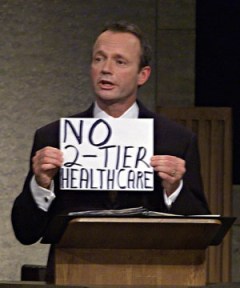
Canadians pride themselves quite deeply on our system. mi-day-2tier-826253 We believe that helping the sick is the responsibility of all.  And we are terrified of anything even closely resembling the current American system.  To even speak of introducing just the slightest bit of privatized medical care can be political poison for a federal politician.  In the 2000 election, the leader of the right-wing Canadian Alliance party (which is now the ruling Conservative Party of Canada), Stockwell Day, was painted as someone who would introduce American-style healthcare, a charge that he had a hard time battling.  He even went so far as to hold up this sign during the leaders’ debate [see right].

Canadians are perfectly happy with our system. We may fiddle with it in the margins, but socialized medicine is here to stay and that’s how we like it. So could Ms. Somers and her idiot fellow travelers please start coming up with their own fact-based arguments and stop lying about Canada?

The Odd Lie Of Barack Obama

The president repeated incessantly that, under Obamacare, Americans could keep their current coverage:

Lowry pounces:

Rarely has a major domestic program been sold on the basis of a premise so patently untrue. No matter what you’ve heard from the president of the United States, hundreds of thousands of people in states around the country are now receiving notices that their insurance is getting canceled. It raises the question of how the president could be so wrong about a basic element of his own signature initiative.

Greg Mankiw runs through various possibilities. Which is more worrying: that the president only vaguely knew what he was promising or that he consciously lied about it? So, on this issue, he is either a spectator of his own administration or a snake-oil salesman. The truth has always been that the ACA would impose a minimum level of benefits, meaning that many folks with cheap and not-so-great policies in the individual market will have to upgrade. So the ACA punishes a small group of people – those who have been thrifty with health insurance. As Ross points out, this is an odd incentive to impose:

If we want health inflation to stay low and health care costs to be less of an anchor on advancement, we should want more Americans making $50,000 or $60,000 or $70,000 to spend less upfront on health insurance, rather than using regulatory pressure to induce them to spend more. And seen in that light, the potential problem with Obamacare’s regulation-driven “rate shock” isn’t that it doesn’t let everyone keep their pre-existing plans. It’s that it cancels plans, and raises rates, for people who were doing their part to keep all of our costs low.

I must say that Ross’s blog has become indispensable in my understanding of the sane conservative critique of the ACA. Allahpundit tackles the administration’s response:

[White House press secretary Jay] Carney’s reply to this is, essentially, (a) a lot of people will be able to keep their plan if they like it, even if it’s not quite everyone, and (b) those who are getting dropped from their plans will get more comprehensive coverage on the exchanges. The latter point is like having the CEO of DirecTV tell customers that their monthly bill is about to double but they’ll now receive an extra hundred channels in return, maybe one or two of which people will actually watch.

Comprehensive coverage is lovely, but if you’re on a budget basic coverage might be more cost-effective; why pay $1,000 extra a year for a new package that includes substance-abuse treatment, say, if you don’t drink or do drugs? Obama took the option of cheaper catastrophic care away from people because insurers wanted to squeeze healthy middle-class suckers for extra revenue by forcing coverage on them that they don’t need. And yet Carney’s basically selling this as a *good* thing about the law, a sort of upgrade over the basic — but affordable! — plans people have now. Remind me again: Isn’t “affordability” supposed to be a key plank of the Affordable Care Act?

Frakt refuses to defend Obama’s promises about keeping coverage:

Let’s start with “if you like your plan you can keep it.” This is never, uniformly true. Plans change every year, even in the years before Obamacare was conceived. The truth is, if you like your plan, there’s a good chance it will change. That’s just as true, if not more so, under Obamacare. I do not endorse or defend this statement.

What Obama might have more plausibly have said is that Obamacare makes only minor or modest changes to coverage for the vast majority of Americans. Where it makes the biggest change is for the minority of Americans who cannot obtain affordable coverage today. That I could defend, though I am sure others would still contest it.

Chait’s perspective:

When it was originally contemplated, several years away from implementation, the process of imposing regulations on the individual-health-insurance market did not feel like taking people’s health insurance away from them. In the current moment, with cancellation notices going out and alternatives not yet available, it feels exactly like that. Which is to say, a promise that felt like a mere oversimplification at the time, and may eventually feel like one in retrospect, currently feels like a lie.

Earlier Dish on this subject here and here.

Two Out Of Five Babies Are Playing Angry Birds Right Now

Finally, a real sense that I’m not alone! (I’m only a few stars away from nailing the latest Star Wars episode.) Lauren Davidson notes that smartphone and tablet use is catching on among the diaper-wearing set:

Thirty-eight percent of American toddlers under age two have used a mobile device for media, which includes playing games, using apps and watching video. This compares to 10 percent two years ago, when Common Sense Media conducted the first stage of the survey. “The past two years have seen an explosion in the use of mobile media platforms and apps among young children,” the survey explains. “In fact, almost as many children now have their own tablets (7 percent) as parents did two years ago (8 percent).”

I wonder how this will affect future media. Surely, it will be pretty huge. My nephew and I bonded over a Tablet. Its intuitive, tactile, interactive mode is so much more immediate to him than even television. If it becomes even more tactile – successfully mimicking the real feel of the world – it will be even more irresistible.

We need a new Lewis Carroll for today’s kids: Alice needs to go through the Tablet Glass this time. And never leave.