The Decay Of Pompeii

Ingrid D. Rowland remarks that “Pompeii is not only the graveyard of an ancient Roman city; it is also, and especially, the graveyard of modern good intentions” due to lack of funding for site preservation and maintenance:

Some of this destruction is inevitable. Pompeii was so well preserved because it lay dish_pompeii buried for seventeen centuries. Having its extraordinary ruins unearthed has meant exposing them to the normal processes of aging that all cities face—wind, rain, plants, animals, gravity, entropy, chaos—without the normal defenses that homeowners provide by caring for the places they inhabit. Furthermore, Pompeii was not by any means an intact city when Vesuvius destroyed it in the year 79. A devastating earthquake had already struck the region in 62, and many of its buildings were still under reconstruction when the volcano erupted in a rain of pumice pebbles. There were earthquakes after the eruption, too, as the emptied mountain settled back down for another few centuries of inactivity. Thus the soil of Pompeii has preserved not a city interrupted in the course of normal life, but one caught in a state of total panic, and whose buildings had already been severely damaged.


What can be done to stop this decay?

On a geological time scale, not much. On a human scale, a great deal. In Massimo Bray, Italy finally has a Minister of Culture and Tourism who means business (one of his predecessors, Sandro Bondi, was mostly known for his soupy poems in praise of former Prime Minister Silvio Berlusconi). There is reason to hope that the waste and neglect that have brought the buried city to its present calamity will stop, at least to some extent, with a more responsible Italian government in charge and a new preservation law on the books.

(Photo of excavation of plaster casts of bodies at Pompeii by Flickr user TyB)

Goth Keeps Going

This embed is invalid


As the British Film Institute heads into its season of Gothic fiction, Roger Luckhurst wonders what keeps the genre so fresh in pop culture:

The gothic has offered a sinuous line of cultural commentary since Horace Walpole wrote The Castle of Otranto in 1764. It falls in and out of favour, but never quite goes away, because its metaphors of haunting and the undead prove so adaptable. Today, horror seems urgent again in an era of profound insecurity. George Romero updated the zombie as an emblem of consumption. The metaphor has now moved back closer to its slave plantation origins, imagining modern masses sapped of every ounce of living labour. Zombie contagion, despite Brad Pitt’s best efforts to ruin the genre in World War Z, remains an effective way of thinking about global interdependence and fragility.

It doesn’t take much to see aristocratic vampires as pulp versions of plutocrats supping on the blood of the merely-human, parasites hoarding wealth across the centuries. The Occupy movement even had a cross-over with the imagery of monstrous horror: Octopi Wall Street was a slogan and internet meme. Elsewhere, nasty and demonic things crawl out of war zones in the films Outpost or even Iraq in Adam Baker’s undead shocker, Juggernaut. But then the gothic, right from its nightmare beginnings, was about colonial anxiety and fears of what comes back to haunt from nefarious doings overseas.

Revisiting the works of Edgar Allen Poe, Sam Jordison pushes back against all the goth-love, finding the genre too moody and meandering:

Even the most famous stories, such as The Fall of the House Of Usher, left me cold. And not cold in a chills-up-the-spine sense: just a bit bored.

The image of the house reflected in the black tarn is admittedly impressive. So too is the description of the crumbling house itself, and the “minute fungi” that cover its exterior. But the symbolism quickly becomes overbearing: the pathetic fallacy of the awful weather, the gothic archways, the wild guitar playing, the gloom, the doom, the adjectives pertaining to gloom and doom, the decayed trees. Too much! And that’s before we get to the dialogue: “‘I shall perish!'” said he. ‘I must perish in this deplorable folly.'” You said it.

It’s possible to defend Poe as a pioneer. Here we can see the model of haunted houses ever since. Generations of writers, not to mention special effects teams and film directors, have been inspired by him. Then again, his scary buildings and emotional weather patterns aren’t a patch on those described by Emily Brontë in Wuthering Heights, while his gothic excesses don’t compete with those conjured by writers such as Matthew Lewis and Ann Radcliffe half a century earlier.

So why do we still read Poe? Is he simply a curio – an early American writer with a crazy personal life? I hesitate to say that, for I still haven’t read enough, for a start. And even though I’ve frequently been bored, I’ve found odd moments fascinating, and gloriously weird. What is this thing about female corpses, for instance? Good job he was born before psychotherapy.

Previous Dish on gothic appeal here and here.

France’s Fiscal Failures

Milton Ezrati claims that the French economy is in “profound decline”:

French authorities mostly have either denied the situation’s severity or blamed it on Germany’s push for budget austerity throughout the euro zone. There is no shortage of critical remarks to make about the German approach, but it can hardly explain France’s economic problems. France, after all, hardly has imposed much austerity. It has promised to do so but otherwise has asked of itself none of the sharp government spending cuts evident elsewhere in Europe’s periphery. On the contrary, French government spending has continued to grow, rising almost 4 percent during the last two years. Government in France now constitutes some 57 percent of the entire economy, well above the euro zone’s average. Meanwhile, Paris recently sidestepped the need for more strictures, receiving permission from the EU bureaucracy to continue wider budget deficits than EU rules allow until 2015 at the earliest. Nor can French officials honestly blame German austerity when their nation’s economic slide has beginnings long before the current crisis or Berlin’s response to it. France, quite simply, has been underperforming the rest of Europe for over a decade.

He blames “ill-conceived policies that have hamstrung business with oppressive taxes, stultifying labor regulations, and a raft of product and production controls”:

Taxes are the most straightforward and immediate economic burden. Payroll levies in France amount to 38.8 percent, and with the added burden of business income taxes and the value-added tax (VAT), employers in France pay the government the equivalent of almost 64 percent of their payrolls. This is a much heavier weight than firms in other countries must bear. Germany, for instance, imposes a tax wedge on its business of about 53 percent, high compared to the 38.5 percent imposed by the United States, but still more than 10 full percentage points less than France. Harder to quantify but no less a burden on French business is the notorious complexity of the French tax code, which, business surveys indicate, rivals even that of the United States. Its myriad loopholes, set against the high statutory tax rates, tempt managers to divert time to tax planning that they might better dedicate to production and sales.

The City As Canvas

Joe Winkler observes the fallout from Banksy’s month-long New York campaign and argues those attempting to preserve or restore the art are missing the point:

In the last two weeks, owners of buildings with Banksy art have taken to hiring guards, putting up plexiglass, rolling gates, and ropes to create lines, all of which is practical and perhaps understandable but undermines much of the purpose of these 30 days. All of these protections simply turn these outdoors, public pieces into indoor museum pieces, introducing a sterility that subverts the spirit of the project. These tactics isolate the art from the bustling environment. The viewer becomes passive, just another viewer waiting in line, no longer a participant. From a theoretical perspective, this all seems backwards. The owners of the building, from the perspective of the actual graffiti art, ought to hold no more rights than the community in deciding what to do with the graffiti.

Meanwhile, NPR interviewed a woman whose building in Williamsburg was tagged by Banksy. Her thoughts:

It leaves us in a sticky place … he’s putting artwork on our wall that now we’re expected either to protect or let it be destroyed, and we can’t sell it. And we don’t necessarily want to sell it; we don’t know yet. But I have been approached by a gallerist, and this is something that this gallery specializes in. They could come, take down the wall, put it up for auction … and that could be the route that we go. It puts us in a conundrum, I mean, we believe — I think we truly believe — that this art is for the public. But we’re also not equipped to serve the public’s needs.

Recent Dish on Banksy’s New York adventure here and here.

Europe’s Anti-Roma Racism

Roma children laugh in front of the came

Joshua Keating zooms in on Europe’s sudden wave of anti-Roma sentiment:

The biggest international story is that of “Maria,” the blond, blue-eyed girl removed by police from a couple during a raid on a camp in Greece when they became suspicious that she looked nothing like her darker-skinned parents. DNA tests confirmed that the child was not related to the couple, sparking a continentwide search for her biological parents. The couple say the girl was not abducted, that it was “an adoption that was not exactly legal but took place with the mother’s consent.” This could be plausible, though further investigations have shown that the couple had used multiple names to register 14 children in three different cities, perhaps as part of a government benefits scam. Greek authorities have ordered an investigation of thousands of birth certificates issued in the last five years, and three more Roma have already been arrested in a similar case case on the island of Lesbos.

While it certainly seems like something not-quite-aboveboard was going on here, the case has raised fears that the case of the “blonde angel,” as she has been called in the Greek media, could reignite old myths of Gypsies kidnapping white children. When ancient prejudices combine with the tabloid media’s fixation on missing blond children, it’s hard to imagine anything good coming from it.

A backlash against Roma appears to be taking hold, with a blonde Roma girl in Ireland separated from her parents until DNA tests proved her to be their biological daughter. Filip Borev points out that the mixed heritage of Roma can produce fair skin and hair, and that the panic speaks to something deeper:

Don’t get me wrong, blond hair is somewhat a rarity among Roma populations. What is rarer, however, is the “pure blood” or tatcho Romany. Indeed, there is nothing more the Romany like to do than fight among themselves over who is the purest Gypsy, but one only needs to take a glance at Britain’s Romany community to realise there has undoubtedly been a great deal of intermarriage. My genes would best be described as a melting pot – my mother is part Bulgarian Roma, part Romanichal (English Romany), and my dad is part Romanichal, part Irish Traveller – thus, it was hardly surprising when I was born a blue-eyed milk bottle.

The notion of the baby-snatching Gypsy is an old racist stereotype. Since I was born it has been a running joke within my family that I was stolen. My mum’s engagement to a Roma man resulted in three considerably darker-skinned siblings. Among my Roma family I couldn’t have stood out more, but lucky for me I can now hand down the “stolen baby” joke to my younger brother who was born with strikingly blonde hair. In the current environment, however, I must ask just how funny this joke is.

Okasana Marafioti bemoans the long history of discrimination against Roma in Europe:

The stereotype of Gypsies as child snatchers is centuries old, but ask anyone if they can give you a specific incident, and they will scratch their heads. More disturbing historical facts have survived, including records of more than 133 anti-Gypsy laws enacted in the Holy Roman Empire at around 1551, which made being a Gypsy punishable by death, and authorities systematically took Romany kids from their parents and placed them in “proper” homes, a trend that continued well into the first half of the 19th century.

Rachel Shukert adds:

One doesn’t like to descend into comment sections, but a perusal of those on these latest stories is like peering into something out of the Malleus Maleficarum, or Borat. Americans, who for the most part see gypsies as something you dress up as on Halloween when your mom forgot to get you a real costume, express utter bafflement, while Europeans, who never tire of calling Americans out on their racism, insist on the toxicity of these people—their essential, unchanging, criminal nature; it’s who they are, they insist. It’s their culture. They can’t be changed, so they have to—somehow—be gotten rid of. (My favorite thread managed to both laud Hitler for killing the Roma along with the Jews, while blaming the Jews for the Roma not getting any credit for the Holocaust. And also, did you know we’re both capitalists and Bolsheviks? Blah blah blah.)

(Photo: Roma children laugh in front of the camera in a camp on the outskirts of Rome on September 8, 2010. By Christophe Simon/AFP/Getty Images)

Black History Sans White Saviors

Wesley Morris reviews 12 Years A Slave. How the film upends the racial dynamics of Hollywood:

There is a kind of audacity in something like Lincoln, in which important white men get discursive about the moral quandary in which slavery mires the country. That debate required men to search their souls and vote accordingly. But after enough of these movies, you’re just hot with insult. You have to stop accepting apologies, accepting, say, The Help, and start demanding correctives, films that don’t glorify whiteness and pity blackness, movies — serious ones — that avoid leading an audience to believe that black stories are nothing without a white voice to tell them that black people can’t live without the aid of white ones.

[Director Steve] McQueen and [screenwriter John] Ridley turn that dynamic inside out. Their movie presents the privilege of whiteness, the systematic abuse of its powers, and black people’s struggles to get out from beneath it. A different movie might have taken this story and turned it into a battle between Epps and the white men who feel a duty to free Northrup. That’s what we’re used to. There have been complaints that the movie is too violent, that it depicts too many lashings, too many cruelties, too much interracial abuse, that all the gashes on all the backs (what Toni Morrison poetically described as chokecherry trees) are just too much. But that’s a privileged concern.

Peter Malamud Smith is troubled with Northrup representing the institution of slavery as a whole:

12 Years a Slave is constructed as a story of a man trying to return to his family, offering every viewer a way into empathizing with its protagonist. Maybe we need a story framed on that individual scale in order to understand it. But it has a distorting effect all the same. We’re more invested in one hero than in millions of victims; if we’re forced to imagine ourselves enslaved, we want to imagine ourselves as Northup, a special person who miraculously escaped the system that attempted to crush him.

Isaac Chotiner counters:

[I]f Hollywood ever did make a movie called 200 Years, Millions of Slaves, how much would you wager that writers like Smith would be denouncing Hollywood for de-personalizing slavery? Doesn’t Hollywood realize that actual individuals suffered? Doesn’t Hollywood grasp that the evils of slavery went beyond statistics? Secondly, 200 Years, Millions of Slaves is not a movie. Movies focus on individuals or groups of individuals. How would one even conceive of Smith’s project? Smith even seems to backhandedly acknowledge as much, writing, “Maybe we need a story framed on that individual scale in order to understand it.” Maybe we do! In the meantime, we should evaluate 12 Years a Slave on its own terms.

Healthcare Needs The Healthy

Health Status By Age

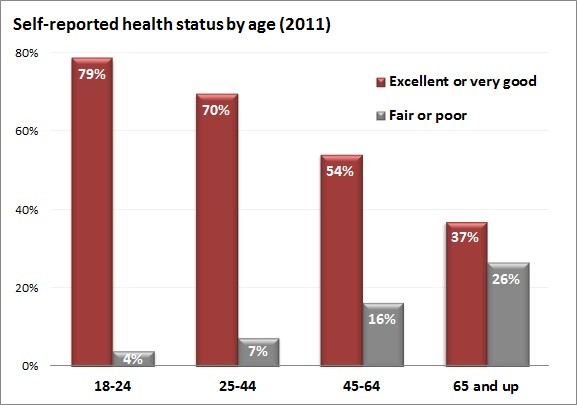
Waldman illustrates why the young must sign up for Obamacare for it to succeed:

The truth is that while we talk about the importance of young people being in the risk pool, what matters isn’t their age but their health. On average, young people will be healthier longer, but every year the system needs plenty of healthy people of whatever age they might be. When you ask them, the young are much more likely to report being healthy, with self-reported health declining the older you get.

Emma Roller covers efforts to get the young to enroll:

Mothers make the health care decisions in 80 percent of families, and they’re the most effective “messengers” to persuade their kids to sign up for health care. Anne Filipic, who leads the nonprofit group Enroll America, says men may be the ultimate target for groups promoting the exchanges—they are more skeptical of health insurance and tend to visit the doctor less—but they’re focusing on women because of their decision-making role. “The messenger matters a lot,” Filipic says. “The most effective thing we can do is get moms and women the information, so in their day-to-day conversations they can be spreading the word.”

Enroll America surveyed young people and asked who they were most likely to trust talking to them about health care. For young women, “someone like me” was the most persuasive messenger. For young men, it was their mom, followed by their spouse or girlfriend. That’s why the Obama administration has promoted the exchanges on mom-friendly media like allrecipes.com, Good Morning America, and Elle magazine.

How Much Is A Little More Life Worth?

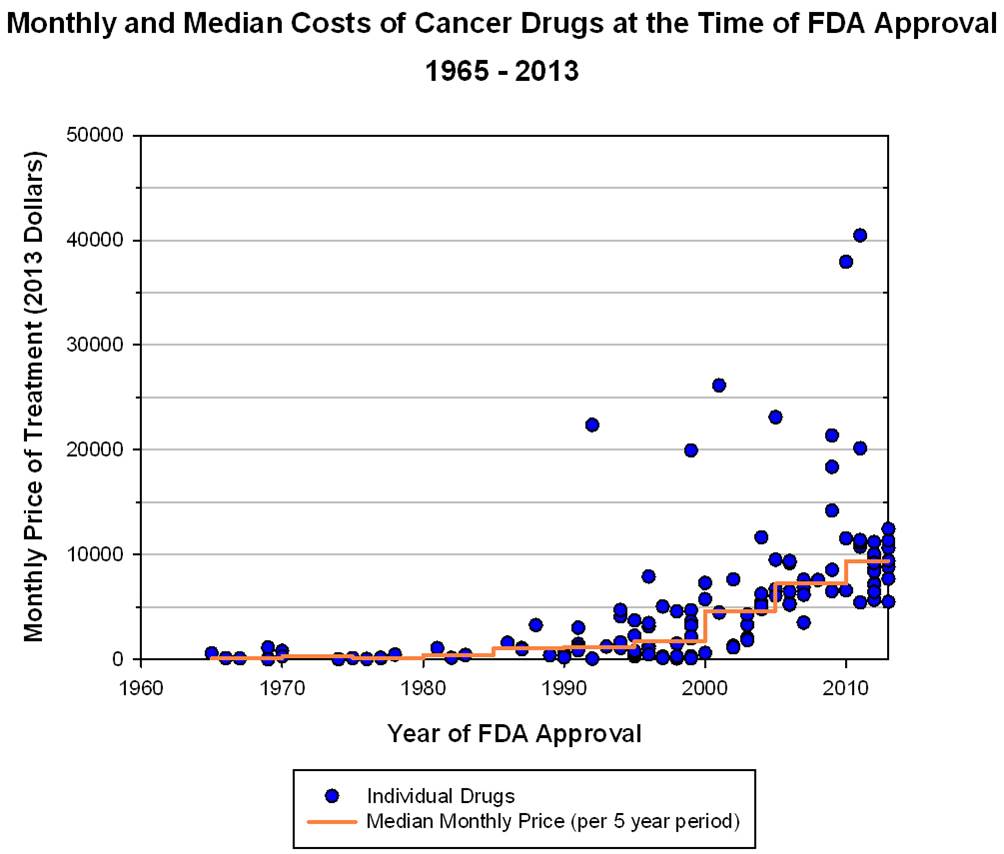
The cost of cancer drugs has skyrocketed:

Cancer Drugs

Stephen S. Hall covers the phenomenon:

What is sobering about this booming business is that, as a group of oncologists wrote earlier this year, “most anti-cancer drugs provide minor survival benefits, if at all.” They often (but not always) reduce the size of inoperable tumors, but they rarely eradicate the disease.

For relatively uncommon malignancies like testicular cancer, some forms of leukemia, and lymphoma, drugs effectively cure the disease; for the common “solid tumor” cancers (lung, breast, colon, prostate, and so on), which account for the vast majority of annual cases, drugs buy some time—precious time, to be sure, but time usually measured in weeks and months rather than years. And even though many of the newer drugs are less toxic, they often still have to be given with older drugs whose side effects include nausea, hair loss, fatigue, and decreasing blood counts. One anti-cancer drug produces a skin rash so severe and disturbing, according to [Leonard] Saltz [head of the gastrointestinal oncology group at Memorial Sloan-Kettering Cancer Center], that some patients have been asked by employers not to come to work. …

In 1994, the median survival rate for someone with advanced colon cancer was eleven months, according to Saltz, and the lifetime costs of the drugs used to treat the average patient would be about $500 at today’s prices. By 2004, the median survival rate had increased twofold, to 22 months, but Saltz says the drug costs had increased hundreds of times for that extra eleven months.

How Many Wiki Editors Do We Need?

Tom Simonite sees the online encyclopedia getting sclerotic:

The volunteer workforce that built the project’s flagship, the English-language Wikipedia – and must defend it against vandalism, hoaxes, and manipulation – as shrunk by more than a third since 2007 and is still shrinking. Those participants left seem incapable of fixing the flaws that keep Wikipedia from becoming a high-quality encyclopedia by any standard, including the project’s own. … The main source of those problems is not mysterious. The loose collective running the site today, estimated to be 90 percent male, operates a crushing bureaucracy with an often abrasive atmosphere that deters newcomers who might increase participation in Wikipedia and broaden its coverage.

But he acknowledges that the decline of participation is largely due to the anti-vandalism measures introduced in 2007, when high-profile hoaxes seemed to pose an existential threat to the project:

The project’s most active volunteers introduced a raft of new editing tools and bureaucratic procedures intended to combat the bad edits. They created software that allowed fellow editors to quickly survey recent changes and reject them or admonish their authors with a single mouse click. They set loose automated “bots” that could reverse any incorrectly formatted changes or those that were likely to be vandalism and dispatch warning messages to the offending editors.

The tough new measures worked. Vandalism was brought under control, and hoaxes and scandals became less common. … But those tougher rules and the more suspicious atmosphere that came along with them had an unintended consequence. Newcomers to Wikipedia making their first, tentative edits – and the inevitable mistakes – became less likely to stick around. Being steamrollered by the newly efficient, impersonal editing machine was no fun. The number of active editors on the English-language Wikipedia peaked in 2007 at more than 51,000 and has been declining ever since as the supply of new ones got choked off. This past summer, only 31,000 people could be considered active editors.

The Classical Remix

A portion of Max Richter’s dazzling take on Vivaldi’s The Four Seasons:

In a wide-ranging essay that connects Kanye West to Beethoven, Michael Markham discusses the similarities between classical music and today’s popular genres:

Vivaldi’s generation reveled, without embarrassment, in instant emotional gratification. Its most popular form of music, Opera seria, was not like later Romantic opera. It did not present a deep unified story in the Wagnerian sense, and instead provided little more than a series of 40 or so fragmented emotional moments, each represented by a static aria that crystallized a single mood.

Baroque-era audiences treated the productions as live “best of” concerts, wandering in and out of the theater, choosing to listen only to the excerpts that touched the right mood for them that night. Baroque composers were trained to enhance such evocative mood-experiences even when writing instrumental concertos. The constant nervous pulse (that for much of the 20th century led to Baroque music being called “sewing machine” music) invigorates in the same way modern rock or hip-hop does; the cascading sequences and recurring fragments of melody produce a pop-like repetition that pulls the listener back again and again to the same emotional starting point. …

The form of the Vivaldian concerto is based on the idea of the reoccurring “hook.” It is similar in this way to the verse-chorus-verse-chorus progression of our own pop songs. [Composer Max] Richter’s own comments on his music reveal this connection to today’s composition: “I was pleased to discover that Vivaldi’s music is very modular. It’s pattern music.” So is Richter’s, as well as that of many of the most prominent composers of both “classical” and “pop” minimalism (not to mention trance, hip-hop, dance, house, etc.) of the last 20 years — from Brian Eno and Meredith Monk to Kanye West, Gotye, Nico Muhly, and John Luther Adams.