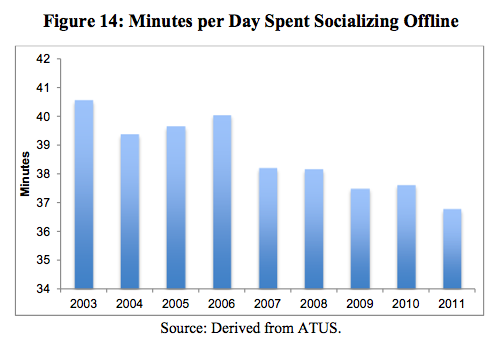
What Web Surfing Has Replaced

Minutes Socializing

A new paper by Scott Wallsten attempts to find out:

I find that, on the margin, each minute of online leisure time is correlated with 0.29 fewer minutes on all other types of leisure, with about half of that coming from time spent watching TV and video, 0.05 minutes from (offline) socializing, 0.04 minutes from relaxing and thinking, and the balance from time spent at parties, attending cultural events, and listening to the radio. Each minute of online leisure is also correlated with 0.27 fewer minutes working, 0.12 fewer minutes sleeping, 0.10 fewer minutes in travel time, 0.07 fewer minutes in household activities, and 0.06 fewer minutes in educational activities.

When your work is entirely online, the social isolation can even intensify further. One reason I cherish my time in Ptown every summer is that it forces me to have much more physical and personal interaction. Walking down Commercial Street is impossible without bumping into friends, new and old, all the time. And they tend to be on vacation so are more prone to stopping and chatting. It re-humanizes me after so much typing alone onto a screen. The rest of the year, I engage with far more people virtually than I do physically. And that can rob life of its essence. If you’re not careful you begin to live online.

Ben Richmond ponders the effect on socializing:

Even though the segment of time most affected is the biggest—watching TV—Wallsten also points out that there’s a visible social shift.

“Other offline leisure activities that involve interacting with other people are crowded out by online leisure: attending parties and attending cultural events and going to museums are all negatively correlated with online leisure,” he writes. “In short, these results based on ATUS data suggest that a cost of online activity is less time spent with other people.”

Of course, the most popular activity for online leisure is social networking, so worries that we’re all becoming hermits should… tempered, I guess. The nebulous nature of the internet is exactly what makes quantifying if what happens online comes at the expense of something else, because “being online” is terribly descriptive of what you’re doing.

Simone Foxman chips in her two cents:

Although Wallsten can’t prove that more computer time causes less sleep, for instance, he concludes, “that online activities, even when free from monetary transactions, are not free from opportunity cost.” This trend is particularly strong among young people. For example, every minute 15- to 19-year-olds spend online leads to 18 fewer seconds doing educational activities. For Americans 20-24 years old, however, the same minute of online leisure is only associated with losing about seven seconds of educational activity. For older Americans, the impact is even smaller. This data suggests—though does not definitely prove—that teenagers are more likely to devote time that would otherwise be devoted to educational activity to surfing the web or instant messaging than do slightly older young adults.


What’s The Problem With Political Ignorance?

Ilya Somin’s new book argues that such ignorance among Americans makes small government preferable. Sean Trende prefers to look on the bright side:

[A] relatively low-information electorate has helped produce one of the most prosperous, most free societies in world history. This country has adopted many policies that economists seem to deem beneficial: tax rates have fallen, deductions have been reduced, and global trade has grown. We’ve become more tolerant with regard to racial, gender, ethnic, and sexual minorities. Sometimes this has come with a push from the courts (but see Gerald Rosenberg’s The Hollow Hope), but there’s no doubt that the will of the people has played a key role as well. I might hope for a more educated populace, but at the end of the day, I’m not sure American electorate is so broken that it demands the sort of fix that Ilya suggests.

Somin defends himself:

In calling the United States successful, we have to ask, “relative to what?” The answer, of course, is relative to other nations, nearly all of which are either democracies that also suffer from problems caused by political ignorance, or dictatorships.

I do not deny that dictatorships are, on average, much worse than democracies. But the relative superiority of the United States compared to dictatorships and most other democracies is not relevant to the issue I raise in the book: whether democracies would suffer less damage from political ignorance if they limited and decentralized their governments more than they do at present.

During most of its history, the U.S. government was both more limited and more decentralized than most other democracies. The large size, limited central government, and numerous diverse jurisdictions of the United States gave Americans numerous opportunities to vote with their feet. And the informational superiority of foot voting over ballot box voting is, of course, a central thesis of my book. Extensive opportunities for foot voting, rather than ballot box voting, historically made the United States unusual.

Earlier Dish on Somin’s book here.

The New Wild West

Oil Boom Shifts The Landscape Of Rural North Dakota

Mike Riggs examines how North Dakota’s Bakken region – home of America’s fastest-growing regional economy – is struggling to police itself:

In 2005, the Williston Police Department in Williston, North Dakota, received 3,796 calls for service. By 2009, the number of yearly calls had almost doubled, to 6,089. In 2011, the most recent year for which data is available, the Williston P.D. received 15,954 calls for service. … And Williston hasn’t even seen the worst of it. The police department in nearby Watford City received 41 service calls in 2006. In 2011 they received 3,938. That’s life in an energy boomtown.

“Policing the Patch, a new study issued by the Department of Criminal Justice & Political Science at North Dakota State University, sheds new light on the problems faced in these boomtowns. Between October 2012 and March 2013, professor Carol A. Archbold and her team interviewed 101 law enforcement officers from eight agencies about how the in-migration of oil workers to the Bakken region has changed the way they do their jobs. The team’s findings tell us a lot about the problems created when cities and towns grow at an explosive rate.

(Photo: Inmates sit in the county jail on July 26, 2013 in Williston, North Dakota. The state has seen a rise in crime, automobile accidents and drug usage recently, due in part to the oil boom which has brought tens of thousands of jobs to the region, lowering state unemployment and bringing a surplus to the state budget. By Andrew Burton/Getty Images)

Gridlock Around The Globe

Divided government is getting more common:

Democracies everywhere—from the oldest and most mature, to the youngest and least institutionalized—are showing a surprising common feature: It is increasingly rare that a presidential candidate trounces his opponent. Elections won by a landslide are endangered species. They still happen occasionally, but the prevalent trend is that wherever free and fair elections take place, the margins of victory are shrinking. Increasingly, elections are won by a hair.

Today, polarized and fragmented electorates are the norm, and their votes offer no clear mandate or dominant position to any party or candidate. This is why so many countries are governed by complex, cumbersome, and unstable coalitions formed by political groups whose members often have little in common and in some extreme cases are even bitter rivals.

As I have noted elsewhere, in 2012, among the 34 members of the “rich nations club,” the Organization for Economic Co-operation and Development, only four featured a government that also had an absolute majority in parliament. In India, 35 parties shared seats in the 2009 election; no party has won an absolute majority since 1984. In fact, absolute majorities are globally on the wane. In electoral democracies, minority parties have won on average more than 50 percent of the seats in parliament throughout the postwar period; in 2008, minority parties controlled 55 percent of seats on average. But even in countries that are not deemed democracies, minority parties are increasing their clout. In those countries, minority parties held fewer than 10 percent of seats three decades ago; now their average share has risen to nearly 30 percent.

Canned Laughter Has Passed Its Expiration Date, Ctd

Scarface finally gets the laugh track it deserves:

A reader writes:

Regarding your canned laughter thread; it’s likely that only those who live in California’s Central Valley will remember that Fresno, the mini-series starring Carol Burnett, was aired twice, originally in 1986 without a laugh track and again in 1989 with canned laughter “added so that the audience would know Fresno was supposed to be funny”, as mentioned on Wikipedia. I remember the talk at the time was that the original broadcast was too dry and people outside Central California didn’t realize it was a parody of Dallas and meant to be funny. I thought it was hilarious as originally aired and felt uneasy about the added laughter in the 1989 version, since it was obviously not filmed in front of a studio audience. The entire four-and-a-quarter hours without the laugh track is here. (You might enjoy a young Gregory Harrison as Torch, since he didn’t wear a shirt in any scene.)

Another:

Apparently when they were taping Seinfeld (an actual, honest-to-goodness funny show), they ran in to a related problem: too much laughter.

As the series progressed, the scripts began to fill more and more of the 22 minutes (later episodes of the show omit Jerry’s lead-in stand-up bits) and were precise enough they couldn’t afford much time for laughter. Apparently, according to the DVD, Larry David was especially annoyed when the audience would laugh too much – or cheer Kramer upon his first appearance, which went on for more than a season – and therefore take up his valuable comedy time. (Of course, Larry David gets annoyed at pretty much everything.)

Another:

The problem of canned laughter extends well past TV sitcoms. A few years ago my wife and I took in the revival of “Promises, Promises” with Kristen Chenowith and Sean Hayes on Broadway, and the audience was the worst audience I’ve ever seen. They too laughed at nearly every line, conditioned to do so by years of TV viewing. My suspicion is that the TV stars in the cast, Hayes and Chenowith, attracted a TV-familiar audience who believed that they were part of the show.

The worst moment, however, was when Hayes’s character discovers that Chenowith, with whom he has been in love, is having an affair with his boss. The audience collectively gasped. It’s not a subtle moment in the production. The affair has been building to this point and anyone paying attention, or anyone who has seen earlier productions, knows what is going on and what’s about to happen. Yet the audience seemed to be stunned by the revelation.

It was like sitting in the movie theater with the cliched woman yelling at the actors on screen not to go into the basement.

“Impostor Syndrome”

Ann Friedman finds that more and more professionals, especially women, are falling prey to it:

We’re all familiar with the gut-level feeling you get when you know you’ve cheated. It often follows specific, concrete acts, like peeking at a classmate’s answers on a test or sleeping with someone who isn’t your boyfriend. The gut-level experience of impostor syndrome is something slightly different—a nervous undercurrent that runs through your day-to-day experience, unacknowledged, only to crop up in salary negotiations or in small phrases like, “It might just be me but….” or “Not sure I know what I’m talking about….”…

Experts note that impostor syndrome thrives when competition is intense and there are few mentors to provide a reality check—which seems to be a pretty apt description of the post-recession American economy. Women—who, despite slow progress in some fields, are increasingly dominant in the professional world—are far more likely than men to suffer from imposter syndrome. Many experts have posited that this is one reason for the so-called “ambition gap.” It’s not that women don’t want to succeed, it’s that, despite their education and experience, they’ve internalized messages about their lack of qualification. This is also true in the earliest stages of a professional career, when the difference between a polite rejection and a modest salary is mostly luck and connections, it can be hard to tell yourself that you earned this entry-level job and that you were qualified above and beyond all of those other applicants.

Heart Beats


Inspired by the “silent” child patients of Holland Bloorview Kids Rehabilitation Hospital in Toronto, researchers have developed a technology called Biomusic, which “translates real-time autonomic nervous system signals including heart and breathing rates and skin temperature, into musical sounds”:

Biomusic sounds something like avant-garde electronic music. Generated using a Musical Instrument Digital Interface (MIDI), it has an ethereal, other-worldly quality. An underlying drumbeat represents heart rate. Skin conductivity—which varies with sweating—controls pitch. Respiration rate dictates the musical articulation and phrasing. The melody and chords are smooth and flowing through the breath, and soften towards the end of the breath.

In the first minute of monitoring, the system takes a baseline reading and assigns the average to middle C. So, every instance of Biomusic begins with the same pitch and moves up or down from there. The overall key signature is determined by skin temperature, which changes gradually about 15 seconds after an emotional or physiological stimulus. States of stress, with fast and jagged breathing, sound different than states of relaxation, when the breath is slow and smooth. …

To see what would happen, [engineer and musician Stefanie] Blain-Moraes and her team recruited a number of residents, caregivers and family members to listen to Biomusic over the course of four visits. They were interviewed before and after the sessions. The results were positive. [Twelve-year-old patient] Thomas’ father said that the music he heard felt like a manifestation of his son’s personality: “it makes me think of the lively boy before.” Changes in Thomas’ biomusic also seemed to express a response to his presence. “When I was at the door, the sound was softer,” he said. “When I was there [at the bedside] it was longer and louder. I think Thomas knows that there is a presence of a loved one.”

(Audio: A clip from SoundCloud user chazmatazz, who used a biomechanical simulator to generate sound based on muscle activation and fiber length for 76 muscles in the legs while walking.)

The Birth Of “Jet Lag”

Cara Parks explores how changes to our environment affect our sleep patterns:

The term jet lag was coined in about 1966; before that, a slow boat across the Atlantic or a horse ride across Asia allowed humans to adjust gradually to their new surroundings (internal clocks can adjust by approximately one hour per day). External or environmental cues to our internal clocks are called zeitgebers, German for time-givers. These factors include temperature and, most importantly, light: the most important sign for early humans on when to hunt and when to lie low came from the sun. … Our clocks reside within us; external cues sync them to the exterior world, keeping us from shifting further from the solar cycle every day. We experience jet lag because of this internal time ticking away as the sun rises and sets. ‘Whatever the exact period is for the body clock,’ an article in 2007 on jet lag in the medical journal The Lancet stated, ‘its timing needs to be adjusted to the solar day.’ That is why jet lag is known medically as desynchronosis. The traveller has become temporally untethered from her surroundings.

Meanwhile, in a review of Jonathan Crary’s 24/7: Late Capitalism and the Ends of Sleep, Erwin Montgomery and Christine Baumgarthuber recount an anecdote about the necessity of sleep:

Irritability, depression, emotional volatility, and, eventually, hallucinations plague the insomniac. Charles Lindbergh experienced the gritty discomfort of sleep deprivation during his first solo, nonstop transatlantic flight in 1927.

His 33 hours without sleep brought him nearer to disaster than did any mechanical malfunction or patch of rough weather. The night before his pre-dawn departure, Lindbergh was anxious. He slept fitfully, later recalling in his memoir that he grabbed two, maybe three hours rest before reporting to Roosevelt Field, his place of departure. Warm inside his flight jacket and lulled by the dull hum of his plane’s engines and an empty expanse of blue sky, Lindbergh felt an irresistible drowsiness come over him only few hours after takeoff. “My eyes feel dry and hard as stones,” he recorded in his flight log. “Keeping them open is like holding arms outstretched without support.” He complained of having little control over his body, and said his mind “clicks on and off, as though attached to an electric switch with which some outside forced is tampering.” He knew that to surrender to his drowsiness, even for an instant, would spell disaster, but his body had its own ideas: “[It] argues dully that nothing, nothing life can attain, is quite so desirable as sleep.”

Previous Dish on sleep research herehere, and here.

Japan’s Relationship Status: It’s Complicated

Vice covers Japan’s “relationship replacement services”:

According to Abigail Haworth, the country isn’t getting much real romance as of late:

The number of single people has reached a record high. A survey in 2011 found that 61% of unmarried men and 49% of women aged 18-34 were not in any kind of romantic relationship, a rise of almost 10% from five years earlier. Another study found that a third of people under 30 had never dated at all. (There are no figures for same-sex relationships.) Although there has long been a pragmatic separation of love and sex in Japan – a country mostly free of religious morals – sex fares no better. A survey earlier this year by the Japan Family Planning Association (JFPA) found that 45% of women aged 16-24 “were not interested in or despised sexual contact”. More than a quarter of men felt the same way.

Carl Scott throws some cold water:

[T]he late wunderkind Japanese-translator blogger Ampontan (Bill Sakovich) utterly debunked one of the three studies the Guardian story relies upon, the one making the particular claim that 45% of women aged 16-24 (and a quarter of the men) “were not interested in or despised sexual contact,” when these claims first surfaced a couple years ago. Here’s the money graf:

In other words, the Internet was agog over a report that 22 males and 38 females aged 16-19 said either that they had no interest in sex or despised it. When the Huffington Post spun this story as “a third of the nation’s youth” disliking sex, they were basing it on the response of 60 self-selected people. The HuffPo also thinks 38 girls is a “whopping” number.

Yes, another survey the Guardian article links to is much better than that, with a sample near 10,000, but as far as I can tell by skimming the report, it deals with fairly different questions, while as a whole it supports the overall trend reported of less effort being put into pursuing love relationships and marriages.

Katy Waldman is fascinated by Japan’s falling marriage and fertility rates, which have more solid data to back them up:

The article tries to put Japan in a larger context: “Across urban Asia, Europe and America,” Haworth writes, “people are marrying later or not at all, birth rates are falling, single-occupant households are on the rise.” But the sense of romantic futility and disillusionment in Japan feels distinct.

Trapped by outdated gender roles and crunched for both time and money, the young people in the story seem to be throwing up their hands in surrender. It would be one thing—new, but not tragic—if all the virtual wonderlands and stimulating careers and electric urban pastimes were diverting attention away from couplehood and even sex. But, at least in this article, the ebbing of human intimacy seems to come from a place of disenchantment and frustration. I can’t make this historical husband-wife arrangement thing work, so I’m giving up altogether.

Fisher focuses on the economic consequences of Japan’s demographic decline:

[T]his is more than a story about Japan and its cultural quirks: It’s a story about the global economy. Japan is the world’s third-largest economy, a crucial link in global trade and a significant factor everyone else’s economic well-being. It owns almost as much U.S. debt as does China. It’s a top trading partner of the U.S., China and lots of other countries. The Japanese economy is in serious enough trouble that it could set the rest of us back. And the biggest source of that trouble is demographic: Japanese people aren’t having enough kids to sustain a healthy economy. One big reason they’re having fewer kids is that they’re not as interested in dating or marrying one another, in part because they’re less interested in sex.

Keating wants us to stop picking on Japan:

The Japanese singledom trend story isn’t exactly a new phenomenon, but I suspect Howarth’s article took off because its descriptions of dominatrixes-turned-sex coaches and the thirtysomething guy who “can’t get sexually aroused unless he watches female robots on a game similar to Power Rangers” fit nicely into the weird-Japan news genre. I suspect some cultural stereotypes are also at work here. A number of Eastern European countries have lower fertility rates than Japan, but we don’t often see articles portraying Czechs and Poles as sexless nerds.

It’s definitely true that Japan, ranked first in life expectancy and 208th in fertility, is facing something of a demographic time bomb. But Japan is a leading indicator of a trend rather than an outlier.

When The Shelves Run Dry

8159652005_b23a554396_o

Siddhartha Mahanta warns that New York City is increasingly ill-prepared for food shortages following a natural disaster:

Until relatively recently, most of the food that wound up in New Yorkers’ stomachs came from the farms of upstate New York, Connecticut, and New Jersey. Even Brooklyn and Queens helped out, for a long while registering as the nation’s two biggest vegetable-producing counties. When that locally grown food got to New York, it tended to stay around longer, sitting in warehouses for perhaps weeks at a time.

Now, New Yorkers rely chiefly on food from across the country, or the other side of the world.

And to complicate matters, in recent decades the big companies that run these systems have radically altered how they manage the flow of this food through their supply chains. Most of the private companies that now dominate the distribution of food in America, like Walmart and Sysco, keep much smaller inventories than in years past, sized to meet immediate demand under stable conditions – a strategy known as “just-in-time.”

Analysts, in fact, expect Sysco – a major presence in the New York region – to continue cutting down an already super-lean supply chain operation. In other words, the food on New York’s shelves flows through supply lines that stretch much further than ever before. And there’s a lot less of it along the way.

(Photo of a post-Sandy supermarket in Edgewater, New Jersey, by Flickr user Bee Collins)