The Sabotage Is Already Happening

Felix Salmon provides a reality check:

The global faith in US institutions has already been undermined. The mechanism by which catastrophe would arise has already been set into motion. And as a result, economic growth in both the US and the rest of the world will be lower than it should be. Unemployment will be higher. Social unrest will be more destructive. These things aren’t as bad now as they would be if we actually got to a point of payment default. …

While debt default is undoubtedly the worst of all possible worlds, then, the bonkers level of Washington dysfunction on display right now is nearly as bad. Every day that goes past is a day where trust and faith in the US government is evaporating — and once it has evaporated, it will never return. The Republicans in the House have already managed to inflict significant, lasting damage to the US and the global economy — even if they were to pass a completely clean bill tomorrow morning, which they won’t. The default has already started, and is already causing real harm. The only question is how much worse it’s going to get.

What is being undermined is America’s central place in the global economy. To dislodge the US from that because the GOP lost the last election is so out of proportion with any conceivable gains even hostage-takers and blackmailers could get it is almost the definition of insanity. I once wrote an essay on the degeneracy of American conservatism – about 15 years ago! – which I called “Going Down Screaming.” But what this rogue faction of fanatics is doing is bringing us all down screaming. They are not negotiating. They are sabotaging their own country.

Except, it’s clear to me at least that this is not how they see it.

They are sabotaging what they regard as someone else’s country – the country that voted for Obama twice, that gave the popular vote majority in the House to Democrats, that gave the Senate to the Democrats, that has a majority for marriage equality, that desperately needs immigration reform, and that, in any long-term fiscal Grand Bargain, must have more revenues for any deal to work.

That’s why I come back to the analogy of a cold civil war. The reluctance of the South to pay the debts of the nation which led to the 14th Amendment’s guarantee of the national debt. It seems to me that if the House GOP really does intend to destroy the American and global economy, to throw millions out of work, to make our debt problem far worse in a new depression … just to make a point about Obamacare, then at some point, Obama, like Lincoln, must preserve the republic.

But no president should ever want to take that position – because it represents the collapse of the American polity. But we are in collapse. If the House pushes the country into default this week, there is no workable American polity left. The most basic forms of collective responsibility will have been forsaken for almost pathological ideological purism and cultural revolt.

The Rape Double-Standard, Ctd

A reader writes:

Your efforts to explore this topic are part of what makes your blog so special.  I mean, really, is there anything you won’t discuss?

I really must agree that there is a double standard with male rape.  By all accounts, I have been a male victim of heterosexual rape within the context of a relationship. Many years ago, I was living with a woman who had a pretty strong sexual appetite, at least in terms of frequency. She wanted sex generally at least twice a day, and for at least one or two hours. And as a young twenty-something, I was happy to accommodate her most of the time (wasn’t it glorious to be 20!). But every now and then I would have to beg off – either I was busy, studying, or just worn out sexually.

One night after a few days of avoiding sex, she woke me up in the middle of the night by stroking me.

Then she held me down with all her strength and basically forced me to have sex with her.  I was really tired and really not wanting sex with her because of some tension in the relationship, so I wrestled against her.  Now, she was almost my size and actually pretty strong and very insistent, so it quickly became apparent that I would either have to seriously kick her ass, or just go along with it. I undoubtedly could have beaten her off, but I gave in and just went along with it as the course of least resistance.  I asked myself, was not having sex worth beating the crap out of my girlfriend?

So she satisfied herself and got off. It occurred to me that I had been raped. I don’t really know what else to call it.  I didn’t want to have sex. She forced me to. Isn’t that rape?

I guess I was technically raped, but I was not particularly traumatized by it. I was annoyed. I don’t equate that experience with anyone else’s in any other context.  I completely get why “real” rape must traumatize the hell out of people.  But we also must understand the incredibly complex panorama of human sexual experience and why I just put quotation marks around the word “real.”  If our genders were reversed, she could have gone to jail for years for what she did. But that wouldn’t have been right.  Whether we want to admit it or not as a society, there are shades of fucking grey all over this topic.

Update from a reader who, if nothing else, illustrates the mainstream attitude toward the subject:

I’m sorry.  If you’re a grown man and can be “forced” to have sex against your will by an unarmed woman, then you are simply an unbelievable pussy.  And, no, you do not “have to seriously kick her ass.” Frankly, I doubt that the candy-ass whose baloney you posted could have done that in any case.

Besides, how could he have penetrated her without an erection? This tale is bullshit in every level.

From Mohandas To Mahatma

Patrick French reviews a new biography, Gandhi Before India, a portrait of the leader as a young man:

[Author Ramachandra Guha] invests much energy in trying to show that Gandhi never dish_gandhi had sex with anyone other than Mrs Gandhi. He certainly had weird, manipulative flirtations with young unmarried women – characterised here as “paternal” – and was the father from hell, refusing to let his sons be educated and forcing them to take vows of celibacy that they inevitably failed to keep. Gandhi’s belief was that everyone who followed him should give up meat, alcohol, smoking and sex, and take up fasting. Guha claims that concerns over his fixation on celibacy and refusal to consult his wife Kasturba about it are a western obsession, but this neglects the doubts many Indian colleagues such as Nehru had.

Zareer Masani observes that Guha “neither censors nor censures the budding Mahatma’s frequent megalomania and his increasingly autocratic and even brutal treatment of his own wife and children”:

He castigated his conventional Gujarati wife, Kasturba, for her caste prejudices and almost threw her out of the house for refusing to empty the chamber-pot of his low-caste Tamil clerk. She was not consulted when he added sexual abstinence — Brahmacharya — to his growing list of household rules and tried unsuccessfully to impose it on his sons as well. When Kasturba fell critically ill, Gandhi wrote explaining that he could not give up the political struggle to be with her, but cheerfully urged her not to feel guilty about pre-deceasing him if death should take her.  Released from prison, he was outraged to find the poor woman, now severely anaemic, being dosed with beef extract by her sensible Parsee doctor. Though warned that she might not survive the journey, he insisted on moving her in torrential rain back to his own Phoenix Colony, where he subjected her to a naturopathic regime of cold baths and a fruit diet. Miraculously, she survived and later earned his respect by courting imprisonment herself.

Meanwhile, The Economist praises the book’s investigation of Gandhi’s early influences in South Africa:

First, an assortment of progressive outsiders influenced Gandhi’s ideas and methods. He drew much from the feminists and activist vegetarians he met in Britain; in Johannesburg he learned from Hermann Kallenbach, a German Jew, and Leung Quinn, a Chinese activist; and he exchanged letters with Leo Tolstoy. All encouraged Gandhi’s unusual broad-mindedness, his belief in peaceful, incremental change and his readiness for self-sacrifice. That seems paradoxical. South Africa for most people was a place of deep inequality. Gandhi’s encounters with black Africans, the majority in South Africa, may have been minimal, but still he found strength in their struggle against white power. He enjoyed “a crucible of human togetherness” among many who were opposed to discrimination. And he shared homes, prison cells and long walks with like-minded, though mostly foreign, friends. That would have been impossible had he remained in India.

Second, and just as important, it was in South Africa that Gandhi developed his methods of peaceful agitation. He liked to use the word “Satyagraha”, loosely translated as “insistence on truth”, to mean civil disobedience. His South African campaigns led thousands of people to court harsh prison sentences, which surprised the authorities, who had dismissed Indian migrants as timid.

(Image of Gandhi in South Africa in 1909 via Wikimedia Commons)

The Abatement Of Cruelty, Ctd

A reader writes:

I thought I might chime in on the thread with a suggestion from Australia: eat kangaroo meat. Kangaroos increased in numbers after European settlement due to land-clearing and are so common (estimated 50 million, versus 22 million people) that in many areas they are periodically culled to reduce numbers, because they exert pressure on the local environment, are a hazard on the roads, and compete with livestock for food.

All kangaroo meat sold comes from animals who lived freely in the wild and were killed with a rifle shot to the head by licensed shooters operating under a strict code of practice. In addition to the ethical benefits, there are numerous environmental advantages.

Kangaroos have soft paws that do not damage plants and cause soil erosion, unlike the hooves of cattle and sheep. They do not require provision of additional food and water. And they are not methane producers, so they are better from a climate change point of view. Kangaroo meat is also very healthy – it is extremely lean, and what fat it does contain has high levels of CLAs, a type of fat thought to be beneficial. The meat is gamier than beef, but not unpleasantly so, and is very tender if cooked well. In certain dishes – for instance as mince in a bolognaise – I doubt most people would realise it was not beef if they were not told.

There are some people in Australia who for ethical and environmental reasons will eat only kangaroo meat and are otherwise vegetarian. My sister’s partner is one of these. There are enough of them that the ugly neologism “kangatarian” was coined to describe the diet.

I’m not sure about price and availability of kangaroo meat in the US, and it’s not a large-scale solution to the problem – we have a lot of roos, but not enough to feed the world! – but it’s an option for readers trying to avoid factory-farmed meat. Since all kangaroo meat comes from animals who lived in the wild and were killed ethically, it removes the necessity of having to track down where your meat was sourced from.

Recent Dish on kangaroos here.

Rap’s Reggae Roots

After a summer of rap artists sampling reggae, Wayne Marshall chronicles the way New York’s ragamuffin counterculture actually birthed hip-hop:

Growing in number since the late 60s, a wave of new immigrants from Jamaica, including ruthless footsoldiers of Kingston’s infamous gang coalitions, eventually reshaped New York’s party culture, organized crime, and the very meanings of Jamaicanness—not to mention the sound of New York. Although reggae offered a template for hip-hop, the sounds of Jamaica were slow to appear in rap recordings. The Fat Boys professed their love of “Hardcore Reggae” in 1984 and Yellowman accompanied Run DMC on an awkward outing called “Roots, Rap, Reggae” in ‘85, but the real turning point was registered—and amplified—by Boogie Down Productions’ Criminal Minded in early 1987.

BDP refashioned the sound of hip-hop by delivering patois-laced lyrics about the ravages of the crack age over choppy, distorted, and stark backing tracks beckoning from the bleeding edge of audio culture. And while KRS-One’s street-level realism takes inevitable cues from precursors like Grandmaster Flash’s 1982 smash “The Message,” the narrator of tracks like “P Is Free” and “9mm Goes Bang” is a rather different character, less a wary observer or potential victim and more an eager participant, a ready reaper of Reagan-era spoils. Criminal Minded signaled a strong tonal shift in hip-hop’s representation of urban malaise and its effects on community relationships, and the album’s first-person “badman” perspective was deeply informed and inflected by dancehall reggae’s images of black, modern gangsters.

The Ethics Of Mathematicians

Amid controversy about the NSA’s surveillance program, Edward Frenkel urges his fellow mathematicians to consider the political uses – and abuses – of their work:

I think it’s very similar to the dilemma that physicists faced when they realized the power of the nuclear bomb. We are talking about a group of physicists who were just trying to understand the structure of the universe, the structure of matter, and inadvertently discovered this incredible power. I would not tell any scientist to stop his or her research because it might have some possible evil applications. But once you discover that it does have these applications, I think it’s also your responsibility to do whatever you can to prevent the discovery from being used for evil purposes. … Mathematical power is not the power of a bomb. You cannot see its effect as immediately as Hiroshima and Nagasaki. But a formula can be just as powerful in terms of controlling our lives. It can alter the course of history.

Ann Finkbeiner says notably few mathematicians have spoken out against NSA surveillance:

NSA-supported mathematicians and computer scientists have remained mostly quiet, to the growing frustration of others in similar fields. “Most have never met a funding source they do not like,” says Phillip Rogaway, a computer scientist at the University of California, Davis, who has sworn not to accept NSA funding and is critical of other researchers’ silence. “And most of us have little sense of social responsibility.”

Mathematicians and the NSA are certainly interdependent. The agency declares that it is the United States’ largest maths employer, and Samuel Rankin, director of the Washington DC office of the American Mathematical Society, estimates that the agency hires 30 to 40 mathematicians every year. The NSA routinely holds job fairs on university campuses, and academic researchers can work at the agency on sabbaticals. In 2013, the agency’s mathematical sciences program offered more than $3.3 million in research grants.

“America’s Black Friend”

A reminder of what happened to Dave Chappelle:

One of the reasons Chappelle abandoned his sketch comedy series at its peak of popularity was that he grew uncomfortable with the response to his racially charged humor from white audiences. During the taping of an ill-fated sketch in which he donned blackface as a “black-pixie” who prodded black people to perform as stereotypes, Chappelle noticed that one white male audience member seemed to find it a little too funny. “When he laughed, it made me uncomfortable,” he said. “As a matter of fact, that was the last thing I shot before I told myself I gotta take fucking time out after this. Because my head almost exploded.”

In a study of Chappelle, Rachel Kaadzi Ghansah explores how comedy can reveal truths about race:

[Chappelle’s Show co-creator Neal] Brennan brings up an idea first posited by the psychologist Beverly Tatum about the ways we tend to segregate ourselves as we get older and grow apart from our friends of different races.

Neal tells me, “It’s like when black kids sit at the lunch table with only black kids, and the white kids sit with white kids. I think it is just like, ‘Well, they look like family.’ It is just some animal shit. It is safety.” When I read Tatum’s book, she says something that sticks with me: that so often the difficultly in discussing race is about working around the divide of that which we do not know.

As I listen to Brennan talk, I think about how he is right, that comedy is different. Comedians live for the joke and the joke alone. White writers have long written jokes for black comics with great success (my favorites being Ed. Weinberger for Bill Cosby and Louis C.K. for Chris Rock), but at the same time none of this goodwill can negate the possibility that Chappelle experienced what his mother had written about twenty years before: the desire to “learn to know himself again.” And that for all the post–civil rights progress we have made, it is possible that you could be best friends with someone of a different race without being able to enter worlds and spaces that they can, or in the way that they do.

Previous Dish on the clarifying power of comedy here and here.

A Pilgrimage With No Vacancies

The Economist finds that it has become harder for Muslims to complete the haj:

[T]he growing global Muslim population of 1.6 billion, coupled with cheaper international travel, has brought its own problems. Back in 2004, 2.2m Muslims went to Mecca. Last year the number was 3.2m, the highest ever. Stampedes in 1990, 2004 and 2006 caused hundreds of deaths. This year Saudi Arabia, which gives a quota of haj visas to each country on the basis of the size of its Muslim population, has slashed the number of visas for foreign pilgrims by 20%, as it carries out renovation works to expand the capacity of the Grand Mosque. … Next year the renovations should mean more visas once again. But the growing number of Muslims, and growing prosperity in many Muslim countries, means the backlog is likely to grow: South Africa recently announced that citizens on the waiting list may face another six years before they get a slot.

Additionally, Rebecca Kreston points out that “the Hajj poses serious challenges in the prevention and control of infectious diseases among the millions of faithful worshipers who seek to complete one of the five pillars of Islam”:

It’s not only that the Saudi Ministry of Health must be on the look out for the typical pathogenic fare that thrive on large masses of humans – such as meningitis, various exotic gastrointestinal bugs, or tuberculosis – but also for more troublesome pathogens. This year in particular seems hardwired for trouble as the beginning of flu season is coinciding with continuing instances of polio trickling throughout Northern Africa and the Middle East.

Last year, Kreston wrote at length about the Haj’s health issues:

Following the Stoning of the Devil and the completion of their religious rites, Hajjees migrate to Mina where hundreds of barbers await with razor blades to shave the scalps of male pilgrims and where women will trim a finger-length lock of hair. This last ritual seals the deal, so to speak, allowing pilgrims to compete their observance of the Hajj. Saudi officials require all barbers to be licensed though makeshift barbers still abound, waiting on roads for eager pilgrims with razors in hand. Pilgrims may also buddy up to shave each other’s scalps. These unlicensed barbers and pilgrims can often be found reusing unsterilized blades to communally head-shave Hajjees, a fabulous technique for transmitting blood-borne diseases (BBDs).

If You See Something, Text Something, Ctd

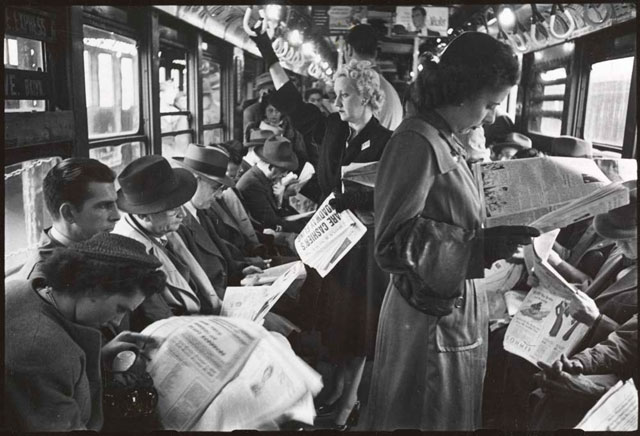
kubrick-subway-newspapers

A reader sends the above scene that Stanley Kubrick captured in 1946:

Yes, smartphones and iPads are the problem, because in the old days we all used to talk to each other on the subway instead of staring down at an electronic object …

Another:

Joe Eskenazi made an uncomfortable point:

Authorities are preaching vigilance, which is probably a smarter thing to do than play Angry Birds. But left unsaid is just what the hell a train full of vigilant people were supposed to do if they noticed a man waving about a pistol – a man, specifically, in search of a random passenger to murder. What then?

I would make a similar but different point.

The reason why people withdraw so much from the public world in transit is because there are about six people in your personal bubble, which is generally considered unpleasant, because you invited none of them. The only way to stay sane in our sardine-packed transit system is to withdraw in your own world. People used to close their eyes and pretend to sleep, or read. These days smart devices give more options to relieve the stress of being squeezed against that fat, sweaty, blob that didn’t shower in the last three weeks, than can be possible relieved by a vigilant, paranoid crowd looking for criminals and terrorists and preventing an occasional crime or very rare terror plot. If we were to allow the latter, the terrorists have won.

Another reader:

Regarding the idea that mobile devices have made us less aware of our surroundings, I would argue that this has actually helped to reduce crime. As a New Yorker and daily subway rider, I can attest to the fact that absorption in texting or gaming can reduce interpersonal incidents that can lead to violence. Additionally, wearing headphones allows you to legitimately ignore an insult – a response that satisfies your honor as well as that of the person trying to pick a fight with you.

The Abatement Of Cruelty, Ctd

Readers keep the thread going:

I have not eaten pork in several years, after I saw the “Pandora’s Box” episode of This American Life (the TV show). Half of the show is dedicated to pig farming and the science behind it.  They keep experimenting with how they house and treat the pigs, which is spurring unexpected side effects. That was galling enough but seeing how the pigs live, how they are shoved into small pens, how they don’t even procreate – they don’t even have a chance to fuck – it was too much for me. Based on all that, I decided I cannot eat any more pork.  Other people can choose to eat pork; that’s fine with me.  I know that I couldn’t.

Another sends the above video:

Two of your recent themes have merged; Banksy is now bringing attention to pig torture in the Meatpacking District.

Another shifts the discussion:

Matthew Scully asks, “Why is it right or fair to pamper dogs [ ] and torture pigs?” He goes on to describe the horrible treatment of dogs as food in Asia. Scully omits mistreatment right here in the United States of dogs for research and agriculture.

The USDA estimates that 65,000 dogs are used in animal testing in the United States. Pertinently for Dish readers, beagles are one of the most common breeds used in research because they are “friendly, docile, trusting, forgiving, and people-pleasing.” Invasive research on dogs commonly involves exposure to experimental chemicals like cosmetics, insecticides, and dog products like flea medicine to determine their toxicity. These experiments ultimately lead to suffering and death.

One of the most horrifying facts about research on dogs is that many animal shelters have arrangements to give abandoned dogs – who at one time were companion animals for a family – to research facilities. These people are infamously known as Class B Dealers in the animal rights community. Everything I just described for dogs in research is wholly permissible under the Animal Welfare Act as long as basic conditions are satisfied such as the provision of clean food and water.

Likewise, the Animal Welfare Act does surprisingly little to protect dogs used for breeding purposes in so-called puppy mills. That law imposes no limits whatsoever on the number of dogs that can be used for breeding at a facility. I am a practicing animal rights attorney and commonly encounter reports of facilities with upwards of three hundred dogs (breeding females and puppies). The space requirement for breeding dogs is sadly insufficient – cages must be a mere six inches longer and wider than the dog herself. Breeders must provide clean food and water, as well as proper veterinary care.

Facilities that meet these requirements can call themselves USDA licensed and are often certified by third party groups like the American Kennel Club that are normally but incorrectly viewed of as reputable. Compliance with the Animal Welfare Act is generally checked during annual USDA inspections, and non-compliance almost always results in a warning with no penalty. When penalties are imposed, they are so insubstantial that the last two Office of the Inspector General audits of the USDA’s Animal Care Program (2005 and 2010) have found that penalties are viewed merely as the cost of doing business rather than having actual deterrent value. (I would link to those reports, but they are offline due to the government shutdown.)