How Thrift Stores Became Cool

Until the 20th century, thrift stores were often scorned due to “a vague sense that such goods were sullied or unwholesome.” Caitlin Moniz and Zack Stanton mark the shift:

The secondhand business model was co-opted by Christian charities, which anti-Semitic Americans saw as more suitable and wholesome than Jewish secondhand shops.

In 1902, Reverend Edgar J. Helms founded what would later be known as Goodwill Industries, which employed the poor and disabled in gathering old goods for reuse. Located in New England, Helms sought to “take wasted things donated by the public and employ wasted men and women to bring both things and persons back to usefulness and well-being.” As Goodwill Industries declared with its new motto in 1922, it was “not charity, but a chance.”

“At the same time,” writes [Jennifer] Le Zotte, “as urban populations swelled, the size of residential living quarters shrank, as did the areas where unused goods might be stored.” Industrialization produced a more frequent turnover of household goods. These factors were accompanied by a boom in immigration, and an increased demand for secondhand goods by these new Americans, for whom it served as a means of assimilation.

The early 20th century was also a transition period for the ideals of giving. Philanthropists, often prominent capitalists, were interested in new theories of poverty that could reshape their approach to charity; thrift was not so much a Christian virtue as an economic one. Philanthropy, writes Le Zotte, was instrumental in “distanc[ing] secondhand exchange from its negative associations while simultaneously affiliating it with benevolence.”

Tax Overextenders

Tax extenders – those oddities of the US tax code that are technically temporary but which Congress renews year after year – are the subject of the latest drama on Capitol Hill. “No one thinks it’s a good policy,” Suzy Khimm explains, but these days, such a consensus is no obstacle to gridlock, and an effort to make the tax code a little less derpy looks like it will fall by the wayside:

Taxes ExpirationGOP Ways and Means Chair Dave Camp and Senate Majority Leader Harry Reid had been putting together a bill that would significantly expand the research and development tax break and make it permanent, along with tax breaks for commuting expenses, teacher expenses on school supplies, and a write-off for state and local taxes. The cost of the proposal, which would not be offset, topped $400 million. The emerging bipartisan proposal would have extended most of the temporary tax breaks for the next two years.

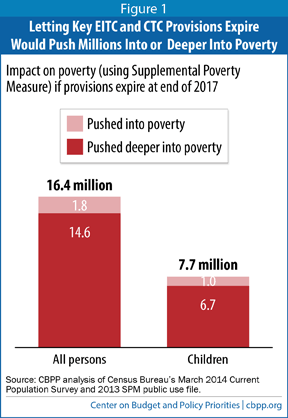
Instead, the House is now expected to vote on a bill that will simply continue most of the tax breaks for yet another year, after President Obama indicated last week that he was prepared to veto the emerging Reid-Camp deal. Along with Senate liberals, the administration objected to the plan for providing permanent tax relief to corporations while failing to provide relief to lower-income Americans as well. Expansions to both the Child Tax Credit (CTC) and Earned Income Tax Credit (EITC) are scheduled to expire in 2017, and Republicans left the provisions — which largely benefit lower-income, working Americans — out of their plan.

The reason given for this move by the GOP?  Republicans feared that the benefits of the expanded CTC and EITC would accrue to undocumented immigrants covered by Obama’s recent executive order:

For years, the GOP has railed against undocumented immigrants who claim the child tax credit, and Obama’s immigration order raised the prospect they would begin claiming the EITC, as well. If Republicans agreed to extend them now, it would look like they were voting to expand government benefits to illegal immigrants. What’s more, the EITC is notorious among Republicans for fraud. It has one of the highest rates of improper payments of any federal program. How would they sell that to rank-and-file Republicans in the House?

Chait doesn’t buy that explanation, though. The way he sees it, Republicans simply don’t want to cut taxes on the poor:

The idea that tax breaks for low-income workers amounts to a form of welfare is itself a somewhat contested premise within the Republican party. Large elements of the conservative party have spent the Obama years simmering with rage at the insufficiently high tax rates paid by low-income workers. Mitt Romney’s candid rant against the 47% percent who (allegedly) pay no taxes merely recycled a right-wing meme. Since Romney’s defeat, some Republicans have gently urged their party to ease up of their campaign to force low-income workers to pay more taxes. But adding the cultural-legal panic to the preexisting class-war panic was apparently enough to turn the GOP’s grudging acceptance of the low-income tax breaks into full-scale opposition.

So first Republicans made the tax breaks for business permanent, while allowing the tax breaks for low-income workers to expire at the end of 2017. Since they would no longer be tied to tax breaks for the more affluent constituencies that have influence with Republicans, this would mean they would almost certainly expire. Families earning $10,000 to around $25,000 a year would lose nearly $2,500 a year — a punishing blow to the working class[.]

Michael Tanner argues that Obama was right to threaten a veto of the Reid-Camp deal, most of which he calls “a grab bag of special-interest giveaways”:

Even the few provisions designed to help ordinary taxpayers are likely to have unintended consequences. For example, state income taxes have long been deductible from federal taxes, but this legislation would allow taxpayers to choose to deduct state and local sales taxes instead, meaning that people in states with no income tax would now benefit from the deduction as well.  But such tax breaks simply encourage states to raise their taxes. They are, in effect, a reward for high-tax states. Economists estimate that state taxes are 13 to 14 percent higher than they would be in the absence of federal deductibility.

Similarly, the American Opportunity Tax Credit, which allows parents or children to claim a tax credit for tuition and other education expenses during the first four years of college, is primarily passed through to higher tuitions. As a result, the credit may actually make it more difficult for non-qualifying families to afford college.

Danny Vinik urges the Dems to accept a short-term deal:

The Reid-Camp deal was flawed for a number of reasons: It was bad for the environment, bad for the deficit, bad for low-income Americans and very good for big business. But two reasons stand out above the others. First, it would have permanently lowered the long-term revenue baseline. By making certain tax breaks permanentlike the credit for R&Dwithout including a corresponding revenue offset, the deal would have lowered federal revenues in the future. Any revenue-neutral tax reform would leave less money for Democrats to spend on policies like universal pre-k. A short-term extension, on the other hand, would have little effect on future revenues, keeping the revenue baseline at its current level.

Howard Gleckman reviews why tax extenders are a bad way to make tax policy:

Real time-limited tax breaks are not necessarily bad. Congress may want to address a short-term problem, such as the recent recession, with a transitory tax cut. And, in theory, a short leash gives lawmakers an opportunity to review the subsidy each year. If it proves unnecessary or inefficient, it can be revised or dropped. In theory. But not in practice. Once one of these tax subsidies becomes law, it joins a tangled web of purportedly temporary tax cuts. They often have nothing in common besides their artificial temporariness and a tacit agreement among lobbyists and lawmakers that they will all be extended together. Thus, they become immortal.

(Chart from CBPP.)

Dudes On Diets

6102711029_0647cca974_b

Alice Robb argues that the new face of “it goes straight to my thighs” is increasingly male:

Calorie-counting has practically become shorthand for female vanity. It recalls Cher from Clueless whining about the “two bowls of Special K, 3 pieces of turkey bacon, a handful of popcorn, 5 peanut butter M&M’s and like 3 pieces of licorice,” that she’s pigged out on. Or Regina George, the villain of Mean Girls, studying nutrition labels in the school cafeteria in an effort to lose three pounds. (Down-to-earth Cady, on the other hand, nonchalantly loads her tray.) …

There is almost a cuteness element to the male diet. Perhaps it’s becauselike wearing skinny jeansit’s trendy, edgeing up to gender norms and then, ever so slightly, transgressing them. “Traditionally, men do not care about what they eat, and prefer a narrow meat-based diet,” says Brendan Gough, psychologist and co-author of Men, Masculinities and Health: Critical PerspectivesMen who do care, and who make a point of showing that they care, are advertising a sort of emotional and physical self-awareness. Weight-consciousness is also relatively new for men, and pop culture hasn’t yet given them a stock of unattractive Regina George–like figures to rebel against.

Or maybe it’s a reflection of the (stereotypically male) impulse to compete, and take things to an extreme. Some of the more all-consuming dietslike Paleo and Dukanare marketed primarily to men. (According to Grub Street, the Paleo diet is “most often associated with city-dwelling males who go around pretending they’re cavemen.) “Men aren’t just going to be healthy, they are going to be ‘super healthy,’” says Christopher Faircloth, a sociologist and author of Medicalized Masculinities. 

Update from a reader:

It is BS that men don’t diet.  My dad, a WWII vet, career naval officer, etc dieted.  I’ve known men all my life who dieted, including me from age 25 to the present (I’m 60).  My weight, when I let it, tends to go about 10% higher than is good for me or attractive to my wife.   I associate male dieting with complaints/criticisms from their wives/girlfriends.  My wife has asked me several times over the years “when are you due?”  That is a non-subtle hint that it’s time to shed some pounds and hit the gym.

I restarted my diet last Sunday.  I regained 21 of 27 pounds I’d lost two years ago (largely due to a very heavy trial docket this year and way too much hotel food while on the road).  Just finished a delicious protein shake.  Salad for lunch, lean meat and veggies for dinner after a workout.  And red wine.  For the heart.

(Photo by Nellies Beemster-Klaucke)

Will The FDA Ever Get Over Its Hemo-phobia?

The FDA is reconsidering its lifetime ban on blood donations by gay men. But, under the proposed reform, gay men would be able to donate only if they had gone one year without having any gay sex. “I hope none of us will qualify,” Tim Murphy snarks. Why he opposes the new rule:

The current test used to screen all donated blood for HIV can detect the actual virus as soon as 9 to 12 days after infection. (That’s compared to the first-generation test, which could only detect antibodies to the virus, and not until several weeks after infection.) Given that narrow window of “blind spot” risk on the newest test, the question all donors should be asked on the form they fill out should be something like: “In the past” — let’s make it six weeks — “have you engaged in HIV risk behaviors — including condomless anal or vaginal sex, or shared drug-injecting paraphernalia — with an HIV-positive person or someone whose HIV status you did not know?” (The same question should be asked about hepatitis B or C, which donated blood is also screened for, as well as all other known blood-borne pathogens.)

Jason Millman reviews the extensive evidence against the current policy, noting that other countries have found ways to screen out HIV-positive donors without excluding an entire segment of the population:

The scientific and medical communities have increasingly rejected the ban currently in place in the United States. The American Medical Association, the nation’s largest physician organization, voted last year to oppose the ban, calling it discriminatory and not based on sound science. Instead, the AMA urged federal policymakers to take a more personal approach assessing each individual’s level of risk. The approach recommended by an HHS advisory committee last month falls short of that standard. And it still falls short of what a number of other countries have done to allow blood donations from gay and bisexual men.

Countries, such as Italy and Spain, use an individual risk assessment for all would-be donors, regardless of sexual orientation. Italy’s blood donation policy, which has been in place since 2001, screens everyone for risk factors, like whether they’ve participated in prostitution, injected drugs or had multiple sex partners with unknown sexual behavior. The policy hasn’t resulted in a significant increase in HIV-positive gay and bisexual male blood donors, according to a study released last year.

And Mona Chalabi estimates how many more eligible blood donors we’d have if the ban were dropped entirely:

[B]ased on the CDC’s numbers on sexual orientation (and setting aside any other possible restrictions on those individuals giving blood), one could estimate that about 2.6 million U.S. men are currently prohibited from giving blood. But that’s a misleading calculation. The sexual orientation that a person states in a survey is not a perfect indicator of his sexual behavior. … Although less than 3 percent of U.S. men say they are gay or bisexual, in a separate survey almost 9 percent said they have had a male sexual partner. Researchers at the Williams Institute, a think tank on sexual orientation and gender identity, used data from the 2008, 2010 and 2012 General Social Survey (GSS) to estimate that 8.5 percent of men say they have had at least one male sexual partner since age 18.

Based on that figure, there would be about 4.2 million more eligible blood donors in the U.S if the FDA were to lift the ban entirely.

Previous Dish on the gay blood ban here and here.

Bhopal: Still Toxic After All These Years

INDIA-DISASTER-POLLUTION-BHOPAL-ANNIVERSARY

Yesterday marked the 30th anniversary of the Bhopal chemical spill, which killed thousands and is remembered as the deadliest industrial accident in history. However, just how many died and were injured in the incident remains in dispute. The Indian government estimates that 3,800 died and 11,000 were injured, but advocates for the victims believe that the true death toll is in the tens of thousands and that over half a million people were exposed to the poisonous gas. Adam Lerner explores the controversy over how many victims there are, what they are owed, and who, if anyone, ought to pay:

The very fact that so much contention exists surrounding the death toll, with different politically motivated figures varying by orders of magnitude, underscores the fact that, 30 years after the tragedy, Bhopal’s wounds are still open.

To this date, the International Campaign for Justice in Bhopal maintains that the site of the plant hasn’t been properly cleaned and that chemical contamination of the groundwater has injured and perhaps killed thousands more. (Union Carbide insists that the evidence linking it to contamination is insufficient.) Many victims and their advocates view the settlement made five years later in 1989 as a pittance given the scope of the damage and the size of Union Carbide and its parent, Dow Chemical.

A jury concluded in 1994 that Exxon should pay $5 billion in punitive damages for its Valdez’s oil spill, despite the fact that no one died. (Subsequent court rulings cut this figure down after Exxon paid more than $3.4 billion in fines, penalties, cleanup costs, and other claims). And this past October Warren Anderson, the CEO of Union Carbide at the time of the tragedy, passed away—a fugitive from the Indian justice system who lived out the rest of his life in the U.S. while Indians burned his effigy in protest. Now, three decades after the cloud dissipated, Bhopal’s tragedy isn’t over.

Sanjay Verma recounts his family’s story:

My sister Mamta told me that there were four brothers and four sisters in our family. Our father was a carpenter, and I was the youngest in the family. We lost three sisters and two brothers along with our parents that night.

I then asked her, “How did we survive?”

She told me that she wrapped me in a blanket, and ran away along with our brother Sunil. When they were running, Sunil had to go to the bathroom, and fainted. The streets were so crowded as people were running and shouting, my sister was forced by the crowd, and couldn’t wait any longer for my brother Sunil to come back.

The following morning, when people came to collect bodies from the street, they found Sunil and thought he was dead too. They put him on a truck with many bodies, and took him to dump into a river so that they could keep the number of deaths as low as possible. When it was my brother’s turn to be thrown off the truck into the Narmada River, about 90km from Bhopal, he woke up and said, “I am not dead.” The people who were about to throw him in got scared, thinking a dead body was talking to them.

Nita Bhalla profiles Rashida Bee and Champa Devi Shukla, two Bhopal survivors who founded a rehabilitation center for children with disabilities allegedly resulting from the disaster:

The two women said they felt a sense of injustice over the lack of rehabilitation given to victims of the disaster, and began a campaign for better support for those suffering the aftermath of the gas leak. In the beginning, they mobilized about 100 women and walked 730 km (455 miles) to Delhi to protest the lack of livelihood opportunities for women like themselves who had to become breadwinners for their impoverished families after their husbands became ill.

Over the years, their attention turned to second- and third-generation children with congenital deformities, born to survivors exposed to the gas and to women who have been drinking water contaminated by undisposed toxic waste around the factory. However, there has been no long-term epidemiological research to prove conclusively that the birth defects of these children are directly linked to the tragedy three decades ago.

Alan Taylor rounds up photographs of the disaster and its aftermath.

(Photo: A notice propagating safety is seen on the casing of a machine inside one of the buildings at the now-defunct Union Carbide pesticide factory in Bhopal on November 28, 2014. By Indranil Mukherjee/AFP/Getty Images)

Illiberal Feminism Strikes Again, Ctd

The in-tray has seen another big wave of reader responses since our most recent post, but we’re trying to balance the need for your input with the need to keep the debate productive and relatively concise. One reader who wants to keep it going:

I dissent from the dissenters. Keep talking about it. Keep questioning the excesses of the feminist hard line. I understand that they don’t want to confront their own worst elements because, like any political movement, talking about your internal messaging problems is guaranteed to annihilate your external message. So I know why they don’t want to talk about it, and I surely know that the mainstream brand of feminism is Emma Watson’s elegant, inclusive variety.

A refrain I hear often from the feminist side is that men have to learn to stop talking and listen. And when I point out that that sounds suspiciously like “shut up”, I then get a 30-minute explanation as to why it’s not hypocritical to tell men to remain silent when you’re angry that women have been kept silent for so long. You are listening, Andrew. Don’t let them tell you otherwise.

Many more readers sound off:

I do think that sometimes your maleness and gayness come together to make you a little tone deaf on feminist issues, but this pushback must just reinforce every bad stereotype you have.

Getting the Oxford debate cancelled is one giant case of ad hominem; your views have no merit because of who you are. The irony is so rich it’s cloying. But the last dissent finally clarified what’s wrong in this discussion. Your critic (male, of course) states, “every feminist contradiction you’ve covered in this thread has been debated within feminism since its beginning” (obviously, demonstrably false), and then whines: “It’s not feminism’s burden to educate.”

Seriously, dude, grow the fuck up. Of course it’s feminism’s job to educate; you just don’t want to do the work. The fact that you have suffered and/or do suffer injustice does not mean you’re not a massively over-entitled asshole. If the top level of the oppressor pyramid is a straight white wealthy intelligent educated first-world man, then almost everyone in this discussion on the first five levels of a fifty level pyramid, pointing furiously up at the top level and ignoring everyone below. They have all the entitled laziness of the top levels, but spend so much time looking up they actually feel (and act like) they’re at the bottom (like the guy who thought $450,000 a year made him poor).

This vocal minority of feminists are not wrong to name and fight the injustices. But they are childish to expect it to come easy, and only this entitled immaturity explains their gall in lecturing you, of all people, on the “burden to educate” – as though you did not spend decades educating and re-educating every new person who came to the table with a sudden insight on marriage equality.

Another continues along those lines:

The fact that this thread has revealed such a wide degree of opinions and experiences demonstrates the necessity of this education. There is a huge swath of people in this country, many of whom are intelligent and well educated, who have reservations towards or disagreements with positions in modern feminism. Even if you are certain that you are right, you don’t get to just snap your fingers and win the argument. Ignoring those who disagree with you isn’t going to help anything. Attempting to censor your detractors is only going to make things worse.

If there really are arguments that are strong enough to settle these debates within academic circles, then why is it treated as such a difficult task to show these arguments to those who haven’t seen them? Why are you “disheartened” when someone whose opinion and understanding you otherwise trust disagrees with you? Why don’t you just explain why this stuff is so damn clear to you?

On that note, a female reader wishes we hadn’t run this email from another woman:

I appreciate that you air comments from a variety of opinions and much prefer this format to a comments section, but that one could have stayed in the in-tray.  Actually, no, I think it’s illustrative in that it presents the hideous stereotypes and gross exaggerations often employed by equality foes.  This view that “feminists don’t care about equality for women … they want domination for women” hurts the cause of equality for all as much as the institutional patriarchy we defend ourselves against.

I’ve been kicked out of feminist forums for being reasonable and having the audacity to suggest that, perhaps, not all men are potential rapists and murders, so I know very well how they “eat their own.”  But that vast majority of people who call themselves feminists, publicly or privately, actually are on the side of equality, do not hate men, and are not seeking gender domination.  I’m sure you know this.  I’m not convinced that your reader does, but I think by posting it you give credence to the idea that probably had some of your readers nodding along.

Another wonders where to draw the line:

I generally agree with your overall take on this subject, but like everything else there needs to be room for nuance. Here is one example: At my law school, a first-year criminal law exam included a very detailed description of rape. A huge controversy arose. Now you might easily think this is more evidence of overly “delicate sensibilities,” but you should consider that at least some women, maybe a significant number, taking that exam would have to fight through their personal experiences with rape and somehow remain as analytically focussed and dispassionate as the men taking that exam. First-year law exams essentially determine your law school success, and one blown question will be difficult to overcome. So basically, by including that rape question, the professor handed a huge advantage to the male students in his class. Should we fault the female students who were enraged by this?

Update from a reader:

Why should we not do this for kidnapping, or traumatic car accidents, or … ? Are these women never going to deal with rape in their law practice? Is there a tipping point where a trauma that potentially affects {n}% of students should not be asked?  I am (perhaps overly) analytical. I’m not saying the precaution is unnecessary, but how are we making these decisions? What is the framework? That is the part that bothers me.

Another expands the debate to include race:

One reader argued that what is being given as an argument is: “I know you think what you’re doing is OK, but it’s not for some unspecified reason that you can’t understand because you are not the correct gender/race/religion. Because of this, you should refrain from expressing an opinion and solicit feedback from those who do possess the relevant identity.”

Sometimes that is the argument being made, and it is self-evidently a flawed argument. And I agree that “call-out culture” is a problem, with so much emphasis put on denouncing and writing people off as bigots. And obviously, as I’m a man commenting on feminist issues, I don’t think that men are incapable of understanding issues of sexism. But there is a more nuanced version of that argument that is much more persuasive, that your reader is ignoring.

Let’s take Ta-Nehisi Coates as an example where you to defer to someone else’s life experience because of your self-admitted ignorance. I don’t think this means, or that you intend to say, that you defer completely to TNC on all questions of racism or race relations. But a lot of questions relating to racism can’t be quantified. A lot of questions relating to racism have to do with subjective experiences. A lot of questions relating to racism are researched using surveys where canny respondents can and often will perceive the “correct” answer. We can’t just ask White people whether they’re racist and expect an honest answer. Sometimes there isn’t an objective answer in the data. And I think there’s enough evidence that White people have glaring holes in their perception of racism that we shouldn’t dismiss the experience of Black people because it doesn’t match with our own. And we can see from well-crafted studies that the perception of Black people is often validated by the results.

For example, I’ve often encountered White people who are skeptical that job discrimination is still a real factor affecting Black people. Often they think that because of affirmative action, the discrimination actually goes in the other direction. Yet studies have found that if you send identical resumes with White names and Black names, the White resumes will get substantially more responses. The statistics lead to the undeniable conclusion that despite what White people perceive, that discrimination is still there. But because this discrimination may be subconscious or is at least conducted in such a way that makes it hard to prove in any individual case, White people often just don’t see it and don’t think it’s there.

This perspective does not mean that White people have nothing to contribute, and they cannot debate racial issues. But it does mean that we have reasons to think that White people’s perception can be flawed.

You are willing to acknowledge these limitations and defer to writers like TNC rather than relying just on your perceptions. But you seem to be much less willing to do this with issues relating to women, despite much sexism operating in the same veiled manner as racism and involving situations with subjective interpretation.

And there’s also good reason to suspect that men often don’t perceive issues relating to sexism accurately. For example, I know from my studies in linguistics that the perception that women talk much more than men is not really true if you look at it quantitatively. The perception simply doesn’t match the data. There were even experiments where, when teachers were forced to actually give equal time to boys and girls, their impression was that the girls were talking more than the boys.

So, when issues of representation of women are derisively dismissed as calling for quotas in order to achieve gender justice, your impression that women are actually represented fairly as journalists and composers not only overrides whatever feminist activists are saying about the issue, but dismisses their analysis as illiberal, censorious fanaticism. That they looked at the numbers, to you, suggests quotas, and the issue of whether there’s actually any sexism causing those disparities wasn’t even considered. The way you think women should interpret objectification of women say, in video games, carries more weight than how women feel about it. But maybe you should be a little bit more circumspect about your ability to perceive these issues fairly.

Another reader questions how useful the word “feminist” is:

The main problem with the label of “feminist” is that it has come to mean something different from its literal definition.  Here’s another phrase to consider: “family values.”  Those words are quite noble if you look them up in the dictionary, but in reality many people suspect the term as a proxy for anti-gay Christianist sentiment.  For this reason, while I value my family and families in general,  I will never, ever say that I support “family values,” nor will any of my friends.

Sadly, the word “feminist” has been similarly corrupted by a very vocal minority who are defined by their damage and penchant for quick disapproval, and they are far more interested in punishing the world than changing it for the better.  It’s unfair, but the word cannot be rehabilitated. I would urge “dictionary feminists” to use the momentum of their hostile sisters against them, and simply pick a new label (“Equalists?”) and reject the old one.  Otherwise, they are going to bang their heads against a negative cultural image that is continually fueled by extremists who simply have no interest in reaching a consensus.

Another tells the story of how he came around to the idea of “privilege”:

I was raised in an ultraconservative, fundamentalist Christian household, where homophobia and sexism were the norm. It should surprise no one that I entered adulthood with some nasty, bigoted views.

Contact with the real world – meeting gay people that were “virtually normal” and realizing that women were obviously every bit as human as me – inevitably challenged my worldview, but also it put me in conflict with myself.  I started to soften my stance on issues such as gay marriage or women’s rights, adding qualifiers and exceptions to my language whenever the topics arose with friends, classmates or colleagues.  Yet, in the course of these discussions, I was still so often insulted, attacked or condemned for my beliefs that I had no reason to think that feminists and “liberals” considered me anything but brutish, stupid and evil.  So I never felt any impetus to consider their positions – you don’t stop in the middle of a fistfight to consider your enemy’s feelings and perspectives, and debate the relative merits of whether you should have your nose broken.

My change of heart came when I made friends with a bisexual woman who, at the time, sat on the board of the local feminist community center.  She and I had many conversations over many hours and evenings about feminism, sexuality, identity politics … you name it, and we jawed about it.  Rather than judging me, shaming me or telling me that my views were out of bounds or that debating certain topics was off-limits, she created a “safe space,” so to speak, and listened, attending to both my thoughts and feelings, and asking smart, vexing questions at opportune moments. It didn’t take long for me to start hearing the words coming out of my own mouth, and to realize how I had been so carelessly and unconsciously destructive with them in the past.

I’ll never forget the day she dropped this bomb: Knowing that Hemingway was my literary hero, she paraphrased him: “You have to pay some way for everything that’s good.” It became bleedingly obvious to me just then. There are so many human beings fighting for the basic privileges that I get for free, just for being white, straight and male.  With great power comes great responsibility: If I don’t accord everyone the same dignity, agency and freedom that I have, I cheapen myself.  You pay the price of privilege by recognizing that the privilege is good, it’s worth something, and that if you deserve it, everyone deserves it.

If she had blithely dismissed me as a bigot (which I was) and shut down the debate over some ignorant thing I said (there were many) I may have never come around.  Thank God that she realized you can’t teach someone empathy, understanding and mercy with hatred, hard-heartedness and vengeance.  You teach people how to be loving and understanding by being loving and understanding.  It makes me think of the recent post “Jesus Amidst the Ruins“; she didn’t attack me or attempt to silence me or give up on me because my beliefs were unacceptable in polite public discourse.  She just washed my feet.

The impulse to silence those that disagree with you may be all too human, but it has no place in a free society. It is the tool of the ideologue, the dictator and the assassin. Those of us that are able to participate in debates like #gamergate or illiberalism in the art world – or any public debate – need to check our privilege. You have to pay some way for everything that’s good, and the price of free speech is recognizing that it is good, that it is worth something, and that if we deserve it, everyone deserves it.

The Lawful Killing Of Eric Garner

A reader writes:

I am in fear.

My son is 15 years old but looks like he is 20. He just crossed six feet tall and is growing, he is an athlete, a swimmer and is muscular and imposing, but he is also a completely sensitive wimp. I am white, he looks more like his mother, who is black. He has already had a bizarre police encounter. When he was 13 years old, we hired a college student on summer break to take him to and from swim practice because we were at work; she is a family friend; young, white and blond. On his first week, they were pulled over by the police and no explanation was given. The police immediately came to the passenger side where my son was, told him to get out of the car, put him up against the car, patted him down and demanded identification. Being a 13 year old, he had no ID. The girl was asked to step out of the car and was questioned, only about my son.

After some time, they left, no explanation, no ticket – nothing. The girl’s parents were as upset as we were but understandably told us that no offense meant but they didn’t want to be putting their daughter in that situation and so we needed to find another ride. We spoke to the police and were told that since there was not ticket or arrest, there was no report, so there was no explanation. Nothing happened, but because I have no idea why the interaction happened in the first place, I have no idea what could have happened.

Therefore I ran through a hundred scenarios, a number of which where my son could be as dead as many others. My ex-wife and I are both lawyers, we have means and can protect our children better than most. They go to private school, they have every other benefit education family and money can provide. (By the way, they had airsoft guns – pink ones – and only used them right around the house but not after last week.) And certainly they have been told often not to argue with authority – teachers and law enforcement – but they are still kids and do stupid things. We live in a city, but not in a dangerous area. But I am terrified because I am white and although I knew these things happen, I have never walked in a black man’s shoes.

However, for me, myself as a father of a kid who fits a profile, black and imposing, the type who seems to lend to unnatural terror among police, this is a scenario I can’t account for or defend against. In this sliver of circumstance, I have some small realization of the plight of people who have to deal with this daily. I am frustrated that people like me, white and privileged, have no inkling how the parents of a black kid growing up a dangerous place must feel every freaking day and how blithely we can dismiss these events because they are never going to happen to us.

Another reader:

I just watched the video for the first time, and I’m pretty sure I’ll hear at work tomorrow (in my smaller southern town in NW Georgia) exactly what I heard a few days ago after the Michael Brown non-indictment: he got what he deserved, he was arguing with the police, he instigated the situation by (insert whatever the cops said he was doing here), what were they supposed to do anyway when he resisted arrest?

For the life of me, I cannot grasp the mindset among so many of my friends and co-workers that finds this sort of thing acceptable, that they can just shrug if off with a “Well, he brought it on himself.”  They have no concept of proportionality, of a punishment fitting a crime.  All the see is a person of color in conflict with authorities, and in those cases – ALWAYS in those cases – the person of color brings it upon him- or herself by not acquiescing to the demands of the police.  And they get what they deserve, because they were asking for it.

A week or so ago, you featured a letter from a gay reader who was thankful that he was gay because, for one thing, it allowed him to understand what it is to be the Other.  As a gay man myself, I join him in that sentiment.  I have so much in common with these friends and co-workers, but on things that matter, on issues of empathy and compassion and attempts at understanding others who are different but who live next to us and work beside us daily, we are worlds apart, and it seems with every passing incident a chasm ever more unbreachable.

There are two tragedies here: the loss of life, and the loss of humanity.  I am emotionally exhausted and distraught by both in equal measure.

You’re not alone.

North Korea Is Not Amused, Ctd

Gordon G. Chang thinks US companies are unprepared for the type of hacker threat plaguing Sony right now:

The real story is that Washington, over the last decade, has done little to prevent cyberattacks against American-based businesses. … North Korea does not appear to hack American companies for commercial purposes, but China does. According to the Intellectual Property Commission, that nation is “the world’s largest source of IP theft.” The Kim regime has undoubtedly noticed Washington’s ineffectual response to China, which has been implicated in Pyongyang’s alleged assault on Sony Pictures—the attackers apparently used IP addresses inside Beijing’s “Great Firewall,” a sign of Chinese knowledge of the crime and perhaps complicity.

David Holmes suggests that businesses aren’t the only ones in danger – you could be too:

While a lot of talk has centered on whether or not North Korea was involved as retaliation for an upcoming Seth Rogen movie, one cybersecurity expert has a different takeaway: That this could create a field day for hackers who didn’t even have anything to do with the attack.

Robert Cattanach is a partner at the international law firm Dorsey & Whitney who specializes in cybersecurity regulatory litigation. After studying the moves of hackers for years, he argues that the films themselves leaked in the attack are going to become a prime target for cybercriminals. … Of course, pirated content has always been a breeding ground for malware. But part of what makes the content associated with the Sony attack so attractive to hackers, Cattanach argues, is that this is a high-profile, headline-making attack, and therefore the leaked movies could attract lots of average consumers who don’t normally seek out pirated content — and who may lack the expectations and experience to avoid malicious websites and prompts.

So bootlegger beware. Meanwhile, Sean Fitz-Gerald notes Sony’s other big struggle right now:

To make matters worse for the studio, Deadline reported that three class-action lawsuits involving an alleged anti-poaching and wage-fixing conspiracy with two of Sony’s animation divisions and other heavyweights have been lumped into one big complaint. Pixar, Lucasfilm, DreamWorks Animation, the Walt Disney Company, Blue Sky Studios, ImageMovers LLC, and ImageMovers Digital LLC are named as co-conspirators. The fixing allegedly began when a handful of animation-studio heads were displeased to learn about Sony’s competitive compensation and recruitment efforts, according to the documents. After restraining wage practices, the studios involved proceeded to agree upon compensation ranges.

Is Obama Radicalizing Republicans?

Screen Shot 2014-12-03 at 1.20.28 PM

Looking over some new polling from Quinnipiac University and CNN, Aaron Blake concludes that Obama’s executive action on immigration has made the chances of a comprehensive reform bill getting through Congress even worse. Why? Because it has “exacerbated the real problem with getting comprehensive reform done: a very motivated opposition”:

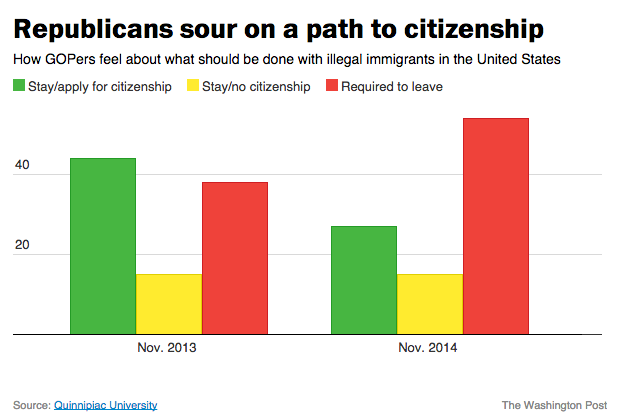
The Q poll shows support for allowing illegal immigrants to apply for citizenship falling to its lowest point since the survey started asking the question two years ago. Fewer than half — 48 percent — now support a path to citizenship, down from 57 percent one year ago. The poll also shows that 35 percent say these immigrants should be required to leave (the word “deportation” is not mentioned). That’s a new high, and it’s up nine points from the last poll. And here’s the real kicker: The shift is almost completely among Republicans. Although they supported citizenship over deportation 43 to 38 percent in November 2013, today they support deportation/involuntary departure over citizenship, 54 to 27 percent.

That’s two to one — a stunning shift.

And if it’s even close to accurate, there are very few Republicans in Congress who will be eager to vote for comprehensive reform in the 114th Congress. … The CNN/Opinion Research poll tells a similar tale. Although 42 percent favored the policies that Obama announced and 46 percent opposed them, it was clear where the motivation remains: with the opposition.

Waldman remarks that the pro-deportation shift among Republicans in the Quinnipiac poll “provides an object lesson in a dynamic that has repeated itself many times during the Obama presidency”:

We’ve talked a lot about how the GOP in Congress has moved steadily to the right in recent years, but we haven’t paid as much attention to the movement of Republican voters. But the two feed off each other in a cycle.

Immigration is a perfect example. Before this latest immigration controversy, Republican voters were at least favorably inclined toward a path to citizenship. But then Barack Obama moves to grant temporary legal status to some undocumented people (and by the way, nothing he’s doing creates a path to citizenship for anyone, but that’s another story). It becomes a huge, headline-dominating story, in which every single prominent Republican denounces the move as one of the most vile offenses to which the Constitution has ever been subjected. Conservative media light up with condemnations. And because voters take cues from the elites on their own side, Republicans are naturally going to think the order was wrong while Democrats are going to think it was right.

Drum wonders how Obama compares to past presidents:

Bush polarized public opinion in the same way Obama does. Perhaps all presidents do. Still, it sure seems as if Obama polarizes more than any previous president. I can think of several reasons this might be true:

• Something to do with Obama himself. This could be anything from underlying racism to the nature of Obama’s rhetoric.

• Our media environment has become increasingly loud and partisan over time, and this naturally polarizes opinions more than in the past.

• The Republican Party has simply become more radicalized over the past decade or so.

• In the past, liberal Republicans and conservative Democrats acted as natural brakes on viewing everything through a purely partisan lens. But party and ideology have been converging for decades, and this naturally makes every issue more partisan.

The Fundamentals Aren’t On Hillary’s Side

Danny Vinik expects a booming economy to help Clinton win the White House. Sean Trende counters with some electoral modeling:

Let’s first use CBO’s estimate of 4 percent growth.  This is probably on the high side (CBO has been forecasting a surge in GDP just around the corner for five years now) so we’ll asterisk it as a high-end probability.  President Obama’s job approval rating is -10.8 percent today.  If we plug these two variables into [one of Alan Abramowitz’s forecasting models], it suggests that Republicans should be favored to win by about three points: 51.7 percent to 48.3 percent.

But, you say, with 4 percent growth, Obama is unlikely to remain at -10.8 percent approval.  Fair enough.  But even if we move him up to a net-neutral job approval, the models forecast a narrow Democratic loss, 50.5 percent to 49.5 percent. Obama would have to reach a net job approval of +6 before the model would forecast the Democrat to win (narrowly).  Obama has accomplished this four times in his six years in office: During his two post-election “honeymoons,” after the shooting of Gabby Giffords, and after killing Osama bin Laden.  If he ties his post-2009 best of +12 percent net approval, the model would favor the Democrat by a point.

Some important caveats:

These models aren’t the be-all/end-all of election analysis, and Republicans or Democrats probably could win under any of the scenarios outlined above.  We also should remember that we’re building estimates on top of estimates here: Personal or national measurements of the economy could surprise us, pleasantly or negatively, and this would alter our estimates for 2016.

Regardless, these models probably can give us a rough sense of what would happen under various fundamentals for 2016.  They point to a reasonably close election; they do not suggest that the Democratic nominee should be considered the favorite at this point.