How Bad Was Kathleen Sebelius Last Night?

Screen Shot 2013-10-08 at 11.00.51 AM

It is hard to find the words to describe it. On The Daily Show, talking to a critical demographic with respect to Obamacare, the HHS secretary was so incoherent, so incapable of even basic reasoning, so tied to exhausted talking points, so unable to concede, let alone explain, error, that she would be fired if she were a spokesperson for a minor member of Congress. And yet she is allegedly in charge of the most important domestic policy initiative of this administration and has presided over a rolling disaster in terms of its critical first week.

Dish readers have done a better job at explaining the huge snafus on the various Obamacare websites. (And The Daily Show – see above – might want to get in a defensive crouch on malfunctioning websites since its own clip of Sebelius is currently as unavailable as Obamacare’s). Today we got a better explanation:

The technical problems that have hampered enrollment in the online health insurance exchanges resulted from the failure of a major software component, designed by private contractors, that crashed under the weight of millions of users last week, federal officials said Monday.

Why was she incapable of saying that?

Why was she incapable of explaining the huge crush of demand or the fact that 32 states refused to cooperate, making the feds’ task that much more difficult? Why could she offer no plausible reason for why corporations with over 50 employees got an extra year to comply, while individuals don’t? This was a very friendly media environment, and she was given acres of time to give even a small explanation. And she was worse than useless.

Part of an official’s job is to be able to be accountable to the public for failures, to help explain them, to give an idea of how they are going to be addressed. She failed. Another part of an official’s job is to make sure that critical programs under her jurisdiction run smoothly – especially when they are as critical as Obamacare. She has failed at that as well. Why is the president content with that kind of grotesque incompetence and lack of accountability? And when will she be fired?

One Month, Many Causes

What happens when at least 11 advocacy and awareness campaigns fall on the same month? Competition:

Rita Smith was watching football in 2009 when she noticed – as if it were possible not to – that the players were newly outfitted in pink socks and gloves. Her heart sank. “I was pretty sure we were toast,” she says. “There was no way we were ever gonna match them.” Smith is executive director of the National Coalition Against Domestic Violence, which also claims October as its awareness-raising month.

Why it’s hard to compete with cancer:

Breast cancer is, as many critics have pointed out, the perfect issue for corporate-funded cause marketing. It’s got an unambiguous villain (CANCER) and a natural constituency (women). Saving boobies is a friendly cause that everyone – even frat boys and NFL players – can get behind. A straightforward health issue.  By comparison, domestic violence is downright controversial. It touches on complicated issues like power, rape culture, victim-blaming, and gender roles, and stirs up uncomfortable emotions. …

One in eight women will suffer from breast cancer in her lifetime. One in four will experience domestic violence. Good luck finding that statistic on a yogurt lid this month.

Update from a reader:

Cancer can’t even compete with cancer! Breast cancer does not kill as many women in the US (41,000) as lung cancer (70,000), but you never hear about this from the pink ribbon brigade

Contemplating Cool

The genesis of the classic American term:

Cool has come a long way, literally. In a 1973 essay called “An Aesthetic of the Cool,” art historian Robert Farris Thompson traced the concept to the West African Yoruba idea of itutu—a quality of character denoting composure in the face of danger, as well as playfulness, humor, generosity, and conciliation. It was carried to America with slavery and became a code through which to conceal rage and cope with brutality with dignity; it went on to inform the emotional textures of blues, jazz, the Harlem Renaissance, and more, then percolated into the mainstream. [Scholar Peter] Stearns argues that cool’s imperatives of flexibility and fluidity helped Americans escape rigid Victorian morality into modernity and developed along with mass production and mass media as a new individualist ethos.

Carl Wilson continues with a meditation on its meaning:

To be cool is to have cultural and social capital, and most urgently it is to be not uncool—a hang-up most of us pick up in adolescence that’s damnably hard to shake even if it mellows with age. Cool is an attitude that allows detached assessment, but one that prizes an air of knowingness over specific knowledge. I think that’s why it doesn’t become dated, unlike hotter-running expressions of enthusiasm like groovy or rad. As Stearns says, cool is “an emotional mantle, sheltering the whole personality from embarrassing excess. … Using the word is part of the process of conveying the right impression.”

Slate continues its month-long series on the meaning of cool with Mike Vuolo delving deeper into the etymology and Mark Joseph Stern focusing on the coolness of Cary Grant.

Betting On The Nobel

Zach Schonfeld checks in with the bookies monitoring the literature contest:

The critically acclaimed Japanese writer Haruki Murakami currently leads the pack, boasting projected odds of 3/1, while American author (and frequent tweeter) Joyce Carol Oates follows closely behind with 6/1 odds. (Bob Dylan, if you’re wondering, drags behind with a 50/1 chance of winning, by Ladbrokes’ count.)

Recent Dish on Dylan’s chances here. In a come-from-behind twist, the odds for Norway’s Jon Fosse has shot from 100/1 to 9/1:

What gives? As we’ve previously covered, the bookmakers’ methods have little to do with the actual quality of the literature.

They’re just thumbing through blogs and mainstream media outlets in a mad dash to figure out which authors are getting the most buzz in the weeks leading up to the announcement. This method, however unscientific and fraught, has provided Ladbrokes with an impressive accuracy rate in past years. … Fosse’s temperature is pretty hot right now. Ladbrokes cut its odds on the playwright dramatically after noticing several surprisingly large bets on him in his home country of Norway. According to the company, “Fosse has come from out of nowhere to become the hottest writer, and it’s not inconceivable that he could become favorite to win before the announcement is made.”

Track the latest odds here.

The View From Your Shutdown

Stories for our popular series continue:

I’m a federal employee furloughed from my job teaching at one of the military academies. Our academy leadership decided to keep classes running while the 30% of our faculty who are civilian had to stay home. That means not only that civilian faculty like me have no work and no pay, but military faculty are teaching two or three sections of cadets combined. Some upper-level classes have been suspended, and fourth-year cadets who need these classes to graduate may be in danger of not meeting their course requirements for graduation. But pretty soon it will be hard to give them credit for the courses.

Another:

I am yet another furloughed employee in the DC area. I am frustrated. I am sick of being demonized. I have had to turn off the news because I just get a lump in my throat every time someone asks why the government even has nonessential employees or a Congressman says he is keeping his paycheck because he earned it. I felt like Congressman Neugebauer was talking to me when he was yelling at that poor park ranger. Since when was doing your job something to be ashamed of?

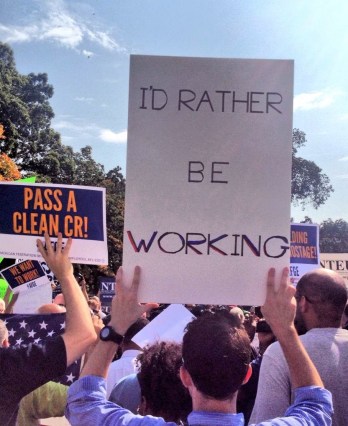
Yesterday I got an email from my employees union saying they would be rallying at the Capitol photo (27)today. Since I can’t be at work, I wandered down there this morning. I saw hundreds of employees from the various federal employee unions chanting “We want to work!” and “Let them vote!” I’m a little embarrassed to say it, but I teared up. I’ve been a union member for years, but it wasn’t until this year that I realized just how important they are. They are looking out for us when no one else is. There were numerous members of Congress out at the rally, too, expressing support. I didn’t see one Republican though. Not one. They hate us. For doing our jobs. And their behavior has just made a big union supporter out of me!
I read to my son every night. Lately he has been asking for us to read a children’s Bible he got for his Baptism. Last night I read the story of how Jesus was so kind to Zacchaeus the tax collector. I know the federal government isn’t perfect, and I fully support making improvements. I just wish these nominally Christian right-wingers would stop demonizing all of us and start looking at the logs in their own eyes.

Another:

My husband is a real estate agent and recently sold a house that was owned by a federal government employee.  The government was paying for the relocation, but as a result of the shutdown, the payment of the real estate commission is being held up.  In his case, it is $14,000 he was expecting at the first of this month, but won’t get until the shutdown is over and then know who knows how long after that.

One of several more readers:

I do not now work for the federal government and am following my usual schedule, but the environmental change in DC is huge.

It took me less than 30 minutes to get to my destination in downtown DC today, unheard of for a Monday morning even when Congress is not in session. At Union Station, most of the restaurants have substantial amounts of their dining areas closed off and the remainder sparsely populated – they have to be hurting.  The Starbucks, whose line usually extends at least 20 feet out into the station, had half a dozen people waiting. The whole place was hushed – and it’s usually a three-ring circus on weekdays at lunch hour.  Dupont Circle looks dead.

But I had to smile this weekend.  Some roads in Rock Creek Park have been left open as they really are major traffic routes, but most are blocked off, as are all picnic and recreation areas.  But on this sunny Sunday, cars were parked right up against those barriers and on nearby level grass, and people were having picnics, playing frisbee with dogs and otherwise enjoying THEIR park.  I saw one young woman in riding clothes exit her car near a barrier and stride off defiantly in the direction of the stable.  The parks belong to the people.  Dammit, the whole country belongs to the people.  This is a farce.  Just hope it ends before becoming a tragedy.

Another:

A point yet to be brought up is that American students living abroad are coming to that time of having to pay for their terms. I’m currently an overseas student, who thanks to school support and financially well-off parents, does not have to worry about this. But I have more than a few friends who are currently abroad with ZERO loan money being disbursed out, even though it’s being reported that this should not be a problem for a majority of loan programs.

This is not only an issue from an education standpoint, but a livelihood one,as well. These people are having to rely on infrequent, and expensive money wires or close friends to get by. Furthermore, if you want to talk about US prestige in the eyes of the international community, nothing looks worse than the government being a deadbeat dad and failing to pony up funds for education. All is not lost, as some universities are developing schemes of directly loaning American students money against what they say they will pay. But this is still deplorable state of affairs being largely ignored by those most responsible.

Another:

As I read these stories of the effects of this shutdown on employees of the federal government and the businesses like hotels adjacent to national parks, and how the effects cascade down to the people who depend on those employees and businesses for their livelihoods, the phrase “trickle-down economics” keeps coming to mind. It would seem that “trickle-down” actually works after all, but not in a very good way.

The Physics Of Gravity

Neil deGrasse Tyson tore into the new blockbuster with a series of tweets. An example:

Marsha Ivins, an astronaut, had mixed feelings about the movie:

I can almost forgive the liberal use of artistic license in violating the laws of physics because they got some things very right. The views of the Earth and the sunrise, the lighting on Sandra Bullock’s face (light in space is so different from light in the atmosphere)—perfect. Her body positions inside the spacecraft, the astronauts’ tether protocol during the space walks, the breathing in the helmet, even the real life, excruciatingly slow movement of the Soyuz undocking from the Space Station—spot on. These things made me happy.

The massive, fatal, horrific, total destruction of every single spacecraft? Not so much.

I guess I take spacecraft destruction personally, movie or not. For me, it’s just too hard to watch. The scene in which debris is falling through the atmosphere, breaking up into streaking balls of white finality brought slamming back to mind the real life image burned there forever of the last moments of the Columbia Shuttle. And I had to look away.

Scott Parazynski, another astronaut, gives the movie much higher marks. On the reality of space debris:

[W]e have taken lots of orbital debris. In fact, every shuttle flight that we flew, there would be dings on the windows, as well as to the Shuttle’s tiles. I actually have experience seeing debris damage when floating by a radiator panel. I was at the very tip of the space station; it was a much larger piece of debris, but it went all the way through the panel, and it looked like a bullet had been shot through it. There were curved metal ridges that showed the spiral pattern. It was probably just a washer from a spent booster or something that ended up crossing the station’s path. These things have incredible energy. Even a fleck of paint traveling at those kinds of speeds could wreak havoc for a space walker.

More Dish on the dangers of space debris here. Meanwhile, in the following video from Gravity director Alfonso Cuarón and re-recording mixer Skip Lievsay, the latter discusses how they “split the difference in terms of the science” between the need for sound effects and the lack of air (and thus sound) in space, relying heavily on the vibrations that the astronauts would hear through their spacesuits:

This embed is invalid

SoundWorks Collection: The Sound of Gravity from Michael Coleman on Vimeo.

Reality Check

The Washington Post finds that Americans are increasingly unhappy with the GOP:

WaPo Polling

Larison analyzes the poll:

It’s true that most voters aren’t pleased with Congressional Democrats or Obama, either, but both the extent and the intensity of disapproval are significantly worse for the GOP. (Strong disapproval of Republicans’ handling of things among registered voters is a little higher still at 53%.) That’s not a surprise when no one, including Republicans in Congress, can explain what the GOP hopes to achieve at this point.

Pew’s latest (pdf) shows that a plurality of Americans blame Republicans for the shutdown and that fewer Americans are blaming Obama:

Pew Polling

JPod tries to talk sense into GOP partisans:

The Tea Party Doesn’t Want Compromise; It Wants Surrender

Supreme Court Hears Arguments On Constitutionality Of Health Care Law

Christopher Parker, co-author of Change They Can’t Believe In: The Tea Party and Reactionary Politics in Americaexplains why the Tea Party caucus is immune to compromise:

They refuse to compromise because, to them, compromise is capitulation. If you go back to [Paranoid Style of American Politics author Richard] Hofstadter’s work when he’s talking about when the John Birch Society rode high, he talks about how conservatives would see people who disagree as political opponents, but reactionary conservatives saw them as evil. You can’t capitulate to evil.

McKay Coppins makes related points:

From its genesis in 2009, the Tea Party movement has been fueled by the rhetoric of revolution. True believers attend rallies unironically dressed in colonial garb.

Their early organizers preached earnestly from Saul Alinsky’s left-wing activist handbook Rules For Radicals — a book that advises just the sort of procedural disruption they’ve imposed this week. And while Nevada Senate candidate Sharon Angle outraged mainstream political observers when she suggested people may start looking for “Second Amendment remedies” to the country’s problems, one recent survey showed that nearly half of Republicans believe armed insurrection might be necessary “in the next few years.”

Data points like those have long been Democrats’ bread and butter as they work to cast the Tea Party as “extreme.” But they also show just how extreme conservatives consider America’s current peril to be. To believe an armed revolution could realistically be on the horizon is to live with the genuine suspicion that your government could, at any point, be overtaken by tyranny. In that context, some temporary furloughs seem like a small price to pay.

Kilgore adds:

71% [of Tea Party conservatives] think Obama is “destroying the country.” Wow. So is it any great surprise that these same people, and the House members who identify with them, are willing to go to dangerous lengths to mess up Obama’s signature policy achievement and force a significant change in the federal government’s direction? Who cares about the risk of destroying the economy if the destruction of the country itself is the current trajectory?

(Photo: Wearing what she calls ‘war paint,’ Susan Clark of Santa Monica, CA rings a bell while demonstrating against Obamacare outside the U.S. Supreme Court on March 28, 2012 in Washington, DC. By Chip Somodevilla/Getty Images)

How Race Informs The Obamacare Fight

Nancy Folbre digs up an AP survey on racial attitudes taken just before the 2012 election:

28 percent of respondents believed that [Obama’s] policies had made black Americans better off, compared with only 15 percent who believed they had made white Americans better off.  I don’t know of any analysis of the president’s economic stimulus program – or any other policy – purporting to show that blacks benefited more than whites. …

Respondents predisposed to believe that a black president will try to benefit blacks more than whites are likely to view the Affordable Care Act through a racial lens, which helps explain the results of a recent Pew survey showing that almost 91 percent of blacks currently approve of the law, compared with 29 percent of whites.

Relatedly, TNC recently argued that the ACA is likely to benefit African Americans less than other groups:

When President Obama leaves office there will almost certainly be efforts to ascertain the impact of our first black president on the black community. Defenders of the president’s record will likely point to Obamacare as the kind of program that expanded the safety net for everyone but specifically for those in need — a class in which African Americans are overly represented.

I have, of late, been anxious to add an asterisk to this accolade. As I’ve noted before, black people are also disproportionately represented in many of the states which are refusing the Medicaid expansion. Thus the idea that Obama has aided poor black people through a broad race-blind expansion of the social safety net deserves some scrutiny.

How The Shutdown Hurts Our Museums

US-POLITICS-ECONOMY-BUDGET

Federally-funded museums receive about 30 percent of their funds from private sources, but as Katherine Boyle notes, the shutdown may cause those donors to be less generous in the future:

This week, the National Gallery of Art turned away the prime minister of Greece, Antonis Samaras, and Adrienne Arsht, the philanthropist who underwrote the gallery’s most recent blockbuster exhibition, “Diaghilev and the Ballet Russes.” Samaras was supposed to view a Byzantine art exhibit co-sponsored by groups from his country. Arsht was set to throw a large party for patrons who wanted to visit “Diaghilev” one last time. Both were canceled due to the government shutdown.

And therein lies a lesson about why the shutdown is even worse for Washington’s museum sector than you might think. In short: The Smithsonian and other federally funded museums rely in significant part on private funding – but the shutdown inhibits their ability to raise even the private funds. … One of the big selling points at the Smithsonian and the National Gallery is that these museums are funded by the federal government, and because of that, will always be free and open to visitors who otherwise couldn’t afford an entrance fee of $15 or more. Shutdowns are a reminder that there are drawbacks to federal reliance, and that Smithsonian leadership is beholden to the whims of Congress. Prolonged closure could lead some patrons to send their gifts to the Met or MoMA …

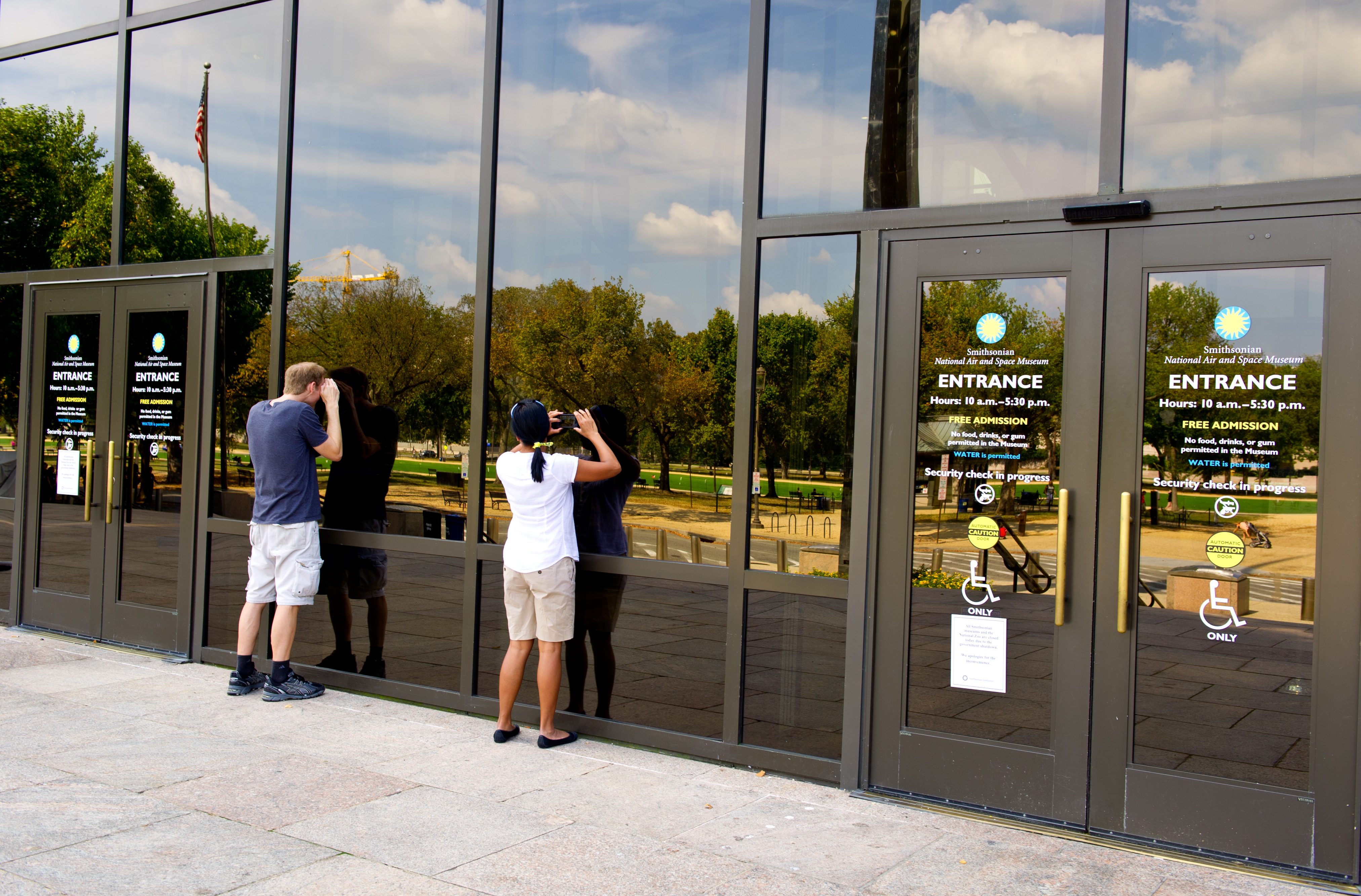
(Photo: Tourists peer into the closed Smithsonian National Air and Space Museum on October 5. By Karen Bleier/AFP/Getty Images)