The Republicans’ “Job-Killing Blackmail”

The Tea Party propaganda outlets have not let up on one particular moniker over the years. Obamacare is, we are constantly told, “job-killing.” John Boehner has used that phrase so often even Frank Luntz’s eyeballs must be slipping backward toward his tenuous toupee. The trouble is: since Obamacare just effectively started, and since the GOP has managed to cut off its provisions from the working poor – and particularly the African-American working poor – it’s somewhat hard to judge the validity of these claims:

“The script is still being written,” said Mark Zandi of Moody’s Analytics. “I don’t see any evidence Obamacare is impacting the job market.” N. Gregory Mankiw, a Harvard economist who worked in President George W. Bush’s administration, agreed. Asked how much the Affordable Care Act had affected the economy so far, he said, “Probably not a whole lot.”

Compare that with the likely job-killing effects of a continued government shutdown and a federal default. There is no doubt about how many jobs they would kill. Economists are not saying things like “Probably not a whole lot.” They are saying the following:

Goldman estimates that a two-day shutdown would reduce growth in the fourth quarter by 0.1 percentage points at an annualized rate, while a week-long shutdown would cost 0.3 percentage points … Now consider the debt ceiling … Analysts at Bank of America Merrill Lynch argue that hitting the ceiling would require the US to balance its budget at once, cutting spending by about 20 per cent, or 4 per cent of GDP. That would push the US into another recession–even if there were no default. The consequences of an actual default, particularly one that lasted for some time, are beyond prediction….

And this, if the GOP gets the default it is now recklessly threatening:

Expect nothing less than near panic in the global financial order.

The former chief economist of the International Monetary Fund, Simon Johnson, describes the repeated face-off over the debt ceiling and prospects for default as an act of “collective insanity,” noting that such irresponsibility in 2011, “put more pressure on European sovereign debt at an inopportune moment, pushing up yields across the troubled euro zone (including, but not limited to Greece).” Consequently, not just America’s recovery suffered. The risk substantially increased that Europe will now face a “lost decade” similar to that suffered by Japan with little or no economic growth.

The Republicans are not only threatening the mother of all job-killing recessions in America; they are threatening the rest of the developed world with a second Great Depression, the end of the dollar as a global reserve currency, a massive jump in interest rates and a sky-rocketing unemployment rate. In their fetid partisan brains, they may think this will hurt president Obama, and it surely would.

But it would also destroy countless lives, families, jobs, industries and American credibility. When will these people learn to love their country more than they hate their president?
We Must Not Negotiate With Economic Terrorists

US-POLITICS-ECONOMY-BUDGET

Boehner reportedly wants “to craft a ‘grand bargain’ on fiscal issues as part of the debt-limit deliberations.” But any serious Grand Bargain would require serious revenue increases in return for lower and flatter rates – and the GOP has simply refused to countenance any whatsoever, and certainly doesn’t appear to be ready to do so now. It’s an obvious way, it seems to me, to try and salvage the situation by changing the subject and making the blackmail seem at least faintly related to fiscal matters … but I can see why Chait is dismissing the idea:

The thing to keep in mind is that there is essentially zero institutional support within the conservative movement for negotiating a budget deal with Obama. Even the “pragmatic” conservatives who pleaded against the shutdown, like Grover Norquist and The Wall Street Journal editorial page, adamantly oppose closing any tax loopholes, regardless of what spending cuts come along with it.

So: What happens when the defunders realize the budget deal is not going to destroy Obamacare, and the anti-defunders realize it is going to include higher taxes? The answer is that John Boehner gets run out of town on a rail. There’s nothing a deal like that could include — not even a provision impeaching Obama and deporting him to Kenya — that could make it acceptable to the right-wing base.

Barro agrees:

A grand bargain would have to entail entitlement reform about which Republicans are lukewarm, plus offsetting Democratic demands, plus raising the debt ceiling and reopening the government. Yet the Republicans floating the idea of a “grand bargain” don’t seem prepared for the “bargain” part. On what planet is this route easier than a deal that is limited to resolving the government shutdown?

It isn’t. It’s a transparent effort to play for time and shift the blame. What matters now above everything else is that the president wavers not a jot or tittle in demanding a clean CR, raising the debt ceiling and then, if the GOP is prepared to raise revenues, a Grand Bargain.

What matters in this present crisis is that we do not negotiate with economic terrorists. Everything else is irrelevant to that fundamental goal.

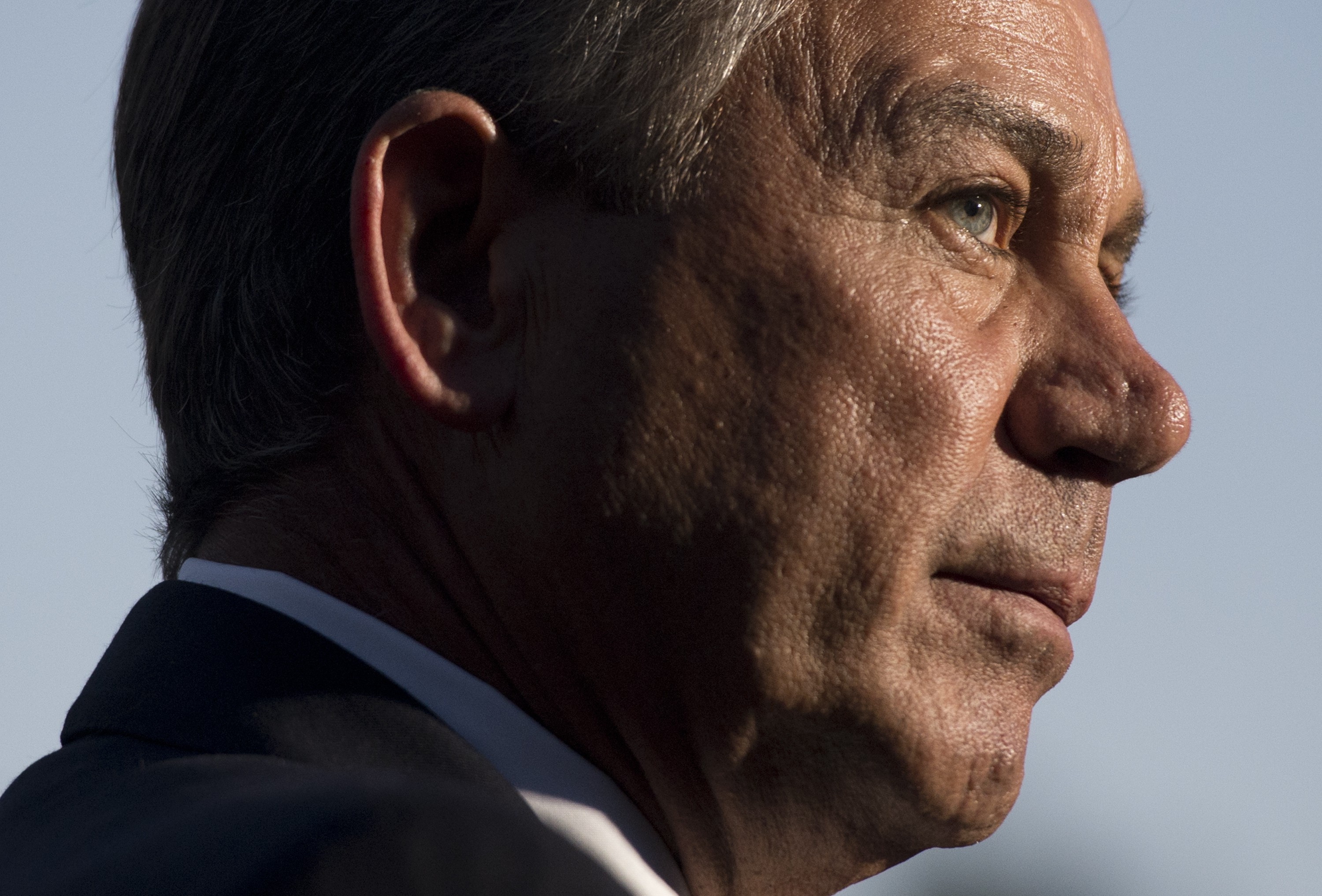
(Photo: Speaker John Boehner by Saul Loeb/Getty.)

The Democrats Won’t Be Fooled Again

The GOP House is passing bills that would undo the most visible consequences of the shutdown. Beutler explains why Democrats aren’t biting:

[Republicans] ran a version of this play after the sequestration order went out earlier this year. They pushed for special flexibility for the FAA, so that business travelers wouldn’t be inconvenienced by flight delays and Dems gave it to them. It was an error. In so doing, they placated a powerful lobby they could have marshaled to rescind all of the cuts. Poor people had no such recourse, and sequestration continues to harm the programs they rely on to this day.

Democrats aren’t falling for it this time. They passed a bill to secure military pay, but have so far rejected all other piecemeal shutdown fixes. Not because they’re craven or want the shutdown, and not even really because they care about the principle of equal treatment, though I suppose they do. Democrats aren’t letting Republicans make the shutdown they caused painless for themselves to endure. And that’s set off a massive fight for narrative control. Who’s really pro-shutdown, if Republicans are at least trying to open parts of it? Republicans want to enlist the press in its campaign to flip the script on Democrats, and have even had some success.

Scheiber imagines a possible endgame:

If the GOP can essentially fold on everything Obama insists they fold on, but come away with some deficit-related totem that gives the Tea Partiers the impression they won something—well, that wouldn’t look so much like a pure retreat. That’s where Boehner appears to be headed, even if he won’t admit it yet.

What would that totem look like? In essence, I think Obama can basically give Republicans a trumped-up, impressive-sounding version of what he’s already offered: You guys reopen the government and raise the debt limit, and then I will dispatch my vice president and my entire economic team to negotiate face-to-face with Paul Ryan over a long-term deficit deal every week for two months (or whatever), after which they will report back to me, and John Boehner and I will discuss what they’ve come up with. Obama would have essentially offered no concessions for the reopening of the government and the raising of the debt limit. He will have committed to no cuts and no deficit-reduction targets of any kind. But he will have given Boehner a fig leaf that he can show his rank and file to persuade them that this whole suicide mission wasn’t entirely futile.

The View From Your Shutdown

A reader writes:

I thought I’d share my small frustration with the shutdown, though it absolutely pales in comparison to the full-time workers who are now going without a paycheck. I’m a full-time student and a drilling National Guard officer. What I don’t think is being widely photo-28reported yet is that in a bunch of states, Guard monthly drills and training assemblies are being cancelled, despite the stopgap bill that was pushed through funding the military through the shutdown.

My state has tentatively cancelled all regular training and drill until the shutdown is over, save for the folks already activated for named operations (Enduring Freedom, etc). All of the state’s National Guard technicians, full-time Guard soldiers who maintain our equipment and weapons, have been furloughed. That really messes with our readiness; we have vehicles in need of repair from training last month that won’t get fixed. Imagine if there was a real emergency like Sandy and a critical unit’s vehicles were inoperable.

It also screws with any full-time Guard technician airmen or soldiers out of a paycheck they may be depending on. So when it’s being reported that soldiers and airmen aren’t being affected by this shutdown, that’s just not true.

On a personal level too, I rely on the GI Bill and my monthly drill pay to pay my rent. The VA has said they have enough appropriations to pay out the check I’m due for September, but if the shutdown continues through October, I won’t get paid next time. Couple that with me missing out on that critical training we’re supposed to have been doing, and I may be in a little trouble come November 2nd. Luckily I have family to turn to.

I want to echo what your writer in Afghanistan said. And I would serve for free. But this isn’t fair to younger Guard/Reserve soldiers and airmen who don’t have the same amount of support that I do. A lot of my soldiers are young college kids who fully depend on drill pay and the GI Bill for 100% of their income while they’re in school. If this thing lasts long enough to get past one paycheck, it’s time for concern for those soldiers, because if they’re like me, they live paycheck-to-paycheck.

(My views and opinions are personal ones that should in no way be read as reflecting the views, official or otherwise, of the Army, the National Guard, or my unnamed state.)

Update from a reader:

From a current National Guardsman who is also trying to complete law school, missing drills for one month or two could make it difficult to get a “good year”. You need a certain number of drill points per year to make a year count toward retirement. As someone who only started a year ago, I struggled to make the minimum number while maintaining my schooling. Now, going into the next FY, if I am starting out four drills behind, I may miss out on a good year. Two months of shut-down could lead toward a full year later retirement for me should I choose to stay in.

Another:

I’m a DoD civilian working for a Major Command of the Air Force. I’ve just filed for unemployment. On Oct. 21, I’ll be undergoing a major operation which my federally subsidized health insurance will cover. The confluence of events and the timing for me are pretty bad. But I’ve had this job since 2009, when I graduated college. I’ve been furloughed eight days total this year, and been threatened with no less than three shutdowns since starting in 2009.

I believed then and believe now that I’m lucky to be working for the fed. I can’t name many people I went to high school or university with who have been putting away for retirement for four years. I can’t name many people who got jobs out of college who have kept them, and had the opportunity for advancement, pay raises and travel like I have.

When we were asked to sign our furlough notifications on Tuesday, my organization gathered all civilians together to answer questions and field concerns. The loudest people in the room were federal civilians with prior military service who will be receiving retirement checks during furlough from their previous careers as servicemembers. I don’t know how to feel about that, because they should be paid, in full, on time, for the time they served and protected us.

I’ve always been the type of citizen and voter happy to pay my taxes and enjoy the fruits of those taxes in the form of public transportation, safe streets and stop signs. I take medications which were almost all the result of NIH research or federal grants. I love the Smithsonians. If taking this one on the chin ensures that more people get more affordable healthcare through ACA, then I’ll live with it.

My overall conclusion is that this shutdown does, indeed, blow. I need it to end, because I want to keep believing that the downsides of federal employment are vastly outweighed by the upsides. If they keep this up, the federal workforce will lose its most experienced employees, and its youngest and most creative, who came into the job looking for a stability that no longer exists.

A final note: I’m glad I subscribed to The Dish for a full year back when I was getting full paychecks. Sound investment.

Read all of the testimonials in our “View From Your Shutdown” series here. And send us your own.

The Innocent Faces Of Organized Crime

More Beg Children Were Rescued In China

Jillian Keenan describes organized begging as “one of the most visible forms of human trafficking – and [one] largely financed and enabled by good-hearted people who just want to help”:

In India, roughly 60,000 children disappear each year, according to official statistics. (Some human rights groups estimate that the actual number is much higher than that.) Many of these children are kidnapped and forced to work as beggars for organized, mafia-like criminal groups. According to UNICEF, Human Rights Watch, and the U.S. State Department, these children aren’t allowed to keep their earnings or go to school, and are often starved so that they will look gaunt and cry, thereby eliciting more sympathy – and donations – from tourists.

It’s not just India:

According to one U.S. State Department report, a man in Shenzhen, China, can earn as much as $40,000 per year by forcing enslaved children to beg. Horrific examples of trafficking in children (and the elderly) for the purposes of organized begging have been found in countries all over the world: Bolivia, the Philippines, Bangladesh, Senegal, Pakistan – even Austria, other European countries, and the United States. No country is immune to human trafficking. … So when we, well-intentioned tourists, give money directly to child beggars, there’s a decent chance we’re actually lining the pockets of criminals who will turn around and use that money to abduct, enslave, rape, torture, and maim even more kids.

(Photo: Three beg children are seen at a rescue station after they were rescued by police on February 13, 2011 in Guiyang, Guizhou province of China. More than 9,300 kidnapped children in China have been rescued since April 2009, when a nationwide campaign was launched to crack down on human trafficking. In less than three weeks, a Chinese microblog called ‘Street Photos to Rescue Child Beggars’ attracted 175,000 followers and posted more than 2,500 images of begging children online for parents to identify. By ChinaFotoPress/Getty Images)

A Pussy Riot Of The High Seas?

Russia has filed criminal piracy charges against Greenpeace activists who tried to board an Arctic oil platform, in a move Eugene Kontorovic calls “unprecedented in modern history”:

The charges are significant for international law because historically nations have been extremely wary of pre-textual or politicized piracy charges. To be sure, nations often publicly accused their enemies of piracy – the U.S. in the Quasi-War constantly denounced aggressive French privateering as “piracy.” In the Civil War, President Lincoln also called the obviously-unrecognized Confederate privateers as pirates. But in these cases the matter would almost never proceed from propaganda to prosecution.

One of the more recent politicized invocations of piracy was the Santa Maria incident of 1961, when anti-Salazar forces hijacked a Portuguese cruise ship. Lisbon denounced the attackers as pirates and demanded their arrest. But because the attackers had come on board as passengers, it did not satisfy the “two ship” requirement, just like in the present case, and the international community did not support the piracy characterization. (The terrorists ultimately got asylum in Brazil.) The point is that looks a lot more like piracy than this, and even still did not meet the requirements.

The View From Your Shutdown

A reader quotes another:

“I’m on furlough, and …. I’m worrying about how this is going to impact the household budget, wondering if I might need to apply for unemployment benefits if this lingers on (and just how I go about doing that).” I’m employed by a state university but my office is located at a federal research lab. I’m not allowed in my office during the shutdown and I can’t access the federal computers and datasets, but I’m expected to work as best as I can and I will continue to be paid. I know I am fortunate compared to my federal colleagues!

At the final, pre-shutdown “Town Hall Meeting” in the federal lab on Monday, one of the federal scientists asked about unemployment. Someone in the audience had researched that: regulations vary by state, and in our state a furloughed federal employee cannot apply for unemployment benefits because they are considered still employed (even though they are not allowed to go to work and are not being paid)!  I don’t even know what part of that last sentence to emphasize. The human toll is potentially huge.

Another reader:

I’m a federal employee, and so is my wife (we have two kids in college).  I can’t complain too much (at least in the short run); we’re prudent and we have some savings.  But between the two of us, the shutdown is costing us about $500/day.  If we end up getting it back, that’ll make a rather big difference.

But in the interim, we’re slowing the economy. How? Just today, our contractor came by; he was going to start to do $3000 of repairs of a basement struck with mold (to which I am severely allergic).  We told him: sorry, we can’t afford it now, go home.  So even though we are weathering the shutdown (in the short term), those who rely upon our spending are getting hurt.

Another:

I run a small, rural domestic violence and rape crisis center in Northern California. We are the only provider of this kind for the entire county and we are supported through funds from the Violence Against Women Act. We just received this email from our grant monitor in Sacramento regarding our federal funds:

Office of Justice Programs (OJP) have sufficient resources to remain operational through Friday, October 4, 2013.  This means that OJP staff will be available to assist grantees and OJP payment systems and services will be available through October 4, 2013. Should funding not be restored by October 4, 2013, OJP will cease all operations and California will not be able to draw down funds and reimburse your invoices.

This means the State of California cannot draw down the VAWA funds to pay us for our services – which by the way, are mandated by law. We are not quality-of-life providers, like social services, but we’re not quite emergency services providers either, like law enforcement. We are somewhere in between and apparently not considered essential.

I can tell you with some certainty that many of the rural domestic violence shelters (who don’t have wealthy communities to draw from) will not be operational should the VAWA funding not be rolling down as scheduled. I can also tell you with certainty, that right now almost every shelter in the State is housing not only adult victims of abuse, but many, many children, all of whom may be forced to hit the rickety road soon, compliments of the mostly males members of the “shutdown coalition”.

Another

Yes I’m on furlough, but who cares. What is that compared to a small group of thugs hijacking my country in hopes that the uninsured will remain so. Crush them. As long as it takes.

The View From Your Shutdown

photo-28

A reader writes:

I’m on furlough, and for the first time, I am worried that this might be more than a couple-day affair. And for the first time, I’m worrying about how this is going to impact the household budget, wondering if I might need to apply for unemployment benefits if this lingers on (and just how I go about doing that). But you are right. Obama’s got to hang tough and not give into the thuggery. I so damn sick of hearing the GOP complain about how Obama won’t negotiate. THIS is simply not anything to be negotiated over!

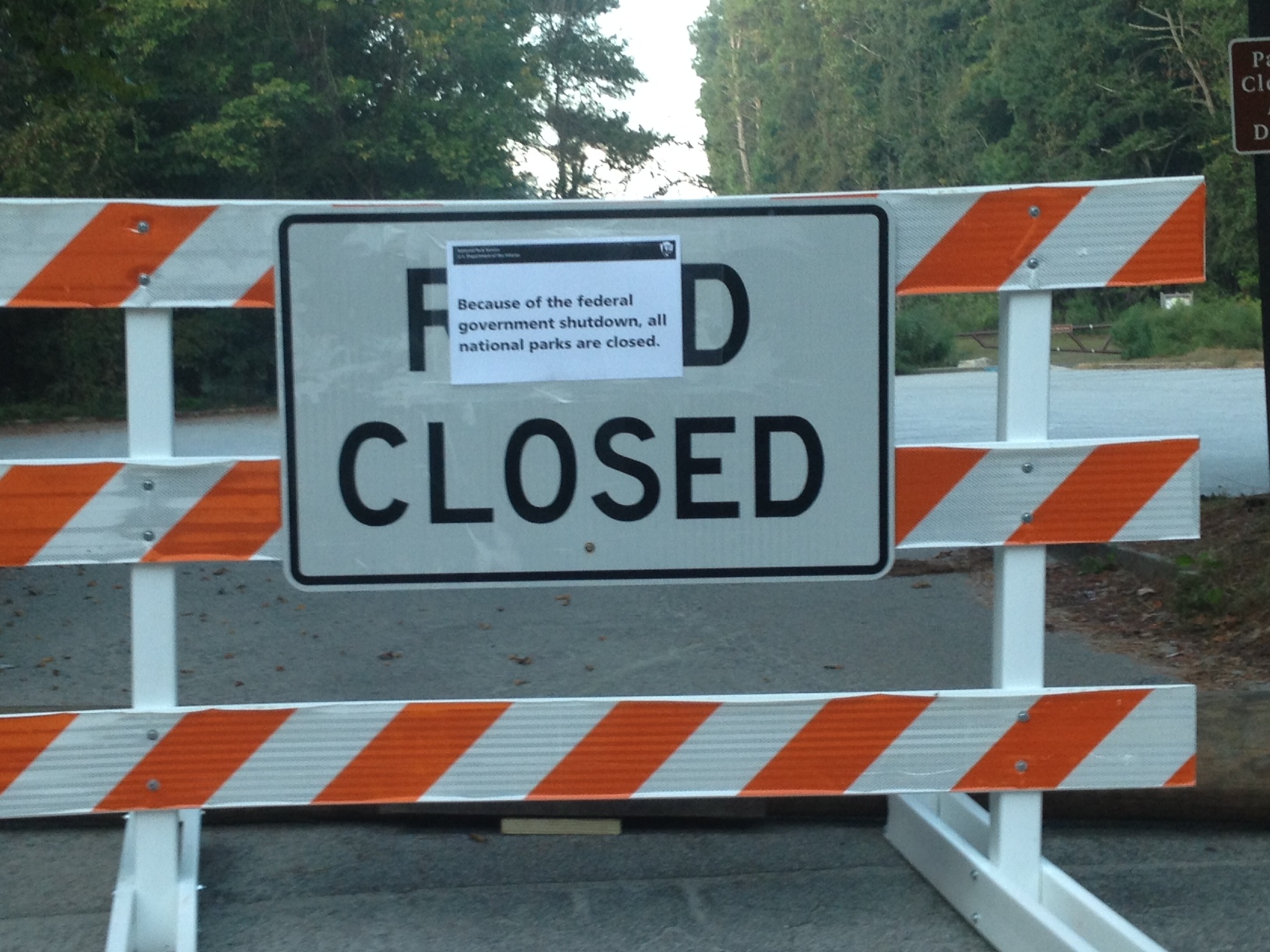
Another sends the above photo:

I know this is a minor inconvenience compared to, say, a federal employee not getting a pay check, but I was LIVID when I drove up to my favorite place to run at the Chatahoochee Recreation area to find it closed. There is some irony that I have to find a new place to exercise because Republicans are unhinged about a healthcare law.

Another reader:

Thank you for publishing that letter from Afghanistan. I also work in a foreign affairs agency that is not DoD, and I am continuing to show up to work (albeit safely in DC). It feels absurd to be showing up to work in an office that supports democracy abroad when our own government is a shambles. This shutdown is defeating and exhausting, especially for civil servants, since Congress shows no interest in or concern for the plight of any non-military federal employee.

Yesterday, all federal employees received a letter from the president:

You do all this in a political climate that, too often in recent years, has treated you like a punching bag. You have endured three years of a Federal pay freeze, harmful sequester cuts, and now, a shutdown of our Government. And yet, you persevere, continuing to serve the American people with passion, professionalism, and skill.

None of this is fair to you. And should it continue, it will make it more difficult to keep attracting the kind of driven, patriotic, idealistic Americans to public service that our citizens deserve and that our system of self-government demands.

People of all ideologies rail against The Government as if it is a faceless bureaucracy operated by mindless minions who serve rules and red tape. The reality is, we are made up of people who are enforcing and implementing the very laws that Americans have asked for through their elected officials, from the Iraq war to the Affordable Care Act.

We have rules and processes, because not only are we America’s largest employer, but we have to provide a level of accountability and transparency to the American public that is unheard of in the private sector. And yes, of course there are people and offices that are deadweight and drag us all down. But only an ideologue would ignore the political interests behind most of our poor policy choices, or try to pretend that the private sector doesn’t struggle with poor performers.

Can you imagine if, on a whim, a private company’s board told employees not to show up? And then if that company told its employees they wouldn’t get paid because they weren’t working? Who in the world would want to work there? How would they ever recruit and retain top talent to stay at the top of their field? I cannot imagine having a family and this kind of pay uncertainty, and I cannot believe that Congressional Republicans would so easily throw us under the bus. And yet, here we are.

I am tired of being told that “Washington is broken.”  It can always be better, but Washington is not broken. Congress is broken, and it won’t get better until Americans hold their elected officials accountable. But between gerrymandering and the current campaign finance situation, I’m losing hope.

What A Shutdown Costs

A rough estimate:

In a research note Tuesday, J.P. Morgan analysts estimated that federal furloughs will reduce national income by a total of $1.3 billion per week. As a result, the shutdown could shave 0.12 percent off fourth quarter GDP growth for each week it goes on. That forecast doesn’t account for any knock-on effects on the private sector or dent in economic confidence, which are harder to quantify.

All that lost income could be recouped if Congress later agrees to give those 770,000 furloughed federal workers back pay. But for now, that’s very much uncertain. Republicans in Congress are split on whether to agree to retroactive pay to workers who get furloughed.

The Real Star Of The Shutdown

9785650044_eb17e5e4bd_c

This adorable fuzzball, of course. Why did the plight of the Panda Cam receive so much attention these last few days? Megan Garber suggests it all comes down to office politics: 

When it comes to actually talking about the news – one of the big motivators for news consumption in the first place – coworkers tend to shy away from politically tendentious topics. Which is understandable: The workplace tends to collect people who might otherwise have little in common into close quarters. Why rock the boat? But it’s also a tendency that has significant implications for the kind of news consumption – and news sharing – that people actually do at and from work. The desire to avoid political confrontation, as [communications researcher Pablo] Bocszkowskiput it, “tends to steer people away from the consumption of politically sensitive topics, and move them towards consumption of sports stories, stories celebrity stories — topics that are more innocuous, and lighter in terms of workplace conversations.”

But the need to publicly appear politically neutral also explains the mass appeal of polarizing talk shows:

Discussing politics with your colleagues or neighbors comes with the fear of saying something unacceptable, and subsequently being excluded from the next barbecue or water-cooler conversation. In contrast, “the comfort zones provided by the shows we studied present no such risk,” [sociologist Sarah] Sobieraj and her colleagues write. “In fact, they offer imagined and, in some cases, tangible social connections.”

But why is their pull apparently stronger among conservatives, who gravitate to such programming in much greater numbers than liberals? Based on their interviews, the researchers believe the answer lies in the fact those on the right have more to fear in terms of social condemnation for their views.

(Photo: The giant panda cub born at the Smithsonian’s National Zoo August 23 was given a clean bill of health following her first veterinary exam September 16. By Courtney Janney, Smithsonian National Zoological Park)