How Callous Are Today’s Republicans? Ctd

A reader writes:

You can’t have a post about Republicans attempting to gut food stamps without including race in the conversation. To the Tea Party base, “food stamps” is code for “handouts to lazy black people,” and nothing gets the base more riled up than their hatred of any social program that helps “those people.” I think you’d agree that right now the right-wing GOP is much more motivated by placating and energizing its base than by any other factor. That’s what the votes to repeal Obamacare are about, and that’s what the food stamp votes are about. The simple fact is that the members of Congress who voted for the massive cut in food stamps did it so they could go back to their districts and tell the old, white, angry voters who elected them: “See, I’m in Washington, fighting the good fight to keep lazy, undeserving (*wink wink*) people from taking your hard-earned tax dollars.”

Another is on the same page:

I really think that people outside the South have trouble understanding these sorts of things. It isn’t callous at all. It is entirely about race. It really is a long-standing race issue for many Southern whites, especially as you get closer and closer to the lower end of the middle class, but it can be found at most every strata. An example of the poisonous logic goes like this: “Food stamps are a handout to blacks who don’t want to work.” Now, you could point out the obvious, and say, “But needy white people get food stamps too,” but the response would be: “But that is different, and in any case, white people want to work so they aren’t the problem.” It is basically the same meme about welfare in general that has persisted for a generation.

Another has a more nuanced perspective:

While all the commentators you cite certainly provide insights into why Republicans are so determined to cut food stamps, I think everyone is neglecting a major point of contention that grassroots Republicans have with food stamps:

unlike other federal programs, they see it happening, day in and day out. When I talk to conservative friends, many of them very intelligent and educated, they frequently become upset when discussing welfare in general, and food stamps in particular. I think I’ve identified two related factors that make this such a big deal to certain conservatives.

First, everyone has a story about someone they know of, usually a friend or family member, who cheats the welfare/food stamp system. It’s no surprise that people abuse and cheat government programs. The difference is that the conservatives I talk to take this as a personal insult, rather than an unfortunate but basically unavoidable reality. When the program in question is so visible, they place an outsize importance on SNAP, and they tend to exaggerate its size and corruption.

Second, and I think more importantly, many conservatives I talk to see people at the grocery store, supermarket, or corner store using food stamps day in and day out. It’s this daily grind that wears on them, and leads them to obsess over these programs. Again, the issue is more emotional than rational: even if the people I talk to have a fairly decent sense that SNAP and other assorted welfare programs don’t constitute a major part of the government’s expenditures, it just does not matter. Food stamps are real to them in a way that farm subsidies or defense spending or any other government program just are not. Food stamps rub their noses in it.

Food stamps are the most visible, tangible manifestation of a broad range of government actions they despise. Its conservative’s perfect storm: people they feel are undeserving gaming the system, and you have to stand in line and watch them do it.

I think this also explains the divergence between elite conservative and “grassroots” conservative opinion on SNAP and other welfare programs. How many conservative economists, who may dislike social welfare spending but worry more about larger programs, have stood in line at the supermarket after working 12 hours at a job they hate only to watch someone pay for their food with an EBT card? Combine this with a preexisting distrust and dislike of government, mix in a narrative about cheats running the system, and you’ve got a recipe for conservative pressure to cut food stamps while more people than ever need access to them.

Another shifts focus:

Instead of stigmatizing poverty, criminalizing and punishing it, we ought to stigmatize unearned wealth. Why do we think badly of people who need food stamps even though they are working hard? Why not stigmatize the Walton family members? They earn their billions off the labor of minimum wage employees, then they instruct them to apply for government assistance to feed their families. That kind of behavior takes more gall, more ugly nerve than applying for food stamps after a long day’s work in a warehouse.

Maybe we should stigmatize the corporate CEOs who accept large government subsidies and pay little or no taxes, who then give themselves million dollar bonuses. Maybe we should stigmatize the Republican congressmen who vote against hurricane relief aid for the East Coast but demand flood aid for their districts. Maybe we should stigmatize the Republicans who have voted 42 times to defund the Affordable Care Act (calling it socialist when it isn’t), while accepting socialist healthcare from the US government in the form of Medicare and Medicaid.

Update from a reader who takes issue with the second email above:

I don’t believe this person actually knows any conservatives, and is merely surmising how she thinks those “racist right wingers” think. Most conservative I know don’t say food stamps are for black people; they say food stamps are mostly for dirtbags and low-lifes, period. They don’t give a fuck what someone’s color is! None of them would say it is different for white people. None.

Screaming racism at everything is the easiest bullshit that prevents you from having to deal with reality. Call the GOP callous all you want, but this racism thing is such a small part of it for a small amount of them that it is not even worth discussing.

Clinton Fatigue … And Exhaustion

Clinton Global Initiative Annual Meeting In New York

Weigel rounds-up all of the anonymous pro-Clinton quotes in Joe Hagan’s profile of Hillary:

To recap: Clinton is humble, strategic, and learns from her mistakes, and if she loses it’s because people don’t trust her and her husband enough. Great—why was any of this anonymous? Again, no disrespect to Hagan, who is operating under the rules of this beat and coming out with a newsy exclusive story. My pre-emptive peeve is that the Obama administration is looking ready to pass the Democratic baton to a coterie that’s even more ridiculous about controlling the press.

And anyone is surprised by that? John Dickerson ponders Clinton’s press strategy:

Most presidential candidates strain for attention. They rush to Iowa, write books, or take extreme positions on controversial issues. Clinton has to do the opposite, trying to flee from the circus ready to chase her down the grocery store aisle. But she’s in a bind. If she makes too much news this far ahead of the 2016 presidential election, there’s a chance people will tire of her candidacy.

Yes, I feel narcolepsy coming on, and if I have to see another tedious interview with Chelsea Clinton, a coma is imminent. Only the newness of the first woman president can overcome it. But I really wish the first woman president were not the wife of a previous one. John goes on:

If she steps back, though, the unstoppable flow of Clinton stories will come anyway (especially the highly unflattering ones that feature people loosely associated with Clinton world, like the New Republic profile of Doug Band, who once oversaw the Clinton Global Initiative). Not all of these people leave a good impression.

Joan Walsh declares that she also Clinton fatigue. Waldman explains why:

The 2008 Obama candidacy was a romance between him and liberal voters. Romance is all about discovery, the excitement of the new, the thrill of venturing into unknown territory with someone as you begin to know them. Perhaps most importantly, romance also allows you to reimagine yourself as you’re seen through this new person’s eyes. And that was the most important thing about 2008: how it made liberals feel differently about themselves. They weren’t weak and defensive and they weren’t losers. They were brave and strong and smart. They were history’s actors, forging real, meaningful change with every yard sign and phone call and Facebook post. They were the future.

We can’t ever have a romance with Hillary Clinton, because we’re already in a relationship with her, one that’s over two decades old. A successful Clinton candidacy isn’t going to allow liberals to reimagine themselves. She could turn out to be the greatest president in American history, but the beginning of that presidency won’t give liberals the thrill that 2008 gave them.

Chait points out the candidacy’s flaws:

Bill Clinton has surrounded himself with wealthy people and paid barely any attention to the money flowing all around him. Even if nothing incriminating ever comes to light, the atmospheric revelations could form a potent combination with the policy agenda. Liberal complaints with their party’s failure to sufficiently regulate Wall Street have focused on figures like Larry Summers and Robert Rubin, but these men are proxies for the president who appointed them. Wall Street will be to 2016 what Iraq was to 2008: both a policy liability and a lever for her opponent to wedge open broader doubts about her character, to paint her as a corrupt and feckless insider. Clinton’s loyalists say she won’t repeat her 2008 errors. But she will have to show she understands just what the analogue is.

And we all know how flexible she is …

(Photo: Former US Secretary of State Hillary Clinton listens during the Clinton Global Initiative (CGI) meeting on September 24, 2013 in New York City. Timed to coincide with the United Nations General Assembly, CGI brings together heads of state, CEOs, philanthropists and others to help find solutions to the world’s major problems. By Ramin Talaie/Getty Images)

How Likely Is A Shutdown?

Philip Klein is betting against it:

The nation now has more than two and a half years of experience with divided government during the Obama presidency. And each time there has been a major crisis, it’s followed a familiar pattern. The sides are far apart. It looks like the crisis may hit. Then, at the last minute, there’s some sort of deal that’s able to pass the Senate that Speaker John Boehner, R-Ohio, is able to get through the House of Representatives with a lot of help from Democrats.

Cohn mostly agrees:

Most informed observers I know would agree with his assessment and, for the record, I would too. The conflict over financing government operations—and, weeks from now, raising the debt ceiling—is all about Boehner and his lieutenants waiting until the last possible minute, so that he can extract the biggest concessions from Democrats while telling the conservative base he did the best he could. One way or another, the two sides will come together before the government runs out of money and before it taps out its borrowing authority. In fact, with Senate Minority Leader Mitch McConnell announcing that he won’t support Senator Ted Cruz’s call for a filibuster, the chances of a shutdown just diminished a little more.

But if the chances of either a shutdown or a debt ceiling crisis are modest, they aren’t modest enough. And there’s a chance the confidence all of us feel could actually make a last-minute deal less likely.

Ezra’s view:

Most in Washington and on Wall Street hold to a serene faith that the two parties will figure something out. And that’s probably right. But in interviews with both Democratic and Republican staff from the House and Senate leadership, as well as the White House, I have yet to hear a plausible story for how they figure something out. The tales range from the unlikely — Republicans expect Senate Democrats to force the White House to delay the individual mandate, while Democrats expect Boehner to simply fold and absorb the backlash from his party — to the nonexistent.

“I don’t know the end of this movie,” says Rep. Chris Van Hollen, ranking member on the House Budget Committee. “I don’t think anybody knows how it ends. And that’s a very dangerous place to be in.”

Missing Matthew Shepard

Stephen Jimenez, author of The Book Of Matt: Hidden Truths About the Murder of Matthew Shepard (out today), describes what Matthew’s complex story means to him:

An excerpt from the new book is now available at the Daily Beast. Below is a long video that details some of the evidence and sources that back up some of Jimenez’s more provocative claims about Shepard and his murderer, including a sexual relationship:

This embed is invalid


Steve’s previous videos in the series are here. Our full interview archive is here.

The View From Your Window Contest: Winner #172

vfyw_9-21

A reader writes:

This photo is from a very lush and slightly tropical place.  The truck driving up the road in the distance on the far right of the photo appears to be driving on the left side of the road.  The buildings appear very British – Scottish actually. There seems to be a flag over the cemetery but the flag looks light blue and white.  Argentina?  That’s not helping. I’m going to guess the north island of New Zealand on the east coast.  Let’s say the Auckland suburbs.

Another:

I know that the palm trees in the picture are yucca trees, which are ingenious to the Americas, the tree version being found closer to water and wet climates while the shrubs are found in dryer climates. Put that with the cliffs and my guess is the coast of California – no idea what city. Also, the road on the left side of the picture along the cliff side looks like Highway 1, which runs along California’s coastline.

Another:

I’m in the midst of moving so I have little time for research, but that view of the breakwater looks very much like the one in Victoria BC, especially with that size lighthouse at the end.  Of course a few of the trees in the photo don’t exactly scream Pacific Northwest, but with the exotic Butchart Gardens nearby I think the locals are inspired to grow non-native flora.

Another:

The vegetation and houses remind me of South Africa’s “Garden Coast” east of Cape Town.  I’m guessing Kynsna, mainly because it’s such a lovely name to say (“NIZE-na”) and such a beautiful place.

Another gets on the right continent:

“Oh wow,” I thought to myself, “that looks just like the Irish coast. The random tropical plants, the blocky stucco houses, the steel-gray skies. I’ll just pop over to Google maps and trace the coastline until I find a breakwater and some rocky coves! Easy!”

Oh, except Ireland has about four billion miles of rocky coastline, and I’m supposed to be working. So I’m going to guess Dun Laoghaire, because who are we kidding with that spelling? Plus it’s the first place I thought of, even though I’m pretty sure it’s not correct.

Another is also frustrated:

I just can’t get this one. It screams southwest Ireland to me – we do actually have palm trees there – but I can’t identify the place.  To solve the Cork VFYW contest I went all around the coast of Ireland on Google maps until I found the right port.  But here I’ve gone back and forth from Cork to Waterford and on to Wicklow and Wexford and I can’t find the river (or inlet) that’s going into the sea.  But a guess is better than no guess, so I’m going to say it’s County Cork, somewhere near Schull.  Even if I’m not close it’s a very beautiful part of the country and it’s nice to remember my trips there.

Another gets on the right island:

I think this is near a small resort town called Largs on the west coast of Scotland. The tropical looking trees might have thrown me off but I was there a little over a week ago and was surprised that they were growing there. Also, the buildings look like what you would find in that area.

Another gets closer:

I’m pretty sure it’s somewhere in Britain. The cars are driving on the left and the boxy white house on the left is very typical British residential architecture. I first thought it might be Torquay, England, where I visited many years ago and recalling how surprised I was to see palm trees there. But checking Google street view, it looked like Torquay was too built up. So I thought of Penzance, further down the coast. I couldn’t find the view in the photo, so I’m really just guessing.  (Alternative guess: Hamilton, Bermuda)

Another:

Oh, those little palm trees don’t fool me. Those windows! The chimneys! The roan sky! Definitely England. Got to be the southwest coast, a place with a quay. How about Falmouth? Is it Falmouth then?

Nope. Another:

My first entry ever and I wouldn’t know how to begin doing it properly, but I think it’s the south coast of Cornwall. Even if it isn’t, it reminded me of home, so thanks.

Very close. Another nails the right town:

This week’s VFYW contest is in Fishguard, Wales. Palm tree was a bit of a red herring. Having visited Ireland, Wales, and England last month for the first time, I immediately recognized this scene as in that general area (rocky coast, palm trees, that glass enclosed room in the foreground). After Google Maps-ing around the circumference of Ireland without much luck, I went to Wales, where I found the view pretty quickly. The image is from Fishguard, Wales. I don’t have the exact window but my guess is that the image was taken from the back of The Manor Town House, on Main St./A487.

An aerial view of Fishguard:

VFYW 2013.09.21

Another nails the right window:

There is a car on the road driving on the left side of the road and I immediately thought Australia. They apparently have some pine trees as seen in the picture, but after an hour I figured out that there are no inhabitants in the northern coast of Australia.

Enter the girlfriend. One look and she says “Cornwall UK!” – they have warm weather, so an hour or two searching for a pier on Cornwall and Truro and islands off the coast … nothing. Then she emails me this morning – “Fishguard!” – gloating because I nailed Sintra in under 30 seconds three weeks ago. I don’t know yet how she did it.

Anyway, I looked around Fishguard for a white canopy/gazebo thing … nothing. That was hard, so I went for a drive on Google maps, focused on the main street area and then I get email #3 from the GF: Manor Town Hotel on Main street (it has great reviews btw). She was on fire.

The pic was likely taken from the second floor window. I’ve attached an almost identical picture taken from the room #1:

image69

Room #1 it is. Another reader:

As it happens, this is the town in which my mother was born, though I’ve never been. Fishguard (in Welsh, “Abergwaun”) is where you get the ferry from the UK to Ireland. It was where the film Under Milk Wood (with that great Welsh actor Richard Burton) chose to portray Dylan Thomas’ fictional town “Llareggub”.

A good hour on Google Maps tells me this window belongs to the back (north-side) of the Manor Town House, 11 Main Street, Fishguard, SA65 9HG, which is now a guesthouse. You can just about make out the circular gazebo on the satellite view. The houses you can see on the hill opposite are on a street called Penslade (which has Streetview, so you can tick off the houses by colour).

A visual entry from a reader:

VFYW Fishguard Actual Window Marked - Copy

You know you’re a little too into the VFYW contest when you find it while furiously searching for clues over Amtrak’s spotty wi-fi on the train down from Albany.

Of the dozen or so readers who correctly answered Room #1 at the Manor Town House, only one of them has correctly guessed a challenging window in the past without yet winning. The tie-breaking entry:

It’s raining. So we must be in the UK. In the background, we see the end of what is either a pier or a breakwater, a pretty big one it seems. Does that point to Plymouth, and its enormous breakwater in the Plymouth Sound? It doesn’t. This picture was taken from what I believe is Room 1 at the Manor Town House Bed & Breakfast on 11 Main Street in Fishguard in lovely Pembrokeshire on the west coast of Wales. (Fun fact: not too far away was the site of the last successful French military invasion of Britain during the War of the First Coalition in 1797.)

(Archive)

AIPAC Readies To Kill Outreach To Iran

In our latest video from NIAC founder Trita Parsi, he explains that, if Rouhani hopes to maintain his power, his diplomatic efforts must ultimately improve Iran’s economy:

 
Near the end of the video, Parsi wonders if Congress will stand in Obama’s way. You think? Eli Lake talks to Israel’s proxies on the Hill:

If Obama seeks to take advantage Rouhani’s outreach, he will need support from a Congress that appears unconvinced about the new Iranian president’s charm offensive. One House staff member who spoke to The Daily Beast Monday said Iran would need at the very least to suspend uranium enrichment to stop legislators from moving a new sanctions bill aimed at the regime’s nuclear program. A memo released last week from the American Israel Public Affairs Committee, a pro-Israel group that has made Iranian sanctions a centerpiece of its lobbying efforts since the 1990s said, “The international community should only consider sanctions relief if Iran complies with United Nations Security Council (UNSC) resolutions that require suspending its nuclear activities. Any such relief must be commensurate with the extent of Tehran’s actions.”

Which means that the Greater Israel lobby will do all it can to prevent any conceivable deal that could ensure Iran’s right to peaceful nuclear energy – the sine qua non of any breakthrough. Which means they aim to kill diplomacy to get the war they have been wanting for more than a decade. In this sense, AIPAC is the American equivalent of Iran’s Revolutionary Guards in terms of scuppering any possibility of genuine peace, by refusing to treat Iran as anything but a pariah state. Israel, meanwhile, sits on a couple hundred nuclear missiles aimed in part at Iran. But that inconvenient truth cannot be uttered on Capitol Hill.

Yesterday, Parsi detailed the very limited window Rouhani has for success, as well as how he thought the US should tackle this new opportunity for rapprochement.

Our full Ask Anything archive is here.

What A Deal With Iran Would Look Like

68th Session Of The United Nations General Assembly Begins

Kenneth Pollack outlines it in a must-read. How far the US should be willing to go:

Rouhani may ultimately need more than the removal of the multilateral sanctions. He may need the U.S. to pledge, as we did to Cuba after the 1962 Missile Crisis, that we will not invade or otherwise try to overthrow the Iranian regime. He may need a commitment from the international community to help Iran develop its nuclear energy sector, which can be done by providing lightwater reactors that would not significantly bolster Iran’s ability to build nuclear weapons. He may also need economic support from international financial institutions like the World Bank and the IMF. He might even want to try to bring Iran into the World Trade Organization, although that seems unlikely given Khamenei’s insistence that the WTO is a subversive organization whose requirements would undermine the Islamic regime. The United States and our allies ought to be ready and willing to agree to any or all.

Amen. But the resistance from the Greater Israel lobby will be intense, as will opposition from Christianists and the 20th Century faction in the GOP, like McCain and Butters. Hence the president’s remark in his UN speech right now about how “the roadblocks may prove to be too great.” But Obama needs to drop some of his caution and defensiveness on this – and embrace the “Yes We Can” of his 2008 campaign. Those of us who supported him back then in the wake of neoconservative catastrophe dreamed of a moment like this one. He must not let it pass.

How Juan Cole understands Iran’s nuclear program:

Ali Akbar Salehi, the head of the Atomic Energy Organization of Iran, has confirmed that Iran has turned 40% of its stock of high-grade LEU into fuel rods for the medical reactor. Once made into fuel rods, the material cannot be weaponized. So Iran only has 140 kilograms left of the 19.75% enriched uranium left. That isn’t enough for a bomb even if Iran knew how to make one and had the facilities to do so, which it doesn’t. Salehi says that Tehran intends to turn the rest of the stock into fuel rods, as well. Iran has in fact been feeding these fuel rods into the medical reactor and not stockpiling the high grade LEU, which is how you would expect them to act if they were in fact only interested in fuel, not bombs. Long time readers know that I have held since the middle of the last decade that Iran does not want an actual bomb, but rather only wants a breakout capacity like that of Japan– the ability to construct a bomb in short order if they faced an imminent existential threat. Such a breakout capacity would be almost impossible to forestall, since it mainly depends on know-how, which is widespread. But if Iran and give solid evidence that it has no active weapons program, that might be enough for a deal.

(Photo: U.S. President Barack Obama addresses the U.N. General Assembly on September 24, 2013 in New York City. By John Moore/Getty.)

The Un-Thatcher, Ctd

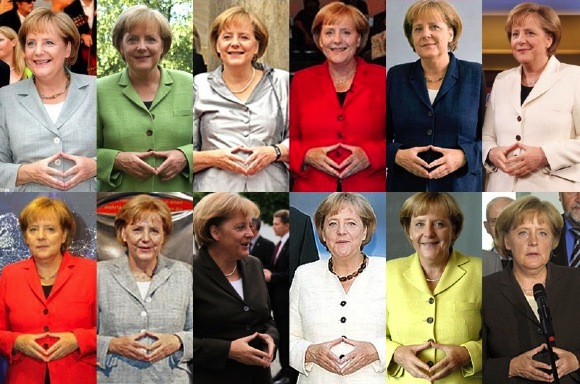
angela-merkel-shapes (1)

Anne Applebaum delivers some backhanded praise for the reelected Merkel:

Her very dullness, her middle-aged frumpiness, and her lack of emotion must actually represent something that Germans want: leadership without drama. It’s not just that she’s a “safe pair of hands”: Merkel provokes no jealousy, no anxiety, and no fear, either in Germany or in Germany’s immediate neighborhood.

Nobody writes about Merkel as the leader of the “Fourth Reich,” after all, and nobody compares her to Hitler or Bismarck. The eastern neighbors treat Germany as a benign partner. The southern neighbors are resentful but can’t really complain. Everyone else imports German products and feels relieved that at least one large European country still has decent economic growth and good prospects for the immediate future. Merkel makes it possible for Germany to be the dominant power in Europe without anybody really noticing, in other words. That suits her countrymen. And for the moment, it seems to suit other Europeans as well.

Maybe not the Greeks:

Greece is stuck in its sixth year of recession, but this has not stopped Prime Minister Antonis Samaras from declaring this month that “Greece is turning the page,” when the national statistics agency reported that the Greek economy shrank by “only” 3.8 percent in the second quarter, less than the expected 4.6 percent.

By the term “Un-Thatcher”, I meant the lack of polarizing drama – not a relentless pursuit of fiscal retrenchment. After all, what Merkel has done to Europe in the last few years is largely what Thatcher did to her own country in the early 1980s. But Thatcher was able to use the British parliamentary system to dominate politics in a way that Germany’s coalition-style polity cannot. Catherine Mayer wonders if Merkel will be able to form a stable government on her current course:

Merkel’s options for coalition partners are limited.

The Free Democrats, who served with her during her last term, crashed spectacularly at the election, failing even to achieve the 5% of votes necessary to enter parliament. Merkel governed in her first term in a grand coalition with her largest rivals, the Social Democrats (SPD). They too suffered at the ballot box after their association with Merkel and fear that a return to coalition with her will damage their party in the long term. They may be right. Proximity to Merkel has proved politically fatal to rivals within her own party, including her mentor, former Chancellor Helmut Kohl, whom she was key to ousting when scandal damaged the CDU’s ratings. Her popularity is also such that her supporter base—which extends far beyond the ranks of traditional CDU voters—tends to attribute every success to her and blame every failing on the government of the day.

(Image thanks to the Internet)

Is Driving With A Cell Phone Really That Dangerous? Ctd

Last month we highlighted a study from Carnegie Mellon and the LES suggesting that cell-phone use doesn’t cause more car crashes. Readers pushed back with other findings. Now Kevin Drum digests a new study (pdf) from the University of Utah:

In general, the authors conclude that hands-free talking isn’t worse than talking on a handset, but neither is it any better: “Taken together, the data demonstrate that blog_cell_phone_reaction_timeconversing on a cell phone impaired driving performance and that the distracting effects of cell-phone conversations were equivalent for hand-held and hands-free devices. Compared to single-task conditions, cell-phone drivers’ brake reaction times were slower and they took longer to recover the speed that was lost following braking.”

The problem with cell phones has never been primarily about taking your eyes off the road to dial, or about the dexterity required to hold a handset to your ear. It’s all about cognitive distraction, and the study’s authors report that drivers who do a lot of talking on cell phones don’t get any better at it: “Real-world experience using a cell phone while driving did not make the so-called experts any better at multitasking than the novices.”

Michael O’Hare’s take on the findings:

The danger is in the conversation itself, and to understand the reason, consider driving while (i) listening to the radio as I was (ii) conversing with an adult passenger (iii) transporting a four-year-old (iv) sharing the front seat with a largish dog. Why are the first two not dangerous, and the last two make you tense up just thinking about them?

The radio is not a person, and you subconsciously know that you may miss something if you attend to something in the road ahead, but also that you won’t insult it if you “listen away,” and it won’t suffer, much less indicate unease. The adult passenger can see out the windshield and also catch very subtle changes in your tone of voice or body language. If you stop talking to attend to the car braking up ahead, the passenger knows why instantly, and accommodates, and because you know this, you aren’t anxious about interrupting the conversation.

The dog and the child, in contrast, are completely unaware of what’s coming up on the road or what you need to pay attention to; the former is happy to jump in your lap if it seems like a good idea at any moment, and the child demands attention on her own schedule and at her will.

Jack Torrance Was Onto Something

Peter Gray details the connection between a decline in playtime and a rise in mental disorders:

It’s not just that we’re seeing disorders that we overlooked before. Clinical questionnaires aimed at assessing anxiety and depression, for example, have been given in unchanged form to normative groups of schoolchildren in the US ever since the 1950s. Analyses of the results reveal a continuous, essentially linear, increase in anxiety and depression in young people over the decades, such that the rates of what today would be diagnosed as generalised anxiety disorder and major depression are five to eight times what they were in the 1950s. Over the same period, the suicide rate for young people aged 15 to 24 has more than doubled, and that for children under age 15 has quadrupled.

The decline in opportunity to play has also been accompanied by a decline in empathy and a rise in narcissism, both of which have been assessed since the late 1970s with standard questionnaires given to normative samples of college students. Empathy refers to the ability and tendency to see from another person’s point of view and experience what that person experiences. Narcissism refers to inflated self-regard, coupled with a lack of concern for others and an inability to connect emotionally with others. A decline of empathy and a rise in narcissism are exactly what we would expect to see in children who have little opportunity to play socially. Children can’t learn these social skills and values in school, because school is an authoritarian, not a democratic setting. School fosters competition, not co-operation; and children there are not free to quit when others fail to respect their needs and wishes.