Where The Public Is On Obamacare

Pew Obamacare

Suderman summarizes recent polling on the ACA:

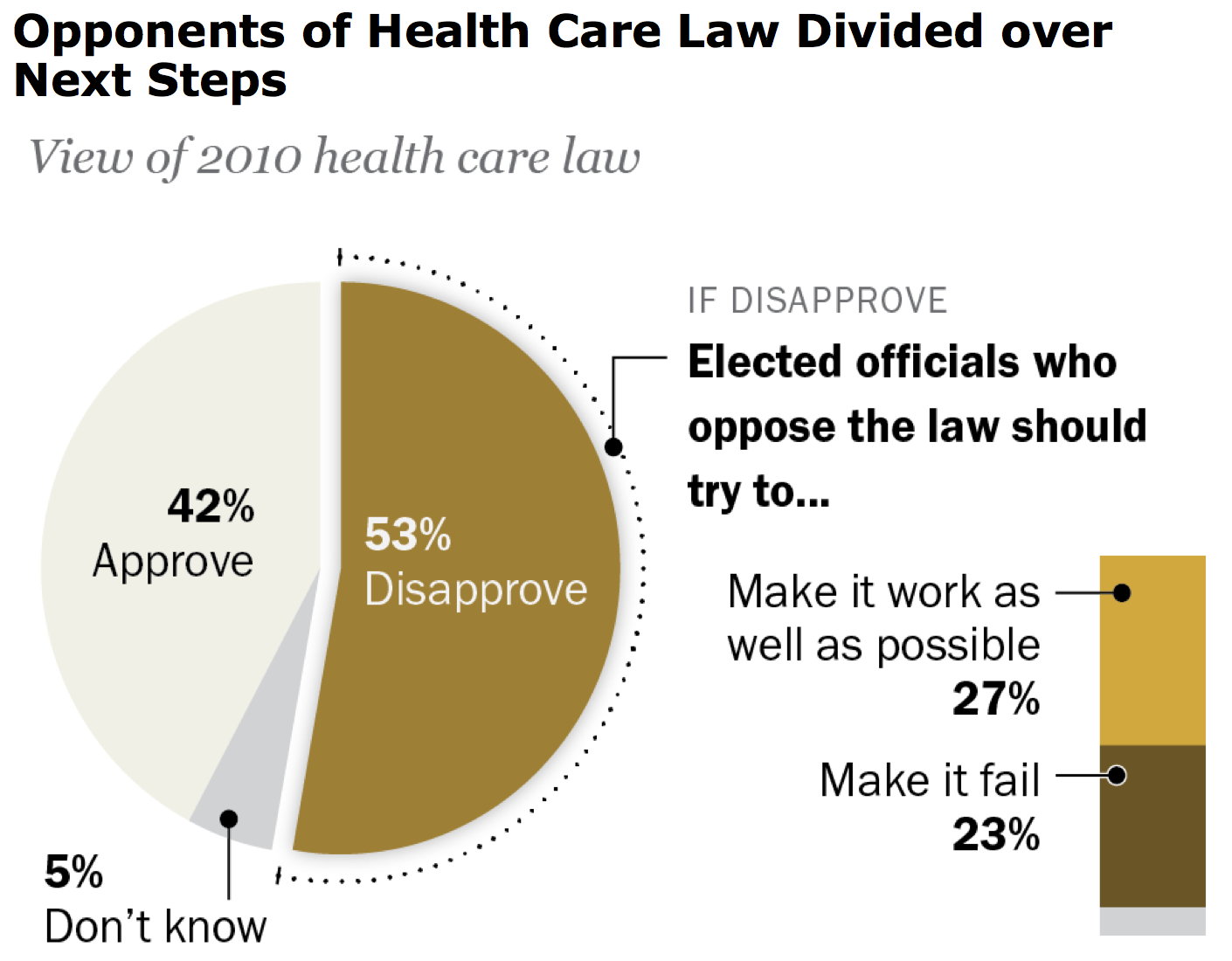
USA Today/Pew poll taken last week and released today finds that 53 percent of the public disapproves of the health care law, with 41 percent saying they disapprove strongly. The same percentage of respondents—53—say they disapprove of the way that President Obama is handling health policy. A Reason-Rupe poll published last week finds similar skepticism about the way the law is being handled, with 62 percent of those surveyed saying that implementation of the health law is not going well.

A poll from NBC/WSJ contains similarly bad numbers. But it also finds that increased knowledge of the law correlates with more support for it:

34% say they don’t understand the law very well, and another 35% say they understand it only “some.” That’s compared with 30% who understand it either “very well” or “pretty well.” As it turns out, that 30% has more positive opinions about the health-care law (42% good idea, 45% bad idea), versus the 34% who don’t understand it very well (17% good idea, 44% bad idea). … The White House has tried to start health-care education campaigns a few times, but to no avail. If they could actually sustain one of their campaign-style pushes on health care, these numbers suggest it COULD pay off.

Greg Sargent focuses on the numbers in the above chart from Pew (pdf), which demonstrate that relatively few Americans want the law to fail:

[L]arge majorities overall either support the law or oppose it but want lawmakers to try to make it work. Simply put, the zeal to prevent the law from functioning as well as possible is well outside the American mainstream.

To some degree this mirrors the situation within the House of Representatives itself. A majority of Members would vote tomorrow to fund the government without any defund-Obamacare rider attached, or to raise the debt limit without any Obamacare delay attached. But because House GOP leaders are loathe to allow a vote on anything unless a majority of House Republicans approves of it, the result is that — if today’s Pew poll has it right — the delusional preoccupations of a small minority of the American people are having an outsized impact on, well, our entire political situation, with potential economic chaos looming as a result.

Chait expects the politics of Obamacare to change once the uninsured are in the system:

Any future revision will have to account for them. Anybody who wants to overhaul the health-care system will not merely have to protect insurers and medical providers but Americans in health exchanges, too. It will no longer be possible for Republicans to propose repealing Obamacare and making some vague hand-waving to do something for the uninsured at some future point. Republican health-care reform will have to include everybody. All this is contingent on the law actually getting up and running.

Republicans are afraid of that transformation, and they’re right to be.

Finding The Words Of Seduction

Last week marked the 1885 birth of D.H. Lawrence. To celebrate the occasion, The New Republic pulled Edmund Wilson’s 1929 review of Lady Chatterly’s Lover from their archives, an essay in which Wilson claims Lawrence “has written the best descriptions of sexual experience which have yet been done in English”:

The truth is simply, of course, that in English we have had, since the eighteenth century, no technique—no vocabulary even—for dealing with such subjects. The French have been writing directly about sex, in works of the highest literary dignity, ever since they discarded the proprieties of Louis XIV. They have developed a classical vocabulary for the purpose. And they have even been printing for a long time, in their novels, the coarse colloquial language of the smoking-room and the streets. James Joyce and D. H. Lawrence are the first English-writing writers of our own time to print this language in English; and the effect, in the case of Ulysses at least, has been shocking to English readers to an extent which must seem very strange to a French literary generation who read Zola, Octave Mirbeau and Huysmans in their youth.

But, beyond the question of this coarseness in dialogue, we have, as I have intimated, a special problem in dealing with sexual matters in English.

For we have not the literary vocabulary of the French. We have only the coarse colloquial words, on the one hand, and, on the other, the kind of scientific words appropriate to biological and medical books and neither kind goes particularly well in a love scene which is to maintain any illusion of glamor or romance.

Lawrence has here tried to solve this problem, and he has really been extraordinarily successful. He has, in general, handled his vocabulary well. And his courageous experiment, in Lady Chatterley’s Lover, should make it easier for the English writers of the future to deal more searchingly and plainly, as they are certainly destined to do, with the phenomena of sexual experience.

Letting Sunlight Through The Bars

Lex Berko explores ways to reduce inmate suicides:

According to the World Health Organization, hanging is the most common form of inmate suicide, a fact that guides most prisoner suicide prevention policies. Rooms should contain no protrusions to which a noose can be tied. That includes doorknobs, clothing hangers, and light fixtures. Items that can be used as nooses or ligatures should also be removed from cells. A seemingly harmless laundry bag cord can become fatal in the hands of someone intent on suicide. …

But what is also interesting are more subtle touches that Hayes lays out.

Housing placement should be based on increasing interaction with staff, “not on decisions that heighten depersonalizing aspects of confinement“. All cells should have a view of the outside world to connect inmates to the larger world. “The ability to identify time of day via sunlight helps re-establish perception and natural thinking while minimizing disorientation,” says Hayes’ checklist. So while it should be obvious, preventing inmate suicide is not just about confiscating the materials necessary to successfully kill oneself, but also about ensuring the general mental stability of those under correctional facility care. Sunlight makes humans feel human, something that can be elusive in the confines of a prison cell.

How The Media Imagines Millennials

Daniel D’Addario feels that Meghan McCain’s new TV show represents “the worst of millennial culture”:

[U]ntil I saw “Raising McCain,” I had thought millennials got a bad rap.

The series, which [debuted] on the new network Pivot TV [on] Saturday, is a combination talk show and unscripted series — half “The View,” half “Sarah Palin’s Alaska.” It follows the exploits of one Meghan McCain, the daughter of the current U.S. senator from Arizona and one-time presidential nominee John McCain; she alternates between interviewing her guest and showing a slice of what it is like to be the daughter of a U.S. senator who lost the presidency in a landslide. She has been given 30 minutes a week on an aspirant cable network to prove that she has nothing to say.

Meghan McCain is the epitome of what it is to be not millennial — a group of individuals of multifarious racial and class backgrounds — but the media perception of a millennial. The media wished that millennials, as a group, could be self-absorbed, entitled and unimaginative; Meghan McCain rose to the challenge.

But Emily Nussbaum thinks the millennial-targeted Pivot network, sans McCain, shows potential:

Pivot is barely a network yet—it’s more of a soft launch—but, at its best, it feels like a thoughtful attempt to reach young viewers without relying on pre-chewed assumptions about who they are. Traditionally, cable networks don’t find their identities until they create a hit: “The Sopranos” for HBO, “Buffy” for the WB, “Mad Men” for AMC. Yet there’s something to be said for watching an institution before it becomes a stable brand, when there’s still oddness and experimentation, and room for interesting mistakes. MTV was like that at first: although the v.j.s barely knew how to handle their microphones, if you were the right age you couldn’t stop watching. Pivot isn’t anywhere near that exciting yet, but it’s been around only a month. Give the kid a chance.

A Pre-Tenderized Meal, Ctd

Brendan Buhler argues that roadkill is the most ethical meat to eat:

Practical, culinary and even legal considerations make it hard for many to imagine cooking our vehicular accidents, but that needn’t be the case. If the roadkill is fresh, perhaps hit on a cold day and ideally a large animal, it is as safe as any game. Plus, not eating roadkill is intensely wasteful: last year, State Farm Mutual Automobile Insurance Company estimated that some 1,232,000 deer were hit by cars in the United States. Now imagine that only a third of that meat could be salvaged. That’d be about 20 million pounds of free-range venison, perhaps not much compared to the 23 billion pounds of beef produced in the U.S. in 2011 but significant.

Laws about consumption of roadkill vary by state:

In West Virginia, the roadkill must simply be reported to the state within 12 hours of its collection. Tennessee considered a similar law, but withdrew it under ridicule. In Massachusetts, you must obtain a permit after the fact and submit your roadkill to inspection by the state. In Illinois, the chain of title is somewhat complicated and no one delinquent in child support may claim a dead deer. Alaska practices roadside socialism: all roadkill belongs to the state, which then feeds it to human families in need.

On the other hand, Texas, California and Washington may not agree on much, but they are three of the very few states that agree that possession of roadkill is illegal. Apparently, they worry it will lead to poaching.

Earlier this year we looked at Montana’s move to legalize roadkill consumption.

How Safe Is Home-Birth? Ctd

A doctor writes:

Home-birth is every bit as dangerous as Laura Helmuth expected. The most comprehensive figures to date were collected by the state of Oregon, when home-birth midwives refused to release their death rates to the state. Oregon asked Judith Rooks, a certified nurse-midwife, to analyze the data, and what she found was appalling. The death rate from planned home-births with a licensed Oregon home-birth midwife was 800% higher than comparable risk hospital birth. Below is the chart that she included in her testimony before the Oregon legislature:

homebirths

By the way, the Cochrane Review that you cited is worse than useless. They drew their conclusions from only eleven home-births. The data above was derived from 2000 home-births.

The Midwives Alliance of North America, the organization that represents home-birth midwives, has collected data on 28,000 home-births attended by their members. They have publicly released the C-section rate, intervention rate, transfer rate and prematurity rate, but they refuse to release the death rate. It doesn’t take a rocket scientist to figure out that they are hiding the death rate because it is extraordinarily high. Even home-birth midwives know that home-birth has a high death rate. They just don’t want the American public to find out.

Another reader:

I am a mother of three and a trial lawyer representing children injured during labor and delivery by obstetrical or nursing negligence. I recoil at the relentless drive of the right wing to control or limit the healthcare options of women, but when it comes to home birth, my job makes it impossible for me to view it as a wise choice for anyone.

My clients all had normal pregnancies, healthy babies, and developed difficulties during labor and delivery that warranted a C-section. No one knows what will happen in any given labor, and a healthy pregnancy is no guarantee you won’t draw that black bean. When a C-section is called for but delayed, the results can be tragic. My infant clients who were denied a timely C-section often have hypoxic ischemic encephalopathy, a condition where child will never walk, talk, eat, or be self-sufficient. Their families courageously soldier on through every day but their lives are never close to normal again. Other children in the family are always neglected. Often the couples divorce because the stress of becoming a nurse to a severely disabled child is just too much to bear.  Every simple task is a strain. The medical care costs are enough to bankrupt anyone, and as a result, most families do without help because they can’t afford it.

Of course, you can’t always avoid this fate by being in a hospital, but it’s far more likely that a baby in distress will experience a dangerous, avoidable delay in delivery if the mother isn’t even AT a hospital. If home-birthers could see one day in my clients’ lives caring for a brain-injured child, I doubt they’d be so gung-ho. Someone should tell these women to stop gambling with their babies’ lives.  The reason birth morbidity and mortality rates are so much lower now than in 1800 is because of medical advances, not because people avoid them.

Can you have a safe home birth? Maybe, if you’re lucky. I just can’t see how anyone’s preferences for a kumbaya birth experience that lasts for a few hours could outweigh a baby’s right to a normal, healthy life.

By the way, I don’t think most women will get any pushback if they refuse an epidural or drugs in the hospital. And I’ve had many friends deliver drug-free in hospitals.

On that note, another reader:

When my daughter was born, we were at the “baby factory,” home to the largest neonatal unit in a sizable city. Approximately a month before the birth, we took a tour of the facility, where they make a point of telling you all the options: lying down, squatting, water birth … the only thing NOT mentioned were drugs. There was, of course, discussion of C-section, and a show of the operating rooms. We were encouraged to pre-select our music/movies that we would like to e played during, and told that midwives were welcome. (we did not use a midwife).

The day of the birth my wife’s contractions were carefully monitored. Our nurse came in, noticing the scale of the contractions, and commented that the intensity suggested that the pain “was probably a 9 or a 10.” A nod through clenched teeth confirmed this assessment. The nurse then offered remedies: ice chips, waking around, shifting positions. Conspicuously absent: medication.

But we were big fans of better living through chemistry, so I offered that we would like drugs. The nurse smiled and then fetched the doctor. It was then later explained: they are specifically trained NOT to offer medication; we had to positively request it.

I heard so much strange advice during my wife’s pregnancy, but the one thing I have no patience for are people who insist that hospitals systematically force people away from their wishes. Every person we met at this alleged “system” was specifically trying to give us the widest berth to do it our way, while caring for our and our daughter’s health. We has a wonderful staff of people who genuinely respected our choices, but did so in an environment fully prepared to handle any eventuality.

I have no issues with midwives or those who use them – except with they claim that people who choose in perinatal medicine as their career, a truly exhausting job where you see people in very high stress who are not at their best, and you get a lot of irrational abuse, are interested in nothing more than pumping new mothers full of drugs. They deserve better.

Another looks at the middle ground between birthing at home and the hospital.

My wife and I have three children, all of whom were born in “home away from home” birthing centres at hospitals in London. The rooms are made up like spacious bedrooms with double beds and comfortable furnishings. My wife was able to deliver each of our children, with support from a midwife, in an environment that combined much of the informality of a home birth with immediate access to nurses, doctors, and medical equipment should they prove themselves necessary. The staff avoided medical terminology, introduced themselves by their first names, and gently and regularly reminded us that mum is not a patient, is not sick, and that pregnancy and birth are part of healthy life.

Several weeks before, we’d been shown around and saw the crash cart and noted the double doors that separated the centre from the hospital proper. The process of admission was explained to us. We were visitors unless something required medical intervention. Only then would my wife/baby would become patients of the university hospital. My wife was able to give birth comfortably and naturally and reassured.

The Fight Over The Fed: Reax

NABE__KSO5214

Larry Summers will not be the next chairman of the Federal Reserve. I cannot say this is a subject I feel that strongly about – except for the symbolism that Summers’ buck-raking and deregulating past conveys about the administration’s view of Wall Street. Cassidy suspects it wasn’t Summers’ decision:

Faced with this rebellion on several fronts, it’s only reasonable to speculate that the White House political shop prevailed upon the President to give up on nominating Summers, that he reluctantly agreed, and that somebody told Big Larry the news and gave him the option of withdrawing gracefully before another name was announced.

How Chait understands Summers removing his name from consideration:

Summers’s candidacy is a rare opportunity for liberals to stymie Obama without committing political suicide. Withholding their votes on legislation simply allows Republicans to prevent any bill at all from being passed – that’s why liberals never had any leverage to push bills like the stimulus or Obamacare leftward. Likewise, if liberals joined with Republicans to block contested nominees for the cabinet or other posts, it would simply help the GOP keep those posts vacant.

But Republicans aren’t willing to completely obstruct the workings of the Fed – business wouldn’t allow it. The collapse of Summers’s nomination is thus the rare case where liberal opposition can result in a more liberal outcome.

Gross’s perspective:

To a degree, Summers has been punished for the shortcomings of President Obama and Wall Street. But he’s also been punished by his own shortcomings.

Let’s be clear. Larry Summers has all the academic, professional, government and intellectual credentials and skills necessary to run the Fed. Had he been appointed and confirmed chairman, he would doubtlessly have been an excellent one. But the job is a multifaceted one. It’s not enough simply to be the smartest economist around. You have to be a consensus builder, you have to demonstrate a capacity for empathy, to take the feelings, sensitivities, fears, of all sorts of actors into consideration.

And you have to possess a certain amount of humility—or at least try to feign it from time to time.

Heh. It always helps not to be a raging asshole. Ambinder’s two cents:

As POLITICO noted, a number of Democratic Senators are circling on the anti-Summers bandwagon and have elections in 2014. The presence of an absolutely qualified and more politically palatable alternative, Janet Yellen, made their decision more easy. Yellen will face fire from Republicans, and partisan fire, which Democratic senators will relish and gain momentum from. Our politics has taken a distinctively populist turn, even if only in tone, Yellen better fits the moment. It is extraordinary that liberal pressure groups have exerted influence on the Fed chair process, but indeed they have. And perhaps it’s a good thing: Not since Paul Volcker has the position been at the center of the debate about the way forward.

Krugman thinks “it’s really, really hard to see how Obama can justify not picking Janet Yellen at this point.” Ezra sees Yellen’s strong track record a primary argument for her nomination:

If you go back to the Fed’s December 2007 transcripts — the most recent we have — you’ll find the Federal Reserve predicting that the economy would avoid recession. William Dudley, now the chairman of the Federal Reserve Bank of New York, said that “fear is diminishing, which implies less risk of a crisis developing from this source” — “this source” meaning the bad mortgages that would imperil Wall Street and the world a year later.

You’ll also find Yellen voicing a prescient note of pessimism. “The possibilities of a credit crunch developing and of the economy slipping into a recession seem all too real,” she warned. In ensuing years, Yellen pushed for the Federal Reserve to do more to combat an employment problem that she didn’t see abating — advice that Bernanke and the rest of the FOMC eventually followed, when their optimistic forecasts proved terribly wrong.

Sarah Binder thinks the administration allowed opponents of Summers too much time to organize:

[N]early three months have elapsed since the president suggested to Charlie Rose that he would not reappoint Ben Bernanke.  The extended flight of the Summers trial balloon lasted too long.  Some argue that the intervening Syria debacle emboldened the left and helped to throw a roadblock in Summer’s path to confirmation.  My hunch is that the Syria diversion mattered because it sucked all the wind out of White House efforts to recruit Senate support for Summers. More importantly, by never actually nominating Summers, the White House left his opponents in control of the confirmation contest.  Opposition groups on the left (and supportive, list-prone economists) organized their troops for battle against Summers and in defense of Janet Yellen.  The White House couldn’t publicly counter-lobby because they had no nominee to defend.   A new Catch-22: The White House refused to nominate until confirmation seemed plausible, but failure to nominate helped to put confirmation out of reach.

Greg Ip notes that monetary policy “played almost no role in the controversy” over Summers possible nomination:

Mr Summers’s critics showed little interest in his views on inflation, unemployment or how the Fed should behave in a world where its main tool, the short-term interest rate, is impotent. If they had they would have found him as dovish as Mr Bernanke or Ms Yellen, all of whom are far more preoccupied with unemployment than inflation. That is testament to the consensus in mainstream macroeconomic circles about the right stance for monetary policy now, and the durability of the framework Mr Bernanke has assembled. This suggests that, even though the search for its next chairman has turned into a circus, the Fed will be fine in the end.

Felix Salmon zooms out:

[T]he Fed chairmanship should never become a political football. If Obama wanted to nominate Summers, he should have just done so, rather than raising a trial balloon in July and then letting it slowly deflate. Both Alan Greenspan and Ben Bernanke were nominated by a Republican and then re-nominated by a Democrat: that above-politics status is exactly as it should be. I hope that Washington will learn from this debacle, and that if the Republican candidate wins the next presidential election, he or she will feel free to re-nominate Janet Yellen. That would be the sign we all need that the Fed chair is a technocratic position, not a political one.

(Photo of Janet Yellen by Kathryn Scott Osler/The Denver Post via Getty Images)

Can Obama Pull A Reagan On Iran? Ctd

Der Speigel reports that Rouhani is preparing to announce a plan to “decommission the Fordo enrichment plant and allow international inspectors to monitor the removal of the centrifuges”:

Rohani reportedly intends to announce the details of the offer, perhaps already during his speech before the United Nations IRAN-POLITICS-EXPERTS-ROWHANIGeneral Assembly at the end of the month. His foreign minister, Mohammad Javad Zarif, will meet Catherine Ashton, the European Union’s top diplomat, in New York next Sunday and give her a rough outline of the deal. If he were to make such wide-ranging concessions, President Rohani would initiate a negotiating process that could conceivably even lead to a resumption of bilateral diplomatic relations with Washington.

Other developments seem promising as well. On Monday, Iran’s new nuclear energy chief Ali Akbar Salehi reportedly told the UN’s International Atomic Energy Agency’s (IAEA) member states that the country was ready to “enhance and expand” cooperation. Additionally, US President Barack Obama revealed on Sunday in an interview with broadcaster ABC that he and Rohani had exchanged letters, though he did not discuss the content of their correspondence.

If verified, this offer strikes me as a huge gamble by Rouhani which demands a commensurate gamble from Obama. Following the Syria model, Obama has a golden opportunity to reach out to the moderate leadership in Tehran, which commands considerable support in the country, in order to propose international transparency for Iran’s nuclear program without regime change. Rouhani, in the mold of Gorbachev, is obviously signaling a willingness to talk.

Michael Axworthy offers an aerial view of the nuclear crisis, urging Obama to re-engage:

The nuclear weapon’s only purpose is deterrence – in this case as an instrument to bolster Iran’s hard-won independence and the survival of the Iranian regime. If there were no hostility, or if the level of hostility could be reduced and made safe, the threat and the need for deterrence would also be reduced. The fundamental problem is that hostility and the need to resolve it – easier said than done, of course.

But it is perhaps relatively easy, notwithstanding the history, the harshness of the rhetoric, the intransigence, the failures of understanding and imagination on both sides, and the vested interests some have on both sides in the continuation of the hostility. Relatively easy because this dispute lacks many of the features that make other longstanding international crises and problems intractable. The three states most deeply involved, Iran, the U.S. and Israel, share no mutual borders. There are no border disputes or territorial claims. There are no refugees demanding the right to return. There is no inter-communal violence. Within quite recent memory the peoples involved have been allies, and even today there is no deep-seated hatred between them – for the most part, indeed, rather the reverse.

The mutual animosity between Iran, Israel and the US is a tragedy. It’s a tragedy forged by history, by the machinations of the CIA, the evil of the Iranian theocracy, and the understandable paranoia of Israelis. But it can be undone. And it must be undone. If that means dealing with a regime, elements of which (the Revolutionary Guards et al) are anathema to us, so be it. There were plenty of factions in Gorbachev’s USSR that were hostile to us. But Reagan saw the bigger picture – and took the risk.

Your call, Mr president. But the stars may be aligning.

Challenging The Myth Of Matthew Shepard

In today’s video, Stephen Jimenez explains how his personal experience as a gay man and survivor of the AIDS epidemic informed his approach to The Book Of Matt: Hidden Truths About the Murder of Matthew Shepard, as well as why he thinks the gay community should be ready to embrace the complexity of Shepard’s life and death:

In Out editor Aaron Hicklin’s review of The Book Of Matt, he compares the aftermath of Shepard’s murder to another landmark moment in the gay rights movement:

There are valuable reasons for telling certain stories in a certain way at pivotal times, but that doesn’t mean we have to hold on to them once they’ve outlived their usefulness. In his book, Flagrant Conduct, Dale Carpenter, a professor at the University of Minnesota Law School, similarly unpicks the notorious case of Lawrence v. Texas, in which the arrest of two men for having sex in their own bedroom became a vehicle for affirming the right of gay couples to have consensual sex in private. Except that the two men were not having sex, and were not even a couple. Yet this non-story, carefully edited and taken all the way to the Supreme Court, changed America.

In different ways, the Shepard story we’ve come to embrace was just as necessary for shaping the history of gay rights as Lawrence v. Texas; it galvanized a generation of LGBT youth and stung lawmakers into action. President Obama, who signed the Hate Crimes Prevention Act, named for Shepard and James Byrd Jr., into law on October 28, 2009, credited Judy Shepard for making him “passionate” about LGBT equality.

There are obvious reasons why advocates of hate crime legislation must want to preserve one particular version of the Matthew Shepard story, but it was always just that — a version. Jimenez’s version is another, more studiously reported account[.]

Of course, if, like me, you oppose hate crime laws altogether, you will not feel so comfortable watching interest groups deploy a politically c0nvenient myth about Shepard to raise gobs of money and pass unnecessary laws (Shepard’s killers were prosecuted and jailed in a state with no hate crime laws, proving their pointlessness even in what appeared to be an extreme case). Pounding complicated crimes into a simple rubric of the crudest homophobia is a very ethically dubious project, if only because you are effectively using a tragedy to further political goals. That remains true even if your motives were entirely good ones, as they obviously were for many who believed what their understandable emotions told them to believe.

Dreher sees the myth of Shepard as an understandable case of confirmation bias:

The first casualty of war is truth. It’s also the first casualty of culture war. The phenomenon Jimenez dissects in The Book Of Matt is one that longtime readers will know is important to me: how we know what we know, and how our desire to believe a certain narrative that comforts or justifies us leads us to accept as true things that are not, or that are at least far more ambiguous than we think.

The story of Matthew Shepard as a martyr struck a deeply resonant chord within many gays and their supporters in the media, who created the hagiography and, as this review acknowledges, was fiercely defended by leading gay activists in the face of contrary evidence reported at the time. The thing is, I wouldn’t be quick to accuse these activists and their media allies to have been conscious liars. I know what it’s like to want to believe something so badly that you close your mind to the possibility that things aren’t what they appear to be — and, in turn, you conceal your motives from yourself. This describes the way I responded to 9/11 with regard to the case for the Iraq War, though I didn’t recognize it until years later. There were liberals and a minority among conservatives — including the founders of this magazine — who didn’t buy the pro-war narrative. People like me considered them gutless, or, infamously, “unpatriotic.” We did not grasp the extent to which we were captive to confirmation bias. We thought we were seeing things with perfect lucidity. But we were very wrong.

This is not a left-wing or a right-wing thing. It is not a gay or straight thing, it is not a religious versus atheist thing. It’s a human thing. …

Strictly speaking, the case for gay rights and same-sex marriage does not depend on the martyrdom of Matthew Shepard. Nor did the case for civil rights for black Americans depend on things like the bombing of the Atlanta church 50 years ago yesterday, a horrifying example of terrorism, one that killed four little girls at Sunday school. It takes stories, though, to make abstract arguments breathe and bleed. In this regard, Matthew Shepard’s murder was the 9/11 of the gay rights movement. And the official story was probably a lie, we now learn from a gay journalist who, if [Hicklin’s] review in The Advocate accurately describes his book, valued journalism more than the Cause.

The Book Of Matt comes out next week (pre-order it here). Kirkus’ summary of the book:

An award-winning journalist uncovers the suppressed story behind the death of Matthew Shepard, the gay University of Wyoming student whose 1998 murder rocked the nation. Jimenez was a media “Johnny-come-lately” when he arrived in Laramie in 2000 to begin work on the Shepard story. His fascination with the intricate web of secrets surrounding Shepard’s murder and eventual elevation to the status of homosexual martyr developed into a 13-year investigative obsession. The tragedy was “enshrined…as passion play and folktale, but hardly ever for the truth of what it was”: the story of a troubled young man who had died because he had been involved with Laramie’s drug underworld rather than because he was gay.

Drawing on both in-depth research and exhaustive interviews with more than 100 individuals around the United States, Jimenez meticulously re-examines both old and new information about the murder and those involved with it. Everyone had something to hide. For Aaron McKinney, one of the two men convicted of Shepard’s murder, it was the fact that he was Shepard’s part-time bisexual lover and fellow drug dealer. For Shepard, it was that he was an HIV-positive substance abuser with a fondness for crystal meth and history of sexual trauma. Even the city of Laramie had its share of dark secrets that included murky entanglements involving law enforcement officials and the Laramie drug world.

So when McKinney and his accomplices claimed that it had been unwanted sexual advances that had driven him to brutalize Shepard, investigators, journalists and even lawyers involved in the murder trial seized upon the story as an example of hate crime at its most heinous. As Jimenez deconstructs an event that has since passed into the realm of mythology, he humanizes it. The result is a book that is fearless, frank and compelling. Investigative journalism at its relentless and compassionate best.

Steve’s previous videos are here. Our full video archive is here.
America’s Agreement With Russia: Reax

Eli Lake calls it “very ambitious”:

The first step of the U.S.-Russian framework agreement requires President Bashar al-Assad’s regime to submit to the United Nations “a comprehensive listing, including names, types, and quantities of its chemical weapons agents, types of munitions, and location and form of storage, production, and research and development facilities.” Press reports say Secretary of State John Kerry and Russian Foreign Minister Sergei Lavrov agreed in private talks in Geneva last week that Syria possessed about 1,000 metric tons of chemical agents, including nerve gas and blistering agents. But the devil is in the details. After the first submission from Syria, the U.S.-Russia plan says an initial round of inspections is supposed to be complete by the end of November, and Syria’s chemical stocks should be destroyed by the middle of 2014.

Jay Newton-Small sizes up the deal:

The framework did not address Assad’s demand in a Russian television interview on Friday that in exchange for his cooperation the U.S. stop arming the Syrian rebels. And Assad could drag the process out for years, as former Iraqi strongman Saddam Hussein did, if at any point he stops cooperating. Syria experts worry that the deal could empower Assad and undermine the opposition. “If [Assad] becomes our interlocutor how do we square that with our statement that he’s no longer legitimate? How do we square that with our statements that he has no future role in Syria?” says Steve Heydemann, a Syria expert at the U.S. Institute for Peace. “In effect this reinforces his future role in Syria.”

Shadi Hamid is furious about the agreement:

For his part, Syrian President Bashar al-Assad is effectively being rewarded for the use of chemical weapons, rather than “punished” as originally planned.

He has managed to remove the threat of U.S. military action while giving very little up in return. Obscured in the debate of the past few weeks is that chemical weapons were never central to the Syrian regime’s military strategy. It doesn’tneed to use chemical weapons. In other words, even if the regime does comply with inspections (which could drag on for months if not years), it will have little import for the broader civil war, which Assad remains intent on winning.

Marc Champion has a different perspective:

[T]he odds of limited U.S. missile strikes ending the slaughter in Syria or toppling Assad are slim-to-zero. In 1999, 78 days of bombing Serbia didn’t remove Slobodan Milosevic, another monster. It took that long to persuade him to pull troops out of Kosovo. … The anger that Hamid and others feel over the U.S.-Russian deal is a displaced fury over the failure of the international community to do zip to end this conflict. That failure is set to continue, with or without airstrikes.

Cassidy weighs in:

For the next few months, at least, events are likely to proceed along three tracks—none of which involve direct U.S. military action. Inside Syria, Assad will continue his efforts to bludgeon the rebels and their supporters, using conventional high explosives and bullets rather than mustard gas and sarin. Meanwhile, and probably under the auspices of the United Nations, the process of identifying, verifying, and securing at least some of the Syrian C.W. stockpiles will begin. Having gone this far, Putin will certainly insure that Assad does enough to prevent an immediate collapse in the disarmament effort. Finally, and most significantly, diplomatic efforts to end the civil war will intensify.

Win-win-win-win. Unless you are the rebels and thought you could get the West to ensure your victory – something that would bring with it another host of questions the neocons haven’t bothered to think through, just as they never thought through the end-game in Iraq.