Marching As To War?

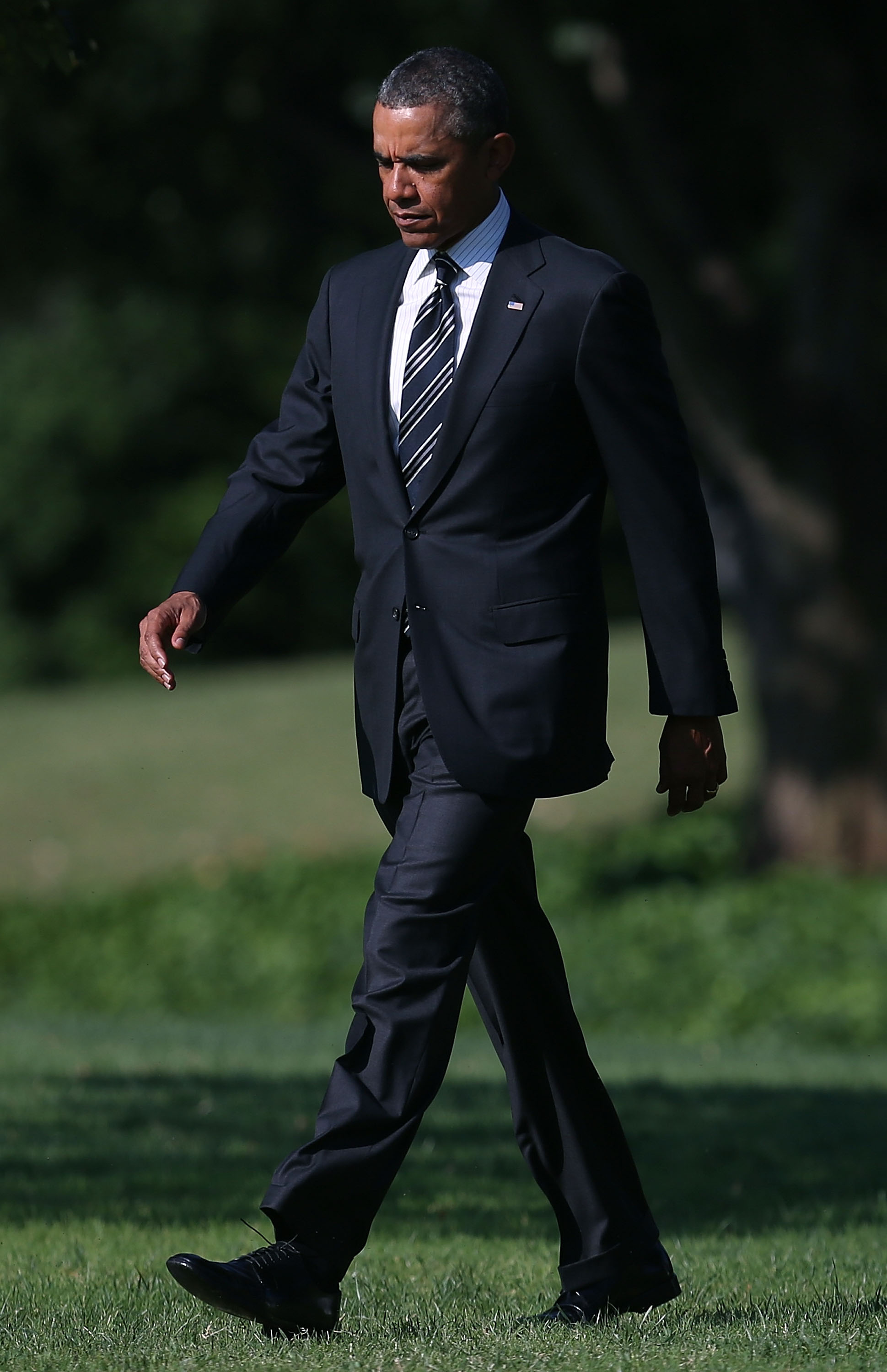
President Obama Departs The White House

This morning, I finally watched the visual evidence of the Assad regime’s chemical attack on hundreds of children. There is a reason, these awful videos prove, behind our fear of these kinds of weapons, even if they follow over 100,000 far bloodier deaths. They kill silently in the dark. Heavier than air, poison gas can sink into the basements and cellars civilians use for protection during wartime. The crippling efficacy of such weapons, once used to propel the mass extermination of European Jews, should draw us all short. It is not that the victims of chemical attacks are any more dead or crippled than the 120,000 or so other victims of the sectarian bloodbath in Syria. It is that the use of such weapons signals that the regime is now prepared to use this final trump card, if it suits its purposes. The Alawites have always had the power to kill their sectarian foes (Hafez al Assad committed a mass murder of 10,000 civilians); but now we know they also have the will to use the most silently lethal chemicals at their disposal. There’s a reason so many millions are now fleeing. The prospect of a sectarian Holocaust from the skies is no longer a dystopian illusion. It is an historical fact.

This makes Obama’s shift explicable, whatever the debating points scored at various junctures in the Syria debate in the last few years. I don’t buy the criticism that he should have intervened much earlier in Syria (there would have been zero public support); and the principle of forbidding chemical weapons use against civilians and rebel fighters is a vital one for the future of civilization. To do or say nothing now would have given Assad a green light to exterminate more people without any cost. So the core question really emerges: what would doing something look like?

Obama has proposed doing something and nothing at the same time. And, sure, a military strike on Syria will exact a cost for Assad for his sectarian extermination program. But it is highly unlikely to bring him down or, unless I am mistaken about the situation on the ground, shift the course of the war. After the dust settles, a US strike may even give Assad more lee-way to use his poison gases against his foes, and enable him to portray himself as a victim of Western intervention. If he got away with it once, and gained ground in the war, why not again and again? And what then?

The McCain faction is obviously right about one thing: the only option that would ensure Assad’s ouster would be a full scale war and invasion conducted by some kind of alliance between the US and the rebel groups. And they are obviously wrong, it seems to me, on one thing as well: there is no way on earth that this country or its armed forces should jump into such a brutal, sectarian vortex of violence, with only the goal of deposing a dictator. Have we learned nothing from Iraq? Our core interests are not affected by the result of the Syrian civil war, and we have simply no assurance that the replacement for Assad would be less monstrous than he is. If our concern is the security of chemical weapons stockpiles – and Syria has the third most in the world – then it seems to me that our cold interests actually lie with Assad’s victory. At this point, his faltering regime is more stable than the opposition and less allied with Sunni Jihadists.

But here, it seems to me, is where we should stop, and demand more clarity and transparency from the president. The Congressional debate – in my view, a constitutionally indispensable procedure – is a great opportunity for this. We all get the gravity of chemical weapons use – and Kerry can stop embarrassing himself by calling his former dining companion another Hitler. What we don’t yet fully know is what the Obama administration has already been doing in Syria and what it hopes specifically to achieve now – by militarily joining one side in Syria’s sectarian meltdown.

I want, first up, a better explanation for this quantum leap in the use of chemical weapons by Assad. My impression is that he was winning this brutal war slowly. Why play your trump card then – with all the risks associated with it? More to the point, why do it when UN inspectors are close by? Yes, Assad is evil – but he has long been that and the Ghouta mass murder has scrambled the situation in ways that indicate reckless, even desperate, stake-raising. So, first up, what I’d want first of all is a clear statement that the US has not been engaged in a covert war in Syria that might in any way have prompted this horror. I would like a clear, emphatic and truthful refutation of the reporting in Le Figaro that implies that a new anti-Assad offensive was launched at the start of last month, as part of a covert war, headed up by the US’s covert war machine. Is this paranoid? Maybe. But I remember Iraq and, forgive me, I have learned the value of deep skepticism about various US administrations’ accounts of reality.

Second, I want a clear explanation of what the goals are of this proposed strike.

If it is merely a symbolic act, then we should understand that we are risking American lives, money and values for moral optics, with no clear goal. If it is an attempt to shift the direction of the civil war, then we should know how the US attempts to win this sectarian struggle in the Middle East, when it could not impose sectarian peace in a country it occupied with over 100,000 troops for a decade (and where the sectarian murderousness endures and thrives). If we “win”, are we sure this isn’t just another move in an eternal cycle of sectarian vengeance? Look at Libya – the other place Obama decided to intervene. Obama’s reward? The attack on the Benghazi CIA facility and a fractured non-state that has allowed al Qaeda to regroup in north Africa. You can more easily see how a rebel victory on Syria could turn into a worse nightmare. If Jihadist nutcases end up in control of the third largest chemical weapons stockpile in the world, the first step toward that result would be this war against Assad.

I’m not denying the moral atrocity. I’m not denying the gravity of this breach of international norms. But military intervention in Syria? For me, the administration hasn’t even begin to present a coherent, let alone a persuasive argument. The congressional debate is absolutely the best forum for this debate to take place – just as the House of Commons was in Britain. If the Congress votes no – which, given the current arguments, it obviously should – then the president should accede to the wishes of the American people as voiced by their representatives. If he were to do that, the kind of transformation Obama promised in America’s foreign policy would be given a huge boost. This would be a president who brought Congress back into the key decisions of war and peace as the ultimate authority on them, as the Founders intended. It would be seen by history as the first key step away from the imperial presidency and the beginning of democratic accountability for the permanent war machine.

This could, in other words, be the dawn of a new, realist and constitutional age. Or the final death-throes of an empire that won’t quit until it bankrupts us both fiscally and morally. That’s why next week’s debate is so critical. And why Obama can still come out ahead on this, even as the conventional Washington wisdom will surely be all about his humiliation in a zero-sum narrative whose attention span is the next five minutes. If he defers to Congress on a new war in the Middle East, we are definitively in a new era.

It’s called 21st Century democracy. And not a minute too soon.

(Photo by Mark Wilson/Getty Images)

When Speaking Is Revealing

Alan Jacobs relays what he learned from reading aloud an essay he was working on:

As I was reading, as my mind was processing words and sending them along to my lips and larynx, a word pricked my conscience; I scanned my word-hoard for alternatives, and managed to retrieve one, to my relief. But it’s not always so easy. A few minutes later in the same lecture I came across a whole phrase that, even as it was about to emerge into the public air for the first time, was revealed to me as fundamentally uncharitable — but because it was a whole phrase I did not have time to construct an alternative. I was therefore forced to utter words even as I was renouncing them, to be convicted out of my own mouth of a lack of generosity. I was made to own, by speaking them, words I wished I had not written.

His broader point about the ethics of writing:

[M]any have been my idle words over the years. I wonder how much harm they have done to others, and even to me. I did not publish my first book until I was nearly 40, and while I used to regret that late start, I now am thankful that I didn’t get the chance earlier in life to pour forth yet more sentences to spend my latter years regretting.

A handful of times over the years I have drafted essays only to realize, before submitting them, that I did not want to say what I had written there; and a few other times I have had cause to thank editors for rejecting pieces that, had they been published, would have brought me embarrassment later.

In some cases the embarrassment would have been because of arguments badly made or paragraphs awkwardly formed; but in others because of a simple lack of charity or grace. An essay begins with an idea, but an idea begins with a certain orientation of the mind and will — with a mood, if you please. We have only the ideas that our mood of the moment prepares us to have, and while our moods may be connected to the truth of things, they are normally connected only to some truths, some highly partial facet of reality. Out of that mood we think; out of those thoughts we write. And it may be that only in speaking those thoughts do we discern the mood from which they arose. “Out of the abundance of the heart the mouth speaks” — a terrifying judgment, when you think of it.

Who’s Got Talent?

Grammy-winning violinist Joshua Bell plays in the DC Metro:

Meg Wolitzer draws a distinction between talent and success:

Soon the 1980s morphed into the 1990s, and somewhere along the way God gave us the internet, which promised to connect previously undiscovered talent with the world at large. Sure, there are the occasional phenomena, those YouTube sensations who burst out of nowhere and reach millions of viewers, or who gather “hits” – an appropriate word, since the image of a hand lazily slapping at a keyboard seems a good way to describe how we choose our cultural intake. But the problem with the rise of internet culture, along with the 24-hour news cycle, is that the furnace constantly needed to be stoked. There had to be a constant stream of people, faces, personalities standing by to fill up all that time. And so individuals who ordinarily wouldn’t have been in the public eye were suddenly drafted for the job. “Celebrity chef”, “brilliant hairstylist”, the terminology reflecting an aching wish, or need, for widespread specialness – acknowledged, of course, by fame. Even at home, my kids would demand, “Mom, can you make your famous mac and cheese?” How easy then to become a star, an expert, a source of acclaim. Everyone had talent.

In fact, though, very few actually do. …

It’s not talent that’s brought to the fore most often these days, but success. Whether it’s Joshua Bell playing masterfully to a swirl of indifferent commuters, or a brilliant film that gets a bad review and barely makes a dent in anyone’s consciousness, talent in its pure, beautiful form can be overlooked or misunderstood. Meanwhile, success – which by nature is bottomless, fathomless, and therefore keeps even successful people constantly on the hunt for it – keeps getting the attention. The two continue to be spoken of interchangeably, when in truth the first is the real deal, and the latter is simply the fairy dust that sometimes gets sprinkled on the real deal, and other times gets puzzlingly sprinkled on the mediocre, or the fraudulent, or the happened-to-be-there-at-the-right-time.

Platitudes Aplenty

“There are too many standard formulations in our language,” writes Teju Cole. “They stand in place of thought, but we proclaim them each time—due to laziness, prejudice, or hypocrisy—as though they were fresh insight”:

Flaubert’s “Dictionary [of Received Ideas]” inspired me to try something similar, over the course of a few hours, on Twitter. I think, also, there was the influence of Ambrose Bierce and his cynical “Devil’s Dictionary,” Samuel Johnson’s mostly serious but occasionally coruscating “Dictionary of the English Language,” and Gelett Burgess’s now-forgotten send-up of platitudes, “Are You a Bromide?” What the entries in these books have in common, in addition to compression and wit, is an intolerance of stupidity. As I wrote my modern cognates, I was struck at how close some of them came to the uninterrogated platitudes in my own head. Stupidity stalks us all.

Many more tweets from Cole:

When Children Weren’t Cherished

Alex Mayyasi leafs through Viviana Zelizer’s Pricing the Priceless Child:

Zelizer writes that in 18th century Europe, “the death of an infant or a young child was a minor event, met with a mixture of indifference and resignation.” She quotes a French philosopher of the time who wrote, “I have lost two or three children in infancy, not without regret, but without great sorrow.”

Historians find, for example, no evidence during the period that the English wore or displayed symbols of mourning when young children died and that the French commonly buried young children in the backyard like Americans bury pets today. Colonial Americans called newborns “it” or “the little stranger.” While the death of young children was greeted with sorrow, the next born child often took the name of its departed sibling.

Today that seems shocking, and Zelizer shows how reverence for young life developed in the 1800s. The deaths of young children became a great tragedy, inspiring memorials for young victims, movements focused on child mortality and health, and literature for parents on how to cope with the unbearable loss of a young child. Attitudes reflected this as childhood became the coddled, special time that we consider it today.

Deaf Architecture

Gallaudet University’s new dorm was designed according to the principles of the DeafSpace Project, “an initiative that sought to develop architectural guidelines to improve how deaf people interact with their built surroundings”:

The tiny design details that are the mark of DeafSpace begin with the building’s entrance. As students near the building, a set of clear glass paneled doors slide open, allowing people to continue their conversation uninterrupted. Most students who attend Gallaudet communicate through ASL [American Sign Language], meaning they need space, and most importantly, eye contact to communicate efficiently. For the hearing impaired, a door that requires the physical act of opening and closing is akin to a booming announcement over intercom speakers for a hearing person—anything that stops students in their tracks or interrupts the flow of conversation is a bad thing. Which is why every detail–from the topography of the floor-plan to the colors on the wall–are taken into consideration with DeafSpace.

[Architect David] Lewis points out that the ground floor’s community room has a subtle amphitheater-like slope that when viewed through the wall of windows, is clearly in line with the natural incline of the campus’ landscape. “Someone walking on the sidewalk on the outside is actually parallel to someone walking on the inside and can communicate across that glass through sign language in a way that literally makes the building transparent,” he explains.

Another building on campus is featured in the above video and it follows many of the same principles as the new dorm. Update from a reader:

I was surprised to see that the video didn’t contain any subtitles to ensure that the Gallaudet community could actually understand what was being said about their campus and their culture.

And I was amused that the camera person often seemed to zoom in on the person’s hands, perhaps thinking they were signing (when in fact it was just hearing person gesturing). Ironic videography and disappointing to see, in both cases. Perhaps it was the case that the video was not made or intended for deaf or hard of hearing people, which leads me to my central question of why do you think our non-film American media culture has not yet fully recognized the need for or embraced the addition of subtitles (even as an option) to their videos in order to ensure equal access of information to those who are hard of hearing or cannot hear?

I recently started dating a deaf person and very rarely think about her as being deaf except for when I watch online videos. Watching online videos, especially ones that I want to share with Katie, remind me that I have unlimited access to anything auditory, whereas most of the information in auditory videos is not directly accessible to deaf or hard of hearing people. Netflix seems to do wonders with its option for subtitles; Katie and I have indulged in watching Orange is the New Black together :o)

Another reader adds:

Out here on the West Coast, your post on “deaf architecture” has an analogy in Berkeley’s Ed Roberts Campus, designed by Leddy Maytum Stacy Architects and completed a few years ago as the headquarters for a consortium of disability right and service organizations.  The interior is organized around a spiral ramp that gives those who can’t climb stairs the primacy in moving through the building, and the rest of the structure – from bathroom design, to decor – stresses universal accessibility and usefulness.

Previous Dish on Gallaudet and deaf culture here.

Obama Asks Congress For A New War: Reax

by Patrick Appel

Obama’s Saturday speech declaring his intention to attack Syria and to request Congressional approval beforehand:

Amy Davidson applauds Obama’s decision to get Congress’s input before attacking Syria:

This may be the first sensible step that Obama has taken in the Syrian crisis, and may prove to be one of the better ones of his Presidency—even if he loses the vote, as could happen. Politically, he may have just saved his second term from being consumed by Benghazi-like recriminations and spared himself Congressional mendacity about what they all might have done.

Fallows is also happy that Congress will get its say:

This is the kind of deliberation, and deliberateness, plus finding ways to get out of a (self-created) corner, that has characterized the best of his decisions. It is a very welcome change, and surprise, from what leaks had implied over the past two weeks.

Larison hopes that Congress will vote against using force:

Presumably, Obama is gambling that he can cow Congress into granting authorization by having publicly committed the U.S. to military action. When presidents have gone to Congress to seek this kind of authorization, they have typically received it and usually by a large margin. I am cautiously hopeful that there are enough members in the House at least that know how deeply unpopular war with Syria is that this will not be the case this time, but I fear that few Democrats will be willing to vote against the White House and too many Republicans will be only too happy to vote yes. If members of Congress judge the proposed attack in terms of U.S. interests or international law, they should definitely reject it. If they judge it in terms of bogus “credibility” arguments or an obsession with wounding Iran, I am less sure that most of them will vote no.

Barro believes that the House might reject Obama’s request for intervention:

Democrats: In the current political environment, they have little reason to think voting against an attack will make them look “soft on terror,” which is what they were most afraid of during the Iraq authorization vote 10 years ago. But they have good reason to fear the Hillary example: voting yes could cost them a primary election if things go wrong.

Republicans: War hawks are a far weaker force in GOP politics than they were 10 years ago. You don’t have to be Ron Paul to defend a skeptical position on intervention anymore. And it’s not that hard to make a case to a Republican primary electorate for why you opposed one of Barack Obama’s initiatives.

Julia Ioffe notes that Obama isn’t rushing the vote:

Obama has clearly learned something from Cameron’s blunder: he’s not rushing this thing. Cameron was dealing with an incomplete Parliament, as some MPs just didn’t bother to come back for the vote. He didn’t spend the time laying out his case, lobbying and whipping the vote in to shape. Obama, by contrast, is not summoning Congress back early. He’s scheduled a second briefing with lawmakers, and there have been reports that he is already personally lobbying the people in his party, like Carl Levin, who have been skeptical of intervention in Syria.

Fisher worries about the delay:

The U.S. Congress is not known for its speed with urgent issues – particularly ones that come during their vacation. It is also not an institution known for compromise or cooperation on issues that are, like this one, daunting, difficult and that have few political upsides. Whether or not you think that off-shore strikes are a good idea, this adds more delays and uncertainty after a week of both. It increases the likelihood, probably already significant, that the Assad regime will see the international community as unable or unwilling to hold him accountable. If strikes are likely to happen anyway, the uncertainty is not good for Syria. And if they don’t happen, Syria would have likely been better off if the U.S. had never signaled otherwise in the first place.

David Rothkopf has similar fears:

If the administration persuades Congress to support military action, it will be seen as a victory for the president, to be sure. But it may also have given the Assad regime another two or three weeks to redeploy assets and hunker down — so that the kind of limited attack currently envisioned has even more limited consequences.

Jack Goldsmith differs:

I am still unconvinced that military action in Syria is a good idea.  And there will be those who complain that the President’s request to Congress harms presidential power, or hurts our tactical position vis a vis Syria (because of the delay, etc.), or reflects poor planning, and the like.

The President is indeed still in a pickle.  But in light of the constitutional questions, the lack of obvious support in the nation and Congress, and the risks of sparking a broader conflict in the Middle East, and for the other reasons I stated in my post last week, it would have been terrible for the President and the nation if he had engaged in strikes in Syria without seeking congressional approval.

Michael Scherer and Zeke Miller report that Obama may ignore Congress’s decision:

Obama’s aides made clear that the President’s search for affirmation from Congress would not be binding. He might still attack Syria even if Congress issues a rejection.

Greenwald pounces:

It’s certainly preferable to have the president seek Congressional approval than not seek it before involving the US in yet another Middle East war of choice, but that’s only true if the vote is deemed to be something more than an empty, symbolic ritual. To declare ahead of time that the debate the President has invited and the Congressional vote he sought are nothing more than non-binding gestures – they will matter only if the outcome is what the President wants it to be – is to display a fairly strong contempt for both democracy and the Constitution.

Drum doubts that Obama would defy the will of Congress:

As for whether or not Obama will go ahead with an attack even if Congress rejects it, I can hardly imagine he would. Am I wrong about that? Is there even the slightest chance he’d go ahead even if Congress votes against it?

Judis is concerned about Congress voting against action:

If he loses, and unlike Cameron, goes ahead anyway, he will increase his troubles at home. Cries of imperial presidency will be heard. But equally important, the military action he undertakes will have less intentional force behind it. One reason why a military strike could deter Syria’s Bashar al Assad from further use of chemical weapons, and perhaps even contribute to a negotiated settlement, is that Assad would have to fear that if he were to escalate in response to the American action, the United States would escalate in kind. But if Obama appears embattled at home, and barely able to act, that threat will not be as credible, and the American action may be less likely to accomplish its objective of deterring Assad.

And Bruce Riedel feels that the “President’s decision to ask for a Congressional mandate should also serve as a precedent for any decision to use force against Iran to halt its nuclear weapons project”:

A war with Iran would be vastly more dangerous and costly than one with Syria, even if both are intended to be limited. Wars always have unintended consequences. If time permits, the people’s representatives should be part of the decision to take on the risks of action. President George H.W. Bush did that before the liberation of Kuwait. As a senior intelligence officer, I spent days explaining the CIA’s estimates of the risks to the Congress. The process sharpened our analysis. There are no good options in Syria. Sliding into the conflict by baby steps and partial measures is the worst approach. Even worse would be to do so without a national debate and Congressional action.

The Sloppiness Of Studying The Self

by Matt Sitman

In a lengthy critique of psychologist Barbara Fredricksen’s Positivity – including news that a recent study found serious problems with the math underlying her work – Will Wilkinson hones in on a perennial problem with happiness research:

[M]ost work in the psychological and social sciences suffers from a lack of conceptual rigor. It’s a bit sloppy around the edges, and in the middle, too. For example, “happiness research” is a booming field, but the titans of the subdiscipline disagree sharply about what happiness actually is. No experiment or regression will settle it. It’s a philosophical question. Nevertheless, they work like the dickens to measure it, whatever it is—life satisfaction, “flourishing,” pleasure minus pain—and to correlate it to other, more easily quantified things with as much statistical rigor as deemed necessary to appear authoritative. It’s as if the precision of the statistical analysis is supposed somehow to compensate for, or help us forget, the imprecision of thought at the foundation of the enterprise.

It’s interesting that Fredrickson in Positivity avoids the term “happiness,” because she feels “it’s murky and overused.” One may say the same of “positivity.” There is definitely murk. According to Fredrickson, the constituents of positivity are joy, gratitude, serenity, interest, hope, pride, amusement, inspiration, awe, and love. But why these emotions? Why not others? As an inventory of positivity, this seems arbitrary.

Tania Lombrozo responds by defending the messiness of psychological research:

There’s a natural back and forth: we think about things a particular way, which motivates experiments, which in turn provide data, which leads us to refine and revise the way we conceptualize phenomena and theoretical entities. This dance between theory and experimentation is common to all science.

In the case of psychology, it is a particularly young field. It’s early days for the empirical study of many core psychological phenomena, including happiness.

So I agree with Wilkinson that psychological theorizing is often imprecise, and I share a craving for conceptual rigor. But some conceptual sloppiness may simply be a sign of immaturity, of psychology’s adolescent state. It’s an unavoidable step in achieving scientific progress, not the mark of a failed or floundering science.

Previous Dish on Fredrickson’s work here and here.

Beauty In Physics

by Jessie Roberts

dish_covariance1

Particle physicist Ben Still collaborated with artist Lyndall Phelps on Covariance, the installation for the Superposition project seen above:

The pair were introduced by the Institute [of Physics] and given the brief of creating a physics installation for public display. Rather than focusing on one particular area of physics, they decided instead to look at the machines that make the science happen — particle physics detectors.

“These [are] massive machines used to see the smallest bits of nature,” Still tells Wired.co.uk. The installation aims to show the way in which the detectors build up a picture of how these tiny particles interact with each other on a larger scale, as well as reflecting the way the electronic data collected by the detectors is then used to create plots on computers. …

“I showed [Phelps] some of the plots I was making for an analysis I was developing and again she was quite struck by how we took data from this massive machine and made these colourful plots to try and extract information,” [says Still]. The colour running through the installation, says Still represents “the way in which the data is presented finally”.

Here’s a close-up of the work, which consists of 28,000 glass beads arranged into 20 different designs:

dish_covariance2

Covariance is on display in the former ice wells of London’s Canal Museum through October 20th.

(Photos by Richard Davies, whose most recent photography and book project is Wooden Churches)

Visiting Your Favorite Film

by Brendan James

Troy Patterson studies what keeps us coming back to amusement parks, after “a record-setting year for the business”:

Projection is what the amusement park is all about—the projection of eager ideas of innocent fun, of nostalgia for things that haven’t even happened yet, of vomit on the X2 at Magic Mountain. The latest and last word in amusement-park projection concerns our disappearance into virtual reality by way of film—meaning, for one thing, the continued trend toward attractions such as Transformers: The Ride 3D at Universal Studios.

Enthusiasts are already anticipating what 2014 will bring, naturally enough, ardent anticipation being among the defining qualities of the amusement-park experience: In Florida, Hogwarts wannabes will thrill to the expansion of The Wizarding World of Harry Potter. In Italy, Cinecitta World will open on the grounds of the venerable movie studio, a development that has some cineastes up in arms but is okay with me so long as they include an Anita Ekberg water slide.

There is a difference in kind between the straightforward pop-entertainment experiences pioneered by Disneyland and those exemplified by Transformers: The Ride (the purpose of which is “blurring the line between fiction and reality”). If we may take a brief ride of the Jean Baudrillard Reverse Bungee, we may theorize that while the old Disneyland model of escapism involves a flight from adult reality into its infantile simulacrum, the new line-blurring Transformers-style escapism represents the next generation of the ethos of Walt Disney Worldand EPCOT Center, with their designs on reshaping reality.