Another War Is Brewing

by Patrick Appel

Only 9% of the American people want to go to war with Syria. Even when chemical weapons are mentioned, a growing plurality is against intervention:
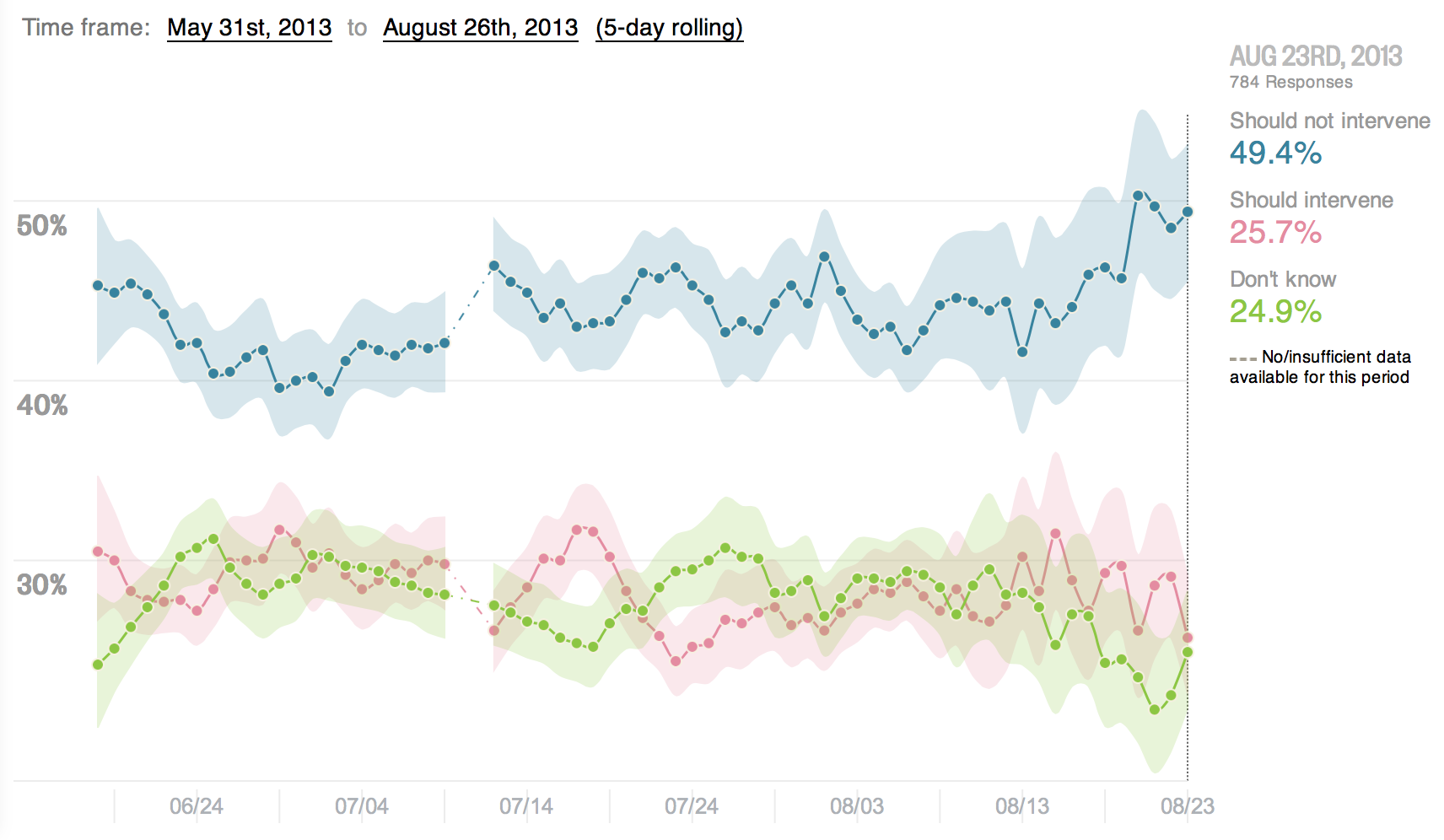
Syria Intervention

But First Read believes that the US will use force:

All the action and body language over the weekend suggests that the United States is preparing for some kind of military response to the suspected chemical weapons attack in Syria. The question is: Just what kind of response will it be? On Saturday, President Obama met with his national security team, and he called British Prime Minister David Cameron. “The two leaders expressed their grave concern about the reported use of chemical weapons by the Syrian regime… The United States and UK stand united in our opposition to the use of chemical weapons,” the White House said per a readout of the call. And on Sunday, the president spoke with French President Hollande. (These are the types of calls a president makes to both build support and inform of upcoming plans. Also of note, Secretary of State John Kerry spent the weekend briefing and speaking with a slew of Arab allies, particular the folks in the Gulf States, who could drive an Arab League decision that gives the U.S. the international legal justification it is currently looking for.) Indeed, as NBC’s Andrea Mitchell reported on “TODAY,” the United States and its allies are considering military options — most likely, cruise missiles from Navy destroyers and submarines in the Mediterranean or U.S. fighter jets targeting Syrian airfields from where chemical attacks could be launched. “I do think action is going to occur,” Sen. Bob Corker (R-TN) said on “TODAY.” The question no longer seems to be “if”; rather, it’s “when,” “how,” and “how long.”

War is the one area where the normal rules of politics are suspended. A president need not convince the American people or Congress that war is advisable. He need not explain the costs and benefits of force. Popular domestic policy proposals are routinely killed thanks to the fillibuster or the House’s ideological fanaticism, but deeply unpopular foreign policy interventions are carried out without haste. Mark Thompson notes how Congress avoids debate over going to war:

The last war Congress declared was World War II. Everything since — Korea, Vietnam, Grenada, Panama, Iraq, Bosnia, Afghanistan, Iraq (again!) and Libya — has been fought with something less than a full-throated declaration of war by the U.S. Congress.

Generally speaking, the President likes this, since he doesn’t have to convince Congress of the wisdom of his war, and Congress likes it even more. Under the current system, lawmakers get to wink at the White House by passing an authorization for the use of military force or other purported justification as a fig leaf they can abandon if things go sour. A declaration of war demands more, and Congress is leery of going on the record with such declarations for its own political reasons.

Hawkishness is Washington’s default setting – it remains one stubborn bit of bipartisan agreement in an era of deepening partisanship. But the disconnect between Washington’s foreign policy consensus and the nation’s has grown larger in the wake of Iraq and Afghanistan. If bombing Syria devolves into a quagmire or it draws us into a war with Iran, the backlash could erase the gains the Democrats made on foreign policy by belatedly coming out against the Iraq War. Obama risks starting one of those “dumb wars” he so famously railed against. Crowley argues that Obama can accomplish his goals through “limited strikes on a handful of military targets, probably by means of cruise missiles that involve no risk to U.S. personnel.”:

The goal would be to impose a cost on Assad that outweighs whatever he thinks he gained by gassing hundreds of people near Damascus last week, as he is accused of doing. In doing so, Obama could hope to deter Assad from using his chemical arsenal again. And to demonstrate to the rest of the world, and especially to Iran, that he means what he says. Anyone hoping for more will likely be disappointed.

Larison fears that, if such measures fail to prevent further chemical weapons use, that “the U.S. will be pressured to continue escalating its involvement until the Syrian government is overthrown”:

After the regime is defeated, Syria’s chemical weapons arsenal will no longer be secure, and these weapons will go to whichever group can seize or buy them first, and it is even less likely that these groups will respect the taboo against their use.

Syrian blogger Maysaloon wants a Kosovo-like intervention:

The Kosovo model for intervention is not perfect, but it stopped the bloodshed and today Kosovo is limping along and people are rebuilding their lives at least. Of course it is still not a recognised state thanks to Russia blocking its recognition, but the important thing is that militias are not slaughtering whole families and villages. The same thing needs to happen in Syria and the country must be given as much support as possible to get back on its own two feet. This is not because Syrians need the world’s charity, but because if that does not happen then Syria will become a Somalia on the Mediterranean and bordering Europe. It is in the world’s interest to stop this wound from festering, and it is in Syria’s neighbour’s interests – all of them – that this country not implode. Because when it implodes all of Assad’s toys are going to end up in the wrong hands, however “careful” the West is and however pervasive Israel’s intelligence tries to be. A poisoned atmosphere and water table is not something anybody in the region can afford. Syria is a big puddle that can splash a lot of people, Assad knows this and he has been using this to stay in power, but it does not mean he cannot be toppled.

Fred Kaplan also compares Syria to Kosovo:

Given the threat, the humanitarian crisis, America’s standing in the region, and the importance of preserving international norms against the use of weapons of mass destruction, the best option might be to destroy huge chunks of the Syrian military, throw Assad’s regime off balance, and let those on the ground settle the aftermath. Maybe this would finally compel Assad to negotiate seriously; maybe it would compel the Russians to backpedal on their support (as NATO’s campaign in Kosovo compelled them to soften their support for Milosevic). Or maybe it would just sire chaos and violence. But there’s plenty of both now, and there might be less—a road to some sort of settlement might be easier to plow—if Assad were severely weakened or no longer around.

Tomasky worries that strikes against Syria could lead to war with Iran:

[T]here are reasons to act. But there’s one massive difference between Kosovo and Syria. Milosevic didn’t have a major regional power watching his back. Syria does. Iran complicates this immeasurably. Also over the weekend, the Iranian armed forces’ deputy chief of staff said the following: “If the United States crosses this red line [of intervention], there will be harsh consequences for the White House.” And this: “The terrorist war underway in Syria was planned by the United States and reactionary countries in the region against the resistance front (against Israel). Despite this, the government and people of Syria have achieved huge successes. Those who add fire to the oil will not escape the vengeance of the people.” Getting sucked into a situation that could lead to war with Iran is unthinkable. Of all the bad options, that is without question the most bad.

Walter Russell Mead wishes we had struck sooner:

Unfortunately, the policy of delay has made all the options worse without, it now appears, succeeding in keeping the US out of war. Instead of the choice we had at one time between American intervention and a humanitarian disaster, we now have American intervention AND a humanitarian nightmare, with a revival of a serious Al Qaeda presence in the heart of the Middle East thrown in for good measure.

And W. James Antle III is against a new war:

The only lesson Obama seems to have learned from Iraq is that large, expensive military occupations with American casualties are politically unpopular. The long-term, unintended consequences of regime change and the question of whether we are arming people today who will shoot us tomorrow do not seem to have left much of an impression.

Egypt’s Copts In The Crossfire

by Brendan James

EGYPT-POLITICS-UNREST-CHRISTIAN

McArdle suggests Western nations give Egypt’s Christians asylum as the country descends further into paranoid violence:

The U.S., along with other nations, should offer greater sanctuary to the Copts, who are clearly at risk as this drama plays out. This animus toward the large Coptic minority is not new — a friend whose grandfather was a prominent Coptic cleric once told me that his grandfather was used to spending time in jail because Hosni Mubarak would lock up some notable Copts every time he sensed the Muslim majority was getting restless. But this seems to be one of the worst spates of church-burning in Egypt since the Middle Ages. There’s a real risk that the widespread attacks on the Copts’ buildings will progress to widespread attacks on their people.

The Economist echoes her concern:

The virulence of the latest campaign stems from a perception among many Islamists, but particularly followers of the puritan Salafist school, that Christians helped orchestrate the July 3rd coup that toppled Muhammad Morsi. During the Brotherhood’s ill-fated sit-in, non-stop sermons frequently alleged Christian complicity in a global anti-Muslim plot. Salafist television stations have repeated claims of arms being stashed in churches.

Waguih al-Shimi, a former member of parliament for Nazla from the Salafist al-Nour party, says that while he disapproves of targeting Christians he understands what motivates their persecutors. Many Muslims, he says, were angered when the Coptic pope, Tawadros II, appeared next to Egypt’s defence minister as he announced the army coup. Salafist websites, according to Mr Shimi, have featured photographs showing soldiers raising the cross in triumph after shooting Islamist protesters. “Considering what has happened to Muslims,” says Mr Shimi, “we can thank God it was only Christian property, not people, that got hurt.”

More recent Dish on the plight of Egypt’s Copt minority here.

(Photo: A picture taken on August 18, 2013 shows a burnt icon in the Amir Tadros coptic Church in Minya, some 250 kms south of Cairo, which was set ablaze on August 14, 2013. By Virginie Nguyen Hoang/AFP/Getty Images)

Why Do Chinese Tourists Have Such A Bad Rep? Ctd

by Chris Bodenner

Some pushback on the thread:

Your reader’s story about the flight to Adelaide was completely underwhelming. Who hasn’t seen oldish folks, of many nationalities, out of their element on airplanes and at airports? How would your reader like it if their first experience with air travel occurred when they were 50, and was conducted in a language they had no understanding of? A bus load of camera clicking tourists is a pain no matter where they’re from. Yes, the Chinese, being new to travel, may be a little worse, but it’s no different than the standards of behavior they follow in their own country. They’ll get better as they gain experience of the wider world. But all this bashing is unseemly and a tad bit offensive. Get a grip people, and try to be a little understanding. Chinese standards of personal space are different from Americans’. If you’ve ever been to Beijing rail station, you know this.

See above. Coincidentally, I had set aside that video a few months ago because it was so striking, not knowing if we could ever use it for a post … but wait long enough and a Dish reader will bring up any obscure, interesting point. Another writes:

The story about the Adelaide trip left a really bad taste in my mouth, because it exhibits exactly the sort of empathetic closure that often underscores unconsciously racist attitudes.  First off, full disclosure – I’m ethnically Chinese, but I’m not from the PRC, and as you might have surmised by now, I’m a native writer/speaker of English. And I do agree with many of the comments about Chinese tourists, especially if they are in tour groups. I ought to know; my native country is a favourite tourist and immigration destination for Chinese nationals. In London, if I see a cluster of Chinese tourists coming down the road, I head for the pedestrian crossings.

In the Lake District, I would immediately take another path. In fact I am often angrier at them even than my white friends, because I am caught in a double bind – just as I would avoid those tourists, I am myself faced with suspicion when I go around Britain, despite being perfectly conversant in English. The flip side of “Chinese tourists having a bad reputation”, it turns out, is that a tourist can be guilty of nothing more than being or looking Chinese.

But I digress. That supposedly amusing story sent in by your reader, about the parents visiting their child in Adelaide and getting things all mixed up, is a very different situation from those group tourists who have not learned, or do not care, to respect the culture they happen to have travelled to. The reader himself indicates that when he says at the end that this was probably the first time that couple has been outside China; yet he does not consider the implications of that.

In a country where vast swathes of the population are still quite poor, and where simultaneously the rich generally have no compunction about showing off their wealth by jetting about, it is very clear to me which group the clueless couple belong to. If they have not been overseas before, and yet have a son who is studying in Adelaide, consider the efforts they must have made for their child to make it there. The skill of knowing airports, air travel and customs work, or to know how to navigate unfamiliar terrain, is not a skill these two hapless people chose not to learn despite having disposable income to fling on overseas trips; it was a sacrifice they made so they could now visit their kid who made good in Adelaide. Your reader, who claims to know a lot about East Asian cultures, curiously seems to have completely missed this point about filial piety and parental love.

Do we really expect, in the context of the previous post about the lack of a guidebook culture, or the general lack of cross-cultural knowledge, that a middle-aged Chinese couple – a middle aged couple from anywhere – would have known perfectly how to get about and handle themselves in a foreign country, after a long flight, when they know no one (and their son had yet to arrive) and do not speak the language? That is in no way amusing. Comedy works best when it kicks upwards – against rude, privileged Chinese tourists who defecate in heritage sites and talk at full volume all the time. I’m completely fine with mocking those people. But to kick downwards as your reader does, from their privileged position (since they “get around” and have ample opportunity to be irritated by Chinese travellers), is not amusing at all.

For some reason I suspect that if that Chinese couple spoke the same language as your reader, or were visibly from the same culture, then they might have been better disposed to them, or to consider them for what they are, ie. clueless and uninformed from inexperienced, as one might be expected to be – rather than judging them simply by what they do or look like, ie. ridiculous and worthy of mockery. Clearly, if the reader has seen fit to post this “amusing incident” even after knowing the facts about the Chinese couple’s situation, I’m not sure such empathy is much in evidence.

On a semi-related point, given the long-standing awareness of how the Chinese tourist market is large and continuously growing, I have to wonder why it seems abnormal that the Chinese tourists could not speak English, but very normal that none of the flight crew know how to speak Chinese. In the ’80s and ’90s, certainly, there was no shortage of enthusiasm about putting up signs in Japanese for the benefit of similarly English-challenged tourists. Admittedly, Japanese tourists are generally better behaved than the Chinese; but I don’t remember that snobbery is a key tenet of capitalism (or democracy, or indeed any universal conception of social forms or rights). Once again, I know the complaints, and I agree with them; but just as English speakers mock the French for their arrogance and refusal to budge on their Frenchness, how is it not sheer arrogance to mock the Chinese without making any effort to come closer to their culture and language, if only to tell them to speak a little more softly?

Thank you for your attention, and I do apologise for this rant.

“Ye Are All One In Christ Jesus” Ctd

by Chris Bodenner

A knowledgeable reader of the Bible counters the conservative Christian trying to argue away the existence of trans people:

Moore’s deflection about epistemology vs. ontology is disingenuous; the trans question is inherently epidemiological. This isn’t about whether “man” and “woman” exist, but how you categorize someone as man or woman. Do you use genitals, genetics, brain structure (which science is finding is also sexed)? And what do you do with ambiguous characteristics? And people with both male and female characteristics?

What science is finding is that brain structure is the strongest, most resilient marker of sex. That makes sense, when you think about it. A man who loses his penis and testes doesn’t become a woman. A woman who has a mastectomy and hysterectomy doesn’t become a man. And people with ambiguous bodily characteristics still have brain structures that correlate with other men and women, and identify as such. The conclusion is that the strongest way to categorize a person’s sex is through neural analysis. Or, conversely, simply ask them what their sex is. That’s what trans activism is about. Medical transition, anti-discrimination laws – all that is aimed at correcting cases where sex was wrongly categorized. This isn’t “changing” someone’s sex, it’s confirming it.

None of this contradicts MathewMark, Genesis, or Genesis. The Bible argues that the sexes exist, and are created by God, but gives no indication of how to categorize them.

In fact, in Genesis 2.19, God tells Adam “whatever [he] called each living creature, that was its name”. (Tantalizingly, the next verse is the Bible’s first reference to ‘Adam’, implying that he also ‘named’ himself.) And, as Jonathan Merritt pointed out, the brain is just as natural and God given as the rest of the body. Other than that, its condemned by neither Leviticus or Lot, and in Isaiah 56, God promises ‘eunuchs’ who keep the Sabbath and the covenant:

to them I will give within my temple and its walls
a memorial and a name
better than sons and daughters;
I will give them an everlasting name
that will endure forever.

Incidentally, Isaiah 56 is called “Salvation for Others”. There is simply no Biblical case to be made against trans rights. Both Orthodox and Conservative Jewish leaders, who also follow Genesis regard homosexuality as a “transgression”, have ruled in favor of medical transition, and changing sex designation. For the trans question, while foreign to many, the theology is cut and dry about its status as sin.

The shame is that trans issues do raise a lot of interesting theological questions. (For example, what does this say about the relationship between brain, mind, and soul?) But that’s by comparing trans people to Legion, or by saying that trans people inherently disrupt the categories of male and female.

Ironically, Russell Moore is right; someone’s sex “can’t be eradicated by a change of clothes or chemical tinkering or a surgeon’s knife.” He’s just wrong about what side of the issue that puts him on.

Update from a reader on another version of the Bible:

Your knowledgeable reader writes “In fact, in Genesis 2.19, God tells Adam “whatever [he] called each living creature, that was its name”. (Tantalizingly, the next verse is the Bible’s first reference to ‘Adam’, implying that he also ‘named’ himself.)” Not true. Adam is named earlier; or rather, he is never named. In the Hebrew text he is always referred to simply as “the man” (Ha-adam). For some reason (perhaps the reason suggested by your reader) the King James Version starts calling him Adam at this point. What is interesting is that it is right after he runs out and names all the animals that he realises he needs a wife – and the first thing he does is to give her a name. (And, pace the KJ version, he doesn’t name her after himself.)

Another reader:

On the discussion of gendering and Christianity, I wonder if the following might not be a helpful tool for (or against) the conservative. In his essay “For You May Touch Them Not: Misogyny, Homosexuality, and the Ethics of Passivity in First World War Poetry,” James S. Campbell uses a quote by Emmanuel Levinas as an epigraph:

Perhaps … all these allusions to the ontological differences between the masculine and the feminine would appear less archaic if, instead of dividing humanity into two species (or into two genders), they would signify that the participation in the masculine and the feminine were the attribute of every human being. Could this be the meaning of the enigmatic verse of Genesis 1:27: “male and female created He them”?

Fictionalizing The Foreclosure Crisis

by Matt Sitman

NPR interviews Patrick Flanery about the backdrop to his new novel, Fallen Land, a thriller that “plays out in a half-built subdivision where construction ground to a halt during the housing crisis”:

I came to thinking about the housing crisis as the natural setting for the story that I wanted to tell. Because I had this vision of somebody who was in a house that was no longer theirs. And it seemed logical to set it against the backdrop of the housing crisis and think about how that was affecting very different kinds of people and the very different situations they find themselves in after foreclosure auctions and things like that…

I wanted the book to speak to a kind of crisis in neighborliness, and thinking about the ways in which people are becoming so inward-looking, and the ways in which it’s incredibly easy — I think in part because of technology — not to think about what’s happening around us. And that’s not just thinking about security but thinking about who needs help. So it’s almost about a crisis of empathy with the people that we should be looking out for but who we fail to look out for in fairly fundamental ways.

Matt Hartman finds the political and social context of the novel an occasional liability. He observes that, in the first couple pages, the book touches upon “the prison-industrial complex, suburban sprawl, strip malls, the prevalence of fast food, industrial farming, and obesity”:

Fallen Land is a sprawling novel about a sprawling house, built in an unnamed state in America’s heartland, and the three generations who owned the land the house sits upon. The novel is unquestionably a novel of the housing crisis, intently focused on the places we make our homes, the machinations that keep us there or force us out against our will, and the connections to the land we’ve gained and lost in the process.

The problem with Fallen Land is that Flanery takes these issues to be novel, as though by speaking of them at all he is “revealing new surfaces for growth.” His everyman character, Nathaniel Noailles, works for a private security firm that concocts ways to increase the profits from their prison labor system. Though this is certainly a crucial issue for America, Flanery approaches the topic without the irony someone like Don DeLillo has used to such great effect, and as a result his earnestness becomes heavy-handed, especially early in the work.

Laughter Is His Only Lord

by Matt Sitman

In an interview, Paul Provenza, a standup comedian and atheist, reflects on the figures who influenced his approach to both religion and his routine:

Even though George Carlin never self-identified as an Atheist, his perceptions on critical thinking had a profound influence [on] me. When I was a young comic just starting out, I was very cautious, as I didn’t want to alienate people. George Carlin’s bravery became a benchmark. I became perfectly fine with alienating some people in the audience. That just comes with the territory. I had a conversation once with George Wallace after a show where, as usual, he won everyone over in the room with such fervor. I wondered how he was always able to create such a love in the room and asked him what his motivation was in doing comedy in the first place. He said, “I just want to make them happy that they were in the room that night.” That’s when I realized what I really wanted for the audience was for them to get into arguments on the car ride home. I’m not sure why, but that just makes it more interesting for me.

His take on how comedy can upend conventional beliefs:

Comedy is inherently subversive because it turns the normal reality on its head. The art form is all about these questions and contradictions. In comedy, we’re dealing with language that we all understand, but words can have a dozen other things around them that alter or affect meaning. Andy Kaufman was a great example of this dynamic. What made him the Picasso of stand-up comedy is that he played with two- and three-dimensionality, in a way. Part of what made Andy so funny is that half the audience didn’t understand what was going on, which was the “punch line” for the other half of the audience. He moved the joke from being onstage to being the experience of it in the audience.

Advice To The Freshmen Faithful

by Matt Sitman

Kevin O’Brien, a Jesuit priest at Georgetown University, reflects on how going to college can challenge the faith of young people, arguing that often “we have to let go of a familiar, tried-and-true way of praying or believing in order to embrace another way of relating to God”:

We have to let ourselves feel incomplete, even empty sometimes, so that we can be filled in unimaginable new ways. This spiritual longing – like homesickness for our loved ones at home – means that in our emptiness, we still love God deeply.

Doubts are natural. Jacob wrestled with his angel. Thomas did not believe the good news of the resurrection. Even Jesus hesitated in the garden and questioned on the cross. To doubt does not mean to lack faith. To the contrary, doubt can be a sign that one’s faith is very much alive. We care enough about our relationship with God to wrestle with the Divine. Questions are a way of keeping the conversation going.

His advice:

[Y]oung adults transitioning to college need to be gentle with themselves and others. Parents do well to model that patience. The devout high school son may come home at Thanksgiving and announce his love for Nietzsche and his conviction that he is now an atheist. The once church-going daughter may return home a “seeker,” having experienced a variety of religious communities with her new friends. I recall that during my freshmen year at Georgetown, after taking the first required theology course, I fell into a deep spiritual funk, which felt very uncomfortable in my Irish Catholic skin. In the class, I addressed unsettling and age-old questions about the existence of God and the problem of evil. I got through it after a few months, with a stronger, more grounded, more deeply personal faith – and a life-long desire to learn more.

Divine Revenue

by Brendan James

Yglesias proposes we start taxing churches:

Whichever faith you think is the one true faith, it’s undeniable that the majority of this church-spending is going to support false doctrines. Under the circumstances, tax subsidies for religion are highly inefficient.

What’s more, even insofar as tax subsidies do target the true faith they’re still a pretty bad idea. The basic problem with subsidized religion is that there’s no reason to believe that religion-related expenditures enhance productivity. When a factory spends more money on plant and equipment then it can produce more goods per worker. But soul-saving doesn’t really work this way. Upgrading a church’s physical plant doesn’t enhance the soul-saving capacity of its clergy. You just get a nicer building or a grander Christmas pageant. There’s nothing wrong with that. When I was young I always enjoyed the Grace Church Christmas pageant. But this is just a kind of private entertainment (comparable to spending money on snacks for your book club—and indeed what are Bible study groups but the original book clubs?) that doesn’t need an implicit subsidiy.

Dylan Matthews crunches the numbers:

[Sociologist Ryan] Cragun et al estimate the total subsidy at $71 billion. That’s almost certainly a lowball, as they didn’t estimate the cost of a number of subsidies, like local income and property tax exemptions, the sales tax exemption, and — most importantly — the charitable deduction for religious [giving]. Their estimate that religious groups own $600 billion in property is also probably low, since it leaves out property besides actual churches, mosques, etc.

The charitable deduction for all groups cost about $39 billion this year, according to the CBO, and given that 32 percent of those donations are to religious groups, getting rid of it just for them would raise about $12.5 billion. Add that in and you get a religious subsidy of about $83.5 billion.

“Think What We Might Do”

by Matt Sitman

Brian Doyle, a Catholic writer, charmingly describes when, as a child, he first encountered a Protestant – at his uncle’s wedding reception, of all places. This exchange between Doyle’s father and the man he simply calls “the Protestant” stands out:

[M]y dad strode back into view and claimed me for family photographs, but before we left he put both hands on the Protestant’s shoulders and said, “I am deeply touched that you are here, that you made the effort and came all this way. It means a great deal to me. It’s the human moments like this that will bring us all back together as a common force for witness and justice, perhaps. It is only history that divides us, and that’s all in the past. Think what we might do if we all walk together again.”

The Protestant said he too was touched to be invited, and honored, and added, “You can count on me as a partner in the long work, Jim, and maybe the time will come, when Brian is our age, that the walls have crumbled among the Christian traditions, and we are joined in the work we were asked to do by the Founder—and him a Jewish man at that.”

My dad laughed and the Protestant laughed and we parted, but all these years later I remember the way my dad put his hands on that man’s shoulders, and the way they spoke to each other with real affection and respect and camaraderie.

I am older now than they were then and the walls among the Christian traditions have still not crumbled, for any number of silly reasons—mostly having to do with lethargy and money and paranoia—and no sensible man would have the slightest expectation that they will in my lifetime. But sometimes I still wonder what it would be like if they did crumble suddenly somehow, and the two billion Christians on earth stood hand in hand, for the first time ever, insisting on mercy and justice and humility and generosity as the real way of the world. You would think that two billion people insisting on something might actually make that thing happen, wouldn’t you?

Don’t Trip Over Psychedelics

by Brendan James

A fresh review of US health records by Norwegian researchers reveals yet more evidence that psychedelic drugs won’t fry your brain:

“Early speculation that psychedelics might lead to mental health problems was based on a small number of case reports and did not take into account either the widespread use of psychedelics or the not infrequent rate of mental health problems in the general population,” [researcher Teri] Krebs was quoted in a release from the Norwegian University of Science and Technology. “Over the past 50 years tens of millions of people have used psychedelics and there just is not much evidence of long-term problems.”

Surely people have had bad trips. And, the researchers report, surely they have. But their population study was looking at more permanent problems; they report that the “adverse effects of psychedelics are usually short-lived; serious psychiatric symptoms following psychedelic use are typically resolved within 24 hours or at least within a few days.” And anecdotal reports of longer-term mental issues or “hallucinogen persisting perceptual disorder” they tend to reject as unsupported by further investigation, mistaking correlation for cause, or derived from small studies with suspect methodologies.