The Rubbish Is Spying On You

High-tech recycling bins in London have recorded data from more than 1 million passing smartphones:

Renew, the startup behind the scheme, installed 100 recycling bins with digital screens around London before the 2012 Olympics. Advertisers can buy space on the internet-connected bins, and the city gets 5 percent of the airtime to display public information. More recently, though, Renew outfitted a dozen of the bins with gadgets that track smartphones. The idea is to bring internet tracking cookies to the real world. The bins record a unique identification number, known as a MAC address, for any nearby phones and other devices that have Wi-Fi turned on. That allows Renew to identify if the person walking by is the same one from yesterday, even her specific route down the street and how fast she is walking.

Why? Advertising, of course:

The scope for new advertising methods offered by this data is remarkable. For example, If Costa Coffee knows that the iPhone with MAC address A8-23-RR-XX usually stops in around 8 in the morning for a coffee and a croissant (don’t forget, this technology could be extended into the stores themselves) is now heading to Pret for a morning pick-me-up, then they might pay to flash an advert on a relevant bin just as the A8-23-RR-XX is approaching, reminding him of a loyalty scheme or a special offer.

Matt Brian is worried about confidentiality:

Renew’s approach is likely to attract attention — both U.K. and E.U. privacy laws require companies to notify consumers they are being tracked and allow them to opt out. Even if the company fixes notices around its trash cans or uses digital signage to warn people walking past it, Renew isn’t able to provide an easy way for them to immediately tell the company that they don’t wish to participate.

David Meyer calls this “yet another reminder of the growing tensions between big data and privacy”:

If you’re trying to harness the vast amounts of data emanating from smartphones and other personal computing devices – even if you anonymize that data once you’ve collected it – it’s very difficult to guarantee that personal data can’t be extracted afterwards. And in this case, the identifying information can’t even be easily stripped out, because it’s the very information the data-gathering exercise is designed to collect.

Lex Berko, who dug up the above promotional video, is just weirded out:

While there are several aspects to this plan that are unsettling, the one that vexes me the most is how little Renew seems to grasp that this idea is unsettling in the first place. On a certain level, it’s understandable—it’s a business and it’s probably not be the best practice for a business to publicly admit that something it’s doing is sneaky. … Renew doesn’t seem to comprehend that most people wouldn’t like to be followed everywhere they go by anything, no matter what it is, let alone by a series of recycling bins with ulterior motives.

Following such criticisms, the bins have been shut down.

Your Brain On Music

Chuck Bryant extols the benefits of playing an instrument, which among other things has “been proven to actually increase your memory’s capacity as well as your ability to concentrate”:

It’s also great for developing your motor skills, it’s literally good for your ears, and it can improve your cognitive abilities. It’s also been shown to improve your math skills, even if you never learn to read music. And if you do learn to read and write music, [it] will help you in the reading and writing department as well.

And this isn’t just me talking—there are countless studies and a lot of research that back up these truisms. Basically, it’s an all-around great workout for your noodle, like a brainteaser puzzle you have to use your hands (and sometimes feet) to solve.

Learning to play an instrument will also pay off at work, by helping to improve your organizational skills and time management. It takes a while to learn to play an instrument, so figuring out how to fit it into your schedule as well as the payoffs of completing a goal are both valuable. Persistence is a great life quality and you’ll get it in spades if you pick up a guitar with even modest goals in terms of how accomplished you want to be. And if you join a band (also something everyone should try) you’ll get some very real lessons in teamwork, social skills, personality management, and again, tenacity and perseverance. All of these things will help you at your job and in your personal life.

Previous Dish on the neurological effects of music here, here, and here.

Peer-To-Peer Proselytizing

Atul Gawande’s article on how innovations spread has inspired Brett Keller, a global health worker who started as a missionary, to consider how the two fields overlap:

[W]hile I think there are very good general reasons to keep public health and missionary efforts as separate as possible, both in theory and praxis, there are several things we secular liberals can still learn from the more devout.

One example is the never-ending debates amongst evangelists between those who seek technological shortcuts and those who stick with old-fashioned person-to-person contact. This is a frequent topic at missions conferences (if you didn’t know such conferences existed, it might be an interesting Google). You can view the rise of Christian radio broadcasts, followed by Christian TV and televangelists, as the great technological shortcuts: they give a single preacher the ability to reach millions, and if the message is just as good as when delivered in person, why shouldn’t it be just as effective? Some people are persuaded by televangelists, of course, but the effectiveness of the individual doesn’t scale easily to mass media.

Likewise, in recent years there’s been much enthusiasm for social media and its potential to save more souls – but the results rarely pan out.  So despite all of the advances in mass and social media, most evangelists still harp on the importance of individual contact, of building relationships. One of the most effective (in terms of growth rate) groups in the world are Mormons, who, no coincidence, devote years of effort to one-on-one contact.

More Dish on Gawande’s article here.

How Can We Save The Rhino? Ctd

INDIA-MONSOON-WEATHER-FLOODS-WILDLIFE

Lauren Kirchner updates us on the devastating black market for rhino horns:

South Africa, where 75 percent of the world’s rhinos live, [is] at the forefront of a counterintuitive move to legalize the rhino horn trade. If adopted, the new policy would promote safer rhino-horn farming: rhinos could be sedated while parts of their horns were cut off, and then the horns would grow back. A team of Australian conservationists signed on to the idea in March.

Legalization remains highly controversial among animal rights activists and wildlife conservationists.

The World Wildlife Fund, the Environmental Investigation Agency, and the International Fund for Animal Welfare have all been critical of the idea. What if lifting the ban increases demand, as it did in fact following similar, previous experiments with the ivory market? Or what if a legal trade simply establishes a parallel but separate market, while illegal (whole) rhino horns and heads continue to sell underground?

Likewise, would legitimizing the sale of rhino cups encourage and validate the baseless myth that they actually have medicinal properties? Perhaps conservationists’ and governments’ efforts would be better directed toward fighting the very misconception that drives the demand in the first place.

Update from a reader:

Has anyone suggested flooding the market with fake rhino powder? It’s not like there is an FDA certification or Good Housekeeping seal of approval for rhino horn guaranteeing authenticity. If the fake can’t be distinguished from the real, then flood the market with fake. Then the expense of getting the real may make it not worth doing since there’s so much more profit with the fake.

Previous Dish on the subject here and here.

(Photo: Indian forest officials stand near a one horned horn Rhinoceros, which was killed and de-horned by the poachers at Karbi hills near Kaziranga National Park, some 250km east of Guwahati the capital city the northeastern state of Assam on September 27, 2012. A rhino was killed by poachers and its horn removed in the early hours on Thursday, barely a day after one was killed and another left bleeding in the world-famous Kaziranga National Park. By Biju Boro/AFP/Getty Images)

Stop And Frisk Is Criminal

Stop And Frisk

The NYT reports that a “federal judge has found that the stop-and-frisk tactics of the New York Police Department violated the constitutional rights of minorities in New York, and called for a federal monitor to oversee broad reforms.” Leroy Downs, a Staten Island substance-abuse counselor who took part in a class-action lawsuit against the city, feels vindicated:

This is something that people in the community are going through every single day, so I feel good that the judge affirmed that we’re not lying; we’re not making it up; it’s not that so-and-so witness has a grudge against the police. These things are happening to us and it’s impeding our lives. I just want to be able to go to the store and walk home without being accused of something.

Mayor Bloomberg, who has already announced an appeal, thinks New York City will collapse without stop-and-frisk:

In a good-cop-bad-cop routine with Police Commissioner Ray Kelly, the mayor argued that the court “ignored the real-world realities of crime” and “displayed disturbing disregard for the good intentions of our police officers,” but he really got heated at reporters who dared question his immovable stance. To one journalist – but really to all of them and any critic of stop-and-frisk, however moderate – Bloomberg exclaimed, “You couldn’t be more wrong!”

Jack Dunphy made the same case a little more crudely:

I do not endorse, nor should any police officer endorse, extra-constitutional means to achieve law-enforcement ends, no matter how noble. But in the Bronx, a week ago Sunday, an NYPD officer shot and killed 14-year-old Shaaliver Douse as he, Douse, was attempting to shoot some rival gang member. Would it not be preferable that the police had stopped and frisked Douse before his crime than shot him after? And is there anyone who believes that the added layer of federal bureaucracy over the NYPD, with all its inherent inefficiencies, will make the city safer? Liberals, especially those who would never dare set foot in the Bronx, can rejoice at Judge Scheindlin’s ruling, then watch the bodies begin to pile up.

Jacob Sullum, on the other hand, welcomes the ruling:

The result-oriented approach that Bloomberg takes is inherently hostile to civil liberties, which by design make law enforcement more difficult.

“This case is not about the effectiveness of stop and frisk in deterring or combating crime,” [Judge Shira] Scheindlin writes. “This Court’s mandate is solely to judge the constitutionality of police behavior, not its effectiveness as a law enforcement tool. Many police practices may be useful for fighting crime – preventive detention or coerced confessions, for example—but because they are unconstitutional they cannot be used, no matter how effective.” Police and their boosters tend to lose sight of this distinction, which is why we need judges like Scheindlin to enforce it.

Ta-Nehisi believes that discrimination is inexcusable:

As I’ve noted before Ray Kelly and Michael Bloomberg justify the number of stops by arguing that black and Latino men commit the majority of violent crime. This position intentionally ignores the fact the data which shows, even after controlling for crime rates, the NYPD still discriminates. It’s very important that people interested in this case understand that.

Adam Serwer argues along the same lines:

Inspiring fear in criminals by targeting anyone who shares their racial background was the sometimes unstated subtext of stop-and-frisk, and the reason why many support racial and ethnic profiling from street crime to the war on terror.  It’s also why stop-and-frisk was so clearly unconstitutional. “The goal of deterring crime is laudable,” Scheindlin wrote, “but this method is unconstitutional.” Defenders of stop-and-frisk seemed to know that from the beginning. They just hoped that if they could convince people it worked, it wouldn’t matter.

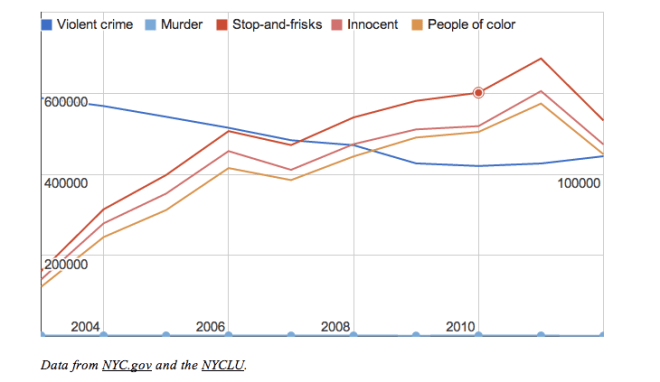
Philip Bump reviews the numbers:

This chart explains why the judge determined that the city’s policy was unacceptable.

Screen Shot 2013-08-12 at 5.19.23 PM

It shows:

• That crime has dropped largely independently of the fluctuations of the number of stop-and-frisks. It began going up in 2011 – alongside more stop-and-frisks.

• The number of murders in 2012 dropped alongside the number of stop-and-frisks.

• In every year, almost all of the stop-and-frisks (red line) were of people who were innocent (yellow line) and / or a person of color (orange line). The gap between the red line and the orange line is the number of those stopped who were not black or Latino.

And Kevin Drum wants further investigation into the causes of New York’s crime drop:

If stop-and-frisk really is the reason crime has dropped so dramatically in the Bronx, then a judge would be justified in weighing this against the legal issues on the other side. Even decisions based on fundamental constitutional rights aren’t rendered in a vacuum. But if reductions in atmospheric lead are the primary reason for the drop in crime, then stop-and-frisk really has no justification at all, and the judge’s decision becomes an easy one. That’s why it’s worth getting a more definitive answer about this. Other cities have seen dramatic crime drops without expanding their stop-and-frisk programs as aggressively as New York, and it would sure be worthwhile to find out how and why that happened.

(Chart from a 2010 report (pdf) by the Center On Race, Crime And Justice)

Tipping Worsens Service?

Instead of traditional tipping, Jay Porter’s restaurant “applied a straight 18% service charge to all dining-in checks, and refused to accept any further payment.” He found that “service improved, our revenue went up, and both our business and our employees made more money.” The reasons why:

 Researchers have found (pdf) that customers don’t actually vary their tips much according to service. Instead they tip mostly the same every time, according to their personal habits.

• Tipped servers, in turn, learn that service quality isn’t particularly important to their revenue. Instead they are rewarded for maximizing the number of guests they serve, even though that degrades service quality.

• Furthermore, servers in tipping environments learn to profile guests (pdf), and attend mainly to those who fit the stereotypes of good tippers. This may increase the server’s earnings, while creating negative experiences for the many restaurant customers who are women, ethnic minorities, elderly or from foreign countries.

• On the occasions when a server is punished for poor service by a customer withholding a standard tip, the server can keep that information to himself. While the customer thinks she is sending a message, that message never makes it to a manager, and the problem is never addressed.

Joyner adds:

I’m not sure if this would work as well at different price points or in different communities but the logic is unassailable.

The Tavern At The End Of The World

Phil Broughton explains what it takes to be a bartender in Antarctica:

I learned to spot the signs that someone was likely to wander drunkenly into the Antarctic night, and had heard too many stories of people returning to base with hypothermia and frostbite. My theory was that it’s easier to recover from too much drinking than to grow back a missing limb; I was happy only when everyone was safely tucked up and accounted for, even if it meant leaving them passed out on the bar’s couch.

I wasn’t just a detached observer, though; I was as enthusiastic a drinker as most of the patrons. One drawback was the hangovers: after a particularly heavy session, I would have to nip outside to be sick. Any liquid that came into contact with the ice froze immediately and, if left alone, it would remain so for ever. It was a point of honor to clear up after yourself, which meant chipping away with a pickaxe.

Olga Khazan spoke with Broughton last month:

Eventually, workers who were predisposed to seasonal affective disorder were hit hard. The darkness and cold caused sleepiness and memory problems, and over time some of the winter-overs became disoriented and lethargic.

“You were supposed to write copious notes to yourself in a notebook,” Broughton said. “Life gets rough when you can’t remember things. My strangest thing was that I lost complete command of written grammar. And I pretty much don’t remember the month of October.”

There were occasional tee-totalers and plenty of moderate drinkers, but for some, alcohol became a refuge.

“You see things that leave you uncomfortable. There were a good dozen people who were drinking to kill the days — that was hard to watch, and it was hard to serve. Though at some level, I’d rather have you drinking in front of me than drinking on your own.”


The Roaming Reel

Sukhdev Sandhu comments on the rise of the “roaming essay film”:

Essay films, unlike conventional documentaries, are only partly defined by their subject matter. They tend not to follow linear structures, far less to buttonhole viewers in the style of a PowerPoint presentation or a bullet-pointed memo; rather, in the spirit of Montaigne or even Hazlitt, they are often digressive, associative, self-reflexive. Just as the word essay has its etymological roots in the French “essai” – to try – essay film-makers commonly foreground the process of thought and the labour of constructing a narrative rather than aiming for seamless artefacts that conceal the conceptual questions that went into their making. Incompletion, loose ends, directorial inadequacy: these are acknowledged rather than brushed over. …

Some of these films started life on television, but these days it is the gallery sector that is more likely to commission or screen essay films, which are attracting ever more sizable audiences, especially younger people who have been weaned on cheap editing software, platforms such as Tumblr and the archival riches at YouTube and UbuWeb. Visually literate and semiotically savvy, they have tools – conceptual as well as technological – not only to critique and curate (moving) images, but to capture and assemble them. Having grown up in the era of LiveJournal and Facebook, they are also used to experimenting with personal identity in public; RSS feeds and news filters have brought them to a point where the essay film’s fascination with investigating social mediation and the construction of reality is second nature. It could well be that the essay film – for so long a bastard form, an unclassifiable and barely studied hybrid, opaque even to cinephiles – is ready to come into its own.

(Video: A clip from Thom Andersen’s Los Angeles Plays Itself (2003))

Greater Than The Sum Of Your Parents

Noah Berlatsky, an introvert married to another introvert whose son turned out to be an extroverted aspiring actor, muses on what he’s learned from having such a different child:

Part of what’s great about it is, of course, just that it’s fun to see your kid do something well, and to see him love doing something well. Part of why he’s good at drama is because you can just feel the joy coming off him when he’s performing. Everybody likes to see their child happy.

But another part of what’s fun about watching him be a thespian is the fact that being a thespian is so thoroughly not something I did, or am. Obviously, it’s great too when your child loves something you love — teaching him to swim was one of the high points of my life. But there’s also something special about realizing that he’s going to be able to do all these things you couldn’t do, or didn’t even try. Or, even more than that, just realizing that he’s not you, or even a combination of you and your spouse, but is instead this whole different person, center stage in his own life, who you get to love.

Hollywood’s Summer Hangover

Isaac Chotiner notes the dismal performance of this summer’s blockbuster season and wonders what studios will learn from it:

The most sanguine possibility is that you look over this roster of dreck and decide to make fewer derivative and dumb movies. (Oblivion, After Earth, and Elysium all have a similar plot; White House Down was nearly identical to this spring’s hit Olympus Has Fallen).

Still, it’s easy to imagine Hollywood studios learning precisely the opposite lesson. The problem isn’t derivative movies, the thinking might go; in fact, the most derivative movies sell. Superheroes sell. Enough of these new and risky products like R.I.P.D. and Lone Ranger: just look at where quirkiness gets you. Instead of taking a bet on an original (albeit not very good) movie like Elysium, why not make Grown-Ups 3, even if no one is exactly begging for it? Instead of White House Down, how about paying Robert Downey Jr. an extra $15 million above-and-beyond his already otherwordly salary for another Iron Man? It’s true that every studio needs to keep creating franchises as well as nurturing its existing ones. But who is to say that an extra sequel can’t be made, and that the new projects cannot just be reboots. No, the real lesson of the summer might very well be that audiences want what they already know. Don’t expect much to change.

Alex Mayyasi suggests Hollywood take a page from Silicon Valley’s book:

Despite their similarities … Silicon Valley and Hollywood have similar failure rates for opposite reasons. Silicon Valley doesn’t know what a future success looks like – every investor has a story about passing on a company like Facebook, Google, or Pinterest because it seemed unlikely to succeed or even stupid – so it accepts risk and celebrates it.

Hollywood knows what success usually looks like (it’s a sequel and tends to wear a cape). But pure repetition is not a sure thing (see the recent flop The Lone Ranger – a reboot of a classic story that was also Pirates of the Caribbean retreated as a Western) and it will miss out on surprise hits like Forest Gump.

Catherine Rampell investigates which movies pull in the most money, under the assumption that the answer would be low-budget horror films:

The genre with the biggest box office R.O.I. was actually documentary, with domestic box office economix-09ROIbygenre-blog480returns averaging 12 times the original production budget, and global returns at nearly 27 times the original budget. Of course, documentaries are generally much cheaper to make than other genres, averaging about $2.6 million in production budget versus $95 million for action films (unadjusted for inflation). So it makes sense that for the small subset of documentaries that do well (remember, these averages include only those films with domestic grosses above $2 million), the R.O.I. can be enormous.