Deborah Blum separates fact from fiction when it comes to having fun with nutmeg:
In the 1965 book, “The Autobiography of Malcolm X,” the activist describes purchasing it from inmates in a South Carolina prison, concealed in matchboxes, and stirring it into water. “A penny matchbox full of nutmeg had the kick of three or four reefers,” he wrote.
Toxicologists say that description is somewhat misleading, an overly romantic account of nutmeg’s generally unpleasant effects. It takes a fair amount of nutmeg — two tablespoons or more — before people start exhibiting symptoms. These can include an out-of-body sensation, but the most common are intense nausea, dizziness, extreme dry mouth, and a lingering slowdown of normal brain function. Dr. Gussow said nutmeg experimenters have compared it to a two-day hangover.
“People have told me that it feels like you are encased in mud,” said Dr. Edward Boyer, professor of emergency medicine and chief of the division of medical toxicology at the University of Massachusetts Medical School. “You’re not exactly comatose, but you feel really sluggish. And your remembrance of events during this time period is incomplete at best.”
Teenage Home Experiment here. Let’s say you are a 17-year-old boy living in a residential high school in Natchitoches, Louisiana, and you and your friends are bored out of your minds.
And let’s say that one of your friends has a copy of The Anarchist Cookbook, which has a few paragraphs in it about how you can get high on nutmeg. You and your buddy might be the kind of people who say, “Dude, you can buy that stuff at the supermarket.” And you might even be the kind of people who will ride their bikes through the rain to the Brookshire’s store after dinner, buy a box of McCormick’s ground nutmeg, and take it back to the dorm to eat.
If you’re me, you mix it with Equal to make it slightly more palatable. It tastes like spicy dirt. We must have eaten two or three teaspoons each, then sat around waiting to get high.
Emma Green contemplates why “secular, Thanksgiving-flavored gratitude seems so fuzzy”:
Religions from Christianity to Hinduism to Wicca all emphasize the importance of thankfulness, especially as a form of prayer. This is because they rely on the premise of an other, some sort of non-human being that has some sort of control or influence in the world who you can thank for the world and the good things in it.
“One of the things that’s really interesting about the human mind is that we seem to want to see agency in the world, almost intuitively,” said Michael McCullough, a psychologist at the University of Miami. “The mind really craves an explanation for the good and the bad, in terms of agency.” By “agency,” McCullough means something along the lines of “a force that can act in the world and cause events to happen.” In crude sociological terms, people give thanks to the forces that act in the universe—God, or god, or gods—as a bid for cosmic benevolence, whether that means making it rain or preserving a loved one’s health or bringing a baby into the world. But these thanks are also an implicit metaphysical claim: Humans owe their existence, their longevity, and perhaps even their daily fortunes to a being beyond ourselves.
While expressing gratitude for the good in her life, Kate Cohen confesses that “as an atheist, I don’t ever ascribe these gracious gifts to God; I never believed a supernatural being to be the source of the bounties that I enjoy”:
And yet, like any other lucky soul, I am still “prone to forget” my many blessings and “habitually insensible” to my own good fortune. I can use a day set aside now and then to make myself remember.
I could — with apologies to the Puritans — keep Thanksgiving, but leave God and prayer out of it. Just because it began as a day of prayer doesn’t mean mine has to be. Atheists don’t have to thank God: they can thank their hosts (or welcome their guests), toast the cooks, and enjoy the food.
Maybe that would be enough for me if I didn’t have kids. But even though I don’t want my children to believe in God, I still want them to believe in blessings. Beauty. Wonder. Good fortune. Grace.
Kay Steiger explains that she and her pals inaugurated a tradition of non-family get-togethers “because we all thought we could make better versions of Thanksgiving food and it’s more fun to get drunk with your friends anyway”:
[F]or all the cleverer recipes and the fancier food, what actually matters is getting everyone together for another year – which was the point of the family Thanksgivings we all either couldn’t or didn’t want to go back to our hometowns for. We aren’t related by blood, but we’re still a family.
The idea of Friendsgiving isn’t particularly unique to us, but it is quietly radical in its way …. The conservative view is that your second family starts with a marriage between one man and one woman, preferably long before the ages we all our now – and, until then, your original family Thanksgiving should take top priority. But creating – and celebrating – families with the people you like rather than the people you might feel stuck with provides a lot of people more reason to give thanks.
But not everyone is so Friendsgiving-friendly. Foster Kamer insists it’s “the ne plus ultra of dumb, idiotic, made-up, fake holidays created exclusively for the most middlebrow human beings intent on perpetuating middlebrow, capital-b Basic culture”:
[T]his is where Friendsgiving is supremely annoying: The core idea here is the implication that, as opposed to Friendsgiving, a regular Thanksgiving must be spent with family, and not friends; should be stogy at best; and if not boring, then at least tense and uncomfortable. Friendsgiving hinges on the idea that Thanksgiving is mediocre.
I resent that implication. I resent the idea that I should have two meals, because one of them just isn’t supposed to be fun. Why else would you need an ostensibly unconventional, wacky and neat alternative?
Melia Robinson differs, reflecting fondly on the Friendsgiving she held last year:
Friendsgiving isn’t perfect. There were hiccups. One roommate scratched her eye after slicing an onion and experienced such searing pain, we thought we were going to have to take her to the hospital. (She’s fine now.) We kept realizing we forgot to pick up needed ingredients; so by the second unplanned trip to the grocery store, I invested in a six-pack of Woodchuck to preserve our sanity.
But there was no screaming, no awkward interactions with relatives you see twice a year, and no tears (besides the onion incident). Just old jokes rehashed and new memories made between people who love each other.
If you’re going to spend Thanksgiving with your relatives, have a Friendsgiving, too. Celebrate both your families, no matter how weird one is.
Ellen McCarthy is on the same page. Meanwhile, in McSweeney’s, Chris Brotzman narrates “The First Friendsgiving.” It all began, he says, with a group of Millennials in 2008:
With the Thanksgiving holiday soon approaching, decisions needed to be made. Plans needed to be laid out. And so they began to wonder.
“Welp. I can’t afford a plane ticket home for Thanksgiving,” said one Millennial to another.
“Me either,” she replied.
A third chimed in. “Fuck it. Let’s have Thanksgiving here [in LA]. It’s way warmer than in the Midwest anyway.”
They began texting other Millennials of their remarkable idea! A feast just for them! No adults! No annoying family members! What a celebration!
Like a miracle, one of the Millennials had a friend in graphic design who was pretty badass at Photoshop and willing to design a logo for the eVites and the Facebook page. It’s even been told that the name “Friendsgiving” was coined by one of these Millennials who worked as an advertising copywriter, but that’s yet to be confirmed by Wikipedia.
“The more the merrier!” it said right there on the Facebook event page. But they all knew it. “Merrier” was just a façade. They knew this whole thing was merely a coping mechanism for their own, deep-seeded unhappiness: lost in a strange place, much like the Pilgrims of the first Thanksgiving, starving for acceptance from strangers. The main difference, of course, is that the original Pilgrims were also literally starving. Like, for food and medicine and stuff.
But do not be fooled. The Millennials had it rough, alright. For it is no easy thing to come to grips with the idea that life isn’t easy and can’t be handed to you.
The Guardian editors offer a taste of the very first Thanksgiving:
Robert Krulwich looks back at how the turkey became the holiday’s leading entrée:
[Writer Andrew] Beahrs gives his biggest props to a 19th century magazine editor named Sarah Josepha Hale. She and her magazine, Godey’s Lady’s Book, campaigned for a national day [of thanksgiving], wrote letters to governors, to every member of Congress, even to the president, and when she wasn’t lobbying, she was writing novels that romanticized turkeys in that over-the-top drooling-with-her-pen way that may make you laugh … but it worked. Here’s a passage from her 1827 novel, Northwood:
The roasted turkey took precedence on this occasion, being placed at the head of the table; and well did it become its lordly station, sending forth the rich odor of its savory stuffing, and finely covered with the froth of its basting. At the foot of the board, a sirloin of beef, flanked on either side by a leg of pork and loin of mutton, seemed placed as a bastion to defend the innumerable bowls of gravy and plates of vegetables disposed in that quarter. A goose and pair of ducklings occupied side stations on the table; the middle being graced, as it always is on such occasions, by the rich burgomaster of the provisions, called a chicken pie.
That’s turkey, then sirloin, then pork, then lamb, then goose, then duck, then chicken pie, all in one sitting! … It took 300 years or so, but eventually the turkey knocked off every other contender and is now center stage, by itself, gloriously supreme, stuffed, adorned, triumphant. Viva la turkey!
Jessica Grose regrets that her family won’t be eating turkey this year, but Betsy Woodruff would rather see the bird sidelined once again. She writes that “turkey’s problem isn’t so much that it tastes bad as that literally any other meat tastes better”:
Ham is better. Duck is better. Chicken, cooked properly, is just as good and takes much less effort, so it is better. Any sort of cow meat is better. Hot dogs, which are in their own meat category, are arguably inferior to Thanksgiving turkey, but they take one-thousandth of the time, cost way less, and are great vehicles for brown mustard. Thus, hot dogs (and of course sausages) are better, too. The president should do America a favor and pardon all the turkeys.
[T]he problem with roasting a whole turkey is that the leg meat needs to get to 165° but the breast dries out over 150° (and note that USDA tells you to cook the breast to 165° which is, as Serious Eats says, “a guarantee you’ll have dry, tough meat”). That’s why we cover turkey in jellied, sugared cranberries and thick gravy at the same time in order to enjoy it. We’re making up for its lack of fat and the fact that it is almost always badly overcooked.
You don’t see people doing that with, say, pork shoulder. …
Unlike turkey, pork shoulder is delicious. Unlike turkey, it’s easy to make insanely well. Unlike turkey, it’s reasonably easy to find in humane, organic forms. And unlike your turkey, your Thanksgiving guests will remember your pork shoulder. It will make your Thanksgiving different, memorable, better. They will fondly think back to how unusually delicious Thanksgiving at your house was, because you served Momofuku pork shoulder and not turkey. You will be a hero. Can’t you hear their cheers now?
Sadie Stein, meanwhile, snarks at manic media takes on unconventional menus:
[E]very November, all the food magazines and blogs start trying to bully us into to reinventing the wheel. Don’t be a fogey! they scream. What, you’re still eating turkey? HAHAHA. Well, if you insist on being a “traditionalist,” stuff that turkey with linguica and kale! Baste it with ramen! Douse it in pomegranate molasses! (All this is said in a vaguely threatening, SportsCenter-style cadence.) This isn’t your mom’s green bean casserole! You’re not even seeing those losers, are you, with their stupid political views and opinions about your love life? Surely you’re having some awesome no-strings Friendsgiving celebrating the new family you’ve chosen! Right? RIGHT?! SRIRACHA. SRIRACHA. SRIRACHA.
She continues:
My own practices are less ambitious. I like order, I like guaranteed results, and I like perfection.
Is this lonely? Yes. Tyranny is lonely. But I cannot risk a guest … succumbing to the lures of something “fun” and playing merry havoc with the priggish constraints of my menu. I was not always thus; life has made me harsh. Life and a particular batch of mashed potatoes made with Benecol butter substitute (because that’s what someone’s grandma had in the fridge), Bac-Os, and a garnish of coffee grounds.
McCardle, for her part, prefers a laissez-faire approach to Thanksgiving dinner:
It’s time for a counterintuitive “smart take”: Eat what you like on Thanksgiving, with a due emphasis on the foods that are traditional to your family and your region. And eat as much as you want of them, without overloading your stomach to the point of illness.
Personally, I find green bean casserole completely disgusting, so much so that I have never eaten it. That’s OK! It’s also OK if you love green bean casserole and wait all year to dig into its creamy depths. Pecan pie makes my teeth ache with its sweetness, but if you love it, tee up the Karo corn syrup and go to town. … I view garlic, sour cream and other Johnny-come-lately additions to mashed potatoes as fundamentally missing the point of Thanksgiving potatoes, which is to serve as a vehicle for more gravy. But if you want your potatoes swimming in wasabi and chantarelles, or whatever crazy combination you’ve come up with, bon appetit. And if you want to skip the turkey in favor of barbecued pork or planked salmon, well, all I can say is: Happy Thanksgiving.
So exclaims John Oliver, shaking his head over the annual tradition of presidential turkey pardoning:
“I issue this challenge to President Obama and all future presidents,” the Last Week Tonight host says in a new YouTube video [above] with his show on holiday hiatus. “If you want the world’s respect, just once, show up at a White House turkey pardoning with a cleaver and administer the justice these birds so clearly deserve.”
Obama has opted to ignore Oliver’s challenge; yesterday, he defended the pardon as an “action fully within my legal authority”. Dahlia Lithwick, tongue firmly in cheek, ponders the implications of the president’s policy, wondering if it will “start a wave of unauthorized poultry immigration”:
Obama’s Republican critics were quick to denounce presidential claims that the turkey pardon authority rests squarely within the enumerated powers of the executive branch. Sen. Ted Cruz published an op-ed in Politico titled “Obama Is Not a Monarch” in which he excoriated Obama’s plan to pardon the turkey as “lawless.” In it, Cruz posited that despite widespread popular resistance to turkey amnesty, “President Obama appears to be going forward. It is lawless. It is unconstitutional. He is defiant and angry at the American people. If he acts by executive diktat, President Obama will not be acting as a president, he will be acting as a monarch.”
Other Republicans pondered what might ensue if millions of turkeys were spontaneously granted amnesty. Some warned that a wave of unauthorized turkeys will soon flood the country, trailing illegal giblets and stuffing, and taking up space on supermarket shelves that should have been held by Americans. House Speaker John Boehner tweeted, “The president has said before that ‘he’s not a king’ & he’s ‘not an emperor,’ but he sure is acting like one.” Former Pennsylvania Sen. Rick Santorum called the turkey pardon “just another in a long line of power grabs by this administration.”
Brad Plumer, taking a more serious approach to the issue, maintains the pardon is a lame tradition:
For starters, the pardoned turkeys don’t get long to enjoy their newfound freedom, because the life of the modern-day turkey is mostly pretty gruesome. The turkeys most widely consumed in America, broad-breasted whites, aren’t built for a carefree life at the farm. They’ve been bred over many years to have oversized breasts and to convert feed into tasty turkey meat as efficiently as possible. Those innovations have been great for humans — they help keep the cost of Thanksgiving dinner down — but they’re not as much fun for the turkey.
Turkeys bred for eating now grow to an average of 30 pounds, much bigger than their wild ancestors did. (The two turkeys that were pardoned in 2013, Caramel and Popcorn, weighed over 37 pounds apiece.) These domesticated turkeys are often so big that their skeletons can’t support all that weight. They frequently develop bone deformities and degenerative joint diseases and suffer heart failure or bleeding around the kidneys. Many are incapable of breeding on their own.
Popcorn, last year’s officially pardoned turkey, has already died of “natural causes” – though his understudy, Caramel, “has trimmed down quite a bit … and seems to be more active as the months go by”. Previous Dish on the sad fate of pardoned turkeys here.
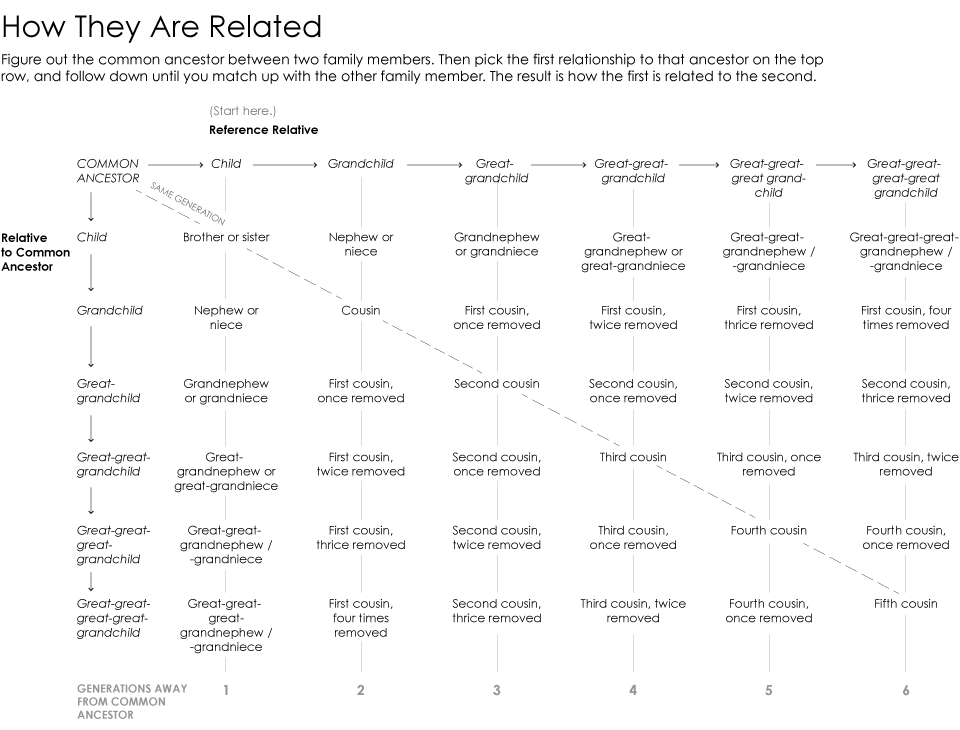
How are you related to all those supposed cousins of yours, anyway? Nathan Yau created the above chart to have you covered at family gatherings:
Here’s how it works. Figure out the common ancestor between two relatives. Then select the relationship of the first relative to the common ancestor in the top row. Move down to the row that corresponds to the relationship of the second person to the common ancestor. The result is the relationship of the second person to the first.
For example, say the first person is the grandchild of the common ancestor, and the second person is a great-grandchild. Therefore, the second person is the first cousin once removed from the first.
Meanwhile, Jessica Goldstein recently investigated how closer familial connections play out during the holidays. She talked to Frank Sulloway, author of Born to Rebel, about how birth order affects family dynamics into adulthood:
“The biological fact that you’re first, second, or third, it doesn’t have any causal influence. What’s causal is, if you are first, you’re bigger, older, stronger, and you have certain privileges you don’t have when you’re younger,” he said.
Time for more fun with stereotypes:
“If firstborns act more, within the family context, as the surrogate parent, not only are they viewed stereotypically as more responsible and harder working — what we’d call conscientious — but they actually are behaving that way with reference to their siblings and the family environment. And also within the family, typically, younger siblings are rated as being more agreeable, which basically means, more cooperative, kindly, less aggressive, less bossy.” If you’re an older sibling, with size and power on your side, “if you want something, in theory you can just take it, and sometimes older siblings just do. And if you’re younger, you have to be more careful about how you behave with a bigger person. You tend to be cooperative, like, ‘I’ll give you this if you give me that.’”
But here’s the funny thing about those differences — and, I think, why family gatherings seem to exacerbate these variances in personality: these differences are much larger within the family context than they are outside of it. … Sulloway has a very Hunger Games-y explanation for this phenomenon. “I like to think of it as, in childhood we develop a little Darwinian toolkit of strategies for dealing with our siblings and basically getting out of childhood alive. … But we don’t go around in adulthood taking stuff out of that toolkit all the time. If you did all the stuff to your friends that you do to siblings, you’d have no friends. So it makes sense that there’s a muting of effects but a continuity of effects.”
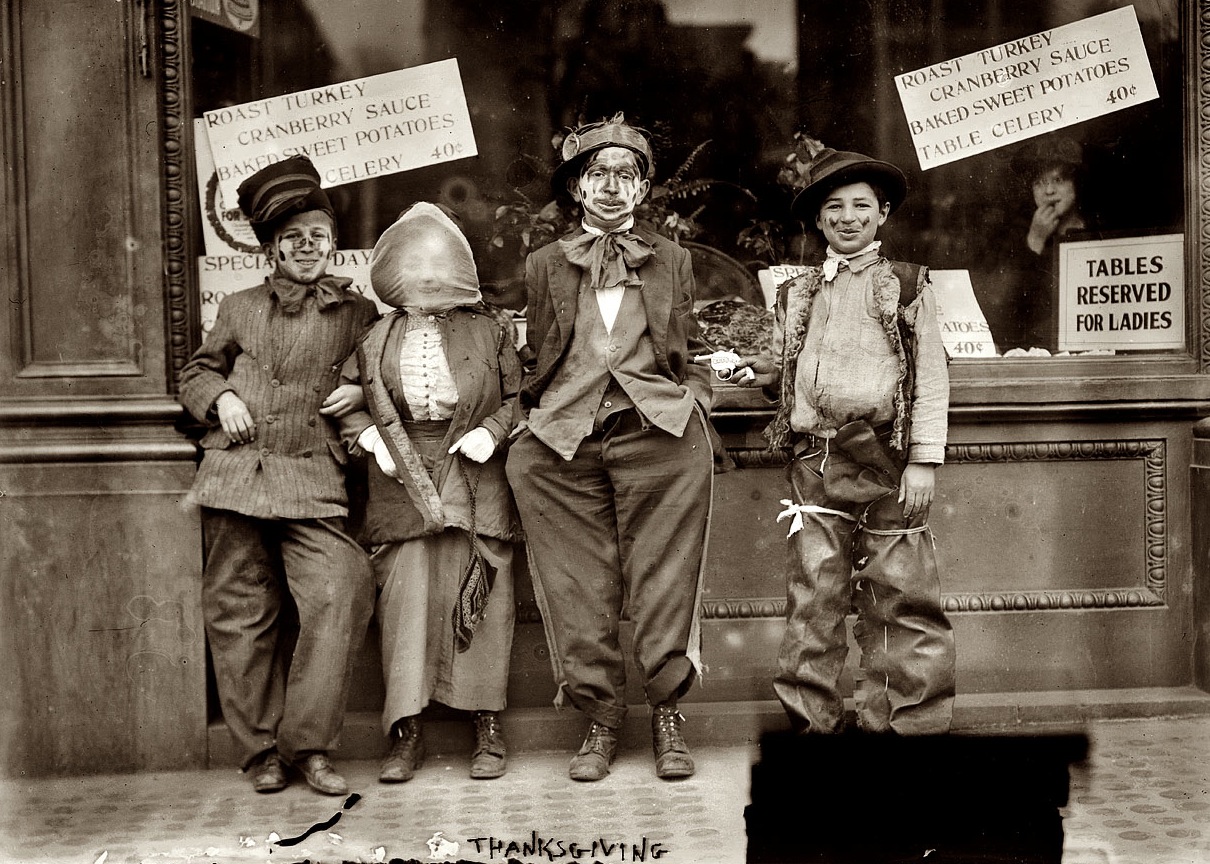
Linton Weeks reflects on the scrappy history of Thanksgiving, which “in turn-of-the-20th century America used to look a heckuva lot like Halloween”:
People — young and old — got all dressed up and staged costumed crawls through the streets. In Los Angeles, Chicago and other places around the country, newspapers ran stories of folks wearing elaborate masks and cloth veils. Thanksgiving mask balls were held in Cape Girardeau, Mo., Montesano, Wash., and points in between. …
In fact, so many people participated in masking and making merry back then that, according to a widely distributed item that appeared in the Los Angeles Times of Nov. 21, 1897, Thanksgiving was “the busiest time of the year for the manufacturers of and dealers in masks and false faces. The fantastical costume parades and the old custom of making and dressing up for amusement on Thanksgiving day keep up from year to year in many parts of the country, so that the quantity of false faces sold at this season is enormous.”
In 2012, Greg Young noted that the “custom was mostly frowned upon by polite society as a distraction from the historic and somber traditions of Thanksgiving”:
Thanksgiving ‘masking’, as it was often called, stemmed from a satirical perversion of destitution and the ancient tradition of mumming, where men in costumes floated from door to door, asking for food and money, often in exchange for music. In the 19th century, makeshift Thanksgiving parades — fantasticals — featured New Yorkers marching through the street in garish costume, most likely inspired by Guy Fawkes Day. By the late 19th century, these had morphed into a day for children to take to the street in ragamuffin garb, going from door to door, begging for fruit, candy and even pennies. …
By 1924, New York could focus its holiday cheer onto more controllable pursuits with the debut of the Macy’s Thanksgiving Day Parade. Within a couple decades, it appears that the merry tradition of Thanksgiving masking slowly relocated over to the less dignified Halloween ….
Children weren’t just roaming the streets begging pennies. What was especially annoying was their “practice of ringing all the doorbells and demanding backsheesh.” By 1930, New York’s Superintendent of Schools was publicly condemning the Thanksgiving begging, calling it a “serious annoyance to householders” and encouraging school principles and teachers to instruct students in the origins, meaning, and proper observance of Thanksgiving. Between official disapproval and the low mood and tight purse brought on by the Depression, Thanksgiving mummery virtually disappeared in the late 1930s.
But dressing up and going about ringing doorbells and “demanding backsheesh” didn’t disappear; it just moved to Halloween. We call it “trick or treating.”
Below, watch a home movie of some of the last maskers to traipse around New York in the 1940s:
This week, the FDA released new rules on calorie labeling:
The changes are sweeping: Any restaurant with 20 or more locations, movie-theater chains, amusement parks, meals sold in grocery stores, and vending machines will all be required to label calorie amounts on food options. There is no exception for alcohol ordered from a menu (mixed drinks ordered at the bar, however, will continue to not have calorie information). The rules take effect a year from now, although vending machine operators will have two years to comply.
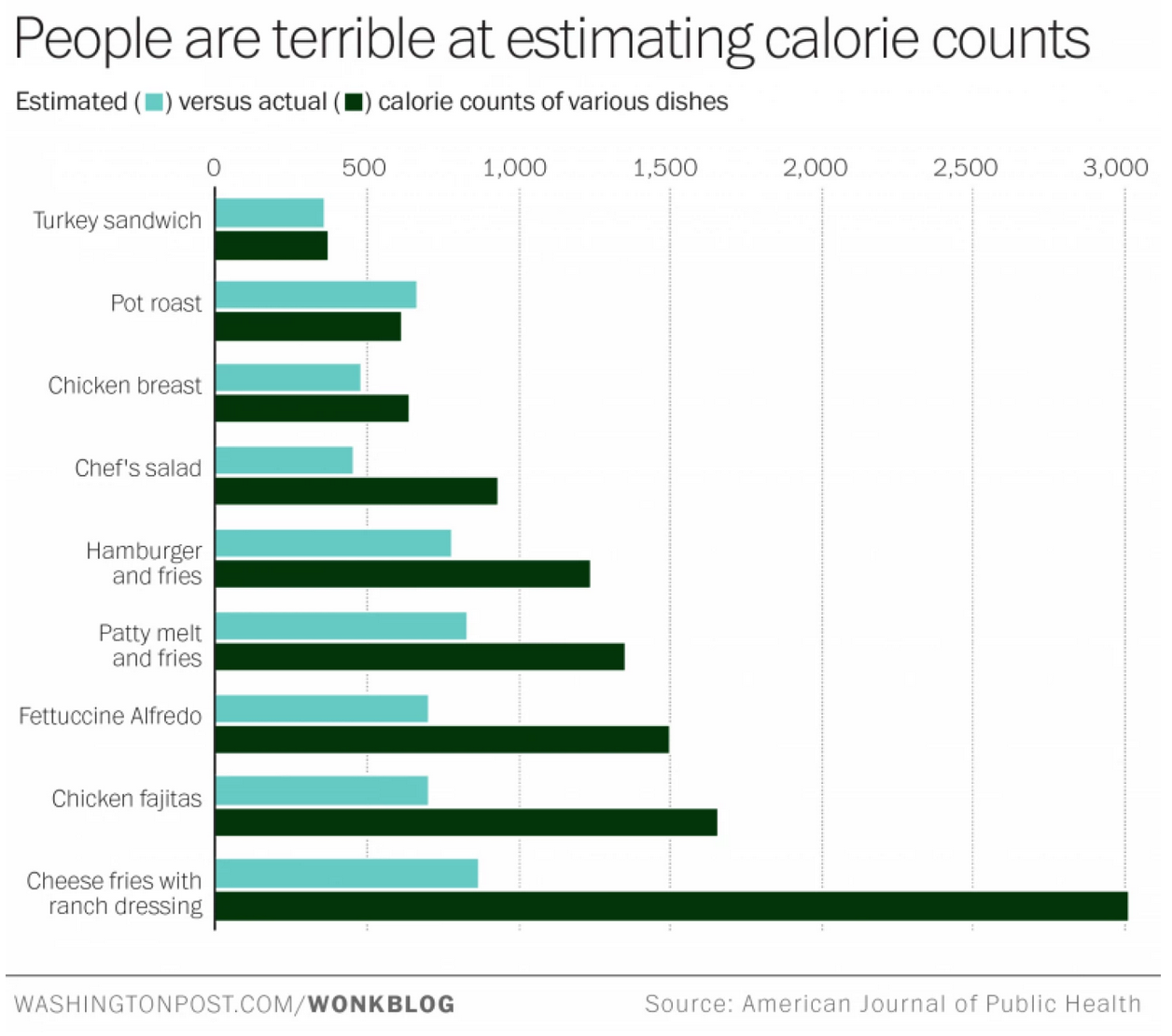
In response, Jason Millman highlights research on caloric ignorance, including the above chart:
Do people eat healthier when they can see calorie counts? The evidence so far seems mixed. The impact seems to be greater when the calorie count is much higher than what consumers expect. What does seem clear from past studies is that people really are terrible judges of how many calories they consume when they dine out.
Harvard Medical School researchers who polled more than 3,400 customers at fast food chains found that people significantly underestimated the calories in their meals. This varied by age group — adolescents on average underestimated calorie content by 259 calories, while adults and parents of school-age children underestimated by 175 calories. More than a quarter of people, though, underestimated calorie content by at least 500 calories, according to the research published in the British Medical Journal last year.
Danny Vinik explains why calorie counts might not alter food choices:
In 2013, researchers at the Robert Wood Johnson Foundation put together a literature review of studies on menu labeling, in order to understand public opinion on menu labeling and the effectiveness on calorie counts. The idea itself turns out to be pretty popular. In the United States, for instance, nearly three-quarters of Americans support menu labeling. After New York required labels in 2008, 84 percent of residents said they found the labels helpful. A majority of Americans also said they would choose lower-calorie food items if they had more information at their disposal—a possible sign that calorie counts could improve health.
But research also suggests that Americans are unlikely to change their behavior, even with the extra information about calories. “Four out of five controlled studies that compare restaurant patron choices in jurisdictions with and without menu labeling regulations before and shortly after menu labeling implementation have not found a relative reduction in calories purchased,” the researchers write.
One study in Seattle, conducted between 2008 and 2010, didn’t find any change in the number of calories ordered at burger and sandwich restaurants — but did see a decline at taco and coffee stores.
Another study, conducted by two University of Minnesota researchers, found that when consumers were presented with calorie information in a survey setting, they would reduce their intended food order’s calories by about 3 percent. But when the same researchers tested out the calorie labels in a real-world fast food environment, nothing changed. Intentions, in other words, didn’t translate into behavior change.”Overall, our results show a considerable gap between actual choices and stated preferences with respect to fast food choices,” they write.
Obviously, not everyone who eats at large chain restaurants is making a conscious effort to eat well. And even those who wish to make healthy choices sometimes lack an understanding of what, say, “1,000 calories” means. A study at the Johns Hopkins School of Public Health found that restaurant customers in Baltimore made little attempt to eat healthily when shown calorie listings. But when food calories were matched with an equivalent amount of exercise, they made more of an attempt to eat less.
Kenneth C. Davis credits Lincoln with issuing “the first two in an unbroken string of presidential Thanksgiving proclamations,” but notes that “the elevation of Thanksgiving to a true national holiday [was] a feat accomplished by Franklin D. Roosevelt.” He reminds us that Americans initially found Roosevelt’s holiday politically polarizing:
In 1939, with the nation still struggling out of the Great Depression, the traditional Thanksgiving Day fell on the last day of the month – a fifth Thursday. Worried retailers, for whom the holiday had already become the kickoff to the Christmas shopping season, feared this late date. Roosevelt agreed to move his holiday proclamation up one week to the fourth Thursday, thereby extending the critical shopping season.
Some states stuck to the traditional last Thursday date, and other Thanksgiving traditions, such as high school and college football championships, had already been scheduled. This led to Roosevelt critics deriding the earlier date as “Franksgiving.” With 32 states joining Roosevelt’s “Democratic Thanksgiving, ” 16 others stuck with the traditional date, or “Republican Thanksgiving.” After some congressional wrangling, in December 1941, Roosevelt signed the legislation making Thanksgiving a legal holiday on the fourth Thursday in November. And there it has remained.
Though Republicans were louder in articulating their opposition, the split between Thanksgiving and “Franksgiving” states was not strictly partisan; rather, it was ideological.
Among those states that shunned Roosevelt’s designated holiday were Alabama, Arkansas, Florida, Kentucky, North Carolina, Oklahoma and Tennessee. Texas, home of Vice President John Nance Garner, split the baby and recognized both dates as a holiday. While Georgia did adhere to FDR’s decree, the editor of the Warm Springs Mirror—effectively FDR’s hometown paper when he wasn’t in Washington—echoed the criticism of conservative Democrats when he suggested that the president move his birthday “up a few months until June, maybe … I don’t believe it would be any more trouble than the Thanksgiving shift.”
Were people angry, as some editorialists suggested, that the president was ruining collegiate football (after all, most of the big rivals had long before scheduled their Thanksgiving games, and for many schools, the season ended entirely the Saturday following the holiday)? Perhaps that was part of it. But mostly, it was a shifting political ground that gave conservative opponents of the New Deal from both parties greater confidence to criticize and ridicule a widely popular president.
Meanwhile, Stephen L. Carter surveys a history of political friction during the holiday. Citing James Madison’s Thanksgiving Proclamation of 1814 – delivered during the War of 1812 – he urges Americans to “put aside our divisions and to approach our blessings with gratitude and humility”:
We’re a divided nation in so many ways. In our responses to everything from the Affordable Care Act to Ferguson to climate change, we’re constantly at one another’s throats, treating those who disagree as enemies to be derided rather than fellow citizens who are part of a common project. College students are being taught to ban speakers whose messages discomfit them. Political parties, egged on by talk show hosts, are raising money through raising fears of diabolical conspiracies. …
We’re an imperfect country, and always will be. The “distinguished favors” and “precious advantages” of which Madison spoke may not always be equally distributed, but they are what mark the nation as distinctive. We can do no greater honor to our forebears than adopting an attitude of respect and humility across our differences, as we give thanks for the remarkable project that is America.
Michael Brendan Dougherty recommends we avoid political squabbling over Thanksgiving:
These advice columns are becoming a genre unto themselves. The stock villain: crazy right-wing uncle, the jokes about stuffing. But I recognize them by what they unwittingly emulate: guides for religious evangelism. The gentle, righteous self-regard, the slightly orthogonal response guides, the implied urgency to cure your loved ones of their ignorance. Your raging uncle will know the truth, and the truth will set him free.
That’s a problem. Our politics are taking on a religious shape. Increasingly we allow politics to form our moral identity and self-conception. We surround ourselves with an invisible community of the “elect” who share our convictions, and convince ourselves that even our closest and beloved relatives are not only wrong, but enemies of goodness itself. And so one of the best, least religious holidays in the calendar becomes a chance to deliver your uncle up as a sinner in the hands of an angry niece.
I’m as guilty of this as anyone.
As a conservative raised in an argumentative and left-leaning Irish-American family, Thanksgiving and other holiday dinners did more than any professional media training to prepare me for MSNBC panels. But arguments like these, particularly when we allow politics to dominate our notions of ourselves, can leave lasting scars. And precisely because our familial relationships are so personal, the likely responses to our creamed and beaten talking points will be defensive, anxious, off-subject, or overly aggressive.
Lizzie Crocker presents one scenario you might relate to:
You are in a steady, long-term relationship with someone whom you adore despite her fringe politics (you are even starting to come around on her anti-vax opinions). Alas your family cannot stand her, not just because they disagree with her political views, but because they find her to be preachy and self-righteous, and because she refuses to put on “nice” clothes when they see her. (Your mother telephoned to ask if she would be wearing yoga pants to Thanksgiving dinner again this year.) But for some unfathomable reason, you really love this woman who lives in her Lululemon everything and who is forcing you to do a five-day juice cleanse with her after the holiday.
Can’t everyone open their narrow minds and try to get along? [Marriage and family therapist Jenn] Berman suggests “setting up boundaries” and warning family members who are prone to starting fights that you’ll “give them one warning if they do so and then leave if things escalate.”
We’re a divided nation in so many ways. In our responses to everything from the Affordable Care Act to Ferguson to climate change, we’re constantly at one another’s throats, treating those who disagree as enemies to be derided rather than fellow citizens who are part of a common project. College students are being taught to ban speakers whose messages discomfit them. Political parties, egged on by talk show hosts, are raising money through raising fears of diabolical conspiracies.
Even Lincoln, in the midst of so desperate a war, conceded that the enemy was “of our own household.” This was an enemy actually being fought on the battlefield. The very day before Lincoln’s proclamation of Thanksgiving,the Union had won its costly victory at the Battle of Cedar Creek, suffering more than 5,600 casualties, including some 3,400 dead. Yet Lincoln evidenced a belief that those who fought against the Union were not monsters, but wayward brothers.
We’re an imperfect country, and always will be. The “distinguished favors” and “precious advantages” of which Madison spoke may not always be equally distributed, but they are what mark the nation as distinctive. We can do no greater honor to our forebears than adopting an attitude of respect and humility across our differences, as we give thanks for the remarkable project that is America.
 The Dish
