What Americans Think Of Abortion

Abortion Opinion

Leonardt examines public opinion:

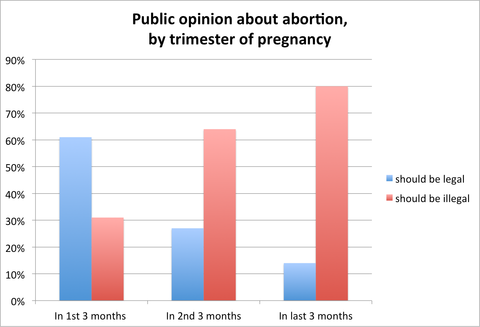
[A]bortion is one [issue] in which selective readings of the polls can seem to prove opposite conclusions. After writing about abortion and public opinion in Sunday’s Times – arguing that the issue does not benefit Democrats as much as other high-profile subjects, like immigration, guns, taxes and same-sex marriage – I wanted to dig more deeply into the polls and their trend lines. For all the assertions that advocates make about public opinion, I think that a few consistent messages emerge.

The main one is that most Americans support abortion access with some significant restrictions.

If you were going to craft a law based strictly on public opinion, it would permit abortion in the first trimester (first 12 weeks) of pregnancy and in cases involving rape, incest or threats to the mother’s health. The law, however, would substantially restrict abortion after the first trimester in many other cases.

Intriguingly, such a policy would be similar to the laws in several European countries, like France, where abortions are widely available in the first trimester and restricted afterward. It would also be consistent with much of Roe v Wade.

And it would almost certainly have become the law in most states has the Supreme Court not fucked it up. On the brighter side, Razib Khan notes that we are learning to detect fetal abnormalities earlier and earlier:

Whole genome sequencing of 2nd trimester fetuses is now possible, and it seems very likely that in the next few years they’ll move all the way to the 1st trimester. At that point the genetic analysis of 1st trimester fetuses will be routinized and be a simple consumption good. The ultimate question is what are we going to do with all that information? This is not hypothetical, speculative, or blue sky. It’s almost a reality.

Anything that might avoid the excruciating decisions faced by many Dish readers is a good thing. For the best thing I’ve ever read on late-term abortion, check out the Dish’s “It’s So Personal” series. You won’t think about this entirely in the same way again.

Detroit Goes Bankrupt: Reax

Population Decline

Yglesias provides an overview:

This is the largest city to ever file for bankruptcy, and obviously no large city goes bankrupt without a complicated array of problems. But the basic reason Detroit needs to do this is pretty simple. In 1950 there were 1.85 million people in Detroit. In 1970, it was 1.5 million. In 1990, it was a million flat. By 2010, it was down to 710,000. When your city is shrinking like that, you end up with a tax base that’s inadequate to maintain the fixed infrastructure or to pay off pension costs that were incurred in more prosperous times. Shedding legacy obligations is a necessary part of the fix. You can shed legacy obligations without filing for bankruptcy by just stiffing pensioners. But the scale of Detroit’s fiscal problems are so enormous that doing it entirely that way would be cruel and pointless—bondholders need to take a hit and this is the way to do it.

Plumer notes some of the city’s other problems:

— The official unemployment is now 18.6 percent, and fewer than half of the city’s residents over the age of 16 are working. Per capita income is an extremely low $15,261 a year, which means there’s not all that much tax revenue pouring in.

— Low tax revenue, in turn, means that city services are suffering. Detroit has the highest crime rate of any major city, and fewer than 10 percent of crimes get solved. The average response time for an emergency call is 58 minutes. Some 78,000 buildings are abandoned or blighted and there are an estimated 12,000 fires every year. About 40 percent of the city’s streetlights don’t work.

— High crime and blight are driving even more residents out of the city. It’s also driving down property values, which means many residents have stopped paying property taxes. The city collected about 68 percent of the property taxes owed in 2011. Both of those things put a further strain on Detroit’s finances.

Soltas zooms out:

Detroit’s dependence on cars … wasn’t exactly the problem. It was dependence itself. Cities should never go all in on any industry, cars or otherwise. It didn’t realize that until it was too late.

Rob Wile explains what happens next:

Assuming the case goes forward — some creditors may try to object to the filing — the court will now determine which entities — corporations, pension funds, employees and anyone else Detroit owes money to —  will actually see the money they were promised by the city.

According to the American Bankruptcy Institute Journal, Detroit technically gets to do all of the proposing for how that works out. It will submit a restructuring plan to the court, and if the plan doesn’t violate any sections of the federal bankruptcy code, it will be voted on by the creditors.

The creditors don’t get to propose their own plan, and the court can issue a “cram down” order to force objecting creditors to accept parts of the plan. But there will be negotiations going along the whole way where creditors will have their say.

John Cassidy expects this process to take time:

Having seen General Motors and Chrysler both emerge from bankruptcy leaner and with much less debt,  [Detroit’s mayor, Dave Bing,] and other officials are evidently hoping for a similar outcome for the city. But even assuming that the bankruptcy filing does survive a legal challenge, it’s far from clear how a case of this size, complexity, and political toxicity will work its way through the courts; the process could take years. Municipal bankruptcy cases are invariably complex. With Detroit’s debts standing at an estimated twenty billion dollars, this is by far the largest such case in U.S. history. And Detroit is still a city of more than seven hundred thousand people. Can an unelected official like [Kevyn Orr, Detroit’s emergency manager,] govern such a city for years on end with no democratic mandate? A mayoral election is due to take place later this year. So long as Orr is effectively running the show, its result won’t mean much.

Tim Fernholz offers three reasons why Detroit filed yesterday instead of in September or October as expected. One theory:

[Orr] feared lawsuits from pension funds seeking to stop the bankruptcy. In Chapter 9, the city’s promise to spend billions paying for retiree health care is likely to be shifted to the federal government, and the pension funds themselves are likely to take significant cuts. Their managers have been filing lawsuits seeking to prevent the city from entering bankruptcy, but the filing stays them all.

Lydia DePillis looks at who Detroit owes money:

Detroit is about $18 billion in debt, and will only be able to pay out a fraction of that in the short term. The two main groups of creditors arguing they’re entitled to that money are public employees and retirees, and bond holders. The investors are likely to make out better, since more of that debt is secured; the city will continue to pay water and sewer bondholders. Most of the pension debt has no similar backstop.

City residents will likely suffer a lack of anything other than the most rudimentary public services for a long time, but the impact is likely to be felt most keenly by those who lost a large chunk of the retirement they were counting on.

Barro wishes the public sector pension system was designed differently:

If a federal court approves Detroit’s bankruptcy plan, its retired workers will see their pension benefits cut drastically.

It shouldn’t be this way.

When a company goes bankrupt, most of its workers’ pension benefits are insured through the Pension Benefit Guaranty Corporation, a federal government entity established under the Employee Retirement Income Security Act of 1974.

Congress should extend ERISA or a similar set of rules to municipal and state governments. This would force governments to manage their pension systems in a safe way, and would protect workers from destitution in the event of a state or municipal insolvency like Detroit’s.

Sommer Matthews also considers the pensions:

Michigan’s constitution technically prohibits the accrued pension benefits of public employees from being reduced retroactively. But Detroit Emergency Manager Kevyn Orr has previously indicated that bankruptcy would mean pension cuts for both current and former city workers would be on the table. The city’s pension funds currently face an estimated shortfall of about $3.5 billion. For (hopefully obvious) political reasons, it’s unlikely that current retirees would see their checks disappear entirely, but smaller checks are a (frightening) possibility. Future retiree benefits would be the big area for cuts, though. Plenty of states and local governments have already slashed pensions even without going bankrupt.

The above map, on Detroit’s population loss, is from Nate Cohn, who rounded up various maps on Detroit’s decline.
Where Music Isn’t Free

Chris Kjorness argues that reggae outlasted mambo for the same reason the United States outlasted the Soviet Union:

At the height of  ’50s mambo fever, you would have been laughed out of the room had you predicted that comparatively tiny and impoverished Jamaica would soon become a dominant force in global music, while the Caribbean’s longstanding cultural capital of Havana fell into irrelevance and decay. But the rise of communism and its attendant cultural protectionism soon choked off mambo and Cuban creativity at the source, while Jamaica’s economic boom and unfettered recording industry uncorked a revolutionary new music called reggae.

Many Cuban musicians welcomed the revolution, and quite a few benefited at first, but that soon changed:

By 1961, all production facilities had been nationalized. State approval was required for any new recording. Censorship and bureaucratic red tape frustrated artists. Reduced tourism and trade cut Cuba off from its most lucrative markets, and the lack of profit motive meant that no one stood to make money by pushing new music or reissuing perennially popular recordings. Meanwhile, the deteriorating economy (exacerbated by the U.S. embargo) made money still more scarce. By 1966, Cuba, which used to press millions of records a year, only managed to eke out 184,000.

Meanwhile, in free-market Jamaica:

[T]he sound-system dance was the place most Jamaicans went to show off their wares and hear new tunes. An underground economy grew around the dances: Organizers charged admission, DJs received a fee, and food and alcohol vendors lined the streets around the venue. Competition between DJs was intense, and customer feedback immediate. The hottest music in 1950s Kingston was American jazz and rhythm and blues. DJs paid a premium for records by artists such as Rosco Gordon and Fats Domino. Records were imported or bought off boat workers coming from the United States. Many DJs actually got their start working as migrant laborers in the United States, using the money they earned to collect equipment and records. A new breed of music entrepreneurs was just beginning to build the infrastructure needed for Jamaican music to flourish.

The Cuban government continued its censorship as recently as December:

A crackdown on reggaeton and other unnamed musical styles that are threatening the revolutionary country’s traditional musical culture will punish artists and fine those who programme it, according to Cuban Music Institute boss Orlando Vistel Columbié. “We are not just talking about reggaeton. There is vulgarity, banality and mediocrity in other forms of music too,” Vistel told the official Granma newspaper. “But it is also true that reggaeton is the most notorious.  On the one hand there are aggressive, sexually obscene lyrics that deform the innate sensuality of the Cuban woman, projecting them as grotesque sexual objects. And all that is backed by the poorest quality music.” …

Musicians who play reggaeton are threatened with being struck off official lists, making it harder for them to work, and recordings are already being purged from official catalogues. Radio and television stations are also under pressure to drop reggaeton – though Cubans can still turn their dials to radio stations in nearby Miami or elsewhere.

Suicide Leaves Behind Nothing, Ctd

A reader responds to this post:

I can go through periods when I think that life isn’t worth living. But I don’t have the will to enact a suicide. For when I think of those in my life who would be affected, it makes those thoughts moot. Life is sometimes not worth living for myself, but it is always worth living for others. I have a cat who depends on me; I have family and friends who love me; colleagues and clients with whom I am trustworthy and dependable; how could I break that love and defile that trust? I can handle my own black thoughts, but I couldn’t handle imposing them on others in such a way. My connections tether me to this world. I stay for them, when I can’t for myself. Suicide isn’t painless.

Another:

My wife tried to commit suicide once, by injecting herself with her diabetic husband’s insulin (that was her second husband, I was her third).  She had three children very young (her first was born when she was 19, the third four years later), which ruined her life financially, and she felt she was an unfit mother.  The incident happened long before we got together and when she told me about it all I could do was hold her. I too have suffered from depression and the occasional suicidal thoughts, so even though I’ve never actually attempted suicide, I understood what she was going through enough so that I could sympathize with her.

To feel like you’re inadequate, that you’re incapable of handling all the things life throws at you, unable to cope with the inevitable sadness that comes to any of us, is a common thought among suicidal people.

It doesn’t matter how much money you have, the rich and poor alike feel the same thing. Some of us, myself included, feel like we’re nothing more than a burden to the people who love us, whether that means emotionally or financially, and don’t want others to have to exert any more energy on our behalf.

I can speak for myself, and I can speak for my late wife (who died several years ago, not from suicide), that what we want mostly is to feel wanted: we don’t always want to be cheered up, we would like people to tell us from time to time that they like us, to recognize that we are just sad sometimes and we’d like them to respect the fact that we have the right to feel sad.  My wife and I were very happy for the five years we were together in great part because we shared that feeling of inadequacy and clung to it as a means of mutual support.  In losing her, I still have the memory of that, and that keeps me going despite the many difficulties I’ve had since she left us.

She would be angry with me if I were to take my own life, and some days that’s all I need.

Update from a reader:

By chance I’ve been to three funerals in the last month: the first a relative, the second an acquaintance, and the last a coworker who committed suicide. There were many bittersweet moments at the the first two – smiles, stories, even a few laughs and you got the impression everyone left feeling better than they did going in.

The last funeral was shocking in comparison. Despite a wonderful service and communion, it was the grimmest affair imaginable. No smiles, no stories – just crying relatives and friends staring at their shoes. Shame, guilt and misery everywhere. You could see it suffocating all the decent, hurting people left cleaning up the mess.

Suicide definitely leaves something behind.

Will Obamacare Become Invisible?

Krugman claims that Obamacare “is going to work, it’s going to be extremely popular, and it’s going to wreak havoc with conservative ideology.” Ezra, on the other hand, bets that “stories about various problems in the implementation of Obamacare will be a net negative for Democrats in 2014, and after that, the program will cease to matter much politically at all – even as it works pretty well, and the coverage it offers is pretty popular”:

The key thing to remember about how people will experience Obamacare is that most people won’t experience it at all, and those who do experience it will never, ever experience a program named “Obamacare.”

If the law works, then a decade from now, about 25 million people will be insured through Obamacare. About half of them will be insured through Medicaid. The other half will be insured through state insurance marketplaces with names like “Covered California” and “Health Access CT.” They’ll get this insurance because their minister will mention it to them or because their community health clinic will sign them up. Few of these people are likely to connect their coverage to that Obamacare thing they heard about a lot back in 2010.

Beutler counters:

If the implementation fails, then it will be a disaster for Democrats for obvious reasons.

But let’s say it goes pretty well. In the White House’s mind, that means about 7 million people in exchanges, about one-third of whom will be young voters. It also means a few million more on Medicaid. That’s not very many people compared to all the folks whose insurance benefits won’t change at all. But it’s still a lot of people! Moreover, not all of these people are going to be partisan Democratic voters, and they almost certainly won’t be people who reliably vote in midterm elections. But they will come into this new benefit in an election year and suddenly be confronted with the fact that one party wants to rescind it, and quickly.

That’s why I think Republicans will dial back the repeal efforts, or maybe even change their campaign strategy more broadly. If they don’t, though, a modest but substantial number of people who might have otherwise sat out November will have a very good reason to vote.

How Can The GOP Win Again?

Responding to critics, Sean Trende writes that his thesis “has never been, as some have suggested, that the GOP should ‘double down’ on white voters while writing off non-whites”:

Far from encouraging the GOP to select a particular path, the series simply lays out multiple options for the GOP. Each of them contemplates some improvement with at least one minority group, as well as some shift of the GOP agenda. The best scenario, described in part three, actually involves modest outreach to all groups, majority and minority alike.

From his conclusion:

Whites have become more prosperous over the past 50 years, and income still correlates with Republican voting habits (for Hispanics, non-Hispanic whites and, to a lesser extent, African Americans).

Moreover, Democrats’ decision to embrace policies aimed at their “coalition of the ascendant” cannot be viewed in a vacuum. A case in point is Arizona, a state where Mitt Romney ran about as well as George W. Bush, despite a less favorable national environment. The Hispanic vote there has grown and, given a state GOP that stands as a poster child for how not to attract Hispanic voters, has moved sharply toward Democrats. But the Democrats’ stance on immigration isn’t particularly popular among whites, and whites, especially whites without college degrees, have shifted toward Republicans, resulting in no net change.

The bottom line is that political scientists have been reasonably successful at predicting elections based on a few basic factors. None of them, to my knowledge, includes a demographic variable. If the only relevant demographic change were the growth in the non-white vote, we’d expect these models to take on a pro-Republican bias over time, as a pro-Democratic variable that the models fail to account takes on increased salience.

Nate Cohn goes another round:

Yes, the GOP is making gains with whites and there are missing white voters. But no, the GOP can’t count on current trends or a pool of missing white voters to hand them the presidency. To win, they’ll need to boost turnout, make heretofore unrealized gains among whites in the non-Southern, “blue wall” battleground states, and, yes, they really could use some gains among Hispanics—especially in Florida. If the economic fundamentals are consistent with another competitive presidential election, Republicans might need to make some painful changes to broaden their appeal by so much.

And The Greatest American Novel Film Is … Ctd

A reader sticks up for Mario Puzo:

No surprise there’s backlash against the inclusion of The Godfather. Academics and those who think of themselves as literary types can’t give credit to any novel that isn’t either “beautifully” written or previously endorsed by the academic/literary community. It’s easier to harp on sentences and metaphors than to talk about mythic story, plot, character, and theme. And the notion that the movie version of The Godfather was saved from the hack Puzo and created by Coppola’s genius is simply not borne out by facts. Coppola insisted the film be called “Mario Puzo’s THE GODFATHER” because Coppola recognized the power and importance of Puzo’s story. And Puzo co-wrote the screenplay.

I give a great deal of credit to Dr. Ferraro for being willing to think outside of the academic/literary box and giving credit to one of the greatest stories of the century. Most of the books on this list are snoozers, far removed from the reading tastes or interests of ordinary Americans.

Update from a reader:

Literary types!  Oh, noes!

First, it’s worth noting that the reader doesn’t defend Puzo’s writing.  S/he just tries to pretend it doesn’t matter by diverting attention from it to what the previous posts had already readily acknowledged: that The Godfather is a great story.  For my money, though, if something is going to be labeled the Great American Novel, it had better damn well be a great story and be fantastically written.  No amount of story greatness can make up for shit writing, and vice versa.

Nor does the writing need to be difficult or flowery to be great.  E.B. White never wrote a difficult or flowery sentence in his life, but his writing is, aside from the usual contrarians, universally praised for its elegance.  To take his most famous book, Charlotte’s Web is an American novel that has immensely powerful story, plot, characters, and theme; and the writing … well, it’s testimony to the wonderful roominess of the human mind that we can even think of what White did and what Puzo did as the same activity.

Remaking An Iranian Epic

Iranian graphic artist Hamid Rahmanian collaborated with Professor Ahmad Sadri on Shahnameh: The Epic of the Persian Kings, a revamping of a 1000-year-old national legend by Abolqasem Ferdowsi. In an interview, Rahmanian explains why he took on the project:

[W]e wanted to take it out of the hands of the scholars and introduce it to a larger, broader audience. There is an interest in mythology here in the West, particularly, in American. If you go to a bookstore, you can find books on every mythology on earth, but for some reason, Persian mythology seems inaccessible and not represented in the pantheon of world mythologies. Also, many younger Iranian Americans know about Shahnameh but few have read it. We thought this would be a great introduction the text for second generation Iranians who have grown up here in the US, a way to connect to their roots.

Rahmanian also discusses the artwork in the book:

In terms of the illustrations, I’ve taken from over 500 hundred years of the visual culture from Iran and its neighbors, The Ottoman Empire, Central Asia, and Mughal India who were influenced by Iranian painting from the late fourteenth to mid nineteenth centuries. I deconstructed hundreds of miniature paintings and lithographs then wove together thousands of these elements into new illustrations, much like a DJ samples different sounds to create new music. For those who are not familiar with Persian miniatures, it’s a great introduction to the art of that region. For those who know the­ work, it’s a totally new take on something familiar.

Sourena Parham emphasizes the cinematic qualities of the work: “The unique result is a fresh visual narration that makes the ancient text feel as if it is flows seamlessly, like a finely edited film.”

The Gym In A Pill

Richard Gunderman considers the benefits that an “exercise pill” – under development in Florida – might produce:

[W]e would recoup even more time than the two hours we actually spend on exercising. Think how many minutes we spend every week just talking ourselves into it, getting dressed for it, and driving to it. And what about all the after-exercise time – driving back home, showering, getting dressed again, and then sitting in the easy chair contemplating how tired and sore we feel or congratulating ourselves on what good care we take of ourselves.

He also imagines some setbacks:

Some might argue that exercise has benefits that extend beyond mere slimmer waistlines, lower blood pressures, and improved serum lipid profiles. They might point, for example, to the self-discipline required to exercise on a regular basis and lament the fact that Americans need no longer make such a concerted and sustained effort to remain trim.

Moralists among the naysayers might go even farther, attempting to portray the able-bodied among those of us who rely on the exercise pill as somehow lazy or undedicated. The most extreme might even argue that working hard at working out is good not just for the body but for the character, helping us to develop habits of short-term self-denial for the sake of longer-term benefits that they regard as an important feature of the most virtuous among us.

Vaccine Trutherism Is A Disease, Ctd

A reader pushes back on this post:

In 1999, shortly before my first child was born, a relative asked me to take a look at vaccine additives.  In a previous life, I designed investigations of Superfund sites.  I decided to approach this as if I were analyzing dangerous chemicals at a waste site. After a review of all vaccine additives, I decided to take a closer look at the amount of organic mercury in vaccines.  I approached my analysis much like the epidemiologists with whom I worked during my career in hazardous waste management.

What I found was astonishing.

Applying the dosage limits in the EPA’s IRIS database for methyl mercury, I discovered that the vaccine schedule was causing two-month old infants to be injected with 120 times the maximum amount of organic mercury.  Newborns and six-month-olds were also being injected with multiples of the maximum exposure level. While the EPA database did not have data for the exact type of organic mercury in vaccines, it made sense at the time to apply the numbers for the most chemically similar compound.

Since 1999, the FDA has spoken out of both sides of its mouth about ethyl mercury.  On the one hand, it was deemed dangerous enough to be removed from most childhood vaccines.  On the other hand, they have made interesting claims about ethyl mercury being relatively safe, when compared to methyly mercury, despite the fact there hasn’t been any significant analysis of it.  As of today, the EPA has not added ethyl mercury to the IRIS database.  My guess is that due to lack of data and analysis.

The bottom line is that the FDA and the vaccine community have made at least one major mistake as the vaccine schedule has been expanded over the years.  And in my humble opinion, this is enough to question everything about the vaccine program. If we label every person who dares ask simple questions about vaccines a “diseased truther”, the vaccine program will likely go off the rails again, as it did during the 1990s.

A strong counterpoint from a recent NPR piece:

Thimerosal, which contains a form of mercury, was removed from most childhood vaccines in the U.S. and Europe more than a decade ago, amid public fear that it could cause autism. Several large studies later found no risk from the preservative and that removing it did nothing to change autism rates. Now the proposal before the U.N. has public health officials once again trying to reassure people that thimerosal is safe. Three separate papers in the journal Pediatrics argue against an international ban.

“This is critical,” says Dr. Walter Orenstein of the Emory Vaccine Center at Emory University, and an author of one of the papers. “Lives potentially would be lost if we banned thimerosal from vaccines.” Thimerosal keeps vaccines from going bad in parts of the world where other options, such as refrigeration or single-dose vials, aren’t practical.

The proposed ban is part of a larger effort to reduce exposure to mercury, which can affect brain development. And public health experts strongly support most aspects of that effort, Orenstein says. “But when it comes to thimerosal in vaccines, the benefits far outweigh any risks,” he says, adding that a ban could mean the return of diseases that used to kill millions of children each year in developing countries. “Pertussis or whooping cough could really resurge in these areas,” Orenstein says.

But Orenstein and other experts weren’t always so certain about thimerosal. In 1999, they asked vaccine makers in the U.S. to stop using the preservative in childhood vaccines. At the time, some parents of children with autism were alleging that the thimerosal in vaccines caused the disorder. Also, researchers realized that some children could be getting more mercury from vaccines than the Environmental Protection Agency deemed safe. So Orenstein says he and others erred on the side of caution. “At the time, we just didn’t know what the toxic effects might be or might not be,” he says. “And one of our concerns was, what if we did the studies and three years later found there was harm?”

The studies showed just the opposite, though. And scientists also determined that the form of ethyl mercury in thimerosal is far less dangerous than methyl mercury, the form found in seafood.