The Word Made Fresh

Dave Brunn, who worked for twenty years translating the Bible for the Lamogai people of Papua New Guinea, describes what the process taught him about supposed “literal” renderings of scripture:

When I first went to Papua New Guinea, I was committed to translating God’s Word as faithfully and as accurately as possible. I thought I had a good idea of what that meant, but I quickly realized that I had oversimplified the actual task of Bible translation. I heard people articulate proposed standards for faithfulness and accuracy. But I found that many of those standards are based on English grammatical features that do not exist in Lamogai or many other languages. So, if those standards are really God’s universal standards, then Lamogai would automatically be disqualified from having a faithful and accurate translation.

A lot of people don’t realize that since English and Koine Greek are both Indo-European languages, the degree of accuracy that we have in our English New Testaments is largely due to the fact that the translators were working with languages that are part of the same family, albeit as distant cousins. Translation into English is not easy, but there are many more difficulties faced by those translating into unrelated languages—difficulties that those translating into English would never imagine.

Why every translation involves the interpretation of the translator:

As I approached a passage to translate into Lamogai, I looked at the original, and then I would compare as many English versions as I could. I thought I understood what “literal” translations were in English. But I found that every literal version frequently breaks its own rules of literalness and word-for-word translation—and not only when the grammar or other specific constraints force them to. Often it’s just a judgment call for the translators. It really surprised me to find out that the supposedly “literal” versions are often not literal in places where they could have been. There is also a surprising number of places where the intentionally nonliteral versions actually end up closer to a word-for word rendering.

“The Light Of Faith”

VATICAN-POPE-AUDIENCE

Friday marked the release of Pope Francis’s first encyclical, Lumen Fidei – “The Light of Faith.” Rocco Palmo provides context for the how the document came into being:

While the less than four month period between Francis’ election and the rollout of his first major document is a modern record, the pontiff let slip in mid-June that he was reworking a draft text given him by Pope-emeritus Benedict XVI, and that the finished product – ostensibly prepared to mark the ongoing Year of Faith – would be “the work of four hands” …

[W]hile Benedict’s first encyclical, Deus caritas est, was likewise rooted in a late effort of Blessed John Paul II, it emerged some nine months after Joseph Ratzinger’s 2005 election. Until now, the quickest time-lapse between a Pope’s ascent and first encyclical was held by John Paul, whose Redemptor hominis was given in March 1979, four and a half months into his pontificate, while Paul VI and Blessed John XXIIII respectively waited fourteen and eight months before publishing their first top-tier messages.

Elaborating on the theme, Samuel Gregg emphasizes the basic continuity between the two popes – and Francis’s humility:

No doubt some will claim (especially after they read Lumen Fidei) that, because Ratzinger penned the first draft, this encyclical “isn’t really Francis’s text.” But, actually, it is. Francis was under no obligation to use Benedict’s initial draft. Yet he did. Moreover, encyclicals are rarely composed in their entirety by a pope. Others, for a variety of reasons (such as expertise in the subject-matter), are normally asked to contribute to the drafting process. Naturally there’s always speculation about particular persons’ influence upon individual documents. In the end, however, final authorial responsibility for these texts belongs to the pope who signs them. They are truly his documents, for without his signature denoting his assent to every word of their content, they lack magisterial authority and are destined to be mere archival curiosities.

One of the many things I admire about Pope Francis is his genuine humility. And it’s a truly self-effacing pope who freely acknowledges his predecessor’s profound contribution to the first encyclical of a new pontificate.

Reading Lumen Fidei, David Cloutier reaches back to then Joseph Cardinal Ratzinger’s early theological work and the argument that faith includes more than mere belief in certain intellectual propositions:

[I]n Joseph Ratzinger’s 1968 Introduction to Christianity…faith is named as “taking up a position” and “to take one’s stand on something.” Ratzinger is trying to identify faith with a certain type of stance toward reality, rather than with any formulae, claiming that faith is the prerequisite of all real human understanding. Without faith, he suggests, all understanding eventually is reduced to “making” – that is, not to standing somewhere, but to remaking the world in one’s own image…

The overall outline of the [encyclical] suggests its central concern, set out in the initial paragraph, to counter the idea that religious faith is in fact a form of “darkness.” Rather, faith means standing somewhere, taking a stand, one that illuminates rather than darkens. In the first chapter, the existential or dynamic (rather than propositional or doctrinal) aspect of what faith means is vividly described, in particular using Abraham.

Kyle Cupp notes that the encyclical’s description of faith leaves room for life’s uncertainties:

We read that “faith opens the way before us and accompanies our steps through time,” summoning us to an unseen future, but then the encyclical says something striking:  “the sight which faith would give to Abraham would always be linked to the need to take this step forward: faith ‘sees’ to the extent that it journeys, to the extent that it chooses to enter into the horizons opened up by God’s word.”  In other words, to see by the light of faith, you first have to take a step in the darkness.  Faith is a choice to move, to journey, and only on this journey is the path illuminated by faith.  The light shines after the taking of each step, and as faith is a choice one must make at each moment of each day, the sight of faith is neither immediate nor constant.  The light and the dark go together.  In the words of the Lumen Fidei:  “Faith by its very nature demands renouncing the immediate possession which sight would appear to offer; it is an invitation to turn to the source of the light, while respecting the mystery of a countenance which will unveil itself personally in its own good time.”

James Martin elaborates on how Francis connects faith to love, a move that he hopes will appeal to “the seeker, the doubter, the agnostic and even the atheist”:

[A]s the pope says, “Love is an experience of truth.” For those still searching for God, then, Francis encourages them to meditate on their experience of love, not simply as an ephemeral emotion, but as a way of tasting faith and experiencing truth, both of which can lead to faith.  As we reflect on the love that God has shown us in our lives, as the People of Israel did over history, we slowly come to belief. And here is a beautiful line that will speak to many seekers: “To the extent that they are sincerely open to love and set out with whatever light they can find, they are already, even without knowing it, on the path leading to faith.”

To that end, faith is a journey. Lumen Fidei speaks of the “path” and “road which faith opens up before us.” In other words, don’t be afraid to keep looking. “Religious man is a wayfarer,” says Francis (and I would add religious woman, too), “he must be ready to be led, to come out of himself, and to find the God of perpetual surprises.”

So, to the seeker Francis says: don’t be afraid of using your intellect, see what love might teach you about faith, and stay on the path. Then one day, you may be surprised to discover that you are in a relationship with God and, more important, that God is in a relationship with you.

John Allen, Jr., reads the encyclical in much the same way:

[T]he new pope’s first encyclical insists that Christian faith “must be professed in all its purity and integrity,” but also strikes a  pose of open arms to all the “seekers” of the post-modern world.

Anyone who is “open to love,” the document says, is “already, even without knowing it, on the path leading to faith.”

In a sense, the document amounts to a synthesis of the spirit of “affirmative orthodoxy” under Benedict, which is now seemingly being extended into the papacy of Francis: Tenacity in defending the content of orthodox belief, but a determination to phrase that content in the most positive and outward-reaching fashion possible.

For those not inclined to read the entire encyclical, you can read a helpful summary of it here.

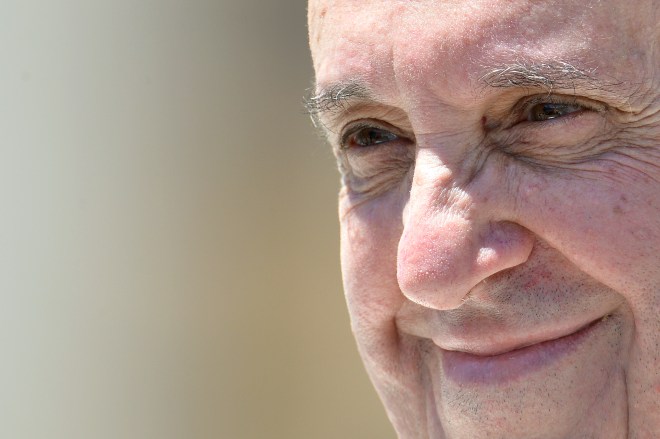
(Photo: Pope Francis smiles after his weekly general audience in St Peter’s square at the Vatican on June 12, 2013. By Alberto Pizzoli/AFP/Getty Images)


When God Grew Up

Michael Tolkin spots this provocative passage from Walter Kirn’s My Mother’s Bible:

Why did God take so long to post the rules, allowing his children to blunder about in darkness between their expulsion from Eden and Moses’ time? It seems so cruel, this interlude of anarchy [creation, Babel, flood, slavery] that left human beings to their own devices and caused them to be cursed, cast out, and slaughtered when their trial-and-error search for answers went awry. Why not reveal the Ten Commandments to Adam, say, so he could teach them to his poor son, Cain? Why for so long did the Lord require his children to read his mind instead of his stone tablets? Maybe it took him a while to know his own mind. Maybe, that is, God’s will didn’t properly exist until human beings revealed it in the negative by confounding it in so many ways. By hovering over them while they lurched through history, God learned as much from his children, it seems possible, as they eventually learned from him. And the chief thing he learned was that he didn’t like it when they acted in ways that reminded him of himself.

Tolkin comments:

The God who surprises and fascinates Kirn is not the great and terrible Oz mocked by atheists; after creating the world, he can only affect it by suggestion, not by changing the rules that God himself put into motion. God’s miracles are limited in duration and scale, and nothing fundamental in creation is ever permanently reversed. God is everywhere at the beginning, and withdraws from conversation as the march across the wilderness comes to an end. Kirn isn’t surprised by the humanity of Adam and Eve or Abraham and Moses; it’s God’s humanity that fascinates him. When God speaks to Moses out of the burning bush and tells him to go back to Egypt and free the Hebrews, Kirn notes that Moses wants to tell the Hebrews who sent him, and therefore wants God to tell him his name, but God won’t do it; all he says is for Moses to tell them “I Am That I Am.” “Today it seems profound,” writes Kirn, “this answer, a great grammatical infinity loop… Considered in context, though, as a piece of dialogue, it strikes me as a joke. Before this, God either damned you or cursed you, but now he’s learned to pull your leg.” Kirn sees comedy in God’s game of inscrutability — “Maybe Jehovah’s crazy-making name is part of a longer ‘Who’s on first?’”

Notes On A Dirty Old Man

In an essay entitled “I Should Have Slept With Philip Roth” – an excerpt from her new memoir, On My Knees – Periel Aschenbrand describes an encounter with the famous author:

I was trying to make a good impression and sound mildly intelligent, so I started talking about French critical theory. This was definitely a gamble since I don’t actually know anything about French critical theory. Had I read “The Dying Animal” before I met Roth, I would have known this was a colossal waste of time. But I hadn’t read “The Dying Animal” before I met Roth because I hadn’t read anything by Roth before I met him. As it turned out, it didn’t really matter what I was talking about because Philip Roth spent the vast majority of the time I was with him alternately talking about his great love for cherries and staring at my tits.

While I was droning on about the great French feminist philosopher Monique Wittig, who is both famous and obscure enough that I thought I could get away with it, Philip Roth interrupted me, “I have a question for you.”

I was already formulating my answer. Yes, Mr. Roth, of course, I would be thrilled to have you write the foreword of my next book. I look at him expectantly, the way I imagine a dog would look at its owner right before the owner is about to fill its bowl with food. I was anticipating a very serious literary question.

Roth said, “Do you like cherries?”

Trying not to skip a beat, I licked my lips and batted my eyelashes. “Who doesn’t like cherries?” I asked as I smiled sweetly.

Roth got a devilish twinkle in his eye, “Would you like to taste one of my cherries?”

He pierced a cherry with his fork. I opened my mouth, and Philip Roth, one of the greatest writers maybe ever, popped a cherry into my mouth.

“Mmmmm,” I said, as I smiled at him, “Delicious!”

It was actually revolting. The cherries were preserved in some heavy, sugary red liquid. They tasted like cough syrup. But hey, who was I to ruin an old man’s good time?

Love, Divided

In an interview, Christopher Bram, a novelist and author of Eminent Outlaws: The Gay Writers Who Changed America, describes the tension that animates much of his work:

One theme that appears again and again is the conflict between big love and little love. The phrase was coined by my friend Mary Gentile, who went to college with me and has been one of my best readers and toughest critics. Mary recognized early that my characters are often torn between their love for something personal and immediate and love for something larger and more difficult. In Surprising Myself, Joel finds himself divided between love of sex and self and his love of his partner, Corey. In Gossip, Ralph is torn between political loyalties and his affection for a closeted Republican. And so on. Sometimes the larger love is just plain wrong, as in Hold Tight, where Hank Fayette, a white sailor from Texas, has no trouble accepting his homosexuality but is angrily confused when he falls in love with a black man, the smart-mouthed Juke. He feels his very identity as a white man is being thrown into doubt.

I’m not sure where this pattern originated in my work. It might come from my experience as a gay person: all of us must learn to choose between what we were taught to feel and what we really feel. Or maybe I just read too much George Eliot in college.

How he writes about sex:

Sex is as important as laughter for me in storytelling. Well, it’s another part of my realism. Sex is not just a sensuous act, but an expressive act, a dramatic act. People reveal a lot about themselves in bed. Or they can anyway. When it’s just sex, I usually skip over the act and say something like, “Afterwards they smoked cigarettes.” But when something in addition to lust is being expressed or worked out, I write a scene. For example, the first real sex scene in Surprising Myself isn’t until fifty or so pages in, when Joel and Corey have been together for three years. They have all these other bonds and memories and emotions, which crowd into bed with them. And Joel finds himself fantasizing about all the guys he didn’t sleep with. He is both confused and excited.

You’re right; people rarely talk about the sex in my novels, but I suspect that’s because so much else is going on. The sex is blended with the rest of life. In novels by, say, Edmund White or Alan Hollinghurst, there’s often not much else going on except sex, so readers really notice it.

Focusing Our Revision

“[I]n most parts of literary culture, revision has become as important as inspiration,” writes Craig Fehrman, who traces the current role of revision back to two influences – Modernism and the typewriter:

Most Modernist writers, like Hemingway with The Sun Also Rises, wrote by hand and then painstakingly typed up the results. That took time, but seeing their writing in such dramatically different forms—handwritten in a notebook, typed on a page, printed as a proof—encouraged them to revise it aggressively. “Much as I loathe the typewriter,” W.H. Auden wrote, “I must admit that it is a help in self-criticism. Typescript is so impersonal and hideous to look at that, if I type out a poem, I immediately see defects which I missed when I looked through it in manuscript.”

Twenty-first century technology has made revising easier than ever – maybe even too easy:

Today, most of us compose directly on our computers. Instead of generating physical page after physical page, which we can then reread and reorder, we now create a living document that, increasingly, is not printed at all until it becomes a final, published product. While this makes self-editing easier, [scholar and The Work of Revision author Hannah] Sullivan thinks it may paradoxically make wholesale revision, the kind that leads to radically rethinking our work, more difficult.

“The ideal environment for revision is one where you can preserve several different versions of a text,” Sullivan says. With only one in-progress draft on a computer, we lose the cues that led the Modernists to step back from their work and to revise it. “It’s that moment of typing things up that led to the really surprising and inventive changes,” Sullivan says. “The authors came back to their text, but it seemed estranged.”

On Literary Translation

In a classic New Republic essay from 1941, Vladimir Nabokov expounds on the necessary qualities of the good translator:

We can deduce now the requirements that a translator must possess in order to be able to give an ideal version of a foreign masterpiece. First of all he must have as much talent, or at least the same kind of talent, as the author he chooses. In this, though only in this, respect Baudelaire and Poe or Joukovsky and Schiller made ideal playmates. Second, he must know thoroughly the two nations and the two languages involved and be perfectly acquainted with all details relating to his author’s manner and methods; also, with the social background of words, their fashions, history and period associations. This leads to the third point: while having genius and knowledge he must possess the gift of mimicry and be able to act, as it were, the real author’s part by impersonating his tricks of demeanor and speech, his ways and his mind, with the utmost degree of verisimilitude.

What not to do:

The … sin of leaving out tricky passages is still excusable when the translator is baffled by them himself; but how contemptible is the smug person who, although quite understanding the sense, fears it might stump a dunce or debauch a dauphin! Instead of blissfully nestling in the arms of the great writer, he keeps worrying about the little reader playing in a corner with something dangerous or unclean. Perhaps the most charming example of Victorian modesty that has ever come my way was in an early English translation of “Anna Karenina.” Vronsky had asked Anna what was the matter with her. “I am beremenna” (the translator’s italics), replied Anna, making the foreign reader wonder what strange and awful Oriental disease that was; all because the translator thought that “I am pregnant” might shock some pure soul, and that a good idea would be to leave the Russian just as it stood.

(Hat tip: buzzwords)

The Afterlife Of A Manic Pixie Dream Girl

8647054660_dea68a2106_o

Laurie Penny describes her former life as a MPDG:

I had the raw materials: I’m five feet nothing, petite and small-featured with skin the color of something left on the bottom of a pond for too long and messy hair that’s sometimes dyed a shocking shade of red or pink. At least, it was before I washed all the dye out last year, partly to stop soulful Zach-Braff-a-likes following me to the shops, and partly to stop myself getting smeary technicolor splotches all over the bathroom, as if a muppet had been horribly murdered.

And yes, I’m a bit strange and sensitive and daydreamy, and retain a somewhat embarrassing belief in the ultimate decency of humanity and the transformative brilliance of music, although I’m ambivalent on the Shins. I love to dance, I play the guitar badly, and I also–since we’re in confession mode, dear reader, please hear and forgive – I also play the fucking ukelele. Truly.

Penny dropped the identity “about the time I got rid of the last vestiges of my eating disorder and knuckled down to a career”:

I became successful, or at least modestly so–and that changed how I was perceived, entirely and all at once. I was no longer That Girl. I didn’t have time to save boys anymore. I manifestly had other priorities, and those priorities included writing. You cannot be a writer and have writing be anything other than the central romance of your life, which is one thing they don’t tell you about being a woman writer: it’s its own flavor of lonely. Men can get away with loving writing a little bit more than anything else. Women can’t: our partners and, eventually, our children are expected to take priority. Even worse, I wasn’t writing poems or children’s stories; I was writing reports, political columns. …

[I]n the real world, the very worst thing about being a real-life MPDG is the look of disappointment on the face of someone you really care about when they find out you’re not their fantasy at all–you’re a real human who breaks wind and has a job.

(Photo: Manic Pixie Dream Girl LARP character sheet by Colin Fahrion)

The Inner Lives Of Animals

Brandon Keim investigates the field of animal consciousness:

The whale biologist Shane Gero is part of a research team that has conducted long-term sperm-whale studies off the island of Domenica in the Caribbean. These studies describe the dynamics of whale families in which children are, in a very real sense, the centre of their lives. Yet Gero told me of being chastised by colleagues for referring to animals by name rather than number. Pressure still exists to think not of individuals, but of general species traits that happen to be manifested in a particular animal. Gero has helped to decode the vocalisations that sperm whales might use as names, something that’s also been observed in dolphins, but this remains controversial.

That’s why a visitor to the ‘Whales: Giants of the Deep’ exhibition at the American Museum of Natural History in New York can learn a lot about their skeletons, heart capacity and navigational abilities, but barely anything about their intelligence and social lives — arguably the most dynamic area of contemporary cetacean research. …

[I]n some respects the general public outpaces much of the scientific community, at least when it comes to the familiar animals we live with and know well. All those cute cat videos, reliably mocked as a symptom of our unintellectual internet habits, bespeak our era’s willingness to acknowledge the inner lives of companion animals. Not that they’re tiny humans in kitten suits, of course — indeed, part of the fun in knowing a cat (not to mention watching those videos) is the obvious disparity between their view of the world and our own. But neither are they entirely incomprehensible, per Ludwig Wittgenstein’s enigmatic statement: ‘If a lion could speak, we would not understand him.’ Wittgenstein probably never saw a pair of lion cubs at play.

The Ethics Of Editing Reality TV

Reality television producer Troy DeVolld talked to the AV Club:

TDV: Like with journalism, it’s choosing your moments, choosing what to discard, being able to rearrange that order. Timelines are a big thing in reality TV. Over the course of four months, you’re trying to find six or eight scenes that relate to each other that you can make an episode out of.

AVC: Is a “Frankenbite” another way reality shows condense timelines?

TDV: A Frankenbite, by definition, is just when you take original spoken material and you cut it into a smaller, or different, version of itself. There’s a big difference between the Frankenbiting that you’re probably thinking about most often and the Frankenbite that actually has to happen for a show. If I say, “Yesterday I went to the mall, I bought a lemonade, I rode the kids’ train, and then I bought a pair of pants,” but all I needed to know is there’s a pair of pants, I will Frankenbite it down into, “I went to the mall and I bought a pair of pants.” Because after all, a reality show’s only half an hour to an hour long, and you can’t have somebody, every time they open their mouth, take 20 or 25 seconds to relay the thought. So Frankenbiting should be for the compression of time.

When you are Frankenbiting for the purpose of making someone say something they didn’t say, then there’s a whole ethical thing that comes into play, which is you don’t want someone to say something that isn’t authentic to their character.

But I could take that same sentence that says, “Today, I went to the mall and bought pants” [and say], “Well, there was a scene where she went to a boutique, and it wasn’t at the mall, and I want to set up the top of the scene. And somewhere else she says, ‘My friend at the boutique.’” I could say, “Today I went to the [cut] boutique [cut] and bought pants.” So I’m changing the location. I’m not doing anything sinister. It’s sort of mixing the spackle to hold the show together without having to redo the interviews.

AVC: Do you think you’re held to a different standard of authenticity because it’s a visual medium?

TDV: Exactly. You can’t see the ellipses in reality TV when we’re putting portions of a thought together. So many people are sloppy as bejesus about it. You just hear the shift in pitch when people are speaking. …

AVC: But you’re not actually putting words in their mouths?

TDV: No. In a scene, I might have to say, “Can you guys please have a conversation about what happened last Thursday, because I can’t make sense of these two scenes without you talking about how you got from this point to this point; something happened off-camera.” There are certain things you’re going to have to ask for. Interview content is a little bit different, because there are some people that come in and they’re like, “What do you want me to say?” It’s like, “Well, I want you to answer these questions.” So whenever I write questions for people, I always start with the phrase, “If this is true…” because you’re going to drive the person bananas if you’re like, “So, tell me about how much you hate so and so.” Then they shut off, and they don’t want to work with you anymore.

Previous Dish on reality TV here, here, and here.