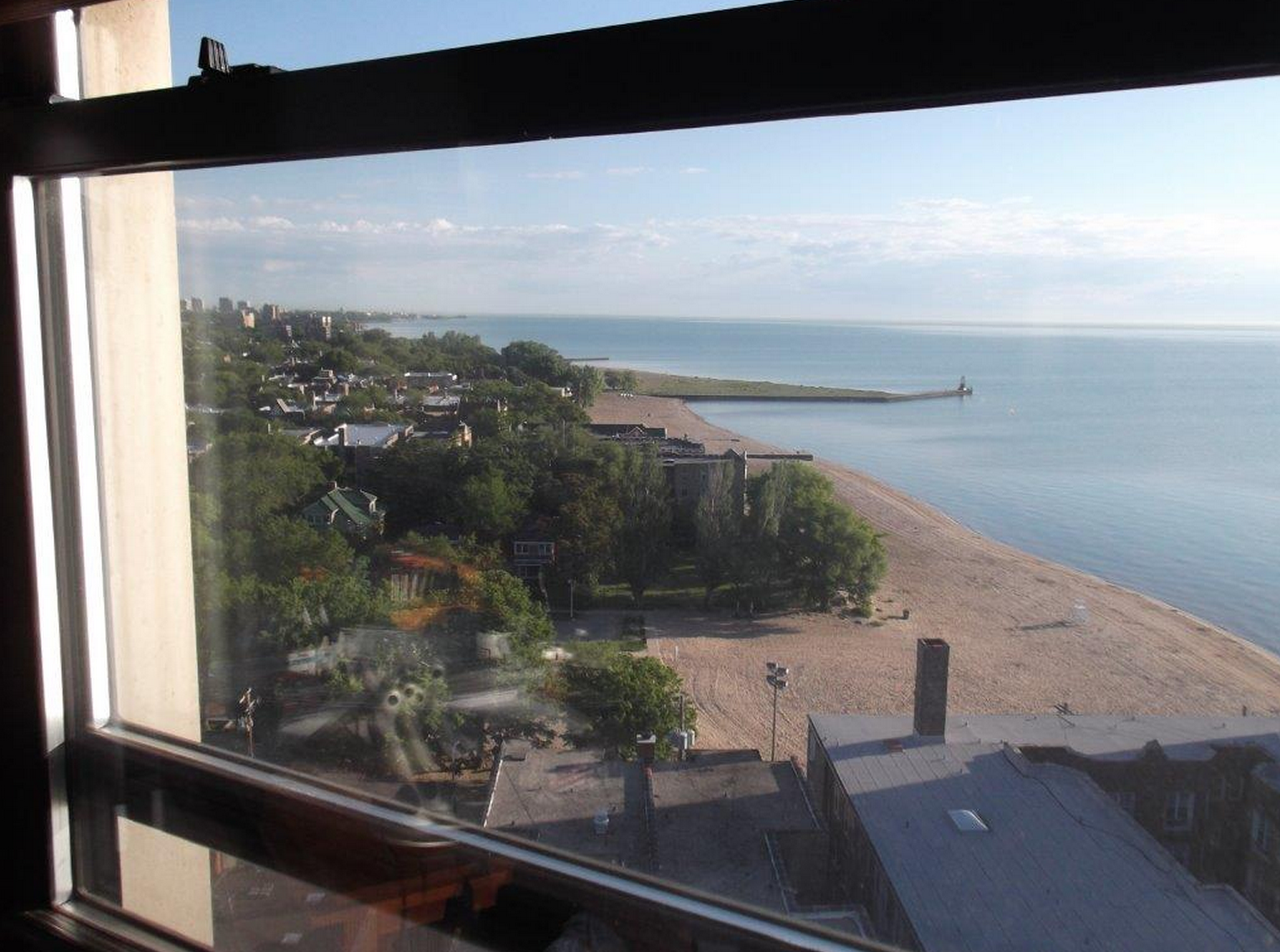
The View From Your Window Contest: Winner #159

Screen Shot 2013-06-22 at 9.39.07 AM

A reader writes:

Deciduous trees of some sort, mechanically raked beaches, the characteristic look of white lifeguard stands and jetties jutting out into the ocean, and something about the quality of the light on the water all say “New Jersey beach” to me. The big hotels of some sort in the back ground, suggest North Jersey, rather than South Jersey. I’ll take a flyer and say it is Ocean Grove.

Another:

Playa del Carmen, Mexico? The long jetty has changed in the 20 years since I was last there. And there’s much new construction near the beach, but the look is much the same.

Another:

That sure looks a lot like the “seedier” part of Malibu, near Pacific Palisades and just north of Topanga Canyon. Catalina peeking over the horizon to the right. I think I parked in that parking lot in the foreground on many an occasion in the ’70s.

Another gets on the right track:

I live on Lake Michigan, and this just screams large, inland lake.  Reminiscent of Rust Belt.  Could be any lakeside area in an arc starting at Buffalo, NY westward, and up to Duluth, MN. How about Erie, PA?

Another locates the right city:

The window latch looks American (I had one similar in Texas many years ago, never have had overseas); the architecture looks vaguely New England to me; the beach feels like a lake (not enough protection for it to be the ocean or a large sea), but for it to be a lake it has to be a large lake because you can’t see the opposite shore. Putting that together led me to the Great Lakes. The empty beach and calm waters make me assume it’s early morning – thus the shadows mean we’re looking north on a western shore.

So then it was a matter of searching Google Earth for a beach front with a uniquely shaped breakwater and high rise buildings in the background. After a lot of trail and error, that led me to the Loyola University Lake Shore Campus, where I was able to find Santa Clara Hall (the building in the right foreground with the square chimney and unusual atrium. I’d like to figure out the actual building, but I’m in Laos and my Internet is dodgy and I can’t get street view to open, so this will have to do: Loyola University Lake Shore campus in Chicago, looking north over the Santa Clara Hall.

Another sends an aerial view:
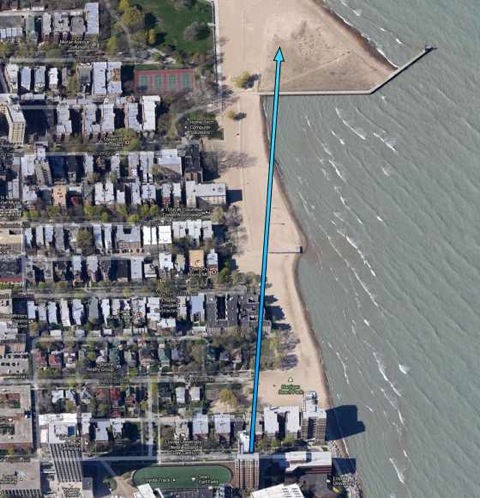
view-jetty

Another reader:

I recognized this view immediately! I lived in Chicago about 15 years ago, when my daughter was born, and we used to visit Rogers Park often. Our close friends lived a few blocks away in a rental on Pratt, overlooking the beach. It was one of the few affordable lakefront areas left. Love it there.

This is a view to the north from the Campus Towers apartment building at 1033 W. Loyola Ave., adjacent to Loyola University. It’s from a window at the front of the building, on about the 8th floor, with a slight northeast angle. That’s Hartigan Beach (though people tend to refer to the beaches informally by street names, and the part we see is at the end of W. Albion), one of a string of public beaches along Lake Michigan run by the Chicago Park District. The Rogers Park neighborhood borders Evanston, IL. If you follow the shoreline and go a bit inland, the small cluster of tall buildings you see through the upper left of the window is in Evanston.

I haven’t made a VFYW guess in months (years?). But I did come close on a couple. I have my fingers crossed on this one, but I’m worried that anyone who’s ever been to Chicago is going to recognize it!

Another:

That is the pier with the light stretching out into Lake Michigan, taken from south. On the spit of land in the distance at the top left of the lake lies the Northwestern campus. You can walk right out the city from Pratt Boulevard onto the beach. A beautiful spot, and a fitting photo; I live just a few minutes’ walk away and must now say goodbye, as I am leaving Chicago after nine wonderful years.

Another angle:

image(2)

Another reader:

Other than the fact that this is the alma mater of Bob Newhart, I have no stories about the North Shore of Chicago. But I do have a story about how many of these window views I’ve identified:

#33 — Double bay in Sydney, but that was before I realized we had to identify the very window. And I e-mailed it to the Andrew’s address, not the contest.
#40 — Mission Bay, San Diego. Got the resort right, misidentified the porch one cottage to the right.
#76 — MS Galaxy of the Tallink Silja Line docked in Stockholm (won it, got the book, thank you.) 11/12/2011
#125 — Balmoral Lodge, Queenstown, NZ 10/20/2012
#131 — Glen Drive, Sausalito, CA 112/4/12
#142 — The Hotel Captain Cook, Anchorage, AL 2/23/13 (off by one floor. Damn!)
#157 — Tom-na-Criege Lodge in Onich/North Ballachulish, Scotland (too easy, I know)
And this one.

I know, as a previous winner, I’m not eligible to win, but going through the archives to get the right numbers of each brought back so many memories of fun Saturdays chasing some of these. I haven’t had time to go after all of them but this is a great game to play.

Another view:
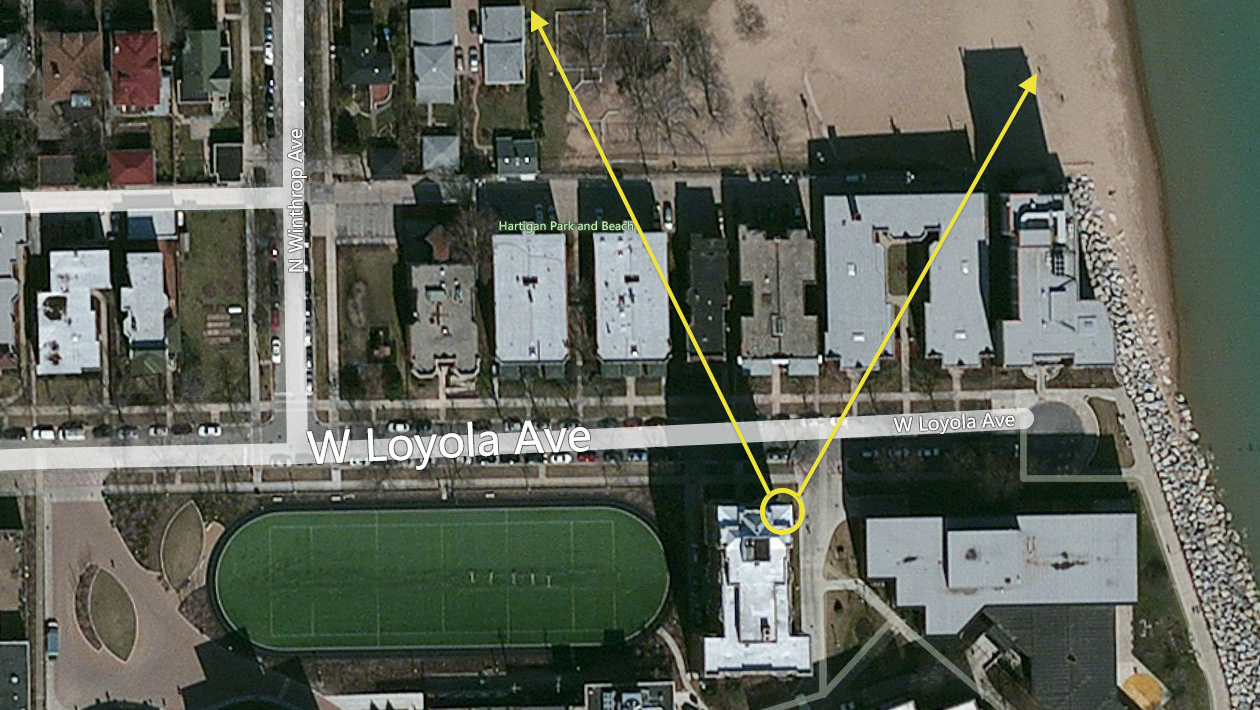
6-22-13 vfyw2

Regarding the track seen above:

As an alumnus of Loyola University Chicago this week’s photo looked immediately familiar.  The picture is taken from the Campus Towers at 1033 W. Loyola – looking north to Hartigan Beach.  I ran cross country and track at Loyola.  At the beginning of the school year our morning workout would be to run two miles north along Lake Michigan to the Evanston border and back to campus – ending at Hartigan Beach where we would finish with push-ups and sit-ups.

The field next to Campus Towers is named for my former teammate and friend, Sean Earl, who died from cancer in the year 2000 at the age of 21.  Sean was a walk-on to the Cross Country team.  He didn’t have a lot of talent – in fact he struggled to make it through that easy four-mile run before the workout on Hartigan Beach for the first month of his freshman year.  But he didn’t give up.  He squeezed every bit of potential out of his body – a body which had a tumor that had been there since he was born – and yet wasn’t found until his junior year.

As you know, losing someone close to you when you’re young changes the way you see the world.  Thanks for providing a reason to think about him.  Thinking of him reminds me about what’s important in life.

On a more mundane note, another reader gets the right floor:

Well I think it’s just dumb luck that I figured out this week’s VFYW. With just a random sense that I was looking at one of the Great Lakes (not that I’ve ever been), and knowing that a view from that high up meant that the window was in or near a city, I started scrolling around Google maps until I stumbled across the Chicago geography that we’re looking at. Specifically, we’re looking north from the Campus Towers Apartment Building on Loyola University’s campus. The exact address is 1033 W. Loyola Avenue. Given the slant of the window and the positioning of the photo, I know we’re looking out of the furthest east window on the north side of the building. I’ll guess the 13th floor, since in every previous entry I’ve guessed too low, and the 13th floor appears to be one of the top floors in the building.

Only one other reader matched that accuracy, but this one breaks the tie by having correctly guessed a difficult view in the past:

Seemed pretty clear this was North America, based on the style of some of the buildings. My first thought was East coast, but the beach seemed too small and the water too calm to be the Atlantic. That left one of the Great Lakes. Seems to be taken from a rather tall building, given that the window is quite a bit above the surrounding 3 and 4 story structures. One house in particular reminds me of style of house that my grandfather built and lived in in the early part of the 20th century in Chicago. So that is where I started looking. It didn’t take long to zero in on the area near Loyola University, where the shore and jetty match the VFYW image perfectly. The picture was taken from the Campus Towers apartment building, at 1033 West Loyola Avenue.

Getting the window needs a bit more effort. The building has two distinctive sort of bay window shapes in the front. Given the angle of the window in the VFYW image, the picture was taken from one of the two columns of windows that angle toward Lake Michigan. The view also aligns almost perfectly with the structure/shape on the roof of the building across the street, which means that the image was taken from the bay windows on the lake side of the building.

Now comes the WAG (Wild Ass Guess) – which floor. I am going to guess the 13th floor (do buildings have a 13th floor?) counting the ground floor as 1. I circled the window in the street view below:

chicago2

I have erred on the low side in the past, this time I am probably too high.
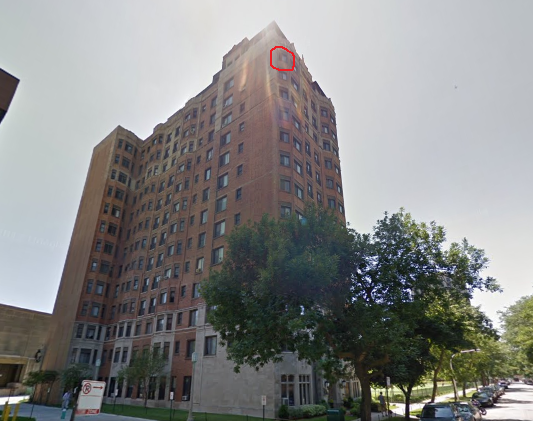
Not this time. One more reader:

Unlike previous entries now I have a story and a connection. I am so excited that I can hardly type this, but here goes. This is from Rogers Park in Chicago, until very recently my neighborhood. It is the far north of the city, just a few blocks south of Evanston (visible, barely, as the tip of Northwestern’s lakefront campus in the far distance). The picture is taken from (probably) the 9th floor or 10th of 1033 W Loyola Avenue (remember that most buildings in Chicago use the European system of numbering floors: ground, 1, 2, etc.) and your source is likely a student at Loyola.

I walked my dogs past this building every day for years and lived just a few blocks away with my partner. In the picture you can just almost see the roof of the building where we met at a New Years Eve party in 2001. You can see the “lighthouse” (a small navigation light that everyone calls the Lighthouse) on the end of the pier off of Loyola Park. It is a great place to take a date on a summer’s night for a walk and a kiss. You can see the tennis courts that some dog owners use as a fenced-in poop-zone and playground (I say this as a dog owner who never did that.) You can see the spot on the beach that needs to have all of the broken bottles and glass cleaned up before I will go out there again in bare feet (all helpfully marked on my annotated map.)

This is an area of Chicago that should be in much better shape. There is a great sense of community here, a lot of quirky shops, and a lot of neighborhood sponsored street art. People who live in Rogers Park tend to love, passionately, this offbeat neighborhood. The area around Loyola University (the location of the window) anchors the south of this wonderful neighborhood and gives the area a touch of campus life. There is a great world to explore in this photograph.

And yet the crime and violence is increasing and no one seems to be able to do anything about it. Just this past week a favorite bar a few blocks north saw the brutal beating of a regular who tried to stop a fight. Locals are worried that this sort of thing will get out of hand and a great neighborhood collapse into the crime and violence of more challenged neighborhoods of Chicago. It will take some effort and attention to save a wonderful neighborhood.

I am excited to see a neighborhood that I love in the contest. I love the idea that some of your readers will have the surprising realization that Chicago has many miles of wonderful beaches. That brings me a big smile.

(Archive)
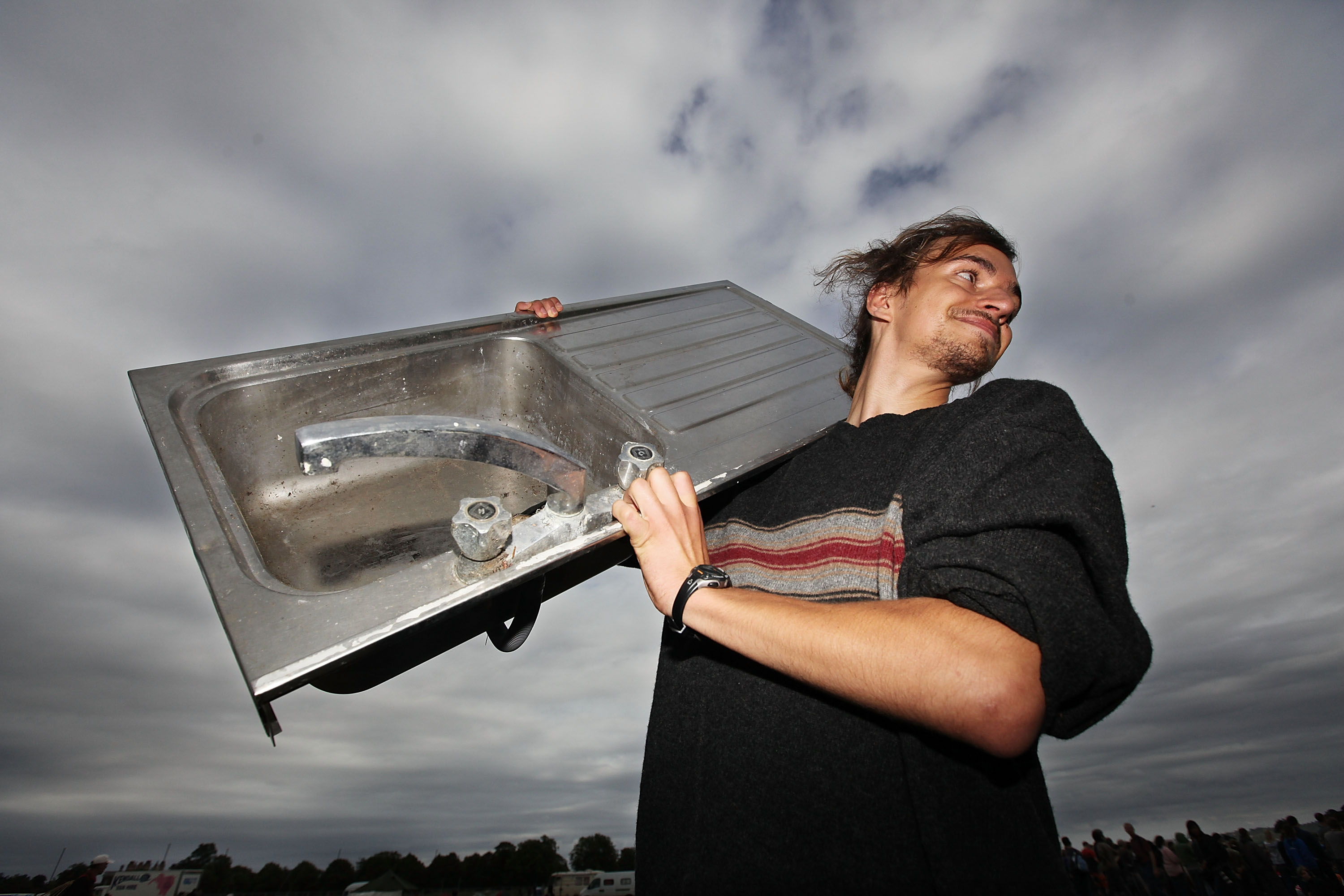
Throwing The Kitchen Sink At Climate Change

Climate Change Campaigners Begin A Week Of Direct Action Camps

Ryan Koronowski outlines the main talking points from Obama’s climate speech at Georgetown University, which will take place later this afternoon:

The plan, according to senior administration officials, has three pillars: cutting carbon pollution in America, leading international efforts to cut global emissions, and preparing the U.S. for the costly impacts of climate change. President Obama will frame action as a moral obligation to do what we can for “the world we leave our children.”

Executive action remains one of the only serious avenues left to cut greenhouse gas emissions — a recent National Academy of Sciences report found that the U.S tax code is not currently doing it, and congressional action still looks unlikely. Jay Carney, White House Press Secretary, said in his briefing Monday that the president’s view “reflects reality.” Carney said “we’ve seen Congress attempt to deal with this issue and fail to.”

Brad Plumer calls the White House plan a “kitchen sink approach”:

The White House is asking the EPA to propose rules for those existing plants by the summer of 2014 and finish them by 2015. “It’s an aggressive timeline and everyone will have a strong opinion about it,” says a senior administration official. “And we’re focused on making sure there’s adequate time to engage key stakeholders here.” …

[T]he White House is pursuing a slew of complementary measures, too. For instance: The White House is hammering out an agreement with China and other countries to phase out hydrofluorocarbons (HFCs), a potent greenhouse gas used in everything from soda machines to many car air conditioners. The administration will also develop a plan for curbing methane emissions from natural-gas production. The Energy Department will set new efficiency standards for appliances and buildings. The Interior Department will try to speed up wind and solar development on public lands. Foreign-aid agencies will cease financing coal plants overseas (except when there are no possible alternatives).

Molly Redden, meanwhile, previews the coming legal battles over any EPA action:

“There is no end to the legal creativity of the regulated industry,” said Lisa Heinzerling, a professor of environmental law at the Georgetown University Law Center. David Hawkins, director of climate programs at the Natural Resources Defense Council, agreed. “Virtually every rule that the EPA adopts under the Clean Air Act,” which the Obama administration will use to regulate power plants, “is litigated. So the fact that it’s litigated doesn’t say a thing about the strength of polluters’ legal arguments,” he said.

And yet, as Simon Lazarus and Doug Kendall have pointed out for Grist, any challenge to new regulations would wind up before the U.S. Court of Appeals for the D.C. Circuit, where conservative appointees hold a majority. And the threat of a court decision against them has already cowed the EPA into delaying its rules for new power plants earlier this year.

Jonathan Cohn considers the implications for international climate policy:

The U.S. and other nations have agreed to finalize a climate agreement in 2015, at another upcoming summit. If, by then, the U.S. is on track to fulfill its previous pledge, other nations might be more inclined to agree to more reductions of their own. Many experts believe that round of international negotiations represents the next, and maybe the last, great chance to avoid some serious and potentially devastating changes to the climate—among them, more severe weather like droughts, floods, and storms.

Philip Radford hopes the speech marks a beginning rather than an end:

[T]o truly meet his obligation to future generations, this must be the foundation – not the final act – of his climate legacy. The current Congress has made it clear that it will be on the wrong side of history, so it is absolutely vital for the President to use his authority to reduce power plant pollution, move forward with renewable energy projects on public lands, and increase energy efficiency. What the President will propose today is just a part of what it’s possible to do without Congress, and to solve the climate crisis, the solutions will have to be equal to or greater than the problem.

(Photo: A man poses for a picture with a kitchen sink at the Climate Camp on Black Heath on August 26, 2009 in London, England. By Dan Kitwood/Getty Images.)

Who Will Take Snowden In? Ctd

Mark Adomanis predicts Russia will pay a serious price for refusing to hand over Snowden during his time in Moscow:

As should be clear, Russia doesn’t actually gain anything from helping Snowden, all it does is expose itself to the full wrath and fury of every part of Washington officialdom. Unless you’re defending a national interest of the first order, exposing yourself to the full wrath and fury of Washington officialdom is a really stupid thing to do.

There’s no obvious principle at stake in the Snowden case, no real “interest” that the Russians are trying to defend: they’re just acting like jerks because they think they can get away with it. This is a foolish decision. Russia has never been popular in Washington and the Obama administration was barely able to prevent the Magnitsky bill from becoming a full-fledged diplomatic disaster (it did so largely by soft-peddling enforcement). How willing do you think the Obama folks are going to be to “defend” Russia when Congress inevitably starts debating additional sanctions or punitive measures? Do you really think they’re going to expose themselves to an endless array of bad press on behalf of a country that engaged in such calculated and deliberate antagonism?

In contrast, Max Fisher suggests that China thought it was doing the US a favor by sneaking Snowden out of Hong Kong:

White House spokesman Jay Carney lambasted the Hong Kong government for apparently aiding in Snowden’s flight to Moscow, saying that the “decision unquestionably has a negative impact on the U.S.-China relationship.” … Take a moment, though, to consider how this might look from Beijing. Typically, when the United States and China argue about transferring a high-profile and politically sensitive individual between their custodies, it’s a Chinese dissident whom the U.S. wants to grant asylum. Those cases are often perceived as deeply embarrassing for China, although Beijing has increasingly learned to live with them. Perhaps Chinese authorities saw this as a rare reversal: an American political dissident looking for asylum in Hong Kong, which despite its special status is a part of China. In the Chinese government worldview, granting asylum would have been the real slap to the United States.

More Dish on Snowden’s search for asylum here.

French Feminist Marxists Against Marriage Equality

On this issue, the left in France sounds … well a little like the American anti-marriage equality left of the 1990s. But with a new twist:

An important current of French thought, which has no real American equivalent, has maintained that while women deserve equal rights, these rights must not entail the supposed erasure of sexual difference. Historians and philosophers such as Mona Ozouf and Philippe Raynaud have seen a particular threat in American-style protections against sexual harassment, which they have labeled “sexual Stalinism.” The sociologist Irène Théry has called for a féminisme à la française that acknowledges the “asymmetrical pleasures of seduction.” The philosopher Sylviane Agacinski goes so far as to call sexual difference the true basis for sexual equality in law. …

This spring, precisely the same concerns have dominated the manifestos against “marriage for all” issued by groups of law professors and psychologists. And interviews with ordinary protesters have shown just how effectively the arguments of philosophers have filtered down to street level, with one figure after another explaining their opposition to the reform in the same way. To quote a popular protest banner: “Un père et une mère c’est élémentaire” (“A father and a mother is elementary”). And the 60 percent support for same-sex marriage has not changed the fact that a majority still favors banning child adoption by homosexual couples. In short, although religion and homophobia obviously fed into the recent protests, the rhetoric employed by the opposition has trickled down from the intellectuals (as one might, indeed, expect in France).

Will The GOP Kill Immigration Reform? Again?

Fawn Johnson expects so:

[T]he House is slogging along on a piece-by-piece approach that does nothing but stretch out the debate until all that’s left are wisps of ideas on work visas, local police enforcement, and electronic verification of workers. Indeed, the House might not kill the bill outright, but the GOP players are passing the ball around until the clock runs out.

Drum thinks the bill “depends entirely on the House leadership”:

If they decide they want to pass immigration reform and get it off the table for good, they can do it in four weeks. If they don’t want to, they can pretty easily fritter away the time. So we’re back to square one: do Republican leaders desperately want to put this whole thing behind them, regardless of the howling from the tea partiers, or do they care more about the backlash from their conservative white base than they do about picking up Hispanic votes in 2016?

Morrissey’s view:

There are two ways in which this gets bypassed. One is for John Boehner to simply put the Senate bill up for a floor vote, but his GOP colleagues would strongly resist that — regardless of whether it would pass or fail. Either way, it creates risk for Republicans, and they’d be better off developing their own version for Boehner to float. The other is to pass a more conservative comprehensive bill and throw it to a conference committee, but the House is so far away from that possibility (as Johnson points out) that it would have to be a shell bill.

Bouie thinks Republians are in serious trouble if the bill goes down in flames:

Latino voters don’t trust the Republican Party. Both because of their policies—hence President Obama’s three-to-one margin among Hispanics in last year’s election—and because of their rhetoric. According to a recent survey from Latino Decisions—a group that tracks and measures Latino public opinion—strongly worded statements against comprehensive immigration reform from Republican senators (in particular, Ted Cruz of Texas and Jeff Sessions of Alabama) harm the party’s standing with HIspanic voters. As Latino Decisions explains, “The results demonstrate that there is no ‘distancing from the party’ when it comes to the immigration reform bill and associated position-taking. It is perfectly reasonable that Latino voters view elected officials as spokespeople for their party, and either reward or blame them in similar proportion.”

Mataconis looks at a poll showing Rubio’s favorables dropping and a wider turning on him within the GOP:

it strikes me that the Republican/conservative (is there really a difference?) repudiation of a guy that they were all rallying behind just a few months ago is just another sign of the utter hopelessness of the GOP when it comes to immigration. One does not have to accept the Senate bill in full, indeed I’d argue that there are several provisions that I find problematic. However, the way legislating ought to work is that if you don’t like a bill then you propose alternatives and try to work out those differences through the legislative process. Instead, though, all I’ve seen from Senate GOP opponents of the bill are proposal after proposal designed more to appease their base with ineffective measures aimed at “border security” than to actually accomplish anything legislatively. In the House, meanwhile, it seems fairly clear that Republicans don’t want to act on immigration at all. In the end, it all points to reason to be pretty pessimistic about the future of immigration reform in the 113th Congress.

Dear Peggy, Your “Scandal” Just Evaporated

noonanBrendanSmialowski:Getty

It was the legitimate one: not the Benghazi bullshit or a surveillance program checked by Congress and the courts, whose secrecy was the scandal. This was the accusation that Barack Obama was Richard Nixon, ordering the IRS to target conservative – and only conservative – groups in their legitimate attempt to check on whether “social welfare” groups actually were just campaign machines. To give a sense of how far the Republican partisans went with this – completely unproven – allegation, let’s leave Darrell Issa behind, shall we? He’s such a creep he’d say anything anyhow to advance his own career.

Let’s go to one Peggy Noonan, once a relatively sane, if lugubrious, columnist for the WSJ. She’s been running around yelling Watergate for a while now, and just accused the president of an impeachable attempt to use the power of government to destroy his political foes:

One of the great questions about the 2012 campaign has been “Where was the tea party?” They were not the fierce force they’d been in the 2010 cycle, when Republicans took back the House. Some of us think the answer to the question is: “Targeted by the IRS, buried under paperwork and unable to raise money.” …

Think about the sheer political facts of the president’s 2012 victory. The first thing we learned, in the weeks after the voting, was that the Obama campaign was operating with a huge edge in its technological operation—its vast digital capability and sophistication. The second thing we learned, in the past month, is that while the campaign was on, the president’s fiercest foes, in the Tea Party, were being thwarted, diverted and stopped.

Technological savvy plus IRS corruption. The president’s victory now looks colder, more sordid, than it did.

And so she reaches back to her “Romney-Will-Win” pre-election mindset. He did. But it was stolen! Now check out how far the WSJ’s James Taranto has run with this Nixonian meme (yes, the right is now anti-Nixon, when it comes in handy):

Screen Shot 2013-06-25 at 10.22.18 AMNotice, en passant, that the WSJ is now indistinguishable both in party line and total hysteria from Fox News and talk radio (not that it’s ed-page was anything but extreme, but at least it was smart). Now check out the latest details from the IRS about 501 (c) 4 and 501 (c) 3 entities:

The instructions that Internal Revenue Service officials used to look for applicants seeking tax-exempt status with “Tea Party” and “Patriots” in their titles also included groups whose names included the words “Progressive” and “Occupy,” according to I.R.S. documents released Monday. … One such “be on the lookout” list included medical marijuana groups, organizations that were promoting President Obama’s health care law, and applications that dealt “with disputed territories in the Middle East.” … “Common thread is the word ‘progressive,’ ” a lookout list instructs. “Activities appear to lean toward a new political party. Activities are partisan and appear as anti-Republican.” Groups involved more generally in carrying out the Affordable Care Act were also sent to the I.R.S. for “secondary screening.” And “occupied territory advocacy” seemed subject to the most scrutiny of all.

So we begin to see the actual truth (and where it usually is, Page A14): the IRS was rightly scrutinizing a whole slew of new groups claiming to be all about “social welfare” and checking to see how politicized they were – on both sides. Most of those on the progressive side were seeking 501(c)3s – not 501(c)4s – so the parallel isn’t exact. But it sure suggests nothing of any malign nature here. Par exemple:

Ameinu, which on its website calls itself a “community of progressive Jews,” received its 501(c)(3) tax-exempt status on May 28 — five years after applying. IRS agents peppered the group with 18-page surveys and lingered for months without follow-up, Hiam Simon, national director of Ameinu, said in a telephone interview. He said he was looking at a 4-inch thick folder of Ameinu’s communications with the IRS. “I think they were painting with a broad brush, with worries about Middle East ties to terrorism,” he said of the IRS. “I don’t think it was caused by malice. Ignorance is too strong a word, too. They simply weren’t nuanced enough or careful enough.”

They’re not perfect, but this is the critical fact:

Werfel said his review of the agency’s actions hasn’t found evidence of intentional wrongdoing or involvement from outside the IRS. That’s consistent with the findings so far of congressional investigators.

So time’s up, Peggy. Put up or shut up – especially with the outrageous smear that the president was behind this. The IRS was trying to flush out bogus non-political groups on both sides. That’s what we pay them to do. Since the targeting used classic code words on right and left, it may have been unwise as an administrative policy, but it sure wasn’t illegal or scandalous. And you can see why, given the volume of applications, these might have been shortcuts to expedite the process.

I think this scandal just evaporated into thin air.

Please let me know if you find any right-wing outlets that have pushed this untrue story that are actually reporting on this new IRS data (this attempt by NRO is lame or needs further clarification); and whether – God help us – they are apologizing and correcting. Over to you, Mr O’Reilly. And Ms Noonan.

Where’s your Richard Nixon now? Breaking into Republican Party offices?

How Predictable Is Popularity?

Ozgun Atasoy describes a research experiment that explored the question:

As one would expect, when people are better connected, they tend to unite around popular decisions. But research also suggests that social connection — fostered by Twitter, say — also makes crowds fundamentally less predictable. With social media connecting people to an unprecedented degree, it is possible that the sudden emergence of unexpected collective action will be a defining feature of this era.

Matthew Salganik, Peter Dodds, and Duncan Watts conducted large-scale experiments to investigate the effect of the strength of social influence on collective action. People were given a list of previously unknown songs from unknown bands. They listened to the songs and downloaded them if they wanted to. In the independent condition, people did not see other people’s choices. In the social influence condition, people saw how many times each song had been downloaded by others. The collective outcome in the social influence condition was more unequal. That is, popular choices were much more popular under social influence. When the researchers increased the strength of social influence by displaying the songs in a table ordered by popularity, the collective outcome became even more unequal.

After the events around Gezi Park unfolded, there were attempts at explaining why they happened. Events seem inevitable retrospectively. But the truth is most people did not know that the uprising was coming. But was it knowable? In other words, could a sophisticated observer accurately predict the events?

Salganik, Dodds, and Watts looked at the collective outcomes in eight different “worlds.” That is, eight separate groups of people downloaded songs under social influence. The collective outcomes in different “worlds” were different. Even though people in different “worlds” were indistinguishable and they did the same task under the same conditions, the collective outcomes were different. When the researchers increased the strength of social influence, the collective outcome became even more unpredictable. That is, the difference between the popularities of a given song in different “worlds” increased as the strength of social influence increased. Apparently, in collective decisions there is an inherent unpredictability that cannot be resolved by carefully examining the initial conditions and decision makers. Stronger social influence results in more unpredictability.

“The Burmese bin Laden”

MYANMAR-UNREST-RELIGION

Max Fisher profiles the “spiritual leader” behind the violent anti-Muslim movement escalating among Buddhists in Burma:

[Ashin] Wirathu calls himself “the Burmese bin Laden” and was recently labeled on the cover of Time magazine as “the face of Burmese terror.” A prominent Burmese human rights activist, after a lifetime of fighting government oppression, now warns that Wirathu’s movement is promoting an ideology akin to neo-Nazism.

Already, the movement has expanded beyond this one self-styled radical Buddhist monk. It’s now expanding across Burma (also known as Myanmar) according to [a NY] Times article. The anti-Muslim sentiment has spread with alarming speed over just the last year, as Burma – which is finally opening up after years of military dictatorship – loosened its strict speech laws. It has prompted boycotts and sermons that can sound an awful lot like calls for violence against Muslims. Monasteries associated with the movement have enrolled 60,000 Burmese children into Sunday school programs.

Walter Russell Mead points out that no one in government is condemning the content of Wirathu’s sermons:

He frequently suggests there is a conspiracy afoot to turn Burma into a Muslim country, that Muslims will overrun “good” Buddhists, force them to convert to Islam, and steal their women and daughters and jobs. In his sermons, heard by thousands of people across the country, he describes violence against Muslims, like the massacre of children in Meiktila in March, as a show of strength.

Nevertheless, President Thein Sein lept to Wirathu’s defense, labeling him a “son of Buddha” and a “noble person” in an official statement. He made no mention of Wirathu’s hate-filled speeches, nor the rampaging mobs that burned and slaughtered their way through Muslim neighborhoods on several occasions earlier this year. As of this writing, celebrated human rights activist and Nobel Laureate Aung San Suu Kyi—whose earlier criticism of violence against Burmese Muslims was pretty weak, at best—has neither defended nor attacked Wirathu.

(Photo: Wirathu attends a conference about the religious violence that has shaken the country at a monastery on the outskirts of Yangon on June 13, 2013. By Ye Aung Thu/AFP/Getty Images)

Should We Maximize The Minimum Wage?

Nick Hanauer wants to raise it to $15:

True, that sounds like a lot. When President Barack Obama called in February for an increase to $9 an hour from $7.25, he was accused of being a dangerous redistributionist. Yet consider this: If the minimum wage had simply tracked U.S. productivity gains since 1968, it would be $21.72 an hour — three times what it is now.

Felix is on board:

There are surely some US jobs which simply aren’t economic at $15 per hour, and those jobs will end up being lost. (In aggregate, as I say, raising the minimum wage is probably good for employment, but the extra jobs at employers taking advantage of all that extra spending aren’t going to be in the same places as the jobs lost at employers who can’t afford to pay that much.) But the point here is that the US has already done a spectacularly good job of exporting most of its exportable low-wage work. As Hanauer says, “virtually all of these low-wage jobs are service jobs that can neither be outsourced nor automated”. As a result, raising the minimum wage will result in many fewer job losses now than it would have done a couple of decades ago.

Dylan Matthews, who isn’t necessarily opposed to small increases in the minimum wage, thinks that a $15 minimum wage is a “terrible idea”:

The evidence we have on the effects of minimum wage increases, [economics professor Arindrajit Dube] notes, are “limited to a historical period where statutory minimum wages have ranged between roughly 35% and 50% of the national median wage.” Hanauer’s proposal would put the minimum wage at roughly 75 percent of the national median, which Dube notes would put it higher than any OECD country, including several European social democracies. “We just do not know what a $15/hour minimum wage would do based on the type of careful research designs that have become the hallmark of modern labor economics, and ones I strive to use in my work,” Dube writes in an e-mail.

Matthews’ bottom line:

There’s a case to be made that mild increases in the minimum wage are worth it, either because one doesn’t believe in employment effects or because one believes the wage increases it causes are worth it. But Hanauer’s proposed increase is recklessly large and even supporters of minimum wage hikes don’t think it’s a serious option.

Brazil Is Still Broiling

Another update to the stellar coverage provided by Dish readers, this one from São Paulo:

Fortunately, even though the initial demands by the protesters have been met (the transit fare has returned to its previous level), the protests have continued. In fact, they are showing this amazing level of self-organization. Groups will march together and decide which route to follow, where to stop and chant, where to sit and block the street, etc. There will be announcements about when and where the next protest will happen, and once the end time is reached, the protest will end.

There have been protests for various things, the largest being against PEC 37, which if passed, will make it much harder to catch and convict wrong doers within the government (involved in corruption, the horrors of the military government, etc).

Among the other protests, there was a protest against the Cura Gay (Gay Cure), which if passed would allow psychiatrist/psychologists to offer treatments to those who want to cure their same-sex attraction. This has been outlawed by the government since 1999, as its fraud, the treatment does not exist, and the acceptance of it sends the wrong message. Keep in mind that a poll done asking whether Brazilians thought the law should be passed found that 49% did not believe it should be passed, 36% felt it should and 11% had no opinion. (I have been desperately searching for where I read these numbers, but haven’t been able to find the link.) Also, unlike the US, same-sex marriage is legal and is recognized by the federal government.

Of note, if the Cura Gay legislation is passed, gays may be able to retire or I suppose go on paid disability as they are “sick.” !!!!  Here’s the link. The Cura Gay is being pushed by Marco Feliciano, who is a Deputado Federal (roughly equivalent to a congressman in the US) and who is involved in the Assembleia de Deus (Assembly of God), one of the powerhouse churches of Brazil’s increasingly popular evangelical movement.

After the jump is a longer update from our reader. Meanwhile, Colin Snider pushes back against critics of the protesters:

As is all too often the case amongst neoliberal analysis, they falsely equated growth to development. Sure, Brazil’s economy had grown, but it also retained one of the higher levels of income inequality in the world. … Brazilians had been told for ten years that things had improved, that Brazil had finally “arrived,” and that they were now enjoying material and social benefits that they’d always been excluded from. And in some ways, there were real gains in the 2000s – the purchasing power of the working class and middle class strengthened somewhat, and programs like Bolsa Familia and Fome Zero helped millions of poor families. But at the first sign of economic instability, it all threatened to come apart… .

James Greiff refers to such insecurity as “the middle-class illusion” in Brazil:

Millions of Brazilians have indeed made it into the middle class and enjoy the trappings of a lifestyle that would be recognized by their economic peers in the U.S., Japan, Canada and most of Europe. They have iPhones and SUVs, Nike sneakers, Oakley sunglasses, take overseas vacations, enjoy imported delicacies, get braces to straighten teeth and plastic surgery to mask the wear of time.

They enjoy much of this material plenty, though, inside a personal-security bubble. Houses are fortified behind high walls topped by broken glass and barbed wire, while iron bars seal windows. Apartment complexes are similarly ring-fenced, with entranceways secured by guards, often bearing arms. These are needed not just to keep out robbers, but also so much else of what’s on the other side. Indeed, the middle-class illusion ends at the first step outside the front door.

And Joshua Tucker observes:

As Brazilians move into or climb up the middle class, they inevitably pay more in taxes – yet they also inevitably grow increasingly aware that they do not get their money’s worth. One commonly hears Brazilians complain that they pay “1st world taxes” – about 36% of GDP – but receive “3rd world services” in return. The protests thus represent growing frustration that established political parties are unwilling to implement reforms on both sides of the fiscal coin – to improve public services (particularly healthcare, education, and public safety) and reduce corruption.

Marc Tracy sees the ongoing protests as an outcome of urbanization:

This process upended centuries of a static social order in which the majority were denied many rights. Brazil’s urbanization, then, was in one sense a major step forward for most Brazilians, providing, as Holston put it, “a new density of opportunity” that stemmed from the literal density of the way people actually lived.

But the dialectical result of this new density and these new nominal rights has been that as tremendous inequality has remained—and when it has been ostentatiously exacerbated by, say, hosting international prestige projects such as the World Cup Finals and the Summer Olympics—Brazilians in the satellite cities on the peripheries (and even poorer Brazilians in the favelas, the frequently illegal shanty towns which are almost like the peripheries of the peripheries) have grown angry that their economic rights have not caught up with their political rights.

When you add to this mix the fact that everyone now lives closer to each other—another opportunity borne of density—you have the recipe for these massive protests.

However, when comparing Brazil to Turkey, James Traub finds that the former has democratic institutions better able to handle such strife:

While [Turkish Prime Minister] Erdogan has demonized his foes, President Dilma Rousseff of Brazil has praised protestors for waking the country to its shortcomings. Brazil, too, faces a crisis, but not a crisis of representation, as Turkey does. Larry Diamond, a leading democracy scholar at Stanford, points out that both Rousseff and her Erdogan-like predecessor, Luiz Inacio “Lula” da Silva, had to do far more political bargaining than Erdogan because they rule through coalitions while Erdogan controls a parliamentary majority. And the reason for this, in turn, is that Turkish law excludes parties from parliament which do not win more than 10 percent of the national vote. The Turkish system enables Erdogan’s worst impulses. Working with rival parties might force him to learn a few hard lessons.

Another update from our São Paulo reader on the ground:

The protests and protesters here have been overwhelmingly peaceful and the police response has been largely peaceful for over a week. Following a series of protests in which the Policia Militar (they are the police force for this type of situation) were being very brutal and injured not only protesters but also passersby and journalists, the state governor Geraldo Alckmin, who controls the PM, told them to cool it. Since then, the front-lines of the PM who are following the protests are largely not carrying guns.

On Saturday night, at this protest I was following the police seemed to be in a good mood, at times were laughing along with the protesters. All this while the protesters were halting traffic on busy thoroughfares. Fortunately, many of the drivers seemed to be in favor of the protest, and were honking their horns and giving thumbs-ups. The difference that I saw between now and a week and a half ago is downright shocking.

In other parts of the country, however, the situation is completely different. While it seems that the vast, vast majority of protesters are peaceful and only want to engage in peaceful actions, the police response has been BRUTAL. In this report on Globo’s Jornal Nacional, one can see footage of the police response during a huge protest that occurred in Rio on Thursday June 20th. This was a huge protest with tens of thousands of people. At one end of the avenue were vandals who decided to attempt to break into city hall and do general damage to their local area. But the rest of the crowd were peaceful protesters, many of whom hadn’t even take part in a previous protest out of fear of violence. The way I have described it to my worried American friends is imagine a protest from Times Square to 72nd Street along Broadway. The crowd is peaceful, except for those between 70th and 72nd.

The police response was brutal. Instead of just focusing on the troublemakers (those between 70th and 72nd), they decided to just go bananas, shooting tear gas and rubber bullets at protesters along the length of the crowd. In Globo’s report, there were people who were just waiting for the subway station to be reopened who were targeted. I came across reports of canisters of teargas being shot into bars where people are not even taking part in the protests, and tear gas was apparently even shot into a hospital.

In addition, there was a report in which three “protesters” were picking fights, yelling at the police and punching the horses of the mounted policemen (horrible!). The peaceful protesters (who were apparently everyone else) demanded that the police arrest these three vandals, but the police apparently refused and decided instead to shoot rubber bullets and tear gas at the entire group. The report was indicating that the bad protesters were planted there by the police to give them an excuse to be violent. Apparently, reporters were there but are no reporting this event. Here’s the link.

The police forces should be maintaining security for the peaceful protesters, in my opinion. Many of the people who have hit the streets have come out because of disgust at the violent police response. Brazilians have the constitutional right to protest and on this point Dilma agrees. However, the situation outside of what I have seen in the city of São Paulo has not changed.

Anyway, I don’t know where this is going. What I do know is that politicians have been incredibly spoiled by a populace who felt largely disenfranchised and who had accepted that the government was corrupt, there was no way to stop it, and let’s just focus on football, novelas and Big Brother. That feeling of disenfranchisement seems to have changed.

In this poll by Folha de São Paulo, 66% of people think the protests should continue. The fact that two-thirds of Paulistanos think the protests should continue is amazing, as the protests are negatively affecting all sorts of businesses (due to lack of customers), not to mention the traffic situation. For many of these people, their two-hour commute between work and home is growing even longer.

As everyone knows, Brazil has lots of problems, but Brazilians seem optimistic. According to Fantástico, Globo’s Sunday night news program, 94% percent of those polled thought that the issues pressing Brazil would be addressed, and 82% said they would not vote for a candidate who was corrupt. Here’s the link.