I’ve long been fascinated by Angela Merkel, and not entirely sure why. She’s been German Chancellor for nine years now, is the most powerful politician on the continent, and has approval ratings of over 70 percent. And yet she somehow eludes easy characterization and her studied affect of dullness deflects any serious scrutiny. And so she has hovered around the edges of my brain – a Thatcher who is also an un-Thatcher, a woman in power for a decade who somehow doesn’t prompt the polarization and drama of the Iron Lady.
George Packer’s long but rich profile manages to crack this puzzle a little. Merkel’s strain of tedium is mostly of the good kind. She’s so thoroughly a pragmatist that she has largely overcome the left-right ideological battle in Germany. And, partly because she was in East Germany at the time, she missed the culture war battles of the late 1960s and 1970s. And so she has risen above the fray – while never veering very much from the dead center of German politics. And yet, she is also a brilliant, revenge-seeking pole-climber of the first order (and I mean that very much as a compliment). This story is eye-opening:
Angela was physically clumsy—she later called herself “a little movement idiot.” At the age of five, she could barely walk downhill without falling. “What a normal person knows automatically I had to first figure out mentally, followed by exhausting exercise,” she has said. According to Benn, as a teen-ager Merkel was never “bitchy” or flirtatious; she was uninterested in clothes, “always colorless,” and “her haircut was impossible—it looked like a pot over her head.”
A former schoolmate once labelled her a member of the Club of the Unkissed. (The schoolmate, who became Templin’s police chief, nearly lost his job when the comment was published.) But Merkel was a brilliant, ferociously motivated student. A longtime political associate of Merkel’s traces her drive to those early years in Templin. “She decided, ‘O.K., you don’t fuck me? I will fuck you with my weapons,’ ” the political associate told me. “And those weapons were intelligence and will and power.”
She bided her time but delivered a ballsy coup de grace to her party leader Helmut Kohl. And I loved this story of how she actually won the Chancellorship after a close election which her main rival, Gerhard Shröder, assumed guaranteed his victory over the schlubby, gray woman seated next to him:
On Election Night, Merkel, Schröder, Fischer, and other party leaders gathered in a TV studio to discuss the results. Merkel, looking shell-shocked and haggard, was almost mute. Schröder, his hair colored chestnut and combed neatly back, grinned mischievously and effectively declared himself the winner. “I will continue to be Chancellor,” he said. “Do you really believe that my party would take up an offer from Merkel to talk when she says she would like to become Chancellor? I think we should leave the church in the village”—that is, quit dreaming. Many viewers thought he was drunk. As Schröder continued to boast, Merkel slowly came to life, as if amused by the Chancellor’s performance.
She seemed to realize that Schröder’s bluster had just saved her the Chancellorship. With a slight smile, she put Schröder in his place. “Plain and simple — you did not win today,” she said. Indeed, the C.D.U. had a very slim lead. “With a little time to think about it, even the Social Democrats will come to accept this as a reality. And I promise we will not turn the democratic rules upside down.”
Two months later, Merkel was sworn in as Germany’s first female Chancellor.
In this deft political style and in her post-ideological politics, she reminds me of Obama but with far less rhetorical skill and far more political success. Packer is too kind, I’d say, about the consequences of her austerity program for the entire euro zone, but he captures something deeper about Merkel’s significance. The country’s strength perhaps needs this undemonstrative figure wielding it; it defuses opposition and calms neighbors’ fears. But her stolidity, complacency and risk-aversion at the helm of a satisfied and prosperous country also taps a deeper German longing and an old German past:
“West Germany was a good country,” Georg Diez, a columnist and author, told me. “It was young, sexy, daring, Western—American. But maybe it was only a skin. Germany is becoming more German, less Western. Germany has discovered its national roots.”
Diez didn’t mean that this was a good thing. He meant that Germany is becoming less democratic, because what Germans fundamentally want is stability, security, economic growth—above all, to be left in peace while someone else watches their money and keeps their country out of wars. They have exactly the Chancellor they want.
She is the very model of a modern German politician, a woman whose empiricism and skepticism makes her arguably the leading conservative figure of our age. And by “conservative”, I don’t in any way mean “Republican.”
(Photo: Photos of German Chancellor and Christian Democratic Union (CDU) candidate Angela Merkel are seen on the front pages of German newspapers on September 23, 2013, a day after general elections. By Barbara Sax/AFP/Getty Images.)
Ani Ucar reports on the gay wing at LA’s Men’s Central Jail “an exceptionally rare, if not unique, subculture, the only environment of its kind in a major U.S. city”:
Nothing like it exists in America’s 21 largest urban jails, all contacted by the Weekly, where officials described in far more modest terms their own steps to deal with and house gay inmates. San Francisco has a transgender housing area, but gay inmates live among the general population. In New York’s Rikers Island, whose similar gay wing was shuttered in 2005, a jail spokesman laughed out loud, saying that whoever decides which men get placed in L.A. County’s gay jail wing “must have really good gay-dar.”…
MCJ’s gay wing was set up in response to a 1985 ACLU lawsuit, which aimed to protect homosexual inmates from a higher threat of physical violence than heterosexuals faced. But something unexpected has happened. The inmates are safer now, yes. But they’ve surprised everyone, perhaps even themselves, by setting up a small and flourishing society behind bars. Once released, some re-offend in order to be with an inmate they love. There are hatreds and occasionally even severe violence, but there is also friendship, community, love — and, especially, harmless rule-bending to dress up like models or decorate their bunks, often via devious means.
The gay wing, of course, is still a jail, and most inmates yearn for their eventual release. Many were disowned by their families after coming out and turned to drugs to cope. About 150 of the 400 inmates take self-improvement classes to help them stay clean when their sentences end, but a number of repeat offenders wind up back behind bars. Life in the gay wing isn’t a happy ending, nor is it necessarily a new beginning. But in America’s cruel, overcrowded prison system—where brutality and sexual violence toward LGBTQ inmates is horrifically common—the gay wing serves as a tiny bright spot of hope.
Unless people provide updated information and have their eligibility re-determined, most who received subsidies for marketplace coverage in 2014 will automatically receive the same dollar level of subsidies in 2015. (These subsidies consist of advance payments of premium tax credits, which are paid to insurers on enrollees’ behalf to help cover the enrollees’ premiums.) But since many factors that affect the level of people’s subsidies change from year to year, a high percentage of people who auto-renew will receive advance premium credits that turn out to be too low or too high. To avert such problems, consumers need to return to the [Federally Facilitated Marketplace] (rather than auto-renewing) to receive an updated eligibility determination. That is the only way to ensure they receive the correct level of benefits.
According to Gallup, only seven percent of newly-insured exchange enrollees plan to shop around. An overwhelming 68% plan to keep their current plan; the remaining 25 percent expect to find coverage elsewhere, drop coverage, or aren’t sure. Call me a skeptic, but I’m hard-pressed to believe two-thirds of exchange enrollees fully understand the volatile nature of subsidies and want to keep their current plans anyway.
Hence, the administration considering changing enrollees’ plans for them:
Under current rules, consumers who do not take action during the open enrollment window are re-enrolled in the same plan they were in the previous year, even if that plan experienced significant premium increases. We are considering alternative options for re-enrollment, under which consumers who take no action might be defaulted into a lower cost plan rather than their current plan.
It’s not just auto-reenrollment. It’s auto-reassignment, at least for those who pick that option. Basically, if you like your plan, but don’t go out of your way to intentionally re-enroll, the kind and wise folks at HHS or state health exchanges might just pick a new plan—perhaps with different doctors, clinics, cost structures, and benefit options—for you. And if you want to switch back? Good luck once open enrollment is closed. There’s always next year.
I saw your blog post about the feministic censoring of my debate in Oxford. I thought you might be interested in my piece about this debacle published in this week’s Spectator. The terrible irony of my having effectively been banned by “pro-choice” students is that I intended to make a very pro-choice speech … now published here.
Another dissents:
Oy, Andrew, your framing of this situation. Like the group who shut down the debate, you have a salient point but undermine it with utter, contemptuous bullshit lines like this:
But men, it seems, are not allowed to debate abortion at all, according to a fem-left group at my alma mater. Because: men. Even pro-choice men.
Come on, you know the impetus behind why they’re upset is bigger than such an idiotic reduction. As a straight man who is also pro-choice, I’m not at all hesitant to say that while I might debate the topic off the cuff with other men, if a woman’s voice is available, I’m going to cede to that voice. The reason should be obvious given that as a man I have no way of knowing the anxieties and issues that go along with childbearing and the general reproductive issues that women face. Similarly to that being that I’m not African American or Asian American, I’m not going to go diving into any debates that concern those groups.
Another responds to that kind of that argument:
Men are not allowed to speak about matters related to the female body? That drives me crazy. Question for these women: how many of them have male doctors who advise them on their health, including pregnancy and abortion?
Another dissenter of sorts:
As a feminist, I share your belief that anti-feminist ideas should be openly engaged and debated, not censored and suppressed, on college campuses. But the ferocity of your response got me thinking. You say that “free speech should be absolute.” But in universities, as everywhere else, there are always ideas that are beyond the pale.
What changes over time is that some ideas break out of that closet, and others get pushed back into it. For myself, I’m not sure it’s such a bad thing that advocacy of slavery, Jim Crow and genocide have been pushed into the closet. I am glad that arguments for inter-racial marriage and gay marriage broke out of it. I am horrified that arguments for torture and ethnic cleansing (just this week!) have broken out of it too.
Some ideas still need to be branded taboo. So it is reassuring to me that you will see campus debates on the proposition that the president should be impeached, but not on the proposition that the president should be shot. You will see proponents of fundamentalist religion, but no one given a stage to declare that priests should be allowed to rape little boys. I’m ok with that.
I guess what I’m saying, Andrew, is that the argument over what ideas should be off-limits is itself one of the most vital arguments a society has with itself. I realize that this position locks us in a conundrum of sorts. But it does give me a lot more sympathy for someone who genuinely believes that pro-life arguments are as odious and threatening as pro-torture or pro-rape arguments, and wants to shut them down.
My point is that a free society will always veer on the side of being able to debate anything. Taboos are dangerous. They can cut us off from various arguments that deserve to be heard, if only to be dismissed. Rendering them unmentionable can give them an allure they would never have in the light of day. Another reader:
I’ve been following your posts on feminism with a lot of interest, and I’ve noticed a trend in some of the responses from readers that I wanted to highlight, ones that take a particularly unfair and pernicious strategy for engaging in debate, and it occurs with great frequency in the context of identity politics. These responses take the form of “I know you think what you’re doing is OK, but it’s not for some unspecified reason that you can’t understand because you are not the correct gender/race/religion. Because of this, you should refrain from expressing an opinion and solicit feedback from those who do possess the relevant identity.”
This is one of the more frustrating rhetorical strategies to encounter, because it doesn’t actually constitute an argument. People who argue this way don’t really seem interested in debate so much as having others agree with their point. They believe they’re self-evidently correct, and that if you just think about it long enough you’ll figure it out for yourself. It’s condescending, self-righteous and lazy, and it flies in the face of intelligent, open discourse.
I strongly believe in social, political and legal equality regardless of gender, race, or any other factor. I consider myself a feminist, and I try to go out of my way to treat the women in my life decently and respectfully. I’m also straight, white, male and Jewish, but that doesn’t mean I’m either unwilling or incapable of listening to and understanding other perspectives. What I’m not willing to do is engage in a debate where the other party refuses to even formulate the terms of the exchange, and you shouldn’t either.
At some point, this is an argument about citizenship. I believe in equal citizenship on an open society. That means we interact solely because we are human in a certain polity. No one is excluded from the debate because of their identity; and no one is given special privileges because of it either. So, yes, straights get to debate the rights of gays. That’s how we’ve gotten this far – and have it stick. Another zooms out:
Of course there has been this illiberal strain in feminism for as long as people have been calling themselves feminist – but I also think that by and large it has been overblown by your coverage. Yes, feminism has shades and facets – some much more militant than others. And yes, there is certainly a backlash against the concept of “mansplaining”, but by and large that’s been directed at male politicians and others who have tried to put forth some truly myopic advice to women on the topics of how to avoid being raped and that they can “shut all that down” to keep from getting pregnant. Or use why they didn’t use their teeth to ward off a lecherous comedian who drugged and orally raped them. You know, that sort of idiocy.
In my experience as a 39-year-old white man, I’ve been involved in countless discussions in many of the feminists sites I like to frequent (as I do a vast number of specialized sites to get a more robust understanding on a lot of issues from a lot of directions), and my opinions have been met largely with rigorous and lively debate with the participants even when in disagreement with much of the consensus there. Most of the people I’ve talked to feel that shutting down discussion like in the article you posted earlier is detrimental to all sides of a debate, and that feminism belongs to and is the responsibly of everyone.
For example, I agree that there is too much focus on culture and society rather than chemical and physical understanding of gender differences. Both play a major role, but only one can really be modified with any real efficacy. So, having seen how effective modifying cultural norms have been for other political ventures like gay marriage/rights and marijuana laws, by and large this is the way that many feminists feel they have a chance to make a real progress. I get this, but also think that if you try to take physiological differences out of the equation it makes changing the culture difficult because it’s important to understand how the culture evolved this way in the first place.
Like many of your readers, I find it fairly odd that you seem to have serious blinders on this topic. It’s starting to feel like an axe to grind, and that’s not like you when discussing non-Palin matters …
One more reader:
I spent a whole dinner party in Cambridge last night trying to keep my cool, infuriating especially because by the end it was clear that I was the leper, with death stares from the wife, merely from failing to go along with the vapid indignation. Talking with her afterwards it was clear her issues are motivated by sexual violence that occurred to her as child and for which she still bears true trauma. Likely she always will. If that’s the deeper issue more broadly, it deserves my compassion, but it will force me to engage every debate on the proposed policy prescriptions. Not one good idea last night. Just people patting themselves on the back for being aware of sexual video games.
To your credit, Andrew, your eloquence on marriage is something feminism should be learning from. Yours was a discriminated class just ten years ago. The focused efforts at something so basic as marriage changed everything and quickly. Real change to real policies affecting real people.
The problem with feminism today, by contrast, is no clear outcome worth fighting for, so no real change. And nothing I’m hearing from the proposed first female president is inspired either.
Obama should feel great shame that so many young men are in prison for non-violent crimes and he has done nothing to address the issue as a policy matter. Where is the left’s answer there? By contrast, Gamergate and Hollaback are a cruel joke.
I have sat in the waiting room of my vet’s office three times a week for the last two months, waiting while my beautiful Maine Coon gets subcutaneous fluids for his failing kidneys. I have seen an entire cross section of the population – all ages, all economic levels, many races, and definitely an abundance of both genders. It has been so heart-opening for me to watch people with their sick pets. There is an attachment that I don’t even see as I sit in the pediatricians office. The look of sweetness and aching pain on the faces of owners as they try to comfort their dog or cat is a lesson in pure love.
But what has struck me is the realization of that universal desire to love and be loved, to need to be cared for and to want to care for others. From the cranky old man in tears over his sick poodle to the hassled moms with the limping giant dog and crying toddlers, to the teenager cradling her sick cat fearing maybe the first loss in her life, the love and the care is the same. It’s such a beautiful window into our humanity. It has been quite the gift to my life to see it all.
Another reader shares his own relationship:
Thank you for sharing the post on pets and recovering from addictions. While I have some doubts about the efficacy of dolphin or wolf therapy (especially as a primary component of therapy), I can testify that pets can, and for me have, played a very helpful role in my ongoing treatment.
In March of this year I was at the end of my rope with depression and anxiety, had been feeling emotionally and physically isolated and was drinking too much. I tried to kill myself, and fortunately, had second thoughts and instead reached out to family for help. In the days immediately following I began a course of medication and therapy, as well as abstaining from alcohol. The first few weeks were, as you’d expect, tough. My primary focus was on taking my meds, making my therapy appointments and maintaining sobriety. But as I began to put pick up and reassemble the other parts of my life (like going back to work) I received a call from my brother-in-law one Saturday asking me if I wanted to get out of the house and go with him to the local animal shelter.
I did not have any intention of adopting a cat when I walked into the shelter. I was going with my brother-in-law because he and my sister were looking for a kitten. It was maybe a month after my suicide attempt, so I figured going with him would at least get me out of the house for a few hours. As soon as we walked into the room with the younger cats and kittens, he was chirping and mewing at us from his crate, rubbing up against the sides to be petted. All of the other cats/kittens remained sleeping or seemed a little skittish. But not this little black cat. He didn’t quite meet what my brother-in-law and sister were looking for, since he was a he and he was a little old to truly still be considered a kitten. But we asked if we could take him out of the crate and pet him. He was great, continuing to make his little cat chirps and purrs while batting at our hands.
I went home that day and mentioned to my mom what a great little cat I had seen. I told her that if I was going to get a cat, I’d want one like that. She and my father and I discussed it, and we all decided that, why not get a cat? If I liked this one so much and could provide him with a good home, why wouldn’t I adopt him?
So the next day I went back to the ASPCA, filled out the paperwork and within a day or two, I was taking the little guy home. Since that day in April, the cat, who I named Bogey, has become such a positive influence on my life and my recovery. Taking care of him provides a structure to my days, companionship in the moments where I feel lonely, but above all, and I cannot say it any better than you did; “[he can] break my spell of narcissism.” Bogey gives me something to care about and for every day that is bigger than me. There have been nights where I might be tempted to drink, and see him, and decide not to for his sake – not for mine.
I still am on medication and I still see my therapist each week. But I have 260 days of sobriety and without attempts at self-harm, and I don’t know if I could say that if I didn’t have that little face looking at me every day and his weird (he is a cat, after all) fits of insanity to make me laugh. Thank you for letting me share this.
Update from a reader:
This thread really hits home. I put my 13-year-old Belgian Malinois down in early June. Less than two weeks later, our newest and third dog Casey, who had been with us just over the year, went out one day and never came back. Three weeks ago we adopted a new dog to keep Miss Annie company. (One is never enough.) Today I called my vet to bring my oldest feline friend Tux to the vet tomorrow to say goodbye. I love my pets but damn, it’s been a rough year.
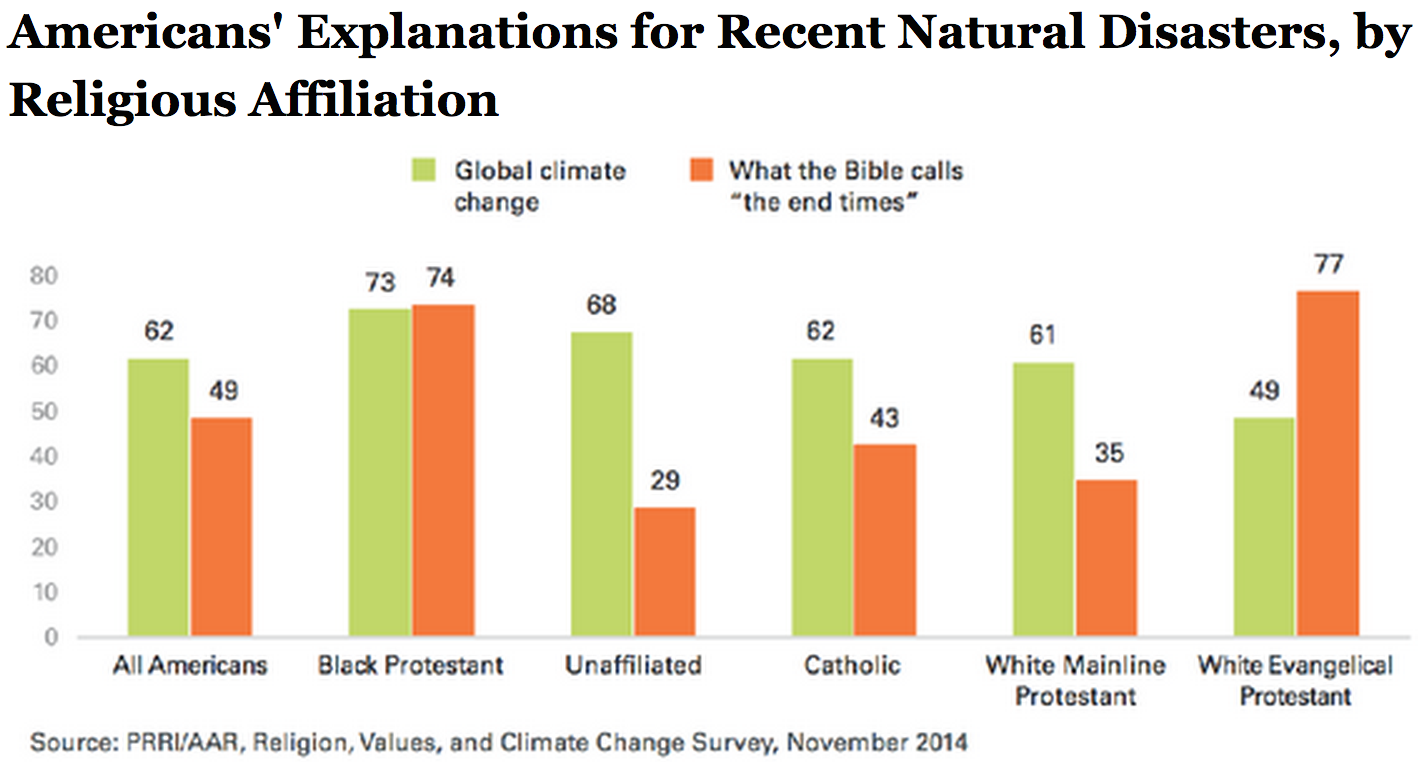
As of 2014, it’s estimated that nearly half of Americans—49 percent—say natural disasters are a sign of “the end times,” as described in the Bible. That’s up from an estimated 44 percent in 2011.
This belief is more prevalent in some religious communities than others. White evangelical Protestants, for example, are more likely than any other group to believe that natural disasters are a sign of the end times, and they’re least likely to assign some of the blame to climate change (participants were allowed to select both options if they wanted). Black Protestants were close behind white evangelicals in terms of apprehending the apocalypse, but they were also the group most likely to believe in climate change, too. Predictably, the religiously unaffiliated were the least likely to believe superstorms are apocalyptic—but even so, a third of that group said they see signs of the end times in the weather.
This fatalistic view of the impacts caused in part by burning fossil fuels could influence the national policy responses to the problem. More than half of the total respondents (53 percent) thought that God would not intercede if humans were destroying the Earth, while 39 percent said that God would step in.
[A]pparently, most of those who believe we’re in the end times also believe God would intervene. Basically at least four in 10 Americans see little reason for a human response — or, at least, doubt things will wind up being catastrophic. It should be no surprise, then, that of all the issues tested by PRRI’s poll, climate change is viewed as the least important. Just 5 percent rate it as the No. 1 issue, behind things like immigration, education and the wealth gap.
Meanwhile, the National Oceanic and Atmospheric Administration reports that last month was the hottest October on record worldwide. Rebecca Leber puts this in perspective:
The last two months of the year would simply have to be an average month in order for 2014 to go on record as the hottest year we’ve experienced yet. As Chris Mooney has written at Wonkblog, we’ve now had 356-straight months of warmer-than-average temperatures (through October). Anyone under 30 years old has never seen a month that was simply average in global temperature compared to the 20th century.
What climate-change deniers confuse is that temperatures in specific parts of the world, like North America, don’t always conform to global trends—which is why scientists look at the bigger picture of temperature records to judge climate trends. Temperatures in North America have been much colder than average, by 1.5 degrees Celsius, this year. This isn’t “proof” that global warming doesn’t exist, and research even links some extreme swings in temperatures, including wintry weather, to climate change.
After failing to reach a permanent agreement, the officials representing Iran and the P5+1 in the ongoing nuclear negotiations in Vienna extended the talks for seven more months:
“We have had to conclude it is not possible to get to an agreement by the deadline that was set for today and therefore we will extend the JPOA to June 30, 2015,” British Foreign Secretary Philip Hammond told reporters at the end of the talks. He was referring to the so-called Joint Plan of Action, an interim deal agreed between the six and Iran a year ago in Geneva, under which Tehran halted higher level uranium enrichment in exchange for a limited easing of sanctions, including access to some frozen oil revenues abroad.
Hammond said the expectation was that Iran would continue to refrain from sensitive atomic activity. He added that Iran and the powers “made some significant progress” in the latest round of talks, which began last Tuesday in the Austrian capital. Hammond said that there was a clear target to reach a “headline agreement” of substance within the next three months and talks would resume next month.
The failure to meet today’s deadline was not unexpected. Elias Groll and John Hudson look over the sticking points that remain unresolved:
“There are still gaps on some of the major issues, particularly the size of Iran’s uranium enrichment program and the sequence of sanctions relief,” Kelsey Davenport, director for nonproliferation policy at the Arms Control Association, told Foreign Policy. “Both Iran and the United States will need to be flexible and willing to make concessions to overcome the remaining hurdles.” At the moment, American diplomats are refusing to provide a date by which sanctions will be lifted and inspectors can ensure Iran is complying with the deal. … Among the other points of disagreement is how long it will take for Iran to be allowed to freely develop a civilian nuclear infrastructure and how much freedom inspectors will have inside Iran to carry out their work.
In reality, the gaps have always been big, and they will remain big as long as Iran wants to develop nuclear weapons. They have played this strategy of using negotiations as stall tactics for more than a decade, after their nuclear-weapons program got exposed in 2003. The Iranians make a big show of holding talks and sometimes even reaching interim agreements, always to find some excuse or provocation to renege or pull out. They then dangle the possibility of talks in order to forestall tougher consequences for their intransigence. Barack Obama and John Kerry were foolish enough to buy this routine as sincere, throwing away the tougher sanctions that forced Iran to deal with West at all.
Time is running out, all right. The Iranians are making sure of that by running out the clock while they finalize their entry into the nuclear-armed state club. They just bought themselves seven more months of time to complete their efforts and deliver a fait accompli. The West is digging its own grave, and Iran is providing the shovels.
The new deadline, of course, means that any prospective deal will come up against the implacable obstacle of the incoming Republican Congress. John Bradshaw encourages Congressional hawks to take a deep breath, think back to the bad old days of negotiating arms control with the Soviets, and not be willfully blind to the benefits of a deal:
Conservative hardliners in Congress say they would support a deal if it guaranteed that Iran would never be able to build a nuclear weapon. This disingenuous claim ignores the fact that the Iranians already have the necessary knowledge to build a weapon. A good agreement can minimize the risks that Iran can clandestinely move toward building a nuclear weapon, and it can provide incentives for the Iranians to step back from the path toward nuclear arms. More thoughtful members of Congress recognize that without a deal Iran can resume activities that can lead to a nuclear weapon, leaving us with only two options: military action or dealing with a nuclear-armed Iran. Without a deal, the international sanctions regime will likely unravel, diminishing pressure on Iran to allow continued intrusive inspections. The world will be more dangerous and unstable in this scenario than it would be if there is a good, verifiable deal that still entails some uncertainties and risks. A little historical perspective can help spark the political courage needed now in Congress to back a deal which will make America safer and prevent an unnecessary war.
Israeli PM Benjamin Netanyahu is pleased about the extension, mainly because it means there’s no deal yet:
“The right deal that is needed is to dismantle Iran’s capacity to make atomic bombs and only then dismantle the sanctions,” the prime minister continued. “Since that’s not in the offing, this result is better. A lot better. I think Iran should not have any capacity to enrich. There is no right to enrich. What do you need to enrich uranium for if you are not developing an atomic bomb?”
Netanyahu highlighted the fact that in addition to its uranium enrichment program, Iran has also also been developing intercontinental ballistic missiles. “The only reason you build ICBMs is to launch a nuclear warhead,” he said. “So I think everyone agrees that Iran is unabashedly seeking to develop atomic bombs and I think they shouldn’t have the capacity to enrich uranium or to deliver nuclear warheads.”
Larison points out that Bibi and other opponents of a comprehensive agreement are in effectively rooting for their own worst-case scenario:
The failure of negotiations with Iran would not be to the advantage of Israel or any of the Gulf states that claim to be so horrified by a deal. Failure would strengthen Iranian hard-liners, it would likely increase tensions between Iran and many other regional governments, and would leave the path open for the nuclear program’s continued development. Republicans may want to deprive Obama of a major achievement for partisan reasons, but Republican Iran hawks shouldn’t want the negotiations to fail. A deal that imposes significant limits on Iranian enrichment would restrict the Iranian nuclear program in a way that nothing else available could. Despite this, the regional governments and hawks here at home have been demanding conditions for a final deal that can’t possibly be met, and they have declared their hostility to any agreement that could be reached. The only conclusion we can reach from all this is that most of these actors are hostile to any diplomacy with Iran and want to make conflict between the U.S. and Iran more likely.
Julia Azari suspects “strong executive action enjoys more legitimacy when it’s taken by a Republican president than a Democratic one”:
Obama’s supporters on the left haven’t really developed a good political story about why governing through enforcement is a good thing. Most justifications involve vilifying Congress – satisfying for partisans but still casting the administration in a defensive role.
For conservatives during the Bush administration, the narrative was pretty easy to develop. Unilateral presidential action defends the nation. Furthermore, the president is a legitimate defender of his own Constitutional prerogatives (so the justification goes; not necessarily my view). This works better for Republican presidents because conservatives have gained issue ownership not only over national security but also, to a great extent, over the question of Constitutional protection.
Civil libertarians are an important part of American political and legal culture. But they haven’t recently formed a political movement around their ideas about the Constitution the way that the Tea Party has. The dominant political framework for understanding the Constitution casts it as a procedural document, meant to protect against excessive government action – even when that action might bring about positive results. This framework is a much more powerful tool for conservatives than for liberals. Although liberals also sometimes draw on Constitutional principles – including limits on executive action – it’s less central to their ideology. This means the politics of enforcement are much more difficult for a Democratic president to justify – enforcement decisions must either be done on substantive, rather than constitutional grounds, or they must tread on territory usually dominated by the other party.
Maybe the Democrats need to take another look at Burke. Or be reminded of the roots of progressivism in The New Republic‘s founder, Herbert Croly. Frank Foer explains:
By the time he crept toward middle age, after so many years of drift, Herbert attempted to fulfill his father’s dreams for him, in one last mad dash for greatness. He poured all his accumulated thoughts and theories into a bulging manifesto called The Promise of American Life. The book, which appeared in 1909, argued that American life had grown hobbled by the lingering legacy of Thomas Jefferson—the nation celebrated an antiquated form of individualism and libertarianism that no longer matched the realities of the industrial age. Modern life had sapped the energy from America; it tolerated rampant mediocrity. To restore itself, the country would have to turn to the theory of government espoused by Jefferson’s old nemesis, Alexander Hamilton. That is, it would need a strong central state. Croly’s book embodied many of the characteristics of the magazine he created: It was in turns wonky and literary; it rigorously analyzed the economic perils of unregulated trusts and calculated the toll of intellectual conformism.
I come at this from a very different Tory tradition. That line of thought wants government to be both limited and yet strong within its rightful parameters. So I don’t have much of a problem with the EPA making rulings based on its statutory authority as an executive office. Or with the president’s war-conducting (if not war-making) privileges. Or with setting priorities within law enforcement. Where does the executive action on undocumented immigrants stand? Somewhere in the middle: within the bounds of legal executive discretion, but in scale and intent, beyond anything that has occurred before – including, it now appears, the actions of president George H W Bush. On balance, I think it’s an over-reach – but an over-reach that needs to be understood in the context of unprecedented Congressional obstructionism. Or to put it tartly in the words of Kevin Drum:
You know, the more I mull over the Republican complaint about how immigration reform is being implemented, the more I sympathize with them. Public policy, especially on big, hot button issues like immigration, shouldn’t be made by one person. One person doesn’t represent the will of the people, no matter what position he holds. Congress does, and the will of Congress should be paramount in policymaking … Both the law and past precedent are clear: John Boehner is well within his legal rights to refuse to allow the House to vote on the immigration bill passed by the Senate in 2013.
While the White House is at pains to say he was not fired, it sorta looks that way:
Administration officials said that Mr. Obama made the decision to remove Mr. Hagel, the sole Republican on his national security team, last Friday after a series of meetings between the two men over the past two weeks. The officials characterized the decision as a recognition that the threat from the militant group Islamic State will require different skills from those that Mr. Hagel, who often struggled to articulate a clear viewpoint and was widely viewed as a passive defense secretary, was brought in to employ.
“This,” Morrissey declares, “is what happens with Cabinet Secretaries when policies go bad”:
Presidents ditch them as a signal for a shift in direction.
In this case, it’s more than fitting, because Hagel was appointed by Obama as Republican cover for his unwillingness to maintain a forward strategy against radical Islamist terror networks. Hagel had long opposed the Iraq war from the ranks of the Senate Republican caucus, and lent Obama some cheap credit on bipartisanship without challenging him on policy in the least. Hagel had next to no qualifications to lead the massive Defense Department, and despite getting ISIS right has not exactly impressed as SecDef. …
The question now will be who replaces Hagel, and when. It won’t be in the lame-duck session; there isn’t enough time. That means Obama has to find a candidate who can pass muster with the new Republican majority in January, while still hewing close to Obama’s middle-of-the-road, hesitationist impulses. It’ll be interesting to see who Obama chooses, but don’t expect the GOP to block anyone who’s capable of handling the new policy. They will have lots of room to fight over Obama’s nominees, but not in national-security positions.
Michael Auslin calls Hagel’s uninspiring tenure at the Pentagon “more evidence of the damage that occurs when a president surrounds himself with those he knows he can dominate”:
[A]s the threats from Russia, China, and the Islamic State developed over the past two years, the president was more concerned about his image as the smartest man in the room and who would brook no opposition to his view of the world. A view, one might add, that shows remarkably little evolution during his six years as president. Thus, at a time of extraordinary global danger, America was saddled with a defense secretary not respected by his president, not expected to bring a sharp intellectual scalpel to the challenges of the day, and one who simply wasn’t up for the job. Early, private reports from inside the Pentagon indicate a sigh of relief, since the thought is it can’t get any worse.
Peter Feaver characterizes Hagel’s ouster as scapegoating for Obama’s own poor policy choices:
Pick your issue: the failure in Syria, the rise of the Islamic State, the inability to check Russian President Vladimir Putin, the yawning ends-means gap in the defense budget, the fractious civil-military relations, the failure to stop Iran’s nuclear ambitions, and so on. Regardless the issue, the chief weakness is not the performance of the staff but the decisions that could only have been made by the president. Of course, these are tough foreign policy problems and much of the difficulty can also be attributed to factors well beyond the control of the U.S. government. But to the extent that U.S. action or inaction is exacerbating the problem, those sins of omission and commission are primarily the president’s, not his staff’s.
Armin Rosen identifies Michèle Flournoy as the most likely choice among Hagel’s potential successors:
One of the leaders of Obama’s transition team at the Department of Defense, Flournoy was an under-secretary of defense from 2009 to 2012, during Robert Gates’ widely praised leadership at the Pentagon. She was was involved in implementing the surge in Afghanistan and is “widely seen as an advocate for the counterinsurgency approach,” former Navy intelligence officer Robert Caruso told Business Insider. Flournoy is also the co-founder of the Center for a New American Security, a Washington think-tank that became a Defense Department-in-waiting for Democratic-aligned natural security hands during the second Bush administration. CNAS is now viewed as an ideas factory — if not an adjunct — for the Obama-era Pentagon.
She seems to think it’s possible for America to “achieve its strategic objectives in Afghanistan” as long as we stay committed with money and resources. Read her report here, and then read some of examples of where money sent to Afghanistan is actually going here. The progressive anti-war group Institute for Policy Studies describes Flournoy’s love of military intervention and spending from the left here. They note she actually has more support from neoconservatives than Republican Hagel, vocal critic of the Iraq war. Rather than proposing a different course for the administration’s foreign policy, she appears to possibly be the person to entrench it for rest of Obama’s term.
And David Rothkopf, who approves of Flournoy, doubts she will solve what he sees as the administration’s fundamental problem:
The challenge is that the NSC and the national security team are always just a reflection of what the president wants. If President Obama is unwilling to ask himself how he must change in order to avoid and undo mistakes like those of the past two years, it doesn’t matter how many Cabinet secretaries come or go. If the move to swap out Chuck Hagel (apparently after a rather contentious tug-of-war about whether he should depart), is as it appears to be — a gesture designed to avoid addressing the real problems within the Obama team — then it is worse than empty. It is a further sign that this is a president resistant to growth or to finding a way to effectively advance the national security interests of the United States.
The in-tray keeps getting flooded with feedback on this subject:
Here is my take, as a long-time reader, on the reason so many of my fellow Dishheads have written in to express disappointment with the coverage of feminist issues on the Dish. I read articles such as the recent expose of the culture of silence and tacit acceptance of rape at UVA in Rolling Stone and am outraged but also moved and emboldened by the recent attention that sexual violence has gotten in the media.
Then I go to the Dish, my daily source for news and analysis, and read that the real pressing issue is the “demand that men be gentlemen, rather than something other than men,” as presumably you believe feminists do.
I can’t help but feel that you have your priorities way off. We’re living through a major shift in the way our culture deals with gender, rape, and sexuality, in large part led by a new generation of feminists (men and women), and the impression one gets from the Dish on this is a sense of annoyance and a worry that masculinity as a whole is being unfairly indicted. This strikes me as an analysis not worth my time to read – something I rarely feel about the blog, even (or especially) when I disagree.
Thanks so much for your work. I hope to see more coverage of issues that actually matter when it comes to gender politics today, such as the sea change in how we address rape as a culture.
Another critic:
Andrew, your stances in the Gender Wars threads are disheartening. As passionately as you’ve argued your causes, surely you must know there is not “always a debate to be had,” and that sometimes debates get good answers on questions that are essentially settled. The endless “debate to be had” is one thing that frustrates feminism and its good cause, because it constantly has to solve the same problems over and over for every new person who comes to the table. Frankly, every feminist contradiction you’ve covered in this thread has been debated within feminism since its beginning. It’s not feminism’s burden to educate.
If I may share an anecdote: in my very first job at an entertainment news TV show, I was endlessly harassed. By men. I’m a cis-gendered straight white male.
My ass was grabbed, my nipples were tweaked, and “playful” advances were a constant. It helped me see that sexual harassment really is a problem with men, of any orientation, and gave me some meaningful context for when feminist women describe an inescapable environment of harassment. It’s real. I believe them. If “feminist bullies” always seem to “make everything about gender,” it’s probably because the world treats their gender as everything about them.
Love the Dish, but the conservative mean streak to irrationally hate old canards (The Clintons! Those Damned Feminists! Cigarette Police!) still runs strong in you, and it’s a shame. Feminism’s core values and goals are so much in line with yours.
You are not a woman, you will never understand what it is like to grow up as a female, work as a female, experience life culturally, interpersonally, electronically as a female. Perhaps it is time you learn to defer a bit on those topics to those that do.
Oh give me a freaking break. Well guess what? I’m a woman (born that way!). I’m damned successful at my job, I’m the breadwinner of my family of four (by a wide margin) and I’ve worked in a male dominated field for 15+ years. I “understand” what it’s like. You want to know how I got where I am? Not by crying about how victimized I’ve always been or blaming men for getting in my way or by buying into the myth that every man just wants to either sleep with me or ignore me. I got to where I am by actually buying the argument that men and women are equal and then comported myself accordingly. I don’t get walked on at work. I don’t get talked down to or ignored or sexually harassed. I demand respect and I get it, from men and women.
Feminists don’t care about equality for women. They want domination for women. Feminists don’t want to have an open and honest discussion about how men and women really ARE different and they can’t always be the same – they want to lambast people for daring to say that testosterone matters. They don’t want girls to have choices about what to be when they grow up; they want to make sure that girls never want to be the things that feminists don’t approve of. They don’t want men to have opinions that haven’t been vetted by a feminist and they sure don’t have a sense of humor about ANYTHING. Feminists make a conscious choice to take everything as an insult and to find the man’s fault in every situation. Why on earth any reasonable person would want to be labeled a feminist is beyond me.
There are legitimate problems for women in our society, violence against women being the top of that list. But the solutions are not going to come from feminists telling every man that he is at heart a rapist or telling every woman that they cannot trust a man. The sooner they get beyond spewing bile at 50 percent of the human race the sooner they might actually make some helpful contributions to the problems.
Another female reader:
While I may agree in principle that the politically correct/language police in our society has gotten out of hand on many fronts, I think you are missing the point behind many complaints. While the language used by many is very absolute and unforgiving, it is simply true that there’s a long way to go until men and women are treated equally by society. Rather than focusing on the unfairness of the language police and lamenting about how rigid feminists are in their definitions, or how they “eat their own,” I think it would move the conversation forward to focus on those who are trying to redefine the word and the movement to include everyone. I’ll point to two things that happened this summer while you were on vacation.
First, the discussion about feminism on your blog that was started by your guest blogger, Elizabeth Nolan Brown. She wrote a post called “This is why men need feminism,” where she pointed to a response that Joseph Gordon Levitt stated when asked about calling himself a feminist. I think his response is perfect, and Elizabeth’s response to it equally perfect. He first states that his idea of the word means that you don’t let gender define who you are. He then follows by acknowledging the long history of abuse of women in societies throughout history. Elizabeth wrapped up the post by stating:
What’s great about Gordon-Levitt’s definition is that it shows why feminism is directly relevant to men’s lives as well as women’s. We’re all in this mess of gender expectations together. Feminism isn’t just about raising women up but helping us all – men, women, cis, trans, whatever – get to a place where we’re a bit more free.
This is important because gender equality is not just a fight for women, but for anyone interested in a freer, more equal society.
But the anger and absolutist attitude held by some in the feminist movement wasn’t formed out of thin air, but in response to thousands of years of oppression. While women’s liberation has made important strides in the past 100+ years, it in no way has eliminated the structural and institutional imbalances in society that perpetuate that inequality. I’d like to argue that the problem of gender inequality has been enshrined in our institutions similar to the institutionalized racism many refuse to recognize. These structural imbalances place women at an automatic disadvantage, even though our society has attempted fixes here and there. It’s important to acknowledge that, even if you disagree with the tactics and language of the feminist movement in its current form, which I know you do.
You point to the balance of security of women from assault and rape against due process of those accused. Yes, there’s a portion of those accused falsely. There’s so many more who have been raped who have not received due process under the law due to the structural imbalances I point to, whether it be a policeman who didn’t believe her story, or the prosecutor more concerned with their track record than prosecuting a crime, or the college that protects the boy while leaving the girl vulnerable to attack and exposure, or the high school sports team that won’t bench their players after gang-rape accusations. You fail to recognize that the recent, and seemingly extreme, action on college campuses is perhaps a response to 30+ years of incremental steps that have not curbed the problem of rape anywhere in our society.
If you want to argue that we should be worrying about this small percentage affected by this problem, tell me how we do that without displacing the thousands of women who have had no ally in prosecuting the crime against them, i.e. the massive storage warehouses throughout the country that are holding backlogged and untested rape kits? To me, worrying about the smaller percentage of those falsely accused displaces the massive amount of women who have been violated twice, first by her rapist, followed by the societal institutions that should be protecting her.
Second, I’d like to point to a UN speech given by Emma Watson this summer in launching her initiative “HeForShe.” Her speech discusses gender stereotypes that both girls and boys suffer from. It’s her task to get as many as possible to recognize that these stereotypes of BOTH boys and girls inhibit society from moving forward towards greater gender equality. It’s a great speech, and it also asks all people to buy in to the feminist idea that no matter who you are, you deserve equal treatment under the law and in society. It asks all of us to fight towards this goal, not just one half.
Here is a link to the full speech for you to read, but one of my favorite sections is the following:
I was appointed as Goodwill Ambassador for UN Women six months ago. And, the more I spoke about feminism, the more I realized that fighting for women’s rights has too often become synonymous with man-hating. If there is one thing I know for certain, it is that this has to stop. For the record, feminism by definition is the belief that men and women should have equal rights and opportunities. It is the theory of political, economic and social equality of the sexes. I started questioning gender-based assumptions a long time ago. When I was 8, I was confused for being called bossy because I wanted to direct the plays that we would put on for our parents, but the boys were not. When at 14, I started to be sexualized by certain elements of the media. When at 15, my girlfriends started dropping out of sports teams because they didn’t want to appear muscly. When at 18, my male friends were unable to express their feelings.
What I appreciate about this part of her speech is that it highlights that gender discrimination flows both ways. It’s not just a problem for girls, it’s a problem for everyone.
My main point is that rather than harping on the “feminist left” and their rigid ideology, why don’t you focus the attention of this blog towards those who are trying to move this conversation forward in a new and meaningful way? It’s simply true that we have a long way to go on this front and we all can participate in moving gender equality forward, or we can sit on the sidelines and bitch about the tactics and language. Your choice.
More criticism from a reader, who sends along the above video:
At the end of that reader dissent you linked to, you pulled a paragraph from the post she was addressing and used it to defend yourself, as though the reader hadn’t acknowledged that you’d condemned misogyny. I don’t want to nitpick, but to say this dissent was totally unqualified isn’t quite accurate – you still had the last word.
And that post speaks the problem I’ve had (as a straight white male) reading a lot of your posts about #Gamergate, masculinity, and feminism the last few weeks – you repeatedly start with a paragraph or two saying something along the lines of, “Of course harassment and violent threats against women are wrong…”, but then spend the rest of the post explaining how you have sympathy for people that have been picked on or those who may feel their masculinity is under attack and how feminists have gone too far and are unfairly targeting certain individuals. You put an awful lot of energy into defending men and gamers from the “femi-left,” so I think it’s understandable why some readers think you just don’t get it when it comes to feminism and women’s issues and have suggested you defer on some of these issues just as you have with race.
I think they have a point. Is it too much to ask that you occasionally write a post that says nothing more than, “Catcalling is primitive behavior that objectifies and degrades women and it should be condemned,” and then leave it at that? Instead, you continue with a nuanced view of this behavior and end with something like this:
And so I think we just have to live with a certain amount of straight-very-male homophobia and sexism, and leave it be. Young men want to live out fantasies of rescuing big-boobed women while being encased in a steroidal muscle culture (precisely because, for so many, it is utterly beyond their actual day-to-day lives). And my inclination is simply: give them a break.
I’m sure you can see why a lot of women (and men) might find this sort of language dismissive, but in a weird way I think the problem is just the order in which you reveal your thoughts/opinions. I expect many of these posts have given readers the impression your loyalties lie first and foremost with men (or gamers) who believe their masculinity or identity is under attack. I’d bet that you wouldn’t have received so many angry responses if you began these posts acknowledging your sympathies with male culture (or whatever) first and then aggressively condemned the tactics used to silence and/or demean women. Because at the end of the day, the point that you end on is really all that matters.
And come on, Andrew, you are a feminist, right?
Lastly, a female reader looks back at my views on Hobby Lobby (full Dish coverage here):
I love reading the Dish and became a subscriber as soon as you offered your readers a way to support your work. As so often happens with the familiar people in our lives, I feel as if I can predict your response to issues centering on women’s experience, whether it is your response to Hobby Lobby or #Gamergate. I wouldn’t write if I didn’t think there were potential for you to treat women’s issues with the same nuanced, well-argued, and fundamental empathy that you bring to so many other subjects.
I am disappointed that your posts employ so much dismissive, glib, or minimizing language when you address events in the culture that center on women and women’s issues. These issues may have passed you by, both as a virtue of your gender and your sexual orientation, but that is a profoundly limiting lens and one that I do not see at play in your otherwise aggressive, curious, and serious coverage of issues that are not part of your autobiography.
As a woman living in the Deep South, many of the issues about women’s rights and status are not theoretical. The stakes are quite real for women’s autonomy over their bodies and women’s equality in professional and civic life. I would like you to consider the demoralizing effect you send your readers about women’s issues when you repeatedly use this language to introduce these subjects:
“The obvious damning answer is that I am a man and no one has taken anything away from me – indeed the all-male majority who upheld Hobby Lobby’s religious rights specifically barred any procedure other than female contraception. If they did that for prescriptions for Truvada, for example, I might react differently.”
“And so I think we just have to live with a certain amount of straight-very-male homophobia and sexism, and leave it be.”
My frustration as a reader is intensified when I see you tackle similar issues of straight-male homophobia and sexism when the instigating event does not center on women. You really bring it in the Alec Baldwin thread, for example. I do not ask for emotional identification, but for a professional, intellectual recognition that maybe Hobby Lobby is alarming for many and that perhaps women in tech or gamer culture do not deserve to be patted on the head and told “leave it be.”
I do not agree with a number of your positions, but, man, you are a great writer and thinker who pushes me and surprises me. To quote you: Know hope.



 The Dish